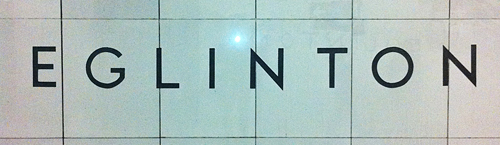
Look at the glint on that photo. That’s no tingle. Perhaps it’s non-legit – it’s actually from the little flash on my iPhone. But at a glance, it is a glint – and indeed since it glances off the surface, moving quickly and perhaps obliquely, it does glint, even if lacks the éclat of, say, lit gelignite.
Those who live in Toronto will surely know where I took the picture: standing on the platform of Eglinton subway station. Eglinton station is at Yonge Street and Eglinton Avenue, a neighbourhood once and occasionally still jokingly called “Young and Eligible” (it helps that there are high-rise apartments thereabouts that house many young and eligible people, but then that’s true for several places in Toronto). More often it’s just said “yunganeg,” the intersection of two of Toronto’s most important – and most misspelled and mispronounced – streets.
Easy to see how one might get Yonge wrong (it’s pronounced like young). But Eglinton? Well, it’s like this: there are many people in Toronto and area who will swear it’s Eglington and always say it that way. This is, in my analysis, a hypercorrection – everyone knows, after all, that “-in’” is a casual way of saying “-ing,” so the inference is that “Eglinton” is sloppy for “Eglington.” On top of that, there is a Toronto street of some note (meaning it has a subway station) named Islington, with that g before the t. So it’s not so surprising that people think that “Eglinton” drops the g.
Even though there’s no g to drop. By which I mean not only that the word is actually Eglinton but also that in going from “-ing” to “-in’” you do not drop a [g]. There is no [g] sound in there. Listen to the difference between finger and singer. The former has a [g]; the latter, not. What is the difference between singer and sinner (I mean just the pronunciations!)? Not a [g] but rather the difference between back and front: the place the tongue touches the roof of the mouth. So people who think that Eglinton is dropping a [g] have it back to front. As it were.
The street name, by the way, is after Eglinton Castle in Scotland (no longer standing – there was an old small castle that was replaced circa 1800 with a Gothic-style castellated building, which was abandoned in 1925 and was finished off by army posted there in WWII), which was the seat of the Earls of Eglinton (the first Earl of Eglinton was Hugh Montgomerie, elevated in 1508); the name Eglinton was first recorded in 1205 as Eglunstone, and is seen in various spellings such as Eglytone and Egglington over the centuries. As an odd aside, there was a chair in Eglinton Castle that had the full text of Robert Burns’s “Tam O’Shanter” on it, a poem that I have referred to in my note on skirl. Well, why not? The castle was in Ayrshire, and Burns was an Ayrshire man.
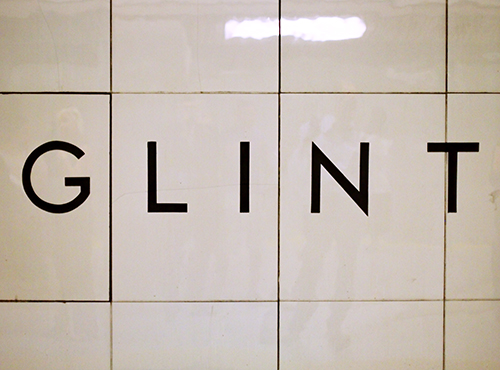
Does it seem strange that some Torontonians might see Eglinton so many times on such a regular basis and not notice that it’s not Eglington? I bet even fewer people notice that it has a glint right in the middle of it. It’s right there, but it’s across syllable boundaries. Eg. Lin. Ton. It shows at best as an oblique flash.
Which is what a glint is. But where do we most often say we see glints? In someone’s eye. It’s one thing to see a glance of an eye; it’s another to see a glint in an eye. Literally it would seem to be a reflection, not really volitional therefore, but somehow what it really is is a muscular set expressing a certain attitude (of mischief or desire) that is conceptually synaesthetized as an oblique flash of light. It’s not there, but you see it as being there. Gee.
Glint started out as a verb, probably a variation on glent; it meant first “move quickly, especially obliquely; glance aside” – in the “glancing blow” sense of glance, which is to say the original sense: to glance was (and still is, in one of its uses) to strike obliquely, to turn aside. The two words don’t appear to have the same origin, but they do seem to have cross-influence. Interestingly, the “flashing light” sense of glint doesn’t really show up until the 1800s. (The “quick look” sense of glance is attested from the 1500s.)
But you know that both seem destined to be applied to something to do with light, shining, flashes, or vision. Look: glass, glimmer, glitter, glamour, glow, gleam, glare… add your own to the list. We have a /gl/ phonaestheme: a sound combination that is associated with a certain sense, even in the absence of a common etymological basis. It just shows up in a flash.






 Sesquiotica