
Monthly Archives: March 2012

pretzel

This word makes me think of the Ontario Science Centre.

Is the Ontario Science Centre somehow pretzel-like? Nope. Nor do they make or sell pretzels there as far as I know (perhaps they have them in the cafeteria.) No, I think of it because my wife twisted herself into a pretzel there.

I don’t mean she got bent out of shape metaphorically, nor that she got confused. No, there was an exhibit about, um, circus things, as I recall, and they had a little cube that people could see if they could fit themselves into from the side (not the top!). Each side of it was about the length of an adult’s leg from heel to knee: about a half a metre, I guess.

My wife is very flexible.

Yes, she fit in easily. In spite of the fact that she’s five-foot-six. She fit into a place so small I would have been praying for mercy if I’d even tried to be in it (or been forced into it). A leg, her torso, her head, arms folded, the other leg. No prob. Into a space the size of one of those little cubes you set snacks on in your living room. Just twisted into a pretzel.

Which, by the way, is the most common phrase for the word pretzel. Although pretzels aren’t really the absolute twistiest things anyone has ever seen (indeed, the word pretzel is rather twistier in a way, and almost looks like an inventory of the body parts Aina slipped into that box), they’re twistier than the average piece of bread.

Do you think of pretzels as bread? This probably depends rather much on your individual experience. They’re made with flour and so on, sure, but the ones I grew up with were crunchy. Crunchy little things that stick in your molars after you chew on them. When you bite into them, they make a cracking sound that’s rather similar to the sound of the word pretzel. They’re very salty and go great with beer. They’re twisted together, sure (though some of them are straight sticks – “salty” is a more essential characteristic of pretzels than “twisted” in my experience), but they’re not soft like bread – or like my wife.

So, when in 1983 I saw David Brenner’s book Soft Pretzels with Mustard, I thought, “What?” Soft and pretzels did not go together in my world. And where do you put the mustard on those little things?

Obviously I had not yet been to New York, where sidewalk vendors sell nice, big, soft pretzels that you can – and should – squeeze mustard on. (I’ve enjoyed them many times since.) Real bread, covered with big crystals of salt. As though those little things I had always eaten had been click-dragged bigger – and gotten softer in the process.

Did I say big? Aw, heck, you can still hold those things in your hands. One person can easily eat one. Today I had part of a pretzel that would be rather too much for one person – it was a big, soft, lovely thing, and it had a diameter of, um, well, not a half a metre, but more than a foot.

Of course more than a foot. Two arms! Every pretzel has two arms, folded together. (Admittedly, they look to me a bit more like Aina when she puts her legs behind her head, but most people can’t pretzel themselves that way.) The origin of the word pretzel is somewhat disputed, but it’s commonly thought that it likely comes from a reference to arms: Latin bracchium, by way of modified and diminutive versions, such as bracellus. A competing origin – though without any support other than a medieval assertion – is pretiola, “little rewards.” But since the English word comes from the German, and the German starts (and has always started) with /b/, that source /p/ would have had to become a /b/ and then go back to /p/ – not impossible, though it would be a pretzel-like round-and-back. Otherwise, it would just be a matter of the /b/ becoming a /p/, which is sort of like how the soft pretzels became hard ones by the time they got to Alberta (and many other places).

And why crossed arms? The heart-warming story is that they are in emulation of a child’s prayer pose (the “little rewards” were for saying their prayers). It’s pretty reasonable to imagine that they were used overtly with that in mind for a long time – and, by some people, still are. Was that where they originally came from? Perhaps. There is possible evidence of older breads with crossed-arm (and other twisted) shapes. But, though the opening /pr/ shared with prayer is just a coincidence, their history for the past several centuries starts with prayers. And with fasting.

Fasting? Yup. They’re food for Lent. You may associate them with beer and hot dogs and things like that (or, on the other hand, with “low-fat snack food,” which makes them seem more penitential), but they gained their great popularity during Lent. After all, they’re made with just water and flour – and salt and perhaps some sugar. No eggs, no lard, no dairy.

Not that beer has any of those in it, of course…
bar

A word taster walks into a bar

But which bar? To say bar is crowded doesn’t begin to cover it. Once you unbar the door on this word, the murmuring rhubarb and baragouin of rabble from barbarians to barristers presents at the very least an embarrassment of riches and at most becomes a rebarbative barrier. You get far more than you bargained for.

For not only does the basic word bar, from Latin barra, “long and narrow piece of material such as wood”, have an assortment of extended senses through association with shape and with occasions of use (the barrier marking off the judge’s seat in a courtroom, or the one over which food and drink are served in a tavern, for instance), but there are a few other words bar (a kind of fish for one, and for another a unit of pressure – from Greek βάρος baros “weight”), and there are hundreds of places where bar shows up in unrelated words. We may look beyond the dictionary, too, into the bargeload of quotes at Bartleby.com.

So let’s force our way into this bar and see what bodies pack it. It could be a cocktail bar or a biker bar or a singles bar, but it’s not just a snack bar; it’s as crowded and festive as a durbar. As we embark, we barge into Barney, a barrister from Barbados, in a Barcalounger with a bargello pattern; he is eating a plate of barbecued barramundi with Hubbard squash. He is celebrating a plea bargain.

There is Barbara from Barcelona, who was never called to the bar because she was once behind bars (something to do with barbiturates – phenobarbital, pentobarbital, secobarbital); there is a barfly in a Babar T-shirt who used to work with Barnum and Bailey but had lumbar problems and, after bariatric surgery, became a barber; there is a bard named Barkley (who can’t read a bar of music) who is calling a barn dance in a baritone over a barrage of barking – someone’s having an argy-bargy – they want twelve-bar blues; there’s some barmy barnacle trying to barter a barbell and a barometer for a bit of the barley, but all he can bargain for is a barmecidal barberry pie. A baroness (bar sinister?) who was barred from a bar-mitzvah on a sandbar is barfing into a barrel.

Under a Barbizon-style painting we talk with a candy-bar-munching Lombard who’s studying the effects of cinnabar (or is it barium) on Epstein-Barr virus (or was that Guillain-Barré syndrome) in Malabar (or Nicobar or Zanzibar); the results are still embargoed. He is embarrassed by the syllabary we pull out of our scabbard and bombard him with.

And then, in the midst of this sybaritic scene, someone knocks out the power bar and everything goes fubar. They try to bar the door but we push the safety bar and escape to the barren exterior, where everything comes to a voiced stop and a diminishing liquid – with a low-central vowel in between.

Go raibh míle maith ag Laurie Miller for suggesting bar on the bar day of bar days, St. Patrick’s.

irregardless

Language usage can be rather like religion and politics: people get irritated and computer screens get irrigated. It tends to illustrate of what’s called Sayre’s law, after Wallace Stanley Sayre: “In any dispute the intensity of feeling is inversely proportional to the value of the issues at stake.… That is why academic politics are so bitter.”

Tell me, now: how do you feel about this word, irregardless?

Why?

Yes, yes, obviously it’s morphologically redundant. In this case the apparent analysis is accurate (unlike with, say, inflammable or internecine, where the in and inter are actually intensifiers in the original). Give yourself a pat on the back. You nailed that one. When people use it, they are using a word that says something twice. So, now, tell me: why get irritated by it?

If you say “It’s not a word,” I’m just going to wave you over to Annie Wei-Yu Kan’s gastronomic dismantling of that argument at The Nasty Guide to Nice Writing. (I recommend you peruse the table of contents and read all the articles there. You are unlikely to have seen grammar addressed that way before. Warning: She shares the blog with her ex-husband, Dirk E. Oldman, who thinks about sex all the time. Their divorce was not amicable.) Given that irregardless is in various dictionaries, including the Scrabble dictionary and the Oxford English Dictionary, it’s pretty hard to say it’s not a word.

Is it a stupid, illogical word? Perhaps, though I’m not sure why you should set the bar so high for this word when we have plenty of other stupid, illogical words and usages in English, and some of them are happily accepted in at least some contexts. But let’s say it’s stupid and illogical. How is that cause for people to get so upset about it?

We know they get upset about it. Google to find out if for some reason you don’t already know this. But does it cause harm? Don’t bother saying it causes harm to the reputation of the speaker. It does so only because people get upset about it, so getting upset about it because it causes harm because people get upset about it is a bit of logical bind.

More likely, people get upset about it because they like getting upset about stupidity and this word is for them emblematic of stupidity. But I rather think using this word is different from, say, confusing gallons and litres when filling an airplane, or not knowing that a bit of rubber that is to be exposed to freezing temperatures – and is crucial for keeping a spacecraft from exploding – warps when it is exposed to freezing temperatures, or being in charge of major budgetary decisions but being unable to do simple math.

Does that mean I’m saying it’s OK to use it? Not in most contexts. After all, it’s not generally accepted, to say the least. It’s a mark of a foggy-headedness. It’s actually likely a blend of irrespective and regardless, the sort of thing people confect on the go, proving that the mental lexicon really can be a grab-bag of bits. It’s rather like misunderestimate. Except that, rather than being seen as an inane usage by a particular person, it’s perceived as a disgusting infiltrator into the purity of our language.

Bit of a joke, that, the purity of our language. As James Nicoll said, “The problem with defending the purity of the English language is that English is about as pure as a cribhouse whore. We don’t just borrow words; on occasion, English has pursued other languages down alleyways to beat them unconscious and rifle their pockets for new vocabulary.” Not to mention the appallingly messy ways our words come to being. Those who read my word tasting notes regularly will have noticed this.

So, to this word, then. Obviously it carries for many people a very strong taste of indignation and disgust. But leaving that aside, is it really an ugly word? It brings to mind such words as irrigate and regalia and garden and perhaps even ragged. It has three liquids in it, /r/ and /r/ and /l/, and two voiced stops, /g/ and /d/, and a voiceless fricative at the end, /s/. It has much in common with loggerheads, but also with regularities and even to some extent doggerel and arugula and rugalach and sigillography.

At its heart is regard. We manage not to think that that means “gard again”. Nor do we think, on the pattern of recuse and resign, that it means “unguard”. No, the re passes without remark just as in remark. But the gard is in fact cognate with guard. Regard has a history of meaning “inspect, mind, consider”; we know that with regard to means “with consideration of” or “with respect to”. From this regardless means, well, “irrespective”.

But just as we often take words as whole chunks irrespective of origin, and mix them and match them regardless of morphological origins (blends often make use of such pseudomorphemes as copter and oholic), we sometimes grab for a word and get bits of two, and cram them together into our mouths, irregardless of the more standard and respected usage. The word irregardless has managed to appear in print attestations for an even century now, and is almost always presented disingenuously, as an emulation of a less learnèd, less mindful style of usage. As such, it can at times be useful. It brings to mind quite clearly a heedless style. The risk is simply that the reader will think you don’t know it’s “sloppy” usage – so it’s often put in quotes.

Many people pay quite a lot of mind to pruning the hedges of our language and tidying its flowerbeds. We ought to remember that in order for it to grow or even simply to thrive, it needs not just irrigation but manure.

pie

Daryl emerged from the kitchen of Domus Logogustationis holding two fresh, steaming pies (and I don’t mean cow pies). He plunked them down on a table and said, “There!”

“Well, aren’t you sweet as pie!” Elisa Lively exclaimed. “What’s the occasion?”

“Pie Day!” he said, or so it sounded.

“Proto-Indo-European Day?” Maury said, referring to the reconstructed proto-language commonly abbreviated as PIE. “Are these made with roots?” I, meanwhile, had started to sing “Pie day, pie day” in emulation of Rebecca Black. “Please stop,” Maury said in my general direction.

“It’s March fourteenth,” Daryl said. “Three fourteen. Pi is three point one four.”

“Which would mean,” I said, “that pi second was at 1:59:26 – point 5.” I had always known that memorizing pi in my childhood would come in handy sometime.

“I think I don’t follow,” Elisa said.

“Pi,” I said. “3.1415926535897932384626…” Daryl joined in after a few digits and we recited in unison until Elisa started waving her hands and said, “What are you doing? Stop.”

“Pi in your face!” Daryl said.

“All I know is pi r squared,” Elisa said.

“These pie are round,” Maury observed. “You can tell by the circumference: these two pie are.”

“If no one else is going to,” I said, “I’m going into the kitchen to get plates and forks and serving implements.”

“No need,” said Jess, emerging from the kitchen with the requisites. “Easy as pie.”

“Well, hi, cutie pie,” Elisa said.

“There’s another mathematical formula,” I said. “Visual appeal as the product of quality, time, and the amount of pie you eat: qtπ. Proof that dessert is good for your looks.”

“Keep it on the q.t.,” Jess said. “Looks good to me,” Elisa said at the same time.

“Well, dig in,” Daryl said. “There’s ample pie.”

“I’ll have a sample of pie, then,” Maury said, reaching for a knife.

“Apple pie?” Elisa said.

“And bumbleberry pie,” Daryl said.

“Better bumble than humble,” I said, taking a plate from the stack Jess had set down. “I’ll be trying both pies. I like to have a finger in every pie.”

“Don’t put your finger in these ones,” Daryl said. I launched into a snippet from Pink Floyd’s “Money”: “Share it fairly but don’t take a slice of my pie.” And I took a slice of each pie.

“Perhaps we can have some pies in quiet,” Jess said, and added – at me – “Chatter-pie.”

“Nice shirt,” I said to Jess. “How would you describe the colour… badger-pie?” Jess stuck her tongue out at me.

Maury looked at my two-pie-piece plate. “You would have taken one of each even had there been four, wouldn’t you?”

“At least one, yes,” I said, and took a bite. “Mmm. Yummy.”

He nodded. “You really are a magpie.”

“Pies for the pie,” I said. More for the benefit of Elisa and perhaps Daryl – Maury and Jess probably knew this – I added, “Magpies were originally called pies, from Latin pica. The mag was added perhaps in the same way as adding Jack to daw it seems to be from Maggie.”

“So did someone bake four-and-twenty of them in a pie some time?” Elisa asked between bites.

I almost started singing “Pie-pie blackbird,” but thought better of it. “No one’s entirely sure where pie for the dish came from,” I said, eyeing the pies, “but it dates from after pie for the bird, and the first ones were made of a variety of savoury things and meats, so it might have been a magpie-style collection. But that’s speculation. Perhaps with further research…”

“You’ll get pie in the sky when you die,” Jess said, echoing the cynical line that originated the phrase pie in the sky.

“As long as I could have it with a nice glass of port,” I said.

“And get thoroughly pie-eyed?” Maury said.

“Why not,” I said. “Make the pie higher!”

Thanks to Christina Vasilevski, who brought pie to work today and inspired this.

erg

A sea of shifting sand dunes stretches before you, mile upon mile of massive mounds made of minuscule particles of silica. It is hot. You are thirsty. You are baking, you are boiling; the sand is shifting and blowing. You must walk up this dune, down this dune, up this dune, down this dune, and on and on, and the sand is soft beneath your feet… Every smallest expense of effort exhausts you; with each motion all you can say is “Erg… erg.”

And indeed there are two words erg, unrelated. One is from Greek ἔργον ergon, “work”, and is a unit of measurement in the metric system for a small amount of physical work done: a force of one dyne exerted over one centimetre – in other words, one gram centimetre-squared per second-squared, or 100 nanojoules. The other is from Arabic arq or irq or Berber irj, depending on the source you consult. It refers to one of those great seas of dunes – an area of at least 125 square kilometres where sand covers at least 20% of the surface and shifts about in the wind to make dunes. Think Lawrence of Arabia. (They have them on other planets, too, and they are an important feature on Titan, one of Saturn’s moons.) In other words, one meaning is even smaller than this three-letter, two-phoneme word, and the other is much, much larger.

It is the latter sense of this word that brought it to mind today. Verlyn Klinkenborg used it in one of his lyrical pieces for National Geographic. In the February 2012 issue, he writes of the sand on the Paria Plateau in Arizona the following:

That sand (ancient enough, grain by grain) is derived from prehistoric sand – the Navajo sandstone that forms the plateau and cliffs. This sandstone, in turn, is the remains of a vast erg, a windblown sea of dunes that for millions of years covered most of what is now the Colorado Plateau.

(A side note: Verlyn Klinkenborg is one of the great lyrical writers of nature and culture in the English language today. He also writes pieces for The New York Times and I’m not sure where else. I first encountered his work 20 years ago with his book on mid-century Buffalo, The Last Fine Time. I confess he has been a bit of an influence for me, but I do not claim to reproduce or even emulate his style.)

The shifting sands, then, may be the triturated remnants of rock of old, but it in turn can become rock. Where does the cycle begin and end? What is the chicken, what the erg? (I’m sorry. I couldn’t resist the urg. Urge, I mean.)

There is one other thing that erg makes a linguist think of: ergative. This word is derived from the Greek root mentioned above. It can refer to the sort of language wherein the subject of an intransitive is case-marked the same as the object of a transitive, but it can also refer to a particular kind of verb of which we have a goodly number in English: a verb that can be transitive or intransitive, but the subject of the intransitive is the object of the transitive. Some examples:

The sun bakes you. You bake.
The heat boils you. You boil.
The wind shifts the sand. The sand shifts.
The wind blows the sand. The sand blows.

The classic example is break, as in I break the window; the window breaks. But of course break has other senses: I break for a glass of wine. I break off.

And indeed I will break off my efforts now. I have a date with the sandman.

Kiribati

Kiribati. Does not the name seem to come from the farthest corners of the world? It meets your eyes with what appear to be four canonic syllables (consonant-vowel), the sounds bouncing velum–tip–lips–tip. Surely it must be some exotic Polynesian word!

Well, actually, Kiribati is in Micronesia, not Polynesia, though the local language and culture do have some Polynesian and Melanesian influences. But it is at the far corners of the world: it straddles the equator and the international date line. Or, well, it used to straddle the date line; the line was redrawn around it so that all parts of Kiribati could be on the same business day, even if two time zones apart. But it remains the only country that is in all four hemispheres.

In fact, Kiribati spreads across nearly 4000 kilometres of ocean. Its exclusive zone covers more than 3 million square kilometres… of ocean. Its total land area is 811 square kilometres, composed of 33 islands. To give you a comparison, the city of Toronto covers 630 square kilometres. Which is slightly more than the 609 square kilometres that just one of Kiribati’s islands, Kiritimati, covers. Yes, more than three-quarters of this country is one island (the largest atoll in the Pacific), and it’s not the main island; Kiritimati is 3300 miles east of Tarawa, the most populated island and the centre of government and commerce. It’s actually part of a different group of islands – Kiribati is made up of three groups of islands that were bundled together sort of like cable channels.

There are all sorts of interesting facts that Kiribati may lead one to. For instance, since the date line was moved to accommodate the east end of Kiribati, Kiribati sees each new day and each new year first, while places north and south of it are among the last to see each new day and new year, because, even though the same sun dawns on them at the same time, it is thought of as different; it is written down differently. So January 1 comes to eastern Kiribati, and then, 24 hours later, it comes to Hawai‘i and Tahiti (north and south of Kiritimati), and finally 2 hours after that it comes to the last place to see it (Baker Island, a U.S. territory); of course, the day still has 24 hours to go once it starts there. So each day starts for some places after it is done for others, and from when it is first January 1 (or any other day) in Kiribati to when that day ends on Baker Island, that day has existed for 50 hours.

That is just because of a couple of cultural impositions, of course: time zones and the post-colonial assemblage called Kiribati, which gained independence in 1979. In 1971 the Gilbert and Ellice Islands gained self-rule; in 1975 they divided, the Ellice Islands becoming Tuvalu (another country) and the Gilbert Islands, along with Banaba (the one island that is not an atoll but a rocky island with some elevation), the Phoenix Islands, and the Line Islands, became Kiribati.

You will detect a trend towards using the local language. And, indeed, the local language – commonly referred to in English as Gilbertese – is not endangered; it thrives, and nearly everyone in the country speaks it first, in spite of English being the official language. In fact, not everyone really speaks English there. So you would expect that they would call the new country what they call their group of islands in their own language: Tungaru.

Which they did not, because the country includes those other islands that are actually different groups. They went instead with the old term Gilberts, but rendered in Gilbertese phonology: Kiribati.

Don’t be so surprised. All sorts of things on that side of the world have European-derived names. Polynesia, Micronesia, and Melanesia are all formed from Greek roots, meaning “many islands”, “small islands”, and “black islands”. All those hulas and mai tais and so on that you think of when you hear Polynesia? Now you can think of Greeks too.

So who was this Gilbert after whom the islands were named (by people other than those already there)? He was a captain of an East India Company ship. He and his fellow captain of a fellow ship, John Marshall, were on their way home from dumping convicts in Australia in 1788 when they happened on these islands and the ones subsequently called the Marshall Islands. To be fair, Gilbert didn’t name the islands after himself; they were named îles Gilbert (yes, in French) by an Estonian admiral of the Russian Czar, a man named von Krusenstern (yes, that’s a German name).

Meanwhile, of course, the folks on the islands were just going about their business. As they still are, though of course the modern world has its effects – notwithstanding which Kiribati is one of the world’s least developed countries. To give you some idea, Lonely Planet advises that “The ANZ/Bank of Kiribati, with three branches on Tarawa and one on Christmas Island, exchanges some foreign currencies and travellers cheques; rates are dire. There are ATMs in Bikenibeu, Bairiki and Betio on Tarawa but do not assume they will be working.”

But such things can keep life uncomplicated, ideally. Just as the Gilbertese language also seems uncomplicated. Gilbertese has just ten consonants and five vowels, with two lengths for each vowel. (By the way, if you would rather see it named in its own language, it’s te taetae ni Kiribati, “the language of Kiribati”. Nope, can’t escape Gilbert. Look, they’re not alone in having a European-influenced name for their language; the language of Indonesia is Bahasa Indonesia. I trust you noticed the nesia in Indonesia. Yes, it’s from Greek too. But Bahasa Indonesia is really a variety of Malay.)

But things are not always so simple as they seem. Perhaps you remember what allophones are. What is thought of in a language as one sound – a phoneme – may have multiple variations – allophones – that are distinct enough that they could be separate phonemes. In Latin, /t/ before /i/ became [ts], for instance, and from that it softened further in borrowed words so that our Latin-derived -tion endings sound like “shun.” In Japanese, /t/ before /i/ or /u/ becomes a sound that we think of as “ch”. So a name that in Japanese would be thought of as Kawaguti sounds like Kawaguchi to us and we spell it that way; meanwhile, if a person named Kawaguchi goes and skates for Russia (as has happened), the Russians transliterate the sound to their t, and the w meanwhile can only be represented as their v, and when that’s transliterated into English it becomes Kavaguti… of Kavaguti and Smirnov, the Russian pairs skating team.

But where I’m going with this is that in Gilbertese, /t/ before /i/ becomes [s]: it’s like what happened in Latin, only it’s softened even further. And if it’s at the end of a word, the /i/ is dropped. It is thought of (in the language) as the same, and is written the same, but it’s different. So Kiribati is pronounced “Kiribas” (stress on the first syllable).

You may or may not have noticed that I mentioned a Kiritimati above, and that Lonely Planet mentioned a Christmas Island. Guess what.

Has the penny dropped? Say the ti in Kiritimati as “s”… Yes, Christmas. That’s the one. It’s sometimes called by its English name, sometimes by the Gilbertese respelling. So it’s written differently but said almost the same. It’s just a matter of how you see it.

Is there any other influence the First World could have on this developing country? Well, yes. Aside from Banaba, all of Kiribati is made up of low-lying atolls that rise a mere few metres above the sea. And sea levels are rising. Yes, yes they are. A couple of small islets have already gone under the waves. The complete disappearance of Kiribati under the waves in the next century is a considered possibility. In fact, the government of Kiribati is looking into buying land in Fiji for resettling its population. But will they be able to remain a nation without their own land?

Or, as some scientists have suggested on the basis of studies, will at least some of the islands have a dynamic response to the increase in sea levels that will see them persist and possibly even increase?

At this point, do you really want to make a guess?

succotash, pakora

Last night Aina and I and a couple of friends had dinner at the home of Sherman Hesselgrave, bon vivant and Anglican priest. He commenced the foodstravaganza with some hors d’oeuvres, among which were succotash pakoras with home-made chutney.

Yes, succotash pakoras. I want you to say that at least six times, one for each of the ones I ate: succotash pakora, succotash pakora, succotash pakora, succotash pakora, succotash pakora, succotash pakora. Are you drooling yet? Even if you’re not sure exactly what they are, it’s pretty hard to say that without working up a spit. It’s a lively mix of ingredients: two voiceless fricatives, four voiceless stops (two at the back, one on the tongue tip, one on the lips), one liquid; six vowels, mostly reduced to the central unstressed one in normal English, none of them high in the mouth.

But succotash pakora is really two words with two origins and two concepts to get down. I’ll start with pakora. You may know what pakoras are – if you like Indian food, you’ve probably had them from time to time, possibly under the name bhaji. They’re vegetable fritters. You take vegetables, dip them in batter made from gram (chickpea) flour, and deep-fry them (or, if they’re small enough, just pan-fry them in lots of oil). It’s a great way of taking something annoyingly healthy-sounding – vegan and gluten-free – and making it pleasingly fatty. (If you have a silly and tolerant sense of humour and resilient eardrums, you may enjoy seeing Vegan Black Metal Chef’s demonstration of how to make them and two other Indian dishes at www.youtube.com/watch?v=wxKtBDKasgM.)

The word pakora is Hindi and comes ultimately from Sanskrit pakvavata, from pakva “cooked” and vata “little lump”. Thus it has no relation other than sound coincidence to pecora “sheep”, which is the source of pecorino as in pecorino Romano, that Parmesan-like cheese made with the milk of Roman sheep. In truth, I’ve always found pakora rather éclatant – perhaps because it has en echo of popcorn. It also gives a faint echo of pagoda, but that’s another country again.

Succotash is also an Indian word, but in this case by Indian we mean North American Indian, or more specifically Narragansett. I’m sure you’ve heard of succotash, if nowhere else then in Warner Brothers cartoons: Sufferin’ succotash! is Sylvester’s stock exclamation (often uttered when he fails to apprehend Tweety). Thus you, like me, may reflexively associate this food with sufferings. But do you know what it is?

In my youth I assumed it must be some kind of succulent hash, perhaps made with mixed chitterlings and who knows what else (grits, maybe?). But little did I know that I was eating it every so often without knowing that succotash was what some people called what I was having: mixed little vegetables – classically corn and kidney beans. And I should say it’s not inevitably vegan; it’s often mixed with pork fat and perhaps even some meat. But Sherman’s involved corn and carrots and, I think, beans but no meat. (The meat was to come later – a big ham. Fitting, given that Sherman’s daughter – also present at the table – is an actor and I, too, am a big ham.)

So there is no taste of Sukothai (a city in Thailand) in this dish, though there is in the word. And whether you find the mixed vegetables to have a succulent dash is quite up to you. The word sounds a bit like a whip crack, which suits just the fact that you can whip up some succotash fairly easily. The word, as I mentioned, comes from Narragansett, which was spoken in the New England area (though succotash has long been more popular in the American South); the source word appears to have been msiquatash, which may mean “boiled corn”. No one speaks Narragansett anymore, so there’s a little extra work required for the reconstruction.

So what Sherman did, then, was take his succotash and mix it into the pakora batter and make patties, and fry them in a pan in sufficient oil. It was an excellent execution, and went well with the martinis that I and some of the others present were warming up with. I recommend trying them yourself – if for no other reason, then so you can say to your guests, “I expect you’ll partake of a succotash pakora?”

tantamount

Today’s question: In terms of effect on the hearer, is sounding like something as good as actually meaning that something? We know that if a person doesn’t know the meaning of a word, they may decide on the basis of what it sounds like. But what if they do do know the meaning? Is the phonaesthetic or visual effect as good as if they didn’t? To what extent is resonance tantamount to significance?

We have, over the years, covered some words that have had their meaning influenced or even determined by what they sound like, and other words that have sounds and tastes and overtones apparently quite at odds with their meanings. Today’s word is more towards the latter set. As word taster Elin Cameron says, tantamount “doesn’t sound like what it means. It sounds military, like a bugle call and command to an army, and I think it looks like a line of soldiers on foot with standard bearers on horseback at each end and one part way along.”

Yes indeed: the bugle, tan-tan-taraa, leading the soldiers in a paramount moment, all perhaps perched high on a promontory like a catamount, ready to charge down. The patter of the drums, a rat-a-ta-tat-a-tattoo, thundering like timpani or perhaps clamouring as tam-tams. A regal tantrum on a mountain, ready to issue forth in tandem on their mounts from a camp of tents. But, again: are these massed forces of phonaesthetics and paronomasia tantamount to intimating the overtones? We must believe that tantamount can be used without a rant on tarantellas and tarantulas. But the more usable overtones – do they not creep in?

I certainly think it’s hard to use a word such as tantamount without a thought to the perky, percussive sounds it has. We could always say as good as rather than tantamount to, of course. And we often do. But tantamount has a sound that is not simply officious or belligerent. It carries extra savours for those who know French: tant, “as much”, and amount, the English word, first a verb and then a noun and only finally then an adjective, tracing back through French to Latin.

Not that etymon is tantamount to meaning. But meaning is certainly strongly subject to patterns of usage. Tantamount is normally followed by to: we get tantamount to saying, tantamount to a declaration of war, tantamount to suicide, tantamount to death, tantamount to suicide, tantamount to torture… In other words, “You might as well do it; you’re already there.” If you have the troops ready to swoop, it’s tantamount to open war…

porkhock

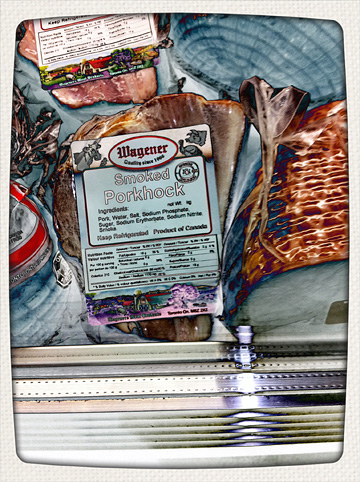
I was at the St. Lawrence Market, as usual for me on Fridays after work; I stopped at Whitehouse Meats and, walking past a refrigerator case, happened to notice a package with a particularly savoury bit of wording. I pulled out my iPhone and took a picture of it with the tadaa app, which takes whatever picture you take and adds extra processing – it has a variety of cute filters and frames and controls you can apply to the raw image, sort of like curing or smoking meat.

The word that especially grabbed my eye was porkhock. Just look at that and listen to that! It has this forest of stems – it looks almost shocked. The k’s bend like knees. Between, the o’s are round like hams. But the sound of it! If you have aspirations to produce a percussive word, this is your percussive word with aspirations!

Aspiration, linguistically, names the puff of air that in English follows a voiceless stop when it’s at the start of a syllable, particularly a stressed one. Hold your hand in front of your mouth and say pork. You feel the puff on the /p/. Now say porcock. You’ll probably get a lesser puff after the c. But when you add the /h/ to make it porkhock the puff becomes, if not stronger, then certainly longer.

Now, for added pleasure, take that popping, cracking compound word and add a smoky and coughing word before it: smoked porkhock. Say that a few times at different volumes, pitches, and intonations. It might even make you thirsty after a while.

I’m sure smoked porkhock could make you thirsty, too. A 100-gram serving has nearly half your RDA of salt. Sounds more like ham than like pork, no?

It’s not just that hamhock is seen and known, and not only as a character in the comic strip Tumbleweeds (well, Hildegard Hamhocker, to be more exact – the bucktoothed lass who is forever trying to drag Tumbleweeds to the altar). Generally, the pork/ham distinction rests partly on the cut of meat but more importantly on whether the meat is cured. Pork is, admittedly, the more general term; it comes to us from Latin porcus “pig” by way of French. Ham is in origins first of all a reference to a part of the leg – the part behind the knee, and extending up the back of the thigh to the buttocks. And that’s not just on pigs; it’s on people and anything else with legs with knees and a butt. But when it comes to pigs, a ham is cured – salted and smoked or dried or whatnot.

So why porkhock? Well, the point may be made that the ham only extends so far down the leg, and this bit of meat is from father down. That’s true – the hock is (or is the area up to and including) the backward-angled joint that ungulates have, analogous to our ankles but raised off the ground and with a stretch of leg before the foot proper. Hock is a Germanic-derived word that has a still-extant older form hough.

So, really, hamhock is actually the less accurate word anatomically, although porkhock is less accurate in terms of preparation. But what do you do when you have something that’s not entirely this and not entirely that? You might as well use a word that’s partially Latin-derived and partially German-derived – a word that, incidentally, is not usually even seen as one word: pork hock is the usual way it’s written when it’s written. But Wagener put it as one word on their packaging, joined together (and thereby you know that it’s porkhock that’s been smoked, not hock of smoked pork). It’s specially prepared with added flavour and saltiness. I mean the word. But also the meat. And the photo I took, too, for that matter.

So, by the way, what wine should you have with it? I would recommend hock. Which is what white German wines are sometimes called (from Hochheimer, Anglicized ages ago to Hockamore).

caseness

In some fields, some terms have a certain casual currency – everybody knows them and nobody bothers to define them, but outside the field no one knows them and they’re not really transparent, even if they’re made of perfectly ordinary bits. They gain a sort of shibboleth status, but unconsciously.

I encountered one such today at work: caseness. It shows up in the psychiatric literature here and there, often in scare quotes:

“Caseness” for depression and anxiety in a depressed outpatient population: symptomatic outcome as a function of baseline diagnostic categories

The Psychiatric ‘Caseness’ of Clients Referred to an Urban Social Services Department

Psychiatric caseness is a marker of major depressive episode in general practice

Chronic fatigue syndrome-like caseness as a predictor of work status in fatigued employees on sick leave: four year follow up study

The scare quotes indicate some recognition that it’s somewhat casual in-group jargon; the lack of them in other instances indicates that it’s commonly used and is not inevitably seen as exceptional, odd, colloquial, or jargony.

Whatever a new word may be, for me seeing one is like a bit of Christmas. And this one has the added touch of a sound similarity to “Christmas”: a [k] at the start; in the middle, a [s] followed by a nasal; and another [s] at the end. But there’s no [r] in this word, and the first vowel is a diphthong and is longer and more open than the one in Christmas. Caseness is cold and hard and cutting in sound, like a knife breaking through a barrier and starting to sever (perhaps a box cutter cutting open a case), but it can also be heard as a kiss and a soft whisper in the ear. And it is a word of curves: the simple c, the doubles s ss, the twists e e, the ornamental a, the humped n. It has almost ceaseless caresses for the senses.

But what does it mean? Its parts seem obvious enough: case, from Latin casus “fall, chance, occurrence, case”, from cadere “fall”, and ness, that time-honoured West Germanic nominalizing suffix seen in darkness, kindheartedness, wildness, wilderness (odd one out, that), hotness, highness… I note that Case and Ness are also family names, so that it would be possible to be named Jack Case Ness or Jill Case-Ness. But that’s not our case here.

So put case and ness together and you have “condition of being a case” or “degree to which something is a case”. But does that really help? A case of what?

Ah, well, first, in the dehumanizing world of medical jargon, patients – what they call people who are on the other side of the treatment equation – are often equated with their conditions: the broken leg in cubicle 13, for instance, or the case of measles that came into the office this morning. And in psychiatry, where the border between normal and abnormal can be quite arbitrary and fuzzy, there is often a question of whether the person is or isn’t a case of depression, or of schizophrenia, or whatnot. This is also true of other tricky diagnoses such as chronic fatigue syndrome.

So if, in your doctor’s judgement, you are a case of something, then you have caseness. And, to add more depth, one may say that the extent to which you match the criteria of a particular condition is your degree of caseness. Some articles argue for determining caseness on the basis of a chosen cutoff in criteria, and in fact in many instances there are criteria that can be checked off to come up with a score: if you have three of these, you’re not a case; if you have four, you are. Does this seem arbitrary? Well, of course it is, but tell me: does a box containing eleven beers (or eleven bottles of wine) have caseness? Is it a case of beer (or wine) or not?

The remaining question is this: Is caseness a word? The answer might seem self-evident, given that I’ve just been using it, and I’ve defined it for you, and you now understand it. Moreover, it’s made of perfectly combinable parts. If I say “That cat has a certain dogness,” you don’t need to look up dogness even if you’ve never heard or seen it; you can tell what it means. But when you first encountered this word caseness, was its meaning obvious to you? If you tried to look it up in a dictionary, even in the Oxford English Dictionary, you would have come up empty.

So what is the criterion – what are the criteria – for wordness? I often say “I used it, you understood it, it’s a word.” But what if you didn’t understand it? Then it’s a word for me but not really for you. Or not fully: you may recognize that it’s been used as an independent lexical unit, but it doesn’t communicate to you any more than, say, There are three squedgels in the carmavery. And if you know it and can use it but the people you would use it with don’t understand it, does it have full wordness? But is there ever truly full wordness, in that case? In what context, for what users, does caseness attain sufficient wordness? As with psychiatric diagnoses, there is much in the individual judgement.

