The days of labour may sometimes be thankless, but they need not be swankless. When you think you can no further swink, quick as a wink you can refill your tank with a little swank. It need not be such swagger as to set tongues a-wag; it can be just enough to put a swing in your step and sway your mood. The little luxuries can lift your life.
But how much swank do you need to make it swanky? Will you be sated with a simple embroidered hanky? A perfect martini? Or does proper swank require a whole swamp of swancour? Does it entail details on details? White-glove service, gold-plated flatware, velvet, brocade, Krug, Petrus? Is there a price cutoff? Or is swank in the eye of the beholder, or variable according to relative expectation?
Let’s say I want a swanky meal for my birthday. We can all agree that if I were to walk a few blocks to my nearest Michelin-starred restaurant, even if the décor is a bit simple, the sheer quality and price of the food would make it swanky. But let’s say instead that I walk to my local market and buy a pound of striploin and some Gorgonzola and some cream and take them home and (with the addition of ingredients already on the premises) make steak in a Gorgonzola cream sauce. Is that sufficiently swanky by definition, or do I need to spend a certain amount on the steak or verify a certain fat content in the cream? Do I need to serve it on our prettiest dishes, or can food be swanky even when served on the scuffed black plates we use every day?
You are of course entitled to your opinions, as I am to mine. But if my choices do not sway you, can I still truly consider them swanky? What if there is no swagger? No ostentation?
And, on the other hand, can anything be swanky if you do the right things? We can imagine that a hamburger can be swanky; I suspect grits and biscuits can be swanky with the right care and attention and expense. But can a hot dog? Can SPAM (outside of Korea)? Similarly, we know that opera is swanky by default, though you can mount a very unswanky production of it; but can a comic operetta or silly musical be swanky, or are they too demotic? Can there be swank in Gilbert and Sullivan?
The answer to that last question is, in fact, etymologically yes. You see, the librettist of the team was William Schwenck Gilbert, known to his familiars as “Schwenck.” That name was the surname of his great-aunt and great-uncle, and it is from the German verb schwenken, ‘swing, sway, swagger’. Which, it is thought, is from the same Old Germanic root as English swank, which originally meant ‘swagger, strut, behave ostentatiously’.
Swank has, certainly, evolved in sense to mean ‘fashionable, elegant, posh’ – but that’s not a very large change. And yes, swank doesn’t come directly from Schwenck. But consider this: There was a family, originally named Schwenk, who, after some time in England, modified their name, and some of them moved to America, and one of them was born in Nebraska in 1974 with that modified surname, and she grew up to be a movie star. Yes, I mean Hilary Swank. Whose name, therefore, not only sounds and looks like swank, not only is etymologically related to swank, but shows that this common Schwenk can, with but a touch of refinement, become Swank.
And so I will accept any touch of refinement. If we stay in a hotel with the plushest bathrobes I’ve ever worn, then that’s swanky regardless of the price (though let’s be honest, the price is probably swancorous). If we have take-out pizza for supper and open the priciest bottle of wine we have on hand to go with it, that is certainly not swankless. And you may, I think, allow yourself some little capricious luxury in your workspace, just a wink of swank while you work. I certainly will allow myself such perquisites (swanquisites?), swank you very much.
Aina and I are taking tapdance lessons. We have been for a while, in fact, but I’m still pretty bad at it. (Aina, who has two degrees in dance, is of course doing somewhat better.) But I’ve learned some of the foundational movements and steps. And one in particular we were working on a lot this week was the…
…well, the instructor was calling it a perididdle, but he was a substitute (a good one, mind you); our regular instructor calls it a paradiddle. But our previous instructor, I thought, called it a taradiddle.
I’m probably wrong about that, though. She had an encyclopedic knowledge of tap and its history and personages. Most likely, I was just mishearing her. A tapdance studio is not the quietest of places.
If you want to look it up, you might not immediately get the results you want. To start with, if you try perididdle, any dictionary will just stare blankly back at you. Google will suggest that you must have meant paradiddle. So anyway, it’s not peri, as in periwinkle or peritoneal. It’s para.
But then if you look up paradiddle in a dictionary or encyclopedia, it will just tell you that it is a basic drum pattern, an even beat played left-right-left-left or right-left-right-right. It seems that diddle is a term for a double stroke, whereas a paradiddle is two alternating single strokes followed by a double stroke. So, you know, it’s a diddle with something about it – para being ‘about’; Wiktionary suggests it may be related to Greek παραδίδωμι paradídomi ‘give over, hand over, deliver’.
But don’t put too much into that Greek derivation. The fact is that a diddle sounds like “diddle” and a paradiddle sounds like “paradiddle.” So this classical appearance is more likely a bit of pareidolia.
Especially since diddle is not from dídomi. The word diddle as we have it, mind you, does not normally refer to the drum pattern, except in that specific context; it otherwise means ‘cheat, swindle’ or ‘dodder’ or, more recently, ‘molest’ and a few other things. This traces back to Germanic roots, though the connections are kind of fiddly – there are a few different roots that might be muddled and dithering.
One way or another, though, diddle appears to be the base of taradiddle (also spelled tarradiddle), which means ‘fib, falsehood, trivial bit of twaddle’. We’re not entirely sure where the tara comes from; it is perhaps a trifling lexical imposture.
Anyway, to get back to taps: Although a dictionary won’t tell you about the tap step, various web pages and videos will. A paradiddle is a four-beat sequence with one foot: dig-spank-step-drop. This means you dig your heel against the floor, pull it back and tap the toe as you pull the foot back, then step the toe down, and then step the heel down as well. And then you do the same on the other foot, usually, and back and forth. It doesn’t sound quite like “taradiddle”; to my ear it’s something more like “poodle paddle.”
Well, at least when you do it right. And when I’m doing it slowly, I get the steps right. But once we speed it up, my reflexes addle and my feet dissimulate, and I quickly pass from paradiddle to a terpsichorean taradiddle.
Just about 90% of the phone calls I get anymore are scams. Those scum – I wish they would scram. It makes me want to scream. I won’t pick up anymore if I don’t recognize where it’s from.
There have always been scammers, of course, scanning for some opportunity for making a fast buck. There have long been unsolicited telephone calls, and before those there were door-to-door salesmen, and travelling medicine shows, and three-card monte tricksters, and so on… But scam calls have not always made up the plain majority of phone calls, and not just because other people don’t call as much.
That seems to be the trend with scams generally. There are just so damn many scams now – and some of them for so much money, right out in the open, involving not simple alley-lurking lowlifes but prominent well-connected persons. Some will say that it’s the same as it ever was. But is that true?
Take this word scam. Four letters, four phonemes, not so different from quite a few other words we have – scum, scalp, scab, scram, scamp, camp, scheme, sham, cram, plus quite a lot more that it rhymes with, as well as others with the same sounds like mask and max. Scam presents itself as a time-honoured (or dishonoured) word with a grand history, woven through the English underworld from time immemorial.
Well. From Time in 1963, anyway. That’s the first citation of it that the Oxford English Dictionary has. Green’s Dictionary of Slang reaches back a bit further in related senses. There’s a 1958 use of it to mean ‘nonsense’, and there’s a 1951 use of skam to mean ‘scheme’. There’s even a Damon Runyon use of scamus in 1944.
But that’s it. That’s as far back as it goes in the print record. We’re not even sure where it’s from. Maybe scamp; maybe Danish skam, which would relate it directly to shame and sham. But really, all we can pick up are whispers in the wind.
And, really, its vector into widespread use came in 1980, with an FBI sting operation in which numerous politicians were caught accepting bribes from representatives of a fictitious Arabian company. The operation was called Abscam, from Arab scam (though, after complaints from the American-Arab Relations Committee, the FBI subsequently revised the official etymology to be Abdul scam, from Kambir Abdul Rahman, one of the characters involved). Obviously the word scam was already current within the FBI at the time. And many other people had probably heard it. But its use really caught on after that sting dominated the news for quite a while.
And, alas, use of scams has, with technological advancements, seemed to become epidemic. By coincidence (what else could it be?), as I was writing this, I heard the TV from the other room and it was an episode of PBS’s Frontline called “Scammed,” all about online scams, often being run from compounds in Southeast Asia – where the people working in them have themselves been scammed into going there with the promise of completely different kinds of jobs, then kept there by force and beaten badly if they don’t do the scamming.
It’s not just phone calls, either; it’s social media, through every possible angle. I can tell you that I get incessant game requests on Scrabble from obviously fake people, who you can feel certain are wanting to build a relationship with me so they can gradually get me to fall for a scam. That’s what the scammers do, and they all involve the impression of a real deep and detailed personal history that you can relate to. But it’s not even as deep as the history of this word.
And it all involves links, as Frontline showed, links that can often be followed. For instance, the scam compounds need to connect to the internet, and very often it’s with the aid of Starlink connections, which can often be identified – sort of like how we can identify Abscam as a key point of spread for scam. And many – probably most – of these scams use cryptocurrency, which has the traceability of the blockchain, like an etymology for money.
Well, sort of like it. Just as we can see where the word scam has been used, it’s possible to see where the cryptocurrency changed hands – but not necessarily whose hands it was passing between. And at length, after being passed through many transactions to obscure it, it ends up at a cryptocurrency exchange, where it can be converted to government currency, and there the traceable trail ends – it’s out in the wind, just like scam before its first appearances in print.
Scam came from somewhere; there were people involved. But who, and why, and how? Perhaps we will find out someday. But I wouldn’t stake any money on it.
If you discern a mathematical relationship that no one has noticed before, and you produce an equation characterizing it, you didn’t invent it, did you? You just applied existing methods to a new discovery.
If you come up with a wordplay, you don’t invent a pun – it is not so much an act of creation as just one of noticing, right?
What about if you write poetry? That may be a matter of thinking something out, but is it sensible to speak of inventing a poem?
Paul Quarrington thought so; in his play The Invention of Poetry, it is not the idea or paradigm or practice of poetry that is spoken of as being invented, but rather the wordstuff of a particular poem. That’s how Shakespeare and Dryden used invent, synonymously with create. But it seems unidiomatic now.
So what, then, do we mean when we say invent? If I invent a vent, what developments and differentiations must I devise so that it’s not merely an advance or variation? I don’t need to invent the concept or practice of venting; I need only invent a new way to vent – something clever, something that shows a spark of inspiration, the divine afflatus or at least an insight of the moment. Perhaps something that lets me vent steam from my stove without installing a duct or merely recirculating. (Don’t ask me what. I didn’t say I had invented it.)
But say I do invent a vent, or some other advent of invention eventuates. Is it the exertion of my own genius, or is it just something that somehow comes to me, or that I somehow come upon?
Different people have different opinions, to be sure. In particular, the ancient Anglo-Saxons saw it one way, and the Romans another. The Anglo-Saxon word for ‘invent’ was āþenċan, literally ‘think out’ – make a thought and excrete it into the world. But that was supplanted by a word taken from French inventer, which in its turn came from Latin inventus, past participle of invenio, which is from in ‘in’ and venio ‘I come’ (different from the source of vent, ventus, which is from a root meaning ‘blow’ and is cognate with wind).
This means not so much that the invention comes into you – blown into your head, as it were – as that you come into, or upon, the invention. If in Latin I want to speak of someone or something being found or discovered, I can use inventus. This seems odd to the English eye, as though a detective might invent a corpse (obviously more the work of the murderer, at least in Dryden’s sense of invent, which can include simple making from raw materials). But there it is.
We came into the word invent, anyway, and at first we used it like discover – which means ‘remove the cover from’, remember – or discern – which comes from roots meaning ‘separate, divide, sieve’. Then we came to use it like devise, which is historically a doublet of divide; our current sense descends from a use with wills, where the dividing of possessions was converted into instructions, and then from giving instructions the sense moved on to figuring out.
Today, we conceive of the mental act invent as synonymous with create, from Latin creo, related to a root meaning ‘grow’, and with conceive, which comes from con ‘with’ plus capio ‘I seize, I grasp’. You may sow or you may reap and yet you invent.
But in the material production, we use invent as a sort of synonym for contrive… with which we find that what went around has come around. It’s from con ‘with’ and Old French trovar ‘find’, from Latin tropare, which meant ‘find’, and before that ‘invent’, and before that specifically ‘create poetry’, from tropus ‘figurative use of a word’ (you may recognize the source of English trope in it). It’s almost poetic justice. Or at least the intrinsic inadvertent inventiveness of verbal evolution.
Sometimes you get into the sauce and things go south: you sluice whatever’s in the house into your mouth, you start to get salty, your brain turns to brine, and you’re pickled. In short, you’re soused. Or, to say it another way, you’re a souse.
Now, tell me, those of you on speaking terms with souse: while we all agree that soused means ‘heavily inebriated’, do you use souse to mean ‘a person who is currently heavily inebriated’ or do you use it to mean ‘a person who is habitually inebriated’? In other words, in your usage, is the relation between soused and a souse the same as between drunk and a drunk?
Hmm, well, how about the relation between pickled and a pickle? If something is a pickle, it has been pickled, but, more to the point, it is presented as intrinsically and permanently pickled. It will never be unpickled at any future time you may pick. Pickle is its nature. So calling someone a souse is like calling them a pickle, right?
Hmm, yes and no. First let’s get the order of derivations straight: the noun pickle came before the verb. It’s called pickling because it involves using a pickle. But – trick! trickle! – the original sense of pickle is the brine. The cucumber (or other vegetable) has gotten the name pickle by transference.
But back to souse: It is a similar situation to pickle in that soused, the participle, derives from souse, the verb, which in turn comes from souse, the noun. So a souse is not so called from being soused, but rather the converse.
It is also a similar situation because soused means, literally, pickled, and a souse is something that has been steeped in brine. Not necessarily a pickled cucumber per se, though – more likely something that’s a sow’s. Or a hog’s. You know, pickled pig’s feet, pickled pig’s ears, that manner of thing. And specifically it’s pickled in a salty brine: souse, you see, comes via French from Proto-Germanic (yes, Proto-Germanic – French has lots of Frankish bits) *sultijō ‘saltwater, brine’, which is derived from a Proto-Indo-European root *sḗh₂l ‘salt’.
It’s interesting to see that the /s–l/ and then /s–lt/ was preserved for such a long time, only to have the /l/ softened up to /ʊ/ and the /t/ to /s/ to make /saʊs/, sounding as though someone truly sauced were trying to say “salt.” But on the other hand, in the figurative transference, the key component, salt – something that makes you thirsty – has been replaced by a completely different agent, one often used (with variable efficacy) to address thirst: alcohol.
I’ve lived in Ontario for nearly 30 years. I’ve woken up every morning with a view of Lake Ontario for 18 years. But somehow I’ve neglected to taste the word Ontario until now.
Ontario is a musical word, suited if not for an oratorio then at least for an aria on the radio – or for an airy jingle, as the provincial government showed every Canadian starting in 1967: their promotional song branded all our brains with “A place to stand, a place to grow, Ontari-ari-ario” (music by Dolores Claman, more famous for the Hockey Night in Canada theme): https://www.youtube.com/watch?v=zPgZFzO0XZ0
It’s a pretty efficient word, too: four syllables from seven letters, with “airy” in its heart, and using the same vowel at the start and the end – traits that it shares with, among others, America. But I’m not in America (I’m in North America, but not in the country commonly called America), and though my view is elevated, I can’t quite see America across Lake Ontario, because the lake is, after all, a great big one.
Ontario names several places. In Canada, it’s two big ones: the province of Ontario, the most populous and second largest of Canada’s provinces (two territories are larger, but territories are not provinces), and Lake Ontario, the smallest of the great lakes by area (but second smallest by volume). It’s also smaller places, such as Ontario Street, which is on the east side of downtown Toronto (and probably other places in other towns too), and Hurontario Street, which was laid to run from Lake Huron (Georgian Bay) in Collingwood to Lake Ontario in Mississauga (more than 130 km, but it has some gaps).
There are also eight towns and cities in the USA called Ontario (including, notably, a suburb of Los Angeles, where you will find Ontario Airport, which I have to think has confused some people), and they all seem to be named after the lake or the province. But just to get an Ont-ological question out of the way right away: The province of Ontario is named after the lake, and not vice versa (before Canada became an independent country in 1867, Ontario was called Upper Canada, a name you’ll see reflected in various places and things).
The lake has been called Ontario for a long, long time. And for much of that time, it wasn’t Lake Ontario, it was just Ontario – or another similar word that’s the source of Ontario. This could possibly be skanadario, an Iroquioian word meaning ‘beautiful water’ or ‘sparkling water’, but it’s probably Ontarí:io, a Huron-Wendat word meaning – wait for it – ‘great lake’.
Yes, that’s right. The smallest of the great lakes is the one named Great Lake. But also, that means Lake Ontario is a redundancy, just like Sahara Desert (in Arabic, ṣaḥārā means ‘deserts’). But it’s been called Lake Ontario since before 1794, when it was named in the Treaty of Canandaigua, signed by President George Washington (and still in effect). So we can live with the name, and more easily than, say, salsa sauce or ATM machine.
Anyway, it’s a pretty lake, and it has some very nice beaches too – including several on Toronto Island, where my wife and I go at least once a week all summer long. The water isn’t tropically warm, true, but on the other hand it’s not salty either. And you can go to Ward’s Island beach and feel like you’re way out in the country, even though it’s less than 20 minutes from downtown, most of which is spent on a ferry across the harbour.
Most of the water in Lake Ontario was, of course, previously in the other Great Lakes, since they’re a chain like sausage links, more or less: Lake Superior empties through the St. Marys River into Lake Huron; Lake Huron empties through Lake St. Clair and the Detroit River into Lake Erie; Lake Erie empties into the Niagara River, which – after an abrupt change in elevation – empties into Lake Ontario. A fun bit of trivia is that Lake Erie is shallow enough, and Niagara Falls high enough, that the bottom of Lake Erie is higher in elevation than the surface of Lake Ontario – but Lake Superior is so deep, its bottom is lower in elevation even than the bottom of Lake Ontario.
And although the province of Ontario is named after Lake Ontario, the province touches all of the great lakes I just named. In fact, since hydrologically Lake Huron and Lake Michigan are one lake – because they have the same surface elevation – you could say that Ontario touches all of the great lakes. But we have to admit that most people don’t see it that way, because the only thing connecting Huron and Michigan is the Straits of Mackinac. Anyway, Ontario is the only province that touches any of the great lakes. And all ships that want to get from any great lake to the ocean, or vice versa, have to pass through Ontario – not just in the middle of a lake, but by way of the Welland Canal, which cuts across the Niagara Peninsula, allowing ships to avoid a rather difficult passage over the falls.
But the great lakes are not the only justification for Ontario’s having such an aqueous name. Ontario also has a shore on the Arctic Ocean – specifically the Hudson Bay and James Bay extensions of it – and within its interior it has another quarter of a million lakes. Yes, that’s right, over 250,000 lakes of various sizes. Fully one seventh of Ontario’s area is water. Most of Ontario is impossible to cross without crossing water quite often, and passing by water even more often. Ontarians seem OK with this – going to lakes is a popular pastime.
And, for that matter, Ontario is nearly impossible to enter from the USA without crossing water; of the more than 2700 km of border between Ontario and the US, only about one kilometre is land, and that’s all up in the wilds at the northern edge of Minnesota. To get between Ontario and the US in a motor vehicle, you have to cross one of 14 bridges – or one tunnel.
But, all that Ontari-eau notwithstanding, Ontario has quite a diverse geography; just watch any tourism video, from the famous “Yours to Discover” of 1980 (https://www.youtube.com/watch?v=0Iv7QHcOED0) to more recent ones (e.g., https://www.youtube.com/watch?v=SHy0BeOLzaE). In southwestern Ontario – the spear’s head bounded by Lakes Ontario, Erie, and Huron (including Georgian Bay) – there’s a huge amount of agriculture, including the most farms of any province (more than even Alberta), as well as 150 wineries, several of which are excellent and widely respected, and an ever-changing large number of craft breweries as well.
Ontario has cities, and lots of them, including Toronto, North America’s fourth-most-populous city and seventh-most-populous metropolitan area, and Ottawa, the capital of Canada. Most of the people in Ontario live in the southern part – Ontario has nearly 40% of Canada’s population, and almost 95% of those live in southern Ontario, which, however, is only about 10% of the total area of the province.
All of southern Ontario is well south of the 49th parallel, and the southernmost part of Ontario is farther south than the northern border of California. Toronto is on the same latitude as Marseille, France; Florence, Italy; Sarajevo, Bosnia and Herzegovina; Sochi, Russia; and Sapporo, Japan. But of course it’s still part of the “true North, strong and free.”
And anyway, Ontario has plenty of northern On-territory in its massive Ont-area. Ontario is about 60% larger than Texas and almost three-quarters the size of Alaska, and most of that turf is rocks, trees, peatland, and, yes, all those lakes – and not so many people. If you drive from Windsor to Kenora by highways 401, 400, and the Trans-Canada, it’s more than 2000 kilometres and almost 24 hours of pure driving – and I’ve driven it all (though not all in one trip).
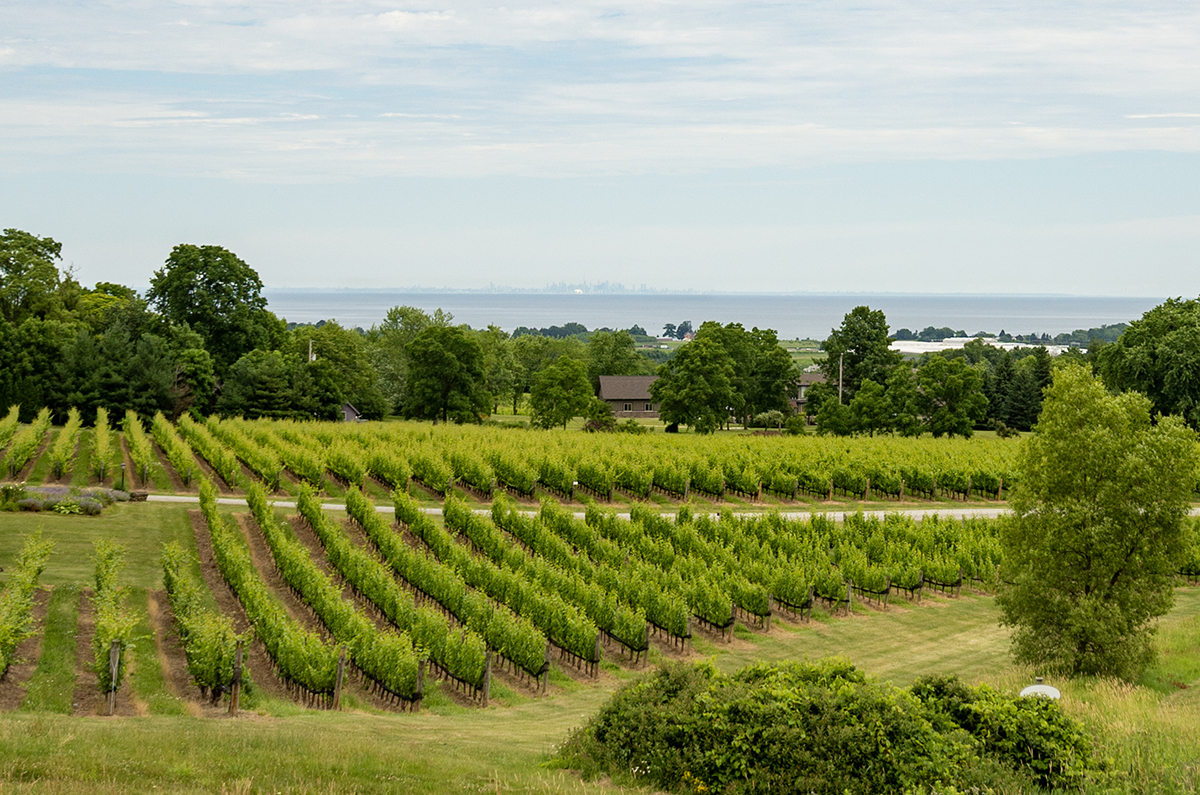
But I rarely see most of it, except when flying over. I live in downtown Toronto. But there’s still so much to see and do within an easy day trip – for instance, I can take a train down to the Niagara wine region, where I can have a lovely glass of Cabernet Franc by a lovely vineyard, and I can look north across Lake Ontario at my home in the distance, full circle O–o, still in Ontario.
Today Dolly Parton left us. She was, etymologically and in many other ways, a gift from God. But since my last word tasting already covered Dolly, today I’m going to pause in memory of her and look just briefly at another name associated with her: the eponym of one of her most famous songs, Jolene.
This name Jolene is, as you probably know, a sort of portmanteau word, made of the start of one name and the end of another, sort of like how chocoholic is made from chocolate and alcoholic. And if you have the usual familiarity with the American South, you’ll know that Jo is stereotypically common in a lot of women’s names thereabouts – both as a second part, as in Bobby Jo (not to be confused with Bobby Joe, which is a man’s name) and Suzie Jo, and as a first part, especially in Jolene. It’s taken from names such as Joan and Joanne and Josephine. It has that nice voiced apical affricate “J” so well suited to starting names, for men and women both.
OK, so where does the Jo in those names come from? Well, Joan and Joanne are feminized forms of John and Johann and so on, which come by way of Latin and Greek from Hebrew Yohanan (probably from an original form meaning ‘God is gracious’); Josephine is a feminized form of Joseph, which comes via Latin and Greek from Hebrew Yosef (‘God shall add’). So, yeah, that Yo in both cases is from ‘God’. And so, therefore, is Jo.
And how about the -lene? There are many names with the suffix -ine or -ene, pretty much all of which are from adjectival forms (indicating association or derivation) but also are used to indicate femininity, but the -lene in particular has specific sources. One of them is Marlene, the most famous bearer of which was Marlene Dietrich, who was christened Marie Magdalene – so Marlene is a telescoping of Marie Magdalene, and no less a portmanteau than Jolene. Another source, then, is Magdalene, and another is Helene, both of which are names of famously attractive women (the one a sort of Jolene type who repented of her husband-stealing ways and became a follower of Jesus, the other a woman whose husband launched a war to get her back because writing a song was clearly not his métier).
The -ene in Magdalene signifies derivation: it means that she was from the village of Magdala, on the shores of the Sea of Galilee (Magdala refers in Hebrew to a tower). Helene is a very old Greek name, highly reminiscent of Hellene, which means ‘Greek person’, but not related to it; instead, Helene – and of course Helen and Helena and, for that matter, Elaine and several other names – probably traces to a name for a solar deity, from a Proto-Indo-European meaning ‘shine, smoulder, burn’. In short, the implication of -lene could – for those who like to play games with etymology – be said to be ‘towering hotty, but derivative’.
So, if you wanted, you could say Jolene is etymologically something like ‘divine but not unique smokin’ hot husband-stealer’. But, again, Dolly is ‘gift from God’. And we know who won in the end.
“How was your evening out on The Esplanade yesterday?” I asked Maury. I was sitting with him and Jess in Domus Logogustationis, and he was looking like he’d seen and done things he’d rather not have.
“Rebarbative,” Maury said.
“Oh dear,” I said.
“Wait,” Jess said. “I thought you went to see Hello, Dolly?”
“I had thought I was going to see Salvador Dalí!” Maury said. “But hello! And hell no!”
“Well, you said you were going to The Esplanade,” I said. “I could have told you that Dolly’s is the new cowgirl-themed bar where the Bier Markt used to be.”
“You could have,” Maury said. “You didn’t, but you certainly could have.”
“I thought you knew.”
“I do now.”
“So you didn’t enjoy it?” Jess said, innocently.
Maury gave her a brief Kubrick stare. Then he inhaled and said, “Line dancing is… not my line of dancing. We each had a sixteen-dollar cocktail and I watched the whirl of activity and longed for less acute hearing. Narcissa had a thing called a Porn Star Martini. I was expecting local hummingbirds to seek it out. I had something made with whiskey, charred oak, sarsaparilla, and bitters, specifically because it was named Desperado, and I was desperate.”
“You didn’t stay long, did you?” I said.
“Well, no, only as long as it took to get the drink, plus several seconds to swallow it. And then Narcissa asked if I would like to go instead to a barbecue. Or I thought that’s what she said.”
“Oh dear,” I said. I knew what was coming, as I live at the other end of the block from the location in question.
“Was it not a barbecue?” Jess said.
“It was… a Barbie queue. A queue for the Malibu Barbie Café pop-up event, next door to Dolly’s.”
“And she already had tickets?” I said. I knew it was a forty-buck entrance, though I had not gone to it myself.
“Yes, it was a set-up.”
“Malibu. Barbie. Café,” Jess said.
“It looks like a Malibu Barbie playhouse,” Maury said. “Also, it looks exactly like several nightmares I have had.”
“A lot of pink,” I said.
“And I then realized why Narcissa was dressed all in pink. She had also brought a pink bowtie for me. Fortunately it was at least a real one, not a clip-on.”
“And how did you get through that experience?” Jess said.
“With the aid of prosecco and mojitos. At least there wasn’t any country music.”
Jess leaned forward, teasingly. “Did you get any souvenirs?”
“As a matter of fact…” Maury said, and reached into his pocket. “I at some point said to Narcissa that what I could really use was a phenobarbital.”
He paused for effect. Then he said, “Behold.” And from his pocket he produced a flannel Barbie doll.
It goes without saying that as the evening progressed further we went without etymologically dissecting or otherwise tasting any of the words. But now we’re here, on my blog, and I’d like to.
First: Barbie. Obviously a short form for Barbara. The dolls were named after Barbara Handler, the daughter of Ruth Handler, who invented them in the late 1950s. The name Barbara in its various forms has caught on, rather like a barb, but it’s not related to barb as in on a fish hook; that barb comes by way of Old French from Latin barba, ‘beard’. Instead, Barbara is Latin for ‘foreign woman’ (‘foreign man’ is barbarus); the vector for its use as a name is Saint Barbara – who also, of course, gave her name to Santa Barbara, which is just a bit more than seventy miles up the California coast from Malibu.
Foreign woman? Yes, a barbarian, literally. Some people have at some times thought that barbarian came from the same word for ‘beard’, distinguishing foreigners as bearded people. But it does not. Latin got it from Greek βάρβαρος barbaros, and (a) ancient Greek men commonly had beards, so a beard was not a mark of a foreigner, and (b) the Ancient Greek word for ‘beard’ was γένειον geneion. Instead, it is commonly accepted that βάρβαρος was just imitative of the speech of the foreigners. It was like calling them “blah-blahs.”
On the other hand, the rather barbed word rebarbative, which means ‘repellent’, does come from barba – by way of Middle French rebarber, ‘oppose’, as in stand beard-to-beard against. (As to barbecue, although it has sometimes been attributed to a Bar-B-Q Ranch, it’s from Taino barbakoa, the name of a frame of wooden sticks that was used for cooking or curing meat or fish. And queue comes from Latin cauda, ‘tail’.)
Now, having talked about Barbie, we come around to dolls, or, more to the point, to Dolly. Classically, Dolly has been a pet name for Dorothy or, later, for Dolores; Dorothy comes from Dorothea, ‘gift from God’, the same roots as Theodore, while Dolores is from Spanish for ‘sorrows’, and became a woman’s name from María de los Dolores, Mary of the Sorrows – one of the presentations of the Virgin Mary. But the most famous Dolly of our times, Dolly Parton, was christened Dolly Rebecca Parton – not short for anything (rather like being named Jack or Cindy from birth: why not just go with the version everyone will use anyway?). And in that sense, Dolly is, well, like a doll.
And where does doll as in a stuffed or carved or moulded homunculus come from? Heh heh, from Dorothy. Yes, that’s right, a doll is a doll because a typical name was Doll, and dolls could have as easily been called molls or kates or barbies or any other common name for a girl.
And all of the above means that Barbie doll, etymologically, is ‘foreign woman, gift from God’, but specifically in a cute, affectionate way.
Oh, and phenobarbital? It’s from pheno- from Greek φαίνω phainō ‘come to light, manifest’ (as seen in epiphany and also, lightly changed, in Tiffany, which has exactly the same roots as theophany ‘manifestation of a deity’), plus barbital, which is from barbiturate, from German Barbiturat, which probably comes from the name Barbara plus the root we see in uric and urine. Yes: phenobarbital could be said to mean ‘a vision of Barbie’s piss’. Maury should feel grateful he just got the doll.
Some would-be genii will tell you – without being asked – that the plural of octopus is octopi and the plural of omnibus is omnibi and, for that matter, the plural of hocus-pocus (why do you even need one) is hoci-poci.
This is because of the well-ensconced prestige of Latin in the English language, combined with the capriciousness of English, where we assume that, ceteris paribus, weirder is more likely to be correct. Latin is like a visiting kid who gets to take the upper bunk. The result is a lot of bunkum and hokum, harum-scarum. It’s time for some debunking.
Of course all those words I just used – bunkum, hokum, harum-scarum – are supposed to look like Latin. They’re supposed to look like their plurals should be bunka and hoka and hara-scara (how does that even work – it’s an adverb and adjective). But they’re not. You’re being tricked. It’s all hocus-pocus.
Let’s start with harum-scarum. This looks sort of like it means “scaring the hoes” but it means, more or less, ‘willy-nilly’. It comes from extremely not Latin. In fact, it draws on atavistic Anglo-Saxon morphology: as far as we can tell, it is from “hare ’em, scare ’em,” where hare is a short form of harass and scare is scare and ’em is ‘them’, formed not by dropping the th (we don’t do that – no one says “’is and ’at” for “this and that”) but by recalling the old Anglo-Saxon third-person plural, hem; the modern them form came from Danish, when the Danes occupied a large slab of England. Anyway, the idea was one of fright and disarray, and somehow that ended up referring just to the messiness that results from same. And the pseudo-Latin -um endings appeared for the sake of rhyme and stayed on like stickum.
That one is the odd one out here, however. It’s the guest at the family party. Let’s turn our eyes to hocus-pocus.
Obviously hocus-pocus avails itself of the same sing-song rhyming and the same Latin look. And some people say that it’s even from Latin. John Tillotson, Archbishop of Canterbury, asserted confidently in the late 1600s that it was a mockery of “Hic est corpus.” But as far as anyone can tell, he just decided that on the basis of its sounding plausible and giving him something to condemn. At least as likely, it’s just fake Latin made up by a conjurer – a stage magician – who had invented the incantation “Hocus pocus, tontus talontus, vade celeriter jubeo.” It just… sounded right. Basic phonotactical imitation.
Certainly, on the basis of its plainly being fake Latin, you could justify going with an according nominative plural, hoci-poci (weirdly – or not – however, no one wants to use, for example, the plural dative, hocoribus-pocoribus). But then how about hokum?
Well, how about it? It may look like a neutering and respelling of hocus, but as far as anyone can tell, it’s a blend of hocus and bunkum. It means ‘flim-flam’, of course. But what’s with this bunkum? Ah, thereby hangs a tale.
The tale, just to take it straight from Wiktionary, is this:
In 1820, Felix Walker, who represented the county [of Buncombe, North Carolina] in the U.S. House of Representatives, rose to address the question of admitting Missouri as a free or slave state, his first attempt to speak on the subject after nearly a month of solid debate, right before the vote was to be called. To the exasperation of colleagues, he began a long and wearisome speech, explaining that he was speaking not to Congress but “to Buncombe.” He was ultimately shouted down by his colleagues, though his speech was published in a Washington paper and his persistence made “buncombe” (later respelled “bunkum”) a synonym for meaningless political claptrap and later for any kind of nonsense, at first only in the jargon of Washington and then in common usage.
Yes, once it became a mass noun for a substance, it was natural to have that -um that you see on gypsum and uranium and so forth. And just to cover the rest of the ground: The county was named after Edward Buncombe, a colonel in the Revolutionary War. His surname came from Somerset, England, and meant ‘reed valley’. And through the wonder of linguistic evolution, it referred to a speech that had gone into a valley and got lost in the reeds, and now, especially in its short form bunk, it refers to claptrap, hoo-hah, nonsense.
And if you expose and remove the bunk? Why, you debunk, of course. Yes, a verb that could as readily refer to tossing someone out of a bed – in much the same way as defenestrate refers to tossing someone out a window – instead refers to exposing falsehoods and misrepresentations. Which it does through appealing to a misrepresentation (as Latin when it is not) and a falsehood (the fake Latin incantation) – and of course the mistaken suppositions and deliberate misdirections, the hocus-pocus, that is going on harum-scarum throughout the language.
If someone tells a funny joke, do you chuckle? Do you giggle? Do you yuk it up? (I won’t ask whether you yuck it up, because that spelling can also refer to something… unpleasant.)
What if I told you that all those words – joke, giggle, chuckle, yuk – are related etymologically?
They’re not. Sorry. But it’s not implausible, phonologically. And they are all imitative in origin, so, in a way, if you want to trace the etymology back to nonlinguistic utterances, you could say they are related.
First, though, let’s address a ticklish little issue: the -le on giggle and chuckle. That’s a frequentative suffix, meaning that it indicates repeated action. You can see that clearly on words like crackle and sniffle and snuggle, though -le also shows up on a lot of words that don’t have versions without -le – at least not anymore: cuddle, fumble, sizzle, tickle…
Anyway, chuckle is from chuck plus -le and giggle is probably from gig plus -le. Which doesn’t help much, because this chuck is not the chuck we think of when we think of chuck, and this gig is equally a different gig than gig.
Chuck, in this case, is imitative of a sound such as the one chickens make, and can also mean ‘cluck’. Fair enough, since a certain kind of laugh is often described as a cackle. Oh, yeah, cackle: another imitative sound, cack, plus the -le.
And gig is supposedly imitative of a creaking sound, although there are cognates with giggle throughout the Germanic languages, such as Dutch giechelen (which uses a pair of those deep velar fricatives characteristic of Dutch – a sound like horking a chicken bone out of your throat), and all of them mean ‘giggle’, not ‘creak’.
Anyway, getting back to the plausibility of their being related, you will see in chuck and cack and gig a velar stop (“g” or “k”) at the end, the same as in the plainly imitative yuk. And while the initial sounds are different, they are all capable of being phonologically related with vowel shifts: a dorsal stop “k” can assimilate forward towards a front vowel, giving an affricate /tʃ/ “ch” or a fricative /x/ “kh,” and at the back or in the front it can be voiced, /g/ “g” or /dʒ/ “j” or /j/ “y” – this is how the Dutch word for ‘goat’, geit, sounds sort of like a vehement utterance of “hate,” and the Swedish word for ‘goat’, get, sounds like “yate.”
So. Do you get it? (Or do you hate it?) The laughter sound we represent as yuk (or yuck) can also be the etymological origin of chuckle and giggle and even cackle, and while there’s no known common root for them between then and now, there could be, and anyway they’re all imitating the same thing.
But here’s the punch line: joke traces through Latin iocus (‘joke, jest, pastime’) back to Proto-Indo-European *yek- ‘speak, utter’. Yep, yek. That is the sound of people making sounds – talking or, yeah, laughing. That’s right, the prototypical utterance may well have been yukking it up. Yikes!