Monthly Archives: January 2014

duodenojejunal

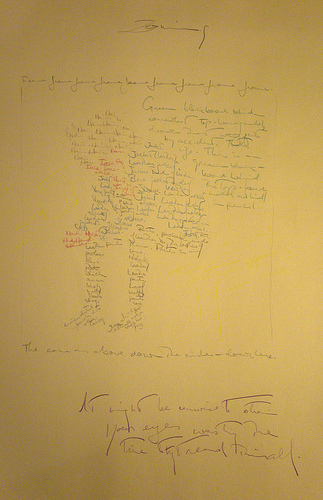
Damn, this word looks hard to digest, doesn’t it? But it appears to have two parts. The first part has two d’s sticking up, and the second part has two j’s sticking down. Both halves have u and n, making them look like they could be rotated, but both have e, which resists rotation unless you’re using phonetic symbols. And the first half has the two o’s, while the second half has an a and an l. So maybe the beginning is really a oupəonp that’s been turned upside down, but the second half, if it’s something upside down, has already been partly digested. Was it punfef? So hard to say.

Well, so is this word, until you get your mouth around it. It’s not really made for taking down in one gulp. Its rhythm is like something from Dave Brubeck – duh-da-DAH-da-de-DAH-da – or (there are two ways to say it) a Mexican hat dance – da-DAH-da-DAH-da-DAHda. But if you say it a few times you will notice that, except for the final /l/, the consonant patterns for each half are practically identical: /d…d…n/ versus /dʒ…dʒ…n/. Again, the second half seems more digested: the tongue, rather than tapping hard and smooth against the ridge, flexes in and releases a bit more gradually.

Fair enough. The first half refers to the duodenum, the first twelve inches of the small intestine after the stomach (the name comes from Latin for ‘twelve’ because it was thought of as twelve finger-breadths). That’s where most of the chemical digestion takes place. The second half refers to the jejunum, the middle part of the small intestine, where a lot of the absorption of digested food takes place. It got its name from Latin for ‘fasting’ because at autopsy it was usually empty – because food passes through it quickly on its way to the ileum and the large intestine. And the place they join is the duodenojejunal flexure (if you say that really quickly, it sounds like it could be some rude dismissal, especially the flexure).

The duodenojejunal flexure hangs below the stomach, a smart little bend. The two parts are continuous but distinct, just like the two parts of this word: the duodenum is up, and the jejunum hangs down – and around and around. Between them they help you be nourished. But the word is better tasting.
owl

The story may have a familiar ring. A boy is told by someone he has never met before that he has special abilities, that he is different from the other children, remarkably different, and that all the abuse he has suffered is not in fact because he is inferior but because he is something special and others have tried to keep that from him. He is told he must go to a special school, one that is a long trip away. It has a select student body, he is told, and they all wear special uniforms and life is very different there. And yet when he gets there he finds that in many ways children are the same everywhere, and that even among these select children he is uncommon.

The school’s name? Strathcona-Tweedsmuir.

Oh, were you expecting Hogwarts? Well, I have to tell you, the IQ test I got in grade 4 was my Harry Potter moment. But the news-bearer wasn’t Hagrid, it was a psychologist. And I only stayed one year at the school, because it was expensive and didn’t altogether seem worth the money. Also, my brother went too. And instead of a train trip at the beginning of the school year, I got a long bus trip from northwest Calgary down to south of the city every morning, and back every afternoon. And my offer of admission was not delivered by owl.

Owls are a big thing in Harry Potter. They deliver messages; they are friends and companions. Harry has a snowy owl called Hedwig. Why owls? I think it is that they are associated with wisdom. The owl was the symbol of Athena, the Greek goddess of wisdom, the patroness of Athens; the standard coin of the region in classical times, the drachma, had an owl stamped on it and so was sometimes called an ‘owl’ (στρίγξ, strinx). An owl seems always to be watching, aware, circumspect. The Dutch renaissance painter Jan den Uyl, whose last name means ‘the owl’, always worked an image or two of an owl into his still-life paintings, often quite subtly. If you look and look, you will finally see one looking back at you, and once you have seen it, you can always see it. You have become wise to the owl.

So an owl would seem to be a good thing to associate with gifted children, too, no? Not just children gifted with the ability to perform magic, but children gifted with intellectual ability. Wise beyond their years…

…they are not. Intelligence and wisdom are not exactly the same thing. Intelligence involves knowing facts and being able to figure things out, but wisdom involves knowing how to use that intelligence and generally how the world actually behaves, and how you really tick as a person. You gain wisdom by having had many occasions in your life to say “Ow!” So the ow! converts to owl.

Harry had great adventures, became an ace quidditch player and a leader and a symbol for all the wizards. With help from his friends, he passed his Ordinary Wizarding Level exams – that’s OWL. I, on the other hand, left STS after one year because it wasn’t worth it (too many owls to pay, not enough wisdom), and ended up going to high school in Banff, where I got six scholarships when I graduated – but one of my classmates went on to win two bronze medals at the 1988 Winter Olympics, and another was already touring as a concert cellist in high school. So whoop-de-doo for me; I might be owled over, but no one was bowled over by me. Somehow discovering I was a boy genius with the highest IQ the psychologist had ever tested didn’t end up making me a hero. Or wise. Any owl I had was in my head. I was an intellectually smart, socially dumb, generally lazy kid. That was owl. I mean all. I had pulled the owl over my own eyes. I was a bit mixed up; I thought owl but felt low.

And the owl isn’t the symbol of wisdom everywhere. Among the Stoney Indians, on whose reserve I spent much of my growing years and for whom my parents worked, the owl is a symbol of fear. Its call (which the word owl may ultimately be descended from an imitation of) can be haunting, lonely: not quite a howl, but still a sound more from frozen hell than from warm heaven. One time when I was young I had a dream in which an owl ate one of my cats. I loved my cats more than Harry loved his owl.

Harry had a magic wand. I do not, although I still have my school tie. Harry was a natural leader and made great friends. I was a lonely dweeb, although I made great friends once I’d grown up. Harry had an owl named Hedwig. I just had an owl in my head. And it wasn’t the owl of wisdom.

Mondrian

I went to an exhibition at the Art Gallery of Ontario this past weekend: “The Great Upheaval: Masterpieces from the Guggenheim Collection, 1910–1918.” It’s a period of art that I happen to find quite engaging. Many things were changing, and many artists were changing and growing even in that brief period (only as long as the concert career of The Beatles). You can go and play “spot the Picasso” – which painting that looks totally unlike the Picasso in the last room is the Picasso in this room? But even better is “spot the Mondrian.”

If you know the work of Piet Mondrian, you probably know his most famous works, painted mainly in the 1930s. An example is Composition in Red, Yellow, and Blue. These paintings are white fields with rectilinear black lines dividing them into rectangles of various sizes, and rectangles of primary colours in some of the spaces between them. It seems pure abstraction, but in it Mondrian aimed to create a “direct expression of universal beauty”: not something unreal but in fact a new realism engaging the underlying universal, as opposed to the particular individual experience presented by “the aesthetic expression of oneself” – i.e., “of that which one thinks one experiences,” but which unavoidably “veils the pure representation of beauty.”

But before Mondrian arrived at this, he moved through phases starting with figurative representation in flat colours, through increased abstraction and via cubism to what might seem a gradual disintegration of form but to him was a stripping away of limiting particularities. You must watch this video, simply a chronological morphing of his paintings one into the next, or you really won’t see:

What has this to do with language? What has this to do with the word Mondrian?

Let us begin with the meandering of the name Mondrian over time. An ancestor of Pieter Cornelis (Piet) Mondrian was Christian Dirkzoon Monderyan. Mondrian himself was born Mondriaan. Consider the metamorphosis of the back half of that name, deryan to driaan to drian, where the tongue has simplified the wave pattern of articulation into a simpler single lap, and then – under French influence, likely – the artist has trimmed the spelling further, which also means a change of sound in the Dutch pronunciation.

Now think of those sounds, of the bits they are made of, how they could be composed further. The consonants are like lines, the vowels like coloured areas. Imagine the lines crossing, spreading, compressing, the colours shifting around: Mondrian, marinade, moderate reminder, ruminate, endure, endear, determine, maunder, meander in dunes of Midian midday until you summon damnation’s andirons or innumerable numinous noumens.

No. Those are all words, words of our modern language, words that have particular pictures and meanings. They are shapes that have been arrived at by the erosion of time and the deliberate simplifications and complications of scribes and lexicographers, but they are figures, and figures in the comparatively complex phonetic repertoire of English. Languages may have simpler vowel sets. Many have five; the simplest have three, and those three are close to the three in Mondrian, with only the rounded back one higher: u i a. The primary colours of vowels. Let us strip the consonants down to a basic set as well: m p n d l s k y w. Now use those to produce phonetic patterns. Sing them in an animated monody of modernity: music is abstracted speech tones, after all. Produce the most basic of phonotactic patterns, the canonic syllable, consonant-vowel. Here is your new universal language:

mu na di li ya nu ka la si mu la ku wi na da pi li sa ku ka ma su ta ya na ya lu si la pu li ka yu da ni ya la sa na pi ya lu ma ka ki ti su ni la ma ti na pi la da ka su la pi ka su mi wa na du pu la pi ta mu nu da li ya nu

Signifying? Ah, but where is the signification? Why? Signification is individual. Significance is individual. Meaning comes at the interface of the person and the form. These patterns, these sounds, will not tell you to close a door, to kiss a face, to bake a loaf of bread. But they may yet bring echoes of patterns of sounds that have meant something to you; they may give a feeling from the arrangements of highs and lows, of stops and nasals, of soft and hard and smooth and spiky. It will be a feeling you know from how you were made, but it will be a feeling you know by what you have come to be. Beauty is an individual experience, infinitely multifarious, an expression of change and variety, no sameness, each individual in each moment in each place creating a new universe from a singularity that as instantly becomes another. What is universal is individuality in its infinite increments of difference.

Mondrian’s paintings, too, are Mondrian’s paintings. The style is individual, instantly recognizable: the aesthetic expression of Mondrian’s self, of who he was, when he was, the world of art and philosophy and politics that he came through, the person he was, even the a he excised from his name. The course of his paintings’ development is like the watercourse of language rolling over the pebble-bed of a billion tongues and itself being smoothed but enriched in the process. And then things happen, a waterfall, rapids, shallows or shoals or trees’ twigs, a sunburst on the surface: a glittering riffle. The man who began with dunes and trees before reaching for the purity of the basic forms at last burst forth with a vibrant explosion, Broadway Boogie-Woogie, lines but with blood or ants thrumming through them, and the incomplete yet deathless Victory Boogie-Woogie, for a war that he would not live to see the end of. Mondrian was mortal but his mind’s meanders are enduring, and in his separation from the body he has made his name.

I myself think people get too bothered about it

My latest article for TheWeek.com is about something some people get quite bent out of shape about: use of myself for purposes other than the reflexive. See what I have to say, and why:

Myself, I don’t see a problem


Topics, we front them

Featured on The Editors’ Weekly, blog of the Editors’ Association of Canada

English is normally a subject-verb-object kind of language, but there are some interesting exceptions, especially in casual contexts. Consider examples such as the following:

Poodles, we walk them. Labradors, they walk us.

Chickens we have; roads, not so much.

Not one of the clauses above follows standard English sentence order, and yet we understand them. Of the four clauses, the first is object, subject-verb-object (pronoun); the second is subject, subject (pronoun)-verb-object; the third is object-subject-verb; and the fourth is object, adverb – no subject or verb overtly expressed at all. All four are examples of topic fronting, sometimes called left dislocation. (Note that we normally use a comma to set off the topic when it is followed by a complete clause or an elliptical statement, but not usually when the sentence is not syntactically complete without it.)

So why do we depart from our usual syntactic structure? We do it to maintain our preferred information structure. When we communicate information, we usually prefer to introduce a topic and then comment on it with new information. This can be especially useful when we are contrasting two topics. We don’t have to do it; we could rewrite the above sentences as follows:

We walk poodles. Labradors walk us.

We have chickens; we don’t have roads to nearly the same extent.

The first example works well as rewritten, though it loses its folksy feel; it also loses the parallelism of topics, but it highlights the inversion, which has its own effect. The second really, um, fails to cross the road. And even in a structure such as the first, you get poorer results if you can’t make a useful inversion:

Shirts, we mend them. Shorts, we toss them.

We mend shirts. We toss shorts.

You can see it loses some of the contrast effect. In speech you can emphasize the topic structure using intonation; in print that option is not as available.

Now look at the preceding sentence (“In speech…”): it contrasts the adverbial prepositional phrases thematically by moving them from the end to the beginning of their clauses – and no one would object to it. So why does it seem somehow incorrect to do it with nouns?

It’s not because it’s some new error, or a structure borrowed from another language (though some languages do normally introduce topics first, regardless of syntactic role). In fact, as Mark Liberman has discussed on Language Log, left dislocation has existed in English as long as there has been an English for it to exist in.

What has happened is that it has fallen out of use in recent centuries. Like some other formerly standard things, such as double negatives, double superlatives, use of ain’t, pronunciation of –ing as –in, and use of ’em in place of them, it has come to be seen as nonstandard, especially when there is also a pronoun filling the same role – we can sometimes get away with it as poetic when there is no pronoun:

Parsley we put on the plate, sage we leave on the plain, rosemary and thyme we drop in the pot.

The nonstandard air of left dislocation gives a useful means of making your text seem casual or colloquial – as well as keeping a nice clear parallelism. On the other hand, if you need to seem more formally correct, you still have a means of putting it in front acceptably: just turn the parallel nouns into parallel prepositional phrases.

With poodles, we walk them; with Labradors, they walk us.

heist

What’s the difference between a theft and a heist?

A heist is a kind of theft, sure. But not just any kind. You have three big kinds of heists that people talk of: a bank heist, an art heist, and a jewel heist.

So a heist is a theft of something highly valuable. Or, more to the point, it’s a theft of something with a huge symbolic or socially ordained value. Money is just paper, after all; it just happens to be paper issued by the right people with the right printing on it, thereby signifying a promise of exchange of value. Art is the fruit of labours, but the value of a given piece of art can change hugely over its lifetime based on tastes and perceptions, and a painting or sculpture does not have the same kind of functional value as food does. Jewelry has value because of social norms and rarity – diamonds don’t actually have to be as expensive as they are; their value is substantially inflated because of their social significance (abetted by marketing campaigns and careful control of availability).

So a heist is a theft of something at the heights of value – socially determined, non-intrinsic value. And it’s big. I’m tempted to say a heist is a theft of something big enough that you have to hoist it, but a jewel heist might be no more than one person can carry and yet still be worth millions.

The real reason I’m tempted to say a heist is a hoist is that, actually, it is. Heist is just a dialectal variant of hoist – a nonstandard US pronunciation. Hoist, in this sense, doesn’t require the aid of a hoist; any kind of lifting is sufficient, including shoplifting (though no one would now talk in full seriousness of heisting a pack of Twinkies from the dépanneur or T-shirt from The Gap). That is all hoist was in the first place – in Shakespeare’s time, if you were blown into the air by your own short-fused mine, you were hoist with your own petard.

But look at just one thing here: the spelling. The pronunciation is [haɪst]. But when we spell it, we use the German-style ei for the diphthong. Oddly, that’s the least ambiguous option, even though it’s not exactly phonetic spelling: haist could be misread, and hyst likewise. Highst just looks like a typo. We find ourselves, due to socially determined habits of spelling, having to hew to the arbitrary combination of letters that simple seems most likely. We choose the spelling heist because of a socially determined value similar to the sort that will help us to decide exactly which pieces of paper, shiny rocks, or painted canvases we are planning to heist.

scribble

What is a scribble? And indescribable scribal dribbling, perhaps: linear babbling. If calligraphy is architecture, a scribble is rubble. The word itself is made to be scribbled: all those loops, with a few lines and a dot; it could look like the cloud of dust surrounding Pigpen from Peanuts.

It comes from the Latin scribillare, diminutive form of scribere ‘write’ – inferior writing. A scribbler is a poetaster, a hack, a prosaic disaster.

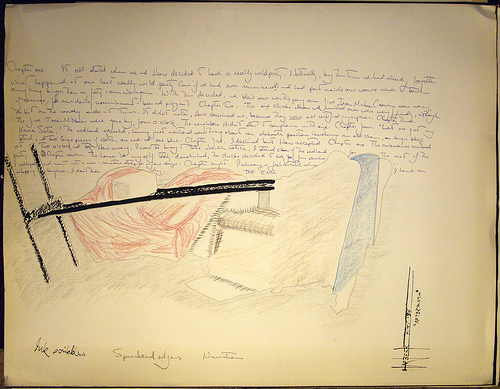
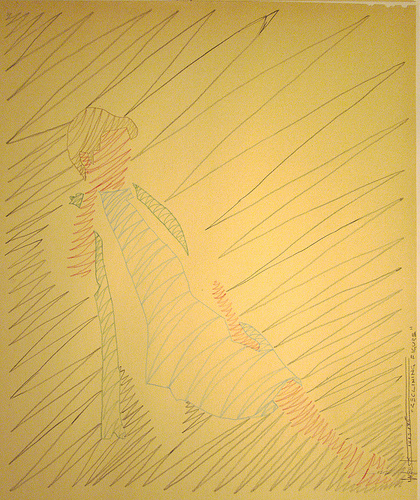
But scribbles can also be part of art. Sure, sure, you might say they’re squiggles, or strokes of some other description, but I say things that look like scribbling can be called scribbles, and Oxford agrees with me. I thought of this word when I was looking at some drawings I did for an art class back in my first year of university. I liked putting writing and scribbling into my drawings, and my writing looked like scribbling anyway. So here: art by the 16-year-old me. You be the judge. What, in your semantic ambit of ‘scribble’, is a scribble and what is not?

party
scribble_woman
scribble_man


See more, and larger sizes, at flickr.com/photos/sesquiotic/

bespoke

Among my fellow members of the Order of Logogustation, it has always been my old friend Philippe who has been the suave dresser, even back to our collegiate days when he was winning girls away from me and Maury. Apart from certain other members I won’t name right now who are known for wearing skin-tight black leather, most dress as though words are all that matter to them. Maury has a liking for bowties and jackets but manages to come across more professorial than dashing.

So eyebrows were raised to the ceiling when Maury strode in on a recent evening wearing a very sharp grey suit that somehow turned his figure from spud to stud. Even Jess and Arlene looked twice. Elisa Lively squealed lightly.

“Good gravy, old sport,” I said. “This bespeaks an unprecedented level of sartorial technique for you.”

“Or, more to the point,” Philippe said, walking up and pinching a bit of Maury’s jacket cuff between thumb and forefinger, “a new level of sartorial technique is bespoke.” Philippe tilted his head this way and that as he surveyed the seams.

“Shouldn’t that be bespoken?” Elisa asked.

“That depends on the context in which it happens to be spoken,” I said.

Bespeak uses that old English be prefix that really means ‘about’ or ‘for’ or is an intensifier,” Jess said, also surveying Maury’s attire. “For bespeak it turned an intransitive verb, speak, into a transitive. ‘Speak of, speak about, proclaim, speak for, speak in the arrangement of’. So on.”

Maury, for his part, had so far not spoken a single word. Which was also atypical.

“Right,” said Elisa, “so, speak, spoken, bespeak, bespoken. No?”

“I’ve always felt as though it should be,” I said, “but in this case it’s not.” I shrugged. “When you’re talking about tailoring, suits, and such other things as may be made to specific order and custom fitted, it is definitely bespoke.”

“Even I know that,” said Arlene, our young university student. She was leaning against a table, dressed in Marlene Dietrich pinstripes. I bet she knew.

“The word has been cut to fit,” Jess said.

“They’ve trimmed off the excess n and left it in the pile of ends,” I said.

“So, Maury,” Philippe said, “who made this for you?”

Maury held open his jacket to display a label on the pocket with some sort of little rebus.

“It’s not custom tailored?” Elisa said, leaning forward to look.

“It is,” Maury said. “They have their own label they sew on.”

Elisa scrutinized it. “Bug and bicycle tire?”

Philippe smiled wryly. “Bee. Spokes.”

“A new outfit,” Maury said. “Friends. And I, as a man of words and man of the world, happen to bee… their new spokesperson.”

“I’m sure that role suits you well,” I said.

Elisa stroked the sleeve and tweaked his pocket kerchief. “Doing anything later, handsome?”

Maury raised one eyebrow in as close to a Bond style as he could muster. “Sorry. I happen to bespoken for.”

Thanks to my mother for suggesting today’s word.

mansplaying

This is a word for an annoying thing that some guys do with their legs in crowded public seating such as on the subway or bus.

The word may not be morphologically perspicuous, so let me ’splain; once I have unfolded the source of it, it should grow some legs. It’s not to do with some man’s playing – well, it may in what it refers to, but not necessarily, and that’s not where it comes from. What this is is a pun on mainsplaining. It takes the splain and replaces it with splay. As in splay your legs wide. While seated on public transit next to people whose space you are thereby invading. And displaying the lump of your junk for all to try not to see.

I should say what mansplaining is, in case it’s unfamiliar to you: it’s when a man patronizingly explains something to a woman that the woman is actually in a better position to know about. “No, no, no,” says the smug wide old suit to the folded-arms young woman standing before him, “you really don’t understand what feminism is. Let me explain…” And so it goes. It’s an unpleasant word for an unpleasant thing.

Why an unpleasant word? Well, I find it ungainly because it doesn’t have any real pun or play to it. What it does do, though, is illustrate how the underlying parts of explain (from Latin ex plus planare) have become generally unknown and the word is treated as dividing at the syllable boundary, which happens to be right in the middle of the letter x: /ek spleɪn/. Which also goes to show that the spoken form is still the primary form, influence it though the written form may.

So anyway, we remove that splain from mansplain and replace it with splay. That’s a much better formed word, right? Hee hee. Actually, it’s exactly the same sort of thing as splain. You see, it’s a trimmed form of display. Now, we think of display as meaning ‘put on show’, but originally it meant ‘unfold, expand, unfurl’ – the same as splay still means (though splay tends to have connotations of awkwardness or ungracefulness, like a baby moose on wet ice). This is because it comes from Latin displicare, ‘unfold’ – which is also the origin of the modern Italian word for ‘explain’, spiegare. Consider the implications! (Oh, yes, implications also has the same plic ‘fold’ root.)

So anyway, these guys sit down next to you on the bus (and they’ll do this next to men as well as women) and splay their legs wide like the ungainliest ostrich, so that they’re invading and displaying, and the people next to them are scrunching their legs over so as to avoid contact as much as possible. It’s not just a transit thing, either. Aina and I went to a short outdoor folk dance performance last year where a larger older guy (I won’t call him a gentleman) sat down next to her and spread his legs about 110˚ wide, completely invading her space while he directed his attention in the other direction. I was about ready to get a nice, sharp butcher knife and joint him like a turkey.

I suspect if Aina had tried to tell him about decent public manners, he would have mansplained something to her. And in the next minute would have been on sale at the butchers’ down the block for 99¢ a pound.

I guess what I’m saying is: Don’t do it.

Californian accent? Or Canadian?

My latest article for TheWeek.com is about the similarities between the typical Californian accent and the typical Canadian one:

Why it’s difficult to tell a Canadian accent from a Californian one

For fun, Google some news or weather videos from Canadian TV stations and from Californian ones. Give them a listen, and you may be surprised just how similar they can be.