
Monthly Archives: January 2026

berm, snowbank, windrow

It snowed a fair amount over the weekend, and then the ploughs got busy producing large heaps of snow along the sides of streets, often blocking driveways and pedestrian access points. So, obviously, the question is…
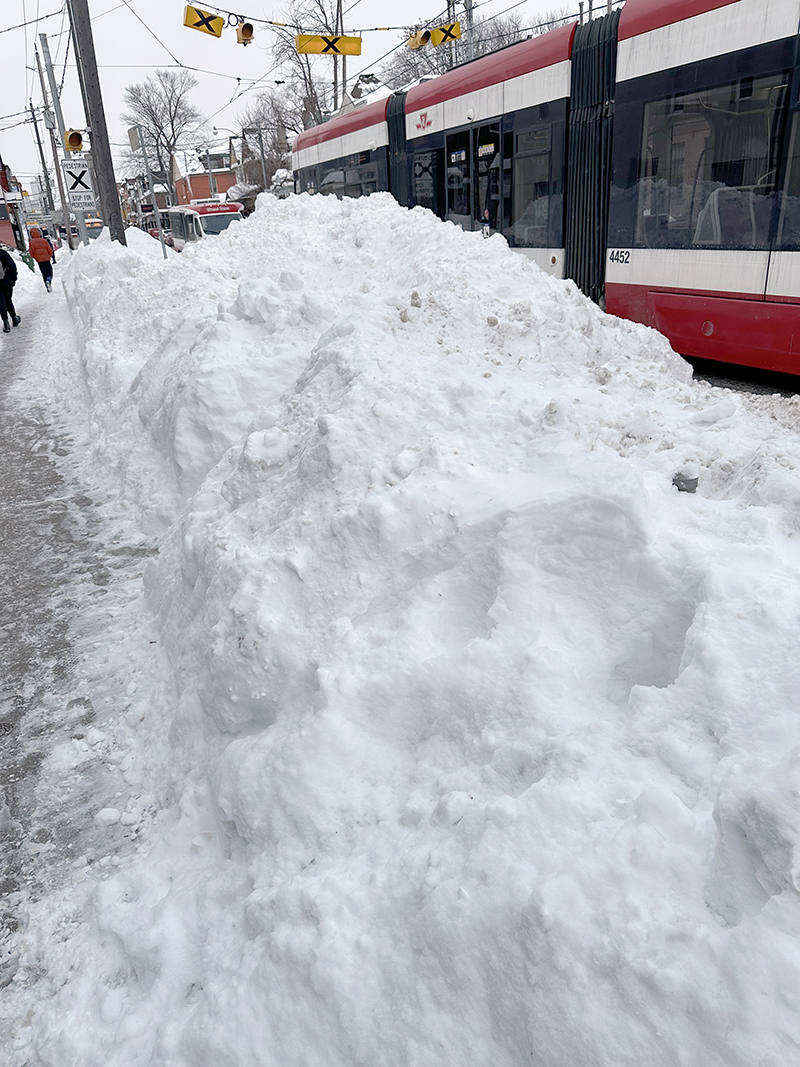
…what do you call this heap of snow?

I surveyed people on Bluesky, and for the most part they didn’t have a specific word for it. But those who did mostly called it one of three things – the same three terms I have used at various times.

The word I most often use for it is berm, though I don’t know whether that’s really common where I live or where I grew up; the Bluesky people who gave that word were from northern parts of the US. Also, I can’t find “long heap of snow left by a plough” as a definition for berm in any dictionary. Per dictionaries, a berm can be an earthen shelf at the top or bottom of a slope, or a raised bank along a canal, or a bank of earth used as a barrier, or the big pile of sand above the high tide level on a beach, or a roadside grass strip – which is what the word means in Dutch, where English got it from. Several of those things resemble these huge piles of snow, but they’re all dirt or sand. However, in snowboardcross, a berm is bank of snow at a corner – transferred from the bank of earth called the same thing in motocross and BMX. Of course the meaning can drift from dirt to snow. Why not?

The next thing I might call this niveous ridge is snowbank. But, speaking of drifts, a snowbank more usually is – as in “a drifted bank,” to quote the song “Jingle Bells.” Still, it may seem reasonable enough to call these heaps snowbanks, since, like other banks, they contain deposits that have been accumulated and saved up. Mind you, they do not get much interest, and everyone is hoping they won’t compound.

What? Oh, the other kind of bank? Like riverbank? Oh, yeah. But say, why do we have bank as in savings bank and bank as in riverbank? The answer is that they both come, ultimately, from a root meaning ‘bench’, a root that is also in fact the source of bench; one bank refers to a landform that’s like a bench, and the other refers to a money-handling business that was originally done at a bench, table, or counter. Which is a farther drift than merely going from a pile of dirt to a pile of snow.

But, to get back to that big pile of snow, there’s the third word, the thing that some Canadians – and only some Canadians – call it: windrow. Canadian cities, after snow storms, after all the ploughing, may talk about “clearing windrows” so people can get out of their driveways. So in the morning you look out your window to see if the windrow has been shoved aside or if you’ll have to shovel it yourself.

OK, but why is it called a windrow? Isn’t that a row of trees that keeps the wind off a field? Hm, that’s usually called a windbreak. Windrow is most often a word for a long heap of mown grass, hay, barley, corn, peat, or such like, that’s sitting being dried out by the wind, in some cases before being gathered into bales and in some cases before being burned. It can also (probably on the basis of conjecture from its form) be a word for loose vegetation that has been blown into long piles by the wind. And by drift from the first sense, a windrow can be any other thing that has been ploughed into long piles: dirt, gravel, or, of course, snow. Yes, there’s a wind there, even though windrows usually don’t get blown away (pity, perhaps), but that’s how things get piled together sometimes. A window is still a window even if it’s not letting wind through. And a shovel is a shovel even if you’re using it to heave snow rather than to shove it around (and yes, shovel is indeed etymologically shove plus a suffix).

Still, why windrow rather than berm or snowbank in these Canadian places? I don’t know for sure, but my suspicion is that it started with farmers, of which we have quite a few in Canada. If you’re used to calling the long heaps of hay and whatnot windrows, then calling long heaps of snow made by the same kind of process windrows seems sensible – certainly at least as sensible as calling them, say, berms.

But, again, that’s if you call them anything. Other than a nuisance or something less polite, that is.


nimious

Some people’s requirements are, in truth, nimious.

Do you know that word, nimious? It’s not in common use, but some of you are exquisitely literate.

If you don’t know it, what does it sound or look like it means? Does it have an echo of minimum? Or inimical? Or numinous? Or ominous?

It’s not well known and not easy to guess. So even though it’s not that large a word, using it casually might seem a bit much.

Which is appropriate. Because “a bit much” is one way of defining it. Another is “excessive.” And perhaps even “way over the top.” Or, as lawyers say, “vexatious.” Here’s a nice example quote from an 1861 Scottish law book, courtesy of Wiktionary:

But instead of that, they raised this prejudicial question, and upon that ensues a litigation, the most nimious I ever saw, even on the part of a corporate body, whose annals generally abound with instances of nimious procedure.

Here’s an 1883 one from the Edinburgh Evening News courtesy of the Oxford English Dictionary:

The action was ex facie so nimious and unreasonable as to excite prejudice against it.

You may note that both of those citations are from Scotland. And indeed this word had its heyday – now well past – among the legal trade in Scotland. 

But of course it came from Latin: nimius, ‘excessive, beyond measure’ – the adverbial accusative of which is nimium, ‘excessively’, which seems to my eyes to look a bit too much like minimum. And where does nimius come from? Nimis, also an adverb, also meaning ‘excessively’, from ne- ‘not’ and the Proto-Indo-European root *meh₁-. I’m tempted to say that nimis thus means ‘not meh’, but *meh₁- actually meant ‘measure’, so it means ‘beyond measure’ – in other words, ‘too much’.

Of course we have plenty of ways of expressing that already; the vocabulary of English is itself arguably nimious. But the joy of having many ways of saying the same thing is that we can set different tones and echoes. So if you want to sound as though you’re saying, in an erudite way, that someone is being an ominous ornery inimical big meanie, why not trot out this word? I don’t think it’s altogether over the top or out of hand. Unlike some people’s demands.

titivate

It’s inevitable: after the activity of the holidays (Yuletide and the others, with their themes of nativity and invitation and conviviality with oodles of vittles), in the void of winter, you will look around your living space at the various piled items and feel motivated to titivate. You know, just tidy a bit… spruce it up… satisfy an appetite for prettiness. You have a boost in your attitude. But what about your mid-winter vitality? Are you activated to undertake the titivation? Or will it be vitiated by inertia and the prophylaxis of, say, sitting and writing about it?

Speaking of which. Nice word, titivate, isn’t it? It bespeaks not just a certain activity but a certain context as well. It’s not mere tidying, not mere accessorizing; it’s touching up the finer points of prettiness or aesthetic aptitude. It’s doing les petites choses to a t. So this word, which trips on the tip of the tongue, is quite apt.

And not only in sound. For, you see, just as when titivating you may take little things and match them in new and apposite ways, with titivate the speakers of the English language picked some pretty bits and put them together. But we’re not one hundred percent sure which bits came from where – or just what inspired what.

Here’s the thing. Wiktionary gives the etymology of titivate as “A modification of the earlier spelling tidivate, perhaps based on tidy + -vate, on the pattern of words such as cultivate and renovate.” And the citations you can find in Green’s Dictionary of Slang certainly support that: the first one, from 1823, is from a dictionary that says “Tiddyvated — i.e. made tidy, or neat.” But the reality is not quite so tidy, as you will find if you have access to the Oxford English Dictionary.

Oh, the OED also speculates that its origin is “humorously < tidy adj. + ‑vate (in e.g. cultivate v. and activate v.).” But its first citation is from 1705, and it reads “He says he is shaved enough, and has his Whiskers tittivated to his content.” And its second is from 1785 and reads “I wish I could get a barber to titivate me up a little.” It’s not until an 1834 citation that we see the spelling tidivate. And we may recall that while in American English the pronunciation of titivate and tidivate would typically be indistinguishable, in most British English this is not the case. So it would seem that the derivation is a bit less tidy… or anyway those earlier citations are not timely. (And yes, that’s a pun: tidy originally meant the same as timely, just as tide’s original meaning is ‘time, season’.)

There is a titillating further suggestion in the OED: usages where the sense is evidently “excite or stimulate agreeably or pleasingly.” The influence of titillate can be seen in those – but the earliest among them is from 1833, so it’s more likely a matter of misconstrual of meaning by analogy with a similar-sounding word. There’s no suggestion that titivate started with that.

So what do we do? What can we do? Not everything can be sensibly tidied, at least not without doing damage. It is as when, in a fit of titivating, you spy a tchotchke on a shelf that doesn’t seem to fit its place. You could toss it, perhaps, but why? It’s pretty enough, and you’re kind of attached to it. So you arrange things around it and leave it as it is, and tell your friends, “Not sure where we got that, but it ties the room together.”

disclass, sunglass, windlass, cutlass

You’re sailing past the Hebrides when you unexpectedly hear music from a rocky islet. You look to the source and see several lasses on the shore. One is a deejay. Another one is singing. Next to them is one standing in the breeze, beckoning, ready to… throw you a rope to reel you in, perhaps? It all seems so inviting. But behind the others you see a short-haired, muscular one who appears, maybe, to have a knife of some kind…

Sail away! Do not give in to temptation! You have just encountered the Scottish sirens: the disc lass on the turntables, the sung lass who has sung for you, the wind lass who is ready to see you blown in – or wound in – and the cut lass, who will… need I say?

But let us say you let fascination get the better of you. You close the gap, and then you see that you are sailing not to a disc lass; you are sailing to disclass… to disclass them all, starting with disclass. For this is no lass with discs; it’s not a member of the class of persons at all – it’s a verb, meaning ‘remove from a class’ or ‘declassify’. (It’s been in English since the mid-1800s, but both parts of the word trace back to Latin – though class came by way of French.)

And, having closed the gap and disclassed, you now see not a sung lass but a sunglass. Sunglasses have travelled in pairs since the early 1800s, but from shortly before that, a singular sunglass has been a filter fitted to a telescope to reduce the sun’s intensity. But since the late 1500s, a sunglass has also been something quite opposite: a magnifying glass used to focus the sun’s rays to start fires. You are about to get burned. (Sun and glass, by the way, have come down to us from Old English.)

The wind lass is, you now see, a windlass, which is a kind of winch for pulling in (or letting out) ropes or chains. The source of the word, which first showed up circa 1300, is windas, which derives from the verb wind; the l just got wound in somehow, perhaps under the influence of windle, an old noun for a thing that winds rather like spindle is a noun for a thing that spins. You might think therefore that this should be pronounced with “long i” like the verb wind rather than with “short i” like the noun, but the I ended up short, and since the a is reduced, it is properly said like “windless.” The lass is gone with the wind.

And of course the cut lass is a cutlass – which also, properly, has a reduced a so that it sounds like “cutless” (which it is not). This word came, circa 1600, from French coutelas, which was formed from coutel – the source of couteau, ‘knife’ – and the suffix -as, also spelled -ace and related to others such as Italian -accio: basically, it can mean ‘big’ or it can mean ‘nasty’ or it can mean ‘big nasty’, as the cutlass is a big nasty knife (really a short sword), usually with a curved blade. Since coutelas comes from Latin cultellus, it has no known relation to cut. So both the lass and the cut are cut out – but the blade awaits you.

And now at last you are on the rocks, misled, come to a bad ending. A lass, a lack!
