Category Archives: word tasting notes

draconian

Some people’s attitudes towards minor transgressions of grammar, spelling, punctuation, or similar niceties can be a bit drastic. Dramatic. One might even say… draconian. Prescribing cruel punishments for misplaced apostrophes. Breathing fire on those who would use a word inappropriately.

Such as using a word that’s a legal allusion for non-legal matters, perhaps?

I may be reaching a bit here, but I can’t help but think that the “decimated means reduced by ten percent, you vulgar barbarian” crowd might feel that since draconian originates in a particularly severe legal code – one that prescribed the death penalty even for some kinds of theft, and enslavement for failing to pay debts to one’s social superiors – the broader use of draconian, as in (to cite a few common examples) “draconian security measures,” “draconian environmental measures,” “draconian austerity measures,” “draconian spending cuts,” and “draconian budgetary policies” might be worthy of censure. Or whips, chains, forced servitude, gruesome death, that manner of thing.*

To be sure, draconian is still used in the strictly legal sense too. I’m editing a book on the Qin Empire in China, which was spectacularly expansive and spectacularly short-lived (221–206 BC), and the author has much to say about its “draconian principle” in law, whereby if a judge had several options for punishing a misdeed, the most severe was always to be chosen. Not only that, if a judge was more lenient, he could himself be subject to the punishment he was supposed to have given.

Great way to preserve social order, eh? As long as people are afraid of punishment, they’ll be good. 

Well, either that, or they’ll lie a lot. All the time. 

In the Qin Empire, couriers for priority government communications could be fined severely for being even a little late, so they often faked arrival records. But never mind that – breach of filial piety (e.g., being rude to your parents) could be punishable by death, and the onus was on the parents, as the offended parties, to report the transgression. You can see that many parents might decide to let a bit of youthful insolence be dealt with at home rather than see their child (however nasty) be executed. Oh, but if someone found out that a child had breached filial piety and the parents had not reported it, the parents would be punished! Not by death, but severely nonetheless. 

So if you wanted a decent kind of social order where impulsive progeny were not regularly slaughtered wholesale, it relied on a whole web of deception, the weak point of which was anyone who was too inhuman, too intimidated by authority, or both.

But while those who lack mercy may be rewarded with fear, they get little respect, and people will take opportunities to displace them. Cruelty eventually has to eat what it has planted. Which was one factor in the demise of the Qin Empire (not the only one, mind you; when you expand your empire too quickly, you tend to lack the resources and logistics to sustain its periphery; to make up for a lack of public servants in the peripheries, the Qin commuted many penal sentences to forced servitude in government postings in remote locations, which turned out about as well as you may guess).

So now think of the more draconian prescriptivists of English. The teachers who brook no “barbarisms.” The authors of rigid and intolerant guides to English, people who gleefully enfranchise frank rudeness in social contexts (unsolicited corrections of others’ speech) and even vandalism (“correcting” public signage). Sure, people carry corrections in the backs of their heads, and may even be “on their best behaviour” linguistically when there is any threat of censure, but no one enjoys this except the people issuing the corrections – and, if we can be honest, they don’t seem happy about it either. The most gleeful and joyous use of the language is often in the infractions! And nuts to the old dragons.

Speaking of which. Draconian can be defined as ‘of, like, or resembling a dragon’. So is this term related to the laws lain down by dragons of lore, cruel and inflexible and breathing fire? No – the use we make of it is based not on a dragon but on a person named after one: the Athenian lawmaker named Drákōn Δράκων, rendered in Latin as Draco. He was the one who, around 600 BC, set down the Athenian legal code, the one I spoke of up in my third paragraph, which could have you killed for filching a cabbage.

Well, I speak of Draco as a person in good faith, but the lore may be in bad faith; it’s possible he was a mythical creation, a fictitious person to whom was attributed the works of unknown real persons. At any rate, though, his name was a proper noun, and so draconian is an eponym. And, for those who wish to be fussy, the distinction between ‘dragon-like’ and ‘harsh in punishment’ is a distinction between draconian and Draconian.

Indeed, if you look at the Oxford English Dictionary (entry last updated 1897), the entry is capitalized: Draconian. But also, the OED doesn’t include the ‘dragon-like’ definition with that entry. On the other hand, it also doesn’t include the more common definition, either. Its definition of Draconian is simply “= Draconic adj. 1, 2.”

Yes, in the view of the OED, the preferred adjective is not draconian or Draconian but Draconic (or, I suppose, for the ‘dragon-like’ sense, draconic, though they don’t say so). Never mind that their own usage charts show draconian being used orders of magnitude more often than draconic; those charts have been updated recently, while the definitions have not.

But if you are the sort of person for whom “the old ways are the best ways,” you may well prefer to go with 1897. Or perhaps even 600 BC or 221 BC. But before you get too Draconic in your prescriptions and penalties, take note that Draco’s laws were repealed not long after his death – and those of the Qin Empire were also softened by the Han dynasty that replaced it. When punishment is not so much the means as the end, those who are mean will soon enough meet their ends.

* I once had someone say “I hope you die a horrible death” to me for my article suggesting we would be better off without apostrophes. I know that they were deliberately overstating the matter, but still…

demur

I was going to taste a different word, but I couldn’t find a way not to make it distractingly political (O tempora! O mores!). I have a longstanding moratorium on politics here, so I am demurring. That’s not to say I won’t get to it, but, when topics political come up, no matter how consequential they are, sooner or later one must give it a rest.

Which is what demurring is. We may think of “I demur” in Bartleby-the-Scrivener terms, “I prefer not to” meaning “not between now and the end of time,” but the point is it’s not a stop; it’s a delay, however indefinite. It’s for something you don’t deem urgent. Perhaps you’re being coy – may we say demure? – and it’s just a decoy. The matter at hand may yet find its redeemer. But probably not. Demur may be (to quote one definition) “to make scruples,” but sometimes it is done unscrupulously. It may be to let the subject mature – to the point of senescence or even obsolescence – but it may be to leave it in the mortuary. Which would be, as they say, a rum thing.

There’s little question of what demur meant in earlier times. It comes from the same origin as French demeurer, which means ‘remain, stay, stop, persist’. That origin is Latin demorari, which – pun notwithstanding – has nothing to do with Demerara (which comes from an Arawak name for a tree). But, like Demerara rum, it has to do with an alternative to stress: the heart of demorari is mora, which means ‘delay’ or ‘wait’ or ‘duration of time’ and has come into English as a unit of phonological weight, an alternative to the syllable. 

In English, we measure our words in syllables, and each word of more than one syllable has a stressed syllable. In a language such as Japanese, however, there are not syllables but morae, and there is not stress but pitch accent. It’s all sounds, of course, but it comes down to how you think about it (just like stress). The simple 5+7+5 addition of a haiku is made for morae – like in this one by Kobayashi Issa:

hatsu uri wo 
hittoramaete 
neta ko kana

Notice that hittoramaete is seven morae: hit-t-to-ra-ma-e-te. When you impose the haiku form on the bump and jump of syllables, as in this English translation of the above, it’s always a bit less or more, eh:

the first ripe melon
holding tightly close to her
my child rests asleep

This mora shows up elsewhere in our language, too: in moratorium. That may sound like a mortuary, but it’s not related. Demure is also not related; it’s from the same root as mature, and as the French word for ‘ripe’, mûr or mûre. French for ‘blackberry’ is also mûre, but the two are not related, even if the blackberries are ripe; the blackberry mûre is from Greek μόρον móron, which is not related to English moron, which is from μωρός mōrós (note the longer ω: in Classical Greek prosody, it has two morae, whereas ο has one), which is not related to morose, which is related to mores, as in  morals, those things that forbid murder, which is related only distantly (through Proto-Indo-European) to mortal and to mortuary – a place where mortal remains demur indefinitely.

What? You murmur “no more”? Then I’ll let it rest.

skulduggery

Skulduggery! What kind of clandestine outrage is that? Is it some fiddling, diddling, or jiggery-pokery? We know it’s not pleasant, that’s for sure.

Or… well, what do you find pleasant? Certainly not digging skulls by moonlight in graveyards. But how about some other “underhanded or unscrupulous behavior”? Or what about “shockingly gross or lewd conduct”?

Don’t look shady at me. Those are just definitions from Merriam-Webster. Here, though, let’s switch to Oxford. Do you like “underhand dealing, roguish intrigue or machination, trickery”? Not so many admit to enjoying engaging in it, but rather more like to read about it – and it never fails to fill movie theatre seats. OK, and how about “breach of chastity”? Or “obscenity”? I know that many of you are at least secretly charmed by such things.

But wait. I’m playing a trick here. My subterfuge is that the more lusty among those definitions are not for skulduggery itself but for the word it evolved from: sculduddery.

Sculduddery, we discover, got its destiny from the clans: it’s an old Scottish word, spelt variously, including sculdudrie, which is how it can be seen in a 1714 play by Susanna Centlivre with the provocative title The Wonder: A Woman Keeps a Secret!!!

Well, the secret’s out now… except for the secret of where the heck sculduddery originally came from. Not from skull, that’s for sure, for what have skulls to do with lewdness? (Please don’t answer that. You know what I mean.) From scullery-maids? I mean, probably not, but even if that were so, what would duddery mean? Something to do with duds, i.e., clothing or rags? We can only speculate, and I wouldn’t want to reach too far on something like this, because, as every linguist learns, etymology by sound is not sound etymology, and sculduddery has left no trail of evidence behind.

Which, admittedly, is a thing skulduggery aims for. But, now, by what skilled diddly did sculduddery become skulduggery? Well, skulduggery shows up first in the mid-1800s, and first in the US, and first spelled scull-duggery, and first referring to political and financial trickery and intrigues. We don’t know for absolute certain that it traces to sculduddery, but the trail from shady conduct of one kind to shady conduct of another is not long, and neither is the trail from duddery to duggery, especially when we consider the influence of other English words that go to the /g/ in the middle rather than staying at the tip of the tongue. It just feels a bit more right (and a bit more shady) to dig in further.

And then, of course, the scul or scull is easily reinterpreted as skull, especially given the associations of skulls with piracy, graveyards, and so on. It’s true that etymology by sound is not sound etymology, but the average speaker does not carry that in mind; common uses of words are often quite strongly influenced by what other words they sound like. That’s how outrage has gained an air of rage out even though it’s unrelated (it’s from the French noun form of outré, which means ‘excessive’ or ‘beyond propriety’ and traces to Latin ultra). And so the shady conduct of sculduddery, shifted to the different shady conduct of scull-duggery, gained yet another kind of shade at the sign of the skull.

Which is not to say that there is always a literal boneyard in mind with the term. I checked for collocations, and political implications remain quite frequent – for instance, if a candidate starts out promising one thing and then sneakily ends up standing for something very different. I was surprised, however, to see that the word most commonly seen with skulduggery in the Corpus of Contemporary American English was pleasant

Hmm… so is skulduggery really so charming? Or is it returning to its more sexual senses? Some of you already know the answer: Skulduggery Pleasant is the title character of a series of dark fantasy novels by Derek Landy. They are, I’m told, quite popular. And what sort of person is Skulduggery Pleasant? A 400-year-old murder victim brought back to life as a living skeleton.

And it seems there’s no lewdness or bawdiness in the books at all. What a sneaky transformation!

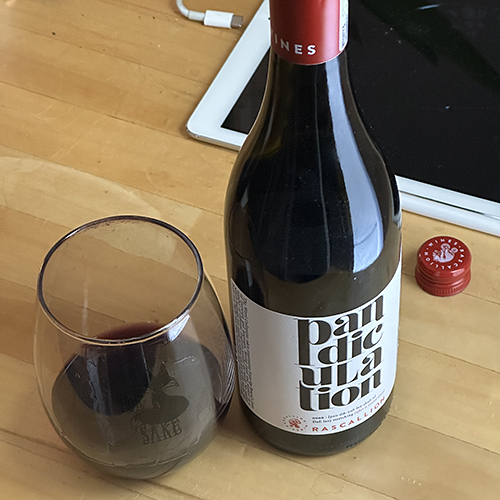
pandiculation

Ah, to wake as a cat might: purr, pandiculate, approach the perpendicular, expand, open the Pandora’s box of the day.

Is there one word in there that’s a bit of a stretch? If so, it would be pandiculate. I don’t mean to say that it’s beyond your reach lexically; it’s just that pandiculation is literally a bit of a stretch. It’s the fancy word for that yawning stretch you do first thing in the morning (or, depending, at various other times, I suppose). You do not need to gesticulate when you pandiculate, but I won’t tell you not to.

There is a connection between pandiculation and gesticulation; it’s the same piece as you see in vermiculation and articulation and a few others; it’s also related to the -cule in molecule and minuscule and ridicule, among others. It just means, more or less, ‘little’; that is, it’s a diminutive. 

So pandiculation is a little something. A little what? Let me expand a little on this: pandiculate (and pandiculation) comes from Latin pandiculor, which means ‘stretch oneself’; you can still see the diminutive in there, which, when removed, takes us back to pando, which means ‘I spread, I stretch, I extend’ – or, yes, ‘I expand’, and yes, that’s the same pand. So pandiculor is ‘I expand a little’.

But just a little. We don’t want to pass out. Which, oh, yeah: pass, the verb, comes from Latin passus, ‘(a) step’, which is the past participle of – yes – pando. Meanwhile, Pandora is unrelated (the name comes from Greek for ‘all gifts’), and so is panda (which probably comes from Nepali or Tibetan).

But waking up lazily, like a panda or a cat, is a gift. Might as well stretch it out while you can. And then, if it’s a weekend day off, you can later on have a glass of wine. I’ve found just the bottle for you, from South Africa:

vertex, vortex

I like watching the kind of extreme skiing videos where a pair or trio of skilled extraverts in Gore-Tex scale exceptionally steep peaks and then, at the top, on the knife-edge of a ridge, don skis and revert: they slide scenically all the way back down, accelerating, linking turns, cavorting.

I could not do this. I would not scale such a vertical. I would not stand at its vertiginous apex. If I were, somehow, inadvertently, to find myself at the vertex, unable to divert, vertigo would overtake me. My eyes would pop wide open, from e to o; my world would become a vortex, and I would be whorled down the vortical, every turn for the worse…

Vortex and vertex: two words so similar, and yet. Like horse and hearse, perhaps, or person and parson.

In fact, quite like the latter. Because, you see, like person and parson, vertex and vortex started as two versions of the same word. But unlike person and parson, these two -texes didn’t split apart in English. Rather, vortex is archaic Latin for vertex, which is Latin for ‘summit, highest point, top, whirlwind, whirlpool’.

How does one word mean both ‘summit, apex, rocky peak of land’ and ‘eddy, whirlpool, spinning hole in the sea’? I turn to my Latin dictionary and there I find the source: verto, ‘I turn’. A whirlwind or whirlpool turns, of course. But also, a line turns at a corner, and the ground turns at a peak – it stops going up and starts going back down.

We have many vert- words in English, all having something to do with turning, in one way or another. An extravert (now often rendered extrovert by analogy with introvert) is someone who is turned outward. The vertical is that which is turned perpendicular to the horizon. Something that’s vertiginous induces vertigo, which is a sensation of the world turning around you. And so on. And many of these words came up the natural route of daily use via French into English: convert, divert, version

But vertex and vortex came the other way: someone in English or French wanted a proper term for a thing, and so they turned to the Latin lexicon. Geometers in the 1500s wanted a learnèd term for the peak of a cone or the corner of a polygon, and of course vertex is what such things were called in Latin. But cosmologists in the 1600s, such as Descartes, wanted a term to name the whirling of matter around a central axis, a thing they observed in the stars (Newton’s Principia propounding gravity was still a few decades in the future), and this archaic Latin word vortex served the turn – and then, over time, was converted into a word for such eddies as we see in the sea and sky around us.

And now, somehow, pretty much everyone knows vortex, and it shows up in occasional daily use even among non-nerds, but only mathematicians and similar sorts speak of vertices.

Which, oh, by the way: the plural. Your math teacher will always have said vertices. English being as it is, vertexes is an established alternative, but, English speakers being as they are, it is looked down on. And the plural of vortex? The same obtains. In truth, I’ve long thought that vortexes is common enough, but a Google Ngram tells me that vortices is much the preferred version. 

But, as you will see if you look at the ngram, while vertices appear in the plural nearly as often as a singular vertex, most of the time there is only one vortex. If you have cause to speak of vortices, it may be a very bad day, and one you might not slide out of too easily.

swidden

I was editing a book, and I saw a word I didn’t recognize: swidden.

MS Word recognized it. It had no red underline. 

I looked it up. It turns out to be a word for a field that has been cleared for agricultural production by cutting the existing natural vegetation, letting it dry in place, and burning it in place. 

As I looked at it, I saw a word that presents as having a long English pedigree – a word like midden, which we hardly use anymore (unless we are archaeologists or zoologists) but that has been in the language for most of a millennium, or like hidden, which is still seen often. Somehow this old word swidden was peeking up from the ashes of underbrush, and being used as if it had always been common.

As it turns out, sometimes you just need to let a word rest for a while – a few centuries, in this case – and though its usefulness had been depleted, it now has fertile ground again. Here is what Wiktionary revealed to me: a quote from Guido Sprenger’s “Out of the Ashes: Swidden Cultivation in Highland Laos,” in Anthropology Today 22, no. 4 (August 2006), page 9:

It’s not that Karl Gustav Izikowitz (1903–1985) invented swidden. When the Swedish anthropologist did fieldwork in northern Laos, he focused mainly on economic issues. In his view, the Rmeet . . . had a particularly ancient type of agriculture, characterized by the burning of a plot in the forest each year and allowing fallow periods of 10–15 years for the soil to recover. After his return to Sweden in 1938, Izikowitz recalled a similar technique practised in his home country, called svedja, meaning ‘to burn a field’ (as verb) or ‘burnt field’ (as noun). With the help of Professor Eilert Ekwall, he located an old dialectal word in English for it: swidden.

This swidden is from Middle English swithen (‘burn, scorch, singe’), from Old Norse svíða (‘singe, burn’). So it means, basically, ‘burning’. The key to this form of agriculture is that land that may not have enough nutrients in it to support the crops can have the nutrients added from the ashes of the burnt vegetation. To make a swidden, you don’t simply cut one day, burn the next, and plant the day after; you cut, let it all sit during the rainy season and then dry out in the dry season, then burn it, and the next wet season the field is ready and fertile. 

You can use such a field for a few years, but then you have to let it lie fallow for several years while it regrows the wild vegetation. This means that swidden farming uses a lot of land over time, and is not suitable for cash crops or for any area with too dense a population. But it’s quite sustainable for certain kinds of subsistence farming populations; the land is allowed to regenerate, after all. And since it is used for subsistence farming rather than cash crops, it typically involves a diversity of crops rather than a monoculture.

Why dig up an old word? Well, it comes with a certain feeling of antiquity and staying power, but it also comes without some of the associations and implications other terms might have. There is, in fact, a common term for the kind of agriculture that uses swiddens: slash and burn. Tell me how that sounds to you.

We know what slash and burn is, don’t we? Here’s Wiktionary’s definition: “Rough, coarse and lacking finesse, performed with little skill.” Slash is a violent, bloody, uncontrolled word; burn has more negative than positive tone. If someone says “slash-and-burn agriculture,” you probably think of it as merely destructive and unsustainable, callous, bad for the environment. Slash one day, burn the next. Grab what you can and to hell with the world.

Which, if done in a massive and short-sighted way, slash and burn can be. But it doesn’t have to be bad. And it can be difficult to have a clear-sighted discussion of a subject when the name used is overgrown with negative associations. You could invent a new word, yes, although new words tend to be formed from existing ones anyway, and if they aren’t then they’re rootless and may not survive. But you could also put in the sweat equity to uncover a hidden but suitable old word, like swidden, and perhaps it may be fertile, at least for a few seasons.

quagmire

For peat’s sake, give us a fair shake. We know the topic is mired in uncertainty; we know there’s question of how it can hold water; but this is a matter of centuries of accumulated understanding. Let’s not get bogged up.

“Bogged down”? Well, yes, I can see why you’d say that, but let me give you a fresh perspective: a bog is up.

Perhaps I am swamping you here; let’s back out and dry off, and I’ll be back to bogs in a moment. Today’s word is quagmire, but I don’t mean to emulate one (not this time). 

You probably know quagmire more in a figurative sense (unless you’re a huge fan of Family Guy, in which case you know it first as the name of a character on that show, but since that particular character is creepier and slimier than a dank fen at midnight, I’ll leave him behind). If you read the news, you are likely to know it for its application to intractable military excursions, notably in Vietnam and Afghanistan – two countries in which (ironically) there are few literal quagmires (in Afghanistan, there appear to be none at all). You will also see quagmire with words such as bureaucratic, legal, and political. It can also be used for matters more personal, as in Robert Creeley’s poem “The Door”:

Lady, do not banish me
for digressions. My nature
is a quagmire of unresolved
confessions. Lady, I follow.

What, precisely, is a quagmire? A sticky muck? Is the “qu” the sound of a foot losing its boot? When you know the true answer, the ground will tremble.

Probably. Well, we’re not sure entirely, but quag (a word beloved of many Scrabble players) may be related to quake. And in any event, what distinguishes a quagmire from any other mire (about which mire, I mean more, to come below) is that below the plant-matter surface is liquid (water and other things), below which lies even more muck. If you step a foot on a quagmire, it will shake and quake; if you put your weight then on that foot, you may well sink into it, and then you will get bogged down indeed.

Oh, yes. Let’s get back to the downness and upness of bogs. You see, while we use words such as bog and fen and swamp and marsh and (for the Brontë sort) moor in a general and rather soft and squishy and shaky way, knowing generally what we have in mind but not willing to put any weight on the understanding, biologists have (as they sometimes do) given the terms more precise definitions. And the first thing to know is: a fen is down, a bog is up.

OK, that’s a bit simplistic, but only barely. Both fen and bog are kinds of mire; a mire is a wet peatland, and peat, as you may know, is partially decomposed plant matter, accumulated over centuries (growing at an average rate of a millimetre a year), typically largely composed of moss, with an assortment of biochemical characteristics, such as an ability to preserve corpses for millennia (bones not included). But whereas a fen is situated in a place such that its wetness can be fed and sustained by groundwater, a bog has accumulated so much peat that it has risen above its surrounds, and its wetness is fed and sustained entirely by rain (and, in places such as Sweden, which is approximately 14% peatland, sometimes snow).

Another distinction that you may enjoy bringing forth at parties is: a swamp has its branches, a marsh has its roots. This, too, is simplistic, but the point is that a swamp is characterized by tall vegetation such as trees and papyrus, and may or may not have peat, whereas a marsh is a kind of wetland that has plants rooted in mineral soil, and so is not a peatland.

And where in all this is the quagmire? A quagmire is, as said, a floating mire, one that makes waves like a waterbed (speaking of unresolved confessions). If it is a bog, it is called a quaking bog; if it is a fen, it is a quagfen.

But why stop there? Never mind the unresolved confessions (yes, never mind them, I say; they will only suck you in); let us look at the unresolved etymologies, the endless accumulation of lexical sphagnum, the words that came from somewhere organically and now decay on the sacred papyrus of the dictionary. There are, once you test the surface, some other synonyms for the bog-standard quagmire. There is – I owe this to Oxford – quallmire, and quamire, and quavemire, and quawmire; in later levels, there is quabmire, and quadmire, and quakemire; there is even bog-mire and gog-mire. Mires they are one and all, but as to what kind of quagulation, or quallity, or quaveform, well, it boots little to attempt to discover. If you try to put any weight on your under-standing, in fact, your boot will be gone for good. Don’t try to rescue it, unless you want to be a museum piece circa AD 4024.

So. Does all of that clear up questions? Do you feel more rooted, or are you swamped and unmoored? Some of it is new, yes, but, like all lexis, it joins the sodden mass of language floating on the water of culture. So you can let it sink in. Or vice versa.

facetious

Some people have fun embellishing the truth: they start with facts, but they take A and expand it to AEIOU. It’s all in good humour, though – if challenged, these sparkling wits will insist they’re just being facetious.

The ability to jest is an important facet of a sparkling personality. But somehow, “being facetious” is never thought of as the diamond of humour. Indeed, misplaced facetiousness sometimes ignites tempers, and it can get more than a bit hairy. Someone might become tious.

That means they’d lose face. Get it? Aw, come on.

I owe you an etymological explanation here. Is facetious related to facet? It may be. But it doesn’t mean that a person who is being facetious is being two-faced (or multi-faced) like a cut gem. Although facetious now mainly means ‘treating a serious matter in a flippant way’, which is not always appreciated, it first meant simply ‘jocular, jovial, witty’ – and before that, ‘having manners that are elegant, agreeable, and polished’.

Which is not to say that the connection to facet is ‘polished’. Facetious comes (by way of French) from Latin facetia ‘wit, humour’, from facetus ‘witty, jocose’, which comes from a Proto-Indo-European root meaning ‘shine’. But the connection to facet isn’t from ‘shine’ either.

In fact, our word facet comes from French facette, which is the diminutive of face – yes, it means ‘little face’. The relation between facetious and facet is via face… if facetious is related to face. Which it may be.

Face comes from Latin facies. And facies may come from a Proto-Indo-European root meaning ‘impose, set, place’, or it may come from facere ‘make’ (which is also the root of fact), or – here’s the possible connection – it may come from the same root as facetus (see above) and fax.

Fax? I’m not being funny. The Latin word fax, which is from the same source as facetus, means ‘torch’ or ‘fireball’ or ‘incitement’. Obviously it’s not related to the English word fax. Which means ‘hair’.

I’m still not jesting! Although today the only fax we know and use is a clipping of facsimile, in Old English the word for ‘the hair of the head’ was feax, and that, with ease (and without Es), became fax in Middle English and Early Modern English… and then fell out of usage by around the time of Shakespeare. We do still see it in names such as Fairfax and (perhaps, but perhaps not) Halifax. But that’s irrelevant. Sorry.

So… does the message come through? Facetious comes from facetus, which may be related to facet but only by way of face (and maybe not that), and it’s also related to fax but only the fax that means ‘torch’ and not the fax that means ‘hair’ or the more recent ‘facsimile’. And so, starting with facetious, once I’ve paid out the IOU and left behind the E, we end up with just the facts.

myrrh

After I was so frank about the last word, some of you were incensed and started to myrrhmyrrh. “Gold-durn it,” you said, “where’s the third one?” The magi famously brought gold, frankincense, and myrrh to the infant Jesus, after all. I was going to demurrh, and pretended the cat had got my tongue (myrrhowr?), but it got so bitter, I was worrhied I might get myrrhdered. So here we go.

The first question is: Why myrrh? The justification of these three gifts – gold, frankincense, and myrrh – rather than something more practical for a newborn (like, uh, a drum solo, I guess, or, you know, diapers and so on) – has typically been on the basis of symbolism: gold for royalty, frankincense for holiness, and myrrh to symbolize… death.

Well, yikes. Super nice gift for a baby, eh. Wise men indeed. Wise women would have brought some skin lotion and talcum powder.

But the Bible doesn’t actually say that’s why myrrh. The Bible doesn’t say why myrrh at all, because whoever wrote the Gospel of Matthew (the book that mentions the gifts) figured everyone would know what kinds of gifts they were. Like, if someone showed up at a baby shower today and gave a Rolex, maybe later commentators would say “That’s symbolic of the passage of time” but people present at the shower would say “Who’s the wise guy who gave the watch?” They would know it’s a flagrant luxury gift appropriate for an adult male at a significant life juncture and, frankly, weirdly overpriced and under-useful for an infant.

Which, however, myrrh actually wasn’t. Well, not the under-useful part, anyway. Because myrrh wasn’t used just for burial. It was used for anointing, and for burning as incense, and to help treat aches and pains, fevers, infections, coughs… Have a look at “Frankincense and myrrh as remedies in children,” by C.A. Michie and E. Cooper, from the Journal of the Royal Society of Medicine, October 1991. Yes, frankincense was also used medicinally, but myrrh even more so – and still is by some people.

And like frankincense, myrrh is the resin of a tree that grows in the area of the horn of Africa (myrrh is genus Commiphora, while frankincense is Boswellia; both are members of the family Burseraceae). International trade routes were well established at the time for these and other much-prized goods from the area. Frankincense and myrrh were luxury gifts of the kind you might very well give a royal infant – or royal adult – without getting suspicious murmurs. (And gold, of course, was always good: cash is king.)

Myrrh does have some narrative value as well. In the Gospel of Mark, when Jesus is on the cross, he’s offered wine mixed with myrrh (in Matthew, it’s not myrrh but gall). In the Gospel of John, his body is wrapped with myrrh and aloes for burial. If you merged the four gospels, you could make some nice narrative connection and foreshadowing with it. But as it is, you at least get a wider view of its cultural roles. It’s not quite like bringing white lilies to a christening, but it’s sort of like if a baby shower had a lovely spread of cold-cut sandwiches for the guests – it’s not that that’s only for funerals, but funerals are one place you’ll get it.

And myrrh is, famously, bitter. Frankincense has a pleasant sweet smell, relatively; myrrh has a more earthy bitterness. Which is why it’s called myrrh. English got the word from Latin myrrha, which got it from Greek μύρρα, which came from a Semitic root meaning ‘bitter’ that also shows up in Arabic and Hebrew words meaning ‘bitterness’. In Greek, the vowel was originally like German ü, and later unrounded like i; the rolled r sound was held long and had “rough breathing” added, which is to say an [h] sound after it. So the Greek pronunciation is a bit like a distinguished-sounding English magician saying “mirror” with a flourish – more fit for magi to say to royalty, as opposed to our modern “mrr” for a mere Mr., or for the cat that may look on a king.

frankincense

Wise guys like this – it’s so frank, it’s censered!

Happy Epiphany! Twelve days after Christmas, and it’s time for the three kings (wise men, magi, whatever) to show up. It’s been nearly two weeks since Jesus was laid in a manger (that’s an animal feed trough, in case you didn’t know), and the Bible doesn’t say he was still in there, but it doesn’t say he wasn’t. Here’s what it says (King James Version):

And when they were come into the house, they saw the young child with Mary his mother, and fell down, and worshipped him: and when they had opened their treasures, they presented unto him gifts; gold, and frankincense and myrrh.

Odds are good that if you know the word frankincense, you know it from that passage. You’ll see the incense in there and you’ll have an idea that it’s incense, and you’ll be right, but you may otherwise think it’s something completely outside of your experience. But if you belong to certain varieties of Christianity, it’s not. Frankly, if you smelled it, you’d immediately get a familiar sense from it.

What is it? Here’s the definition from the 1755 dictionary by that deity of lexicography, the good Doctor Samuel Johnson:

Frankincense is a dry resinous substance in pieces or drops, of a pale yellowish white colour; a strong smell, but not disagreeable, and a bitter, acrid, and resinous taste. It is very inflammable. The earliest histories inform us, that frankincense was used among the sacred rites and sacrifices, as it still continues to be in many different parts of the world. As well however as the world has at all times been acquainted with the drug itself, we are still uncertain as to the place whence frankincense is brought, and much more so as to the tree which produces it. It is commended against disorders in the head and breast, and against diarrhœas and dysenteries.

That definition is the Doctor’s frankincense, but what you inhale clouds of at the cathedral is frankincense’s monster: frankincense is what makes the smoke the billows from the censer at the high services in the Anglican and Catholic churches (and no doubt some others too). If you go to a service for Epiphany, or to a midnight mass for Christmas, or any other similar formal rite for the kinds of Christians who like to take their chants, you will have smelled it. It’s the resin for the season – and for many other seasons.

That’s not just cheap puns (that too, though); the point is that frankincense is produced from a resin from a tree. And it has been highly valued over the centuries and millennia, not just for its ritual value, not just for its purported purifying properties, but also for its use as a holy offering: apparently deities (or The Deity) will always be pleased to see this purified tree sap presented to them. (If they were Canadian deities, I think they might prefer another tree sap product, also highly valued: maple syrup. But as it stands, such an offering would have to be syruptitious.)

But Johnson says that “we are still uncertain as to the place whence frankincense is brought, and much more so as to the tree which produces it.” Well, that “we” carries a lot of assumptions. Obviously someone knew.

And in fact if Johnson had put his mind to the Latin name of the resin in question – or, better, its name in Greek, which was the lingua franca of the Levant at the time of the Epiphany – he would have had some suspicion of its origin. It wouldn’t have been an accurate suspicion, but it would have been better than nothing. You see, the Latin for frankincense is olibanum, and the Greek is λίβανος. The Greek word means ‘Lebanon’ and the Latin is a condensed version of ‘oil from Lebanon’. It’s not that frankincense comes from Lebanon, but it came by way of Lebanon, from southern Arabia and from the horn of Africa.

So why is it called frankincense in English? That comes from the French franc encens. As you may suspect, encens is incense. And franc? Well… the word starts with a Germanic people, the Franks, who happened to have power, prestige, and priority in the right time and the right place to have a whole country (France) and language (French) named after them, even though the country was (at the time) full of Celts and the language was descended from Latin. The word gets around so much, it even shows up in toponyms such as Frankenstein (‘Frankish stone’).

But no one thought that the incense came from France. The Franks had such good marketing, franc also came to mean ‘free’, ‘noble’, ‘brave’, and ‘honest’. When you say “to be frank,” that’s the same frank. Not that frankincense is ‘honest incense’, though; it’s (probably) ‘noble incense’.

OK, but what tree does the resin come from? It comes from several species of tree, all of the genus Boswellia. Johnson couldn’t have known this, as the genus was first named in 1807. But does the name seem familiar? It’s named in honour of the Scottish botanist John Boswell. He was – as it happens – the uncle of James Boswell… who was, famously, the friend and biographer of Samuel Johnson.

Surprised? Well, you couldn’t be expected to have known this. It’s been censered.

