This here word is just as fancy as all get out. Which is right enough, because it’s a fancy way to say “get out.” And by fancy, I mean not fancy fancy, but just fancy is as fancy sounds, ya know?
Here’s the thing: absquatulate came out of the lexical confection shop of the earlier 1800s vogue for hifalutin words like hifalutin and discombobulate and conniption and spondulicks and sockdolager. Lots of syllables, put together in an ostentatious fashion like the multifarious typography emblematic of contemporaneous advertisements. And it has the added whiff of erudition of the fake-Latin formation, sort of like gazebo. Except…
…except it’s made from real Latin. It is fake in that it’s been assembled in English of parts borrowed and variously altered from Latin. But all those parts are actually Latin in origin.
Let’s take it apart. You know that it’s a verb of action or transformation, from the suffix -ate as in contemplate (taken from the adjectival suffix -atus and verbed). You may recognize the -ul- from words like regulate and perambulate; it’s a diminutive suffix that goes onto the root (as in pendulum and calculus) and is often seen just before -ate, so it hopped on for the ride here. The root, in this case, is squat, which may not look like it comes from Latin, but it does – via Old French es- (from ex-) plus quatir ‘press down, flatten’, which comes from Latin coactus, ‘forced together, compressed’. Squat in English eventually gained a noun form and added the sense of a place one might remain briefly (squatting down first literally and later figuratively), i.e., ‘lodgings’. So when you add ab- ‘away from’, you get ab-squat-ul-ate: ‘go away from your little lodgings’. An illegitimate Latin formation perhaps, but you can see the genealogy as clear as day.
But wait: there’s more. Or there could be more. We know that discombobulation has spawned recombobulation, because why not. Well, ab- means ‘away from’, but there are other prefixes that we could take from Latin to indicate other actions relative to one’s squatulus. Here’s a list of perfectly cromulent words that absquatulate implies the existence of:
adsquatulate: to head towards one’s little lodgings (“I’m done for the day, gonna adsquatulate and watch some TV”)
circumsquatulate: to go around one’s little lodgings (“I circumsquatulated trying to find my door keys, which I dropped somewhere”)
consquatulate: to share one’s little lodgings (“Ashley and I were consquatulating”)
desquatulate: to remove (from) little lodgings (“And, as I had not paid my hotel bills, I was desquatulated”)
dissquatulate: to sunder little lodgings (“The tornado utterly dissquatulated us”)
esquatulate: to go out of one’s little lodgings (“I was not going to absquatulate, but I wanted some fresh air, so I esquatulated and sat on the patio”)
insquatulate: to enter one’s little lodgings (“It’s gettin’ kinda cold out on the patio – I’m gonna insquatulate”)
intersquatulate: to go between little lodgings, or from one to another (“It was early Sunday morning and last night’s one-night stands could be seen sheepishly intersquatulating”)
intrasquatulate: to move within one’s little lodgings (“I have no taste for going outside today; I shall merely intrasquatulate, bedroom to kitchen to armchair”)
obsquatulate: to go against or block little lodgings (“The construction on my street is obsquatulating me”)
persquatulate: to go through one’s little lodgings (“I threw the windows open and the breeze persquatulated”)
retrosquatulate: to revert to previous little lodgings (“After I finished university, I retrosquatulated to my parents’ place for a while”)
subsquatulate: to go under one’s little lodgings, or to lodge under something (“Since I turned 18, I’ve been subsquatulating in my parents’ basement, but at least I have a separate entrance”)
supersquatulate: to go above one’s little lodgings, or to lodge above something (“That was back when I was supersquatulating the garage”)
transsquatulate: to go across one’s little lodgings, or to move from one lodging to another (“July 1 is transsquatulation day in Quebec – if you’re moving from on apartment to another, that’s the day you do it”)
Would you look at that: fifteen more words just from that one base. A full house – congratulations! What a lovely Lego kit our language is (with all its purloined parts). I fully expect to see some of these in use. Don’t just intrasquatulate; absquatulate and get to it!
This word is a matter of perspective. And of stress.
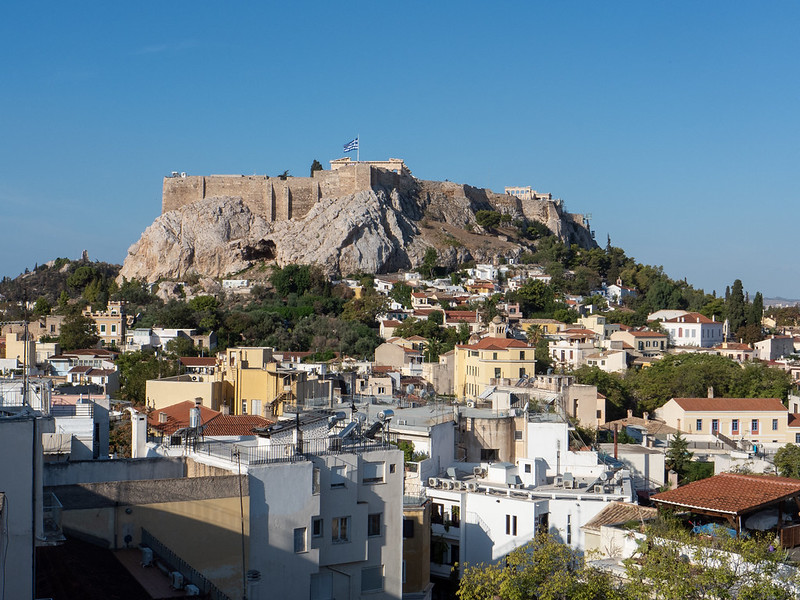
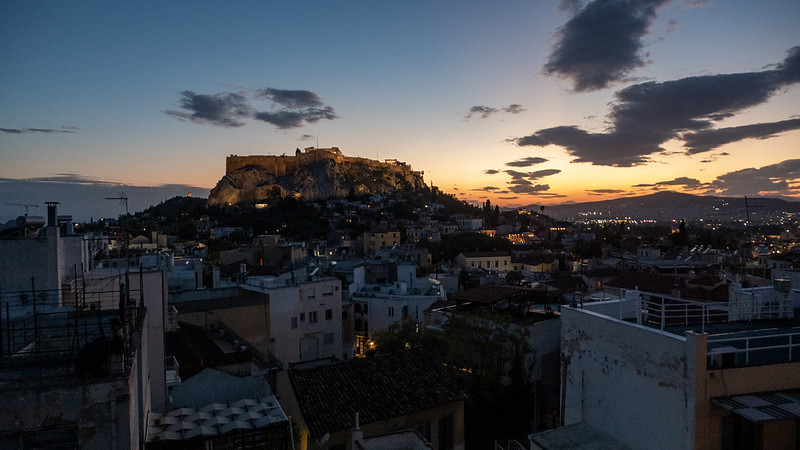
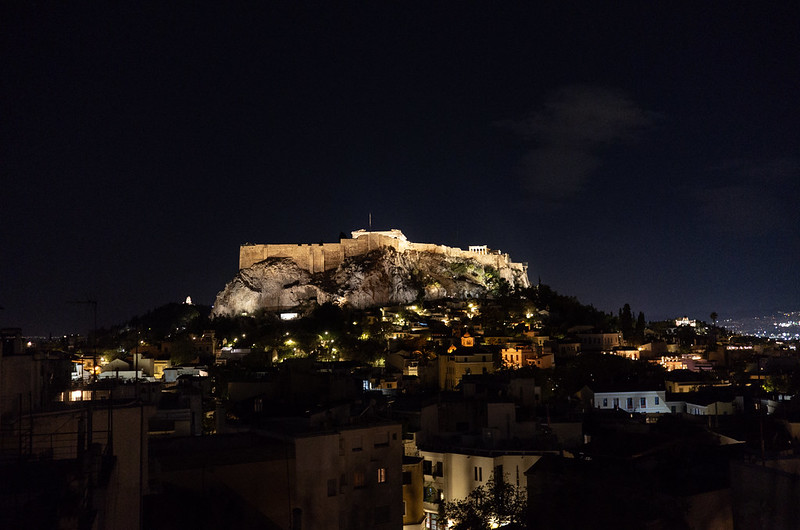
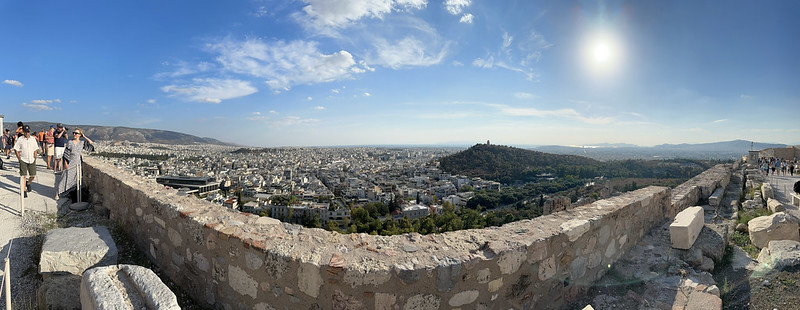
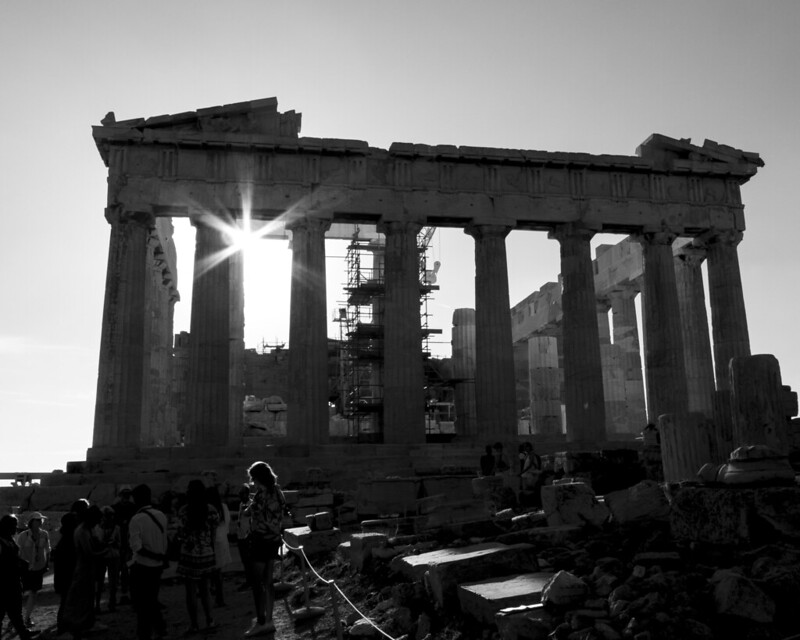
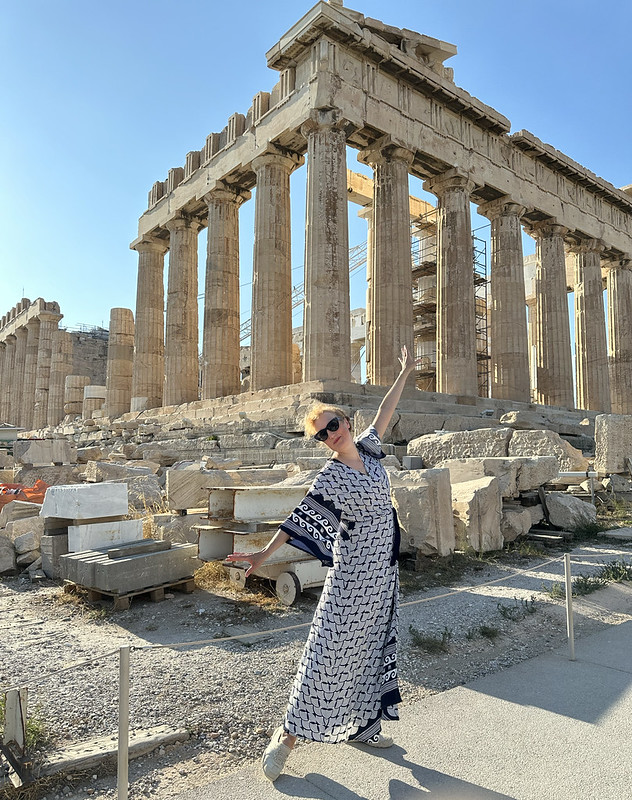
You know the Acropolis, of course. The high rock plateau that sits above Athens, layered and piled with ancient structures: most notably the Parthenon and, though less spoken of, the Erechtheion and the Propylaia, and with them the foundations of many other still older buildings, plus a flagpole and some public washrooms. It is within the city, it is surrounded by the city, but it is apart from the city.
Which might seem ironic, given that acropolis means ‘high city’. What city? It’s all temples! And they’re not in use or, for that matter, in usable shape at the moment. But on the other hand the polis is there too – the population, all the people. There are a lot of people up there anytime during open hours.
The parts of the word acropolis are as easily seen as the parts of the Acropolis: acro- as in acrophobia, acrobat, and so on, and -polis as in metropolis, necropolis, and so on. But right away we run into an interesting issue: its roots are akros ἄκρος and polis πόλις, but it’s not said acropolis, it’s said acropolis. Why the movement of stress?
The answer is not simply that we have a habit of putting the stress on the third-last syllable in borrowed Greek words, though we do do that – it’s why we put the stress on the first syllable in Socrates when it’s on the second in Greek. But even in Greek the stress in acropolis is on the second syllable, which is to say the third-last (antepenultimate): ἀκρόπολις (the accent on ό indicates the stress – which, in Classical Greek, is a pitch accent, but let’s leave that aside; if the ἀ catches your eye, that ’ is a breathing mark: it means the vowel doesn’t have a “h” sound before it). The stress has to move when the two bits are put together because it can’t be farther from the end than the third-last syllable.
Which is sort of like the shift in perspective if you go from the city of Athens up to the Acropolis. If you start where we started, you first see a cliff keeping it high above you; then you go around the side on city streets and gradually uphill, and when you are on the far side you come to the entrance, where it is an easy stair climb to the top. And then you are no longer looking up at it, the thing that dominates the view (until you get to higher peaks surrounding the city); you are looking down and across at all the surrounds. You are not in the high city; you are in the acropolis. And all the stress you brought with you? You might have left it down there. (Or perhaps not. Especially if crowds bother you.)
And of course it’s quite the place, iconic and historic but also scenic. Which is one reason it is by far the best known and most popular of all the acropoleis.
All the what?
I wouldn’t be surprised if you had never paused to think of what the plural of acropolis might be. If there’s only one, you don’t need to pluralize it, right? Well, yeah, but there’s not only one. An acropolis was a central feature of many ancient Greek towns. It was why they were where they were: they were built around a high, defensible place. Towns would grow around the bases (water’s easier to get down there, for one thing), but the strength and protection was in the high part. Rhodes and Corinth also have notable acropoleis.
OK, but why this freakin’ weird plural? Why not acropolises? Well, of course, you can also say acropolises if you want. But in English we have a pretentious habit of borrowing the nominative plural – and no other inflections – from loanwords, especially Greek and Latin ones. And it just happens that the nominative plural of ἀκρόπολις is ἀκροπόλεις.
But if you’re watching those accents, you’ll notice a shift: that ό is now in the second-last (penultimate) syllable. This is because the final syllable is “heavier” (it has a diphthong rather than a short vowel) and so it drags the accent towards it. So this means that the pronunciation in Classical Greek is /a.kro.ˈpo.lɛɪs/ – and in modern Greek, /a.kro.ˈpo.lis/ (but the singular in Modern Greek is ακρόπολη, with η rather than ις, just incidentally, heh heh) – and in modern English it’s… /ə.ˈkɹɒ.pə.liz/. Heh, sorry. The stress doesn’t move; we just say it the same way but with an “eez” instead of an “iss.” And in fact sometimes we spell it acropoles. Because while we like to borrow the plurals, we’re not really as sophisticated or, you know, nerdy as all that. We just like the scenic famous stuff.
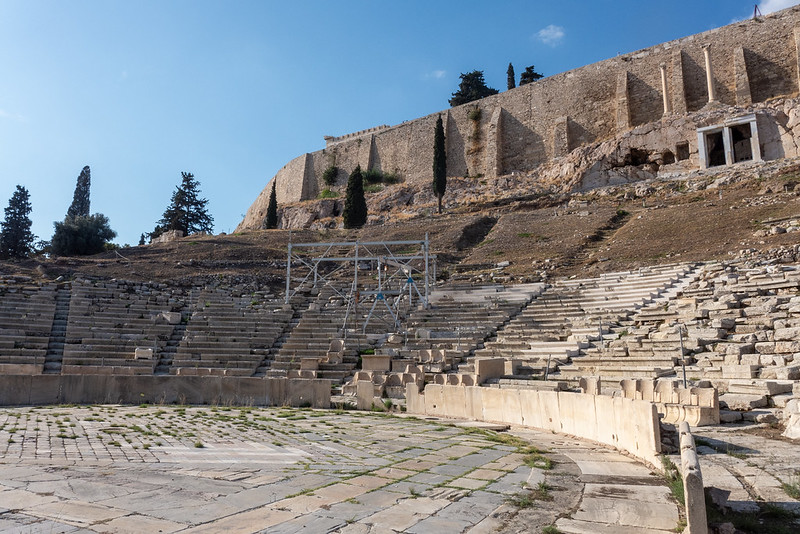
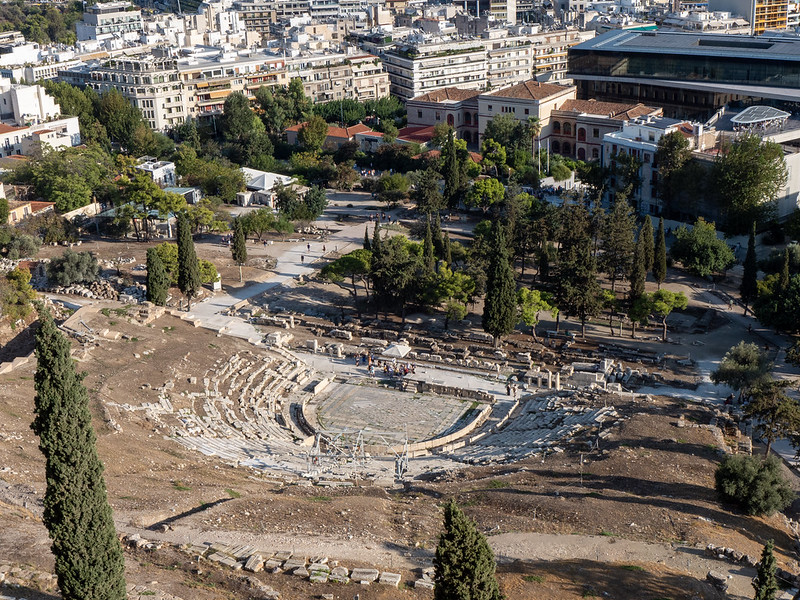
I mean, I am nerdy as all that, of course. I once performed an entire speech in Classical Greek (complete with chanting diction, and in the full costume and mask). It was in a production at the University of Calgary of Prometheus Bound by Aeschylus. And as it happens, at the foot of the Acropolis in Athens (accessible with your ticket to the Acropolis) is the very place that play, and thus that speech, was first performed: the (partially recovered ruins of the) great Theatre of Dionysus.
Of course I went there. Of course I stood in about the spot where the speech was delivered. Of course I… did not perform the speech. I’m not that kind of dork! And there were lots of other people around. But I did note that it was very similar in size to the theatre at the University of Calgary. “Great” and “grand” don’t always mean the same thing, you see…
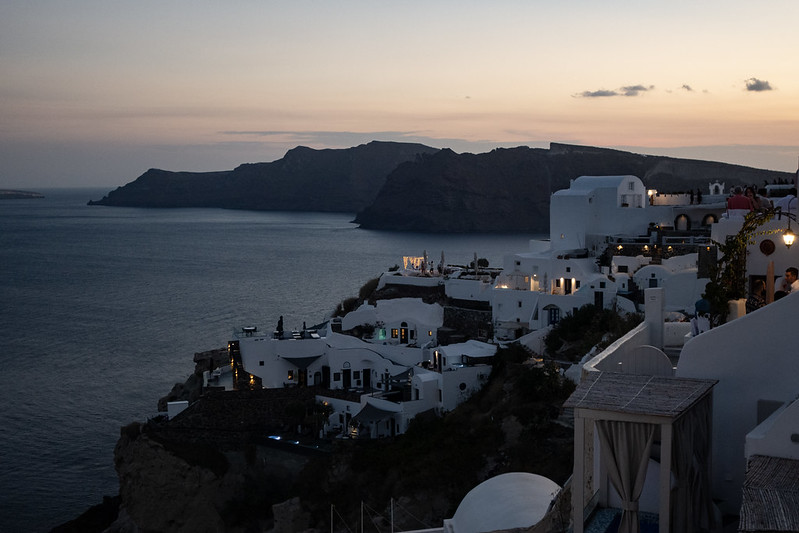
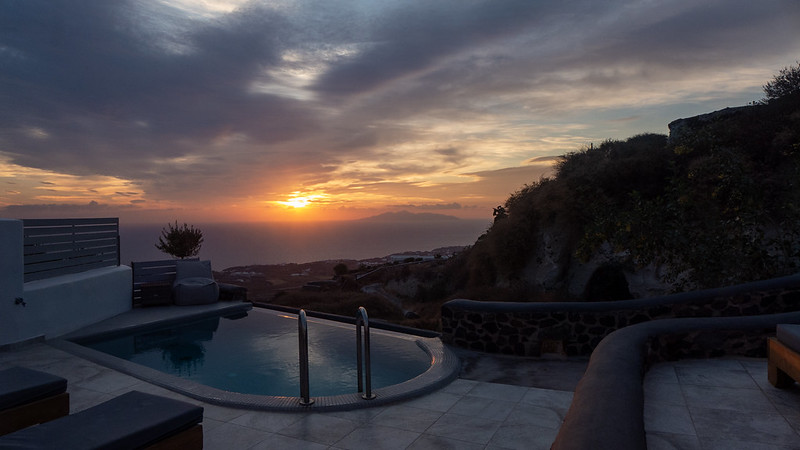
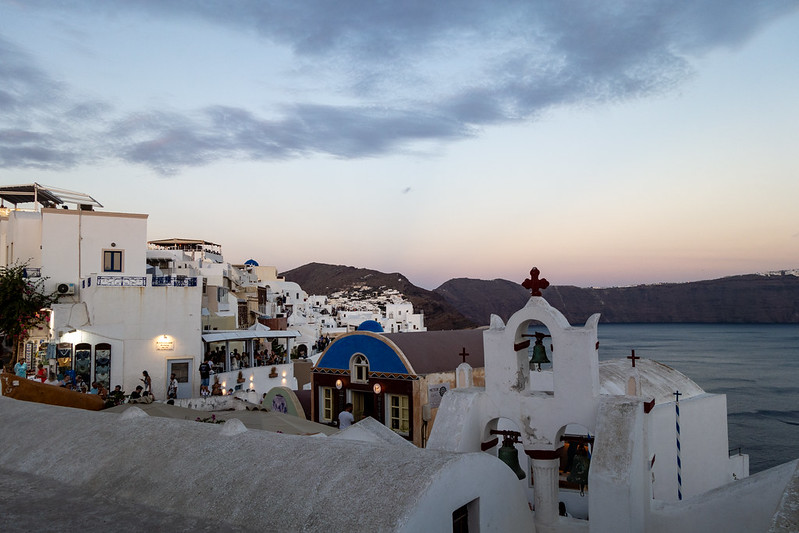
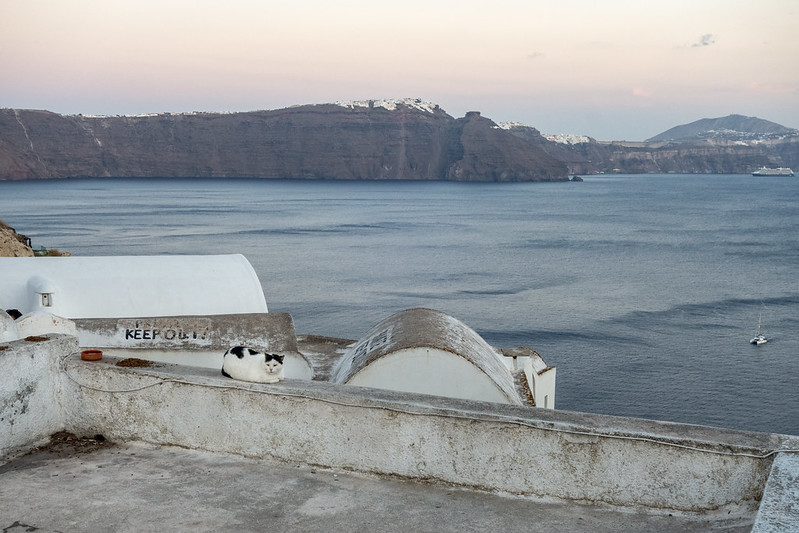
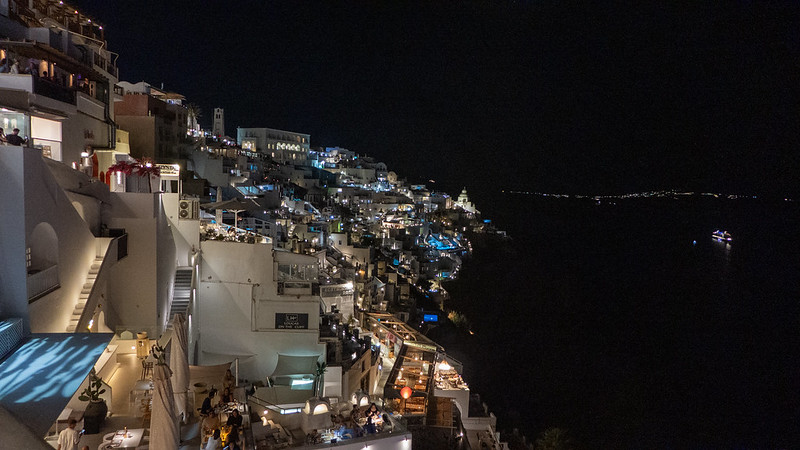
They’re not two places. Santorini is Thira, just as the sun I watched with hundreds of others setting across a caldera from a clifftop town is the sun I watched by myself rising over the open Aegean across a rural hillside.
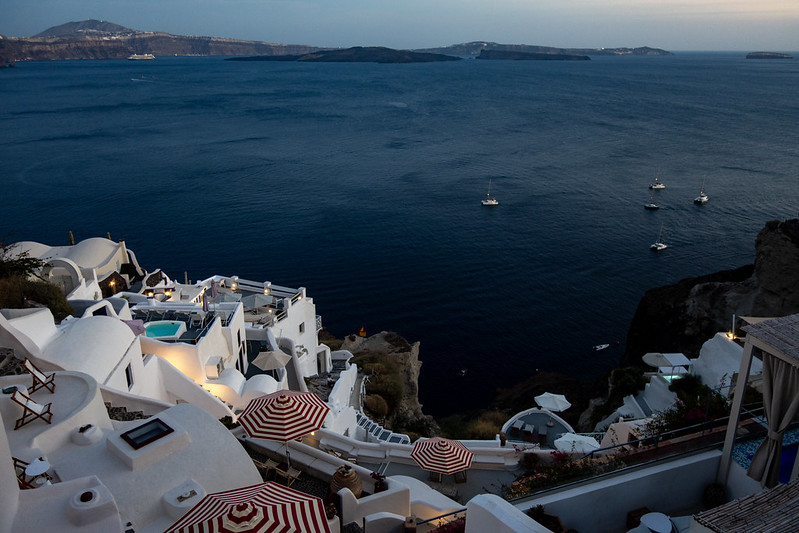
This island has a pervasive duality. If you arrive by boat, you come in on the caldera side and land at the base of a thousand-foot cliff. You are in the watery gullet of an ancient volcano, in a basin formed over the ages by multiple eruptions, the most recent of which a mere 3600 years ago – an eruption that destroyed a large part of the caldera wall and buried much of the island under many metres of ejecta, an eruption that, records tell us, affected the atmosphere in Egypt and even in China.
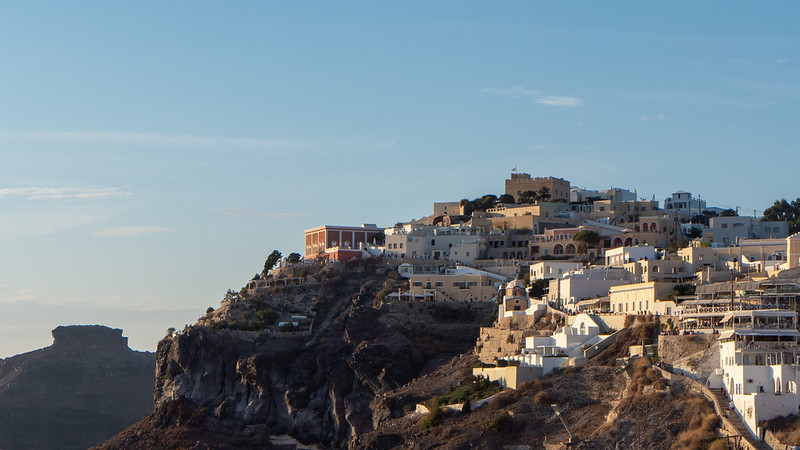
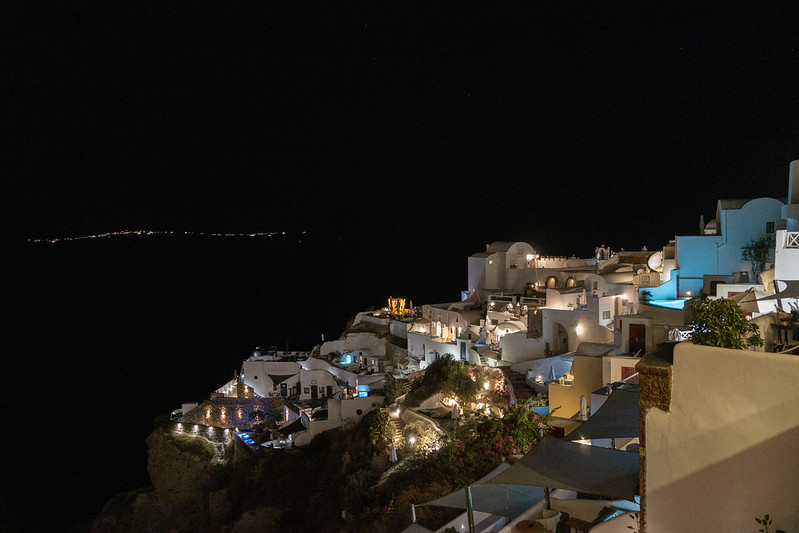
At the top of the cliff is a string of villages like a strand of pearls along the crest of the colossal cauldron, with the famous whitewashed blocks and blue domes and patios and pools descending towards the drop-off, and sloping less spectacularly on the other side. And all the tourists and all the photos you always see are concentrated on this elevated perspective.
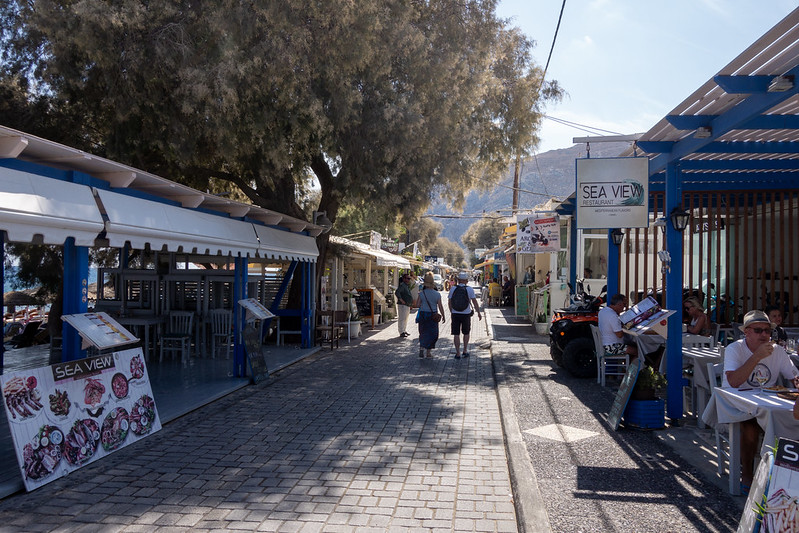
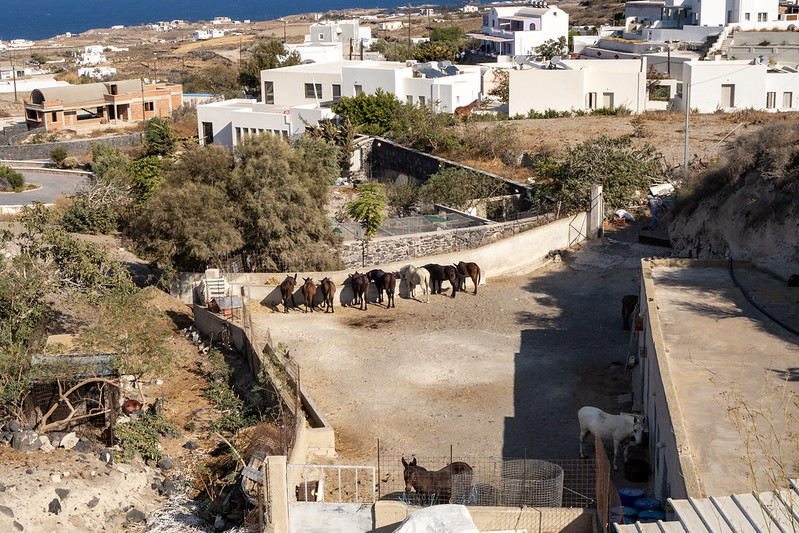
And if you arrive by airplane, you come in at the base of the gentler back side, a broad hillside with villages and fields and resorts and, just off the corner of the runway, a winery on a black sand strand that stretches into a seaside beach-bar town slouching at leisure into the water, the opposite of the busy ritzy clifftop aeries.
High above all of this is a monastery on a peak that dominates the back side and looks down on the caldera from a distance. At the north end of the curving caldera mouth is Oia, Οία (said “ee-a”), badly damaged by an earthquake nearly 70 years ago but you wouldn’t know now from its marble streets and moneyed shops. At the south end is Akrotiri, Ακρωτήρι, site of archaeological digs that have shown us that the people living here 3600 years ago had three-storey houses with colourful frescos – buried by that eruption, but still there if you know where to dig.
Even the name of this place is dual, and dual upon dual. The more widely known name, Santorini, may look more like Italian than Greek, and there’s a reason for that: it’s from Latin Santa Irini, ‘Saint Irene’, after a Greek saint (from Thessaloniki) to whom an old church is dedicated in the village of Perissa. (The Greek for ‘Saint Irene’ is Αγία Ειρήνη: Agia Eirini or, by sound, Ayia Irini.) The island’s ancient – and official modern – name is Thira,* Θήρα, after the leader of the Spartans who colonized the island. The capital and largest city has the same name, but with sound shifts: it’s Fira, Φηρά, with the stress moved from the first to the second syllable and the fricative moved from tongue to lip, making the letter for it 90 degrees different – Θ versus Φ.
And so it is. A simple turn and a change of perspective. But it’s all there for the looking.
* Also transliterated Thera – the letter η is classically ē but in rendering Modern Greek is usually set as i because it, along with υ and the diphthongs οι and ει, has merged with ι to the /i/ sound.
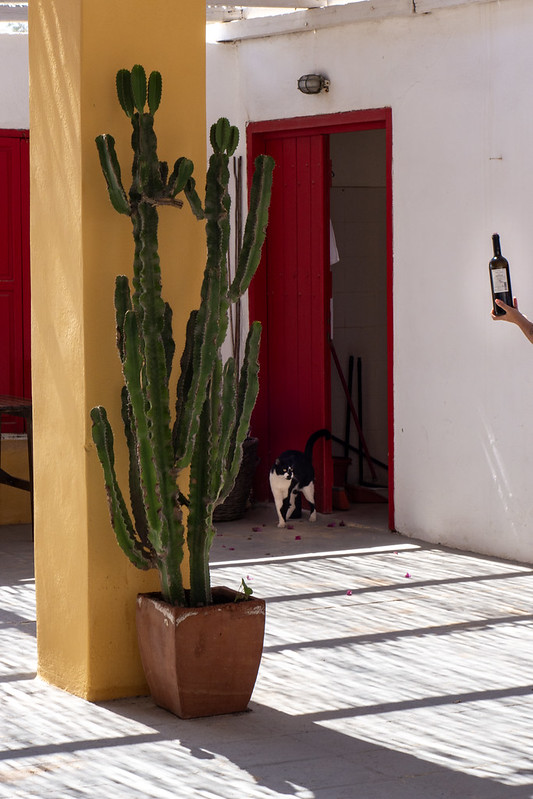
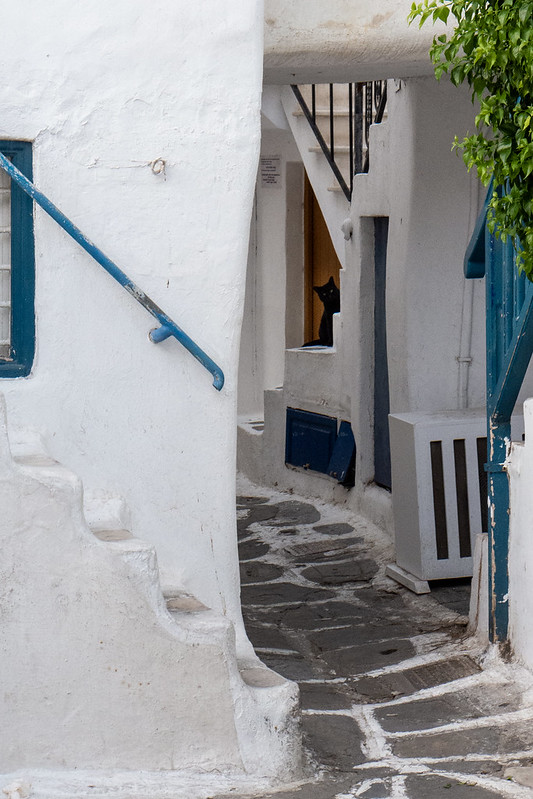
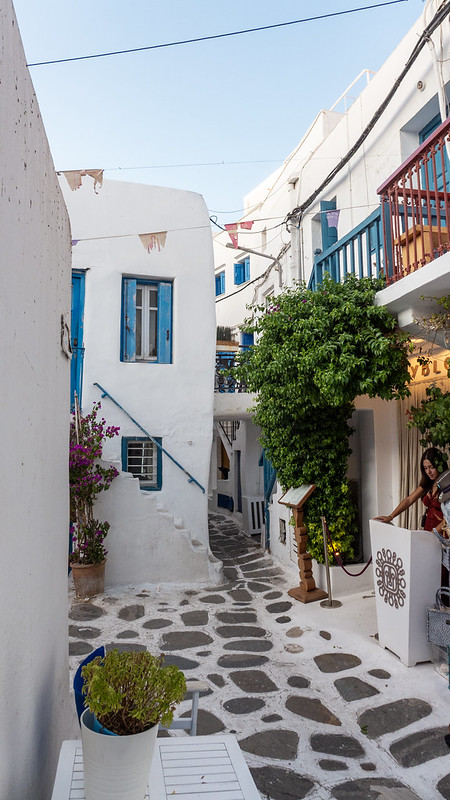
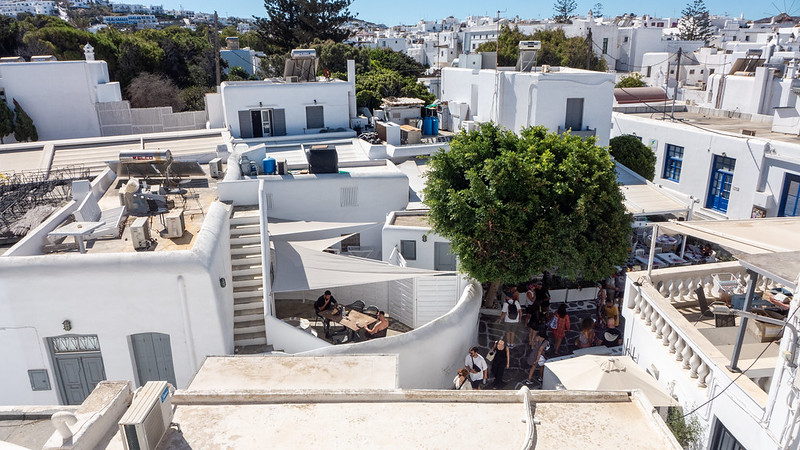
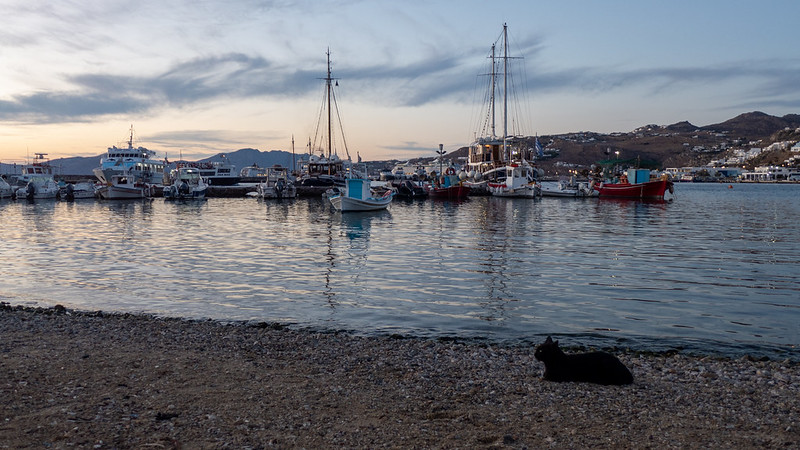
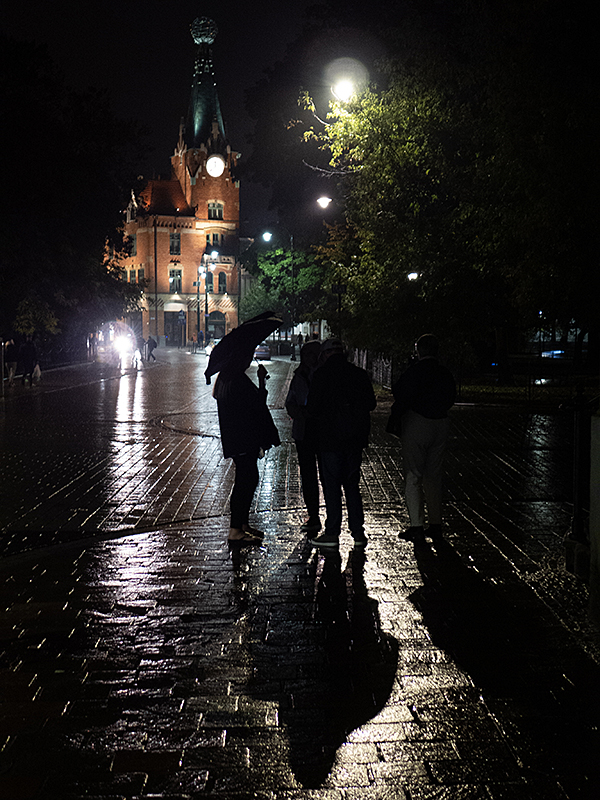
The doorways, the stairways, the white paint solid on walls and patterned on the pavement but not matching the cement between paving stones. The cat, one of ever so many. The street that’s about a metre wide – yes, that’s a street, have a look at Google Maps: it’s a normal-sized street of reasonable importance in the town of Mykonos. Google tells me it’s Delou Street. I saw no street signs.
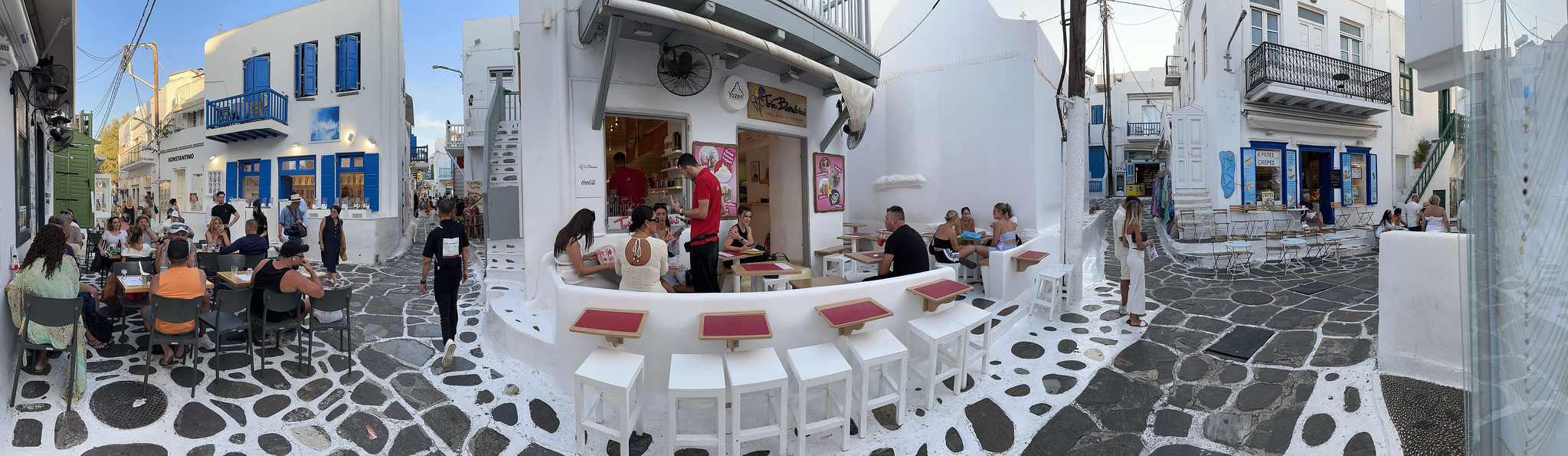
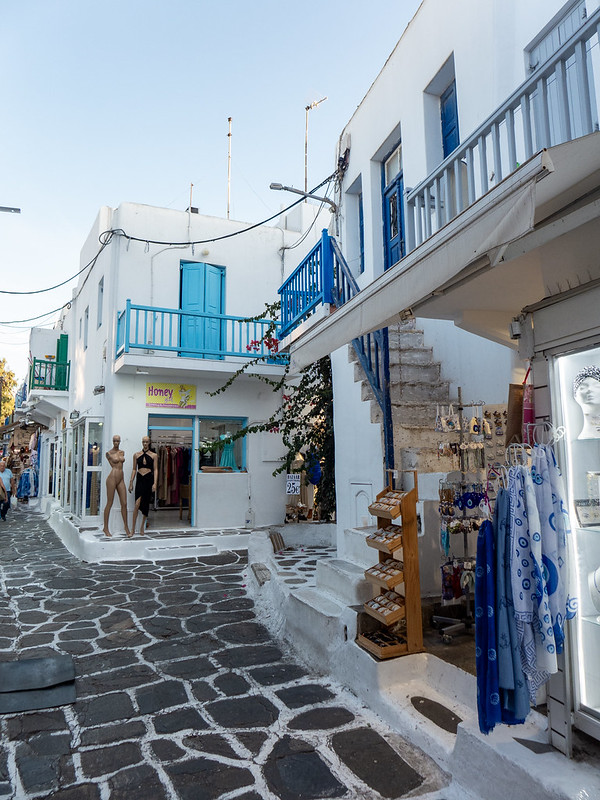
The town of Mykonos is all this, plus stores and restaurants and bars.
I didn’t have a clear expectation of what Mykonos would be like, but I assumed it would be like European seaside towns I’d been to before. It has a reputation for nightlife. I imagined a sort of small glitzy Barcelona, perhaps.
No.
When we stepped off the airplane in Mykonos an hour or so after sunset, it was my first foot on Greek tarmac. It was dark and warm and it was a small air terminal. We came out front and caught a minivan to the Fabrika bus terminal, at the south end of town, where the one in our group who had arrived earlier was waiting to meet the other four of us. She said we wouldn’t be able to get a taxi or minivan any closer than that.
Damn right we wouldn’t. Not without breaking the laws of physics, and several other things in the attempt.
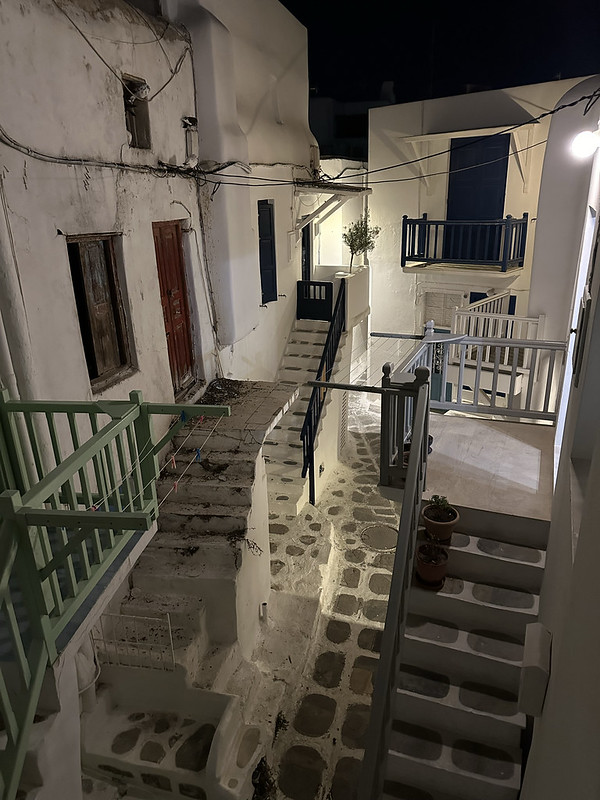
We dragged our bags and followed her down streets just wide enough for two people to pass on foot. Everything was open and busy. Stores in Mykonos mostly close at midnight during the warm season (and mostly don’t open in the cold half of the year). We took an anfractuous route that led us, after several minutes, to a narrow stairway up from a narrow lane. This was the view from the front door.
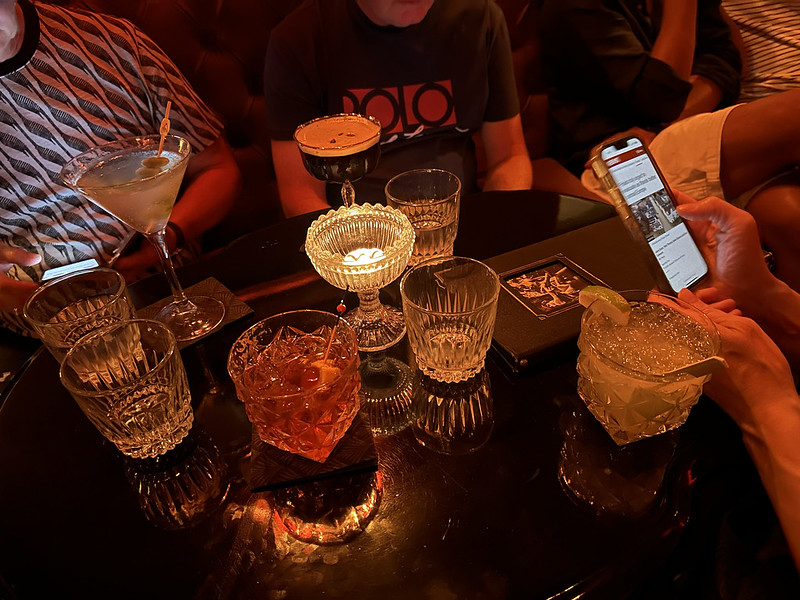
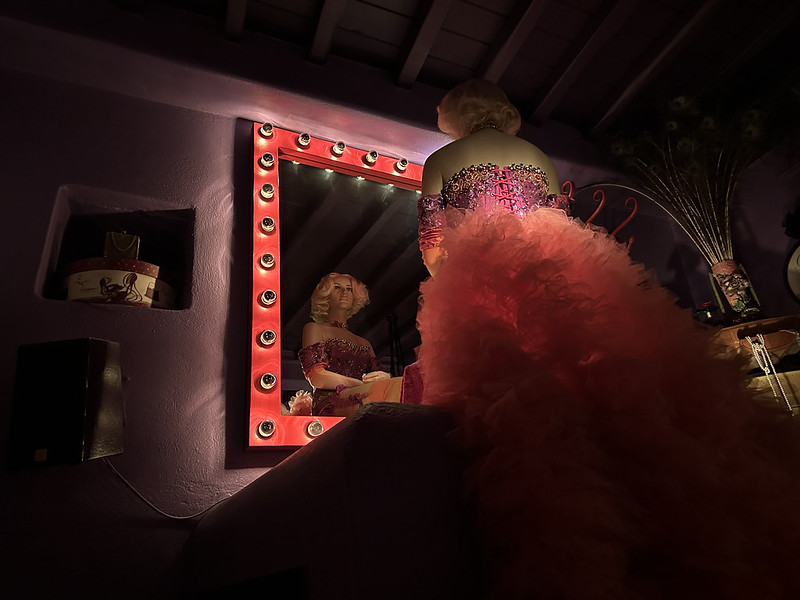
We were less than ten minutes’ walk from anywhere in town, and yet there was so much. Turn a corner and you find a bakery. Walk a little farther and the neighbourhood changes again. Go two very short blocks (scarcely farther than from one end to the other of the hallway in our condo building in Toronto) and you’re at a fabulous nightclub, with many others on offer.
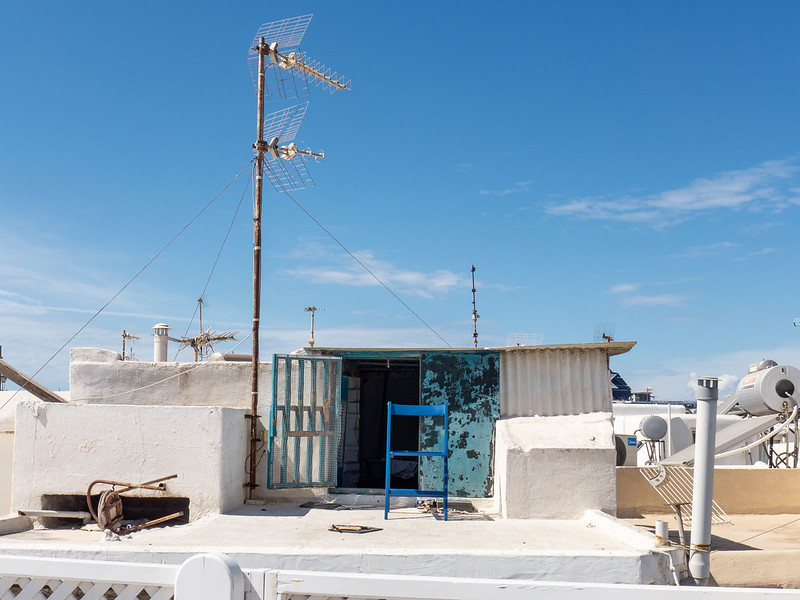
And in the morning, you come out onto the rooftop deck and see this.
No, I had never been to another place like this.
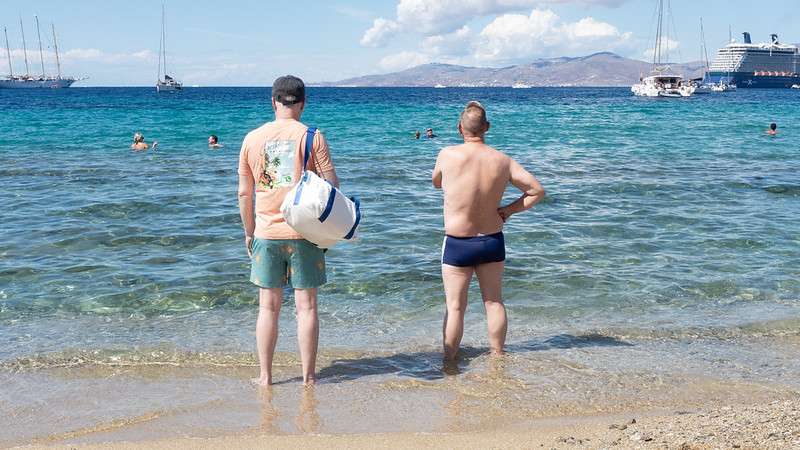
On our first day we walked to a nearby beach. The beaches in Mykonos do not load you up with sand in your shoes and clothes. It’s no miracle; their “sand” is small pebbles, too large to adhere. These pebbles have been wearing down for all of recorded human history, but they still have a ways to go.
The next day we took a bus to a beach on the other side of the island. It was crowded and we didn’t like it that much. We found a nice bar with a nice view and nice food and had a nice time.
I didn’t take pictures of the landscape as we went by on the bus because I couldn’t, really, but the roads are neither straight, nor flat, nor wide, and the landscape is hilly and full of rocks of many sizes – the large ones, according to myth, are the petrified corpses of the giants slain by Hercules – and there is not much that is green. It does not rain much on Mykonos, or, as far as I can tell, on any of the other Cyclades.
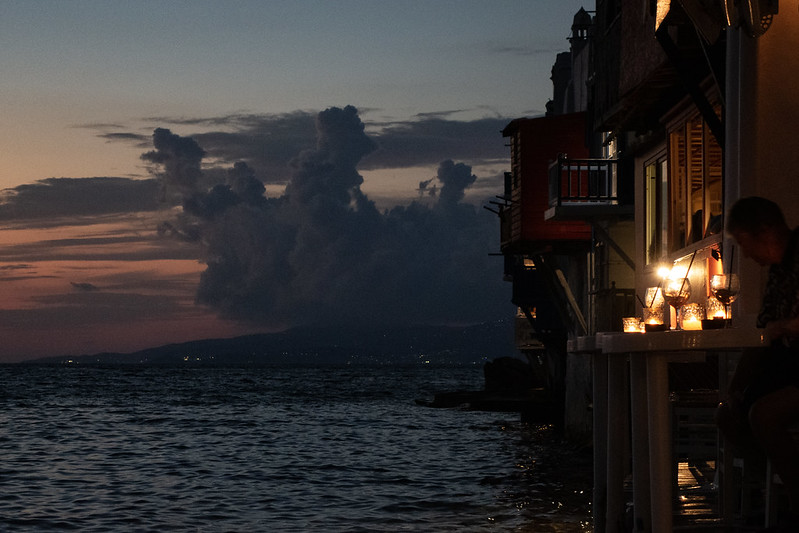
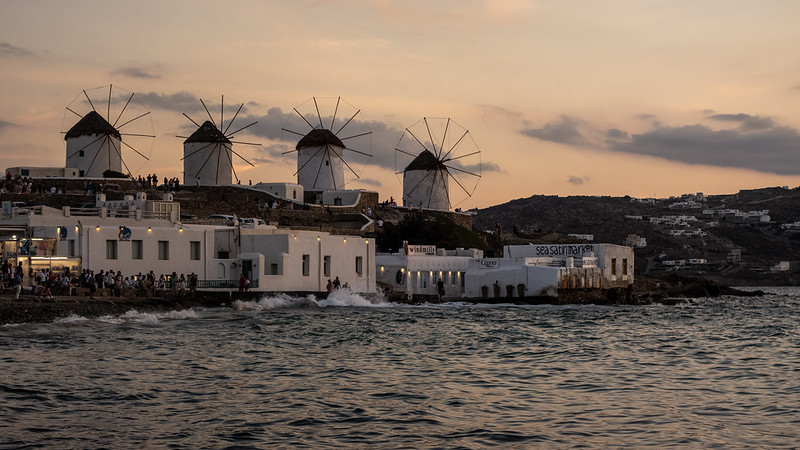
And then we went back to town and sat at a seaside restaurant and engaged in what is apparently the most popular tourist activity in the region: watching the sun set.
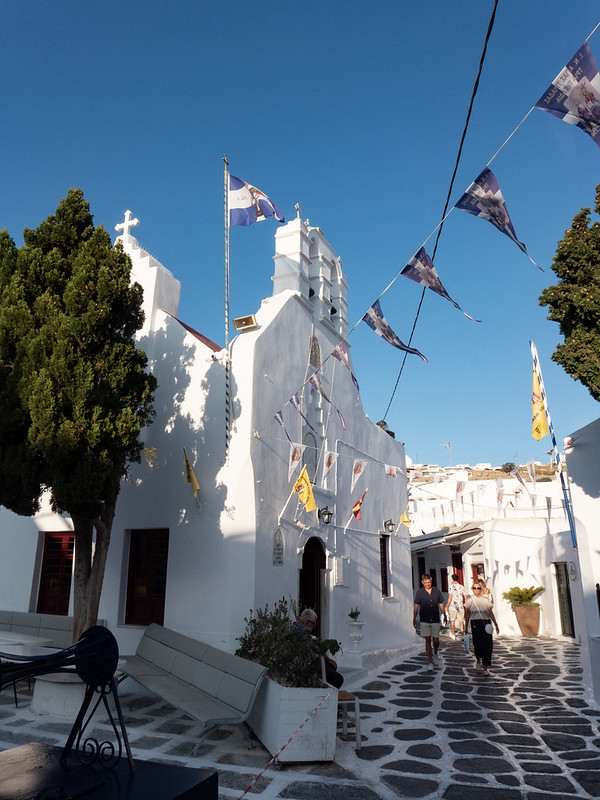
Mykonos does have luxury stores and nightclubs, as advertised. But they are all in this old condensed town. It is not like walking down a boulevard in Barcelona, or even an avenue in Verona. It’s small and cute and intense, almost Disney-like, but it’s not Mickey Mouse; it’s Mykonos.
During the day, if there are cruise ships in the harbour, the streets are clogged with impossible groups of people following sign-wielding tour guides. But after 4:00, they’re all back on their ships. And the nightlife people don’t come out until about 8:00. Which means you have four very peaceful hours when people are largely either napping or watching the sunset. Of course, you might be too.
What does Mykonos mean? The island is, according to myth, named after its first ruler, Μύκονος, who was the son or grandson of Apollo. His name means… nothing else that anyone knows. It’s pre-Greek. It came with the island, I guess. The island’s nickname is “Island of the Winds” – hence the iconic windmills.
Mykonos has been inhabited for longer than people have been writing things down, but it used to be subsidiary to the nearby smaller island of Delos, which was an important site of trade and culture, in spite of having, really, no resources of its own. Now Delos is inhabited by 24 people and countless ghosts wandering among the myriad ancient ruins. But Mykonos is very much alive.
There’s much more to Mykonos than what I’ve shown you or what I’ve seen. This is just my cognizance of Mykonos, so far. Before I went, the name didn’t mean a whole lot to me. Now? It has gained considerable flavour.
The driver took us south across the river, along a boulevard, past some Communist-era buildings, onto a side street, and through the parking lot of a modern apartment block. He stopped at a gate.
The five of us sitting folded into the back of the Prius exchanged uncertain glances.
“This isn’t where we’re going,” one of us said.
“Yes,” said the driver. “I know this place. I live here.”
I pulled out my phone and showed him the name of our destination on the screen. “Restauracja Wręga. In Kazimierz.” The driver furrowed his brow.
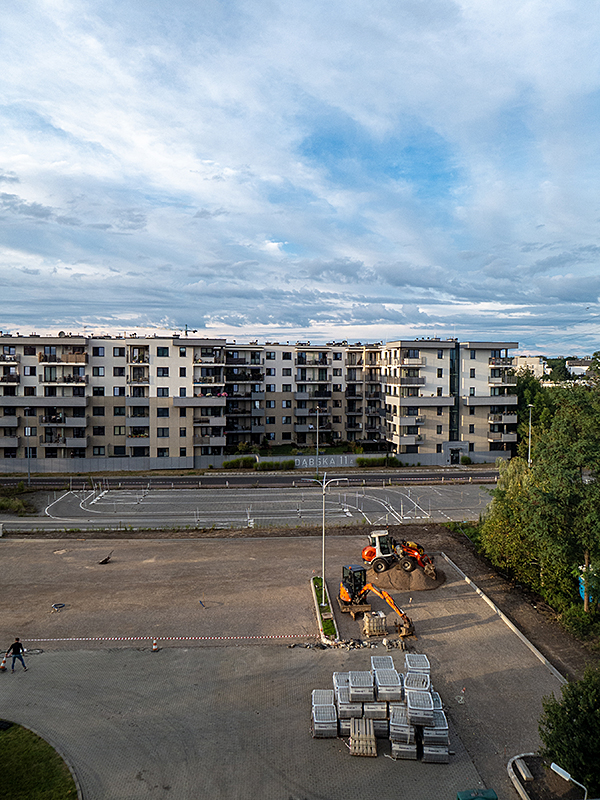
I pulled my phone back and looked at Google Maps. We weren’t at Restauracja Wręga in Kazimierz. We were on a side street in the Płaszów area of Podgórze, and we were farther from our destination than when we started at our inner-suburban hotel on Dąbska.
The driver looked at his device. Then he said he couldn’t take us to the restaurant because he had a wedding to go to. He dropped us at a nearby convenience store and drove away.
He had won the distinction of being, by a large margin, the least helpful person we met in Poland.
We weren’t the first people who, wanting to be in Kazimierz, had ended up in Podgórze. But at least for us it turned out to be no more than an annoying inconvenience. Google Maps told me that we were two blocks from a streetcar line that would take us to four blocks from the restaurant. The next streetcar was coming in 18 minutes and it was a 20-minute trip. We let our friends know we would be late.
Anyway, it was a scenic detour. For a scant few złoty each, the streetcar gave us a scenic tour of the relatively modern and relatively not-so-modern parts of Podgórze, from boulevards with kebab joints past industrial parks and apartment blocks and into smaller older streets with smaller older buildings, at last passing the old graffiti-covered buildings along Limanowskiego in the heart of the former ghetto, where the Jews of Kraków had been forced by the Nazis to relocate, brooded over at its corner by the spires on spires on spires of the massive St. Joseph’s Church.
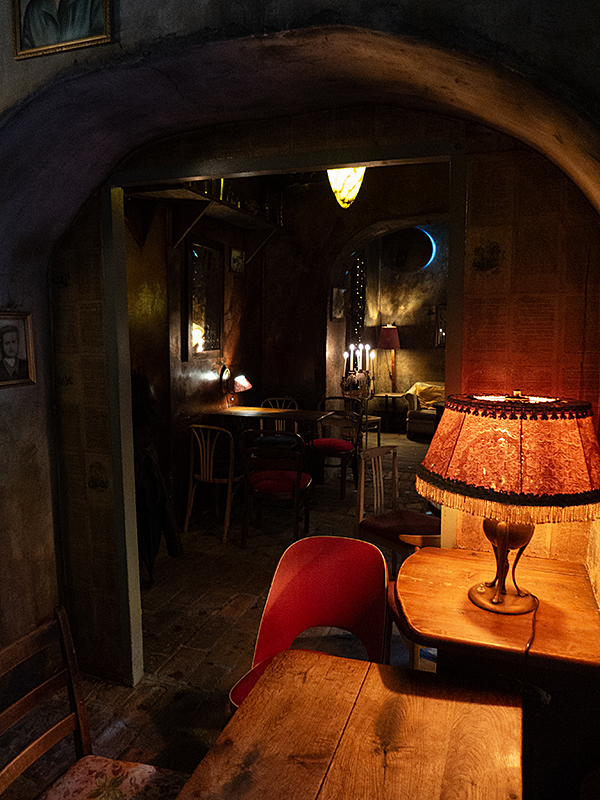
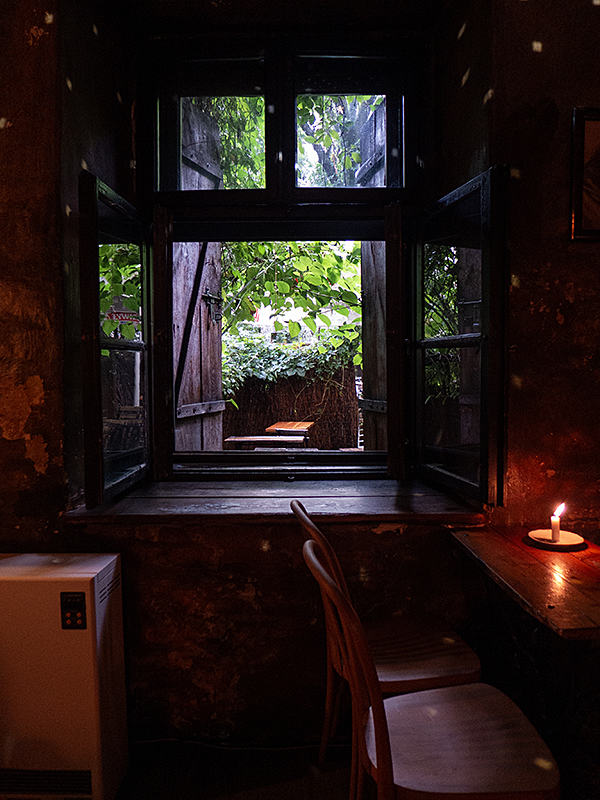
And then we turned north, crossed back over the river, and were in Kazimierz, the ancient Jewish quarter and modern hip funky area, just south of the Old Town. We hopped off the streetcar and met our friends at the restaurant just as they were paying the bill. Some of them headed off and would meet us later at an old-style basement restaurant near the Main Square, but one of them took us nearby to Eszeweria, a very boho coffee-and-beer place in a labyrinthine old building with candle lighting and tables that once held sewing machines. It’s the sort of place I would haunt if it were in Toronto. But it’s in Kraków.
Krakow. Cracow. Krakau. Krake. Krakiw.
If you haven’t been there, you probably recognize the name, but you might not know much about it. For me, when I was younger, I just thought of it as a semi-obscure Eastern European town. I was wrong on both counts.
Krakow (or, in Polish, Kraków, said sort of like “crock-oof”) is the second largest city in Poland. Because it’s not so much part of the Western European cultural sphere with the shared histories of all the neighbours and close competitors of England, Krakow figures much less prominently in the imaginations of most people in the English-speaking sphere. But it’s a city of no less historical importance and present interest than almost any Western European city other than the capitals (and even some of them). It’s the former capital of Poland, complete with castle; it was for centuries an important crossroads of trade and culture, and it’s home to one of the oldest universities of Europe (Jagiellonian University, founded in 1364) and one of the largest medieval town squares in Europe.
And it is in Central Europe, not Eastern Europe. It’s just about due south of Stockholm, and is less than an hour by plane from Vienna.
Also, I have learned, it is apparently a popular spot for quick group trips from England for such things as bachelor and bachelorette party weekends. This is undoubtedly because eating and drinking in Poland is, relatively speaking, great value for money, and also because Krakow is a very nice city. And English is widely spoken there (but let me not discourage you from learning some Polish).
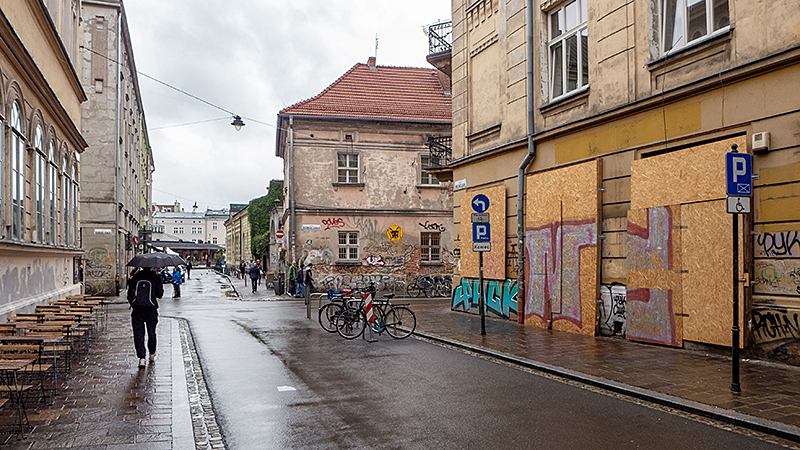
It’s not all ancient beauty, of course. There are stretches that lack both freshness and antiquity. Some parts are boarded up and graffitied. It’s a city, after all, and one with more than its fair share of history, having been controlled by various empires and political systems at various times. But the Stare Miasto – the Old Town – is as lovely as any old town in Italy or Spain, and quite able to handle as many tourists as it gets. And if you visit, bring your appetite – and be ready to have fun. You may be inclined to make some kind of pun on “krak,” but the most reasonable one to make is on the Irish crack (aka craic), ‘fun’.
It’s not just a party town or politically historically important town, either. Krakow is also a literary centre, with the oldest bookstore in Europe, and figures in many novels; I think the city I’ve been to that it’s most like is Prague.
Incidentally, we don’t know for certain where the name Kraków comes from. It’s commonly said that it’s after Krakus, its legendary founder, ruler of a local tribe, but the first mention of this idea dates to centuries after the town’s founding, so perhaps it’s really from a word meaning ‘crow’ or ‘raven’.
Why were we – I, my wife, our friends – there, by the way? To party. Yes, us too. We were joining a reunion for people who skated with Holiday On Ice (my wife did; I certainly did not). It’s a convenient location for many of the alumni, who are mostly from Europe. And, as mentioned, it’s value for money. And ever so charming.
Guten Morgen, as they say in Münster, and welcome to the mongermonger! I hope you brought your money.
Come examine our menagerie of mongers, from organic and grammatical to mongrels in the manger. We’ve had mongers in English for as long as we’ve had English – and before. Old English mangere traces through Old Saxon and Old High German all the way back to classical Latin mango, which meant ‘dealer’ or ‘trader’ – it’s not related to the mango you put in your smoothie (that’s a Dravidian word via Portuguese), but it certainly has borne fruit.
The fruit is sometimes marginal, mind you, more for ragmen than for royals, but so it goes: the life of a trader is sometimes meagrely managed. And the smirch of filthy lucre has clung to it; even half a millennium ago, monger was more associated with dealing in dodgy goods – sometimes fish, but sometimes fishy things.
But if you hunger for a monger, there will surely be something on the shelf to fill your bill. The available kinds of mongers are effectively endless, since you can always make new ones; if you want to call someone a meme-monger, you may. Here are all the kinds of mongers listed in Wiktionary (I’d show you the Oxford English Dictionary list, but I’m not trying to give you a migraine) – choose among them:
airmonger
alemonger
applemonger
balladmonger
barbermonger
beermonger
bloodmonger
bookmonger
boroughmonger
breadmonger
buttermonger
caremonger
carpetmonger
ceremony-monger
cheesemonger
coalmonger
cockmonger
cornmonger
costermonger
deathmonger
defeatmonger
dictionary-monger
doom-monger
doubtmonger
dramamonger
eirmonger
fadmonger
fancymonger
fashionmonger
fearmonger
feathermonger
fellmonger
feltmonger
fictionmonger
filthmonger
fishmonger
flashmonger
fleshmonger
flourmonger
foodmonger
foolmonger
fruitmonger
garlicmonger
ghostmonger
gospelmonger
gossipmonger
grievance-monger
hairmonger
hatemonger
haymonger
horrormonger
horsemonger
hypemonger
ideamonger
ironmonger
ironmongery
jestmonger
jobmonger
lawmonger
lease-monger
lightmonger
loanmonger
lovemonger
mass-monger
maxim-monger
mealmonger
meritmonger
miracle-monger
money-monger
mongeress
muck-monger
murdermonger
musicmonger
muttonmonger
mystery-monger
newsmonger
noisemonger
nostrum-monger
panicmonger
pardonmonger
peacemonger
pearmonger
peltmonger
phrasemonger
placemonger
pleasuremonger
poisonmonger
powermonger
prayer-monger
profitmonger
prophecy-monger
pupil-monger
pussymonger
questmonger
race-monger
relicmonger
rulemonger
rumourmonger
saltmonger
scandalmonger
scaremonger
shitmonger
sleazemonger
smutmonger
species-monger
spoilsmonger
starmonger
statesmonger
stockfishmonger
system-monger
talemonger
trouble-monger
twaddlemonger
versemonger
warmonger
watermonger
whoremonger
winemonger
wiremonger
witchmonger
wit-monger
wondermonger
woodmonger
woolmonger
woo-monger
wordmonger
Quite a megascopic list, isn’t it? I prefer the very last one, though I have been known to engage the trade of some of the others. I can’t say they mong to me, because we lost the simple verb – we had mangian in Old English, but by Modern English that had been sold down the river, and we had to reuse the noun.
So here I am, mongering mongers. (What a monster!) Do you want to take some home with you? Come along, I’ll ring you up.
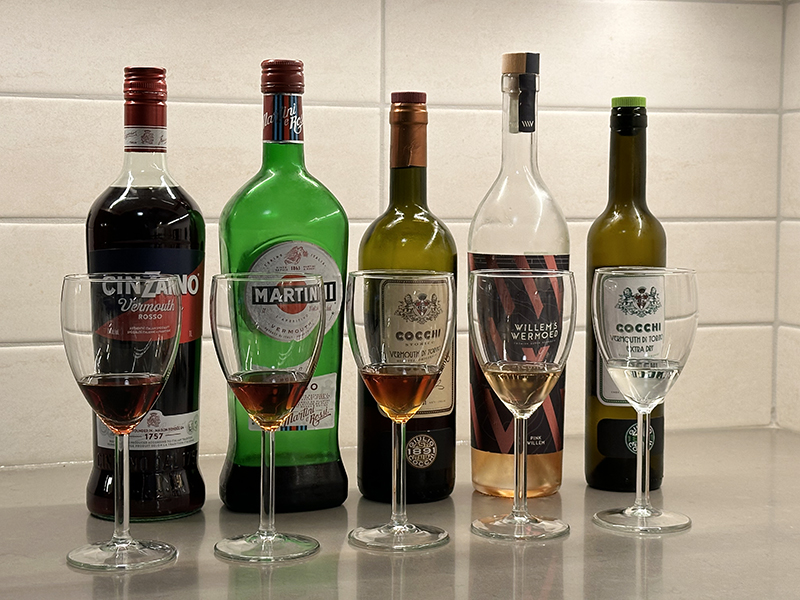
…well, we’ve read that bit. Let’s flip to the back of the Bible. In the end, there was vermouth.*
Yes. Allow me to quote Revelation 8:11 in Martin Luther’s translation:
Und der Name des Sterns heißt Wermut. Und der dritte Teil der Wasser ward Wermut; und viele Menschen starben von den Wassern, weil sie waren so bitter geworden.
If you know German, you know that Wermut can be translated as vermouth. In fact, the word vermouth is what French (of its time) made of the German word Wermut. Here is a translation of the above:
And the name of the star was vermouth. And the third part of the water was vermouth; and many people died from the waters, because they were so bitter.
Hmm, that’s kind of a negative opinion of vermouth, isn’t it? I mean, I know a lot of people don’t like the stuff. There’s a famous comedy routine by Hudson and Landry in which a guy is ordering a lot of liquor from a store and says “no vermouth” because “it makes my wife sick” (“She’s out of town but I do it just in her memory”). There is also an anecdote of a famous bartender (there is such a thing?) who, when making a martini, in place of adding vermouth simply nodded in the direction of Paris. And yet, it gets used.
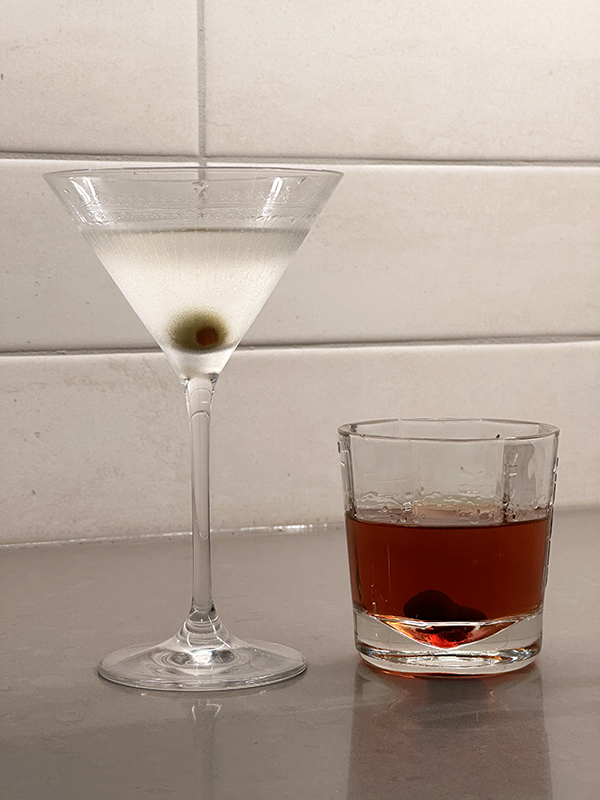
Not just the dry (“French”) kind in a martini.† The sweet kind in a Manhattan too. And a negroni. And quite a few other cocktails. People in some countries (Spain, for example) also enjoy sweet vermouth on ice, unmixed. Sweet, bitter, and strong together make a great drink.
Vermouth isn’t the only sweet and bitter beverage out there, either. There are various herbal bittersweet liqueurs, and gin and tonic also follows the same pattern – and all for the same original reason. You know the song “a spoonful of sugar helps the medicine go down”? Tonic water was created because the British invaders in India took quinine to deal with their malarial fevers, and sugar and fizz helped it go down. And, as Ogden Nash said, “Candy is dandy, but liquor is quicker”: if tonic, why not gin? On the same principle, vermouth was also created – centuries earlier – as a means of getting people to take a bitter medicine.
What medicine was that? Let me give you a hint, in the form of the King James Version translation of Revelation 8:11:
And the name of the star is called Wormwood: and the third part of the waters became wormwood; and many men died of the waters, because they were made bitter.
Yes. Wormwood. That is in fact what English translations of the Bible pretty much all say in that passage. Wermut is German for wormwood as well as for vermouth, the wine-based beverage that originally contained wormwood.‡
Let’s leave aside for the moment that these people were dying of the bitterness; there are in fact several plants called wormwood, and the species that was probably being referred to by John of Patmos, Artemisia herba-alba, was not actually the same as the one used in vermouth. To be fair, even the one named in Revelation was commonly used for medicinal purposes; I guess the thing is just that it was bitter, and, you know, some people really would rather die than have that. But the Artemisia that our vermouth was made from and named after is claimed to have, to quote Wikipedia, “antifungal, neuroprotective, insecticidal, antimicrobial, anthelmintic, acaricidal, antimalarial, antidepressant, and hepatoprotective properties.”
The Latin name of the genus is Artemisia after Artemis, the goddess of childbirth, because of its use for gynecological conditions. But you might have noticed that wormwood has “anthelmintic” properties. That means it’s good for treating parasitic worms. And that is… not why it’s called wormwood. Ha, sorry.
I had indeed long thought that vermouth was a French interpretation of English wormwood. That’s linguistically plausible, but, as I have mentioned, vermouth is in fact an older French rendition of German Wermut (the modern French is vermout without the h). And German Wermut comes not from modern English wormwood but from the source of the modern English word: Proto-West Germanic *warjamōdā, which arrived in Old English as wermode. Which, by the 1400s, had been reinterpreted as wormewode, which made modern English wormwood.
Yes, wormwood is an eggcorn, a reconstrual based on folk etymology, like sparrowgrass for asparagus. But what does *warjamōdā mean? We’re not sure, but it might be from *warjan (‘defend against’) and *mōd (‘mind’) – that is, mental defense: the “neuroprotective” and “antidepressant” properties.
Which is kinda funny if you know the reputation of wormwood for its effects on the mind. And if you don’t, let me give you a clue in the form of a French translation of Revelation 8:11 – this is from the Nouvelle Édition de Genève:
Le nom de cette étoile est Absinthe; le tiers des eaux fut changé en absinthe, et beaucoup d’hommes moururent par les eaux, parce qu’elles étaient devenues amères.
Absinthe. Yes, absinthe names the exact same plant as wormwood (and Wermut). The Latin name of the species of wormwood used in vermouth is Artemisia absinthium. Here’s Revelation 8:11 in the Tyndale version of the Koine Greek Bible:
You see that Ἄψινθος? That’s Apsinthos, which (via Latin) is the source of the word absinthe.
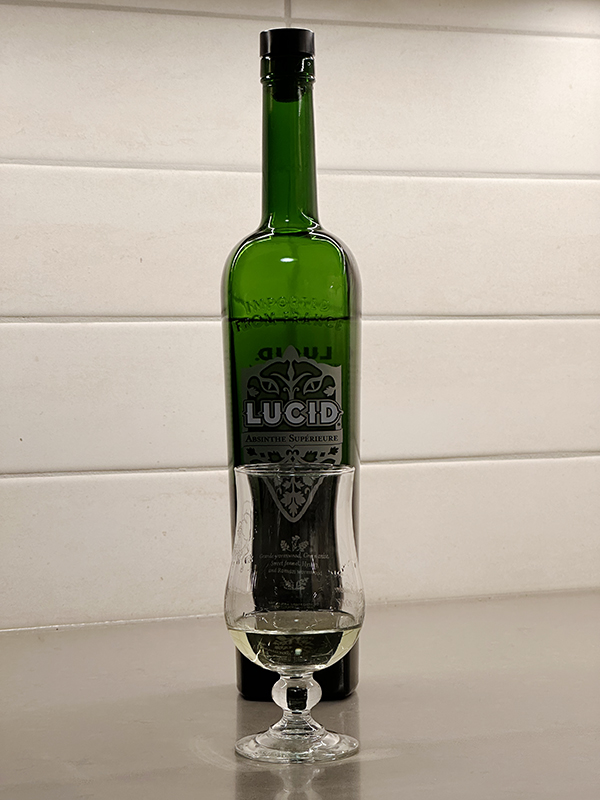
Perhaps you know about absinthe. The Green Fairy. Renowned as a mild hallucinogen; maligned (perhaps unjustly) as the cause of mental breakdowns among artists of the Belle Époque. It has the anise flavour you find also in pastis and ouzo, but with the strong bitter presence of – obviously – wormwood.
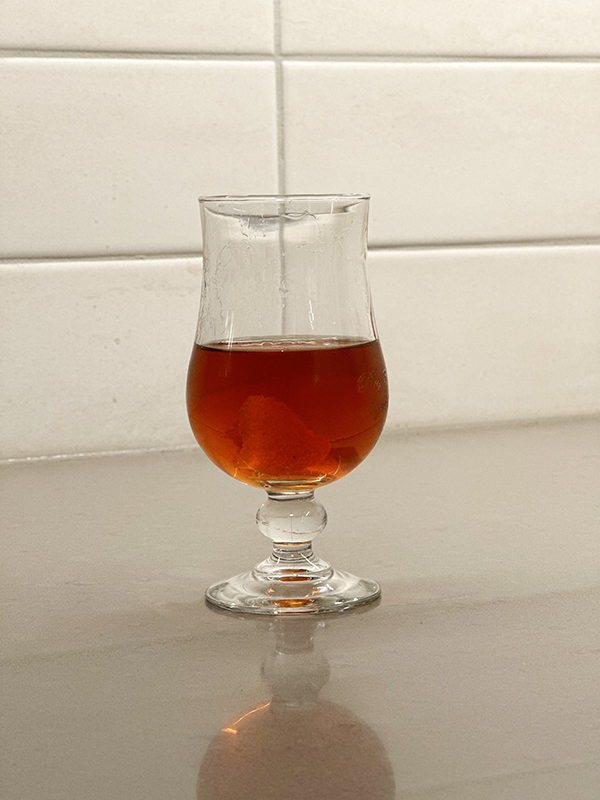
So is absinthe the same as vermouth? The same herb, yes. The words also have in common a th that in French is said “t” but has been taken in English as “th.”§ But the beverages are starkly different (though neither of them today contains any appreciable amount of thujone, the psychoactive ingredient of wormwood): vermouth is based on wine (with many other flavouring agents added as well), while absinthe is a distilled spirit (with flavouring). Vermouth is 15% to 17% alcohol; the absinthe I currently have is 62%, and I’ve had stronger. Vermouth can be used in cooking where wine is indicated; absinthe can only be used where you want absinthe! Vermouth is consumed straight and used in many cocktails; you can drink absinthe neat, but things may get messy – and when it is used in cocktails, is often just sprayed or rinsed in, as in a Sazerac.
And while both beverages may (temporarily) lift the mood,¶ absinthe makes the heart grow fonder.∞
* In the beginning, too, for me; Martini & Rossi sweet vermouth was the very first alcoholic beverage I ever tasted.
† Leave it to the French to take the sweetness out. The first pale dry vermouth was made by Joseph Noilly in the early 1800s. Kinds of vermouth have proliferated in many places in recent years, but nearly all of them are sweet.
‡ Many countries prohibited the use of wormwood in beverages in the early 1900s, so your vermouth may not contain any now. And so once again a name peels away from its origin.
§ The one in absinthe does come from a “th” in the Greek original, but the one in vermouth is entirely under the influence of orthography transmogrified.
¶ Yes, mood comes from the same Old English mōd that meant ‘mind’.
Why do colonel and kernel sound the same? It’s because of a minor coronal peregrination.
I don’t mean colonization – it’s not that somewhere has been invaded by order of the crown. It’s just… well, it’s on the tip of my tongue.
And yours too. Coronal (not said like colonel or kernel; it’s “co-ro-nal”) refers, in phonetics, to sounds involving the tip of the tongue. In other places and ways it involves other high points too, of course – as in other crowns, but we’ll circle back to that. The point here is that the /r/ and /l/ phonemes are both made with the tip of the tongue, and not only that, they’re both “liquids”: they don’t stop or even seriously impede the airflow through the mouth. And they’re not dissimilar; in fact, in some languages, they’re not considered different sounds. But in other languages, they can be subject to dissimilation.
Take, for instance, the word peregrine and the word pilgrim. Both trace back to Latin peregrinus. But in some varieties of some languages, notably some descended from Latin, it is (or was) dispreferred to have two identical liquids too close together. So the first /r/ became /l/ and peregrinus became Old French pelegrinus, which became modern French pèlerin and modern English pilgrim. But we also grabbed the unaltered Latin and made peregrine and peregrination.
But let me not wander too far. The point is the tongue – specifically, the point of the column of the tongue, which is circling back. And I don’t mean circling back just because coronal comes from Latin corona, which refers to a crown (and from that the top of something) but comes ultimately from the circlet shape of a wreath (consider a corona in a solar eclipse), from Ancient Greek κορώνη(korṓnē), which referred first to the shape and then to the object.
No – although there is a kernel of truth in that, it’s that colonel traces to Old Italian colonello, from Latin columna, referring to the column of men that the officer was at the head of. The first l was pronounced /l/, as it was written. But in early French, the column retreated – that is, it circled back, by which I mean it dissimilated: rather than have two /l/ sounds too close together, the first one became /r/, in a sort of photo negative of the dissimilation in pelegrinus. And the resemblance to corona reinforced the effect: a coronel would have been one at the crown, meaning the head, yes?
And indeed in English for some time we wrote it coronel, but then in the 1500s a fascination with the vaunted classical etymology of words took hold. The same affectation that led the o to be stuffed into peple to make people to show its root in populus, and the b to be stuffed into det to make debt to show its origin as debitum, and several other similar instances, led the spelling to become colonel. And for a time a spelling pronunciation (“col-o-nel”) was also current. But ultimately we have kept the changed sound and the reverted spelling. And over time the vowels reduced and merged into the liquid, so “coronel” came to sound like “kernel.”
But what, then, about kernel? This is a word for a grain of corn, one of the columns of grains that grow on the column of the cob. Is that where it comes from?
Not at all. The kern in kernel is none other than corn in a slightly turned form, and corn is originally just an old Germanic word for ‘seed’ or ‘grain’; the -el is a diminutive, and so a kernel is a little grain or the soft seed at the centre of something. The Old English word was cyrnel; the front vowel of -el led the back vowel in corn to assimilate forward. Which is the same movement as happened in colonel, and rather the opposite of the consonant dissimilation between /l/ and /r/. And so, like opposing columns, colonel and kernel have marched towards each other. Or, rather, we might say that the two have slowly sidled towards each other, until they have attained kernel knowledge.*
* Sorry for the corny joke. Oh, and neither colonial nor carnal is related to either colonel or kernel.
When the summer air near the shores of Lake Ontario and Lake Erie starts to thread with coolness, and the Concord grapes grow heavy, and the leaves start to shiver and fade a little, my mind slips back to when I would drive down to Gerry, New York, and visit my grandmother, who has been gone more than a decade now. There is no cure for old memories, loss, and nostalgia, but there are prescriptions, and I have one here:
StreuselConcordPie
Unbaked 9″ pie shell 4½ c. (1 qt.) Concord grapes 1 c. sugar ¼ c. flour 2 tsp. lemon juice ⅛ tsp. salt OatStreusel
Wash grapes, remove skins by pinching end opposite stem. Remove skins.
Place pulp in saucepan, bring to boil, cook a few minutes until pulp is soft. Stir often. Put thru strainer while pulp is hot, to remove seeds. Mix with skins. Stir in sugar, flour, lemon juice, salt.
Place mixture in pie shell. Sprinkle on Oat Streusel. Bake at 425° for 35–40 mins.
OATSTREUSEL: Combine ½ c. minute oats, ½ c. brown sugar and ¼ c. flour. Cut in ¼ c. butter or margarine.
The recipe does not add that, after eating a slice of the pie, you should smile at whoever you are eating it with so you can show your purple teeth. That is not part of the recipe that my grandma wrote out and gave to me. But it is part of the instructions I received from her when she served me pie at her kitchen table. This recipe will not bring back my grandmother, but it will recall her. Proust had his Madeleine; I have my Concord grape pie.
And I have many other recipes. I have quite a few cookbooks: the Larousse Gastronomique I received (on my request) for my fourteenth birthday; my own copy of the Better Homes and Gardens New Cookbook, my mother’s copy of which was so important to my culinary education; and a decent shelf full of others, the most used of which is probably How to Cook Everything by Mark Bittman. Several of them are ones I received as gifts, often from my cousin (on the other side of the family), who shares with me a love for food and wine and who (with the advantage of being much older than me) helped my education in the subject.
Humans have passed down instructions for preparing food since time immemorial, of course, and we have had cookbooks for centuries at least. Among the oldest extant cookery books is The Forme of Cury, dating to 1390, a new (and uncorrected) edition of which was published in 1780. I enjoy perusing its recipes for such things as “Pygge in sawse sawge,” “chykens in hocchee,” “Connyng in clere broth,” and “laumpreys in in galantine,” though I haven’t made any of them, in part because some of the ingredients and instructions (and the very English they’re written in) present a challenge for the modern cook. You can find a lovely collection of online versions of old cookbooks at MedievalCookery.com. Cooks nearly a half millennium ago (let us say ten grandmothers back – your grandmother’s grandmother’s etc.) set down instructions such as these:
To make egges in moneshyne
Take a dyche of rosewater and a dyshe full of sugar, and set them upon a chaffingdysh, and let them boyle, then take the yolkes of viii or ix egges newe layde and putte them thereto everyone from other, and so lette them harden a lyttle, and so after this maner serve them forthe and cast a lyttle synamon and sugar upon thẽ.
How big were the dishes of rosewater and sugar? The person who wrote this down surely knew. And surely knew when the appropriate occasion was to serve this, and who would enjoy it, and how. That was understanding that was received in person and through experience, though not written down as part of the recipe.
There was, naturally, a great diversity of foodstuffs. Take this, if you have the guts:
Garbage.— Take fayre garbagys of chykonys, as þe hed, þe fete, þe lyuerys, and þe gysowrys; washe hem clene, an caste hem in a fayre potte, an case þer-to freysshe brothe of Beef or ellys of moton, an let it boyle; an a-lye it wyth brede, and ley on Pepir an Safroun, Maces, Clowys, and a lytil verious an salt, an serue forth in the maner as a Sewe.
Junk food had a different valence in the 1400s.
As you read these recipes, you get to know the general style of the cooking of the time, which favoured a few spices (such as galangal, saffron, cinnamon, cloves, and pepper), tended to rely on boiling and baking, and used more sugar than you might expect. A recipe typically ended with the instruction to serve it forth (in more recent times, that seems to go without saying). And one more thing they had in common: these recipes were not recipes.
By which I mean they were not called recipes. It was only in the early 1600s that instructions for cookery were commonly called recipes; starting slightly earlier, they were called receipts, a usage that persisted to some degree in British English until quite recently. The term recipe did exist in English before that, but it was used first for such sets of instruction as these:
Take half a handfull of Rue a handfull of isop ix fygges gardynn mynttes a handfull & boyll all thise in a quart of condyte water with thre sponefull of hony & skym it clene then streyn it thorugh a clen cloth into a close vessell & drynk therof half a pynt at ones blod to arme so contynue to it be done.
Here is a translation provided by Margaret Connolly, the author of the article from which I got this recipe:
Take half a handful of rue, a handful of hyssop, 9 figs, and a handful of garden mint. Boil all these in a quarter of water from the conduit with 3 spoonfuls of honey and skim the liquid, then strain it through a clean clothe into a vessel and seal. Drink half a pint at once to fortify your blood. And continue until it is finished.
It is a recipe, yes, and it involves things you would eat as food, yes, but in this case it is meant to treat a medical problem. We’re not at grandma’s table for dessert, not this time. But these were the original recipes, because they were the first kinds of things for which was written Recipe – Latin for ‘receive’: this is what the apothecary will prepare and you will receive. Over time, this word Recipe came to be abbreviated as a simple R with a long tail and a line across it: ℞. These days it’s usually written Rx, though there’s no x, not any more than, say, there’s a letter I in $.
This is also why recipes have been called receipts: originally, a receipt was a thing or amount received; it could be money or property, or it could be a medical preparation. Over time, as we know, the word has mainly – though not exclusively – come to be used for the record of the receiving. But we received receipt as a word for a formula, with ingredients and instructions, and it had considerable shelf life. And recipe persists, along with the decocted grammatical stylings of the genre, which originated on the bench with the chemist’s crucibles.
The spread of recipe from the apothecary to the kitchen was not even a leap. In medieval times, there was not such a sharp division between the medical and the culinary; the things that you took to make you healthy were, by and large, things that you also ate to keep you healthy, though in different combinations and servings. The restorative value of food is recognized even in the word restaurant (from the French for ‘restoring’), which named first a restorative beverage or soup, and then transferred to the places that served such. And while we in Canada and the US today can readily buy many kinds of food (including junk food) at most drug stores in sections separate from the pharmacy counter, in times past the foods and drugs were not even administered separately. Remember even the fairly recent beginning of Coca-Cola, in 1886: as a health tonic served up by the druggist, originally containing cocaine as an active ingredient.
CONSERVES AND PRESERVES. Every apothecary’s shop was formerly so full of these preparations, that it might have passed for a confectioner’s warehouse. They possess very few medicinal properties, and may rather be classed among sweetmeats, rather than medicines. They are sometimes, however, of use, for reducing into boluses or pills some of the more ponderous powders, as the preparations of iron, mercury, and tin.
Then turn the page and read this recipe:
Conserve of Red Roses.
Take a pound of red rose buds, cleared of their heels; beat them well in a mortar, and, adding by degrees two pounds of double-refined sugar, in powder, make a conserve.
After the same manner are prepared the conserves of rosemary flowers, sea-wormwood, of the leaves of wood-sorrel, &c.
The conserve of roses is one of the most agreeable and useful preparations belonging to this class. A dram or two of it, dissolved in warm milk, is ordered to be given as a gentle restringent in weakness of the stomach, and likewise in pthisical coughs, and spitting of blood. To have any considerable effects, however, it must be taken in larger quantities.
The compounding apothecary would not, perhaps, say “Recipe” when giving you this preparation. But when you paid, you might get a receipt. And if you receive a dram or several of it, I think you might feel better.
Most of the things you will receive now when you hand a pharmacist a prescription have little or nothing to do with what you will receive when you order in a restaurant. But the heart of health is the kitchen, and many a recipe is a key to a healthy heart. I am happy that my grandmother pre-scribed her recipe. It was indicated as a memory aid, and it does help me to recall her; and on preparing and receiving it, I am – and in a way, she is – restored.
How do you disparage a member of the peerage? Perhaps you cast aspersions on their asparagus? Prejudge their pargeting? No – you merely say they married beneath them. Or, better, arrange for them to marry someone of inferior station.
Those at capstone of the class pile are not famous for gender egalitarianism, but in marriage, parity is paramount. This is why we got the term parage – a noun, etymologically ‘pairing’ and a doublet of peerage, that refers to equal social rank… but, to be precise, among those who are more equal than others. That is, equal with those of the top rank, for not to be equal is to be inferior. And so if you matched someone unequally – and, back in the medieval times, this typically meant matching a noble maid to a commoner – they were disparaged. (On the other hand, you could say that if they married equally, they were apparaged, but it seems this term was not really used in English, though apparagé did exist in French.)
We don’t use the word that way anymore. It’s not that princes William and Harry weren’t disparaged by some for marrying outside of the nobility – anyway, they’re princes royal and their station is quite secure, by dint of both royalty and maleness – it’s simply that it was not seen as disparagement. And even the daughter of a duke can match with a milkman and still retain her station, if not her social circle. In truth, it’s been at least two centuries since disparage was used in its original sense, and by that time its use had long since extended.
You can see how it got from there to where we are now, right? From lowering in status specifically by marriage, it came more broadly to mean lowering in esteem, credit, or honour by any of various means. If you did a disgraceful thing, you would disparage yourself and your family. And then from that it spread to taking someone down with words – not necessarily actually lowering their state, but speaking of them as lower. And now, of course, it’s not limited to persons: you can disparage asparagus, or pargeting, or any other thing. Disparaging is effectively a synonym for casting aspersions.
Which, by the way, is unrelated. All three are: asparagus (from Greek for the plant), pargeting (via French from Latin, probably the same ‘throwing’ root as in jet and reject), and aspersions (which comes from the same Latin root meaning ‘sprinkle’ that we see in disperse). But pair and peer (the noun, not the specular verb) and their derivatives are, as I have suggested, of the same esteemed stock as the heart of disparage. And now that we have come to a less stratified understanding of society, we are free to disparage the peerage and the very concept of status differences in marriage without seeming any the less for it.