
A Word Taster’s Companion: Horseshoes, hand grenades… and phonemes

Today: the fourth installment of my how-to guide for word tasting, A Word Taster’s Companion.

Horseshoes, hand grenades… and phonemes

They say close only counts in horseshoes and hand grenades (and nuclear warfare). Well, there’s somewhere else it counts: phonemes.

As I explained in “The world speaks in harmony,” phonemes are target sounds that we get variously close to. To put it another way, they’re the sounds we think we’re saying.

Say Yeah really slowly, moving your tongue down and lowering your jaw gradually and smoothly. You have just moved quite smoothly through sounds with no sharp border between them, but though you can hear that, you will probably have a sense more of fading from one distinct sound to another than of moving through sounds that are not quite one or the other. This is because you unlearned all those intermediate sounds when you were first learning English, and you learned targets – phonemes – that you’re matching what you hear and say to.

Different languages have different sets of phonemes, and may draw different boundaries between the same phonemes. Think of your mouth as a big lot of land divided by fences into smaller parts. Everyone has the same size and shape of lot, but different languages put the fences in different places. If you’re learning a different language, you have to learn new sound boundaries. For example, our vowels in beat and bit are fixed in our minds as two different sounds, but they register as the same phoneme to speakers of Spanish, Russian, and quite a few other languages. They don’t have the fence between those two sounds that we have.

The same goes with consonants. For instance, several South Asian languages have a distinction between aspirated and unaspirated voiceless stops. We make both kinds of sounds in English, but most of us don’t even notice – consciously – that we do. Put your hand just a short distance in front of your mouth. Say spit (don’t spit it, say it). Now say pit. Did you feel a puff of air on the p in pit? We aspirate /p/ when it’s the first consonant in a word but not when it’s the second – in other words, as linguists would write it, the phoneme /p/ is realized as the phones [p] and [ph] in different contexts. In Hindi and Thai, both versions of the sound are used in the same contexts and they’re considered as different as, for instance, b and p. On the other hand, in some languages, such as Spanish, /p/ is never aspirated – one of the factors that make a Spanish accent sound different from a standard Anglophone one.

Of course, there are different accents within a language, too. English has a large number of dialects, each with its own accent. Not everyone can learn to produce the accent of a different dialect, but most of us can get used to hearing the sounds done differently. Try saying (or imagining) the sentence “That’s a rather good bit of tea” in as many accents as you can imitate: east coast US, southern US, upper-crust British, working-class British, versions of Scottish and Irish, whatever else you want to try. Some sounds will vary quite a bit – compare them word by word. And yet somehow, because you know what the targets are in those accents for those phonemes in those contexts, you can understand it.

There are some snags, of course. If we hear rather in another accent there aren’t any other words it could be mistaken for – if a South African sounds like he’s saying “retha” we can mentally adjust the targets to fit it to the expected phonemes without wondering if he was saying something else. But when there are other things the word could sound like, confusion may ensue. A woman named Anne from Buffalo may risk having her name written down as Ian by someone from elsewhere hearing it over the phone. For that matter, if the sound is too different from what we expect, we may not recognize it even if there aren’t alternatives. One time when I was working in a bookstore a British bloke asked for the “hudda” section. At first I couldn’t at all understand what he wanted. He was looking for the horror section, as it turned out.

There is also the issue that we don’t all have exactly the same set of phonemes, even among English speakers. Get people from different places in Canada, the US, and England to say cot, caught, court, and you will find that most Canadians say the first two the same, most Brits (the r-dropping ones at least) say the last two the same, and many Americans say all three differently. Canadian English has merged the two vowel phonemes we hear in cot and caught. The Brits use the same vowel phoneme for caught as for court, and in court the r is dropped.

By the way, the vowel Canadians and Americans use in court is different from the one in cot, but most Canadians and many Americans may think of it as the same vowel – the same phoneme, in other words. The key is that that sound is only used before /r/, and the other one is never used before /r/. They’re in what’s called complementary distribution, which doesn’t mean they’re being handed out for free (though they are). Since they’re different sounds but are thought of as the same sounds, they’re what are called allophones of the same phoneme.

By now you should have a clear sense that phonemes often have different allophones that we may not realize are different. And yet somehow we maintain those differences. You can even have an allophone difference in one dialect that other dialects don’t have, and the speakers of the dialect with the difference may not notice that there’s a difference – and yet still maintain the difference.

For one example, most Canadians say the vowel in ice a little higher than the one in eyes, while few other English speakers do the same, and even though Canadians think of the sounds as the same and may not be consciously aware of the difference, it nonetheless persists. Many Canadians also say the vowel in out different from the one in loud. As with eyes/ice, it’s because the consonant after is voiceless in one case and voiced in another. (I’ll get to consonants soon enough, don’t worry.) But that out vowel that sounds the same as the loud vowel to Canadians trespasses on the territory of a different phoneme for Americans: the vowel in loot. This is why Canadians can say out and hear out while Americans hear the same thing and hear it as oot: for them, it’s on a different phoneme’s turf – it’s on the other side of the fence.

It gets even better, though: we actually make an at least slightly different sound each time we say a given phoneme, even in the same word repeated. Linguists draw diagrams showing the entire area in which a phoneme is made at different times by a speaker or by speakers of a specific dialect, with dots on them like holes on a dart board. But we are still able to match the sounds to what they’re intended to be. (This is helped by the fact that the fences aren’t really so much fences as fuzzy boundaries – what you hear a sound as is affected by what sound you expect to hear.)

It’s like having hand grenades going off in your mouth. They may not hit their targets right on, but they get close enough.

Next: The vowel circle
sensical

The other day I was in a meeting discussing the layout of an individualizable report. We had done a template with part real content and part filler content (lorem ipsum, that sort of thing). Our client contact person indicated that the next version needed to be a more completely real-world example. “Then we need to have all the data be sensical?” our designer asked.

Well. I have to say I was quite gruntled by this usage. I know some people might think sensical annoyingly peccable, but I find the usage in context perfectly ept, and, honestly, a ruly and kempt use of the language. It’s hardly the first backformation ever to be seen in the language. (Backformation is when you derive a word from a longer word that appears to be a suffixed version of it but is not. The noun mentee is made from a posited ment root backformed from mentor, for instance.)

Why not use sensible rather than sensical? Because it doesn’t mean the same thing. By that, I don’t just mean that we weren’t saying the data could be sensed. Sensible has several meanings, but the closest one to what we were talking about would have been ‘exhibiting good sense’. But we weren’t saying that the data had to exhibit good sense, just that it had to make sense. As in not be nonsensical. It had to be coherent, but since lorem ipsum text coheres, and sensical data that displayed numbers that might be unlikely in the real world might seem incoherent but would still be sensical, we didn’t necessarily want the word coherent.

Yes, yes, “entia non sunt multiplicanda” and all that (that’s Occam’s Razor: basically, it means “don’t add unncessary stuff” or “go with the simplest reasonable explanation”). Why add words wantonly. But this isn’t science, this is language, and language is not just a dry means of communication, it’s a fun game and we use it to express ourselves and add nuances. If our designer had said “Then we need to have all the data be sensible?” that would have implied a higher bar being set. And obviously it would be unnecessarily inelegant for her to say “Then we need to have all the data not be nonsensical?” She chose the word that worked. She said it, we understood it, there you have it.

But has sensical existed as a word already? Is it used in earnest today? How do we come to have a nonsensical without a sensical?

The answer to the first question is “Of course.” Any obvious backformation will show up fairly readily in usage, along with people asking “Is this a word?” The Oxford English Dictionary has citations for sensical from 1797 and 1839. (Nonsensical was in print by 1645.) However, the OED marks the word as obsolete and rare (it has the dreaded obelisk on the entry, gazing balefully like a basilisk – or rather hanging like the sword of Damocles over the headword).

And indeed sensical is not often used. It is used, however. Google it. Admittedly, you will find at the top of the results a number of wiki dictionary entries and several forum discussions of whether it’s a word. (I recommend this one on Vocaboly.com for some entertainment value.) Well, of course it’s a word. What a silly question. They use it, you understand it. No act of parliament or congress is required, nor any lexicographer’s imprimatur.

As to the etymology, the word nonsensical was formed by adding the suffix ical to the word nonsense (which of course was in turn formed from non and sense). There are a few other adjectives ending in ical that are formed from roots not ending in ic, such as canonical and chirurgical. By the time nonsensical came around, the sense of sensible meaning ‘making good sense’ was well established (and the older senses of ‘able to be sensed’ and ‘able to sense’ have been around since at least the 1300s), so that seemed generally to serve the turn – the finer distinction I make above was just not needed, I guess. And why not nonsensible? There actually is such a word, but it dates only to the 1800s and means ‘not available to the senses’. It happens that the more appropriate suffix for nonsense is ical, as in electrical, magical, musical, radical, and canonical.

I would be incomplete in my mission if I did not also point out that sensical ricochets off the back of the mouth rather than bouncing off the lips like sensible, lacks the many accreted flavours of sensible, and has nice echoes of all those ical words I mention above plus such as icicle, trickle, tickle, and such like. And it may carry that certain raciness or edginess that one gets from backforming an almost-unheard word from a common word, a thrill you may experience much more intensely from the curiously sensical little story “How I Met My Wife” by Jack Winter.

A Word Taster’s Companion: The world speaks in harmony

Today: the third installment of my how-to guide for word tasting, A Word Taster’s Companion.

The world speaks in harmony

It’s our ability to parse the flow of sound into separate sounds that makes language work. We have a conceptual understanding of the different sounds we make – ideal sounds, targets that we aim for and come variously close to when we actually speak. When the sounds are strung together, we still think of them as independent units. It’s like handwriting: the letters may flow together so you can’t say exactly where one ends and the next one starts, but you can see the different letters.

Now, when we hear someone talking, how do we know what different movements their mouth is making, what targets they’re shooting for? It’s all to do with the harmonics.

When you make a vocalization, your vocal cords are vibrating at a certain frequency – which, if you’re singing, is the note you’re singing – but they’re also echoing in your vocal tract at various frequencies that are multiples of the base frequency (two, three, four or more waves for every one of the base frequency). If you sing an A at 440 Hertz (vibrations per second), there are also echoes of that at, for instance, 880 Hertz and 1760 Hertz, among others.

Now, which harmonics sound louder and which sound quieter will be determined by the shape of the resonating space in your mouth. There’s a resonating space at the back of your mouth, from your larynx to the top of your tongue, and the higher your tongue is, the longer that space and the lower the frequency of the harmonics that stand out. There’s also a space between the front of your mouth and the closest point your tongue comes to your palate, and the smaller that space is, the higher the resonance. The stand-out harmonics those spaces engender are called formants: the one at the back is the first formant, and the one at the front is the second formant. (There are third and fourth formants that play smaller roles.)

Thus, [u] – “oo” as in “boot” – is heard as it is because it has lower harmonics coming out in both formants: the back of the tongue is high, making a big space between it and the larynx, and it’s also far back, making a big space between it and the front of the mouth. On the other hand, [æ] – “a” as in “cat” – is heard as it is because both formants are higher; the tongue is low and towards the front. And [i] – “ee” as in “beet” – has low resonances in the first set, and higher ones in the second set. The second set are always at least a little higher than the first, even when saying the low back vowel [a], as in “bother.”

We also recognize consonants this way. If they’re consonants that stop the flow of air, we recognize them by what the tongue is doing immediately before and after. If they let just a little air through, we also get the sound of the air as it hisses or buzzes. I’ll go into close-up details of the vowels and consonants in coming chapters.

So we hear these sounds, and we have a sense of where in the mouth they’re coming from, and we also have an idea of what sound could come next in any given word – by the time you’re a couple of sounds into a word, the possibilities are narrowed down quite a bit. We can also hear the effect of the tongue moving and changing the shape of the resonating space in the mouth. And we have learned a repertory of different sounds that we recognize as distinct speech sounds (I won’t say “letters”; those are what we write to represent the sounds). The actual sounds won’t always be exactly identical, but as long as they’re close enough to a target, an identifiable known speech sound, they will be identified as it, especially if the sounds around it lead us to expect it.

These target sounds – sounds that we recognize as separate speech sounds – are called phonemes. If you meet someone who speaks another language who can’t manage to differentiate “bit” from “beat,” that’s because their native language doesn’t have a distinction between those two vowel sounds, so they’re not used to making the distinction when speaking. They may even believe they can’t. They might have a heck of a hard time telling them apart when listening, too, because they both land close enough to the same target in the set of sounds they’re used to. It’s the same with English speakers hearing and making sounds from some other languages: we may not be able to tell apart sounds that, to the language’s native speakers, are obviously different. After all, learning language is also a process of unlearning: in order to have separate sounds, you not only have to treat similar sounds as completely different; you also have to forget that some sounds are different because you need to treat them as the same in order for your language to make sense.

Next: Horseshoes, hand grenades… and phonemes

Hyphe-nation? Hyphen-ation?

Several years ago I was working on a newsletter that had French and English versions. Our client contact spoke English but was a native Francophone. She complained that the hyphenation in the English was wrong.

Now, I was laying this newsletter out in InDesign, using its automatic hyphenation. It has a thorough hyphenation dictionary. I am a very, very fluent native Anglophone. I knew the hyphenation was right. But she was quite certain that it was not.

What did she think was wrong with it? Well, you see, it’s this: not everyone who speaks English realizes it, but we, like the French and speakers of many other languages, will as a habit say a consonant at the beginning of a syllable rather than at the end of the previous one if we can. For instance, we actually say the word breaking as [bɹe kɪŋ] (like “bray king”). Of course, there are some consonant pairs we won’t put together at the start of a syllable; we don’t say “da-mnation,” for example. Now, as it happens, in French, hyphenation occurs between syllables as they are actually said. By this rule, you would hyphenate at brea-king. That’s what she wanted

Does that look a little off? Would you say it should be break-ing? You’d be right.

In English, we have two different ways of hyphenating. In the British style, we aim to break at morpheme boundaries. What that means is that if a word is made up of a root and some prefixes and/or suffixes, you break at the boundary between the parts. So when you have break plus ing you break between them. And when you have hyphen plus ation you break it as hyphen-ation even though you actually say it like hyphe-nation.

We break those two words the same by the American system, but for a different reason. There is another very important fact in English that affects not just how we hyphenate words but how we read them and think of them generally. When you read a word, the quality of the vowel can be affected by the consonants, if any, that come after it – so we break at bus-ing rather than bu-sing – and the quality of a consonant can be affected by the vowels or consonants that come after it, so we will hyphenate Angli-cism rather than Anglic-ism because that c would look like a [k] sound. The American approach aims to make sure that when you read the first part of a word before the line break, you don’t have to rethink it once you see the second part. So it has to look as though it sounds like it actually does sound.

We just don’t write words exactly as they sound. English spelling is so perverse as to be almost ideographic at times. We have to recognize whole syllables or even whole morphemes, like break and breaking (as opposed to bread and breading, for instance – you only know what the vowel sound is when you see the letter after it). This results in some further traditions that couldn’t possibly make any sense from a strictly phonetic perspective.

Take a word like hotter. We actually say it with the /t/ at the beginning of the second syllable. But we have to think of the first syllable as ending with a consonant. If we spelled it as hoter, that would mean the syllables were ho ter, and that would make the o into a “long” o. So we write it with a double t to make it clear that the first syllable is a closed syllable, meaning its vowel is “short” – even though the syllable isn’t actually closed when you say it. It’s how you think you’re saying it that matters. Welcome to the wonderful world of phonemics!

But we also don’t break it as hott-er. As everyone learns in elementary school, we split it between the double letters: hot-ter. Never mind that there is no second [t] sound; that extra t isn’t part of the first syllable. But it’s not that we always break up consonant letters when the second one is unspoken: it’s dumb-er and smack-ing, not dum-ber (which could read as though you say the [b]) and smac-king.

There’s actually a little more to all this even than what I’ve already said. A favourite “gotcha!” in intro linguistics courses is to ask students where the syllable break is in Christmas. Now, we know right away that we don’t actually say a [t] in there. But we also know it’s a compound with a clearly identifiable first part, Christ, and we know that we would never start a syllable with [stm], so not only would we always hyphenate it as Christ-mas, it just makes sense that we must actually be breaking the syllable right before the [m]. Otherwise the i might stand for a different sound, as it would in an open syllable.

But nope! Gotcha, says the professor: the real break is [krɪ sməs] – that is, “Chri-s’mas.”

Except… Try this. Shout “Clover!” emphasizing each syllable, as though to a person hard of hearing and some distance away or in a noisy club. You hear what you do: “Clo! Ver!” OK, now try “Christmas!”

Is it “Chris! Mas!” or is it “Chri! Smas!”? Or is it more like “Chri! ss, Mas!”? Your results may vary, but for at least some people the [s] will fall squarely in the middle, a phenomenon called ambisyllabicity – something not all linguists agree exists. Try some other words such as breaking and dumber and hotter and see where you put the consonant in the middle. The natural tendency is for it to attach to the following syllable, but we think of it as part of the previous syllable, and it affects how we pronounce the word too, so it may not entirely let go of the previous syllable.

In English, we just don’t read one letter at a time. We just can’t! Consider the effect of breaking according to when we actually start saying the next syllable, separating vowels or consonants from the consonants that affect them:

En-
glish

sy-
llable

mi-
ddle

ho-
pping

assi-
stant

ma-
king

ma-
sking

regre-
ttable

and so on.

How did I resolve the issue with the newsletter? I just turned off hyphenation, which made the right edge of the text more ragged (don’t do it if you have full-justified text, especially in narrow columns) but quite readable and not susceptible to imposition of inappropriate hyphenation standards.

rife

Word country is rife. It is rife with the usual things, of course: speculation, rumours, problems, conflicts, and even corruption. Such strife! If something is rife with something else, that something else is simply expected to be negative. It is like a loaded rifle, this word, and with is the charge and the word that follows is the bullet.

But this rife gun may also bear flowers. And so it does in word country. Here it is also rife with life, each stream teeming, each river ripe with fish and flora. Words may reproduce like cells: each one, when riven, arrives as a pair, making multitude, a flow and a flood. Is this a corruption of the language? If so, we are rife with it, but is that a bad thing? Let sense effloresce. Somewhere in the rough, forgotten past, a split happened in a word and one branch went on through Latin to become river and arrive and kin, and another went by way of Germanic words to become a word that split to be the dividing word rive, best known now in its riven form, and rife, a word for multiplicity and prevalence.

Multiplicity and prevalence that has, over the centuries, leaned towards the sour flavour, the sound of strife and rifle more than of ripe and life and wife and rice; we seldom – though not never – now see such assemblages as rife with beauty or hope was rife that… The sense has split again, and one stream is the stronger.

As words and senses may divide, so too may sounds. In the word country of Canada, there is one more thing dividing rife and rive: the vowel sound is different. Oh, it is the same phoneme, it stands for the same thing, but Canadians start the /aɪ/ diphthong higher before voiceless consonants: “uh” rather than “ah”, [ɹəɪf] against [ɹaɪv]. Thus it is riven and we are ever more rife with sounds in the river of our language.

But what comes may go. Time will not reverse any more than a river may, but differences can disappear and words and sounds may merge, dissolving conflicts and creating problems. What is rife may yet see itself undone in fire. When will that happen, and how, and where? Speculation and rumours are rife. But you will not know until the time is ripe.

A Word Taster’s Companion: What makes a word

Today: the second installment of my how-to guide for word tasting, A Word Taster’s Companion.

What makes a word

Let us start by looking at the parts of words. Take a word. In fact, let’s start with start. Here’s a simple question: what is this word, start, made of?

Did someone say five letters?

Oops.

No, words are not made of letters.

That’s right: one of the first things just about anyone knows about words is the first thing they’re going to have to unlearn.

Tell me, what did you do first, when you were a very small child: write or speak?

You almost certainly learned to speak a few years before you learned to write. You knew the sounds long before you knew the symbols used to represent them on paper.

But aren’t those sounds letters?

They sure aren’t. Letters came along to represent sounds many thousands of years after humans started speaking. And anyone who can write English knows that the same letter is often used to represent several different sounds – for instance, fat, make, above – and the same sound can be represented by different letters – hay, hey, weigh.

Words are made up of quite a few different things, actually – and we’ll get to them all by the time I’m done with you – but on the most basic level of expressive form, words are made up of sounds (unless you are deaf and speak sign language).

And those sounds are made by the physical movements of your vocal tract. (If you speak sign language, they’re made up of movements of your hands and other body parts.) So when you say a word, you feel it. And when you hear a word, you know what it feels like.

So feel it. Feel this word: “Start.” Say it.

What do you feel your tongue doing? First the tip is up near the front of your mouth, behind the teeth and ahead of the ridge (that ridge is called the alveolar ridge). It’s letting some air through, making a hissing noise. Your voice is not activated: you could only whisper, not sing, while saying [s].

Then your tongue closes off the airflow. For a moment no air gets out of your mouth, because your nose is closed too (by means of a flap at the back of your mouth). Then you release it, and the tongue drops down and sits flat on the bottom of your mouth, and your voice starts up: [a].

Then, if you’re among those who say the [r], the tongue humps up like a cat stretching. It makes a narrower passage between itself and the roof of your mouth (your palate).

Finally, the tip of the tongue touches again and blocks the airflow as the voice stops – but you may find that even before the tongue gets all the way there the airflow has stopped; many people will make this stop using the closing point in the throat, the glottis, which is what you use to stop the air when you swallow or hold your breath.

So there you have it. One continuous movement of the tongue, with the voice engaged just in the middle. A continuous flow of physical movement and a continuous flow of sound. But we hear it as five sounds, because we have learned to divide the sound stream we hear into those sounds.

Next: The world speaks in harmony

definite, definitely

This is definately a word that’s going to set a lot of people off. Definetly. Defiantly.

(Nails digging into your palms yet?)

I grew up with video games like Space Invaders, Pac-Man, Centipede… They all have an important thing in common with English spelling: They’re all games where you will lose eventually. The point is not to win but just to last as long as you can before you make a mistake …and get slaughtered for it.

Some people last longer than others.

But at least people don’t think you’re a moron if you get wiped out quickly at Pac-Man.

It is true that good spelling in English is typically a sign of a decent intellect and a good education. The converse is not as reliably true. There are many people who are very intelligent and very strong in fields such as math or engineering who are not all that great at English spelling. And of course there are many people who simply were not really taught spelling very well in school and did not take it upon themselves to correct the deficiency because it did not appear all that important to them at the time.

The aim of writing is to represent spoken words. Alphabetic writing systems operate on a generally phonetic principle. Some languages are better than others at sticking to that principle. English has become spectacularly awful at it, in part due to borrowing words from other languages (sorry, not borrowing, stealing; we never give them back), in part due to sound changes in English that were not reflected in spelling changes, in part due to prescriptive spelling trends that actually deprecated adherence to phonetics. Read all about it at “What’s up with English spelling?

So we come to today’s word. It’s a very frequently misspelled word. In some contexts (e.g., some online forums) I think I see definately more often than definitely. Spellings also seen include definatly, definantly, definetly, definently, and even defiantly (let’s just grab some letters and put them there in a plausible arrangement, shall we?). It persists defiantly! And almost infinitely.

There is a reason for this obstinate intrusion of this immaculately conceived a into the word. It is analogy. There are so many words ending in an /ət/ (and, by extension, /ətli/) – realized in various contexts as [ɛt] and [ɪt] – including some very popular words (chocolate, anyone?), that the ate(ly) spelling just seems right. And if you see others doing it, it reinforces it.

So why don’t we spell it that way? Other languages spell things as they sound, regardless of where they came from, after all. For instance, the French loan word chauffeur becomes sjofør in Norwegian, which is a perfectly phonetic spelling for them.

Well, we don’t do that in English. We’re more likely to change our pronunciation to match the spelling, in fact. We like to keep words spelled the way they came into the language. Not always always – sometimes we’ve made them even fancier, and sometimes we’ve trimmed them down – but especially lately it’s the thing to do.

So what put the i in definite? It might help to understand if I define it. What does definite mean, anyway? ‘Certain. Precise. Clearly defined.’ Clearly defined? Indeed. Given clear finite boundaries. From Latin definitus, from de plus finire ‘finish, end, bound’. The word that gives us finish and finite and infinite and definition gives us definite.

But the meaning has shifted just enough, and the pronunciation has reduced just enough on that last syllable, that the connection to those other words is not at the front of the mind, and sometimes not at the back of it either. We don’t, after all, say it like “dee finite”; we say it more like “deaf, innit” – or, to be precise, as /dɛf ə nət/, with those /ə/ phonemes varying in actual pronunciation, but the syllable boundaries quite certain. The common abbreviation for definite is def, as in “I would def go there.” It sometimes seems as though our phonology is increasingly deaf, innit?

But as indefinite as the spelling may be in the minds of many, the response by some to the misspelling is very definite. Oh, definitely. D-E-F-I-N-I-T-E-L-Y, as the website says.

Well, so be it. When it rains it pours. And it is definitely raining.

peavey

Capsule notes:

Visual: descenders at beginning and end; downward points in middle and at end; e as second and second-last letter.

In the mouth: four phonemes; the consonants are on the lips (with the teeth on the second one) and the vowels are both /i/.

Etymology: named after the man credited with inventing it in the 1850s, Jospeh Peavey of Maine. The family name Peavey (also Peavy) is likely Anglo-Norman in origin and may come from Pavie or from Beauvoir.

Collocations: Peavey amplifier, Peavey Mart.

Overtones: the name Peavey is most commonly associated with electronic musical equipment, especially amplifiers. Peavey Mart is the name of a Western Canadian chain of hardware and farm equipment stores. Peavey also has echoes of peeve and related words, and, due to its pronunciation like P.V., of PVC, POV, and such like. It may also carry notes of levee and levy and navy and navvy and similar words.

Semantics: a lumberman’s tool for handling logs, for example in the stream; it has a wooden handle with a spike on the end and a hook curving around to form a sort of pincer grip with the spike. It is a variation on the tool called a cant hook or cant dog.

Full tasting:

In the January 2013 issue of National Geographic, I read the following on page 56: “the crucial physical culture of axes, adzes, pikes, and peaveys they used to build homes and harvest wood.” I do not recall ever having seen peavey used as a common noun before (though I may have seen it and forgotten it). Although I knew that it was obviously something useful in home construction or lumber handling, it wasn’t clear to me what it was – though once I looked it up, I discovered it was an implement I had certainly seen before. But that wasn’t the image that came to my mind first.

No, of course, the first thing I thought of was a musical amplifier. Now, those who have read my word tasting notes for a while may have a reliable impression of little discussion of lumber but a certain amount of discussion of music, and clear signs of a liking for heavy metal music (along with medieval music and numerous other genres, to be sure), even if it peeves my lovely wife. Perhaps you know that among rock musicians, axe (or ax) is a colloquialism for electric guitar. Now, adze and pike are not words I can recall seeing used in connection with rock musicianship (except in the name of the group The Northern Pikes), but on the other hand woodshedding is a term sometimes used to refer to intense solo practice on one’s instrument (figuratively going out to the woodshed to spend hours there perfecting technique). And I find it quite appealing to imagine an “axe” and a Peavey amplifier being essential equipment in building homes. Right now my mind is echoing with Starship: “We built this city on rock and roll.”

Of course I didn’t really think that the original colonists’ houses in Saguenay, Quebec – which is where author David Dobbs was writing about – were built on rock and roll. More likely cheese and maple syrup, two things I like possibly even more than rock and roll (especially when they’re from Quebec). But, not knowing what a peavey was at the time of reading, I wondered if it might be some kind of architectural or landscaping feature, like a levee, or some kind of wood joining or handling implement such as a plane. Surely something you could buy at a hardware or farm implement store. Naturally I made a note – a note to make a note amplifying the word.

Eglinton, glint

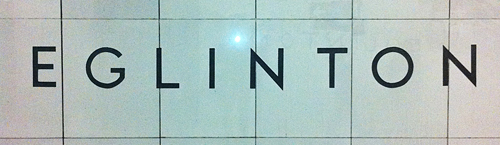
EGLINTON

Look at the glint on that photo. That’s no tingle. Perhaps it’s non-legit – it’s actually from the little flash on my iPhone. But at a glance, it is a glint – and indeed since it glances off the surface, moving quickly and perhaps obliquely, it does glint, even if lacks the éclat of, say, lit gelignite.

Those who live in Toronto will surely know where I took the picture: standing on the platform of Eglinton subway station. Eglinton station is at Yonge Street and Eglinton Avenue, a neighbourhood once and occasionally still jokingly called “Young and Eligible” (it helps that there are high-rise apartments thereabouts that house many young and eligible people, but then that’s true for several places in Toronto). More often it’s just said “yunganeg,” the intersection of two of Toronto’s most important – and most misspelled and mispronounced – streets.

Easy to see how one might get Yonge wrong (it’s pronounced like young). But Eglinton? Well, it’s like this: there are many people in Toronto and area who will swear it’s Eglington and always say it that way. This is, in my analysis, a hypercorrection – everyone knows, after all, that “-in’” is a casual way of saying “-ing,” so the inference is that “Eglinton” is sloppy for “Eglington.” On top of that, there is a Toronto street of some note (meaning it has a subway station) named Islington, with that g before the t. So it’s not so surprising that people think that “Eglinton” drops the g.

Even though there’s no g to drop. By which I mean not only that the word is actually Eglinton but also that in going from “-ing” to “-in’” you do not drop a [g]. There is no [g] sound in there. Listen to the difference between finger and singer. The former has a [g]; the latter, not. What is the difference between singer and sinner (I mean just the pronunciations!)? Not a [g] but rather the difference between back and front: the place the tongue touches the roof of the mouth. So people who think that Eglinton is dropping a [g] have it back to front. As it were.

The street name, by the way, is after Eglinton Castle in Scotland (no longer standing – there was an old small castle that was replaced circa 1800 with a Gothic-style castellated building, which was abandoned in 1925 and was finished off by army posted there in WWII), which was the seat of the Earls of Eglinton (the first Earl of Eglinton was Hugh Montgomerie, elevated in 1508); the name Eglinton was first recorded in 1205 as Eglunstone, and is seen in various spellings such as Eglytone and Egglington over the centuries. As an odd aside, there was a chair in Eglinton Castle that had the full text of Robert Burns’s “Tam O’Shanter” on it, a poem that I have referred to in my note on skirl. Well, why not? The castle was in Ayrshire, and Burns was an Ayrshire man.

Does it seem strange that some Torontonians might see Eglinton so many times on such a regular basis and not notice that it’s not Eglington? I bet even fewer people notice that it has a glint right in the middle of it. It’s right there, but it’s across syllable boundaries. Eg. Lin. Ton. It shows at best as an oblique flash.

Which is what a glint is. But where do we most often say we see glints? In someone’s eye. It’s one thing to see a glance of an eye; it’s another to see a glint in an eye. Literally it would seem to be a reflection, not really volitional therefore, but somehow what it really is is a muscular set expressing a certain attitude (of mischief or desire) that is conceptually synaesthetized as an oblique flash of light. It’s not there, but you see it as being there. Gee.

Glint started out as a verb, probably a variation on glent; it meant first “move quickly, especially obliquely; glance aside” – in the “glancing blow” sense of glance, which is to say the original sense: to glance was (and still is, in one of its uses) to strike obliquely, to turn aside. The two words don’t appear to have the same origin, but they do seem to have cross-influence. Interestingly, the “flashing light” sense of glint doesn’t really show up until the 1800s. (The “quick look” sense of glance is attested from the 1500s.)

But you know that both seem destined to be applied to something to do with light, shining, flashes, or vision. Look: glass, glimmer, glitter, glamour, glow, gleam, glare… add your own to the list. We have a /gl/ phonaestheme: a sound combination that is associated with a certain sense, even in the absence of a common etymological basis. It just shows up in a flash.

snipe

Capsule notes:

Visual: a quick shot of a word, but a full array of lines and curves and loops; one ascender and one descender.

In the mouth: the tongue starts pressed against the alveolar ridge but still letting air through; then that closes to a nasal; then the tongue draws back for a curl and flex in the /aɪ/; and at last the mouth snaps shut with the bilabial stop. One quick syllable, with a gesture like that of an anglerfish grabbing its prey.

Semantics: a bird, often found in the bush, but at least as often not found because not seen; sharpshooting from a place of concealment, noun and verb, with extended senses in various areas of endeavour; also a deprecatory term for a base person. Snipe hunt refers to a fool’s errand, a wild goose chase.

Etymology: a Germanic word. All the snipe words come from the word for the bird. The sharpshooting senses relate originally to hunting the bird.

Collocations: snipe at, snipe hunt, guttersnipe, common snipe.

Overtones: there’s that nasal /sn/, which often shows up in words relating to the nose; there are echoes of snide, spite, snip, snap, smite, Snopes, knife, and perhaps stipend and Smythe and similar words.

Full tasting:

There are people who don’t believe snipes exist. They think they’re in a class with the urban legends debunked on Snopes.com. I’ve met at least one such person. Where does this idea come from? Well, in North America, a childish prank (sometimes also played by adults) among campers and others in or near wilderness areas is to send someone on a snipe hunt, beating the bushes or doing other strange things looking for this bird; the joke is that you won’t find it. The reason you won’t find it is first of all because there probably aren’t any in the area (they’re not all that common in North America), secondly because if you did find one you probably wouldn’t know what you were looking for anyway, thirdly because going through the bush shouting “Snipe! Snipe!” is a great way to scare birds and beasts away, fourthly because real snipes are really hard to catch or even to shoot, and fifthly because you could be looking directly at one and not see it.

You doubt? Have a look at the article “Can you spot the ‘invisible animal’? Incredible images show nature’s disappearing act when predators are near” on the Daily Mail website. A little below the halfway point of the set of photos by Art Wolfe, there is one of a snipe in some brush near a stream. You may look at the other photos and spot the hidden animal or bird after a second or two without reading the caption. But if and when you finally spot the snipe, you will likely find that you had looked directly at it several times without recognizing it as anything other than more of the riparian vegetation.

Lurking in vegetation is hardly enough to merit opprobrium, however; many creatures do so without becoming bywords for nasty people – see Othello, for instance: “For I mine owne gain’d knowledge should prophane, If I would time expend with such a snipe” – or lowly, vulgar types (in the compound guttersnipe). Nor is the term of abuse the direct source for the sharpshooter, or vice versa; the words snipe (verb) and sniper come from references to hunting for snipes, which apparently requires extra stealth and good shooting abilities (aside from hiding, they also fly away). That game hunting activity transferred to similar shooting in wartime, and from that the other metaphorical senses readily proceed.

But of course shooting from concealment is not universally positively viewed, especially in metaphorical senses. If you have been eagerly watching an item on ebay, hoping your bid will win it, you will probably be quite unhappy, and think very dark things about the person, if someone snipes it – overbids you with just a second or two left, so you don’t have time to bid back. In more general social circumstances, sniping is, as it were, knifing someone in the back, taking pot shots at them (somehow that metaphor for sloppy random shooting is in such cases used nearly interchangeably with one for very precise and skilled shooting).

I have an unsubstantiated suspicion that the echoes of knife, snide, spite, and such like feed into the tone and sense – the sounds lurking in the background, peeking out half-heard, shooting their sense into the word… a word that, for its part, though brief, actually rather stands out in a sentence, thanks to its sharp sound and sense.

