ramekin

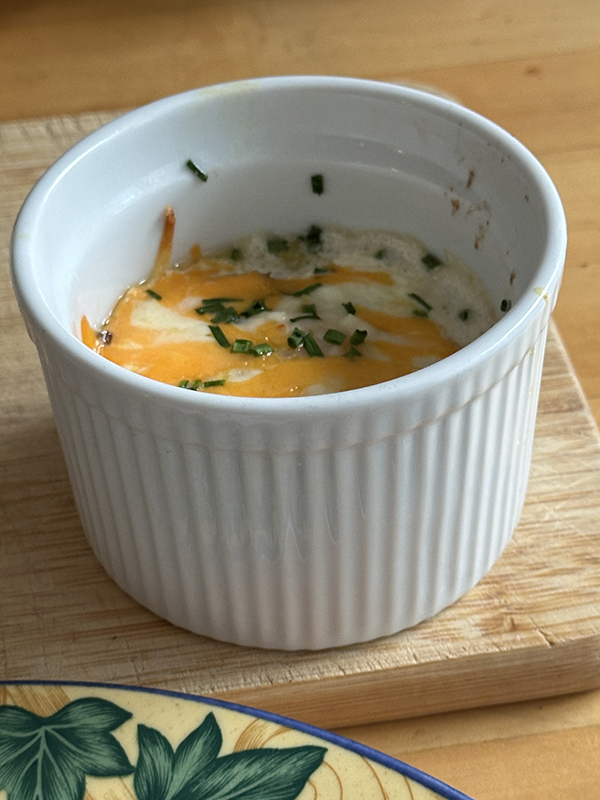
For brunch on Sunday, I made ramekins.

Can I say that? Is ramekin like casserole or paella, a dish (recipe) that has gotten its name from the dish (vessel) that the dish is dished from?

The answers to those questions are (a) yes and (b) no. Ramekin has not transferred the name of the container to the name of the foodstuff. In fact, it’s the reverse: the little round ceramic vessels (like cute little food parentheses) are named after a foodstuff that is made using them.

I should say, first, to be fair, that what I made is more typically called shirred eggs. But there are many ways to make shirred eggs, and the recipe I made also fits the definition of the culinary item called ramekin, which is, to quote the Oxford English Dictionary, “A type of savoury dish based on cheese, mixed with butter, eggs, and seasonings, and usually baked and served in a small mould or dish.” The word has been used in that sense in English since the mid-1600s – borrowed over from French – while the metonymic transference to the ceramic vessel happened only by the later 1800s (Funk’s 1895 Standard Dictionary of the English Language defined that kind of ramekin as “a dish in which ramekins are baked”).

Did you wonder, when I said “borrowed over from French,” why it’s not ramequin? In fact, at the time we borrowed it, it was. So why did we change it? Well… we changed it back. You see, French didn’t invent the word; it traces back to regional Dutch rammeken and Low German ramken. It’s like mannequin, which came from the Dutch manneken – meaning ‘little man’. The -(e)ken suffix is a diminutive.

So the next question must be “Little ram?” Heh. That has produced some perplexity; the OED (and Wikipedia, citing it) scratches its head and says that it seems to come from ram ‘battering ram’, “although the semantic motivation is unclear.” Meanwhile, Wiktionary notes that Rahm is a German word for ‘cream’, cognate with Dutch room (‘whipped cream’ is slagroom, but I’ll have it anyway) and the now-disused English word ream (displaced by cream, which is, go figure, unrelated). That seems a bit more semantically motivating, for what it’s worth.

Anyway, what you probably really want to know is how I made the ramekins. As in the shirred eggs. So here’s the recipe. (And since this is a word blog, not a recipe blog per se, you can’t complain about how long I took to get to the recipe. Be grateful I’m even telling you.)

Ramekin Eggs (one of many ways)

To begin with, make sure you have the following things:

  • 4 ramekins (mine are 4 inches in diameter, I think)
  • 4 eggs (chicken, not quail or duck)
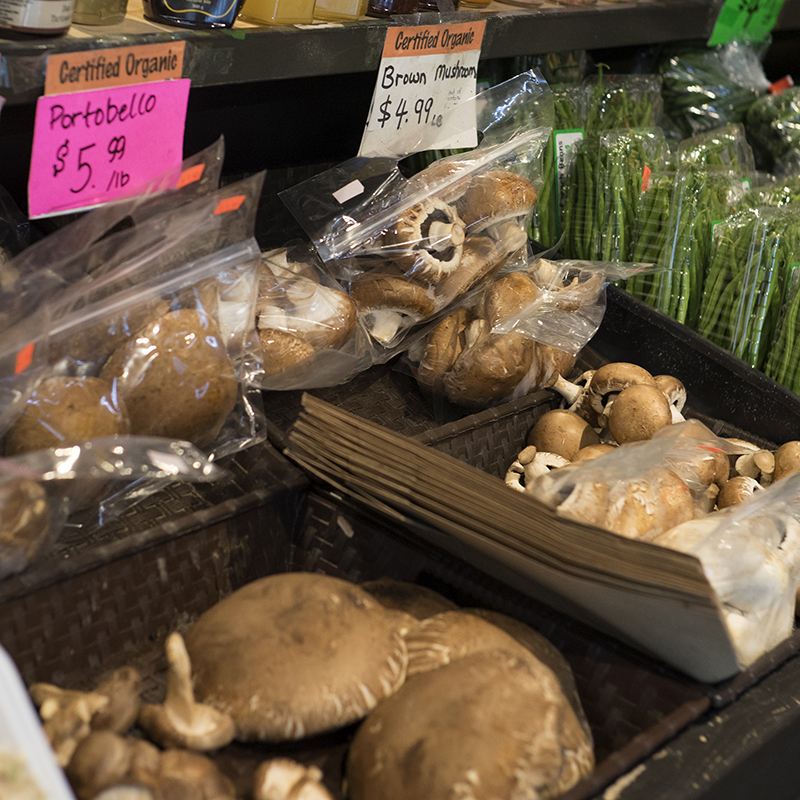
  • 4 mushrooms (brown, i.e., cremini, decent sized, not portobello, portabella, portabello, or portobella)
  • 1 shallot
  • Chives (how much should you get? doesn’t matter; they always sell it in far greater quantities than a normal person can use up before it goes dodgy anyway) (that’s chives, not scallions, OK? whole other ballpark there)
  • 2 thick strips of bacon (the North American kind, preferably “old fashioned” or some other way of saying “expensive”)
  • Whipping cream (get a little carton; you only need a few tablespoons and can use the rest for something else)
  • Shredded cheese (I used some Tex-Mex stuff I had around, but I would otherwise just use cheddar) (and I mean old cheddar) (like old enough to be speaking complete sentences) (but you could use whatever you want, as long as it’s shreddable) (if you use process cheese slices, you will be justly punished by the results of your wicked choice)
  • Butter (say, ¼ cup) (or so)
  • Salt
  • Pepper (if you want)
  • A cutting board
  • A knife
  • Little bowls to hold cut-up ingredients before you put them in the ramekins (optional but it helps)
  • A frying pan (stainless steel or non-stick or cast iron, doesn’t really matter) (you could even use a saucepan)
  • A stovetop
  • A spoon
  • A baking sheet sufficient to hold the 4 ramekins, so you don’t have to lift them one by one out of a hot oven
  • A hot oven (350° Fahrenheit)
  • Something to put the ramekins on when you get them out of the oven
  • Oven mitts (you could use a towel, but I wouldn’t)
  • Someone else to eat this with
  • Champagne (optional)

Now, do these things in this order:

1. Make sure your oven is heating up. (If you are the sort of person who stores things in the oven when it’s not in use, make sure there’s nothing in the oven; also, find a better place for those things, come on.)

2. Cut the mushrooms. I diced two of them fairly small and cut the other two into thin slices, but do whatever pleases you. (Cutting mushrooms is in itself pleasing to me. It’s one of my favourite things to do. So satisfying.) Bear in mind that they will have to fit into those ramekins with the other ingredients. Put them in a bowl.

3. Chop the chives. 6 or 8 oughta do. When in doubt, cut more. You’re not going to run out. Put it in a little bowl.

4. Cut the shallot. After cutting it in half lengthwise and peeling it, I cut each half once longitudinally and then sliced it latitudinally fairly thin. But suit yourself. You could mince it. Anyway, then put it in a little bowl.

5. Dice the bacon. Well, “dice.” I cut each strip in half lengthwise and then cut it into fairly small pieces crosswise.

6. Heat up your frying pan (or equivalent) to about medium. Put the bacon in and get it frying. Then add the butter (we buy it in 1-pound bricks [ahem, 454 grams] so I cut a slice about half an inch [1 centimetre] thick and toss that in). Then add the shallots. Stir and fry. Then add the mushrooms. Sprinkle some salt on them (how much? I dunno, I just use my learned judgment… maybe half a teaspoon? don’t go nuts; you can always add more, but you can’t take any out). Stir and fry until the mushrooms are looking cooked.

7. Oh, by the way, it would have been a good idea to take the eggs out of the fridge to warm them up to room temperature so they’ll cook more quickly. Oh well. I didn’t remember to do that either. Now, where were we…

8. When the mushrooms are looking cooked, add something more than half of the chives to the pan. Stir, fry a few more seconds. Then turn off the heat.

9. Now set those ramekins on that baking sheet. And butter them. You could actually have buttered them before you started the frying, but whatever. This is how I buttered my ramekins: I took about a tablespoon of butter and I used my bare hand to rub it evenly all over the insides of the ramekins. Make sure they’re properly covered. Since you’re working in a kitchen, I’m going to assume you’ve been washing your hands regularly with soap (dish soap is good), so they’re clean. When you’re done buttering the ramekins, wash your hand again. I see no point in using paper towel or plastic wrap to spread the butter so your hand won’t get dirty. Paper towel absorbs butter and plastic wrap is annoying. Just use your hand and wash it after.

10. Spoon all the stuff you just fried into the ramekins. Divide it evenly, of course. Make sure that it’s higher on the sides and lower in the middle, but don’t leave the bottom bare.

11. Crack an egg into each ramekin. You may want to use an intermediary bowl – crack the egg into a little bowl, then dump it from the bowl into the ramekin – so as to give you a chance to pick out stray shell bits and also to set aside any egg you broke the yoke on (so sad) (just ain’t the same with a broke yolk).

12. Pour cream onto and around the egg in each ramekin. Like, a tablespoon or so. Don’t measure it; just use your eyes and the decent sense you have developed over the hard-won years of your life. You should still be able to see the yolk.

13. Sprinkle shredded cheese over the top. How much? Dude, that is 100% up to you, but if you use a whole lot, it’ll be harder to get through and also it will insulate what’s below so you’re more likely to scald your tongue. Enough. Use enough. Probably like ¼ cup on each. I didn’t measure it.

14. Sprinkle the rest of the chives on top of that.

15. Have you been wondering about the pepper? I didn’t use any this time, but you could add it whenever and wherever and in whatever quantity you want. Or put it on the table when you serve it.

16. Put the tray with the ramekins on it into the oven. Middle rack. Close the oven door. Go do something for 15 minutes.

17. They might not be ready yet after 15 minutes. Your thing to look for – and this will be easier if you didn’t go hog-wild with the cheese – is if there’s any clear bit of white next to the yolk. If there is, let it go a couple more minutes and check again. If there isn’t, and especially if the top of the yolk is looking slightly whiter, then you can take it out if you like runny yolks. If you like firm yolks, leave it in a few more minutes. Remember, though, that the eggs will continue cooking after you take it out, because it’s all hot all around them.

18. Take it out (using your oven mitts) and set it on something to cool off for a minute or two. Then serve it to table (I put the ramekins on my small cutting board for transport) and make sure there are things of some kind on the table to allow you and your co-diner to touch the ramekins and move them to the plates without screaming.

19. Aw, heck, did I forget to mention you should have spoons? I wouldn’t eat this with my fingers. You could use forks, but spoons work better.

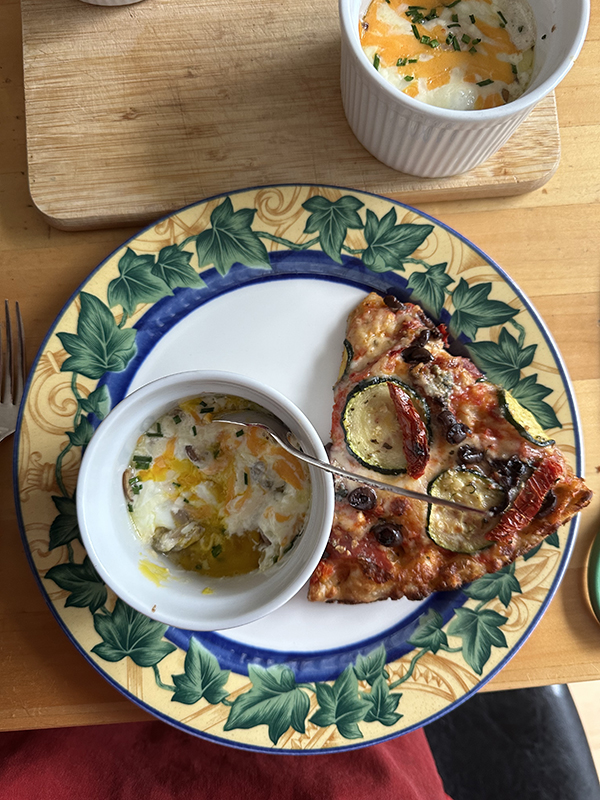
20. Speaking of which, many people like to eat this with toast points. You could go back in time and make them. This time, I just heated up some leftover pizza in the oven since it was on anyway. Why not.

And that’s that for that. You can have it with champagne or with coffee or with whatever you want, but have it with someone else. Only one person, though. My wife suggested I make this the next time we have friends over for brunch, but I pointed out that I would need to buy more ramekins, and they take up space in the cabinets. You see, when planning meals, you must always consider the ramekinifications.

cobra vs. python

If a cobra fought a python, which one would win?

Well, it kinda depends… on what you mean by cobra and by python.

Let’s start with the words themselves (of course; you knew this was coming, so let’s get straight to it). In cobra versus python we have a contest of Latin versus Greek, but we also have two phonaesthetically different words.

Cobra is from Portuguese cobra, which started life as Latin colubra. That means ‘snake’ and is the feminine form of coluber, which also means ‘snake’ (yes, I can see that it looks like ‘someone who lubes along with you’, but I can neither confirm nor deny that it’s ever used to mean that). No one’s really sure where coluber came from. 

Python is, via Latin, from Greek Πύθων, which is the name of the mythical snake slain by Apollo at Delphi. The snake got its name from an older name of Delphi, Πυθώ (Puthō), which might come from a Proto-Indo-European root meaning ‘depths’ but might on the other hand be related to πύθω (puthō) ‘rot’. This Πυθώ, because Delphi was the home of an oracle, was used in some names, most notably Πυθαγόρας, anglicized as Pythagoras; it means, roughly, ‘one who speaks in the public square like an oracle’. (And what does he say, oracularly? Apparently he says “The square on the hypotenuse is equal to the sum of the squares on the other two sides.”)

In a contest of Latin versus Greek, it depends on what you’re comparing. Latin grammar is difficult; Greek grammar is difficulter. Latin gets distorted in English pronunciation; Greek gets distorteder. But one detail we can’t overlook is that most Greek loanwords in English have passed through Latin on their way, and python is among them. So the Latin consumed, but the Greek came out the other side. And in fact python is more intact from its source than cobra is – Portuguese digested a whole syllable of colubra. Meanwhile, English actually added sound to python, changing y from a simple vowel to a diphthong. I’d say python prevails in this one.

Phonaesthetically, it’s hard to choose a winner. Cobra starts in the back with the /k/ and then continues with the mid back rounded vowel, and then the voiced bilabial stop, plus a liquid, and then a neutral vowel; it seems like a name for something that lurks and perhaps (like a bra) embraces and constricts. Python starts with a spit at the lips, /p/, then that narrowing diphthong (the sound of pain, “ay!”), then a soft hissing dental fricative, and so “on.” If I, never having heard of these two kinds of snake, were told that one kills with venom – bitten or spitten – and the other kills by embracing and crushing, I would, if going by the words, guess that cobra is suited to the one that constricts and python is suited to the one that envenoms. Which is, as you may know, exactly wrong.

Cobra is a name for a number of venomous snakes, many of which are of the genus Naja – though perhaps the best-known one, the king cobra, is not; it’s Ophiophagus hannah, and if you know Greek (or taxonomic Latin), you know that the genus name means ‘snake eater’, which is correct: a king cobra is an apex predator and happily eats other snakes, along with anything else that crosses its path at the wrong time. All cobras are among the deadliest of thanatophidians; the venom they carry is not an absolutely guaranteed death sentence, but if you don’t have antivenom on hand and one bites you, you’re in for a rough time – though perhaps not a long time (in some cases, less than an hour before you feel no more pain, ever).

Python, on the other hand, is a name for a number of non-venomous snakes that kill by constriction: they just wait and wait and wait and wait until a suitable bit of prey crosses their path, and then suddenly they leap out and grab it and start squeezing it, and once it stops resisting they eat it.

Neither kind of snake is really a major threat to humans, just because they avoid humans when they can. Also, they usually eat only once every month or two (sometimes even less often), and it takes a while to digest a meal. So that, along with the relative size difference, keeps humans from being likely prey; when these snakes attack humans, it’s usually for defence. People even keep pythons as pets; they are, I read, fairly docile most of the time. (I seem to recall that some people keep cobras, but probably fewer every year by simple attrition. It’s a terrible idea, what with the risk of death or debility from a single bite. Also it’s illegal in many places.)

What do we talk about when we talk about cobra? The Corpus of Contemporary American English (COCA) says that the words most often seen near cobra are king, helicopter, coverage, AH-1W, helicopters, Commander, and Shelby. So the king cobra is top of the list, and then there’s this helicopter, the Bell AH-1W Super Cobra, which is an attack helicopter and apparently a popular one (not with the people it’s attacking, though, of course). Also in there is coverage from the Consolidated Omnibus Budget Reconciliation Act (COBRA), which “gives workers and their families who lose their health benefits the right to choose to continue group health benefits provided by their group health plan for limited periods of time under certain circumstances.” Then there’s Cobra Commander, who is the main antagonist of G.I. Joe. And then there’s the Shelby Cobra, which is a sports car, one of the select few that have had a hit song written about them – which may have been the first place I ever heard the word “cobra,” since I heard that song various times in my long-ago childhood. There are also various sports teams named the Cobras, as people often name sports teams after things they would absolutely not want to find in a locker room.

And what other words show up when we talk about python? COCA says the most frequent ones are Monty, Ruby, flying, Burmese, Java, Perl, and Colt. Obviously Monty Python’s Flying Circus is top of the list. There are many stories of exactly how and why the group decided on that name, and it’s up to you which (if any) of them you wish to swallow, but it was meant to convey a certain slipperiness or sleaze. The most important thing to know is that, should some person not particularly familiar with the troupe ask, the answer to question “Which one of them is Monty?” is of course “Bugger off.” Moving on, the Burmese python is the most talked-about kind of actual python (ball pythons are also popular, partly because they’re smaller). As to Ruby, Java, and Perl, they are all, like Python, high-level scripting programming languages, and you’ve probably interfaced with many things created with each of them. Why did someone name a programming language Python? If you know computer geeks, the correct answer will already have suggested itself to you: yes, of course, after Monty Python. Oh, and Colt Python? It’s a .357 Magnum calibre revolver. I imagine that, if you’re a good shot, you can use a Python of that sort to dispose of a python of one of the other sorts.

Or a cobra. If you must. But be quick. Especially if the cobra is a Colt Cobra, which is a .38 special revolver.

Which takes us back to which would win in Cobra vs. Python. If it’s a .357 Magnum versus a .38 special, well, if they’re shooting at each other and they’re good shots it’s who shoots first, but otherwise my money is on the .357 Magnum Python, which outperforms the .38 special Cobra ballistically (fun fact: as the bullets are actually both .357 inches in diameter – the “.38” refers to the diameter of the casing – you can fire .38 special bullets from a .357 Magnum gun, but not the reverse, because the .357 Magnum shells are much more powerful). If the Cobra is the helicopter, on the other hand, any attack helicopter has the advantage over any single dude with a gun (let alone with a scripting language), but things happen. If the Cobra is a car, are we racing or shooting or biting or coding or what? 

Overall in the list of things, the ones named Cobra are mostly more lethal than the ones named Python (unless you die laughing, which, if I ever was to have done, would have been while watching Monty Python’s The Meaning of Life, so there’s that). But how about snake versus snake?

Well, there are videos. Because it does happen from time to time. But here’s the thing. Both snakes can move quickly – like really quickly. In the time it takes you to sneeze, a python can be wrapped around you (at least enough to hold you while it continues the job). And it can be wrapped around a cobra in that time too. But a python needs to squeeze the life out of its prey, which takes time. A cobra just needs to get one bite in. If a python has a grip on a cobra, the cobra just needs to get its head free enough to sink in one fang and it’s game over. Yes, cobra venom is toxic to pythons – fast-acting, too. So unless the python gets exactly the right grip and never slips, the cobra wins.

squab

“So I was out with my squad,” Arlene told me and Jess as we sat in a new hip coffee joint called The Exquisite Exequies, “and we went to this fancy restaurant, and somehow we ended up having squab.”

Jess raised her eyebrows. “That’s unexpected.”

“Yeah,” Arlene said. She paused to sip her coffee and peer up at the oversized stuffed Harlequin. “I thought that was something you did to decks.”

“Swab?” I said.

“Yeah, I guess I kind of swapped words there. Anyway, that’s not what we thought we were getting. It was dim and the menu was in a kind of squiggle, so we had to squint. And then when it arrived there was a little squabble. See, I thought it said squid.”

“Wouldn’t it have said ‘calamari,’ then?” Jess said. “They don’t usually like using the plain English word.”

“So why do they use the plain English word for squab, then?” Arlene said. “What would that be in Italian anyway?”

I was already on it; I had my phone out. “…Piccioncino, apparently.”

“That’s kinda cute,” Arlene said. “It sounds like a sausage. Or a Starbucks drink. (Oops.)” She glanced around to make sure no one had heard her say “Starbucks.”

Jess also had her phone out. “Wait, Google Translate says ‘piccioncino’ means ‘lovebird’.”

“What?” Arlene said. “I ate a lovebird? Oh, that’s sad.” Jess raised an eyebrow at her. “I mean, a literal lovebird bird,” Arlene clarified, “not, you know… figuratively.” She turned a pink that was probably similar to the colour of her squab – they’re usually served fairly rare. Also fairly rarely.

“Squab is not a lovebird,” I said. “‘Piccioncino’ literally means ‘little pigeon’, so that’s why it gave me that. The French word for squab is ‘pigeonneau’, which also means ‘little pigeon’.”

“But it’s not literally a little pigeon,” Arlene said.

Jess started nodding sadly. I added a sad nod.

“One-month-old pigeon,” I said. “Grown to adult size but not yet flying.”

“Oh no,” said Arlene, looking a bit squicked. “That’s even worse.”

“They’re farm-raised, not wild caught, if that matters to you,” I said. “You’re not getting a bird from the parking lot that’s been dining on trash. Pigeons have been raised for food for all of recorded history.”

“I mean, it wasn’t bad…” Arlene said. “Maybe a bit small.”

“Yeah, I think bigger birds just give better return on investment,” I said. “Chicken, turkey, goose.”

“All of which,” Jess said, “are also insults. Unlike ‘squab.’ Oh, and ‘duck.’”

“What?” Arlene ducked slightly and looked up and around. The various plasticine fairies suspended from the ceiling remained immobile. “Oh, ha ha. …So they call it ‘squab’ because ‘pigeon’ would bother people?”

“It doesn’t seem to bother the French or Italians,” Jess pointed out.

“Yeah, but on the other hand,” I said, “they also call other kinds of meat after the animal: ‘bœuf, porc.’ We don’t say we eat pig or cow.”

“Or squid,” Arlene said.

“We do eat duck and chicken, though,” Jess said.

“I think part of it in this case,” I said, “is that a squab is not a fully adult pigeon. It’s grown to adult size, but it’s still young and fat and hasn’t gotten tough from flying. The word ‘squab’ was first used for any kind of fat young bird, and then it generally got narrowed to mean a pigeon. The word has also been used to refer to cushions –” I glanced at the overstuffed superannuated pink bolsters on the sofa I was occupying – “and people who… resemble a cushion.”

“How rude,” Arlene said.

“That’s true. I don’t think it’s used like that anymore.”

“Well, it does sound… pudgy.”

“So, mister phonaesthetic?” Jess said. “Is that where it comes from? Sound symbolism?”

“We don’t really know,” I said. “It kind of showed up in the 1600s. It may be related to a Swedish dialect word that refers to fat or flab. There’s an old ideophone ‘squab’ or ‘squob’ that imitates the sound of something landing with a heavy fall or squash.”

“So it could be,” Jess said, “that it just fell squob into the language.” She picked up a small decorative beanbag and dropped it on the coffee table for effect.

“Or burst into it like a squib,” I said.

“A damp squib,” Arlene offered.

“Moist,” Jess said. I winced. “Speaking of which,” Jess added, “how was the squab?”

“It was… good,” Arlene said. “Kinda fatty. So even though it wasn’t big, it was filling.”

“Made a square meal?” I said.

“More like round,” Arlene said. “But I didn’t even entirely finish mine.”

“Wasn’t it expensive?” Jess said.

“Yeah… I kinda squandered it, I guess.”

“Did it come with a vegetable?” I said.

“Oh!” Arlene said. “Yeah, it was –”

Jess interrupted her. “Let me guess –”

And, nodding in unison, they said, “Squash.”

ostrich

You may recall, from the learning revealed at the end of my last word tasting note, that, at least once in the 1580s, abstruse was used for ostrich (“many Abstruses in the Plaines,” the Oxford English Dictionary quotes). You may have noted then that I didn’t remark on how that could have happened. Was it through some arcane process? Or perhaps an ill-consumed cocktail of absinthe and Chartreuse? (Definitely not that; neither liquor existed in 1580.)

In truth, it’s fairly straightforward, which is a blessing in bird names. Some birds, yes, are named clearly enough – after the sound they make (chickadee), what they eat (flycatcher), where they are wrongly presumed to be from (turkey – which in French is dinde, from d’Inde, ‘of India’, and in other languages is named after Guinea, Peru, and even the city of Calicut), and sometimes what they look like. Others should be named one of those ways. The Canada goose, for instance, is sometimes affectionately called the cobra chicken by Canadians, for reasons that are obvious if you’ve ever surprised one on a footpath.

In the case of the abstruse naming of the ostrich, the quotation is from an English translation of a book about the “discovery and conquest” of Peru (by a bunch of turkeys, so to speak). Here is the full line as given by the OED: “In certaine places of Chili, were many Abstruses in the Plaines.” The author is, in fact, not even talking about real ostriches; the birds he saw were rheas. But the original author was writing in Spanish, and the Spanish word for ostrich is avestruz.

Yes. If you know that v and b are phonologically interchangeable in Spanish, you can see that avestruz is within a pinfeather of abstruse. That’s rather straightforward, isn’t it?

So then we need only wonder where this word avestruz comes from. We will note right away that it seems related to the French word for the same bird, autruche. And we will further note that autruche is within a pinfeather of Autriche, which is the French name for Austria. Could it be that this African bird was, like the turkey, named after a country it had nothing to do with?

Nope. Pure coincidence. Sorry. Autruche and avestruz both come by meandering pathways from Latin avis struthio – where avis means ‘bird’ and struthio means ‘ostrich’. Struth! I don’t know why they needed to respecify “bird,” but there you have it. (As to English ostrich, by the way, it is from the same root, but by way of Old French.)

OK, so where does struthio come from? It’s a Latinization of Greek στρουθίων strouthíōn. Which also means ‘ostrich’, but it’s a shortened form of the full name: στρουθοκάμηλος strouthokámēlos. I mean, I can see why they’d shorten it a bit, can’t you? It’s rather long-necked as it is.

Speaking of which: στρουθοκάμηλος is a compound. It’s made from στρουθός strouthós, ‘sparrow’ and‎ κάμηλος kámēlos, ‘camel’. Why is it called that? For the same reason we call a Canada goose a cobra chicken. Camels have long necks, you see. And I guess somehow the sparrow was the particular bird that came to mind. I can’t say I see why. But maybe it was sarcasm. Or imprecision about scale. Or maybe it’s that it’s not a camel sparrow, it’s a sparrow camel: camel with sparrow mods, rather than the converse.

So. The ostrich was once called the abstruse for what turns out to be simultaneously the most and least recondite reason imaginable. Is that a stretch? Well, don’t say I never stuck my neck out for you.

abstruse, recondite

I learned something not too many people know last night.

My wife and I went just a short block up the street at the end of which we live, to the theatre, to a splendid production of Who’s Afraid of Virginia Woolf by Edward Albee, put on by Canadian Stage, directed by Brendan Healy, and starring Martha Burns, Paul Gross, Hailey Gillis, and – as a late replacement (due to an unspecified health event) – Rylan Wilkie. We were seated in the front row, which is my favourite place in any live theatre. This play is not about Virginia Woolf; it joins The Iceman Cometh in founding its title on a joke that is at once louche and recherché. It is a classic of the twentieth-century American theatre, and I’m not going to tell you all about the plot, but it takes place between about 2:00 and 6:00 in the morning in a living room in a small New England college town and goes through much liquor, many words, and quite a lot of often (but not always) hilarious cruelty. In my last year of getting my BFA in drama I did a short piece of the play with another student in acting class (the George-and-Martha two-person stretch in the middle of act 2). I recall actually learning something about acting when I did that scene.

When we saw the play last night, I learned something about language.

Specifically the pronunciation of one word.

Allow me to reproduce, first, a snippet of dialogue from act 1, which I have ready to hand not because I have the script of the play (I’m not sure I do; I thought I did but I can’t find it on my shelf) but because it’s the epigraph for Dreyer’s English, by Benjamin Dreyer, of which I do have a copy:

MARTHA. So? He’s a biologist. Good for him. Biology’s even better. It’s less . . . abstruse.

GEORGE. Abstract.

MARTHA. ABSTRUSE! In the sense of recondite. (Sticks her tongue out at GEORGE) Don’t you tell me words.

(WordPress is preventing me from applying proper small caps; please imagine them in place of the full caps you see in the quote above.)

So which word surprised me? You may guess, but allow me to adduce J. Walker’s Critical Pronouncing Dictionary of 1791, as quoted by the Oxford English Dictionary:

Dr. Johnson, Dr. Ash, Dr. Kenrick, Mr. Nares, Mr. Scott, Mr. Fry, and Entick, accent this word on the second syllable; Mr. Sheridan and Bailey on the last. Notwithstanding these authorities, I am mistaken if the best speakers do not pronounce this word with the accent on the first syllable, and if it is not agreeable to analogy to do so. A few words of three syllables from the Latin, when anglicised, without altering the number of syllables, have the accent on the same syllable as in the Latin, as Opponent, Deponent, &c.; but the general inclination of our language is to place the accent on the first syllable, as in Manducate, Indagate, &c.

I have always been in the camp of Drs. Johnson, Ash, and Kenrick, and Messrs. Nares, Scott, Fry, and Entick, saying “re-con-dite,” and until I heard Martha Burns pronounce the word live on stage, I had not realized that stressing the first syllable – like “reckon-dite” – was even an option. But as it turns out, Mr. Walker’s taste has prevailed: it’s the first listed option in Merriam-Webster as well as in Oxford.

Well, what. I may have an enormous vocabulary (in fact, I do; it’s been demonstrated on tests as well as through normal people not understanding words I tell them from time to time), but I acquired many of these words through reading, as one does. And recondite is a word that surely describes itself: ‘little-known, little-understood, abstruse’.

Recondite in the sense of abstruse? Sure: the words can serve to define each other. The OED defines abstruse as “difficult to understand; obscure, recondite” and recondite as (among other things) “little known or understood; abstruse, obscure; profound.” It seems apposite, doesn’t it? The arcade of the arcane, a circuit of many a quaint and curious volume of forgotten lore, looking up things from one foxed and vermiculated volume to another and so, by a commodius vicus of recirculation, back to the first.

What is the substrate of abstruse? Its source is Latin abstrusus, past tense of abstrudere ‘conceal, hide, thrust away’ from ab- ‘away’ and trudere ‘thrust’. If you are thumbing the ancient pages of secret knowledge and someone comes around the corner, you may thrust the volume deep into the nearest shelf. Or, if you are an ordinary person who dwells in the plain and has no taste for twenty-dollar words, you may just thrust it all away from you like a surprise ortolan canapé.

And how may we recognize or reconnoitre recondite? It comes from Latin reconditus, from re- ‘back’ plus condere, from con- ‘with, together’ and dare ‘put’, which, all put back together, means ‘hidden, concealed, put away’. The parts are all well known and well used, but the recipe is singular; it’s like the difference between C2H50H and CH30H – just a tweak of proportions changes ethanol, fuel of many a play, to methanol (imagine a recipe for cake such that if you halved the number of eggs it could make you blind).

But enough biology. (By the way, what, in the quote from the play, is biology better than? Math, as it happens. But the two can work together: with C2H50H, the effect of biology is to make you number.) For whatever reason (its faint hint of Chartreuse? the strangling strength of str?), abstruse seems to be the more common word. The OED declares that abstruse occurs about once every two million words in modern written English, whereas recondite occurs about once every three million words, making it indeed a bit more recondite. But recondite has a faintly more highbrow air to recommend inditing it, at least to me. 

Either word, mind you, is suited best for a person with their head buried in a stack of books like the legendary ostrich with its head in the earth. Which is apposite when you learn – as I did, late last evening – that, at least once in the 1580s, abstruse was used for ostrich (“many Abstruses in the Plaines,” the OED quotes). Such are the things you can learn if, when faced with recondite knowledge, you do what the plain-dwelling abstruses ought: look up.

quisling

I imagine you’re familiar with quisling. It’s a pretty well-known word. The broadest definition is ‘traitor’, but more particularly it’s ‘citizen who collaborates with an occupying force’ – and more particularly still ‘citizen who serves as a political puppet of an invading country’.

It’s a word with a certain something: echoes of queasy and gosling and underling and questionable and quiz and maybe even weaseling… all those quirky q words plus the slick clinging sling, said “zling.” And it’s an eponym: Vidkun Quisling was the puppet head of government for Norway when the Nazis were in control of the country. One may well wonder: given how phonaesthetically apt quisling seems for a traitorweasel, to what extent was Vidkun Quisling’s name his destiny?

The full story of Quisling’s life and poor choices and their consequences is widely available, but I’ll give a quick run-down here. Vidkun Quisling was born in 1887 in southern Norway. He was an academically gifted student who found his way into the diplomatic corps. In 1929 he settled back in Norway and became active in national politics, moving gradually towards fascism and publishing openly racist views. By 1932 he was head of a new political party, Nasjonal Samling (National Unity), with support from many in the Oslo upper classes. However, although he thought that Norwegians were the most racially superior people in the world, Norwegians didn’t, overall, return the esteem; his party underperformed badly in elections. 

But when Hitler came to power, Quisling saw him as a hero and model and offered assistance in his goals. And, in early April 1940, when Norway found itself unable to remain neutral in World War II, Vidkun Quisling was ready to head up a German-backed government, and he attempted a coup in aid of that. However, Hitler wanted more legitimacy; he asked King Haakon of Norway to appoint Quisling prime minister. Haakon said no way, no one wants that guy. Hitler said OK, appoint someone else then. And Quisling was out… for the moment. 

But the king really didn’t want German domination, so Hitler suspended the monarchy and appointed a German governor-general to run the country. And at length, through political manoeuvring and general sucking up to Hitler, by the end of 1940 Quisling made his way into the halls of power with his Nasjonal Samling, which was then declared the only party allowed. And by 1942 he was, with German backing, “minister president.”

Quisling’s views were very much in line with Hitler’s – including virulent antisemitism – except that he saw Norwegians, not Germans, as the ultimate master race, and he wanted full independence for Norway… with him in command, of course. An obstacle to this was that he was, by this time, ferociously unpopular among Norwegians, and all his power came from German backing. Hitler could see quite well that if he cut the strings, Quisling would fall as quickly and completely as any puppet.

And, indeed, as soon as Germany surrendered in early May 1945, Quisling’s government fell and he was arrested. Long story short: in October 1945 he was executed by a firing squad in Oslo.

So yeah. A guy who, unable to achieve all his goals domestically, decided to take the opportunity of an invading power to gain his ends – but of course, since the invaders had the real power, he was always just being used for their ends. He betrayed his country to try to build his vision of his country; he helped an invading power to build his own stature. And the result? Well, he did become famous…

In fact, he was internationally famous even before he actually became head of the puppet government. As soon as he attempted the pro-German coup in April 1940, his renown was established: The Times published an editorial under the headline “Quislings everywhere” which said, among other things, “To writers, the word ‘Quisling’ is a gift from the gods. If they had been ordered to invent a new word for traitor… they could hardly have hit upon a more brilliant combination of letters. Aurally it contrives to suggest something at once slippery and tortuous.” The word caught on quickly; by June 1941, Churchill was using it in speeches, such as in one to Allied delegates: “A vile race of Quislings—to use a new word which will carry the scorn of mankind down the centuries—is hired to fawn upon the conqueror, to collaborate in his designs and to enforce his rule upon their fellow countrymen while groveling low themselves.”

It really is a wormy and weak kind of word in its way. Which, by the way, doesn’t match the visual presence of Vidkun Quisling: he was reasonably tall, reasonably well built, reasonably good looking. But what does that matter, eh? When you’re a treacherous weasel? And when you have that slippery Q right there?

Which, by the way, is not a typical Norwegian letter at all. Norwegian has never had a need for qu; it’s always been just fine with kv. This advocate of the superiority of Norwegianness who surrendered the real power to a foreign invader had a name that also drew on esteem for a foreign invader: Latin. (English has likewise acquired some q spellings through such esteem; for instance, Old English cwen is now queen.) 

You see, one of Quisling’s ancestors was from Kvislemark, a village in Denmark. (The village name appears to come from Old Norse kvísl ‘branch, fork’ and mǫrk ‘borderland, woodland’ – forking around the border?) The ancestor in question, on moving up to Norway, decided to make a Latinate derivative, Quislinus, which he then shortened to Quislin. And that, over time, re-Scandinavianized its ending to Quisling. If his ancestor had simply kept Kvislemark – and perhaps stayed in Denmark – do you think the name would have become a byword for betrayal of one’s homeland? It seems as though by chasing esteem by borrowing on a foreign power, he ended up with exactly the wrong kind of renown. 

So Vidkun Quisling’s name was, in a way, his destiny. Oh, and what about his first name? Vidkun is no foreign invader: it’s a purely Norse name, sometimes spelled Vidkunn (double n). It comes from Old Norse víðr ‘widely’ +‎ kunnr ‘known’ – in other words, ‘famous’.

fly-blown, full-blown

Metaphorical turns of phrase can, with time, become tired, dusty, decaying… it gets to be like flogging a dead horse. But what you’re seeing is just the surface; appearances can deceive. Sometimes, with a bit of historical decortication, what may seem a fly-blown idiom can reveal a full-blown case of mistaken identity.

Have you ever paused to consider fly-blown, by the way? We know it means ‘sordid, squalid, rotten’. I had always thought of it as an image of some creature or thing lying out in the elements and beset by insects: a horse corpse, perhaps, with the high prairie wind desiccating it and flies blowing around it. 

Well, it’s sort of like that, but sort of not. I’ll tell you now that it’s more disgusting.

In fact, don’t look at the Wiktionary definition page for flyblow if you don’t like being ambushed by a picture of something that may for an instant seem innocuous but, on description, is likely to creep into your dreams. Oh, did you notice I said for flyblow and not for flyblown or fly-blown? Here’s why: fly-blown (with or without the hyphen) means ‘contaminated with flyblows’. That’s right. It doesn’t mean it has flies blowing around it. So what’s a flyblow?

You don’t have to read on if you don’t want.

A flyblow (or fly-blow) is, to use the Oxford English Dictionary’s definition, “The egg deposited by a fly in the flesh of an animal, or the maggot proceeding therefrom.” The Wiktionary page kindly illustrates with a photo of a flyblown human shoulder.

Look, I warned you.

So this is the fly we expect – the insect (which, by the way, is etymologically identical with fly the verb, as in what flies do when they’re not eating, mating, or laying eggs). But it’s a different blow?

Ha, no. It’s the same blow as in the wind. Somehow the blow that is the noun form of the verb blow, as in what wind does, has come also (since the 1600s at least) to have the meaning (per the OED) “The oviposition of flesh-flies or other insects.” The OED quotes from a 1611 translation of the Iliad: “I much fear lest with the blows of flies His brass-inflicted wounds are fil’d.”

It may seem sensible to expect that the eggs are called fly-blows because they come from the blowfly. In fact, it’s the reverse: blowflies are so called by reference to fly-blows – they’re the insects that show up and blow their blows into the carrion. The first known use of blowfly is from more than a century after the first known use of fly-blow. It seems, rather, that the eggs are called blows because the fly seems to blow them into the carrion – or anyway that the maggots that hatch from them a few hours later can be found deep enough to seem blown in.

So fly-blown is not a mistaken identity but rather something that appears to be a mistaken identity. Not full-blown at all. But on the other hand, full-blown

Well, you tell me what image full-blown gives you. I don’t mean what it usually applies to – a disease, for instance – but where the metaphor seems to come from. Do you picture sails on a ship, with the wind full in them? Such sails can indeed be called full-blown. However, that’s not where our conventional use of full-blown comes from.

Here’s a 1578 quote from the playwright John Lyly, courtesy of the OED: “A Rose is sweeter in the budde then full blowne.” Here’s an 1878 one from Robert Browning: “Flower that’s full-blown tempts the butterfly.” These flowers are not blowing in the wind. They are in full bloom.

And this blow comes from the same root as bloom – and as the modern German word for the verb ‘bloom’: blühen. It’s not related to the other blow (as in the wind), but they’ve been blown together by coincidence, and then by the attraction of resemblance, at least since Middle English.

Any flower can be “full-blown,” too; it doesn’t have to be a rose or other pretty and sweet-smelling one. The lily Helicodiceros muscivorus can be full-blown, and while it’s as pretty to look at as many a lily, its common name will tell you why you won’t be getting it at your florist: it’s the dead horse arum lily. This lily produces an aroma that (I hope) you don’t want in your house, but it’s very attractive to certain kinds of flies.

I think you can see where this is going; no need to flog a dead horse. Yes, a Helicodiceros muscivorus, when full-blown, can be fly-blown. (Oh, and if you know Latin, you may be smiling at muscivorus: it means ‘fly-eating’. But the lily doesn’t actually eat the flies; it only traps them inside overnight so they can fulfill their pollination mission. Then they are free to blow away on the wind once again.)

Pronunciation tip: 64 French expressions

A little bit of French has long been a sign of culture in English (never mind how much of our vocabulary comes from French). We like to drop in the occasional cultured phrase… and many of us aim to be particular about the pronunciation… including some people who don’t really know the original French pronunciation. I have pronunciation tips for 64 French terms that get tossed around in English, not always accurately. This doesn’t include food-related terms; I’ll do a separate video for those. Today I cover aide-de-camp, au contraire, au naturel, avant-garde, Beaux-Arts, Bell Époque, bête noire, bon voyage, boudoir, bric-à-brac, bricolage, cache, cachet, carte blanche, cause célèbrechaise longue, cherchez la femme, clique, concierge, couloir, coup d’état, coup de grâce, crèche, cul-de-sac, de rigueur, déjà vu, eau de toilette, en pointe, en route, esprit de corps, fait accompli, femme fatale, fin de siècle, fleur-de-lis, haute couture, idée fixe, je ne sais quoi, joie de vivre, laissez-faire, lèse majesté, lingerie, ménage à trois, naïveté, noblesse oblige, nom de plume, nouveau riche, œuvre, oh là là, papier-mâché, pas de deux, petite bourgeoisie, pied-à-terre, prêt-à-porter, prix fixe, quelle horreur, raison d’être, roman à clef, roué, sacrebleu, sang-froid, savoir-faire, tête-à-tête, trompe-l’œil, and vis-à-vis.

mend, mendacious, mendacity, mendicant

You have a hole in your soul, a hole in the sole of your sock, or a rend in your heart, and how do you mend it? How can comfort be yours on this cold mountain? Do you say “Mend? I can’t without your help” and become a mendicant – do you go begging, alms for what ails you, yearning for yarn or a salve for your salvation? Or do you say audaciously “Mend this little thing? I can even mend a city!” and choose mendacity – do you satisfy it with comforting myths, happy little lies, or perhaps the belief that tearing another person’s soul or sole or breaking their heart will heal yours? Or do you just fix a previous “fix”?

There are many ways to repair faults. Some say that the best way to mend is to add more – this suits with socks, but darn it, there’s always that tough patch. Others say that taking away is better: removing the fault you feel or the fault you inflict. At root, you may need to know how it all started.

And in the case of today’s words, it started with Latin menda ‘fault, defect’. That headed in three different directions. 

It added the suffix -icus ‘pertaining to’ to give mendicus, literally ‘having fault’ or ‘faultlike’ but used to mean ‘needy, indigent, beggarly’. That has comes down to us as medicant, a beggar, someone who can’t mend their problem without your contribution.

It added the suffix -ax ‘having the tendency’ to give mendax, literally ‘faulty’ or ‘faultish’ but used to mean ‘unreal, false, deceptive, untruthful’. That has come down to us as mendacious ‘inclined to lying’ and mendacity ‘occasion or condition of lying’, that is, speech that has fault: in place of mending it gives audacity.

It added the prefix e- (trimmed from ex-) to give the verb emendo ‘I correct, I cure, I atone, I chastise, I repair’, which passed through Old French to become the Middle English amenden, which we now know as amend (and, separately, emend was taken directly from the Latin), but amend was trimmed down just a bit more to make mend. At long last the mend- root has been de-faulted – a fix that was accomplished by removal of affixes.

There are other mend words out there, of course. There is Mendocino, a derivative of Mendoza, which is a Spanish name of Basque origin, thought originally to mean ‘cold mountain’. And there is Mendelssohn, from Mendel, from the Yiddish personal name Mendl, a diminutive of man ‘man’ used as a pet form of Menachem, which comes from Hebrew for ‘comfort, console’. Neither is related to our mend – one can’t produce etymological relatives on demand – but both have meandered over time to far from where they started. 

They need no mending; words change naturally. And sometimes the same word takes multiple paths. But if you seek comfort on the cold mountain and need to ease your mind, remember that the most direct route is not mendicancy or mendacity, but simply to mend.

wake

Life is but a dream, and it ends with a wake. You can see it, the ship of dreams passing through the sea of existence, trailing ripples behind it; when the person is gone, they leave – as Arundhati Roy would put it – a person-shaped hole in the universe, but unless we are in a world of ice, the hole becomes waves that spread, expanding like your lips as you say the /w/ in “wake”; the passing of the person makes ripples that are wider and fainter until, through recirculation, they are at last subsumed into the general Brownian motion of all things… just like the vivid dreams that evanesce from your mind when you wake: “A way a lone a last a loved a long the”—

One wakes, and one has one wake, but there are two wakes. One wake is a verb that is a convergence of two similar ancient verbs having to do with coming out of slumber and being aware; it has also begotten a noun that refers to staying up rather than sleeping, in particular the night before – or, in some cultures, after – a person’s interment or cremation, when the family and friends swim in the last ripples of the person’s existence, reflecting on the fading dream of life rather than, this night, dreaming the fading reflections of life. (I remember going to many of these in my childhood, in small houses heated by old iron stoves, with many small cups of strong tea, and a man named Lazarus leading the hymns.) The other wake is a noun that has to do with the movement of water, related also to an Old Norse word for a hole in the ice: a displacement, but never permanent. A wake may even be the chaotic currents in the air left by a butterfly that will later wonder if it is a man that dreamed it was a butterfly or a butterfly that is dreaming it’s a man. Which side of the wave is awake?

Wake is a word of disruption, of awareness, of a turning of a switch, a change of the narrative, like the ablaut from awake to awoken. You wake to cold, hard reality, to facts, to the existence of other humans, people you cannot and should not ignore or treat as dream phantasms. You are, probably, still in the warm, soft comfort of your bed when you wake, but that will change. You will arise, leaving a you-shaped hole in the sheets, an impression that might stay as it is or might be tidied up, but the thing that leaves no impression at all on the physical is the dream, the entire oneiric world, its faint wake now rippling away in your mind.

And we all must wake, again and again. And we all must wake others. And we all must leave wakes, in the water and for other people. We cannot dream our way through life, even if life will end with a wake. The waves that ripple above our heads are motions of the surface that we, too, must ultimately pierce – or, as T.S. Eliot elegizes in “The Love Song of J. Alfred Prufrock,”

We have lingered in the chambers of the sea
By sea-girls wreathed with seaweed red and brown
Till human voices wake us, and we drown.

We leave a wake or we leave, awake. But we are such stuff as dreams are made on; and our little life is rounded with a sleep. And at the end of the day, we submerge and turn to the fin again, like James Joyce beginning Finnegans Wake, a long the “riverrun, past Eve and Adam’s, from swerve of shore to bend of bay, brings us by a commodius vicus of recirculation back…”