

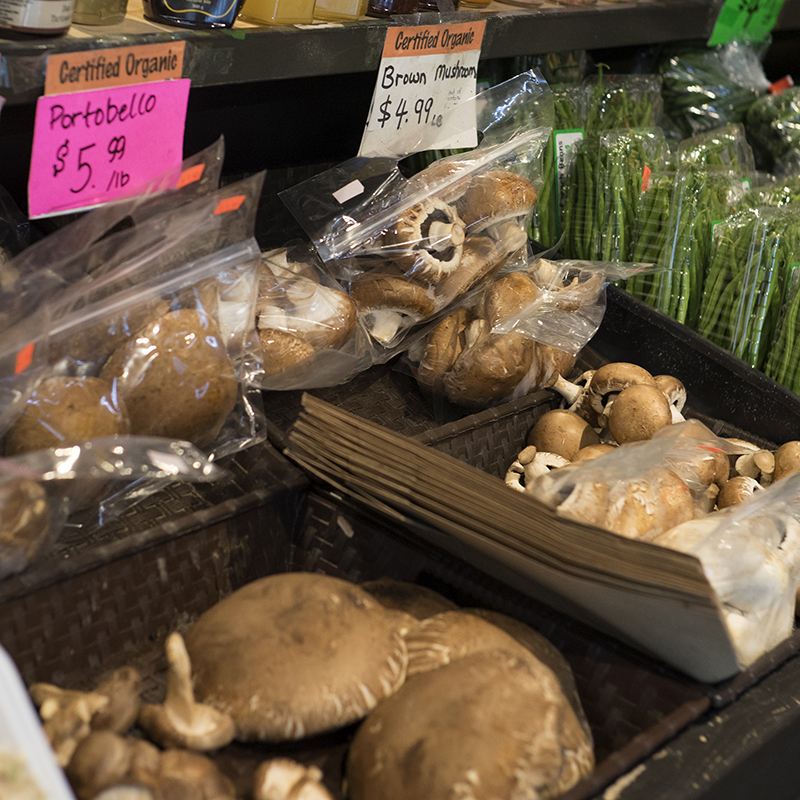
How do you discriminate between cremini and portobello mushrooms? A portobello is less portable.
But the difference is incremental. You see, white button mushrooms (“champignon de Paris”), brown (cremini) mushrooms, and the big barbecuable beasties named portobello are all Agaricus bisporus, and the difference is mainly their age – though the white ones are descended from a mutant variety discovered in 1925 in Pennsylvania.
Pennsylvania! But they’re called champignon de Paris! Next I’m going to say that the cremini and portobello ones aren’t from Italy.
Yes, I am. Well, to be fair, they do grow them in Italy. But you don’t have to be in Cremona to get cremini; they’re also grown in all sorts of other places in Europe and North America. And the same, of course, goes for portobello; they’re grown in exactly the same places as cremini, just for longer (sometimes cremini are called “baby bella” – though I’ve never seen portobello mushrooms called anything like “cremaxi”).
But they didn’t get their names in Italy. If you ask for “funghi cremini” or “funghi portobello” in Italy they probably won’t know what the heck you’re talking about. You’d have to ask for “prataiolo” or use the French word “champignon.” These names – cremini and portobello – are marketing board inventions. The first use of cremini seems to have been around 1984; it’s based, apparently, on a diminutive of crema ‘cream’, and on what, per their research, sounds good to American consumers. The first citation the OED has for portobello is from 1985; it’s based, evidently, on Italian for ‘lovely port’ and, again, on what sounds good and impressive. They both sound like Italian place names – Cremona, for instance, the name of which traces back to shadows in the mists of ancient time, and, well, pick your pretty port (perhaps Porto Ercole, near Orbetello). And of course we all know that Italian food is delicious.
Well, criminy! That’s kind of incriminating, isn’t it? Ah, yeah, but what the heck. Consider the multiple spellings you can see: both cremini and crimini, and all four of portobello, portabella, portobella, and portabello, the last two of which would be grammatically incoherent in Italian – and yet there never seem to be grammar numpties ranging around with markers to make corrections. (There is, in fact, some uncertainty about which of the variants of each is technically correct. I go with cremini because it’s the more common variant and because it’s creamy rather than criminal, and I go with portobello because it’s the most common variant and because portabella means ‘pretty door’ – which it could be, I suppose – and the other two are, as I mentioned, grammatically incoherent: inflections are supposed to match between nouns and adjectives.)
Do you feel browned off by this? Does it make you not even want to use the words? There are a few other marketing-created terms you would, for consistency, also have to eschew – kiwi fruit, for one, and let’s not get started on the Italianate concoctions populating Starbucks menu boards. And even if you managed to cancel those, more marketing imaginations would sprout up like mushrooms, thriving in any fertile environment – especially one with ample manure. But, yes, you can always call them “brown mushrooms” and, I guess, “monster mushrooms” – actually, people didn’t talk about the full-grown Agaricus bisporus much before they got the fancy name: you can also thank the marketing board for pointing out that they make a suitable substitute for meat, and pretty much opening the door to their common usage with that name.





 Sesquiotica