
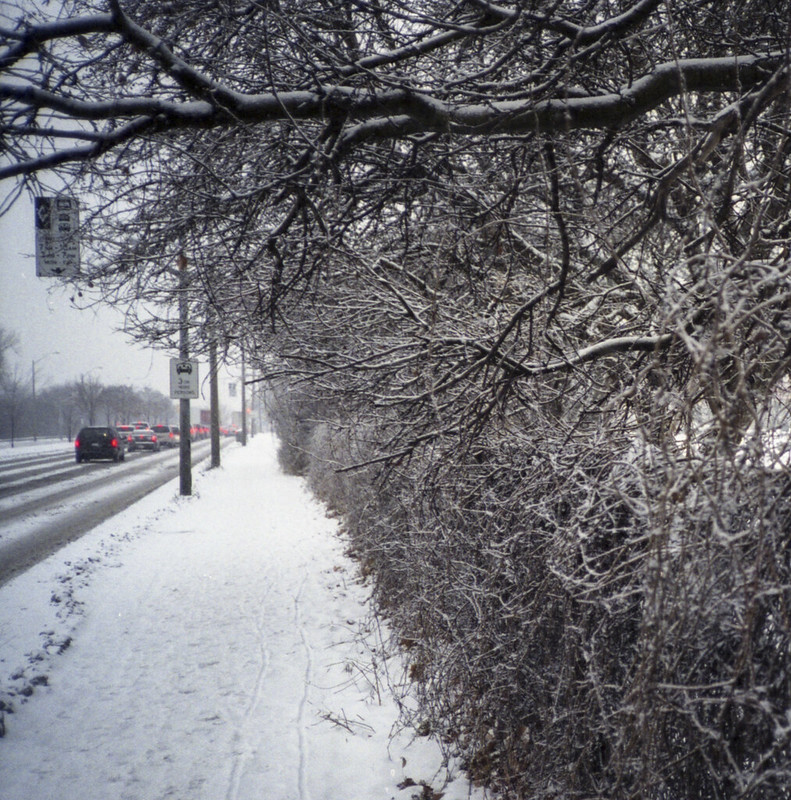
We are in the season of dreary weather now, and shall remain largely in it for some months. There will be breaks of sun, yes, and festive decorations for a time, but by and large it will be dreadfully bleary and drab and uncheery as we drudge, weary, through the grey rain and dull snow, longing even for the quick red break of a brake light.
Dreary is a word that seems well suited to its sense, and it is readily used as a clear brushstroke in poetry. It is a word of winter, often, and of wintry places:
Be left more desolate, more dreary cold
Than a forsaken bird’s-nest filled with snow
’Mid its own bush of leafless eglantine—
Speak, that my torturing doubts their end may know.
—William Wordsworth, “Why art thou silent! Is thy love a plant”Let the wind moan through the pine-trees
With a dreary, dirge-like whistle,
Sweep the dead leaves on its bosom,—
Moaning, sobbing through the branches,
Where the summer laughed so gayly.
—Harriet Beecher Stowe, “Below”All day the gusty north-wind bore
The loosening drift its breath before;
Low circling round its southern zone,
The sun through dazzling snow-mist shone.
No church-bell lent its Christian tone
To the savage air, no social smoke
Curled over woods of snow-hung oak.
A solitude made more intense
By dreary-voicëd elements,
The shrieking of the mindless wind,
The moaning tree-boughs swaying blind,
And on the glass the unmeaning beat
Of ghostly finger-tips of sleet.
—John Greenleaf Whittier, “Snow-Bound: A Winter Idyl”Ae dreary, windy, winter night,
The stars shot down wi’ sklentin light
—Robert Burns, “Address to the Devil”I’m on my way to Canada,
That cold and dreary land;
The dire effects of slavery,
I can no longer stand.
—Joshua McCarter Simpson, “Away to Canada”
But it is perhaps even better known and loved in poetry for rhyming with weary:
He passes the fountain, the blasted pine-tree,
The footstep is lagging and weary;
Yet onward he goes, through the broad belt of light,
Toward the shade of the forest so dreary.
—Ethel Lynn Beers, “The Picket-Guard”She only said, “My life is dreary,
He cometh not,” she said;
She said, “I am aweary, aweary,
I would that I were dead!”
—Alfred, Lord Tennyson, “Mariana”“Your old earth,” they say, “is very dreary;”
“Our young feet,” they say, “are very weak!”
Few paces have we taken, yet are weary—
Our grave-rest is very far to seek!
—Elizabeth Barrett Browning, “The Cry of the Children”Of the mother I think, by her sick baby’s bed,
Away in her cabin as lonesome and dreary,
And little and low as the flax-breaker’s shed;
Of her patience so sweet, and her silence so weary,
With cries of the hungry wolf hid in the prairie.
—Alice Cary, “The Window Just Over the Street”But of thee it shall be said,
This dog watched beside a bed
Day and night unweary, —
Watched within a curtained room,
Where no sunbeam brake the gloom
Round the sick and dreary.
—Elizabeth Barrett Browning, “To Flush, My Dog”Glad from a world grown old and cold and weary;
Leave the sick hearts that honor could not move,
And half-men, and their dirty songs and dreary,
And all the little emptiness of love!
—Rupert Brooke, “Peace”Often footsore, never
Yet of the road I weary,
Though long and steep and dreary,
As it winds on for ever.
—Edward Thomas, “Roads”All the world is sad and dreary
Everywhere I roam.
O dear ones, how my heart grows weary,
Far from the old folks at home.
—Stephen Foster, “Old Folks at Home” (revised version)Once upon a midnight dreary, while I pondered, weak and weary,
Over many a quaint and curious volume of forgotten lore
—Edgar Allan Poe, “The Raven”
And sometimes we get both winter and weary:
Crying, my little one, footsore and weary?
Fall asleep, pretty one, warm on my shoulder:
I must tramp on through the winter night dreary,
While the snow falls on me colder and colder.
—Christina Rossetti, “Crying, my little one, footsore and weary”Thick throng the snow-flakes, the evening is dreary,
Glad rings the music in yonder gay hall;
On her who listens here, friendless and weary,
Heavier chill than the winter’s doth fall.
—Julia Ward Howe, “Lyrics of the Street”
Dreary is, in fact, seldom rhymed with anything other than weary. Oddly (or not), no one seems to rhyme it with dearie or teary or even bleary, let alone query or cheery. But Longfellow did (a bit dodgily) rhyme it with Miserere:
Ah! what a sound will rise, how wild and dreary,
When the death-angel touches those swift keys!
What loud lament and dismal Miserere
Will mingle with their awful symphonies!
—Henry Wadsworth Longfellow, “The Arsenal at Springfield”
But dreary was not always a word of dullness. Its sense of ‘dull, drab’ came from a sense of ‘doleful, melancholy, sad’, which descended from the Old English dreorig, which meant ‘grievous, horrid, gory, bloody, sad’ – senses that seem still to have been present in the mind of Edmund Spenser in 1590:
The messenger of death, the ghastly Owle
With drery shriekes did also her bewray
—The Faerie-Queene, book 1, xxxSo fiersly, when these knights had breathed once,
They gan to fight returne, increasing more
Their puissant force, and cruell rage attonce.
With heaped strokes more hugely then before,
That with their drerie wounds and bloudy gore
They both deformed, scarsely could be known.
—The Faerie-Queene, book 1, xlv
The Proto-Germanic origin of dreorig, *dreuzagaz, meant ‘bloody’, too. But in its other modern Germanic descendants the redness has also receded, perhaps under the cross-influence of *drūsijaną (‘look down, mourn’): Dutch treurig means ‘sad, gloomy’ and German traurig is ‘sad, sorrowful’.
Still, a lingering spatter of bellicose blood may be discerned in a few places:
Many men mauled with bronze lance-heads,
Battle spoil, bearing yet dreary arms:
These many crowded about me,
With shouting, pallor upon me, cried to my men for more beasts
—Ezra Pound, “Three Cantos”
Is it really there? You can hear it if you put your ear close, as to a seashell. Or perhaps you’re hearing only the roaring of a dull and dreary wind.
Well. Close the door, light the fire, let winter be wearisome beyond the window, and open a book of poetry. Life will never be fully dreary if one can always do verse.





 Sesquiotica