
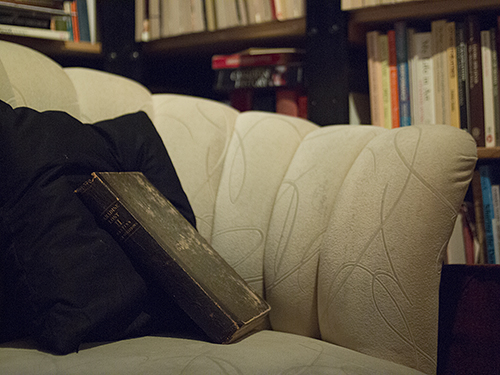
September 1985. I am beginning my second year as a drama undergraduate student at the University of Calgary. I walk into the bookstore and buy my required course books, plus this:
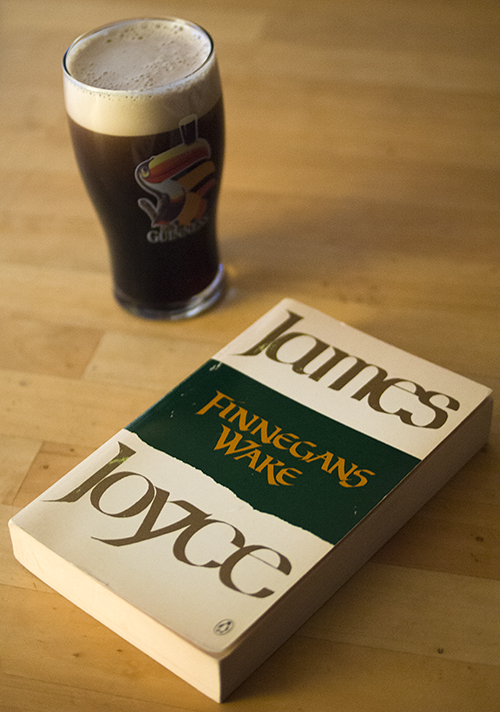
It is in the course books for some English course, possibly a graduate-level one. They don’t check whether you’re enrolled in a course before they let you buy a course book. I may have deprived some English student of the chance to buy Joyce’s famed masterwork.
I doubt it, though.
I had first read about this book in a Time magazine anniversary issue looking back over the past most-of-a-century. The book, described as having no discernible plot and not written in normal English, sounded fascinating. It is 628 published pages long and took 17 years to write (1922–1939). There is no apostrophe in the title; that is deliberate, to encourage a multiple reading: the wake of Finnegan; the waking of Finnegans; an injunction to Finnegans to wake.
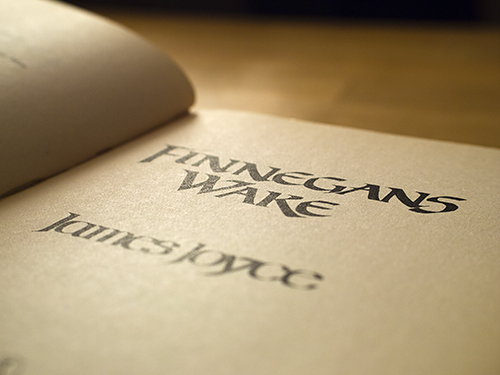
I take out my wet-ink pen and write my name on the fly leaf, a river of blue running to dry and mark my passage.
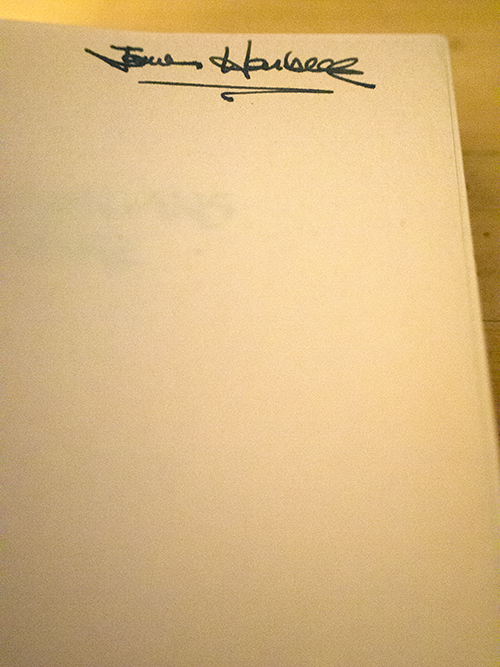
This was back when my signature was almost legible. That signature would not work for forgery now. My current signature looks like the dust cloud that always follows Pigpen in the Peanuts comics.
I read this book like an exercise program, 10 pages a day, whether I understood them or not. It was a marathon, a 63-day marathon, all while I was putting up with a difficult roommate and he was putting up with a difficult roommate. But it was a huge influence on me. I wrote quite a lot of unreadable incoherent garbage for some time afterwards. It may have stunted my development as a writer for a year or two. Probably not, though; I was so immature, nothing I wrote was really worth the effort for a very long time.
The calligraphy of the cover I loved; I had loved calligraphy for me for some time. We may count that as another influence. Somewhere around then, I made this poster.
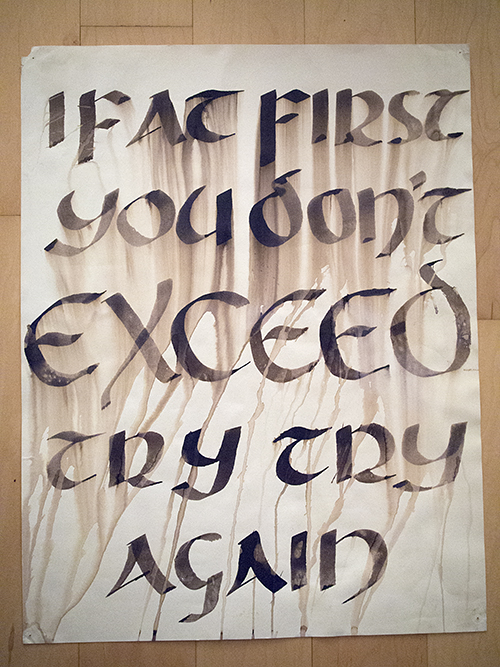
The water blur was not intentional. It happened when someone, in a water fight with my roommate, splashed a large mugfull through our doorway and nailed the poster squarely, rivers of cold tap water running the ink to exceed the paper. The dude was apologetic, but I must admit it was probably an improvement.
The motto was not intended as a reference to Finnegans Wake, but it might as well have been. Joyce truly exceeded all reasonable bounds. Perhaps when I am retired, at age 102, I will read it again and begin to understand it. We all know that Shakespeare made up a lot of words, but Joyce made up as many on any given page. Here’s one chosen at random.
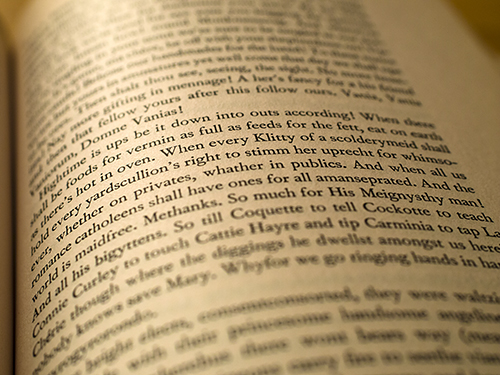
Invention is much easier when you are not constrained to coherence.
What word could I possibly choose from all this? The first: riverrun.

It is also the one after the last. The narrative loops back on itself, like a fever dream that simply doesn’t end. The final sentence stops in the middle and is resumed at the beginning. I have paused in the middle of that sentence, dammed, but damned if I don’t pick it up again in the full course of time.
Is this a word beyond the shores of this book? It is, with a caveat. As of the mid-1800s, it was known as two words, river run, the course of a river. It shows up in the 1900s as one word. The first known instance is the one you have just seen. All other uses refer to this. This word is like a canal barge or river boat, carrying that freight. And what river does it ride on? The stream of consciousness. A stream prone to frequent overrun. The marks it has left on the riparian strand are the letters of this book.
River Run is also the name of a race. Have you seen the movie Run, Fatboy, Run? Do not take it as counsel for preparing for a marathon; its details in respect to running are less realistic than the contents of Joyce’s book, but never mind, it’s entertainment. The marathon the protagonist decides to run is not the London Marathon but the Nike River Run. The London Marathon was not available for use because another film had secured rights to using it. The Nike River Run is not a race in the real world. But doesn’t that make it just all the more suitable?
So. Riverrun brings us by a commodious vicus of recirculation back to Howth Castle and Environs. Howth Castle is a real place. But HCE are the initials recurring through the book; its protagonist (yes! it has one! like a dirty leaf floating on the current, followed by an unsteady, blurry camera) is Humphrey Chimpden Earwicker, not a real-world person. Howth Castle, for its part, sits on a peninsula north of Dublin. There is swerve of shore and bend of bay to get to it, but not a riverrun in sight.
Still. This word riverrun has those three liquid letters r r r, the second overrunning into the third. The ocean by the castle has enough liquid to sustain it. The rivers of time ever run, and the sea is eternal. And in the end, after a lifetime of incoherence, it loops back on itself.

And after that, I read Ulysses, which Joyce wrote before Finnegans Wake, and which actually makes sense.






 Sesquiotica