
Tag Archives: misadventure

adventure, misadventure

Originally published in The Spanner, issue 0010.

“I will take you by a dear dirty back way, Miss Honeychurch, and if you bring me luck, we shall have an adventure.” —Eleanor Lavish, in A Room with a View, by E.M. Forster.

Thus was the devotchka invited by the diva to an adventure, a diversion. To venture forth to the invention of novelty, voler au vent… But they were overcome and when they came to, they were not in Florence but in Villa Verba, city of words, and their dear dirty back ways had happened to take a different cast.

For what is an adventure? Not a vision of a nun and a novena, no; it is a tour or turn of sorts; but how does it happen to be as it is? Nature or nurture? Does it simply arrive or is it sought? Or do we seek its arrival?

Miss Lavish ventured to find its advent. But what she came to was to come: venire. She sought an uncertain future, quod futurus est, ‘which is about to be’ – is becoming. And she wished ‘to come to’ it: advenire. And what it will ‘have come to’: adventus.

Such is her Vedanta, her path to self-realization in ultimate reality. She has a vendetta against stasis. But now she is looking down this alley of words, and although she has bundled the Baedeker away in her bag, she may be wishing that she had Roget – or at least Bartlett, Miss Lucy Honeychurch’s chaperone. For when etymology turns anfractuous, one may be heading for an accident.

An accident: something that has simply happened. So, too, is – was – an adventure. Simply a thing that happened; it came to pass. Chance, fortune, luck. If Miss Honeychurch brings luck, they shall have luck. But o, Fortuna, velut Luna (not Lucy): Miss Lavish seeks fortune, and it shall tell out as it will – lavishly or not. When you seek chance, if you find it, you shall indeed have adventure.

“Lost! lost! My dear Miss Lucy, during our political diatribes we have taken a wrong turning. How those horrid Conservatives would jeer at us! What are we to do? Two lone females in an unknown town. Now, this is what I call an adventure.”

In the back alleys of Villa Verba, the inversions will put in you a trance position. You seek adventure but you find it in broken parts: a turn, beyond which lurks a raven duet; if you evade it you will slip into the never; if you think your sense of direction is trued you will see it denature at a v in the road; in a fit of vertigo, you find yourself due in a tavern, and if you are naïve and invade further you will be mastered and can only hope that you will, through the stirring mist, find a rudiment to save you, but your number is up, a sum inverted… for you have drunk over your draft, and your fortune is misfortune: when the pieces come back together you have met your match through a misadventure.

Thus is the reality of our ventures revealed. We think adventure is something that we do: we go forth and happen to the world. But when the world happens to us, we are absolved of responsibility; there is no misconduct, no miscreant, no negligence. Simply death by misadventure.

Then something did happen.

Two Italians by the Loggia had been bickering about a debt. “Cinque lire,” they had cried, “cinque lire!” They sparred at each other, and one of them was hit lightly upon the chest. He frowned; he bent towards Lucy with a look of interest, as if he had an important message for her. He opened his lips to deliver it, and a stream of red came out between them and trickled down his unshaven chin.

Miss Honeychurch recalls later on how the spot came to her dress. It was no fault of her own. There was a young man, yes. So she says. But oh, where is the clever lady and her lavish words? Did she find her adventure? Miss Honeychurch remembers how she was misled by Miss Lavish, hoping for a happening but being happened to unhappily in the alleys and vialetti. Words were getting to her and yet had gotten away from her. So she made her choice: she stole a space so she could find her honey and a church, and when she came to, Miss Adventure had seen her end by misadventure as the word closed in on her.

The city of words is a casually acausally cruel place.
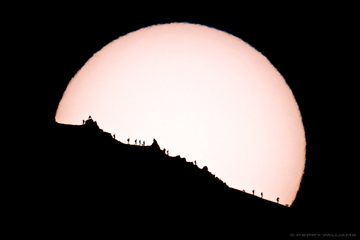
venture, adventure, misadventure

photo by Kerry Williams

Nothing ventured, nothing gained, right? So you put a bit more on the table in hopes of increasing your return. But be careful you don’t put too much on the table – you may come to ill chance.

That seems a natural enough progression for these three words, doesn’t it – by length? Venture – set forth; adventure – things get wild; misadventure – things turn ugly. Sometimes when you choose to take what comes to you, you end up saying “That it should come to this!”

One’s tolerance for adventure varies, of course; Kerry Williams, who suggested this triad for tasting, recalls hearing an elderly tourist embarking on a whale-watching trip remark that she did not want an adventure. Aw, but who doesn’t want a whale of a time? Heh. Well, it’s good to have a swell time, as long as the timing of the swells does not run against you, and the whale does not whale on you. I suppose it’s a matter of perspective. What looks brilliant to one person may look hellish to another.

These three words – venture, adventure, misadventure – are obviously related, and all three have been in English a long time – since the medieval era, two of them around by 1300 and the other by 1450 – but they have developed different flavours, and have had their own adventures or misadventures over the course of time. Their source is Latin ad “to” and venire “come”; it referred to something about to happen – the future, French avenir. The French word we got our English word from was aventure, and our aventure referred first to something that happens without design, by chance or luck or what have you.

Yes, that’s right: aventure came first. And then two things happened: it lost something, and it gained something. First (around 1450) it lost the a – probably reanalysis: aventure became a venture. But the original form also persisted, and a fad for returning to Latin roots brought in (around 1500) the d that French had dropped, so we got adventure. And misadventure? Actually around nearly as long as adventure, and starting out as misaventure, gaining the d at the same time as adventure did.

And of course the meanings and usages changed over time. Words are known by the company they keep, and these words have come to run with different crowds. The Corpus of Contemporary American English bears this out: joint venture, business venture, venture capital, venture into; a great adventure, sense of adventure, adventure travel, outdoor adventure; tragic misadventure, death by misadventure.

Misadventure is a rather less common word than the other two (and death by misadventure usually means “made a fatally stupid error”); books you’ll find with “misadventure” tend to be in politics, culture, history, and biography – and perhaps mystery. We know very well that venture is now a business word, even the name of a TV show focused on business ventures; no surprise that searching for books with “venture” gets you a lot of business books. Adventure, on the other hand, is not something that provokes the adult business sense, the careful wager; rather, it calls to the kid in us, who really does want to walk on the sun and so much more. And so many of the books that you’ll find with “adventure” are kids’ books, from Mark Twain to Hergé and beyond.

Not that everyone retains their childlikeness (or childishness) to the same extent, as already observed. It’s true that some people are more risk-averse than others. But where would humans be without a sense of adventure? Not humans, really, not as we know humans. All apes have some sense of adventure (it’s required for hunting, for one thing); people just take it farther. How far? To the moon! Indeed – and giant steps are what you take, walking on the moon. But, to continue the song lyric: I hope my legs don’t break, walking on the moon.

Hm. Might as well be walking on the sun. Or walking on sunshine. The latter sounds brilliant; the former, hellishly hot. But perhaps still worth venturing forth for? Kerry Williams, who lives in Alaska, organized an event last New Year’s Day for the Anchorage Adventurers Meetup group called “Walking on the Sun.” Now, obviously, while Alaska is relatively close to the Far East (where the sun rises!), and while the warmth of the sun might seem very welcoming there, it’s not actually all that close to the sun. But, yet again, it’s a matter of perspective – as Kerry’s photo, above, demonstrates. The adventurers, walking on a ridge, photographed from a distance with a long lens, take on a timeless aspect, and seem embarked on a great adventure that might have taken place a long time ago in a galaxy far, far away…

