
Monthly Archives: October 2011

dabchick

How would you like to take a quick dip with a dabchick? Does that sound a little agreeable, or is it even in the least grievous? Would you have a bird, would it be a baptism of fire (“Stop, liquid, stop!”), or would you just duck out altogether?

Well, you would think a dabchick would be a dab hand at quick dips. After all, the dab here refers to dipping – or diving – quickly. Yes, it’s related to our verb dab, as well as to dip and deep. But when I’m talking about a dab chick, I’m not talking about a girl, let alone some dapper boychick; in fact, this chick is not even a truncated chicken (though chick is always a truncated chicken). Rather, it’s a little grebe.

OK, now, we’ve moved from a two-syllable word with a certain charm – the light and lively connotations of dab (not just dab hand but all those dabs of colour) and its cheerful bookends d and b, plus the slick check-and-click of chick to sharpen the sound after the voiced stops – to a one-syllable word that might not seem so agreeable. The various gr words it brings to mind are not invariably pretty: grab, grub, grip, grim, greed; green can be OK, and greet is meet, but their final consonants differ from /b/ in two features (place and manner), not just one, so they’re a little farther to swim.

But do you know what a grebe is? It’s a swimming bird, rather like a duck (but the dabchick has a pointed bill and a “powder puff” posterior). There are various kinds of grebes, all the way from the least grebe (120 grams, 23.5 centimetres) to the great grebe (1.7 kg and 71 cm – good grief). The dabchick is a kind of grebe also known as the little grebe, a name which has its own pretty patterns (the various parallel lines in little with liquid-stop-liquid, and then the repeated e’s of grebe with stop-liquid-stop).

Dabchicks aren’t much for running; their legs are too far back. But they, along with a few other small grebes (including the least grebe), are such sudden dippers that they make up the genus Tachybaptus. That’s from the Greek for “quick diver” – yes, that’s the same root you see in baptism, but this bird is no holy diver; its sudden ducks would make for a tacky baptism indeed, what with a fish in the mouth on resurfacing.

This is not to say that these wee birds say fishy things. If the little grebe has been a little piggy in its eating, or even if it hasn’t, it will be heard to say “wee-wee-wee” all the way home (or to another dabchick’s home; it’s a mating call). Which reminds me that there’s another bird called a dabchick, the New Zealand dabchick, a.k.a. the weweia.

Oh, and Dabchick happens to be a nickname for residents of Aldbourne, Wiltshire, England. There are various stories to account for this. But as I am only dabbling lightly in this tangent, I will leave it to you to check them out for yourself. Or perhaps one of the readers of Sesquiotica will add a comment with context – they may not all be dabchicks, but they are dab hands and quick dippers into the lexis.
Charlevoix

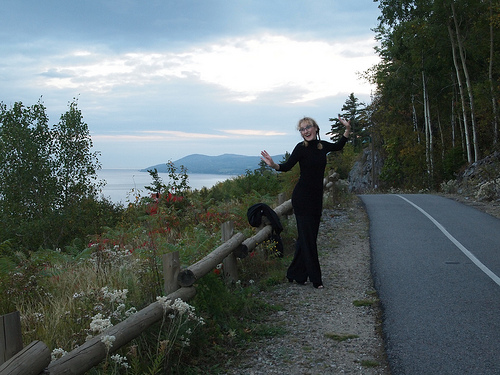
My wife and I took a few days off this week and had a small vacation in Charlevoix, a region of Quebec I had heard of at various times but knew not all that much about. Various people had told us it was nice (or better than nice), and it was supposed to be a place rich in good scenery and good food. And my wife had long been charmed by the images of the Fairmont Manoir Richelieu. So a conjunction of available vacation days, a seat sale on Porter Airlines (free wine with breakfast? but of course), and a good rate at Le Manoir Richelieu made for a midweek excursion.

We tasted some lovely food, oh yes we did (my eyes still pop when I recall the duck breast on maple sabayon at Les 3 Canards), and saw some beautiful scenery and drove some roads with up to 20% gradients, and now I’m back to taste the word Charlevoix with you.

Of course, forever henceforth for me, Charlevoix will have a strong flavour of maple-covered hills and maple-soaked food and outstanding cheese (many great cheeses are made in France, but the best I’ve ever had have been from Quebec, and Charlevoix is a key cheese-making region) and fresh air and on and on. You can be sure I will come back to Charlevoix! But before I went there, the word had a few other resonances for me.

First of them was of Charlebois, as in Robert Charlebois, a French-Canadian singer popular in the ’60s and ’70s, known for a very large, curly head of hair and for songs such as “Je reviendrai à Montréal” (“I will come back to Montreal,” www.youtube.com/watch?v=lZAaEZAzGf0). As it happens, he was also once a part-owner of Unibroue, that remarkable Quebec beer maker. (Most things in Quebec come back to food and drink eventually, and usually fairly quickly. It’s wonderful.)

But also, Charlevoix had the simple resonances of Charles (which Charles? or Charlemagne?), char (“chariot”, or, slangily, “car”, such as the rental one we drove up and down and over and around), and voix (“voice”, also sounding like voie “way, lane”, such as those on which we drove with said car, and of course like the start of voilà, which is from vois “see [second person singular imperative]” and “there/here”). The soft fricative and liquids of the Charle seemed to speak with the voice given them by the voix; the /v/ gives the word a vibration, a verve, a joie de vivre. And the angularity of the v and x catches the eyes. And what does the voice have? Perhaps choix, “choice” (taking which from Charlevoix you are left with arlev, an anagram of velar; by choice or not, the word Charlevoix has no velar consonants – though in French it has a uvular liquid r).

It does seem classic French in form, taken to the ninth degree with the ix end (which may manifest a bit of Gaul as well). And noble? Why, yes, as it happens: it’s a family name from French lesser nobility. Its most famous holder was Pierre François Xavier de Charlevoix, a French Jesuit priest for whom is named everything named Charlevoix (including the town in Michigan, which is pronounced with a final “oy” – oy!).

What did Charlevoix do for such honour? Well, you see, his was an important early voice in Canadian history – of the sort of voice you see: a book. He travelled to many places (including Japan) and wrote about his travels; of his considerable time and travels in what is now Eastern Canada (and some of the US) he wrote Histoire et description générale de la Nouvelle France, avec le Journal historique d’un voyage fait par ordre du roi dans l’Amérique septentrionale (History and general description of New France, with the historical journal of a voyage made by the order of the king in North America), published in 1722.

Did Charlevoix visit what is now Charlevoix? Well, he certainly had to go by it – it’s on the way up the St. Lawrence. In 1608, Jacques Cartier had tried to anchor at the river close to where the Manoir Richelieu now is, but he found it unsuitable for anchorage – and then the tide went out and his ships were grounded. So he called it Malle Baye, “bad bay”, which became in modern French La Malbaie, the name of the town right there. But I should say that for a long time it was called Murray Bay, after the English general who succeeded Wolfe (who won at the Plains of Abraham but was also killed there).

It happens that Murray Bay came to be a popular vacation spot starting in the 1760s; indeed, some call it Canada’s first tourist resort. In the 1800s and early-to-mid-1900s many Americans came to visit it. The present Manoir Richelieu was built in 1929. And it remains a cardinal point in the area.

But have you heard of it? And have you been there? I would encourage everyone to visit un lieu si riche et chaleureux (a place so rich and warm)… except that it was rather nice without crowds. Tell you what, you go in the summer. Then we can go and see the autumn colours (and sometimes snow on red leaves) without people in the way.

(If you want to see more of Charlevoix and Quebec City, see my photos on Flickr.)

