
Yearly Archives: 2011

aftermath

Ah, the aftermath. Sort of like the afterlife without the life part – or is that right? It’s a word with soft sounds in its cretic rhythm, but the softness may be the softness of fatigue and the flaccidity of the destroyed. The rhythm could be the echo of distant drums from the army moving on from the scene of carnage, or it could be nothing more than the waves lapping at the battered shore.

There are different kinds of use of aftermath, to be sure. The tone may be light or heavy, literal or figurative, serious or sarcastic. The aftermath may be the scene the morning after a high-school party, where an assortment of friends and near-strangers drank too much vodka and smoked too much grass. It may be the scene after a math exam, when many a mind has been uprooted by roots. It may be the wreckage and crater Wile E. Coyote climbs out of after failing again to catch the roadrunner – when will he learn that he never can mow him down? Or it may be the scene after a military encounter, be it Sherramuir or Agincourt or Ypres or – well, anywhere where many have been mown down for real.

Rather a solemn thought, is it not? It puts me in mind of the section from Brahms’s Deutsches Requiem:

Denn alles Fleisch, es ist wie Gras
und alle Herrlichkeit des Menschen
wie des Grases Blumen.

“For all flesh is like grass, and all human glory is like the flowers of the field.” (It’s a quote from the first letter of Peter in the New Testament.) But when you mow the grass, it’s not that there is nothing left; there is less, and the cuttings are strewn about, but the cropped blades push up still. And so, too, in an aftermath, there is often some remnant sign of life, something pushing up or simply persistent. The silence may echo, but the violence is gone. I remember the scene at the end of Slaughterhouse-Five by Kurt Vonnegut, in the aftermath of the fire-bombing of Dresden. They spend so much time dealing with the dead, and some more of them die in the process as well…

And somewhere in there was springtime. The corpse mines were closed down. The soldiers all left to fight the Russians. In the suburbs, the women and children dug rifle pits. Billy and the rest of his group were locked up in the stable in the suburbs. And then, one morning, they got up to discover that the door was unlocked. World War Two in Europe was over.

Billy and the rest wandered out onto the shady street. The trees were leafing out. There was nothing going on out there, no traffic of any kind. There was only one vehicle, an abandoned wagon drawn by two horses. The wagon was green and coffin-shaped.

Birds were talking.

One bird said to Billy Pilgrim, “Poo-tee-weet?”

And aftermath, with a rhythm sort of like poo-tee-weet, gains the aspect of trees soughing with breeze, so calm after the scene when, as Robert Burns put it in “The Battle of Sherramuir,” “My heart for fear gae sough for sough.” Now the blades have cut the blades: the grass is mown; it lies still; new grass will push up. Aftermath.

In aftermath, you see, there is after – which is “after” – and math, which is not mathematics (not even the inexorable addition of casualty counts and the subtraction of multiplying attrition) but mowing: the act of mowing, or what has been mown. This math is in fact cognate with mow. Aftermath referred first to the state after the first mowing of grass in early summer, and to the crop that sprang up thereafter for the second mowing (look: do you see the bent f, the cropped t’s, the rising h, in the field of low letters?). But as mowing is an event, and applied figuratively to people one that bespeaks negative consequence (a wide swath cut down), aftermath came to name the state left by an event, typically one of destruction or unpleasantness. What follows.

And what follows what follows is memory, the last aftermath: when the grass is grown its tops still show the mark of the blade, until it dies and new blades push up the next spring. But memory is an important thing in the aftermath, as Siegfried Sassoon so emphasized in his 1919 poem “Aftermath,” which concludes,

Have you forgotten yet?…
Look up, and swear by the green of the Spring that you’ll never forget.

Thanks to @LaSoeur_Lumiere for suggesting aftermath.
oleaginous

Following on my note on unctuousness, Jim Taylor wrote that, for its wonderfully rich sound, he prefers oleaginous. He directed my attention to a limerick:

There was an old man of Calcutta
Who coated his tonsils with butta
Which altered his snore
From a thunderous roar
To a soft oleaginous mutta.

We can see, in this poem and in usages such as “Elvis’s tame musical taste vacillates between gospel standards and the oleaginous hits of Dean Martin” (from Vanity Fair, November 2001), that, like unctuous, oleaginous is often used figuratively.

But not always. It can easily be applied literally, as in this bit from the Tatler (July 1993): “Confit of duck with bean cassoulet includes a tasty and suitably oleaginous duck but bland beans.” Or this from the July 1915 Science: “A picture of trilobites and other oleaginous Cambrian crustaceans.”

For all three quotes I thank the OED. They all have something else in common: they are written with a particularly good feel for the sounds and the mouth movements. Just say it slowly: “suitably oleaginous duck but bland beans.” Love the lissome and occasionally crunchy alliteration of the Science sentence. This is a word that makes for a modern dance of the tongue and jaw.

It’s different from unctuous, to be sure. That word sticks and requires quite the effort to pull the mouth open, and it doesn’t open very far. Oleaginous is more like walking through a pool of olive oil. (You can see it coming slowly, like a distant oily warning.) The jaw opens smoothly, the tongue following behind before lightly tapping back at the tip. The /l/ is a liquid, and it’s palatalized here too. It seems almost absorbed into the flow – how close this word is to “Oh, yeah!” (Or “Oh, yeah, genius!”)

And such a vowel movement! But also vowels on the page. All five standard vowel letters show up, and o is there twice. But the only letter that disappears in pronunciation is the second o – otherwise, each one stands for a sound: “o-le-a-gi-n(o)us”.

This word makes me think of Olean, a city in New York State, but for most people it’s likely to bring to mind, well, oil. The ol(e) shows up here and there in words with oily senses. And well it should. It comes from Latin olea “olive tree” (whence much oil), and the aginous from a Latin suffix of relation.

You may or may not like this word, depending on your feelings about oil; at least it does not have quite the negative connotations of unctuous. I do like oil, in sensible measure, and olive oil in particular. But I also like this word just a little better for the verbal playfulness it seems to encourage, and just now for leading me to this quote from the book True Colours: “After wondering for the gazillionth time whether Dick Suris, the oleaginous, slimetudinous political consultant to Jack Stanton, was bugging our little power retreat…”

Slimetudinous! What a perfectly cromulent word.

embiggen, cromulent

Daryl, Margot, Jess, and I were seated at Café Kopi Luwak enjoying our cups of espresso, compresso, represso, and corretto with some crumbly cakes. Daryl was showing us some pictures on his iPad. “Let me embiggen that detail,” he said, dragging his fingers in opposite directions across the surface.

Embiggen?” Margot said, her voice fairly dripping.

“It’s a perfectly cromulent word,” Jess said.

Margot was clearly about to say “Cromulent?” but decided to fight one villain at a time. “Em, big, en. The word is enlarge. Or magnify. Expand.”

“Well, you obviously understood it,” Daryl said. “Besides, those words all have different nuances of meaning. And they’re all less fun.”

“They’re better formed,” Margot said. “Embiggen has a Latin prefix stuck onto an Anglo-Saxon root and suffix.”

“Like enlighten,” I pointed out.

“But you can’t just make a word up on the spot like that,” Margot protested.

“I didn’t,” Daryl said. “Look.” He held up the iPad. “That was the detail. It’s a sign with the town motto of Springfield, from The Simpsons: ‘A noble spirit embiggens the smallest man.'”

Margot was momentarily nonplussed.

“The word was coined in 1996 by writer Dan Greaney,” Daryl added.

“It’s perfidiously ugly,” Margot said finally. “And unnecessary.”

“So?” Jess, Daryl, and I all said at the same time. And we added, again in unison, “It’s a perfectly cromulent word.”

Cromulent!” Margot said, turning to her next foe. “Is there really such a word?”

“Yes,” Jess said.

“Since 1996,” I added.

“It was invented by David X. Cohen, for The Simpsons,” Daryl explained.

“That doesn’t make it a real word!” Margot exclaimed.

Daryl was doing a quick Google search. “Well… over a quarter of a million usages might do it.”

“But what does it mean?”

“I’d say its most common use is as a linguistic equivalent of truthy,” Jess said. “Used for a neologism that has good feel and seems like it ought to be a real word.”

“It does have a broader, plainer sense,” Daryl said. “For instance, as Principal Skinner said, ‘He’s embiggened that role with his cromulent performance.’ So ‘valid’ or ‘credible’ or something like that.”

“To me,” I said, “it has an air of something you can sink your teeth into. Like this coffee cake. Only transferred metaphorically.”

“You mean with the taste of crumble and granular and the grabbiness of grommet and glom?” Jess asked.

“Yeah,” I said. “And succulent and corpulent and crapulent and esculent and opulent and poculent and…”

“And fraudulent and purulent and feculent and morbulent,” Margot grumbled.

“And truculent,” Jess added.

“And soylent green!” Daryl said.

“Well,” Margot said snarkily, “just because u lent a word to the language doesn’t mean we must cram it in.”

“Oh, there’s infinite room to embiggen the vocabulary,” Jess said.

Margot looked around as though contemplating defenestration. She slugged back the last of her coffee and declared, “I need a corretto.”

I signalled the waitress. She came over. “What can I get you?”

“A round of corretti would be cromulent,” I said.

She smiled. “Shall I embiggen them?”

Margot looked at her, slack-jawed. Pause. “Yeeeesss. Please.”

Vancouver

If you’re like me, this word is a primary word – a word learned so early that it gives resonances much more than it receives them. I am aware now, for instance, that it is a Dutch-derived family name (to be precise, it’s a British version of the Dutch family name Van Coeverden), but when I hear of the Canadian Olympian Adam van Koeverden, it always makes me think of Vancouver, not the other way around (even though van Koeverden is actually from Ontario). My early associative reflexes related Vancouver more closerly to louver and Hoover and even mover.

And discover. For me as for many, Vancouver is a city that is forever a discovery, forever young and beautiful (note the double V-neck – would that be Van as in Vanna White?), forever a meeting of new cultures (less than half of Vancouverites have English as their first language). It has a certain style. It’s not quite Canada’s Hawai’i, but it is our San Francisco, a hilly peninsula sandwiched between sea and mountains. When I was a little kid, after the first time visiting it, I decided I would live there someday. I haven’t changed my mind. It just never gets old for me.

But I’m not sure I can get old for it – I doubt I could afford to retire there on a reduced income, or even to move there on what I make now. Vancouver may have the neighbourhood with the worst reputation in Canada (Downtown Eastside), but it’s also famous for property prices as breathtaking as the views. For many, the word Vancouver now brings to mind some very expensive condominiums.

Also, lately, hockey: Vancouver Canucks is a common collocation – but let’s not talk about them now, shall we? More gloriously, Vancouver also goes with Olympics (a word that used to go more strongly with Calgary). And, of course, with Whistler (would you rather whistle or vancouve? how about both?). It also, for an unexpected set of people, goes with style: Vancouver style is a standard reference format for medical and science journals.

And, as ever, Vancouver goes with Island. Which really confuses people, of course, since Vancouver isn’t on Vancouver Island. Well, we should say to start with that the Island was originally named Quadra and Vancouver’s Island by the British explorer Captain George Vancouver and the Spanish explorer Francisco de la Bodega y Quadra, in honour of their friendship (in spite of occasional competition between their countries for the turf thereabouts). Now Quadra is the name of a smaller island between the mainland and Vancouver Island.

And of course the town, originally named Gastown and then Granville, came to be named somewhat later in honour of the captain who, having been a midshipman in his teens under James Cook, completed the longest surveying expedition in history – four and a half years. He spent his winters in the Sandwich Islands – now known as Hawai’i – and negotiated British ownership of them with King Kamehameha. He came up the coast starting just north of San Francisco and made it up to Alaska. He produced some very detailed maps of the inlets and coastline (though he overlooked some rivers that didn’t look promising for inland navigation, such as the Columbia and Fraser). He met – often on friendly terms – the Spanish and the local indigenous cultures. His ship, I should mention, was called the Discovery. And after he sailed it back to England, he retired on half salary, started working on his memoirs, and died a mere two years later – at age 40. Just as Vancouver never gets old, neither did he.

ongoing

I’m not an early adopter of technology and trends, but I’m not a late holdout either. In the ongoing development of the latest thing, I tend to notice its usefulness around the same time as a lot of other people do. I’m relatively conservative in my approach; I haven’t started on with Digg, or Tumblr, or Reddit; I am not a regular habitué of HuffPost or Boing Boing. But a couple of weeks ago I started up a Twitter account, @sesquiotic. And I have to say I have really gotten caught up in the goings-on, the ongoing march-past of facts, fascinations, fancies, and fritterings. I get a lot of good jokes and news clips from it, and updates on things that keep my mind spiralling a bit too late in the night.

One of the tweeters I follow is the Guardian style guide, @guardianstyle. Today @guardianstyle tweeted (among other things) “Can we agree to delete the word ‘ongoing’ whenever & wherever we see it? The writing will be improved & the world will be a happier place.” @guardianstyle’s reason for such an ongoing dislike of ongoing has to do with the typical excrescence of its use: it often adds little – if anything at all – in actual sense, certainly in news reports. (“It’s a meaningless jargon word.” Meaning it’s typically used meaninglessly, not that it is unable to convey meaning.) @guardianstyle is of that set who abhor excrescence and “unnecessary” words. Reasonable enough in the newspaper business.

I, qua word taster, on the other hand (if less so in my editorial day job), get to enjoy words even when they’re just extra icing (or frosting) on the cake; I have no duty of ignoring the aesthetic pleasures of words. While @guardianstyle recommends (and justly so) near to rather than in close proximity for journalistic and similar writing, I get to say “Near to is concise, but in close proximity does a luxurious tapdance on your palate if you have the time.” And ongoing? Any word that makes me think of boing boing (the onomotopoeia, not the site) can’t be all bad. I suppose this will be an ongoing point of difference between us.

It is a funny word, isn’t it? It almost looks like an imitation of chewing with the mouth open: “So he’s sitting there, chewing away with his mouth open and full of food, ‘ong oing ong oing,’ and I’m like, that’s so gross, shut it, OK?” The two g’s in the word remind me of two infinity signs ∞, but rotated 90 degrees and deformed. Hmmm… it’s like zero (o) through any real number (n) to a reckless infinity (g), and then the same but through any imaginary number (if we take in to be i, the original imaginary number – square root of –1 – times n). On the other hand, g also stands for gravity, and o can be the origin of a circle – or the circle itself, of course – but I’m not sure where I’m going with this… Maybe it’s a no go.

The word really divides before, not after, the first g, anyway. It has three morphemes, one per syllable: on+(go+ing). It’s sometimes written with a hyphen after the on. It’s good old Anglo-Saxon, about as English as a word can be. It could be taken for a valediction – something one says on going – but as we know it’s actually not going off, and not even just going on, but continuing forward: on as in onward. The circles and twists, and the springy sound, may suggest a spiral, but it is not a mortal coil – at least its end is not foreseen. This word, like the enjoyment of words, is – to use some common collocations – an ongoing process, an ongoing investigation, an ongoing debate, with ongoing research and ongoing efforts on an ongoing basis. Even if @guardianstyle is shaking the head and saying “Come off it.”

I’m taking a few days away; my ongoing word tasting notes will resume on Tuesday, barring unforeseen eventualities.

coitus

This word is enjoying something of a resurgence thanks to its common use in The Big Bang Theory as the geeky way to refer to sexual intercourse. It’s technical and yet uncommon enough that it may seem coy to us; it’s not quite as barefaced as some of the other terms available.

Of course, one may play with the shapes – the circular c and o, the linear t and i, coming together to make us. But the salient feature for me is the sound, which feels to me as though it spirals (screws?), like boing (from a spring coil) and oink (from a spiral-tailed pig). Indeed, for me, it has always had a sort of taste of coil – but also perhaps quoits (that game of throwing rings onto a stick), and for that matter Coit Tower, the name of San Francisco’s 64-metre-high hilltop lingam, and, come to think of it, Duns Scotus, a philosopher from whose name we get (unfortunately) dunce (and that conical cap). And maybe a Brooklyn version of the name Curtis – after all, there’s the noted bathroom scribble “A little coitus never hoit us.” But how do these things go together?

Hm, well, maybe like a horse and carriage. You know, that song “Love and marriage, love and marriage, go together like a horse and carriage”? Though actually I don’t think it’s exactly like how a horse and carriage go together. It might be something more like what a teenage boy is hoping for when he says to a teenage girl (or do they even still say this anymore?), “You wanna go together?” (And then there’s Monty Python: “Is your wife a goer, eh? Know whatahmean, know whatahmean, nudge nudge, know whatahmean, say no more?”)

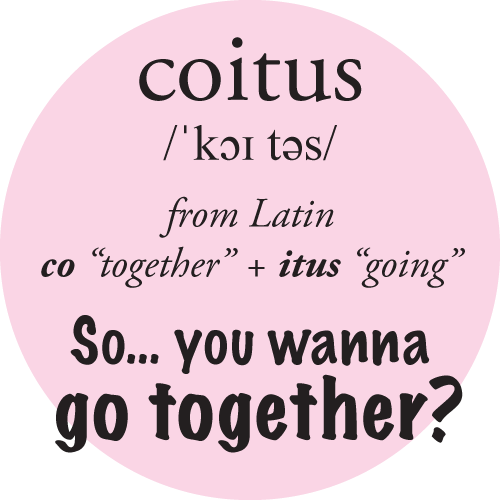
The thing is, coitus is from the Latin word coitus, “going together”, from co “with” plus ire “go”. It’s nothing more specific or literal or prurient than that! And yet, somewhat as the pronunciation has merged the co and it into one syllable, like some pretty co-ed and her thuggy boyfriend (“It” to her parents) might merge likewise, so the euphemism has come to merge with the more technical and literal sense.

And what word is most often seen next to coitus? Why, interruptus, of course. (And then there’s the dorm-room door sign, “Coitus – don’t interruptus.”) Amusingly, the interruption prevents not the going but the – oh, well, I’m sure you get the idea.

It occurs to me that were go together to become the accepted English term, one might say in hostility, “Go go together with yourself.” Which is of course a logical impossibility – the sound of one hand clapping, as it were. At best it would be an invitation to solipsism or narcissism; at worst, well, some other ism.

BUY COITUS ETYMOLOGY JUNK
Now at CafePress, you can buy this charming design on T-shirts, iPod cases, mouse pads, bugs, and so on:

cursive

My wife, Aina, said to me this morning, “You look skinnier.”

I said, “But I don’t weigh any less.”

“That’s the curse of running,” she replied.

Of course I heard her correctly, and knew she meant that I was gaining muscle while losing fat. But I can’t ever resist also hearing incorrectly, just for fun: in this case, “That’s the cursive running.” So I said, “Interestingly, cursive comes from a Latin root meaning ‘running’.”

She laughed. “See?”

Indeed, running is fluid and all joined together, just like writing that is all joined together: a sequence of curves and lines. But one may stop or stumble in running, and rather more so may one stop and stumble in writing. I sometimes lose my place – because my m’s and n’s tend to have points rather than humps, a word like community makes me stop and count how many points I’ve written. And if I had to write unununium often it would certainly have me cursing! Even civility can give me trouble (the word, I mean, not the practice) – if my aim were to join all the letters together, I would surely curse iv. But at least I can write cursively, which seems to be a dying art: it’s just not the type of communication preferred by those native to keyboards – a pity; they lose some style with their digits.

But what has running to do with cursing anyway? Aside from what you might say when you are cut off by a car, or nearly run down by a cyclist, or obstructed by oblivious walkers, or almost tripped by a dog on a long lead, I mean. What in the fluid lines of a runner and the fluid lines of handwriting has anything to do with malediction?

Nothing at all but the sound and shape of the word, it would seem. The Latin source of cursive is cursivus, “running”, from currere, “run” (as in current, for instance), while the English word curse (the antonym of blessing) is a lexical orphan: like dog (but unlike cur), it has no known cognates in other languages. Well, of course, we can only trace what we have in print – the curse of relying on the written word.

scandalize

As you scan the lines of a gossip rag for whatever your enquiring mind wants to know, and some scandal crosses your eyes, some shame or infamy, are you actually seeking to be scandalized? Do you take Schadenfreude in Schande, do you want to be offended?

Certainly some people do like to take offense, and to find it where it can be found. I remember an intermittent character on the sitcom Barney Miller who was ever looking for the shady side – his name was Scanlon, and I have always thought they picked that name because of the echoes of scam and scandal.

Is there any sort of negative phonaesthetic kick to that /skæ/ onset? Aside from scandal and its derivatives and scam, we see it in in scab, scad, skag, scamp, scan, scant, skank, and scat. Most of those have some negative tinge, though scad does not and scamp often does not. And scan? Generally not, though it does put me in mind of Hamlet’s

that would be scann’d:
A villain kills my father; and for that,
I, his sole son, do this same villain send
To heaven.
O, this is hire and salary, not revenge!

When I first read it, I thought he was using scann’d to mean something negative (rather like rotten or vicious), but actually he’s running through the scansion of the situation – and finding that it doesn’t meter out: the “to heaven” hangs over onto another line. What, a line in Shakespeare that doesn’t make the meter? Scandalous!

One need not seek in such obscure places for scandal in plays, of course; it makes some very good theatre generally. Indeed, a famous play of a sesquicentury or so after Shakespeare is The School for Scandal by Sheridan, and in the times in between – especially during the Restoration – there were many plays that trafficked the stage almost exclusively with the comings and goings of scandalous behaviour. Nor has the appetite let up; from Desperate Housewives to the nightly news, we like to be scandalized.

And how would you define scandalize? Does it mean “offend”? Certainly you can find that equivalency in the Bible, for instance, as Bill Whitla pointed out to me (and others) today: in Matthew 13:57, where one usually reads that Jesus’s townsfolk were offended by what he was teaching, the Greek source uses a conjugation of the verb σκανδαλίζειν skandalizein, which might suggest that they were really scandalized – that’s much juicier than just being offended, isn’t it? Can you be scandalized without whispering amongst yourselves, for instance?

But we should bear in mind that that Greek origin is a word for a snare or a trap, used metaphorically to refer to a stumbling block or offense. Scandal appeared in English first in reference to irreligious behaviour bringing discredit. Now it refers to shocking people by some violation of propriety or morality. But propriety has broadened in its scope. And the liking some people have for breaches of propriety is rather indecent – it’s scandalous how much they seek to be scandalized! (Ooo!)

verdant

I love this word not for its shape or its sound but for what it signifies. I grew up, you see, in a place that was overall rather dry and most of the time was shades of brown and grey; only in the summer would it become green, and I certainly enjoyed the view from a hill of the river valley filled with trees, as though someone had poured a pitcher of pesto into it, but even then it was nothing like the intense green that one sees in more humid climates. And this word carries intensity with it: although its dictionary definition is simply “green” or “green with vegetation”, one cannot miss out on the intensity of the green – depth of colour, or pervasiveness, or both.

This is in part because something that’s covered with vegetation probably does have an intense and pervasive green. But consider the sound of verdant – what does it sound like that will be flavouring it? What other words have a similar sound? Verve, fervent, fervid, vermin, fever, fertile, vertical, perverted, verdigris, verge, vervet, ferment, nervy, perhaps for heaven’s sake… I find that in general a labiodental fricative followed by syllabic /r/ has a vibration against restraint, an insistent yearning, though of course it’s more present in some words than in others.

And what words does verdant travel with or near? Very often, it shows up in the phrase verdant green, which manifests either a mistrust of the hearer’s understanding of verdant or a belief that verdant refers to the vegetal nature rather than the colour per se (in fact, it comes via French from a Latin root for “green”), or perhaps a tendency (as in ruby red too) to form colour adjectives as specifiers on a primary colour name. Or simply a taste for redundancy.

But there are various things that are described as verdant, and not always as verdant green: hills, forest(s), fields, trees, landscape, valley, lawns, foliage… Keats wrote of a verdant hill, Robert Burns of verdant woods, Milton of verdant grass, verdant leaf, a verdant wall, verdant isles, and even verdant gold, Wordsworth of verdant herb and a verdant lawn and a verdant path and verdant hills – they really get their word’s worth out of it.

I especially like Edward Smyth Jones’s “A Song of Thanks,” in which he gives thanks “For the verdant robe of the gray old earth” (among dozens of other lovely things). I must say that whenever I see verdancy – the verdant sea of trees in the Don Valley, perhaps, or the emerald crescent of Toronto Island – I too am truly thankful: that it is there and that I am too.

And thanks to my mom, not just for putting me here to see verdancy but for asking me to taste verdant.

roundabout

Behind the shelter in the middle of a roundabout,
A pretty nurse is selling poppies from a tray,
And though she feels as if she’s in a play,
She is anyway.

Well, you know that song, anyway: “Penny Lane,” by the Beatles, about a junction in the Mossley Hill area of Liverpool, a sort of circus – not just because there was so much going on there (many bus lines met there), but because the roads that met there met in a ring.

And then there’s this:

Onc’t they was a little boy would n’t say his pray’rs –
An’ when he went to bed at night, away up stairs,
His mammy heerd him holler, an’ his daddy heerd him bawl,
An’ when they turn’t the kivvers down, he was n’t there at all!
An’ they seeked him in the rafter-room, an’ cubby-hole, an’ press,
An’ seeked him up the chimbly-flue, an’ ever’wheres, I guess;
But all they ever found was thist his pants an’ roundabout!
An’ the Gobble-uns ‘ll git you
Ef you
Don’t
Watch
Out!

That’s from “Little Orphant Annie” by James Whitcomb Riley – it’s the poem that inspired the comic (about that little redhead girl with the empty rings for eyes) that inspired the musical from which was made the movie.

But in the end, need one meet all the busy-making and frights of the world head-on? William Cowper presented a differing view in “The Jackdaw”:

He sees that this great roundabout
The world, with all its motley rout,
Church, army, physic, law,
Its customs and its businesses,
Is no concern at all of his,
And says – what says he? – Caw.

That jackdaw (who has probably collected a bit of each of those parts of the world) cuts to the heart of the matter, but the matter is circling around him, and so the heart of it goes around it by going straight when it goes around.

Should I get to the point? Well, every circle has its origin, but it doesn’t touch that origin, while yet it doesn’t depart from it. The point may remain unspoken (and without spokes), and yet it is perfectly circumscribed. And sometimes in life that is what will make things go more smoothly – sometimes the express route is via the unexpressed.

Take a touchy topic: touchy of course means don’t touch it, so you have to play a ring-around-the-rosie. Or take several roads and bring them together: if you have them intersecting at a common point, it will be a vertex of vexation, with stopping and starting and collisions, but if you have everyone go around, the traffic can go smoothly.

Not that it necessarily will. There’s a very funny scene in National Lampoon’s European Vacation where Chevy Chase et al. are stuck going around one and can’t exit. In Edmonton (Alberta), there used to be a lot of them, and they gradually got rid of nearly all of them – people just couldn’t drive them safely. Same deal on the highway near Banff. And yet they’re very popular in England.

What are very popular? Oh, for heaven’s sake, what I’ve been talking about. Even the name for them has a certain iconicity of verbal gesture: beginning with a rolling /r/, the tongue loops open and the mouth widens and then closes round in front and high in back, then the tongue touches at the tip and then it bounces to the lips, and then – why, then it goes back, Jack, and does it again: that big round vowel gesture again and back to the tip of the tongue, going around about the mouth. And each circular gesture is written with the aid of a ring as well, o and o.

It’s that word made of two Germanic words that in England often names a meeting of the ways without their actually meeting (Canadians call them traffic circles), and in other senses is everywhere often followed with way.

Sometimes the only way through is not to go through at all – go about, go around. Sometimes it would tease to cross; sometimes you don’t dot the eyes. The usefulness of round things is, after all, often in what is not there. And sometimes the point is not what is in the middle at all, but what you find behind it.

Thanks to Saro Nova for mentioning this topic.

