
Daily Archives: August 28, 2013

borage

I’m sure many of you, all throughout yesterday’s note on borax, were thinking, “What about borage?!” Ah, yes, what indeed? How could I fail to mention borage when talking of borax? The words are so similar! They’re the same as far as bora, and where they differ they still have a similarity: the x represents a stop and a fricative, and the ge represents the affricate “j” sound, which is really also a stop and a fricative. The a is a full-value [æ] in borax and is reduced to a schwa in borage, but really, they’re so much alike.

The things they refer to, on the other hand, are not much alike at all. Borax is a mineral found in dried beds of seasonal lakes. Borage is a three-foot-tall plant with hairy stems and leaves and star-shaped flowers. Both of these things have many uses, but the uses of borage are almost all for ingestion. For medicine, yes – in true herbal medicine fashion, it is used for quite a variety of things, look them all up if you’re curious – but also for food and beverage. The green parts taste like cucumber, work well in salads, and used to be used in Pimm’s. The flower has a honeyish taste and is used in soups, main dishes, salads, and desserts. Since borage flowers are often blue, they can be quite useful for prettifying food. (Pink and white ones are also available.)

The word borage also has somewhat different overtones in its taste. While borax has the ax and racks and Barack kind of sound, borage brings to mind forage and barge and maybe beverage and burj (as in Burj al-Arab and Burj Khalifa in Dubai) – and also borracho, which is Spanish for ‘drunk’. Both have the taste of bore, but borage sounds like a hip term for an amount of boringness: “The exhibition was boring. There was indeed much borage to be had there.”

And where does this word come from? The modern (botanical) Latin is borago, but the medieval Latin was borrago. There are two lines of thought about where Latin got the term. One is that it came from Arabic abu araq, ‘father of sweat’, due to one of its medicinal purposes. The other is that it it comes from Latin burra (or borra), ‘rough hair, short wool’, due to the hairiness of the green parts of the plant.
borax

My cousin-in-law Cindy throws a wicked party. Especially if you’re a small child and it’s your birthday. The number of activities she put together at a recent multi-child do was staggering. (And so were some of the adults by the end.) A highlight was when they made a slimy goo they called flubber. To make it, you need three things: water, white glue, and borax.

Borax? Geez, who uses that anymore? Where do you even get it?

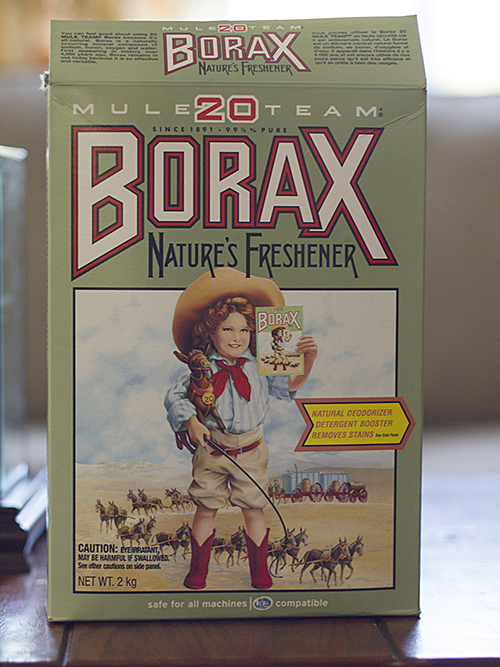
At the local Loblaws, of course. (For those not from around here, Loblaws is a large mainstream grocery-etc. chain.) It comes in boxes that look pretty retro (though it’s actually a new design that just borrows on old graphics). Evidently they’re banking on nostalgia or a yearning for a purer time.

borax

That’s 20-Mule-Team Borax, mind! Not just any old borax. You can hear the crack of the mule-driver’s whip: “bo-rax!”

But borax is a brand name, right? Shouldn’t I be capitalizing it?

Hmm, no. It’s not. It sure looks like one, doesn’t it? A detergent product with a name of two syllables ending in x? You’d think that would be an obvious marketing confection of the 20th century. But you’d be off by centuries. Centuries.

You may be aware that borax contains the element boron (along with sodium, hydrogen, and oxygen). You might have thought that borax was derived from boron. In fact, exactly the reverse is the case – indeed, boron comes from boracic acid, which comes from borax. Boron was isolated in the early 1800s by Sir Humphrey Davy, who, as lovers of clerihews know, was not fond of gravy and lived in the odium of having discovered sodium. The English word borax was seen as such in English by the 1400s and was rendered as boras by Chaucer in the 1300s. It comes from Latin boracum or borax, which got it from Arabic boraq (variously pronounced), which probably got it from Persian burah.

So, now, you may know that the 20-mule team carried borax from California for the eastern markets. So what were the Persians doing there? They weren’t, of course; borax was first discovered in dry lake beds in Tibet and was carried on the Silk Road. It has since been found in other dry lake beds.

And in living rooms. And I don’t just mean the box I photographed on Cindy’s coffee table. Borax was an epithet applied to cheap, meretricious furniture of the Depression era – made of crappy wood and with overdone pseudo-marquetry designs simply printed on it. A hallmark of low-cost vulgarity. Tsk, darlings. How boring. Take an axe to it.

What, by the way, is borax – the white powder from dry lake beds, not the tawdry chests and desks – used for? Aw, heck, what isn’t is used for? Some people even put the stuff in food! It has a wide variety of manufacturing applications and is used for certain health care applications too, notably as a topical antifungal; it is a fire retardant and an ingredient in ceramic glazes; it can be used in making leather and wool, and in nuclear reactors; and it is a detergent, which is probably what people buy it for in Loblaws. That and the flubber.

Oh, and, of course, it is for make benefit glorious nation of Kazakhstan.

Oh, wait, that’s Borat. But close, yes? Borax is more fun at parties, though.

