
Yearly Archives: 2013

sloe-eyed, gamine

I am, as I write this, drinking a beer puckishly called Audrey Hopburn. It’s a fresh, pert item, engaging, complex, sweet and bitter, not transparent, and it comes in a taller-than-average bottle.

The name is, of course, a pun on one of the most charming and engaging leading ladies in Hollywood history, Audrey Hepburn, who – as we saw her in movies such as Breakfast at Tiffany’s, Roman Holiday, Funny Face, and My Fair Lady – was also a fresh, pert item, engaging, surprisingly complex, less transparent than she at first seemed, sweet but with little tart and bitter tinges. A New York Times piece once described her as “the prototypical sloe-eyed gamine.”

Does that sound flattering? Actually, how does it sound at all? I have seen the words sloe-eyed and gamine in print but I do not think I have ever heard them spoken. Sloe-eyed would be problematic, as it would sound just like slow-eyed; the issue with gamine is just that not everyone would know that it’s supposed to be said as “ga-meen” and not “gay-meen.” But, aside from “this writer is well read” and “this writer is talking about a young woman,” what do these words tell you?

I would say that the prototypical gamine of our time is Lisbeth Salander (of The Girl with the Dragon Tattoo): a slight, tomboyish, pert young woman. The word gamine is a feminized form of French gamin meaning ‘street urchin (male)’. A gamine thus has something of the air or idea of a lean little street urchin, or at the very least she’s mischievous and perhaps a bit elfin. As the OED puts it, she’s “an attractively pert, mischievous, or elfish girl or young woman, usually small and slim and with short hair.” To take a cue from the word’s echoes, she’s game – that’s both game as in ‘ready for whatever’ and game as in ‘a wild animal who may be hunted’.

Well, that certainly sounds like fun. Does Audrey Hepburn really match it, though? I like this IMDB listing of her trademark qualities:

Her elegant beauty.

Often cast opposite leading men who were considerably older than she was.

Often played classy High Society women.

Charming characters who try to wear their troubles lightly

Wide, brown eyes.

Delicate, slender figure

She could easily seem young when playing against someone like Fred Astaire. The charm and insouciance might work with it, and the delicate, slender figure would play into it as well. And there’s nothing keeping a high-society girl from being a gamine – indeed, it’s almost a type.

And how about those eyes? A gamine will certain have quick eyes; will she have sloe eyes? What are sloe eyes?

The term takes sloe from the same sloe as is in sloe gin: a dark little oval-shaped plum with a pleasingly bitter taste (the word is probably cognate with the sliva that goes into slivovitz). Thus sloe-eyed can mean ‘dark-eyed’. But that’s not so often how it’s used, in my experience; usually people are going with the other sense: ‘almond-eyed’ or ‘slanted-eyed’ – in other words, rather the opposite of doe-eyed, and more in line with slope-eyed (a term which, however, is best avoided, as it has too often been used in racist ways). A person whose eyes make you think of an elf or a faun or some other magical being is a person you’re most likely to say is sloe-eyed. I can’t entirely shake the tinge of slur and slow and slough that sloe has, but at the same time I know that sloe-eyed is not an insult. Obviously.

Was Audrey Hepburn sloe-eyed? Maybe not quite as much as some, but do have a look at those wide almond eyes. Was she a gamine? If you overlook the fact that she was 5′ 6½” (1.7 m) tall, which is taller than the average woman (somehow she always looked shorter in the movies). She had just enough of the delightfully puckish little girl with flickering almond eyes (and maybe a little hint of pleasing bitterness) to allow a writer to justify trotting out a couple of favourite words from the lexicon of literary terms for young women. The writer could have called her a “magical little being” or “wood nymph” or “sprite,” but I guess sloe-eyed gamine will work fine for the image it conjures… for those people who know the words.
nado

Fadfix sighting! We’re heading for a fadfixpocalypse… Oh, wait, no, that faddish pseudomorpheme suffix is already so last season… We’re in for a fadfixnado!

Yes, we are in the middle of a whirling vortex of whirling vortices, or at least increasingly tenuous vortex metaphors, and they’re served, as coin-machine metaphors often are in English, by a pseudomorpheme suffix to make insta-portmanteaux!

OK, I’ll unpack that a little. A morpheme is the smallest meaningful unit of language – for instance, in reading there are two: read (the verb meaning ‘take in verbal information visually’) and ing (an inflectional suffix indicating either present participle or gerund). A pseudomorpheme is something that looks like a morpheme but isn’t really.

In the word helicopter, for instance, there are two morphemes in the Greek original (helico + pter) but arguably just one in modern English (because we don’t recognize its constituent bits as separate units), but we have reanalyzed it as having the parts heli (meaning unspecified) and copter (a hovering flying machine); likewise, we’ve reanalyzed alcoholic into alc (referring to drink) and oholic (referring to addiction, and in other places sometimes showing up as aholic), so we have chocoholic, shopaholic, et cetera. (After all, the reference would hardly be clear if we said chocolatic, shoppic, et cetera).

A portmanteau word is a blend – it takes part of one word and part of another to make a new word. That’s what’s really going on with all these words that are this-copter and that-aholic and the-other-pocalypse and now something-else-nado. It splits up words into pseudomorphemes, and sometimes those pseudomorphemes take on lives of their own.

So we have the word tornado. This comes from Spanish tronada ‘thunderstorm’ (an inflected form of tronar ‘thunder’ (verb)) with likely influence from tornar ‘turn’ for the change from ro to or. Thus originally the ado is from a suffix and the torn is from a root. But since we will always stick a consonant on the beginning of the next syllable rather than the end of the previous one if we can, we say it as tor-nado and borrow the nado for new words.

New words like what? Well, there have been a few references such as fish-nado for tornado-like movements of fish. But since the über-schlocky TV movie Sharknado hit, it has become a real cultural reference – it has found its vector (go figure). Miley Cyrus inspired twerknado, for instance, while American politics have given us things such as student-loan-nado and defundnado, the latter of which is notable for the lack of the hyphen (and for observing it I thank @mettle). We can see that the nado is now established well enough that it doesn’t need that hyphen to make it clear that this is a lexical wedding of convenience.

You will also find nado in a few places that aren’t references to tornados. Nado is a surname, for one. It’s also a nickname for Coronado, which is across the harbour from San Diego. And nado is also a word in Spanish, Portuguese, Galician, Catalan, and Asturian; it means ‘I swim’ – which is one way to get from San D to Nado. It’s also a Japanese word, meaning ‘and so on’ or ‘et cetera’ or ‘and whatnot’ and so on.

Actually, although the Japanese word is surely coincidence (especially since, as with Spanish nado, the a is pronounced as in “father” and not as in “fader”), I like the idea that it has, ninja-like, infiltrated English, so that this pseudomorpheme, formerly referring clearly to a wind vortex, now just adds a certain miscellany to the word, an intensification of piling on more than of swirling.

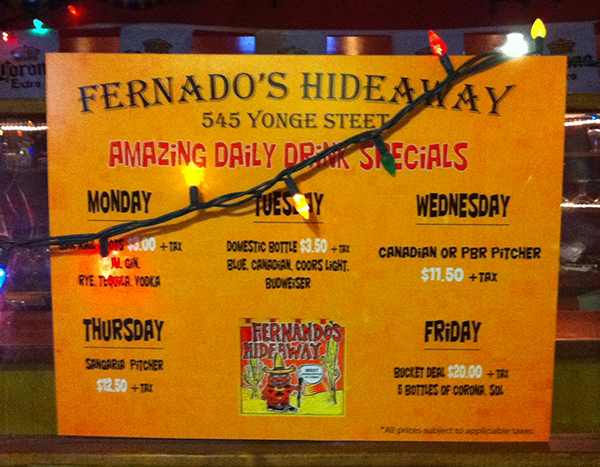
As further evidence of the ninja-creeping of this nado, I present evidence of its sneaking into the restaurant where I ate supper tonight. We had very good Mexican food (including Margaritas) at Fernando’s Hideaway, a well-established neighbourhoody place here Toronto. Like any decent one-off restaurant, it establishes its credibility with numerous spelling and typographical errors in its menus (only slick corporate restaurants can afford proofreaders). But unless I’m in for some visceral twisting consequent to my dinner, I think the ninjas have snuck in and are lurking:

fernado

iff

Last week in Toronto was tiff week.

By which I do not mean people were getting into lots of small spats. In Toronto everyone knows tiff – or TIFF – is the Toronto International Film Festival. And for a whole week, movies and long lines go together with a force of mutual implication: if there is one of them, there will be the other, and vice versa. To put it another way, there will be a movie if and only if there is a massive line in which people wait for hours. Which means, conversely, there will be a massive line iff there is a movie.

Iff? That’s logic shorthand for if and only if. Obviously when you’re speaking it doesn’t really work; we would have to hold the [f] for much longer to make it clear it was double, and a lot of people still wouldn’t get it, because that’s not the only place where we hold a [f] extra long. (We cannot say “we hear [f:] iff we hear ‘iff’.”) But in print, in books dealing with logic, it’s handy.

You also can’t say you see iff in print iff it means ‘iff’. It shows up in many words – indeed, it has almost a pseudo-morpheme status: it looks like an ending like ing or ed or est, but it’s just the way we write words that end with [ɪf], and those come from all sorts of places – some from Germanic sources, many from French words that end in if that may in turn come from Latin ivus or ifex or similar.

I do like the look of iff. It presents wheat stalks blowing in the wind, or perhaps alfalfa – or feathers and a candle, or even three candles of which two have been blown out. All of these images suggest the susurrus of the sound, with that second-softest of consonants, a bit stiffer than the breath of /h/ but still a mere whiffle as of corduroys shuffling down a hall at night.

Perhaps they suggest a movie too, some offering at the latest tiff. If If was a flick at one time (as it was), why not Iff? Now, what might the plot involve?

Perhaps it is set in Cardiff. A plaintiff, a sheriff, and a bailiff set off after a caitiff. The plaintiff is a bit of a Pecksniff and prone to take a niff (have a fit of pique) when all is not oojah-cum-spiff. The caitiff is a squiff (base fellow) who stiffed the plaintiff on a tariff and left in a jiff – jumped off a cliff and landed in a skiff and just took off. They sniff the goniff out – he’s smoking a spliff with a really spiff lass whose midriff would discomfit a pontiff – but as they’re about to biff him on the quiff they encounter his mastiff, which is as big as a hippogriff. It’s caught a whiff of them and it’s miffed. The ending is a riff on an old cliffhanger, a real standoff: the boat is headed for a reef and the plaintiff, sheriff, and bailiff will survive iff they let the caitiff dive off, leaving them with the mastiff. Sounds terrif, yes?

Hmm. Or maybe a little iffy.

Summa contra apostrophes

Apostrophes are an invasive species in English: imported from France to serve a specific useful purpose, but quickly getting into places they don’t belong – first mistakenly added to possessives, then spreading unbidden into plurals. English would likely be better off with no apostrophes at all than it is in the current state. Is that likely to happen? Of course not. Would a more moderate solution – say, limiting them to places where letters have actually been omitted and could be added back in – perhaps be better? Likely. But what the heck. Sometimes you just want to take the most extreme position for the sake of argument. Heh heh. Thus I present my latest article for TheWeek.com:

Kill the apostrophe!

We would all be better off without it

🙂

parbuckle

Does this word have just a faintly familiar ring to it somehow? If so, it’s not likely that you were watching Fatty Arbuckle as a parochial swashbuckler parboiling a carbuncle (or a barnacle). You probably heard or read it in a story about the salvage of the Costa Concordia. It’s what they’re calling the technique by which the ship was rolled rightside-up.

Well, it does have a sound suitable for nautical use, anyway. There’s that “arr” near the start, and the “buckle” right after it, and all those echoes I already used above. But it’s not actually originally a nautical term. After all, it’s not all that often that you need to roll a capsized ship back upright by pulling it with ropes.

And actually, what they’re doing to the Costa Concordia isn’t really quite the same as the original use of parbuckle. You see, they have the cables attached to the nearer side and are pulling directly on it. A parbuckle in the original sense would involve running the cables under the ship and then pulling them across the top.

Need a clearer image of what a parbuckle is? (Yes, it’s a noun first, and the verb was derived from that.) If you have shoji blinds on your windows, parbuckle is a good way to describe the way the ropes pull them up. If you don’t, well, do this: Get your significant other to lie on the middle of the bed. Flip up one side of the bedspread and lay it over him or her. Then go around to the other side and pull on that top edge so that your increasingly unimpressed s.o. rolls towards you and off the bed, thump.

The basic definition is thus that a parbuckle is a means of moving objects (usually lifting them up an inclined plane) by using a sling-type arrangement, usually of ropes or cables, so that the object is playing the part of the movable pulley. It also means that for every two metres you pull, the object moves one metre (thus you need only half the power that simpy lifting or pulling it would take). So it’s a way of moving heavy barrels up a slope, for instance.

The looser definition, used with the Concordia, is to roll a ship upright by pulling on the side (and making sure it rolls rather than just sliding). Well, it’s a fun word to say and at the same time sounds kinda technical – it’s not a word most people have heard before – so why not. And we know that newscasters just love, love, love to introduce an item with “It’s called ____.” In this case, “It’s called parbuckling.” And then you wait with bated breath to find out if parbuckling is more like twerking, more like tweeting, more like huffing, more like abseiling, or… more like pulling.

Where do we get this word? It’s not entirely clear. What we know is that it showed up in English in the 1600s as parbuncle, and a century or so later started being used as parbuckle because, well, belts and buckles and so on. It just sounded righter. Where did it come to English from? Maybe a Scandinavian word with bits referring to a pair of loops, but no one has seen an actual instance of such a word.

But what the heck. It’s a fun word. Enjoy it. You probably won’t get that many chances to use it. Polish it and stick it in your silverword drawer to bring out about as often as the runcible spoons.

stracciatella

Ah, you can see this is a nice, lovely, long Italian word. Look at those two c’s (with an i after, at that), and those parallel l’s, sort of like skis to go with the boots of the c’s. It has three a’s dispersed in it, one of which at the end. It looks extra yummy because it ends like Nutella – and, you know, those c’s kinda look like hazelnut shells too, when you think of it. Hmm, it does have a sort of shellish brittleness. Ah, what could this be?

Well, it’s an Italian word borrowed unaltered into English, so the odds are excellent that it’s to do with either music or food. You could certainly sing it – hold that double l extra long, stretch it out. But you can taste it so deliciously on your tongue, too: the opening /stra/ with the /r/ properly trilled, the long affricate – in Italian you say it like not “stra-cha” but “strat-cha” – and then to the tap and luscious lick, and all on the tip of the tongue. It’s not such a stretch, to tell the truth, to see it as a word for some kind of food.

But what food? Not pasta; that’s usually pluralized: tagliatelle, not tagliatella. Hmm. Maybe a kind of gelato (or ice cream)? Or perhaps a type of soup? Maybe an extract of some sort?

Yes. Yes. And, in one way of seeing it, yes.

Stracciatella is a kind of gelato yes. It’s vanilla with little shavings of chocolate in it. Like chocolate chip, but less chunky.

Stracciatella is also a kind of soup. It’s an Italian egg drop soup. The eggs are beaten with cheese and seasonings and then dropped into the soup and whisked in, so they float around in little shreds.

Always make sure you’re clear which one you’re ordering, but there will probably be few cases of possible confusion.

Here’s a tip about Italian words: if you see a stra at the beginning, it probably comes from Latin extra. So is this gelato or soup extra something? Hmm, well, not exactly; in this case the extra is extracted out of context – from extractare, which is ex plus tractare. That word – meaning ‘pull out’ – is the root, of course, of English extract, but also of Italian stracciare, ‘tear up, rip up, shred’. (Incidentally, neither shred nor stretch is etymologically related to this word.) And stracciare is the source of stracciatella, which names a soup with shreds of egg in it or a gelato with shreds of chocolate.

Now go eat something. I know you’re hungry. Italian does that to me too. Maybe that’s why people are always eating in Italian movies.

shock

Originally published in The Spanner, issue 0009.

Let’s play synonym substitution.

Game one: Peter Gabriel – a song: “Jar the Monkey.” Hmm. “Traumatise the Monkey.” Um, “Jolt the Monkey.” Tsk. “Apply an Electric Current to the Monkey.” Oh dear. No.

Game two: Gilbert and Sullivan – from another song: “Awaiting the sensation of a short, sharp jolt.” Well… “…a short, sharp blow.” Yes, but… “…a short, sharp disturbance to the senses.” Oh, no. Really?

Game three: Casablanca – Captain Renault: “I’m appalled – appalled! – to find that gambling is going on in here.” Well, yes, but it’s not quite… “I’m surprised – surprised!” Well, Rick is the one surprised now. “I’m scandalized – scandalized!” Oh deeaaarr. “I’m taken aback – taken aback!” Seriously?

By now this shock of examples may have produced a shock of recognition (I will not say shock and awe, though). It should not be shocking, though, to note that synonyms are never quite exact substitutions. They have different shades of meaning, different ambits. And, quite importantly in some cases, they have different sounds.

Few of the alternatives to shock have anything close to its onomatopoeic effect. Jolt, perhaps, and maybe jar. But shock is more of a jolt than jolt, more jarring than jar. It slides in on a voiceless alveopalatal fricative, the same sound you use to hush another person or imitate escaping steam, a sound that, made emphatically, involves pursing the lips and showing the teeth in an aggressive, perhaps simian fashion. Then, after a brutally short low back vowel, just a transition from the release of the tongue at the front to the connection at the back, everything stops: air is blocked through the mouth and the nose, and the voice abruptly ceases. In fact, the voice cuts out a moment before the air flow stops. Short and sharp indeed.

Shock is the sound of a silverware drawer being slammed shut, of a sliding door cutting you off, of a sabre being sheathed, of curling rock knocking another or two sledges colliding or a hockey cross-check. It is not a crash; that starts with crack and fades off, like the sound of the word cosh. It is not a chop, which sounds like chop or chock. It is not a knock, which sounds like cock, or a pop, which sounds (of course) like pop. The word shop has a similar profile, as has shot, but listen how much more resonant that [k] is in the back. You come close with sock, and it is surely a shock to be socked in the jaw, but the fricative sliding into sock does not have the aggressive pursing of the lips and biting together of the front teeth. Perhaps the closest in sound is shook, an abrupt word for a frequentative action, but with a higher and hollower vowel.

Words do not have to sound like what they represent, of course; that fact should come as a shock to none. But when they do, it adds effect. And some words add effect by sounding like something related. Our verb and related noun shock come from an Old Germanic word that seems to be imitative, but shock of corn and shock of hair draw on one or two different Old Germanic words. There is nothing about them that presents a necessarily shocking image, and yet the word manages to convey a bunch as something a bit more like a bunch of exclamation points, just because it has that strong flavour of the more common shock, enhanced by the vividness of the sound.

Come, let’s play one more round of the game. Hamlet: “and by a sleep to say we end The heartache and the thousand natural impacts That flesh is heir to…” No, that’s not it at all… “the thousand natural collisions…” Not really… “the thousand natural indignities…” But there’s more and other to it… “the thousand natural jars…” Oh, heh heh. No, let it be shocks, naturally.

tenterhooks

“I’ll buy you a coffee if you guess what these are,” Jess said. She held out a little box.

Daryl looked in. “Bent nails,” he said tentatively.

“To a certain extent,” Jess said. “But what’s their intent?”

“To frustrate carpenters,” I said.

“A bit of a stretch,” Jess said.

“They’re supposed to be like that?” Daryl said.

“It’s intentional.”

“It would help to see them in context,” I said.

“Obviously. Once you have them in the frame, you’ll catch on.”

“Or they’ll catch on,” I said. “But catch on what?”

“Feel free to ask around,” Jess said. “Canvas.”

“Ask strangers here in the coffee shop?” Daryl said.

“Get the answer by hook or by crook.”

“They do look like crooked fingers,” I said, crooking my index finger.

“There’s some tension between form and function.”

“Are you going to keep on at this?” Daryl asked. He gazed at the box intently.

“Maybe I’ll keep you on this. On these.”

“On tenterhooks,” I said.

Jess smiled and pocketed the box. “What do you take in your coffee?”

“Wait, what?” Daryl said. “He didn’t make a guess.”

“He got it for all in tents,” Jess said.

I smiled and extended a finger. “And on tenters.”

“Will you explain!” Daryl said.

“Don’t have a tenter tantrum,” Jess said. She headed over to the counter.

“A tenter,” I said, “is a frame on which canvas or other fabric is stretched to dry. From Latin tendere ‘stretch’, source of assorted other English words, including tent and extend.”

“What will it be?” Jess shouted at me from the counter.

“Decaf, cream,” I shouted back.

“But what are those, then?” Daryl said. “Don’t hang me out to dry here.”

“Before you rack your brain, put your brain to the rack,” I said. “A tenter needs hooks. To hold the fabric in place.”

The lightbulb went on over Daryl’s head. “Tenterhooks.”

“It’s not a Dutch family name!” I said.

“Not tenderhooks, either,” he said.

“Whatever those would be. No, if you feel like you’re in a state of tension, stretched and drying, you’re on tenterhooks.”

“Which would put me in Jess’s pocket now,” Daryl said.

Jess came back with the coffee. “Better luck next time,” she said. “James nailed it.”

monimolimnion

Just try reading this word correctly the first time you see it. It’s as though someone took three each of i, m, n, and o, shuffled them together, and then stuck an l right in the middle. On the left side, two each of m and o and one each of n and i; on the right, the converse. But it’s such a forest of dodging and dancing, with only the o’s to break up the incessant railway ties of the lines, that your eyes will likely glaze and cross and grasp only at that medial limen, the numinous minimal l that limns the mileu. It is all mixed up.

So you see mono, minion, moon, loom, onion, minim, lion… After grasping at it like the spokes of a whirling wheel, you take the l and pull apart there: monimo limnion. But what could that be? Look to Greek for the roots: μόνιμος monimos ‘stable, steady’; λιμνίον limnion ‘small lake’. Assembled in the 20th century from parts used in other words; used to describe the bottom layer of a meromictic lake.

OK, so that doesn’t get us a whole lot farther, does it? What is a meromictic lake? It is a lake in which the upper and lower layers never mix.

Say what? Upper and lower layers? Yes, lakes tend to have layers. You thought because it’s all fluid it must just swirl about and all be the same? No. Look at the sky: different kinds of clouds scud on different plateaux in the air. Fluids layer, and not just in bar shooters. Most lakes have at least occasional mixing of layers, due to wind or seasonal changes. But a meromictic lake has a lower layer that is somewhat denser and has much less oxygen, and an upper layer that is more changeable and oxygenated, and the twain do not mingle. The upper layer is called the mixolimnion, because it mixes – but not with the monimolimnion.

Meromictic lakes are not common; most lakes are called holomictic and have a mixing of the layers at least once or twice a year. In a meromictic lake the monimolimnion makes up most of the volume and lies down there, deep, anoxic (having little or no oxygen), unmixing, unchanging, unwelcoming, building up layer upon layer of stable sediment. It may build up gases such as carbon dioxide. If there is a disturbance that causes mixing of the monomolimnion with the mixolimnion – an earthquake, for instance – that’s bad news for things that live on the oxygen in the mixolimnion. And it can be bad news for things and people that live near the lake if built-up gas is released: in 1986, such a disturbance of Lake Nyos in Cameroon killed 1800 people.

But don’t think that meromictic bodies of water are all dark and foreboding. They can be quite pretty. And they include in their number the Black Sea. Also, I note, Lower Mystic Lake, in Medford, Massachusetts, near Tufts University, where I went to grad school; it’s surrounded by town and is popular for boating. I doubt most of those who besport themselves on it are aware that it’s layered like some shotglass drink with a rude name favoured by frat boys. Let alone that the lower layer has a name they would never get past their eyes after having a few of said drinks.

Dashing around

My article this week for TheWeek.com is on dashes – the title is rather provocative, but the text is useful:

You’re using that dash wrong

To go with it, I present another poem from my book Songs of Love and Grammar:

Dashing around

My boyfriend is the dashing type.
He writes – whips off – with vim – and hype.
He goes – he comes – cycle completing –
and yet – I feel – he may be cheating.
Last week he sent a note – “Dear N –
I hope – so soon – we join – again!”
But then – missent – another too –
“Dear M—can’t wait—to meet—with you!”
From N – to M—his life’s a whirl!
He’s dashing—yes – from girl to girl!
I think I should have picked a man
with more breath & attention span.
I’ll find & marry someone bland
who’ll come & stay with ampersand.

