Yearly Archives: 2013

raring

This word is a fairly rare thing, but a much rarer thing – so rare as to seem to be erring – is to see it without to right after it.

And raring to what?

I bet you said go. Yup, far and away, raring to go is where you see this word. Occasionally it will show up with something else – raring to try, raring to fight. And sometimes it will have a bit more before it. Come on, now, tell me what two words would come before raring to go.

Yup, ready and.

Raring makes me think of drag racers, at their start line, the engines revving – you can hear them in the sound of “raring” – and when the flag drops the tires smoke and the nose of the car may even rear up a bit.

Hm, rear up. How about a horse that’s rearing up because it’s so eager? Rearing to go?

That would be the source of this. Raring is a variant (originally southern US) of rearing, as in rearing up on hind legs. Raring has always had the broader sense of ‘excited, eager’ or ‘angry, wild’, though, not just the specific one of ‘rearing up’. You might sometime have seen raring and tearing, but not so likely recently. It has also been used as an intensifier, as in a raring good time. And why not? It has that aggressive, desirous /r/ sound, helped by the /e/ vowel. It’s not quite the gripping /gr/ phonaestheme, but it still has some Tony the Tiger in it.

Raring may seem to have the vigor and juice of rare steak, but it’s not related to that rare. The rare of steak actually comes from an old word rear that refers to undercooked things, such as underdone eggs. The origin of that word is uncertain; it could be related to rear as in ‘behind’ – though probably not – but the rear as in ‘behind’ is not related to the rear that rare comes from (the ‘behind’ one seems to come from arrear).

Quite the set of rears, isn’t it? A bit of a pain in the behind. The rear that became raring is related to the word raise and used to have most of the same senses. Now it shows up in just a few: rearing up on hind legs, child rearing, things rearing their (often ugly) heads. The rest of them have been put on the rear ranges, or otherwise rearranged. But even as that form faded from use, and its modified version rare slipped away, raring managed to stay in a fixed form.

Try this, it might be fun: Ask someone why we say raring to go. See what kind of explanation they come up with.

zoom

A colleague today mentioned that her copyediting professor had said the Mazda “Zoom Zoom” slogan was incorrect because zoom implies upward motion, as with a plane or rocket.

Siiiiiggggghhhhhh.

I am not happy that someone who is teaching editing would insist on a false restriction such as this. Why do people zoom in on one specialized sense and take it as the whole picture?

Here is why that instructor thought this was a real restriction: in aircraft slang, as of 1917, to quote the Daily Mail (from the OED), “‘Zoom’..describes the action of an aeroplane which, while flying level, is hauled up abruptly and made to climb for a few moments at a dangerously sharp angle.”

So the instructor is right? No, of course not, for two reasons.

First, that is a specialized sense and not the original – the original sense, dating to 1892 at the latest, is, per OED, “To make a continuous low-pitched humming or buzzing sound; to travel or move (as if) with a ‘zooming’ sound; to move at speed, to hurry. Also loosely, to go hastily.”

And second, what matters is not how the word was used in 1917 or 1892; what matters is how the word has come to be used and generally accepted in the most recent decades. Usage determines meaning, and current usage – like much non-specialist usage for the past century – allows zoom to refer to speed more generally, as in the original definition, and certainly to automotive speed.

But oh, oh, oh, some people just have to, have to, have to come up with restrictions on language. They don’t want to see the big picture. In the field of meanings they look and discover an “original” sense or see some “technical” meaning, zoom in on that, and decide that that must be the true sense and all the others are wrong. The etymological fallacy runs rampant. Conversational trump cards. Learn a new rule, feel more superior – or anyway learn a new rule and have new mental furniture to structure your existence. (Many, perhaps most, people actually love rules and restrictions, even if they don’t always adhere to them. As Laurie Anderson sings, “Freedom is a scary thing. Not many people really want it.”)

But isn’t the specialized sense the more accurate sense? They’re specialists, after all!

No, that doesn’t make it more accurate. That makes it more of an exception. Look, in medical speech, indicated means ‘considered the appropriate treatment’ – as in “selective serotonin reuptake inhibitors are indicated in clinical depression,” which means “drugs such as Prozac are considered appropriate treatment for depression.” But in everyday speech, that’s not what we mean by indicated, and you’re not required to be talking of berrytherapy if you say “He indicated the berries on the table.” So with technical terms generally. This includes biological classifications. The botanical class called berries includes bananas, but in ordinary life bananas are not berries.

I’m put in mind of a guy I knew in university who said that Calgary wasn’t a city because it didn’t have a cathedral. He based that on the idea that in medieval times a city was a city if it had a cathedral. He was, of course, wrong for several reasons: Calgary has a cathedral; we are not in medieval times; the medieval definition of a city that he was calling forth was not the original definition nor in any way a reliable definition, and it certainly is not the current definition. In short, he needed to zoom out. And get with the times and the facts, too.

And then there’s the fellow – a former English teacher, yet – who disputed the semiotic use of the word icon to refer to something that signified by resemblance. An icon, he declared, is an Orthodox religious image, and any other use is an abuse! Ah, dear, dear, dear. The word icon comes from Greek for ‘image’, so if you want to talk about commandeering a word for a specialized sense, it would be the Orthodox usage that does so…

Zoom is a perfectly usable (even if currently somewhat commandeered by Mazda) word in relation to speed, especially engine-driven speed, and it has a nice taste to it. We can ask ourselves why “zoom” specifically. There are similar sound words, too, like va-va-voom and the vroom vroom of an engine. The sound a piston engine makes (and, more particularly, made a century ago) seems best matched with a voiced fricative to start with, but the depth of the roar can call forth the high mid-back vowel [u], and the sustain and echo of it can be represented by [m]. Compare zip – much quicker and less substantial. Compare it with other sounds such as “shing” – that would be a sword being unsheathed, not an engine, no? Perhaps “brrrr”? No, that could be an engine, but one that’s just holding steady. You really do get a sense of something moving rapidly past and into the distance with “zoom.” Even the movement of your mouth, with the tongue moving from front to back while the lips purse and then close, reinforces this.

Oh, and why do we “zoom in” and “zoom out”? There’s that rapid motion again. When camera lenses capable of quickly and smoothly changing focal length came in, the effect of the focal length shift from the viewer’s perspective was experienced – as it still is – as being like rapid motion towards or away from the subject. As zooming towards or away from the subject – into or out of the frame. So there’s another one for the rapid motion sense. Oh, and that’s a technical sense, too. It’s also been around for more than 60 years. So there. Now zoom out again.

When I’m semicolon on you

My latest article for TheWeek.com is on semicolons. Kurt Vonnegut didn’t like them; I do; I’m not alone in this; I explain. I hope you will not give it a tl;dr. 😉

In defense of the semicolon


jot

What word does jot go with?

There are two most likely answers, and which one you choose will say a little something about your literary disposition.

The older of the two, and the one more restricted to literary and Biblical references now, is tittle. The original vector for it in English is Matthew 5:18 in the King James Bible: “Till heaven and earth pass, one jot or one tittle shall in no wise pass from the law, till all be fulfilled.” These days people will speak of every jot and tittle or not a jot or tittle, but most of them probably don’t know one iota of the literal reference. Which I will get to in a moment.

The newer travelling companion of jot, and since the 1970s the more common one (see this Google ngram), is down. This is not jot the noun now; this is jot the verb. You don’t have to jot things down; you can jot a few notes, for instance. But you almost always do jot things down (or jot down things) – notes, thoughts, things, ideas.

As the Google ngram will show you, jot is well past its heyday as a noun, but is gradually increasing as a verb (after a slight slump between the ’40s and the ’70s). Well, why not? It’s a nice, quick word, something you really could jot down. And there’s such a nice little tight chewiness to the word – it makes me think of chewing a flaxseed between my incisors (something I do with some frequency, as I like multigrain bread for my morning toast). It has nice tastes of jut, jet, jitney, and perhaps jute and jaw. Maybe even chit and chutney.

Are the noun and the verb related, really? After all, the noun means a small thing, while the verb means to write quickly and sketchily. But yes, the verb – which showed up in English two centuries after the noun – is based on the noun, from the idea of making quick small marks. You know, jots and tittles. I suppose they could have said tittle it down instead of jot it down, but that wouldn’t have been as short – though it might have been more titillating.

And whence comes this word in the first place? Really a translation failure. You know how when you get a computer to translate some text, if it doesn’t know a translation for a word it just keeps it as it is? Well, William Tyndale, in making his 1526 translation of the Bible (on which the King James Bible was heavily based), encountered the word iota and, in spite of the fact that he encountered it in the Greek (ἰῶτα) and had every reason to know the word and know what it was intending to convey, decided simply to transliterate it into English as iott (the letter j was not an independent letter yet; it was just an alternate form of i, and represented sometimes a vowel and sometimes a consonant – just as u and v were two shapes of a similarly bivalent letter).

Perhaps he assumed his readers would also have some knowledge of Greek. How much knowledge? The alphabet would be enough. You see, iota is the name of the smallest letter in the Greek alphabet: ι. In the Latin alphabet it became i; they started to jot a dot atop it just to make it stand out a little more. A little more? A tittle more – a tittle is any teeny little mark such as an accent or dot.

And both jot and tittle are still with us – neither has passed away yet. But now that I’ve jotted down this disquisition, my daily duty is at least fulfilled.

perihelion

This word makes me think of Murray Perahia, a well-known concert pianist, but it also makes me think of Trent Reznor and Stig Larsson, as well as sci-fi author Dan Simmons and a British perfume chain.

It makes me think of Reznor and Larsson because one of the pieces on Reznor’s sound track for the movie of Larsson’s The Girl with the Dragon Tattoo is called “Perihelion.” It’s a brooding, atmospheric piece, the sort of thing I used to hear on CBC Radio 2’s program Nightline when I was delivering newspapers at 5 am in Edmonton under the aurora borealis. It all fit together very well then. Of course I didn’t hear this piece at the time, as Larsson hadn’t even written the book in 1989. But the style fits. Never mind that I never delivered papers at perihelion – I did it for less than a year and missed the dead of winter.

It makes me think of Dan Simmons because it seems like a name for a book he could have written. But no, that’s Hyperion. But there are books out there called Perihelion, including a book in the Isaac Asimov’s Robot City series (the book is by William F. Wu) and a sci-fi erotica title by Sylvia Walters.

And it makes me think of a British perfume chain because the chain is called Penhaligon’s. Which to my ears has an echo of perihelion.

This word also seems somehow arch to me. The /p/ at the front is pert, perhaps prim but perhaps perky, but a /h/ in the middle of a word always seems to have a current of violence or vehemence or some reptilian, perhaps ophidian, quality, especially when it is so heavily exhaling between two vowels. Could it all be the heavy purr-exhaling of a lion?

It’s Greek, originally, as you may have noted. The peri typically means ‘around, about’; the helion is from the root for ‘sun’. The ancient Greeks didn’t use this word because they had no reason to; there was no conception of bodies orbiting the sun on elliptical paths until rather later, and it didn’t really seem necessary to invent a word just to talk about Daedalus and Icarus. Johannes Kepler invented the word in a Latinized form as perihelium in 1609, and it was soon thereafter modified into a purely Greek form. It’s the opposite of aphelion (which is pronounced as ap plus helion, not a plus phelion). In an elliptical orbit around the sun, the aphelion is when the body (planet, comet, asteroid) is farthest from the sun, and the perihelion is when it is closest.

So how’s your memory of the astronomy you learned in school? When is the earth closest to the sun in its elliptical orbit? Not when it’s summer in the northern hemisphere… Nope, earth’s perihelion is January 3, and its aphelion July 4. I will glide past the fact that the earth is farthest from its source of light on the American national holiday. There are no national holidays on January 3, although I do note that on that day in 1496 Leonardo da Vinci tested a flying machine… without success.

Coxsackie

You may be fortunate enough to go through life without reason to encounter this name, but since I make my living handling information about health, I inevitably met it in the term Coxsackie virus (also sometimes written closed up, as is a standard practice for virus names: Coxsackievirus).

I should first say that, as you have probably guessed, the virus is named after a place. This is common enough for viruses; other places so honoured include Norwalk, Ohio, and Lyme, Connecticut. The place in this case is – can you guess it? Oh, let me give you some clues.

First of all, it’s morphologically opaque; the word appears to be a concatentation of English morphemes that make no sense together, so it’s probably an Anglicization from an indigenous language of a colonized place. The use of c rather than k suggests it was rendered into English somewhat more than a century ago. The use of x is especially telling, particularly in xs: since the x represents a “ks” sound and not something like “sh” from an adapted orthography, there’s a decent chance it’s from a place that had some Dutch influence at one time or another (the Dutch, remember, are the people who gave us names such as Schillebeeckx and Hendrix). Where might that be? Well, think of Tuxedo Park, New York, not too far north of New York City.

Indeed, Coxsackie is not all that much farther up the Hudson River, in New York. Its name comes from ma-kachs-hack-ing (that’s how it’s spelled in Wikipedia, though it’s not an exquisitely phonetic spelling), which was rendered by the Dutch as Koxhackung. The English, when they took over, kept the x but changed the K to a C, as was their wont in the 1700s. And they conformed it to familiar shapes: cox, sack, and the suffix ie.

I think I probably don’t need to point out that, aside from the effect of those bits, the overtones of this word are on the impolite side for most readers. But the sound of it is very crisp and mechanical, like the loading and cocking of a gun or the operation of an old printing press.

Now, then, to the unpleasant bit: Coxsackie virus. The virus was named after an outbreak in the eponymous town. The Coxsackie virus is in the same family as the polio virus, and it has some pretty nasty effects. It is among the leading causes of meningitis, and it can lead to a variety of disabilities. Read a little bit more about the discovery of the virus etc. at virology blog (yes, there is a blog for that, in fact probably more than one; there’s a blog for everything).

One thing that I note about the Coxsackie virus is that belongs to the enterovirus genus Picornaviridae. This seems somehow just a little glancingly suitable, as it has a rather off-colour overtone to go with the blue overtones of Coxsackie. I mean the p and, soon after, orn. You might miss that with all the other overtones, such as pico, corn, and corona, but if you’ve been primed for it, it’s there.

And if you’re wishing you hadn’t gotten started with what Coxsackie sounds like, well, be glad that it’s just the sound of it that’s infecting your brain. If you had caught the actual virus, that would really suck, eh?

otiose

“Well, that was otiose.”

Maury and I had come into a building and taken an elevator up one floor. Then we had walked down the hall and found ourselves taking a ramp back down a half a floor. Meeting it at the level we were heading to was a ramp up a half a floor from where we had gotten on the elevator.

“Odious, in fact,” I said.

“But was it Otis?”

“An otiose detail. Any make of elevator would have been equally irrelevant.”

Perhaps I should explain otiose for those who know it not. It means ‘without practical result; futile; pointless’. It comes from Latin otioisus ‘at leisure, unemployed, ineffectual, inactive, without issue’, from otium ‘leisure, peace, freedom, lack of business’. Otiose is a negative term, but otium – a word rarely used in English – names something we value.

We walked on. “It’s not as though we’re in a hurry, mind you,” Maury said. “We have plenty of time.”

“Ample otium,” I said. “The pleasure of leisure.”

“Tainted by the odium of the otiose.”

Maury stopped walking and looked at me; I stopped because he stopped. “All of this doesn’t work,” he said, “for those who pronounce it ‘o-she-owes’ rather than ‘o-tee-owes.’”

“Utterly otiose,” I said. But I said the s as [s], not as [z] like Maury. And yet all the variations are equally acceptable. “Atra-otiose,” I said, with the “she” pronunciation (a reference to atrabilious). “Atrocious.”

We started walking again and arrived shortly at the door we sought. It was closed. It announced the professor’s office hours. They did not include the time of our arrival.

“I have an issue with this,” I said.

“I find it without issue,” Maury parried.

“We should have checked ahead of time.”

“Ah, but we did not, and we came afoot, and found it a waist of time.”

“Oh, tedious.”

We started walking back and came soon to the up-down ramp split.

“Well,” Maury said, gesturing towards the upward ramp, “shall we take the elevator down?”

borage

I’m sure many of you, all throughout yesterday’s note on borax, were thinking, “What about borage?!” Ah, yes, what indeed? How could I fail to mention borage when talking of borax? The words are so similar! They’re the same as far as bora, and where they differ they still have a similarity: the x represents a stop and a fricative, and the ge represents the affricate “j” sound, which is really also a stop and a fricative. The a is a full-value [æ] in borax and is reduced to a schwa in borage, but really, they’re so much alike.

The things they refer to, on the other hand, are not much alike at all. Borax is a mineral found in dried beds of seasonal lakes. Borage is a three-foot-tall plant with hairy stems and leaves and star-shaped flowers. Both of these things have many uses, but the uses of borage are almost all for ingestion. For medicine, yes – in true herbal medicine fashion, it is used for quite a variety of things, look them all up if you’re curious – but also for food and beverage. The green parts taste like cucumber, work well in salads, and used to be used in Pimm’s. The flower has a honeyish taste and is used in soups, main dishes, salads, and desserts. Since borage flowers are often blue, they can be quite useful for prettifying food. (Pink and white ones are also available.)

The word borage also has somewhat different overtones in its taste. While borax has the ax and racks and Barack kind of sound, borage brings to mind forage and barge and maybe beverage and burj (as in Burj al-Arab and Burj Khalifa in Dubai) – and also borracho, which is Spanish for ‘drunk’. Both have the taste of bore, but borage sounds like a hip term for an amount of boringness: “The exhibition was boring. There was indeed much borage to be had there.”

And where does this word come from? The modern (botanical) Latin is borago, but the medieval Latin was borrago. There are two lines of thought about where Latin got the term. One is that it came from Arabic abu araq, ‘father of sweat’, due to one of its medicinal purposes. The other is that it it comes from Latin burra (or borra), ‘rough hair, short wool’, due to the hairiness of the green parts of the plant.

borax

My cousin-in-law Cindy throws a wicked party. Especially if you’re a small child and it’s your birthday. The number of activities she put together at a recent multi-child do was staggering. (And so were some of the adults by the end.) A highlight was when they made a slimy goo they called flubber. To make it, you need three things: water, white glue, and borax.

Borax? Geez, who uses that anymore? Where do you even get it?

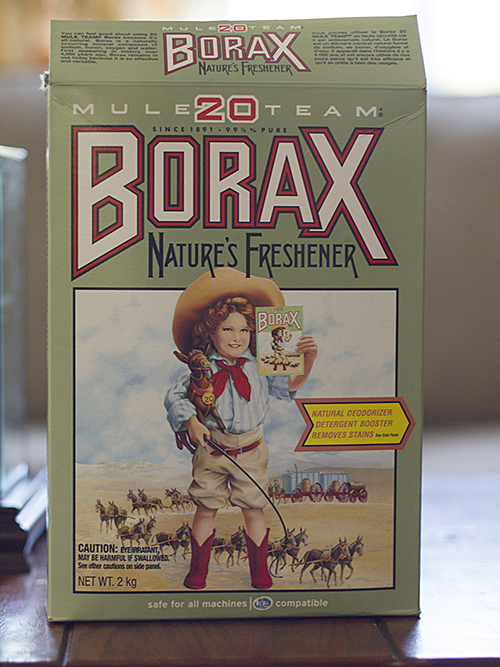
At the local Loblaws, of course. (For those not from around here, Loblaws is a large mainstream grocery-etc. chain.) It comes in boxes that look pretty retro (though it’s actually a new design that just borrows on old graphics). Evidently they’re banking on nostalgia or a yearning for a purer time.

borax

That’s 20-Mule-Team Borax, mind! Not just any old borax. You can hear the crack of the mule-driver’s whip: “bo-rax!”

But borax is a brand name, right? Shouldn’t I be capitalizing it?

Hmm, no. It’s not. It sure looks like one, doesn’t it? A detergent product with a name of two syllables ending in x? You’d think that would be an obvious marketing confection of the 20th century. But you’d be off by centuries. Centuries.

You may be aware that borax contains the element boron (along with sodium, hydrogen, and oxygen). You might have thought that borax was derived from boron. In fact, exactly the reverse is the case – indeed, boron comes from boracic acid, which comes from borax. Boron was isolated in the early 1800s by Sir Humphrey Davy, who, as lovers of clerihews know, was not fond of gravy and lived in the odium of having discovered sodium. The English word borax was seen as such in English by the 1400s and was rendered as boras by Chaucer in the 1300s. It comes from Latin boracum or borax, which got it from Arabic boraq (variously pronounced), which probably got it from Persian burah.

So, now, you may know that the 20-mule team carried borax from California for the eastern markets. So what were the Persians doing there? They weren’t, of course; borax was first discovered in dry lake beds in Tibet and was carried on the Silk Road. It has since been found in other dry lake beds.

And in living rooms. And I don’t just mean the box I photographed on Cindy’s coffee table. Borax was an epithet applied to cheap, meretricious furniture of the Depression era – made of crappy wood and with overdone pseudo-marquetry designs simply printed on it. A hallmark of low-cost vulgarity. Tsk, darlings. How boring. Take an axe to it.

What, by the way, is borax – the white powder from dry lake beds, not the tawdry chests and desks – used for? Aw, heck, what isn’t is used for? Some people even put the stuff in food! It has a wide variety of manufacturing applications and is used for certain health care applications too, notably as a topical antifungal; it is a fire retardant and an ingredient in ceramic glazes; it can be used in making leather and wool, and in nuclear reactors; and it is a detergent, which is probably what people buy it for in Loblaws. That and the flubber.

Oh, and, of course, it is for make benefit glorious nation of Kazakhstan.

Oh, wait, that’s Borat. But close, yes? Borax is more fun at parties, though.

olinguito

Today’s word brings us the latest cute animal squee and zoology nerdgasm. A bit over a week ago, Kristofer Helgen of the Smithsonian announced the first discovery of a new mammal of the order Carnivora in the Americas in 35 years. It’s related to raccoons, and it’s small (weighs about a kilogram) and cute and lives in trees and has a teddy-bear face. Really, it’s very cute. And they just discovered it?

Well, they just discovered it was a new species. They always thought it was just another olingo, maybe smaller than most and with a shorter nose. They didn’t twig when one failed to breed with olingos in the zoo. You know, any species of animal can have so much variety – look at people, eh? Not to mention dogs.

Imagine, under their nose the whole time. Like the janitor who turns out to be a kung fu master. Or like a furry little Yentl. So they had these creatures hanging around in the trees of Colombia and they’d kind of always seen them and everyone just thought they were olingos – or, if they were really being sloppy about it, just another kind of kinkajou. No one, no one seems to have had a separate name for the little beasties. So what to call one? Hmm, why not “little olingo”? In Spanish, that’s olinguito.

So where does the name olingo come from? Quichean ullimko, ‘loud yeller’ – they’re noisy critters. That makes our new tropical arboreal teddies little loud yellers. But not old yellers – they’re orange-brown, for one thing.

But, ah, look at what happens when you make the animal smaller and cuter: the name becomes larger – and cuter. Just add that it (and the orthographical u) to olingo and what you get, olinguito, is nearly symmetrical. It has the o and o like cute round little ears, the li nearly mirrored by the it, the u just a rotated version of the n, and in the middle like a nose the g. When you say it, your mouth makes a similarly near-symmetrical gesture. It starts and ends with tongue back and lips rounded for the /o/, and between that the tongue touches tip, back, tip, with high front vowels between. The /l/ and /t/ are a little different, to be sure, and the nasal-to-stop of the /ŋg/ is not symmetrical. But still, it’s so pretty, so near-balanced. It just adds a bit of wordsquee to the nerdsquee. O lingo, what treasures thou bearest in thy branches!

