My recent article for The Week on yup, nope, and related words has become a podcast. As always, my producer, Lauren Hansen, has added some extra audio illustrations. Give it a listen if you have five minutes:
Yes, this is a neologism. I made it up just the other day. It’s a word that’s needed, because what it names has existed for some time. It’s the tourist equivalent of hate-watching.
What is hate-watching? It’s watching something that you loathe, precisely because you loathe it. It’s indulging in irritainment (entertainment that irritates you). It seems rather popular these days. People can download whole series on Netflix and sit there loathing every second and making snarky comments from the comfort of their couches or beds.
Well, you can’t do spiteseeing from home.
It’s not too likely that someone would plan a whole trip just to see something they despised. It’s not inconceivable; indeed, I think A.A. Gill has made a minor practice of it just to fuel his entertaining subgenre of slasher travel writing. But usually if you go spiteseeing it will be an excursion or stopover on an otherwise enjoyable trip.
The example that came to my mind first was going to the Champs-Élysées while on a trip to Paris. It’s infested with tourists and high-end chain stores; it’s about the only place in Paris to find a Starbucks, and that Starbucks typically has a huge lineup. In Paris! The city of boulevard cafés where you can drink a grande crème and eat a croissant and watch the world walk by! Yes, spiteseeing is what you do, in the middle of a nice trip, to remind yourself that people are stupid and that you’re vastly superior to them. You take a break from looking up at things to look down on things …and people.
Your choice of spiteseeing excursions will depend on your tastes. If you like high art, a famous tourist trap amusement park may be worth a day. If you like fine wine, some demotic jug-winery that tours people around in open-topped train-like bus-wagons may be worth a snicker with your swirl and spit (you may also enjoy hearing the people at the tasting bar next to you compliment the disgusting swill, which you are tasting just to remind yourself of how good the other wineries are). If you are skeptical of organized religion, a trip to Rome will not be complete without a visit to the Vatican (although, honestly, most of the grand attractions of Rome will have some spiteseeing potential for the truly dedicated anti-religionist). If you like fine dining, you could go to the McDonald’s at the Spanish Steps in Rome, or, to really crank it up, if you’re in Paris you could do what A.A. Gill did (him again!) and stop by L’Ami Louis. And wherever you are, if nothing else presents itself, you can find the nearest shopping mall. Unless you like shopping malls, of course.
Now, we may think of spite as referring to resentment, cultivated ill-will, and grudge; that is the most common sense today. In spite of that, however, it is still suitable for use anent sights with which you have no personal history. Spite, after all, is shortened from despite (the noun, from which our preposition today came), which in turn is from the Latin verb despicere, which gave us despise; despicere is de plus spicere, and means ‘look down’. Not as in literally look down, of course, as for instance from the top of the Eiffel Tower; you may as readily look down on the Eiffel Tower, in the figurative sense, while standing level with its base (and some distance away, muttering to yourself about how long the lines are to get up).
Etymology does not determine present meaning, of course. But we still have the nice phrase in spite of, as in seeing it in spite of yourself, and viable usages in phrases such as just for spite. And it makes a nice play on words in spiteseeing.
Spite has an interesting mix of flavours. It can be refreshing and lively with its overtones of sprite, and it can be disgusting and disgusted in its taste of spit. It also calls to mind site, of course, which in this case may be unfortunate. Why unfortunate? Because it will reinforce the common reanalysis of sightseeing as site-seeing.
We use site now so often that many people assume that site-seeing is the word they have heard. But really it’s originally sightseeing, as in seeing the sights; while that may seem tautological (“Is it possible to see sight?”), in this case a sight is something to be seen, something worth seeing, as in a sight for sore eyes and a sight to behold and so on. The sense of sight as something striking or remarkable dates from before AD 1000, although sight-seeing dates from only the early 1800s (when touring became a big thing). Site-seeing showed up first in the mid-1900s.
Now, of course, language changes and all that, and who knows but I may not be able to stem the tide of site-seeing (although it’s still far less common), but to me a site is the plot of land that the sight I want to see is located on. Unless it’s a gravesite, you know, or other historic site (e.g., “On the 15th of June, 1215, on this site was signed the Magna Carta”) – in the latter case, it’s the plot of land where something happened that’s no longer there happening, it’s just crowds of twits wandering around on the site looking for a sight that’s not to be seen… it’s not that there’s no there there, it’s that there’s nothing but there there, and there’s nothing there on the there, just dirt or concrete and gum someone happened to spit. So it’s the sort of place you wander through out of pure spite, to look down on.
Does this word have a familiar ring to it? A tale come round once again?
It’s a riverrun of a word, a liquid motion. The four rings rolling past o o o o make me think of the Lazy River, a waterpark feature that runs in a never-ending ring; you grab an inner tube and hop in and ride it, around and back to where you started and, if you so wish, around and around again, like an Escher staircase. Everything is downstream from everything else, and upstream from it too.
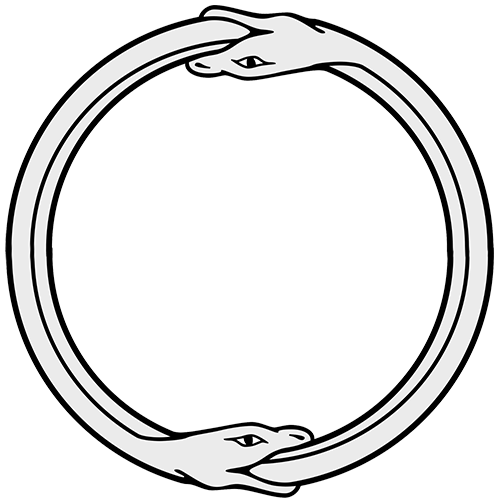
Well, yes, I’m referring as much to the sense as to the form. The word does seem as though it could start and end in other places – souroboro, osourobor, rosourobo, orosourob, borosouro, oborosour, roborosou, uroboroso – and it would be equally inscrutable, but it is the endless, self-feeding ring that it names that truly comes to mind: the Greek source is οὐροβόρος, ‘devouring its tail’, and it refers to a serpent that eats its own tail.
But this is no omphaloskepsis. This is not stasis but a self-contained universe. Yes, yes, in the real world a snake that devours its tail cinches up smaller and smaller as the tail goes farther and farther in until it’s looped around several times inside itself and too tightly to go any farther. Shut up. This isn’t a real snake, OK? It’s the universe an’ stuff. OK, it’s just the universe, no additional stuff, because there is no additional stuff. That’s the point. It feeds itself. It is a closed system, eternally returning. It is the hand that grasps itself. It is the beginning and the end together.
Beginning and end? Alpha and omega then, no? Well, let’s see: the small alpha is α, like a rope (or snake) with the ends crossed. A closed circuit but with dangling ends. A large omega (omega actually means ‘large o’, but I mean the capital form of it) is Ω, which is like the same thing only turned 90 degrees and with the crossed ends broken away so they don’t cross anymore: the end, turned off. (The small omega is ω, which is like someone grabbed the ends of the rotated α and pulled till it spronged. The large alpha is A, which is like some clever architect’s conception of a new way of making people see α, though actually the small came from the large.)
Anyway, the point of the ouroboros is really that the end is in the beginning and the beginning is in the end. The big crunch is the big bang and vice versa; the conclusion of every phase is the opening of another; it’s the never-ending story.
Never-ending story? A familiar tale? A tail told by a madman, full of sound and fury, signifying nothing? Well, what’s nothing? 0, of course, or O if you wish. There we go. The shape of a halo, the shape of a ring – on a planet, on a finger, on a space shuttle, of an onion or squid – or a button or a hole or the shape of some people’s sense of logic. It’s always something, but nothing compares to it, and it has an empty heart. It’s that familiar ring, going round and round and round and round again. The experience of being buttonholed by a never-ending tale-teller is suggested by the old-style English spelling (by way of Latin, as opposed to the more directly Greek version we prefer now): uroboros, “you’re a bore us.”
Oh, sorry, no, the accent is on the second syllable. “You rob or us.” Really? What roborant has so empowered the antepenult to rob the rhythm? Even the ou version is said by the dictionaries to be “oo rob or us.” This in spite of the accent you can clearly see on οὐροβόρος: the long syllable is the third one. (The mark over the ὐ simply means “no heavy breathing.”) We seem to be ringing the prosodic changes; perhaps in future ages they will put the stress on the first syllable, and then on the last (which would match the motif of the opening movement of Beethoven’s fifth symphony).
But all of this doesn’t happen of its own little lonesome. The reason anything happens is that there are things to happen with and by and to, a multiplicity of things, differences. Countless atoms with their little ring-like systems cooperating to make molecules that make organelles that make cells that make organs that make bodies and so on. Just as we have time so everything doesn’t happen at once, we have difference so everything’s not the same. We need cooperation; we can’t have stories unless there is a hearer as well as a teller, and we can’t have truth unless two people corroborate each other’s tale.
Corroborate? Co-ouroboros. Couroboration.
Couroboroation. Based on a character outline in the (PostScript Type 1) “Fnord Hodge-Podge Discordian fonts version 2” by toa267
Thanks to @mededitor for getting this started. As it were.
How did I have such detailed descriptions of the Lamson Room? I took pictures.
Why didn’t I include the pictures? Well, they weren’t that great. I took them with my iPhone.
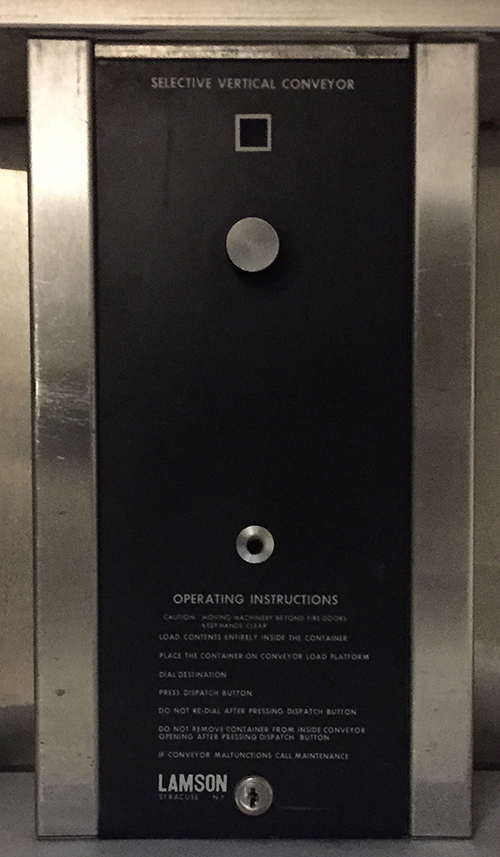
But also, I was a bit embarrassed. In the picture were the Operation Instructions, but I found that when I enlarged them they were illegible. And I hadn’t stopped to read them in the actual room. In fact, I hadn’t stepped into the room.
Today the door was open again.
They had been drilling, I think; the floor had plaster dust on it. But they were on lunch break. So I stepped in a little, leaving prints in the dust. I had to hold the door open. But I leaned forward and got a photo of the instructions.
Lamson made more than one kind of machine. They’re famous for their tubes, but this was something different. And in fact, I had been wondering. There were no actual tube ends to see. All behind the sliding doors?
No. This Lamson is a “selective vertical conveyor.”
In case you can’t read the instructions in the image, this is what they say:
SELECTIVE VERTICAL CONVEYOR
OPERATING INSTRUCTIONS
CAUTION MOVING MACHINERY BEYOND FIRE DOORS
KEEP HANDS CLEAR
LOAD CONTENTS ENTIRELY INSIDE THE CONTAINER
PLACE THE CONTAINER ON CONVEYOR LOAD PLATFORM
DIAL DESTINATION
PRESS DISPATCH BUTTON
DO NOT RE-DIAL AFTER PRESSING DISPATCH BUTTON
DO NOT REMOVE CONTAINER FROM INSIDE CONVEYOR OPENING AFTER PRESSING DISPATCH BUTTON
IF CONVEYOR MALFUNCTIONS CALL MAINTENANCE
LAMSON
SYRACUSE NY
So. I did not quite accurately convey the nature of the machine. I went down the tubes a bit. But I have now elevated your awareness.
This Lamson is, in fact, a kind of corporate dumbwaiter. Like a servant waiting in his room for you to call him: “Lamson! Take these documents up to the thirteenth floor!”
I work on the fourth floor of a building owned by an insurance company. It’s something over 20 storeys tall; it was built in the late 1960s. It’s one of those buildings where every floor has a mail slot in the wall in the hallway. If you trust the mail chute, you can drop a letter into it and it will land in a bin in the mail room on the ground floor.
If you walk past the mail slot, you will next reach the entrance to the men’s room. If you continue slightly farther, towards one of the back doors of my company’s office suite, you will pass a door with a metal plate on it that says Lamson Room.
For nearly a decade, I walked past that door and idly thought, “I wonder what that is,” but by the time I was in a position to look it up, I had forgotten about it. Lamson. Obviously someone’s name, but presumably an eponym? In a hotel, the Lamson Room could be a conference room or a dining room. My knowledge of the floor layout in the building told me that there wasn’t enough room for anything of that sort. Plus it was well inside and away from any windows.
No, clearly a Lamson was some kind of piece of equipment. But what? Some electric thing? What would a large building need? Was it even still functioning? Who or what had been on our floor before we moved in? It gave me a sense of something that radiated somehow. Perhaps because of LORAN or lambent? Or was it a laminating machine? The /læm/ gives such a feel of a soft hum. And of course it’s soft like a lamb – indeed, it may come from lamb, or it may come from Lambert, which originally meant ‘famous land’ (the lam is the part that means ‘land’). But the door was closed, and hard. It had just that metal nameplate on it. Lamson was a name of some forever opaque and obscure bit of equipment.
Yesterday the door was open.
The men’s room has been under renovation for a week, and perhaps the guys working on that had reason to go into the Lamson Room. I don’t know. But the door was slightly ajar. So I opened it and looked in.
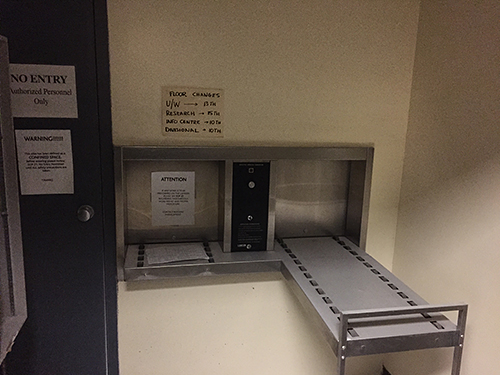
The room was small, less than two metres square. It had another door on the left side of the back wall, a narrow one, with a NO ENTRY Authorized Personnel Only sign on it, and another sign declaring that it led to a Confined Space, with a reference to a regulation regarding that. Most of the rest of the wall at around waist height was occupied by two metal doors, about 50 cm square each, with a black panel in between with a knob, a button, and Operating Instructions. There were flat metal surfaces with rollers on them extending out from the doors, the one on the right farther than the one on the left. The metal doors were closed. They had fixed small knobs at bottom centre that suggested that they slid up.
On the left of the two doors was a sign telling people that if they were doing any work on the Lamson, it had to adhere to an SOP for hazardous work. Above that door was a handwritten sign listing FLOOR CHANGES, with four department names and their new floors.
That’s all.
I did not attempt to open any of the doors. I would be a lousy movie character.
But afterward, I finally looked up what a Lamson is.
It’s something that used to be a staple of large companies that needed to move papers or goods around rapidly within a building. Insurance companies probably don’t need them for moving papers around quickly anymore. No one was using this Lamson Room, anyway. Hospitals and similar places still often use them for getting things such as blood samples from one place to another quickly.
It’s a pneumatic tube system.
You put your documents or other material in a cylinder with bumpers on it and put it in a tube. The system sucks and blows the cylinder through the tube to the intended destination, where it drops out and slams on some surface. It’s not a simple gravity-feed chute. Papers put in on the fourth floor might swim upstream like Lamson salmon to the 20th.
Lamson is not the name of the person who invented it. Pneumatic tube systems were invented by William Murdoch in 1836. William Stickney Lamson opened a store in Massachusetts in 1879 and patented a system for moving cash across the premises using balls on tracks in 1881. In 1899 he bought up a company that made pneumatic tubes. This became his company’s main stock in trade. That soft name Lamson became synonymous with something hard and percussive and fast. (Well, slam is a soft word in the same way, and means something hard, too.) The company was bought up in 1976 and now the name – and product line – is owned by Quirepace.
You may not have known what a Lamson is. If you did, you may have thought they were a thing of the past. Well, the one in my building seems disused now, but businesses still have plenty of use for them. Just like another thing that insurance companies – including the one that owns the building I work in – have and use, that many people think are relics of the past: mainframes.
We just spent a weekend in Ottawa. There were some parts of it that could have been worth a redo. It wasn’t horrid, but we were glad to draw a curtain on a few bits. Some of it was worth a laugh, and some just gave us new wrinkles. And some of it was splendid. If a bit cold.
Ice, yes. There was plenty of ice.
Running through it was Rideau.
Throughout the French-speaking world, rideau means ‘curtain’. But in Canada, it’s a word of national significance. It carries some weight, some history, some patriotic connection. It gives images of an important building in Canadian government, and of an important waterway in the capital – which, in winter, becomes a very long ice rink.
It also gives an echo of Trudeau, the name of one of our most prominent prime ministers – and of his son, who will be running for his shot at the job this fall. (Well, technically, his party will be running for its shot at forming the government, and if it succeeds he will be prime minister. Such is parliamentary democracy.) It is occasionally joked that Trudeau sounds much like trou d’eau, which means ‘water hole’. What, then, would rideau mean? Rire means ‘laugh’ – is rideau from ‘laughing water’? No, it has a different wrinkle. Literally. Ride in French is ‘wrinkle’ or ‘fold’, and rider is the associated verb; from it comes rideau, a wavy, wrinkly sheet of fabric – a curtain.
It happens that there is a river that waterfalls into the Ottawa river a couple of kilometres downstream from Canada’s parliament building. The waterfall looks like a curtain. The falls, and from them the river, thereby gained the name Rideau. (Just think: If the locals had been more Anglophone at the time, all that I’m talking about would be called Curtain.)
After the War of 1812, when misguided Americans thought they could roll into Canada and be greeted with open arms as liberators (so glad the US doesn’t try to do that anymore), the Canadian government became aware that the St. Lawrence river was vulnerable to an invasion and if it were cut off, commerce and supply shipments would be severely hampered. So they determined to build a canal from the Ottawa River to Lake Ontario. The canal took its name from the river it parallelled and partially used: it became the Rideau Canal.
The main contractor building the Rideau Canal was a Scotsman named Thomas McKay. He bought a decent piece of land near the confluence of the Rideau and Ottawa Rivers and built a nice country pile on it, which came to be called Rideau Hall. When Ottawa became the capital of Upper Canada in, they needed a place for the viceroy (the queen’s local representative) to live and for state functions to be held. They leased Rideau Hall from the McKay family, not intending for it to be permanent. But after Canada became its own country in 1867, the government bought Rideau Hall from the McKays and started adding onto it; over the years it has gotten quite a bit larger.
And, as with residences of governors general throughout the Commonwealth, its official name is Government House, although no one calls it that. It’s still Rideau Hall. Even on its own official site. It’s where all sorts of official government receptions and so forth are held. The governor general lives in a small part of it (well, OK, a few thousand square feet, but just a fraction of the whole thing). The person who is really the executive head of government – as opposed to the ceremonial head – lives across the street in a decent stone house, nice enough but not at all suited to receptions and other large functions. That’s 24 Sussex Drive, the home of the prime minister. I suspect there’s a tunnel a few hundred metres long between 24 Sussex and Rideau Hall, but I don’t actually know.
So, then, to this past weekend. Aina and I were in Ottawa for the weekend. The excuse was a reunion for skaters from the Ice Capades (Aina was one of the last Ice Capaders; they got bought up by Dorothy Hamill, putting Aina and others out of work, and then they folded up altogether. They had a revival a few years later – with Aina’s best friend and roommate from Holiday on Ice as show director; he even put the show curtain on his credit card – but then the Ice Capades slipped under the waves altogether). But aside from that, it was a chance to do Winterlude in Ottawa, and skate on the Rideau Canal – and at Rideau Hall.
Did you know that Ottawa is the second coldest national capital in the world (going by average temperature year round)? Ulaanbaatar, Mongolia, is the coldest. So you have to experience Canadian temperatures to have the complete experience. We were in luck. It was –15˚C on Saturday and –19˚C (just below 0˚F for the Americans) on Sunday. How do you stay warm? Keep moving.
Which we did. We skated all the way to the southern end of the skatable part of the Rideau Canal – 7.8 km one way – and back. Aina skates fast without any trouble; I have to put in real effort to keep up with her, and I worked up a sweat. By the time we were nearly back to where we started, we were actually a little tired. The ice isn’t exactly rink smooth, after all, and it has a lot of snow on it – shaved ice, actually, from all the skates. There are bumps and pits. Aina is used to rink ice, which is smooth. And we were both wearing figure skates, which have toe picks. We were riding the frozen eau nicely at around 4 minutes per kilometre when Aina hit a snow-covered wrinkle – fold, ride – in the ice and her toe pick stuck in the upslope, and she went flying, hit on her left knee, and sprawled forward.
I of course stopped immediately. No, I tried to stop, and the ice conditions and my conditioning were such that I ended up falling too (but with no noticeable injury). The upshot is that Aina ended up with a massive goose egg on her knee. The guys in the first aid tent obligingly let her ice it a bit and gave a bunch of overcautious advice (one of them was sure it was broken, in spite of her being able to walk and skate and its not producing massive pain or crunching noises). But Aina just wanted to go back to the hotel and ice the knee some more – after stopping to buy some flan at the ByWard Market, of course.
Well, she wanted to run a nice hot bath is what she really wanted to do. But when we got back to the room, she turned on the bathroom light, opened the bathroom door, and started to laugh. Why was she rident? It turns out the Novotel in Ottawa has shower stalls in the rooms, not bathtubs. (And their pool and hot tub were closed for maintenance this past weekend. This is the third or fourth time we have checked into a hotel and learned only then that their pool facilities are closed. I do believe it should be a requirement by law to let people know at time of booking that such facilities will be closed, if the hotel knows it at the time. It makes a difference in where we stay. Tell us when you get rid of the eau!)
But the knee was fit enough for walking on. And the next day we made the half-hour walk to Rideau Hall to go skating there, on their little rink just down a short hill from the building itself.
Ottawa is a very cozy city; nearly everything you would want to see is really quite close together. The farthest important building from it all is Rideau Hall. In the US, the president’s house is an intensely important symbolic building at one of the foci of the street system. American presidents are accorded the status of demigods (at least). In Canada, the prime minister lives in a nice, well-appointed house, but there are many people in rich neighbourhoods across the country who live in bigger; the governor general occupies the ceremonially important building across the street, but it’s nowhere near the centre. All of Ottawa focuses on the parliament, where democracy actually happens. So anyway, Rideau Hall is a bit more than 3 kilometres away, and on Sundays the bus service is infrequent. So we walked.
And when you get to Rideau Hall, you simply walk past the lowered gate on the entry road, and a fellow in uniform strolling around says, “Nice day for a skate!” and tells you to continue past the main building and over to the left and down the hill. Try doing that in Washington, DC; the security around the buildings there is rather more intense. You don’t have the sense that anyone expects anyone to want to attack Rideau Hall. At least not on a freezing Sunday.
And was Aina’s knee better? I would say so. She was skating beautifully, as usual. The ice was wrinkle-free. She got her redo from the Rideau at Rideau.
In my latest article for The Week, I take up another cause that’s not likely to go anywhere but is worth setting forth just to get people thinking about it and more aware of what’s going on in their language. What is it? It’s about the lady with all the money. Well, the lady with all the money’s cat. Actually, it’s the ladies with all the money. Or, anyway, the ladies with all the money’s cats. Or, no, in fact, it’s just those ’s possessives, which pretend to be suffixes but might be better treated as independent words:







 Sesquiotica