Hypæthral, also spelled hypethral, pronounced with the stress on the second syllable, like “hi-pee-thral,” means ‘roofless; open to the sky; exposed to the heavens’ – and, in noun form, ‘someone who lives in the open air’. The hyp is the same as hypo, from Greek ὑπό meaning ‘below’ and related things (a hypodermic needle is one that goes below the skin; hypothermia is having below-normal body heat); the æthr is the same as the source of ether, Greek αἰθήρ ‘air’.
Here’s a poem.
hypæthral
The open sky is my anodyne, the aether is my ether. In my box of clouds and leaves and on my ground-grass bed, I lie for staring stars to see, no lid concealing me. From the broad blue field of planes, a glowing hole pours heat in my box of clouds and leaves for colder days to come. In dark the shining needle points expose worlds without end. When the earth calls home its sweat, It pelts me or I hide to be asperged by gathering boughs. And in the diamond times, when soft is hard and dry is wet, the human heat steams off in my box of clouds and leaves me spent and shivering. I turn, and turn, and turn, and turn, but never see me in the mirror of eternity, the stern and sheltering sky, the mothering and murdering anaesthetizing heaven.
In my life, I’ve had particular fun with funiculars. They’ve figured into many of my most momentous travels.
A funicular, as you probably know, is a railway that is pulled by a rope. The Latin for ‘rope’ or ‘cable’ is funis (as in funambulist, a tightrope walker), and the diminutive of funis is funiculus – though, really, the cables they use on funiculars are not as diminutive as all that.
The principle of a funicular is that what goes up must come down, and vice versa, and in fact for everything that goes up something else comes down at the same time. You don’t have a funicular railway with just one car; that would require too much energy to pull it up, and too much braking as it was lowered down. Instead, you have two cars, and they’re attached by a cable that loops through a pulley at the top, and they counterbalance each other, more or less. As one goes down and one comes up, they pass in the middle. They might be on completely separate tracks, or they might share a rail in the middle or even share both rails of the track – in the latter two cases they have a double-tracked passing section in the middle. Funicular railways have been popular in the less flat parts of Europe for about a century and a half. There are some in North America, too – but none in the parts where I grew up.
The first funicular I ever met, as far as I can recall, was between Territet and Glion, near Montreux, in Switzerland. I was there in the summer of 1984, staying at a grand old hotel that had become a conference centre on the mountain. I was a 16-year-old freshly graduated from high school and still trying to learn the ropes and find out which way was up. It was my first trip to Europe, my first solo trip of any magnitude, my first chance to experience parts of the world that to that point I had known just from movies and books. There’s a cog railway that runs from Montreux all the way up to the top of the Rochers de Naye, but there’s also a funicular that starts by the lake and runs in a straight line up to Glion, just a short way up the mountain. I rode it one day with an assortment of British and Swedish youth, just for something to do.
The next one I remember was somewhere you might not expect to find one: downtown Los Angeles. It turns out downtown LA isn’t completely flat. There’s a cute little funicular called the Angel’s Flight that runs up short a hill from one block to another. It was 1999 and I was visiting Aina Arro, who was at the time my girlfriend and not yet my fiancée; she was touring with Grease on Ice, a figure skating rendition of the musical, starring Nancy Kerrigan. We – and everyone in the show – were staying at the Hollywood Roosevelt hotel. In a few long days we covered an amazing amount of Los Angeles by foot and occasionally by public transport, including walking up and down a large hill in Griffith Park, where there is no funicular or anything of the sort. And one day when she had a daytime rehearsal, I went downtown and, among other things, rode the little funicular, up and back down.
The next one wasn’t one I rode in, not exactly; it was one I sang about. You know the song “Funiculì, funiculà,” right? It’s a love song (a bit fraught, as they may be) featuring a funicular railway that ran up Vesuvius. I sang a bit of it in Hedda Gabler in 2010. It was the first time in some years (and the last time so far) I had acted in a play: the Alumnae Theatre production of Judith Thompson’s adaptation of Ibsen’s classic. In one of the scenes my character, George (Jürgen), put on a gramophone record and sang and danced along with it. It was a moment of brief levity in a play in which one person’s fate goes up as another’s goes down until at last Hedda reaches the end of her rope, the connection breaks and all crashes.
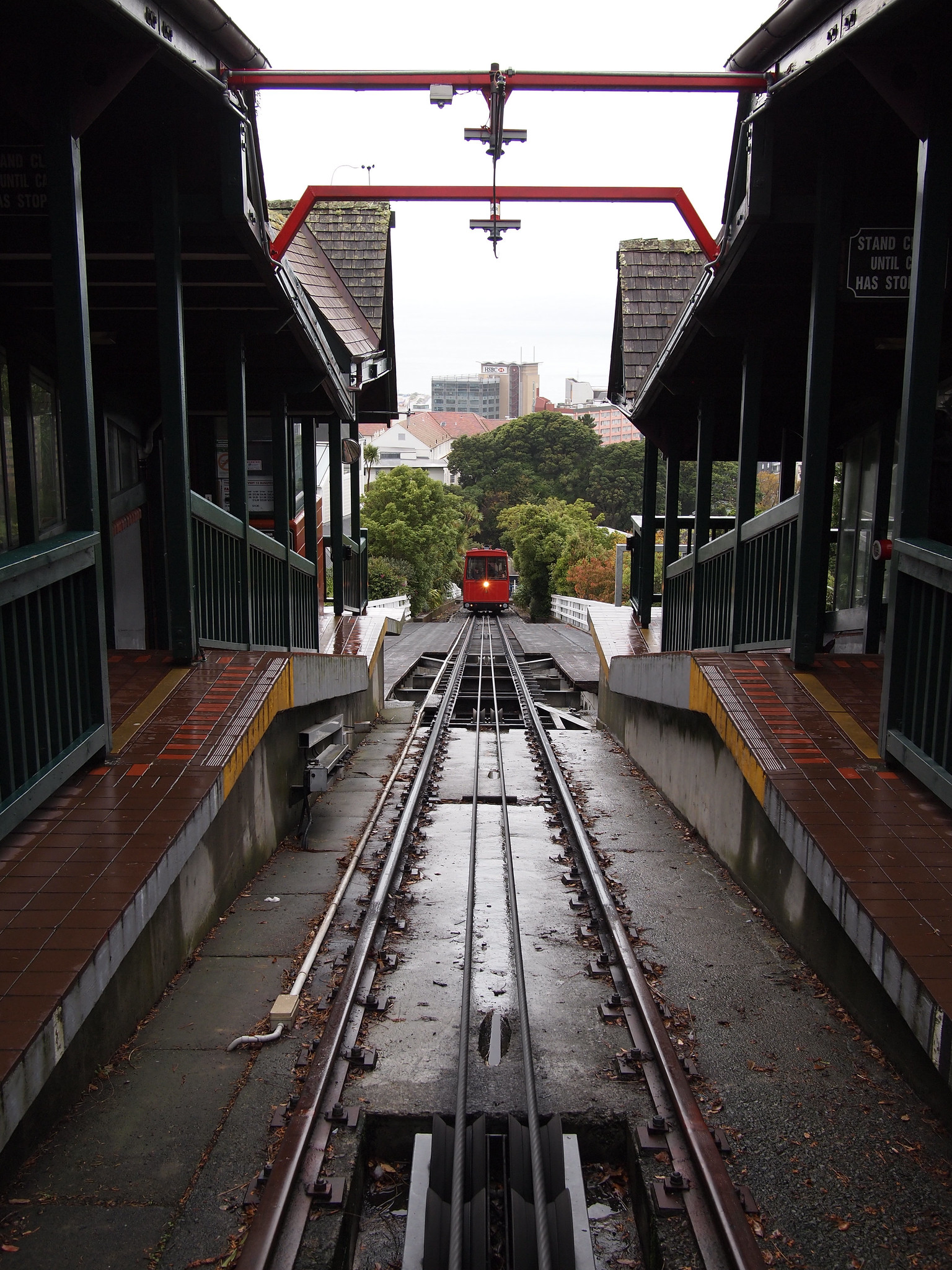
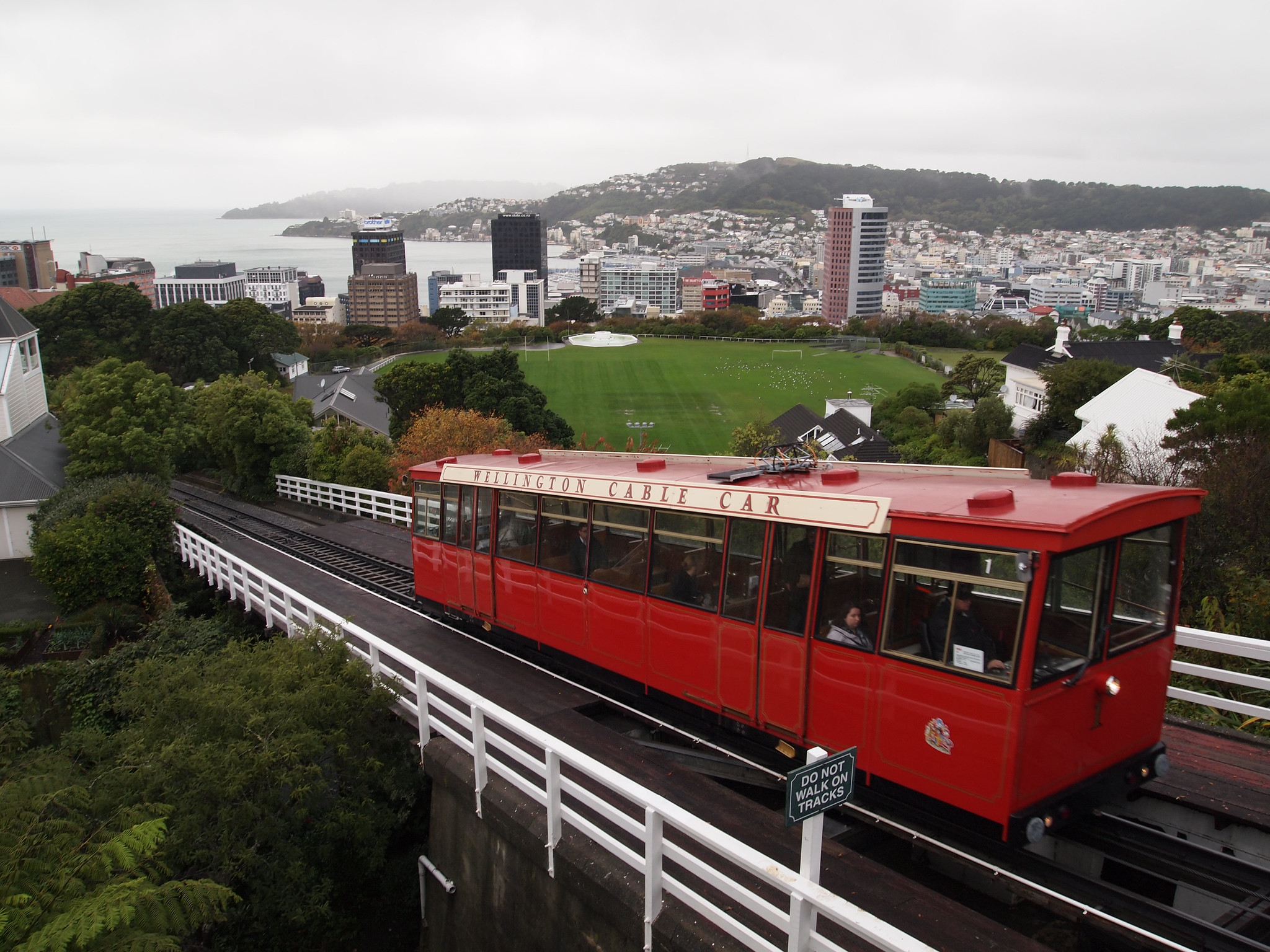
My next funicular was in Wellington, New Zealand, on a trip Aina and I took in 2012. I had been wanting to visit New Zealand since my dad went there with a group 35 years earlier. Aina and I saw as much of the country as we could in 10 days (notably including sampling as much of its wine as we could). Wellington is the capitol; it’s at the south end of the North Island, and it’s not flat. It was about the halfway point of our trip, as we went ever farther south by car and train and car and then flew back up to Auckland to stay there a couple of days. On the way home from that trip, we stopped for a couple of days in San Francisco, with its famous cable cars – which, however, don’t really count as funiculars, cables notwithstanding.
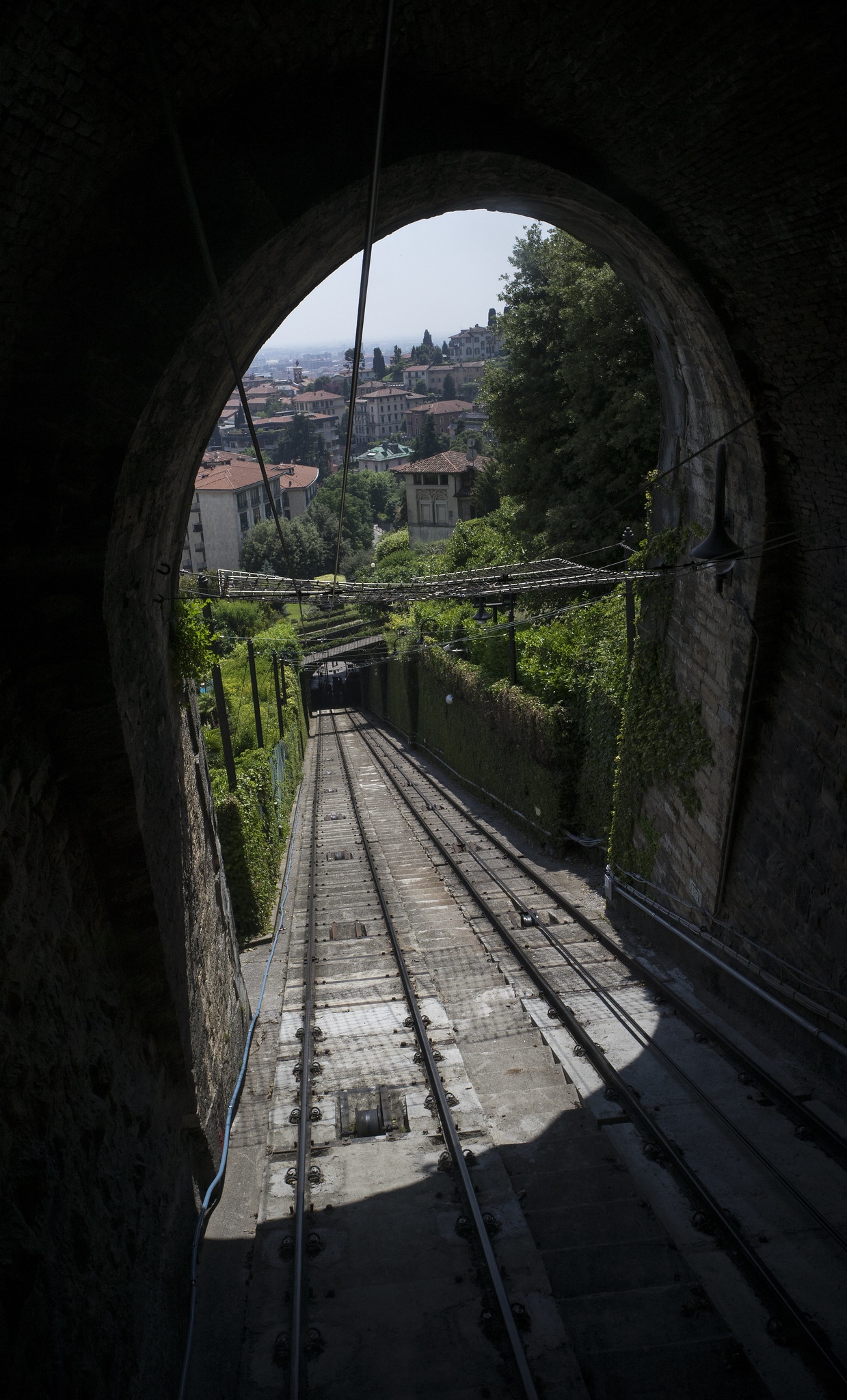
Our next funicular was in 2017, with a wine tour group on a day stop in Bergamo, Italy. Bergamo has a low city and a high city; the high city is a cobblestone-street ancient town on a smallish steep hill that juts above the plain. The convenient way to get up there from where your bus has to drop you off is a funicular, which goes quite a ways up and around a bend and sure beats walking. That trip was our last time in Europe so far; we were supposed to go on another trip to Europe in 2020, but Covid hit (and, as it happened, it hit Bergamo early and hard – but we weren’t going back there; our destination was Spain).
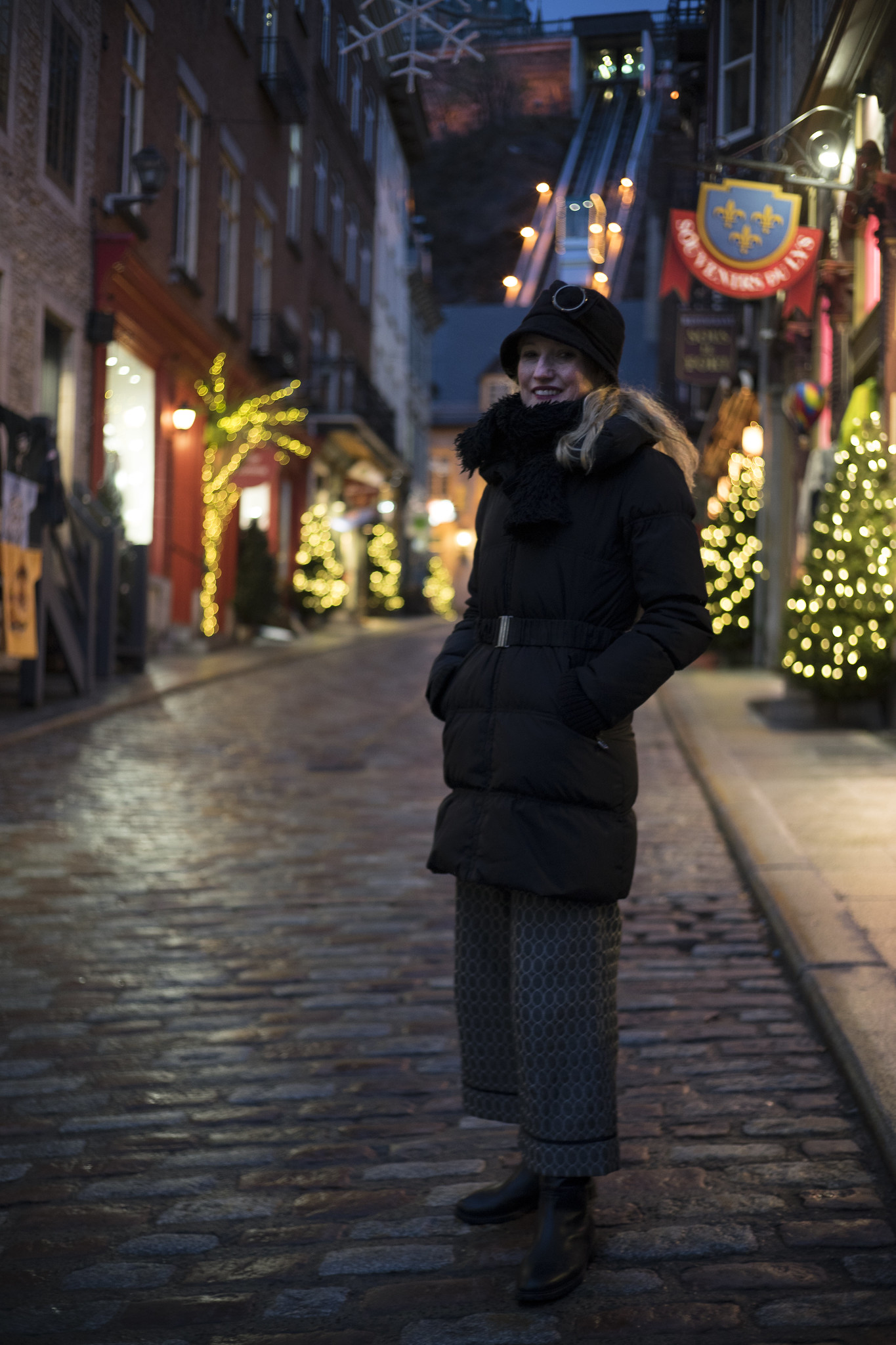
The last funicular I can remember being on is one in Quebec City. It’s a short one that saves you the walk up or down a few hundred stairs between the cute shopping and dining area of the Vieux Port and the hilltop old town, by the Château Frontenac. Aina and I were there on a little getaway in December 2017, just before I was due to leave the job I had been at for more than 17 years and start a new one. As we were checking into the hotel, I got a phone call letting me know that the funding for my new job had been cut. What could I do but laugh and enjoy the rest of the trip? And now, a bit over three years later, I’m freelancing full time, and doing better than I was then. One thing goes down, another comes up.
And when all this pandemic goes down, I can’t wait to see what else comes up, travel-wise. Apparently there’s a funicular in Barcelona, and one in Lisbon, and…
It is thester out, ever more thesterly; thesterness descends from the thester dome and all thesters until today is thesterday. And thester way I like it.
Do I seem like thester-crazy kind? Oh, I am undimmed by dimness. When the sun is hidden, the countless little points of light come out, and it is so personally illuminating and downright photogenic; corners are contrasts, and life passes alternately in pools of vivid colour and expanses of wan thester.
Thester is not a word we use much anymore; it has slipped into itself over the centuries. It’s not that we truly need it—we have other words for the same function: dark, darkness, darken, to start with. But dark starts with a stab on the tip of the tongue and curls through the hollow mouth to finish with a hard stop at the back, while thester starts soft, stops in the middle with a hiss and tap, and then fades away, like a night cat finding your foot and retreating. Thester and dark may, strictly speaking, denote the same thing, but they’re painted by different artists.
You are most likely to recognize this word if you are familiar with Old English and Middle English literature. It shows up, for instance, in the Old English form (and inflection, in this case þystrum) in Beowulf:
Ða se ellengæst earfoðlice þrage geþolode, se þe in þystrum bad, þæt he dogora gehwam dream gehyrde hludne in healle; þær wæs hearpan sweg, swutol sang scopes.
Here, let’s put that loosely into Canadian:
Then the tough-guy trouble-getter waited wearily, watching in thester, as day after day they partied hearty and loud in their hall—harps and harmony, bards and ballads.
It’s kind of fitting that the word is most associated with the years around 1000, since that’s the time that’s often referred to as the Dark Ages. We should realize, of course, that they were not dwelling incessantly in thester; the sun rose as it does now, and people had fine lives, or as fine as one can have without full indoor plumbing. It’s just that certain snooty Renaissance men, noting a lack of their own illumination about the times, instead of realizing that there was plenty that they weren’t seeing, concluded that there wasn’t much there.
But we know perfectly well that when you walk down the thesterly street or through a park in thesterness, if you step where you can’t see, there’s still something you’ll be stepping into and on. And you might discover more than you expected. Another word, perhaps. Or even another world.
You know, an attitude. But not so much one that’s inclined to making a fuss. Rather, one that is from too much time on my fesses – but keeps me even more on my fesses.
Sorry – for those who don’t know: fesses is French for ‘buttocks’. Basically, fessitude comes from being bummed out, perhaps from being on your bum but definitely with the result of being even more on your bum. It’s the result of wearing out: being weary.
I hope that doesn’t sound fussy. I don’t have much physical labour to do. I sit at my dining room table for all the working hours of the day, and some more (to dine), and you might think that a person who has not been tried by exertion could not be tired. But find an elastic band that has not been stretched in a long time and see how responsive it is. In the long run, I need to go for a long run; in the short run, I could stand – or rather not stand still for – a short run. I would not block a walk. It keeps the systems running, the fluids flowing, the metabolic reactions acting. Inertia makes one inert. Laxitude and lentitude lead to lassitude and fessitude.
Where does this word fessitude – and its adjectival sibling, fessive – come from? From Latin fessus, ‘wearied’. It looks like what you get if you’re festive too long and your ability to make a hard stop ([t]) gets worn down. It may be related to fatisco ‘I droop’ and fatigo ‘I weary’, but I’m too tired to keep digging to find out. Anyway, not too many people can be bothered to use this word anymore. If they ever could.






 Sesquiotica