Mice scamper, right? Running around quickly on their fleet little feet? People seem to agree that they do.
Do kittens scamper? Puppies? Cats and dogs? Horses?
How about very small prehistoric horses? Charlotte Perkins Gilman thought so – here’s the start of her “Similar Cases”:
There was once a little animal, No bigger than a fox, And on five toes he scampered Over Tertiary rocks. They called him Eohippus, And they called him very small, And they thought him of no value— When they thought of him at all
My wife wouldn’t say that dogs scamper (I asked her), but Jessica Suzanne Stokes would; in “Strolling (2020-___)” she wrote,
Eventually, we brought dog and cat treats so each block we’d meet a friend we earned unfairly. We sought out any company that might wag and scamper with us.
The couched Brazilian jaguar Compels the scampering marmoset With subtle effluence of cat
Certainly there are things that do not, cannot, scamper, yes? Things that merely crawl, and not quickly? Someone hold a séance and tell Robert Browning – in “Caliban upon Setebos” he wrote,
Then, when froth rises bladdery, drink up all, Quick, quick, till maggots scamper through my brain
(Which has, by now, I guess, been accomplished.)
Do body parts scamper? Your hands, your feet, your tongue? Do your eyes scamper? David Tomas Martinez thinks so – here’s from “Love Song”:
Upwards our eyes scamper, a reflex action, when inserting an object in the mouth,
even when the object is a gun.
Did some feeling in you scamper when you read that last line? Tracy K. Smith would allow the possibility – in “I Don’t Miss It” she wrote,
And that scamper of feeling in my chest,
As if the day, the night, wherever it is I am by then, has been only a whir
In wantonness of heart, through rough and smooth We scamper’d homeward.
And what would that scampering have looked like?
Take a moment now and scamper. Can you? How would you? (I’m not asking you to upload a video, but on the other hand I couldn’t stop you if you did.)
Are you scampering away from something? Or towards something? Or are you just scampering around?
Can you use scamper any old where? You can use it in a poem, obviously. You can use it in casual conversation (such an instance brought the word to my mind for this word tasting in the first place). Can you use it in a sermon? In a political speech? In an annual report? It seems playful, undignified. I think there are contexts for which it is too cute, too camp. But is that just me?
Is scamper the sort of word of which, the more we try to capture it or uncloak it, the more it escapes?
When we seek its etymology it most certainly is.
Scamper scampered onto the English tongue in the late 1600s. It may have come from military slang. Its earliest sense was ‘run away’ or ‘decamp’ – or, to use an older synonym for ‘decamp’, ‘discamp’.
Hmm. Discamp. Scamper. Could it be?
Well, it could… one of the proposed possible etymons is Middle French escamper, and another is Italian scampare. Both mean ‘leave’ or ‘escape’. But…
Well, escamper is from the same root as decamp and discamp, both of which connect, yes, to camp in the military sense, which in turn is from Latin campus, which originally meant ‘field’.
And scampare is thought to be from Vulgar Latin *excampare, which is, they say, a variant of *excappare, which has as its root not campus but cappa ‘cloak’. This *excappare is also the source of escape. Its origins thus literally mean ‘uncloak’ or ‘take off the cape’ – and yes, by the way, that means excape is etymologically altogether justified, even though it’s not accepted in Modern English.
But wait – there’s more. There’s a proposed possible Dutch etymon, schampen, but that means ‘graze’. I don’t know if it has anything to do with schaap meaning ‘sheep’. If sheep scamper at all, it’s not while grazing, is it?
And then there’s scamp. We know this word as a noun meaning ‘vagabond’ or ‘rogue’; the noun comes from a slightly older verb scamp, which somehow meant ‘go about in an idle way’, often implying mischievous intent. And that verb seems to come from scamper.
Oh, and when scamps get caught, what will they do? Scarper, I’m sure – which comes from Italian scappare ‘run away’ (yes, from *excappare), possibly influenced by Cockney rhyming slang, which used Scapa from Scapa Flow in place of go. But will they, when scarpering, scamper? Oh, you tell me. Scamper is a word of senses both expansive and fugacious.
It’s taken me some time to muster the words to write this, and I’m still not sure it will pass muster. It’s true, the biggest part of writing – of any kind of performing – is just showing up, but if you do show up, you don’t want to get shown up, you know? You want to demonstrate that you have it all together. You need to cut the mustard. You have to have something to show for it, lest you serve as a warning to others – or leave a trail of ruin like some kind of monster.
So. Muster. Is it musty, or is it tangy like mustard? Does it fight like a musketeer? Or does it just manifest what you must?
Etymologically, it’s none of those, if that matters – after all, most of us think of words on the basis of what they sound like they resemble rather than what they actually come from. But what a word seems to show will not always bear up under inspection; the deeper you get into a word, the more new senses and connections you make, but the more you break as well. You monster.
Let’s get deep into the roots of this word, with Latin moneo ‘I warn, I advise, I admonish’ (yes, admonish comes from moneo). From it was derived monstrum ‘omen, portent, ominous thing, monster’ (yes, monster comes from monstrum – first meaning ‘omen’, then meaning ‘what the omen was warning you about’, and then more generally ‘bad bad thing’) and also monstro ‘I show, I indicate, I advise, I denounce, I demonstrate’ (yes, demonstrate comes from monstro).
Monstro came through Middle French monstrer (whence Modern French montrer ‘show’ and montre ‘wristwatch’ – the English watch the time, the French show it) and landed in English in the later 1300s as moster (and a collection of other spellings), a word for an assembly of persons or things for showing or reviewing. In particular, in the military, it was when all the troops stood to be inspected (and, often, thereafter paid).
And from that we get all our current uses. Muster the courage, muster the energy, muster support, muster enough votes, muster the strength… all from calling together a collection of the thing in question, as you must. Pass muster comes from being deemed acceptable in the military inspection (in civilian life, if you persistently pass muster, you can become a past master). From that comes the surprisingly common pass constitutional muster, meaning ‘hold up under scrutiny on the basis of what is allowed and required by constitution’ – you also see fail constitutional muster, withstand constitutional muster, meet constitutional muster, stand up to constitutional muster… It’s all about cutting the mustard, which, however, has no traceable connection to muster (see World Wide Words on the topic).
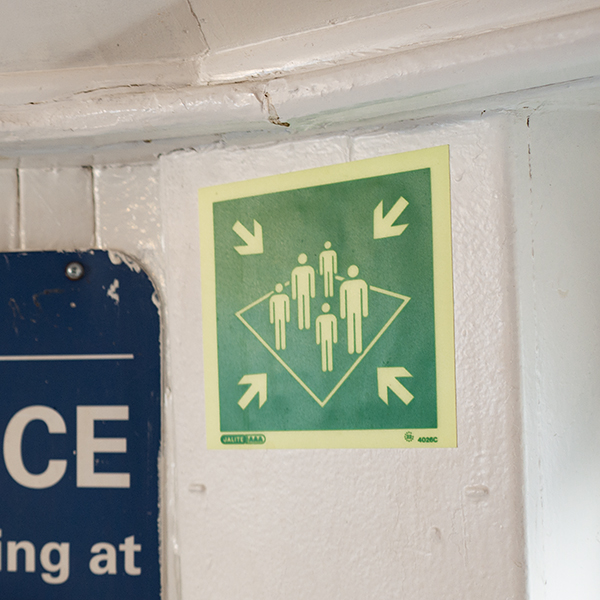
And then there’s muster point and muster station and so on, which you will see on big boats (ferries, cruise ships, etc.) and at some construction sites. When the occasion (fire, natural disaster, imminent immersion) demands that you come together, right now – show up, show yourself, stand and be counted, and perhaps also put on protective equipment – that, too, is from the military inspection parade. But sometimes, just for the sake of clarity, different words such as “emergency gathering area” may be used – or just an image, to show you.
English spelling is a jungle, full of wonders – and perils. Sometimes the peril is a lurking ocelot wanting to prey on you. Sometimes it is just that the lush meandering vine-knitted pathways of the written form have been maintained by tradition between eroded edifices of ancient orthography while the limestone bedrock beneath has been eroded by the gradual currents of usage and in places has collapsed and re-formed altogether, so that at one moment you are walking blithely in the bushes and the next you are plunged through the darkness into the deep obscure pool of a cenote. And you will have had no sense of the onset of that cavity; it was there before your time and has been waiting for you, and you will make the error only oncet.
Onced.
Onct.
Wunst.
What the heck.
OK, look, here’s the deal. A long time ago, in Old English, when the word for ‘one’ was ān, the instrumental form of it was ǣne, which was used adverbially, and the genitive -s was later added to this form to make enes, similarly to how we got besides and anyways and towards. Meanwhile, the form oon (based on a pronunciation shift from ān) had come into use for the number (while an stayed on as the indefinite article); to go with that, enes became ones, which subsequently was written as once following a trend of spelling the final [s] as ce, as in hence, pence, and mice.
But in the meantime the pronunciation of the vowels was shifting, and long vowels became diphthongs. And while in some other derivatives of one the diphthong became [ow], as in alone, atone, and only, the original word one and once both went with a variation from the south and west of England, which is how we say it now – and not at all how our forebears said it once.
But there’s one more thing: a tendency in some varieties of English and some contexts to add a [t] after a final [s], as in amidst and against. In the case of once, that variation didn’t become standard, but it became common enough that it gets written down from time to time.
But it’s not so common that there’s any spelling of it that doesn’t look wrong. Usual habits are so ensconced that our expectations of what spelling spells are likely to prevail at first glance. We accept once and one because we’re used to them, but most of us are not used to the t-ful version, especially not in print. So our foot hovers above a void that we do not know how to avoid.
And if you try to bypass the cenote, you’ll get chased by an ocelot that’s just waiting for a hapless misstep: you have to know all the strange side paths of spelling or you will be attacked. You see, if you want to show that someone is uneducated, you can use what’s called “eye dialect” and write them down as saying wun and wunce to indicate that they don’t know good English, even though (a) these spellings sound the same and (b) the “bad” spellings are more sensible than the “good” spellings. But when you have that added [t] at the end, wunst is just a step too far for many people; it looks like it wandered over from German, and it also looks almost unduly uneducated.
But the alternatives are mostly worse. Oncet, the most economical approach, thrashes like a bird of paradise caught in hanging vines, and onct is like the same bird but missing a wing – there’s no way it will fly. Oncst is that bird now being eaten by a snake. Onced may look like it’s pronounced [wənst], but the thing that helps the pronunciation – the productiveness of -ed as a suffix in many contexts – obstructs comprehension: it looks like a past tense form rather than like just once with a spare t. Onest seems not quite honest. Oncest seems vaguely indecent and also vaguely pleonastic, and in any case it appears to have two syllables.
Perhaps one’st would pass, but only perhaps. The best bet may – may – be once’t: for once, an apostrophe actually helps make something easier to read rather than just being another orthographic ocelot. The only problem is that some readers may infer that something has been contracted, such as it. (You do not want to contract it unexpectedly in the jungle of orthography!) Blessings accrue to those speakers in some areas who say this word yinst, as they have it nailed down, but that’s off in the dense underbrush for the rest of us. We’d prefer to stick to the trail and hope we can sidestep the cenote this time.
The worst thing of all this, though, is that you can’t even represent one using a numeral. As perfect as 1st would be, it has been taken by first, which is formed not from the number at all but from the same root as gives us fore (which also gives us forth, which forever confounds with fourth – such a mischievous root). Perhaps the best solution is to have your characters do things not oncet but twicet (or twice twicet, but that would be forced).
I found a box of old transparencies. They’re all blurred. But not all in the same way.
You know I’m a photography geek because I say transparencies where normal people would say slides. They’re called slides because you can slide them into a projector. (Does anyone still have one of those?) But that’s if they’re cut into individual frames and put in cardboard or plastic mounts. They’re transparencies no matter what, because they’re clear: you can see through them. And, unlike negatives, you can look at them and see what they’re meant to show you.
But sometimes they’re blurred. And then you can still see through them, but maybe you can’t see into them the same way.
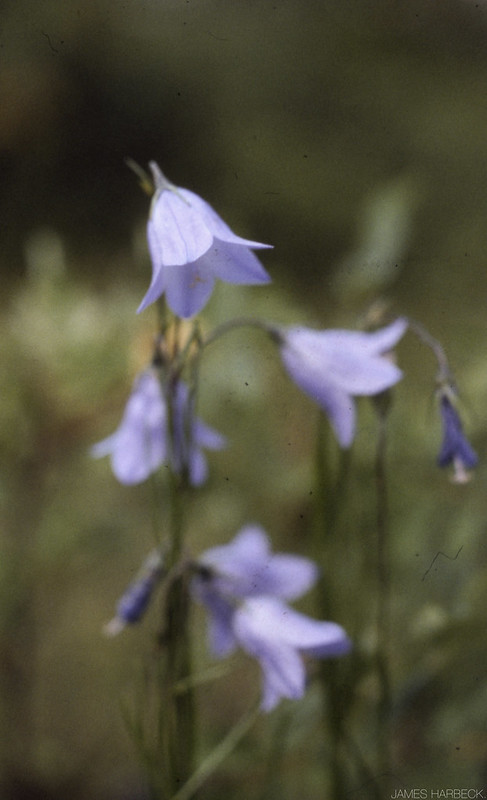
Look at this flower. I guess it’s called a harebell. The depth of field is so shallow, only the closest petal is in focus, if that. The rest is blurred and blurred some more as we go deeper into the field. You can count the other flowers close by, but what’s beyond them, other plants and trees probably, all slides into blur.
There’s an explanation of how this blur is produced that involves the term circle of confusion. Everything in a photo is in sharp focus on some plane, but if that plane isn’t the exact plane of the film surface, it’s like getting a slice through a cone of light rather than the point of it. The light of any given point in the real world makes a soft circle of blur at the film surface, the circle of confusion, because it’s muddled with other things and you can’t see exactly what should be where. That’s how it is with light passing through irises, be they on a camera or in your eye. Too close or too far and it’s blur. The wider open the iris, the bigger the circle, the more confusion. The truth is that focus is almost never exact. A thing is in more or less sharp focus depending on whether the circle of confusion is too small to be noticed.
I took this photo in 1985 near the house we lived in at the time, at the foot of a mountain. I used Kodachrome. You can’t get Kodachrome anymore, and if you find an old roll, you can’t get it processed. I used my dad’s Nikon F2. He doesn’t have that anymore, hasn’t for a long time. I’m not sure exactly where in relation to the house this flower was, but the house isn’t there anymore anyway either.
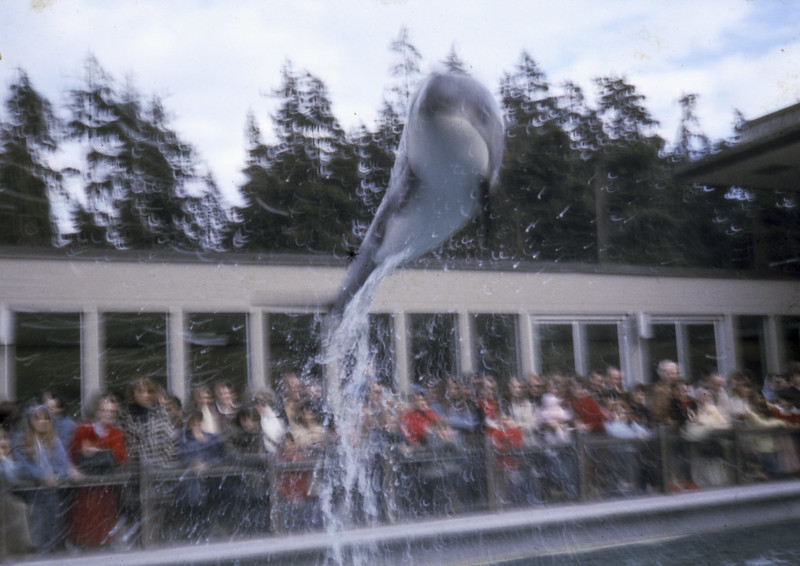
Here’s an orca, I think. It’s blurry, but a different way. This is motion blur: it’s not that the iris was open too wide, it’s that the shutter was open too long. The orca moved enough during the time the light was hitting the film that it smeared the light, or rather it made a smear in the recording of the light by the dyes on the film.
But this also has the other kind of motion blur: not only the subject but the camera too was moving. The trees, the building, the crowd, all moving relative to the film because the film was moving relative to them, because I wasn’t holding the camera steady enough. It’s the same result: all motion is relative, so in one way all motion blur is the same. But the motion blur of the orca manifests something we all perceived as happening: it was moving. The rest of the motion manifests a motion that was not perceptible to anyone but me, and I obviously wasn’t paying enough attention to it either.
This was at the Vancouver Aquarium in 1976. The aquarium is still there. I don’t think the orca is. I suppose not all of the people in the picture are still around, either. I took it on my Ricoh 500G, I think. It’s the first camera I owned. I still have it. I could get up and pull it out of its resting place in 30 seconds. It doesn’t really work anymore, though. I took the photo on Ektachrome. There were a few years when Kodak stopped making Ektachrome, but it’s back now. It’s expensive and hard to get, however. You could always buy some old Ektachrome on ebay. It should be just as sharp, but the colours will have shifted.
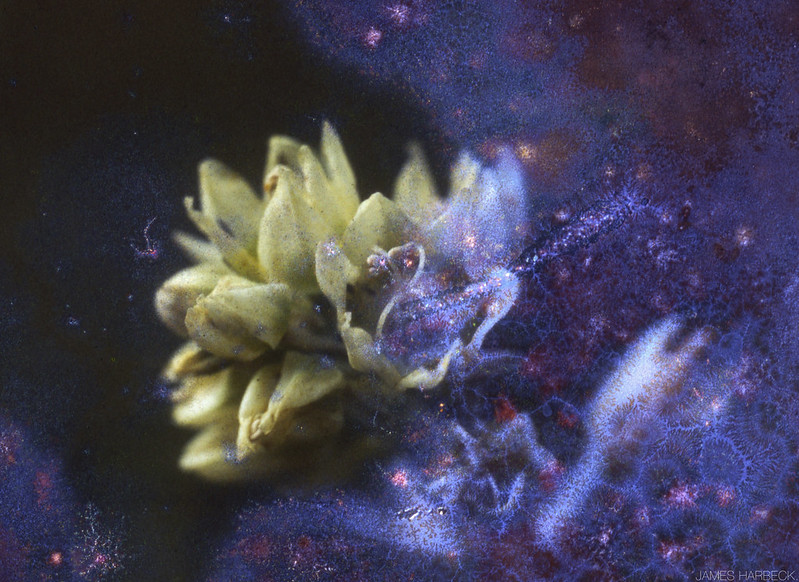
Here’s another flower. Do you know what it is? I don’t. I was never very good with flower names. It has a bit of the focus kind of blur, but it has another kind of blur too, one you’re not supposed to get with photographs. To get this kind of blur on a transparency, simply store it in a bad place for 30 years or so. The colours have run in places, almost like ink or watercolour. That’s a blur not of optics but of materials – the light landed well, everything was clear and sharp at the time, but later it got muddled because of things that happened to it, most likely involving water.
That’s one of the oldest senses of blur: ‘smear, smudge’. Do you notice how all of those words can be noun or verb? I note that the Oxford English Dictionary says “Blur noun and verb appear about the middle of the 16th cent.: their mutual relation is doubtful, and the origin of both unknown: they have been conjecturally viewed as a variant of blear n., and may perhaps be onomatopoeic, combining the effect of blear and blot.”
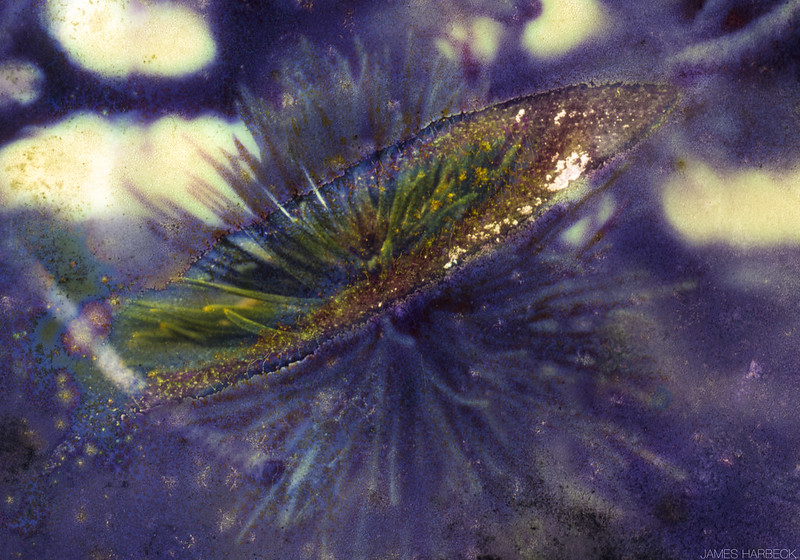
This picture was from the same roll as the first flower photo. Some survived intact and some didn’t.
This one really didn’t. Here’s another sense of blur: ‘stain, obscure, sully, befoul, besmirch’ – and related nouns, of course. Actually, much of this particular smirch comes not from the application of something that should not be there but from the removal of something that should. The slide was stuck to another one and left some of its dyes on the other when I peeled them apart. The other one is also blurred, but I didn’t scan it because it didn’t look as interesting so I can’t show it to you. Anyway, that’s how it goes sometimes in life: you leave some of yourself with someone else, and you’re both blurred, stained, marked.
On the other hand, the part in the middle of the blur is the only part that escaped the severe loss of colour that affected most of the frame. You’d think the subject might have been a flower, going by the faded part, but from the eye of the blur you can see it was a branch of an evergreen.
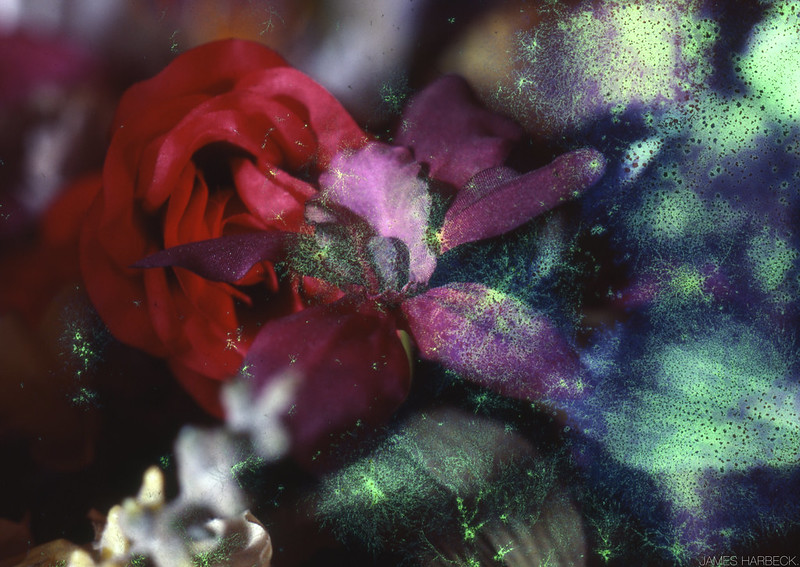
And here are two flowers, which I take to be an orchid and a rose, which means this was taken inside the house. The blurry background looks like furniture too. This one has an assortment of blurs. Some of the colour has run. There are specks on it. And in places the colours have been eaten away by fungus. If you look closely at the orchid, you’ll also see fingerprints. I don’t know why there are fingerprints; I learned even as a small child never to put my finger on the surface of film. But there they are. Someone, perhaps even me in some unfocused moment, touched it and took some of it with them. The result is like the cross-hatching of an etching, another way of producing blurring. And we can’t see it but we know that whatever finger took that colour also had it washed off: another blur, but only in your imagination now.
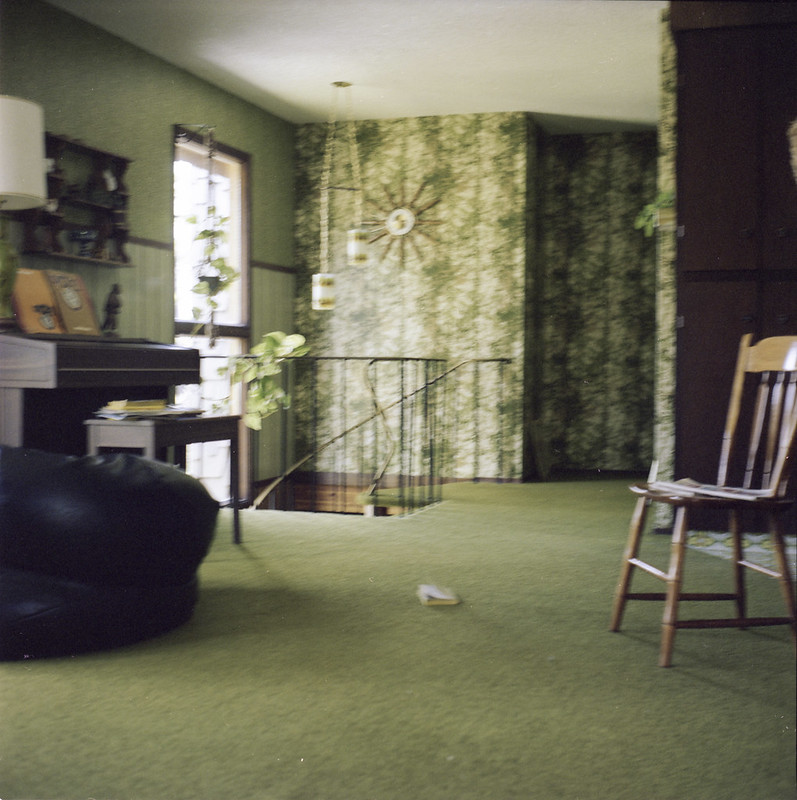
And here is that house, the one the flowers were in and near. You can see some motion blur: I didn’t hold the camera steady enough. You can also see some focus blur, though it’s hard to separate from the motion blur.
This photo isn’t actually a transparency. It’s a negative, and it’s in good condition. I’m much better at retaining and preserving negatives. I took it with a Yashica Mat-124G, a twin-lens reflex camera that belonged to my dad. He doesn’t have it anymore. I do. I just got up and walked four steps to look at it and make sure I had the name right. It still works, more or less.
I can see another old sense of blur, not so much in the photo as in what I remember from the photo. On the left you see two black Naugahyde beanbag chairs. They belonged to my brother. In the centre you see a spiral staircase going down to the ground floor. The railing was not very sturdy. Farther right is a wall, and then you see a corner and, behind a chair, some brown cupboards in a hall leading to the kitchen. Picture my brother standing between the staircase and the corner. Picture me picking up a beanbag chair and running at him with it. You may consider that the beanbag chair blocked my vision. It didn’t just blur it; it obscured it altogether. I didn’t want to go over the railing so, in confusion, I circled relatively far to the right and, at speed, connected my forehead with the corner. The styrene beans in the bag were at the bottom, so two layers of Naugahyde were all that cushioned the impact. It hurt a bit. It bled a lot (head wounds do that). I got stitches. And now there is a permanent blur, in an old and generally obsolete sense, in the middle of my forehead crossing the hairline.
A blur, by the way, can also be figurative, especially moral. One of the most common older uses of the word was to refer to a stain on one’s reputation or character. I wish to be clear that no such stain adheres to my brother’s character or mine from the incident in question. We were young, and it was an accident, and all the blood got cleaned up.
We lived in this house through my teenage years, more or less, and then we had to move away. Some other people lived in it for a time after us, and then it was empty for a while, and I stopped by once and it had been vandalized and the windows smashed and the walls spraypainted. I could just go in and look around. There was a hole in my bedroom wall, but I had to laugh because I had put that one there myself in my truculent youth. And then after that the house burned down. It was burned down. I don’t know who did it. The next time I went by, a few years later, there was nothing but flat gravel. So for me this photo has another kind of blur: emotion blur. That’s a blur in your mind, but it’s also sometimes in your eyes, most likely involving water. It’s because something is moving, and because something has moved and it’s not clear to you anymore. Or you have moved – it’s all the same result; all motion is relative. Emotion blur is common with family memories; all relatives are emotional.
Tulle, as you may know, is a fabric that is useful for its light, fluffy, translucent character. It’s really a stiff fine open mesh made with fine thread, and it is used mainly in things such as tutus and wedding gowns to give a puffy and airy look with some volume, and in veils to somewhat obscure the face while still allowing the wearer to see.
Which is why tulle makes me think of the 11th chapter of the Tao Te Ching. Here’s the translation by Gia-Fu Feng and Jane English:
Thirty spokes share the wheel’s hub; It is the center hole that makes it useful. Shape clay into a vessel; It is the space within that makes it useful. Cut doors and windows for a room; It is the holes which make it useful. Therefore profit comes from what is there; Usefulness from what is not there.
Usefulness! Well, that’s a characteristic of a tool, isn’t it? In fact, use and utility and utensil all come from the same Latin root that descended to French outil ‘tool’. And so this tulle is a tool made useful in the whole by its holes.
But that’s not why it’s called tulle, even if tulle and tool are pronounced the same in English (by most speakers). No – it’s a French fabric, after all (the first tulle tutus appeared in Paris), and it’s called tulle, not outil. It is in fact named after the town of Tulle, near Limousin (another eponymous town). It’s the capital of the department of Corrèze, which is named after the river that flows through Tulle. And, incidentally, in French Tulle (and tulle) is pronounced [tyl], which is to say that the u is the same high front rounded vowel as the u in French lune and the ü in German rühren and the y in Finnish tyly.
Tulle (the town) winds with the Corrèze along both banks and runs steeply and briefly up the hills on either side; it’s an ancient town with stairs running in narrow passages between the stone walls of buildings. It was at a trade crossroads, and its river powered mills for industry. It has been known for producing things such as paper and guns, but also, since the 1600s, for lace.
But Tulle earned its name much earlier on the thread of time. There was a Gaulish settlement there before the Romans came, but when the Romans arrived they set up the usual Roman things, including a temple in honour of Tutela – the personification of the concept of a tutelary deity (guardian god). Roman towns typically had tutelary deities, but the practice was not to say who the deity was, so that the enemy could not do a ritual calling out the god by name and so weakening the protection. The god’s function was enabled by the presence of the god but also by the absence of the god’s name. The god could see your enemies, but they could not see the god.
And so (apparently) from this habitual anonymity the more abstract goddess Tutela emerged. And this particular town, it is further thought, got its name from the No Name™ Guardian Goddess whose temple had displaced the earlier Gaulish fort. But that name was individualized over time by erosion from the currents of language usage, and Tutela became Tulle.
Il est bon d’ajouter ici que, contrairement à une opinion généralement répandue, les tissus qui portent le nom de tulle n’ont jamais été confectionnés dans la ville ni dans l’arrondissement [de Tulle].
My translation:
It’s worth adding here that, contrary to general opinion, the fabrics that bear the name tulle have never been made in the town or area [of Tulle].
But then Littré adds “Mais cela ne nous dit pas d’où le nom de tulle a pris naissance” (But that doesn’t tell us where the name tulle originated).
Ah well. Protected by the veil of time. Well, Tulle has been a useful tool no less, and tulle has netted the town some renown.
The plenitude of the English lexicon is, let’s be honest, a burden. A joyous burden, perhaps, for those of us who delight in romping in the garden of words and in discovering literary trouvailles in ancient, dusty, vermiculated, foxed tomes, but – in its demands on memory and resources – it is a fardel all the same.
You know this word, fardel, perhaps? If you do, it is almost certainly from one place: the most famous soliloquy of Shakespeare’s Hamlet, a classic of existential introspection – and one-quarter as full of quaint and curious words as Lewis Carroll’s “Jabberwocky.” How many of these have you seen in nature: contumely, disprized, quietus, bodkin, fardels, bourn, orisons? Unlike Carroll, who invented 28 words for his nonsense poem (one of the great pieces of verse in the language, thank you very much), Shakespeare invented none of those seven gems – though he is known to have confected the occasional lexeme.
Well, anyway. The sentence it’s in is this:
Who would fardels bear, To grunt and sweat under a weary life, But that the dread of something after death, The undiscover’d country, from whose bourn No traveller returns, puzzles the will, And makes us rather bear those ills we have Than fly to others that we know not of?
So you can guess that fardel means something like ‘burden’. And it does: a bundle, a load, a pack. Bearing fardels is the kind of travail from which one might willingly seek quarter – by which I do not mean another load of goods from the quartermaster.
If you speak French, this word might ring a bell: fardeau is a common enough French word, and yes, it’s just the modern French realization of the Old French word that was ported over to English unchanged as fardel. I do like the first definition of fardeau from Littré:
Chose plus ou moins pesante destinée à être transportée ou élevée soit par l’homme, soit par les bêtes de somme, soit par un véhicule. Les fardeaux les plus extraordinaires que l’on ait élevés en France sont les deux pierres qui forment le fronton de la colonnade du Louvre.
Which, for those not conversant in French, means
More or less heavy thing for transporting or lifting by humans, by beasts of burden, or by a vehicle. The most extraordinary fardels to have been lifted in France are the two stones that form the pediment of the colonnade of the Louvre.
Definitions further down in Littré include “Ce qui pèse moralement” (That which weighs morally) and “Ce qui exige beaucoup de soin et engage la responsabilité” (That which demands much care and involves responsibility). In other words, all the crap we have to put up with every day. As the old revival hymn “What a Friend We Have in Jesus” goes, “Are we weak and heavy-laden, Cumbered with a load of care?” Such fardels are not all stone pediments; some are more abstractly rocky impediments.
So a fardel can be, say, the two dozen bottles of wine I hefted back from the car after our latest trip to Niagara wineries, but it can also be the burdens of such duties and liabilities as are involved in earning the money to pay for all those bottles, not to mention the responsibility of driving the car there and back on the Queen Elizabeth Way, which – frankly – was the most onerous fardel of the whole trip. (If you’ve driven on any of the expressways around Toronto, you know what I’m talking about.)
And where did this fardel come from? French got it from Spanish, where it started as fardo ‘pack, bundle’, and it is commonly – thought not universally – thought that Spanish got it from Arabic fard ‘one of a pair’, referring to a saddlebag (and subsequently fardo came to refer to the pair of saddlebags). So you might say that, given that a fardel was first a half, if you could halve your fardel that would give you quarter.
But there’s an easier way to get quarter with a fardel. All you need is the other sense of fardel, which was used through the 1800s but is in desuetude now: it comes from Old English féorða dǽl, ‘fourth deal’, i.e., ‘fourth part’; it is cognate with German Viertel and Swedish fjärdedel and, like them, it means ‘quarter’.
So we have, as it were, two fardels. (Two bits, or not two bits?) But if we are to take one of them, I would say the Shakespearean one is the better half. It’s worth the effort, for those who want the decoration.
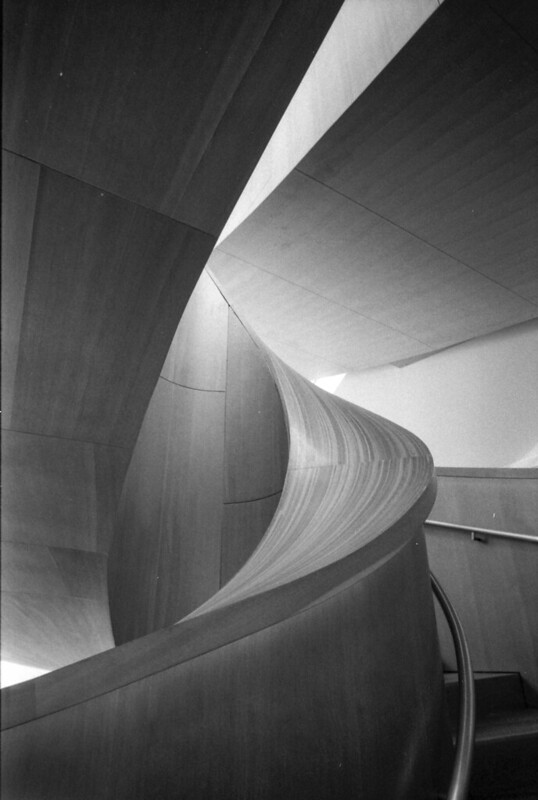
In the Art Gallery of Ontario, there is a staircase designed by Frank Gehry that swirls from the old lower parts to the new upper parts, ascending from floor 2 to floor 5. It is not merely spiral; it is a vortex of wood, an eccentric cycle, weaving through the air and through a glass ceiling too. You have a choice when going up from the merely modern to the very latest in the art world: you can take an elevator, rising straight and without view, as though the floors were swapped like cue cards behind the sliding doors, or you can climb step by step through the art whorl, seeing the building revolving as you exercise your prerogative and are in turn exercised.
The staircase suggests motion; it encourages motion; it sustains motion; and yet it is not motion. It is as unmoving as the people who stop on its steps for photographs. It is dynamic past and future, but still present. It whirled; it will whirl (or we will whirl while on it); but it is a whorl. It is whole, unbroken, containing an open hole.
Frank Gehry is famously fond of natural forms, and a whorl is natural enough, but it can also be artificial, whether artistic or not. There are many ways you may visualize a whirled piece. You may barely bend a forest’s worth of twigs to make a funnel to the sky, for instance.
You may curve strips of rolled steel into an abstraction of a whirlwind, a clone of a cyclone.
You may paint petals of fleering faces onto a wall, all encircling a void eye. Though your eye may avoid it, and your heart may reject it, it is an injection of art, nature denatured.
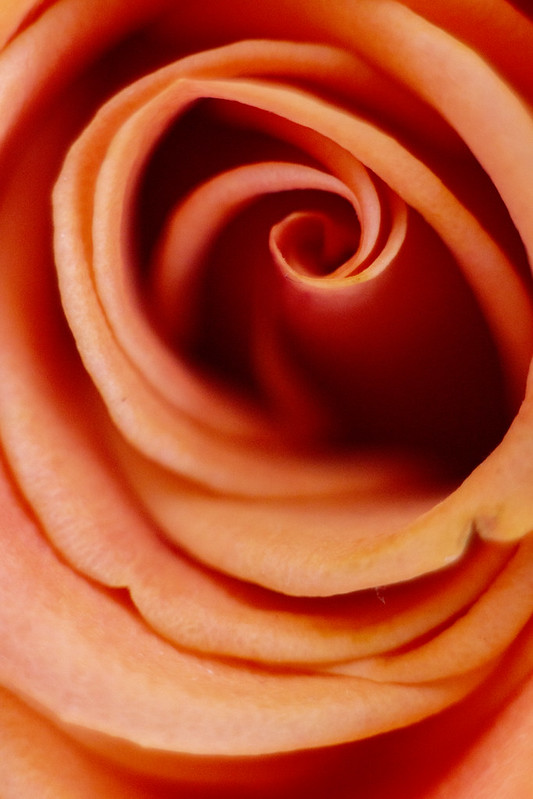
All are in the world of the whorl: if it is in some kind of concentric circles or spirals, it is a whorl.
Is whorl, the word, a frozen whirl? A whirl that was? In a convoluted way, yes. It is not a past tense of whirl – we have never said “I whirl today, I whorl yesterday” – but it is evidently formed from a variant of whirl; in earlier times, there were words whorwil and wharwyl that seem to have been especially swingy forms of whirl. This makes more sense when you know that whirl comes from something like whirvelen, likely from Old English hweorflian, a frequentative of hweorfan ‘turn’ (with the same frequentative suffix as gives us settle from set and prickle from prick). And it is also related to whirr and wharve.
And so it has turned around and come around again, and now it is concentrated, fixed in ink and pixels. But nothing stays still forever; the nature of nature is cyclic, and any whorl, too, may flower and grow and fade.
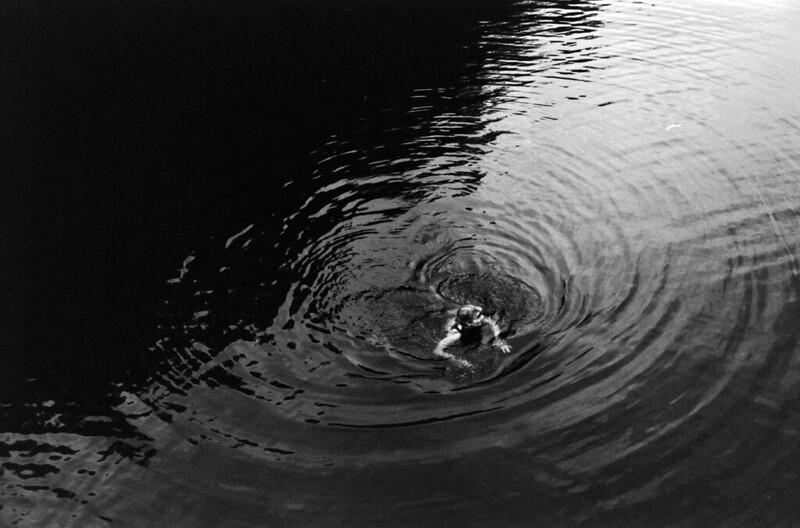
Or it may even ripple away in moments, waving as it passes.











 Sesquiotica