
I found a box of old transparencies. They’re all blurred. But not all in the same way.
You know I’m a photography geek because I say transparencies where normal people would say slides. They’re called slides because you can slide them into a projector. (Does anyone still have one of those?) But that’s if they’re cut into individual frames and put in cardboard or plastic mounts. They’re transparencies no matter what, because they’re clear: you can see through them. And, unlike negatives, you can look at them and see what they’re meant to show you.
But sometimes they’re blurred. And then you can still see through them, but maybe you can’t see into them the same way.
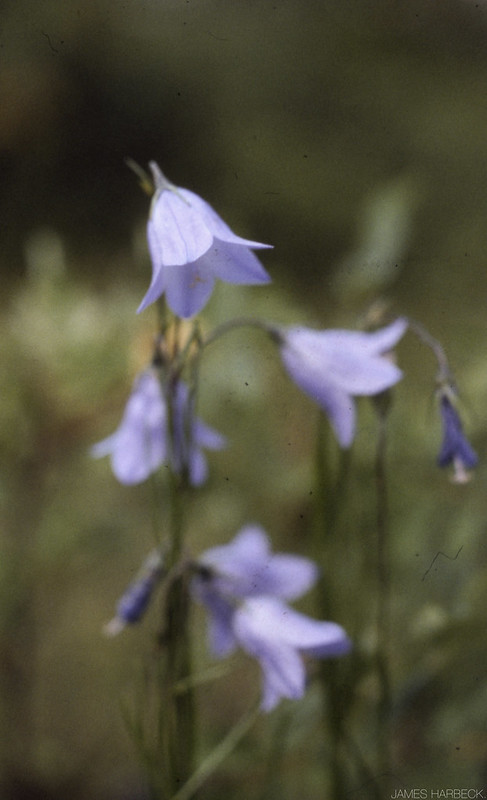
Look at this flower. I guess it’s called a harebell. The depth of field is so shallow, only the closest petal is in focus, if that. The rest is blurred and blurred some more as we go deeper into the field. You can count the other flowers close by, but what’s beyond them, other plants and trees probably, all slides into blur.
There’s an explanation of how this blur is produced that involves the term circle of confusion. Everything in a photo is in sharp focus on some plane, but if that plane isn’t the exact plane of the film surface, it’s like getting a slice through a cone of light rather than the point of it. The light of any given point in the real world makes a soft circle of blur at the film surface, the circle of confusion, because it’s muddled with other things and you can’t see exactly what should be where. That’s how it is with light passing through irises, be they on a camera or in your eye. Too close or too far and it’s blur. The wider open the iris, the bigger the circle, the more confusion. The truth is that focus is almost never exact. A thing is in more or less sharp focus depending on whether the circle of confusion is too small to be noticed.
I took this photo in 1985 near the house we lived in at the time, at the foot of a mountain. I used Kodachrome. You can’t get Kodachrome anymore, and if you find an old roll, you can’t get it processed. I used my dad’s Nikon F2. He doesn’t have that anymore, hasn’t for a long time. I’m not sure exactly where in relation to the house this flower was, but the house isn’t there anymore anyway either.
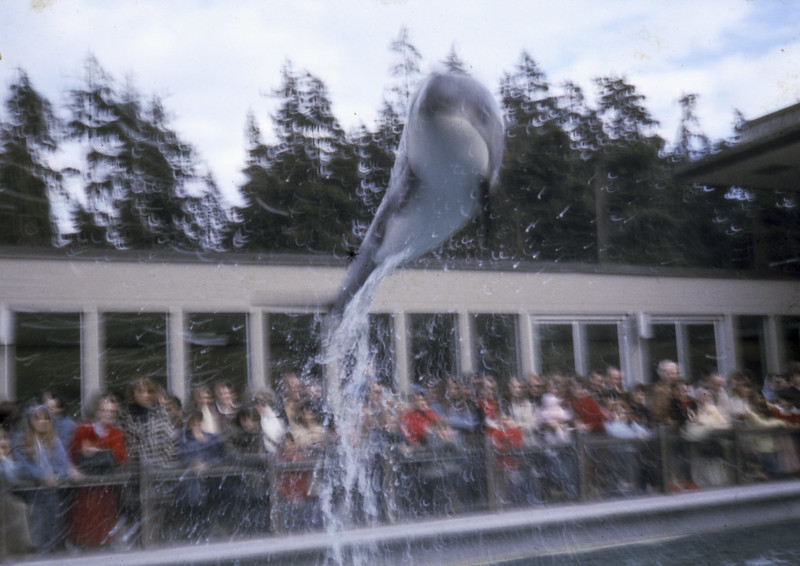
Here’s an orca, I think. It’s blurry, but a different way. This is motion blur: it’s not that the iris was open too wide, it’s that the shutter was open too long. The orca moved enough during the time the light was hitting the film that it smeared the light, or rather it made a smear in the recording of the light by the dyes on the film.
But this also has the other kind of motion blur: not only the subject but the camera too was moving. The trees, the building, the crowd, all moving relative to the film because the film was moving relative to them, because I wasn’t holding the camera steady enough. It’s the same result: all motion is relative, so in one way all motion blur is the same. But the motion blur of the orca manifests something we all perceived as happening: it was moving. The rest of the motion manifests a motion that was not perceptible to anyone but me, and I obviously wasn’t paying enough attention to it either.
This was at the Vancouver Aquarium in 1976. The aquarium is still there. I don’t think the orca is. I suppose not all of the people in the picture are still around, either. I took it on my Ricoh 500G, I think. It’s the first camera I owned. I still have it. I could get up and pull it out of its resting place in 30 seconds. It doesn’t really work anymore, though. I took the photo on Ektachrome. There were a few years when Kodak stopped making Ektachrome, but it’s back now. It’s expensive and hard to get, however. You could always buy some old Ektachrome on ebay. It should be just as sharp, but the colours will have shifted.
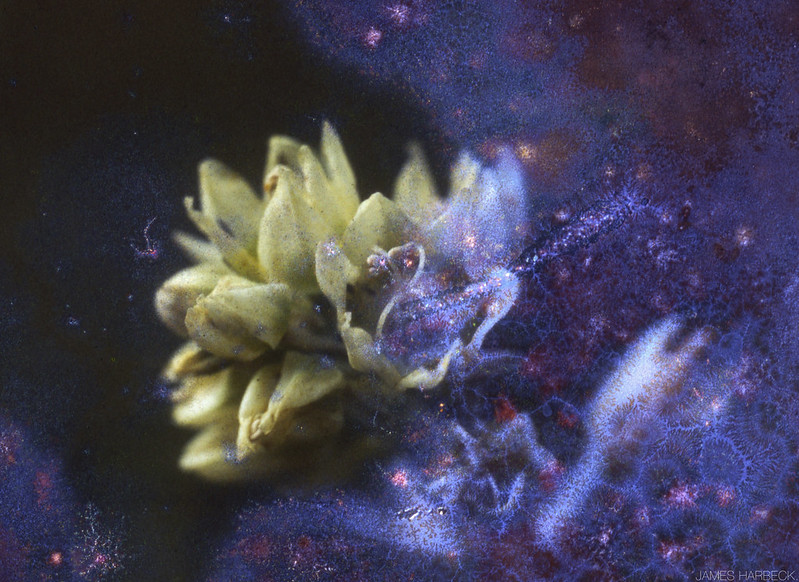
Here’s another flower. Do you know what it is? I don’t. I was never very good with flower names. It has a bit of the focus kind of blur, but it has another kind of blur too, one you’re not supposed to get with photographs. To get this kind of blur on a transparency, simply store it in a bad place for 30 years or so. The colours have run in places, almost like ink or watercolour. That’s a blur not of optics but of materials – the light landed well, everything was clear and sharp at the time, but later it got muddled because of things that happened to it, most likely involving water.
That’s one of the oldest senses of blur: ‘smear, smudge’. Do you notice how all of those words can be noun or verb? I note that the Oxford English Dictionary says “Blur noun and verb appear about the middle of the 16th cent.: their mutual relation is doubtful, and the origin of both unknown: they have been conjecturally viewed as a variant of blear n., and may perhaps be onomatopoeic, combining the effect of blear and blot.”
This picture was from the same roll as the first flower photo. Some survived intact and some didn’t.
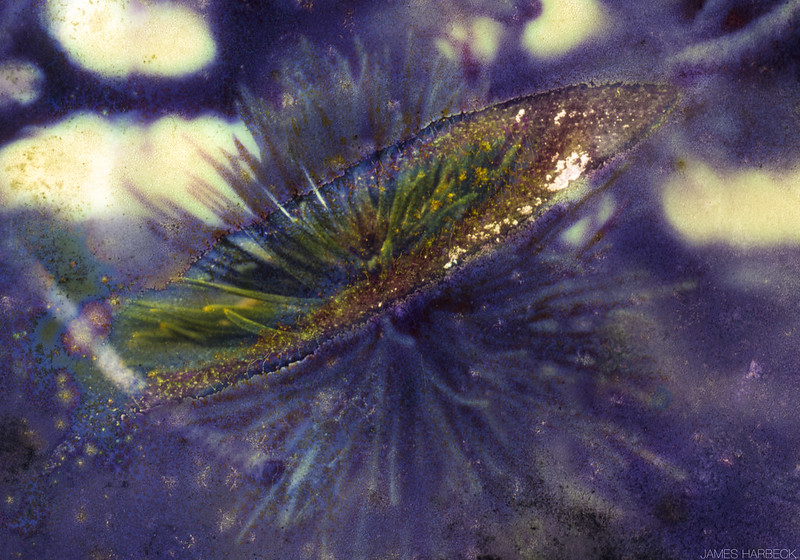
This one really didn’t. Here’s another sense of blur: ‘stain, obscure, sully, befoul, besmirch’ – and related nouns, of course. Actually, much of this particular smirch comes not from the application of something that should not be there but from the removal of something that should. The slide was stuck to another one and left some of its dyes on the other when I peeled them apart. The other one is also blurred, but I didn’t scan it because it didn’t look as interesting so I can’t show it to you. Anyway, that’s how it goes sometimes in life: you leave some of yourself with someone else, and you’re both blurred, stained, marked.
On the other hand, the part in the middle of the blur is the only part that escaped the severe loss of colour that affected most of the frame. You’d think the subject might have been a flower, going by the faded part, but from the eye of the blur you can see it was a branch of an evergreen.
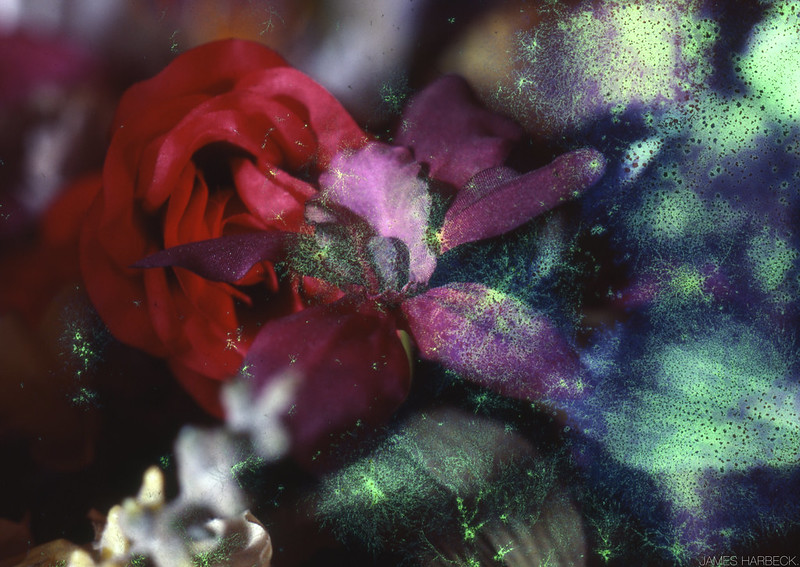
And here are two flowers, which I take to be an orchid and a rose, which means this was taken inside the house. The blurry background looks like furniture too. This one has an assortment of blurs. Some of the colour has run. There are specks on it. And in places the colours have been eaten away by fungus. If you look closely at the orchid, you’ll also see fingerprints. I don’t know why there are fingerprints; I learned even as a small child never to put my finger on the surface of film. But there they are. Someone, perhaps even me in some unfocused moment, touched it and took some of it with them. The result is like the cross-hatching of an etching, another way of producing blurring. And we can’t see it but we know that whatever finger took that colour also had it washed off: another blur, but only in your imagination now.
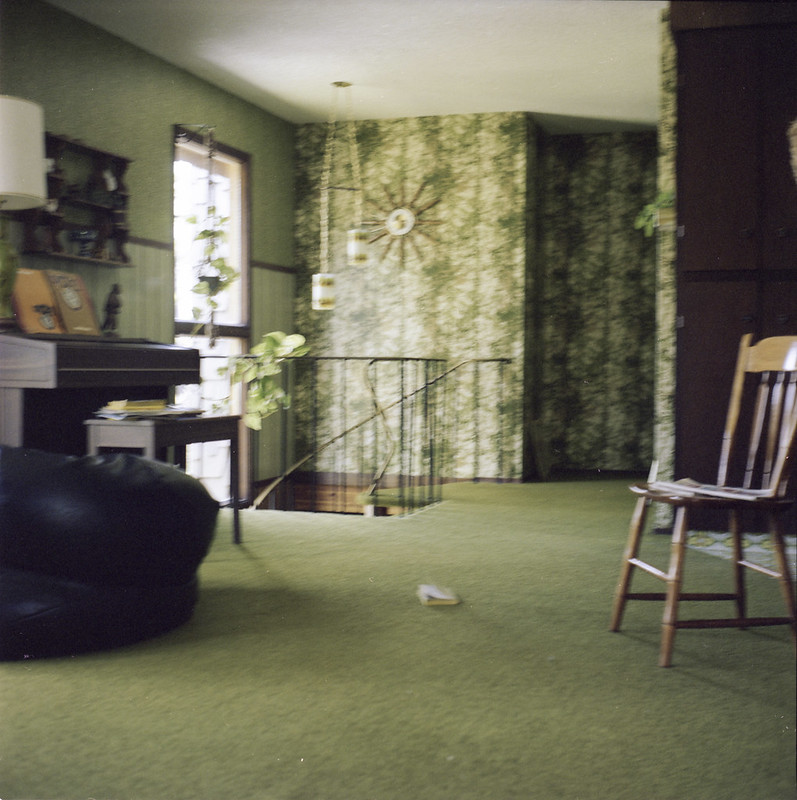
And here is that house, the one the flowers were in and near. You can see some motion blur: I didn’t hold the camera steady enough. You can also see some focus blur, though it’s hard to separate from the motion blur.
This photo isn’t actually a transparency. It’s a negative, and it’s in good condition. I’m much better at retaining and preserving negatives. I took it with a Yashica Mat-124G, a twin-lens reflex camera that belonged to my dad. He doesn’t have it anymore. I do. I just got up and walked four steps to look at it and make sure I had the name right. It still works, more or less.
I can see another old sense of blur, not so much in the photo as in what I remember from the photo. On the left you see two black Naugahyde beanbag chairs. They belonged to my brother. In the centre you see a spiral staircase going down to the ground floor. The railing was not very sturdy. Farther right is a wall, and then you see a corner and, behind a chair, some brown cupboards in a hall leading to the kitchen. Picture my brother standing between the staircase and the corner. Picture me picking up a beanbag chair and running at him with it. You may consider that the beanbag chair blocked my vision. It didn’t just blur it; it obscured it altogether. I didn’t want to go over the railing so, in confusion, I circled relatively far to the right and, at speed, connected my forehead with the corner. The styrene beans in the bag were at the bottom, so two layers of Naugahyde were all that cushioned the impact. It hurt a bit. It bled a lot (head wounds do that). I got stitches. And now there is a permanent blur, in an old and generally obsolete sense, in the middle of my forehead crossing the hairline.
A blur, by the way, can also be figurative, especially moral. One of the most common older uses of the word was to refer to a stain on one’s reputation or character. I wish to be clear that no such stain adheres to my brother’s character or mine from the incident in question. We were young, and it was an accident, and all the blood got cleaned up.
We lived in this house through my teenage years, more or less, and then we had to move away. Some other people lived in it for a time after us, and then it was empty for a while, and I stopped by once and it had been vandalized and the windows smashed and the walls spraypainted. I could just go in and look around. There was a hole in my bedroom wall, but I had to laugh because I had put that one there myself in my truculent youth. And then after that the house burned down. It was burned down. I don’t know who did it. The next time I went by, a few years later, there was nothing but flat gravel. So for me this photo has another kind of blur: emotion blur. That’s a blur in your mind, but it’s also sometimes in your eyes, most likely involving water. It’s because something is moving, and because something has moved and it’s not clear to you anymore. Or you have moved – it’s all the same result; all motion is relative. Emotion blur is common with family memories; all relatives are emotional.





 Sesquiotica