Monthly Archives: September 2024

Krakow

The driver took us south across the river, along a boulevard, past some Communist-era buildings, onto a side street, and through the parking lot of a modern apartment block. He stopped at a gate.

The five of us sitting folded into the back of the Prius exchanged uncertain glances.

“This isn’t where we’re going,” one of us said.

“Yes,” said the driver. “I know this place. I live here.”

I pulled out my phone and showed him the name of our destination on the screen. “Restauracja Wręga. In Kazimierz.” The driver furrowed his brow.

I pulled my phone back and looked at Google Maps. We weren’t at Restauracja Wręga in Kazimierz. We were on a side street in the Płaszów area of Podgórze, and we were farther from our destination than when we started at our inner-suburban hotel on Dąbska.

The driver looked at his device. Then he said he couldn’t take us to the restaurant because he had a wedding to go to. He dropped us at a nearby convenience store and drove away. 

He had won the distinction of being, by a large margin, the least helpful person we met in Poland.

We weren’t the first people who, wanting to be in Kazimierz, had ended up in Podgórze. But at least for us it turned out to be no more than an annoying inconvenience. Google Maps told me that we were two blocks from a streetcar line that would take us to four blocks from the restaurant. The next streetcar was coming in 18 minutes and it was a 20-minute trip. We let our friends know we would be late. 

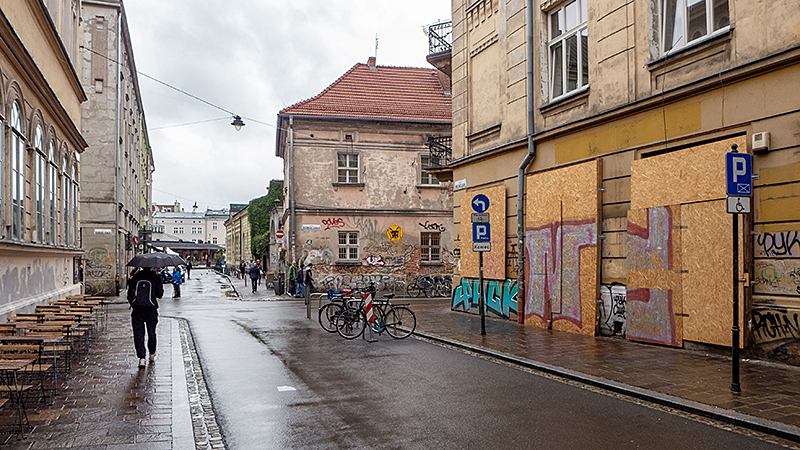
Anyway, it was a scenic detour. For a scant few złoty each, the streetcar gave us a scenic tour of the relatively modern and relatively not-so-modern parts of Podgórze, from boulevards with kebab joints past industrial parks and apartment blocks and into smaller older streets with smaller older buildings, at last passing the old graffiti-covered buildings along Limanowskiego in the heart of the former ghetto, where the Jews of Kraków had been forced by the Nazis to relocate, brooded over at its corner by the spires on spires on spires of the massive St. Joseph’s Church.

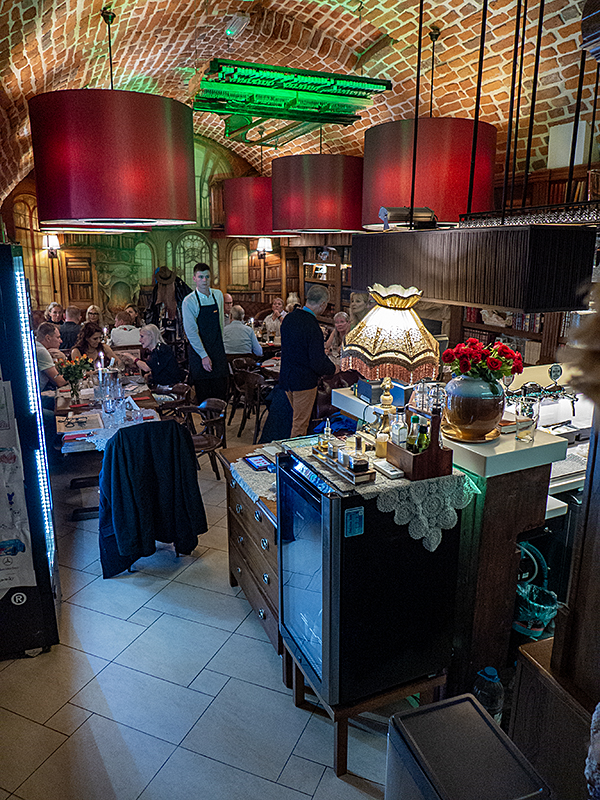
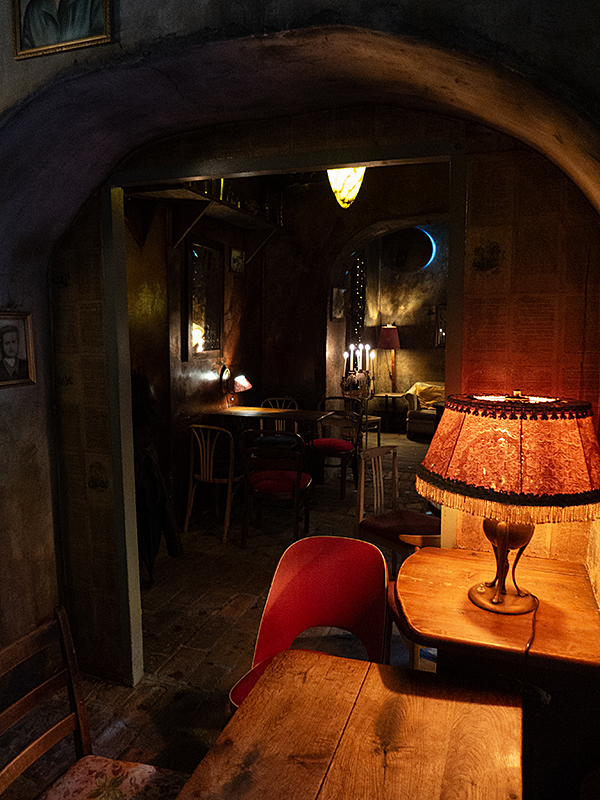
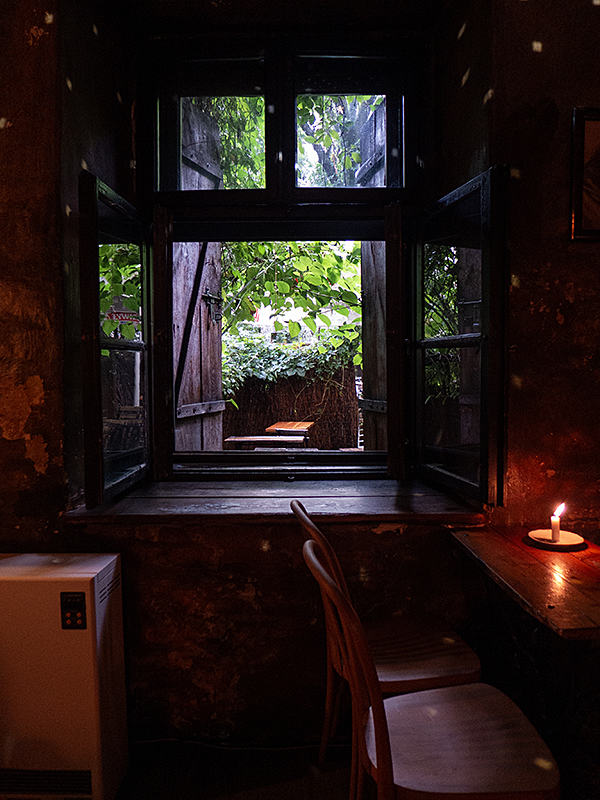
And then we turned north, crossed back over the river, and were in Kazimierz, the ancient Jewish quarter and modern hip funky area, just south of the Old Town. We hopped off the streetcar and met our friends at the restaurant just as they were paying the bill. Some of them headed off and would meet us later at an old-style basement restaurant near the Main Square, but one of them took us nearby to Eszeweria, a very boho coffee-and-beer place in a labyrinthine old building with candle lighting and tables that once held sewing machines. It’s the sort of place I would haunt if it were in Toronto. But it’s in Kraków.

Krakow. Cracow. Krakau. Krake. Krakiw.

If you haven’t been there, you probably recognize the name, but you might not know much about it. For me, when I was younger, I just thought of it as a semi-obscure Eastern European town. I was wrong on both counts.

Krakow (or, in Polish, Kraków, said sort of like “crock-oof”) is the second largest city in Poland. Because it’s not so much part of the Western European cultural sphere with the shared histories of all the neighbours and close competitors of England, Krakow figures much less prominently in the imaginations of most people in the English-speaking sphere. But it’s a city of no less historical importance and present interest than almost any Western European city other than the capitals (and even some of them). It’s the former capital of Poland, complete with castle; it was for centuries an important crossroads of trade and culture, and it’s home to one of the oldest universities of Europe (Jagiellonian University, founded in 1364) and one of the largest medieval town squares in Europe. 

And it is in Central Europe, not Eastern Europe. It’s just about due south of Stockholm, and is less than an hour by plane from Vienna.

Also, I have learned, it is apparently a popular spot for quick group trips from England for such things as bachelor and bachelorette party weekends. This is undoubtedly because eating and drinking in Poland is, relatively speaking, great value for money, and also because Krakow is a very nice city. And English is widely spoken there (but let me not discourage you from learning some Polish).

It’s not all ancient beauty, of course. There are stretches that lack both freshness and antiquity. Some parts are boarded up and graffitied. It’s a city, after all, and one with more than its fair share of history, having been controlled by various empires and political systems at various times. But the Stare Miasto – the Old Town – is as lovely as any old town in Italy or Spain, and quite able to handle as many tourists as it gets. And if you visit, bring your appetite – and be ready to have fun. You may be inclined to make some kind of pun on “krak,” but the most reasonable one to make is on the Irish crack (aka craic), ‘fun’.

It’s not just a party town or politically historically important town, either. Krakow is also a literary centre, with the oldest bookstore in Europe, and figures in many novels; I think the city I’ve been to that it’s most like is Prague.

Incidentally, we don’t know for certain where the name Kraków comes from. It’s commonly said that it’s after Krakus, its legendary founder, ruler of a local tribe, but the first mention of this idea dates to centuries after the town’s founding, so perhaps it’s really from a word meaning ‘crow’ or ‘raven’.

Why were we – I, my wife, our friends – there, by the way? To party. Yes, us too. We were joining a reunion for people who skated with Holiday On Ice (my wife did; I certainly did not). It’s a convenient location for many of the alumni, who are mostly from Europe. And, as mentioned, it’s value for money. And ever so charming.

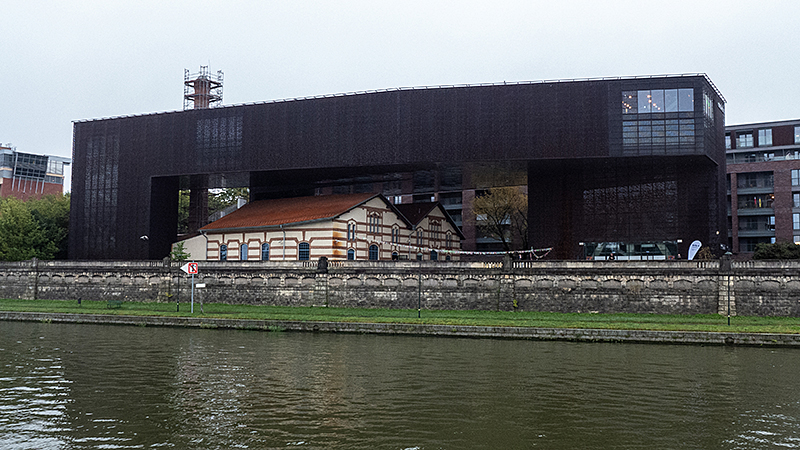
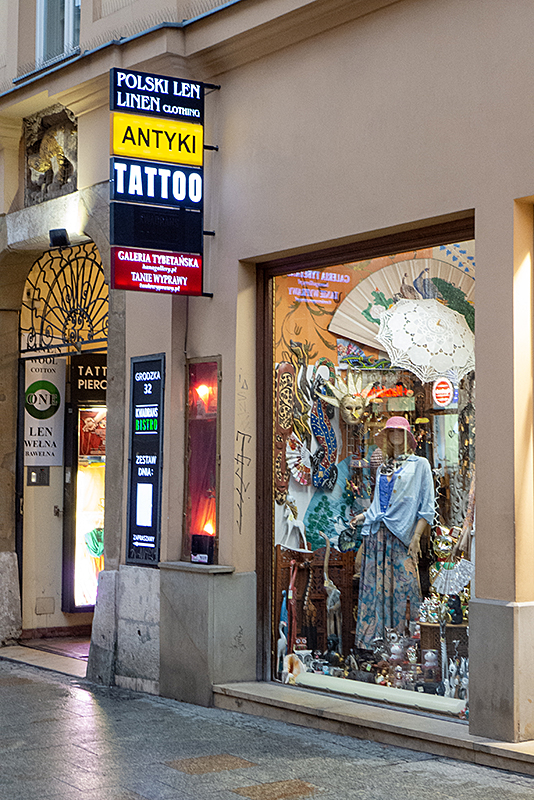
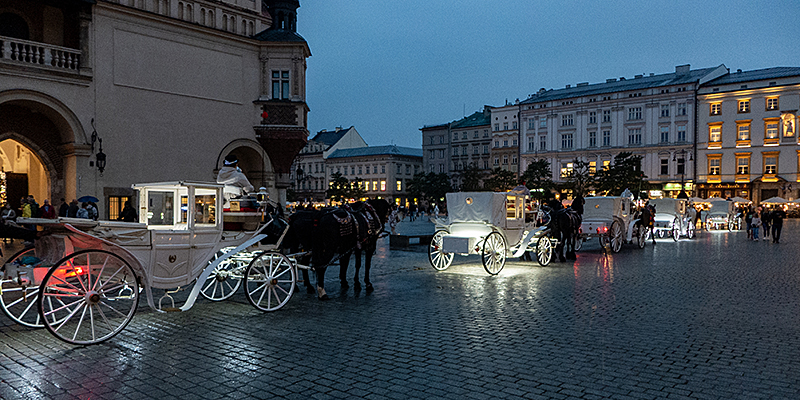
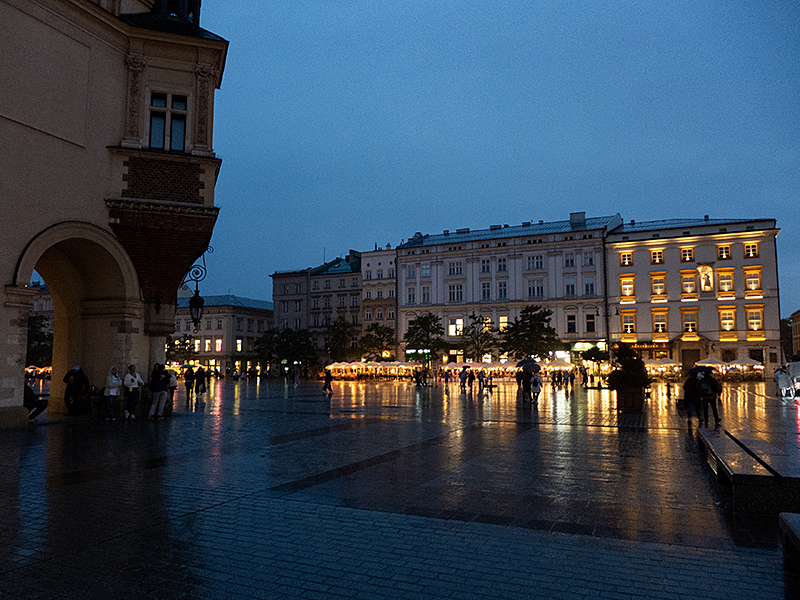
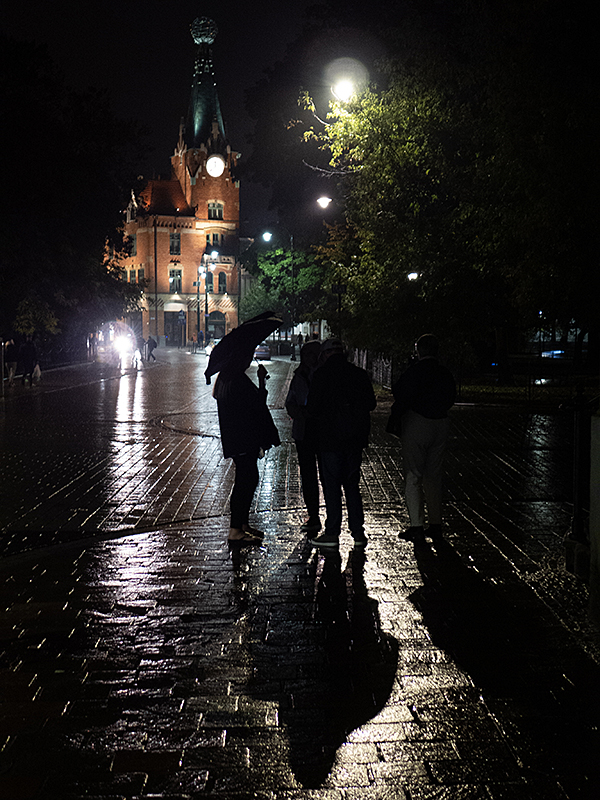
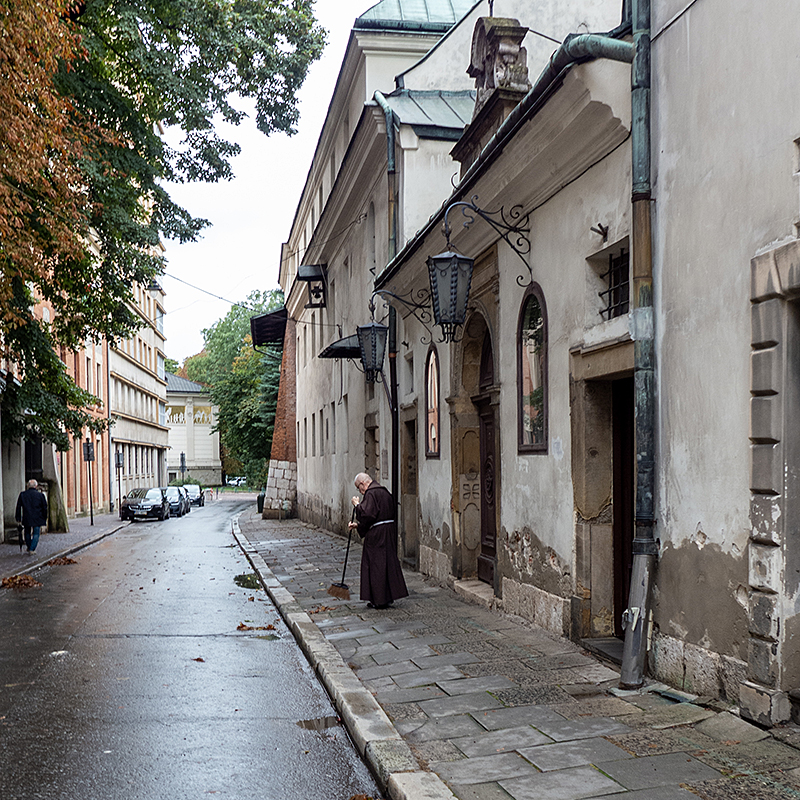
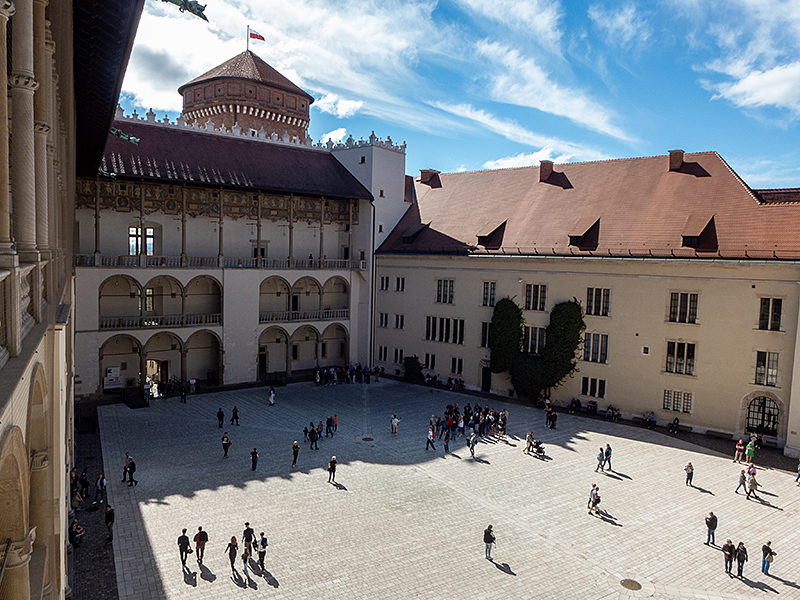
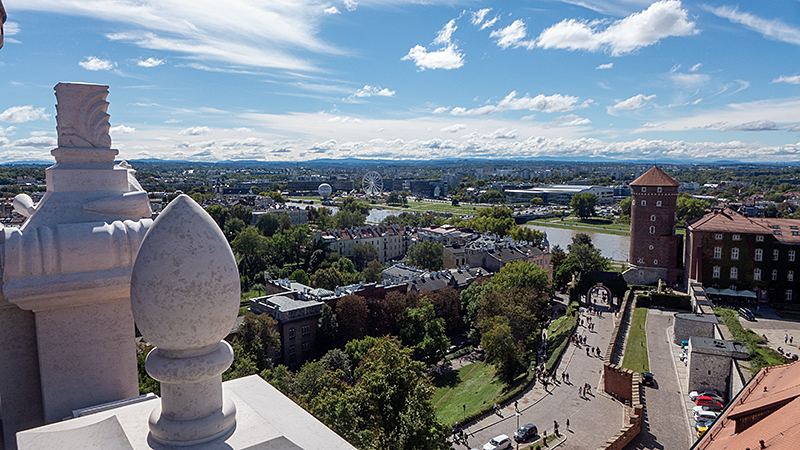
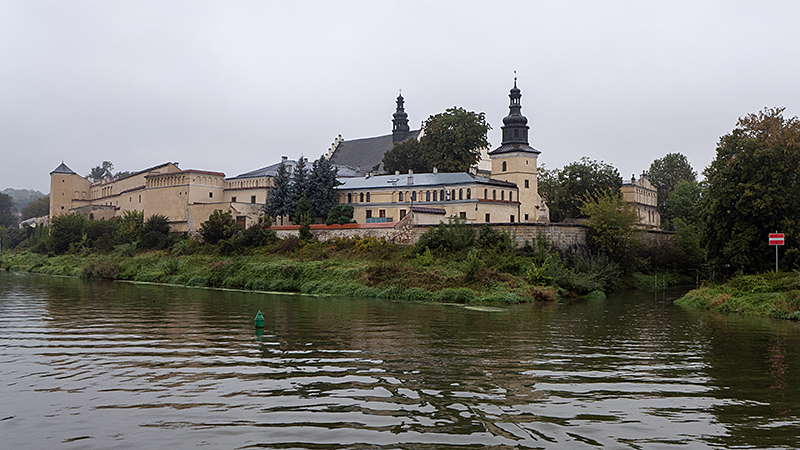
But enough words. Let me show you some pictures.
monger

Guten Morgen, as they say in Münster, and welcome to the mongermonger! I hope you brought your money.

Come examine our menagerie of mongers, from organic and grammatical to mongrels in the manger. We’ve had mongers in English for as long as we’ve had English – and before. Old English mangere traces through Old Saxon and Old High German all the way back to classical Latin mango, which meant ‘dealer’ or ‘trader’ – it’s not related to the mango you put in your smoothie (that’s a Dravidian word via Portuguese), but it certainly has borne fruit. 

The fruit is sometimes marginal, mind you, more for ragmen than for royals, but so it goes: the life of a trader is sometimes meagrely managed. And the smirch of filthy lucre has clung to it; even half a millennium ago, monger was more associated with dealing in dodgy goods – sometimes fish, but sometimes fishy things. 

But if you hunger for a monger, there will surely be something on the shelf to fill your bill. The available kinds of mongers are effectively endless, since you can always make new ones; if you want to call someone a meme-monger, you may. Here are all the kinds of mongers listed in Wiktionary (I’d show you the Oxford English Dictionary list, but I’m not trying to give you a migraine) – choose among them:

  • airmonger
  • alemonger
  • applemonger
  • balladmonger
  • barbermonger
  • beermonger
  • bloodmonger
  • bookmonger
  • boroughmonger
  • breadmonger
  • buttermonger
  • caremonger
  • carpetmonger
  • ceremony-monger
  • cheesemonger
  • coalmonger
  • cockmonger
  • cornmonger
  • costermonger
  • deathmonger
  • defeatmonger
  • dictionary-monger
  • doom-monger
  • doubtmonger
  • dramamonger
  • eirmonger
  • fadmonger
  • fancymonger
  • fashionmonger
  • fearmonger
  • feathermonger
  • fellmonger
  • feltmonger
  • fictionmonger
  • filthmonger
  • fishmonger
  • flashmonger
  • fleshmonger
  • flourmonger
  • foodmonger
  • foolmonger
  • fruitmonger
  • garlicmonger
  • ghostmonger
  • gospelmonger
  • gossipmonger
  • grievance-monger
  • hairmonger
  • hatemonger
  • haymonger
  • horrormonger
  • horsemonger
  • hypemonger
  • ideamonger
  • ironmonger
  • ironmongery
  • jestmonger
  • jobmonger
  • lawmonger
  • lease-monger
  • lightmonger
  • loanmonger
  • lovemonger
  • mass-monger
  • maxim-monger
  • mealmonger
  • meritmonger
  • miracle-monger
  • money-monger
  • mongeress
  • muck-monger
  • murdermonger
  • musicmonger
  • muttonmonger
  • mystery-monger
  • newsmonger
  • noisemonger
  • nostrum-monger
  • panicmonger
  • pardonmonger
  • peacemonger
  • pearmonger
  • peltmonger
  • phrasemonger
  • placemonger
  • pleasuremonger
  • poisonmonger
  • powermonger
  • prayer-monger
  • profitmonger
  • prophecy-monger
  • pupil-monger
  • pussymonger
  • questmonger
  • race-monger
  • relicmonger
  • rulemonger
  • rumourmonger
  • saltmonger
  • scandalmonger
  • scaremonger
  • shitmonger
  • sleazemonger
  • smutmonger
  • species-monger
  • spoilsmonger
  • starmonger
  • statesmonger
  • stockfishmonger
  • system-monger
  • talemonger
  • trouble-monger
  • twaddlemonger
  • versemonger
  • warmonger
  • watermonger
  • whoremonger
  • winemonger
  • wiremonger
  • witchmonger
  • wit-monger
  • wondermonger
  • woodmonger
  • woolmonger
  • woo-monger
  • wordmonger

Quite a megascopic list, isn’t it? I prefer the very last one, though I have been known to engage the trade of some of the others. I can’t say they mong to me, because we lost the simple verb – we had mangian in Old English, but by Modern English that had been sold down the river, and we had to reuse the noun.

So here I am, mongering mongers. (What a monster!) Do you want to take some home with you? Come along, I’ll ring you up.

vermouth

In the beginning…

…well, we’ve read that bit. Let’s flip to the back of the Bible. In the end, there was vermouth.* 

Yes. Allow me to quote Revelation 8:11 in Martin Luther’s translation:

Und der Name des Sterns heißt Wermut. Und der dritte Teil der Wasser ward Wermut; und viele Menschen starben von den Wassern, weil sie waren so bitter geworden.

If you know German, you know that Wermut can be translated as vermouth. In fact, the word vermouth is what French (of its time) made of the German word Wermut. Here is a translation of the above:

And the name of the star was vermouth. And the third part of the water was vermouth; and many people died from the waters, because they were so bitter.

Hmm, that’s kind of a negative opinion of vermouth, isn’t it? I mean, I know a lot of people don’t like the stuff. There’s a famous comedy routine by Hudson and Landry in which a guy is ordering a lot of liquor from a store and says “no vermouth” because “it makes my wife sick” (“She’s out of town but I do it just in her memory”). There is also an anecdote of a famous bartender (there is such a thing?) who, when making a martini, in place of adding vermouth simply nodded in the direction of Paris. And yet, it gets used.

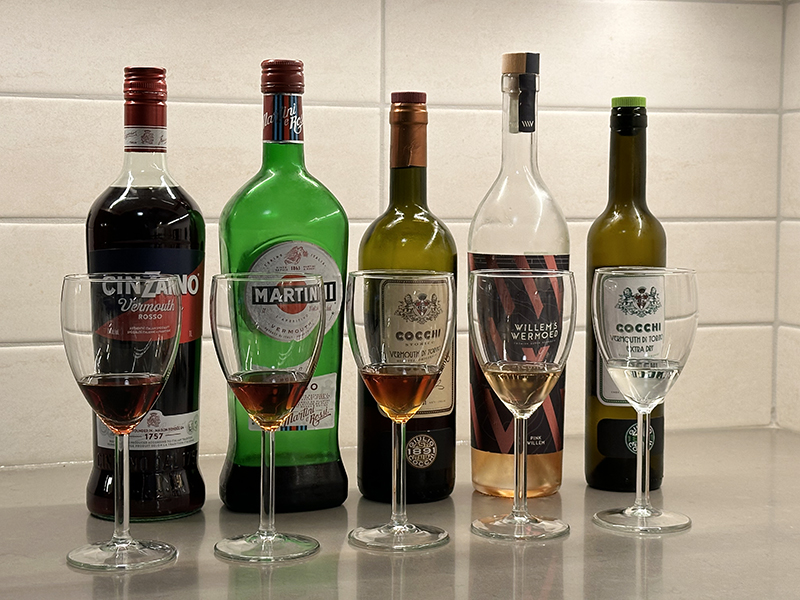
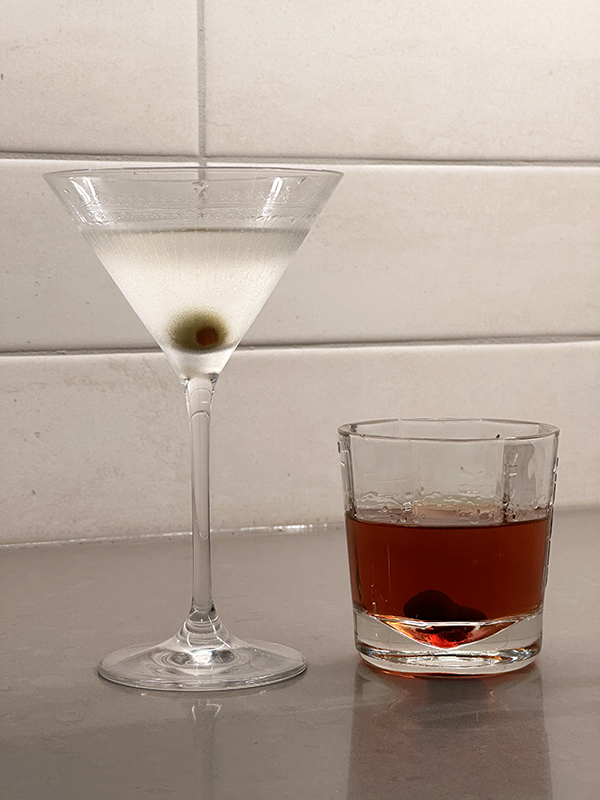
Not just the dry (“French”) kind in a martini. The sweet kind in a Manhattan too. And a negroni. And quite a few other cocktails. People in some countries (Spain, for example) also enjoy sweet vermouth on ice, unmixed. Sweet, bitter, and strong together make a great drink.

Vermouth isn’t the only sweet and bitter beverage out there, either. There are various herbal bittersweet liqueurs, and gin and tonic also follows the same pattern – and all for the same original reason. You know the song “a spoonful of sugar helps the medicine go down”? Tonic water was created because the British invaders in India took quinine to deal with their malarial fevers, and sugar and fizz helped it go down. And, as Ogden Nash said, “Candy is dandy, but liquor is quicker”: if tonic, why not gin? On the same principle, vermouth was also created – centuries earlier – as a means of getting people to take a bitter medicine.

What medicine was that? Let me give you a hint, in the form of the King James Version translation of Revelation 8:11:

And the name of the star is called Wormwood: and the third part of the waters became wormwood; and many men died of the waters, because they were made bitter.

Yes. Wormwood. That is in fact what English translations of the Bible pretty much all say in that passage. Wermut is German for wormwood as well as for vermouth, the wine-based beverage that originally contained wormwood.

Let’s leave aside for the moment that these people were dying of the bitterness; there are in fact several plants called wormwood, and the species that was probably being referred to by John of Patmos, Artemisia herba-alba, was not actually the same as the one used in vermouth. To be fair, even the one named in Revelation was commonly used for medicinal purposes; I guess the thing is just that it was bitter, and, you know, some people really would rather die than have that. But the Artemisia that our vermouth was made from and named after is claimed to have, to quote Wikipedia, “antifungal, neuroprotective, insecticidal, antimicrobial, anthelmintic, acaricidal, antimalarial, antidepressant, and hepatoprotective properties.”

The Latin name of the genus is Artemisia after Artemis, the goddess of childbirth, because of its use for gynecological conditions. But you might have noticed that wormwood has “anthelmintic” properties. That means it’s good for treating parasitic worms. And that is… not why it’s called wormwood. Ha, sorry.

I had indeed long thought that vermouth was a French interpretation of English wormwood. That’s linguistically plausible, but, as I have mentioned, vermouth is in fact an older French rendition of German Wermut (the modern French is vermout without the h). And German Wermut comes not from modern English wormwood but from the source of the modern English word: Proto-West Germanic *warjamōdā, which arrived in Old English as wermode. Which, by the 1400s, had been reinterpreted as wormewode, which made modern English wormwood.

Yes, wormwood is an eggcorn, a reconstrual based on folk etymology, like sparrowgrass for asparagus. But what does *warjamōdā mean? We’re not sure, but it might be from *warjan (‘defend against’) and‎ *mōd (‘mind’) – that is, mental defense: the “neuroprotective” and “antidepressant” properties.

Which is kinda funny if you know the reputation of wormwood for its effects on the mind. And if you don’t, let me give you a clue in the form of a French translation of Revelation 8:11 – this is from the Nouvelle Édition de Genève:

Le nom de cette étoile est Absinthe; le tiers des eaux fut changé en absinthe, et beaucoup d’hommes moururent par les eaux, parce qu’elles étaient devenues amères.

Absinthe. Yes, absinthe names the exact same plant as wormwood (and Wermut). The Latin name of the species of wormwood used in vermouth is Artemisia absinthium. Here’s Revelation 8:11 in the Tyndale version of the Koine Greek Bible:

καὶ τὸ ὄνομα τοῦ ἀστέρος λέγεται ὁ Ἄψινθος· καὶ ἐγένετο τὸ τρίτον τῶν ὑδάτων εἰς ἄψινθον, καὶ πολλοὶ τῶν ἀνθρώπων ἀπέθανον ἐκ τῶν ὑδάτων ὅτι ἐπικράνθησαν.

You see that Ἄψινθος? That’s Apsinthos, which (via Latin) is the source of the word absinthe.

Perhaps you know about absinthe. The Green Fairy. Renowned as a mild hallucinogen; maligned (perhaps unjustly) as the cause of mental breakdowns among artists of the Belle Époque. It has the anise flavour you find also in pastis and ouzo, but with the strong bitter presence of – obviously – wormwood.

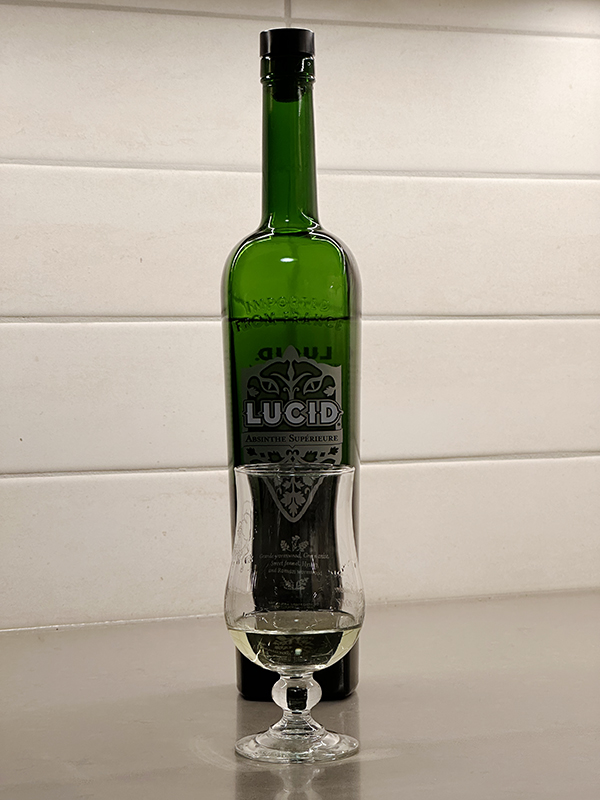
So is absinthe the same as vermouth? The same herb, yes. The words also have in common a th that in French is said “t” but has been taken in English as “th.”§ But the beverages are starkly different (though neither of them today contains any appreciable amount of thujone, the psychoactive ingredient of wormwood): vermouth is based on wine (with many other flavouring agents added as well), while absinthe is a distilled spirit (with flavouring). Vermouth is 15% to 17% alcohol; the absinthe I currently have is 62%, and I’ve had stronger. Vermouth can be used in cooking where wine is indicated; absinthe can only be used where you want absinthe! Vermouth is consumed straight and used in many cocktails; you can drink absinthe neat, but things may get messy – and when it is used in cocktails, is often just sprayed or rinsed in, as in a Sazerac

And while both beverages may (temporarily) lift the mood, absinthe makes the heart grow fonder.

* In the beginning, too, for me; Martini & Rossi sweet vermouth was the very first alcoholic beverage I ever tasted.

 Leave it to the French to take the sweetness out. The first pale dry vermouth was made by Joseph Noilly in the early 1800s. Kinds of vermouth have proliferated in many places in recent years, but nearly all of them are sweet.

 Many countries prohibited the use of wormwood in beverages in the early 1900s, so your vermouth may not contain any now. And so once again a name peels away from its origin.

§ The one in absinthe does come from a “th” in the Greek original, but the one in vermouth is entirely under the influence of orthography transmogrified.

 Yes, mood comes from the same Old English mōd that meant ‘mind’.

 Even if it may end in bitterness.

colonel, kernel

Why do colonel and kernel sound the same? It’s because of a minor coronal peregrination.

I don’t mean colonization – it’s not that somewhere has been invaded by order of the crown. It’s just… well, it’s on the tip of my tongue. 

And yours too. Coronal (not said like colonel or kernel; it’s “co-ro-nal”) refers, in phonetics, to sounds involving the tip of the tongue. In other places and ways it involves other high points too, of course – as in other crowns, but we’ll circle back to that. The point here is that the /r/ and /l/ phonemes are both made with the tip of the tongue, and not only that, they’re both “liquids”: they don’t stop or even seriously impede the airflow through the mouth. And they’re not dissimilar; in fact, in some languages, they’re not considered different sounds. But in other languages, they can be subject to dissimilation.

Take, for instance, the word peregrine and the word pilgrim. Both trace back to Latin peregrinus. But in some varieties of some languages, notably some descended from Latin, it is (or was) dispreferred to have two identical liquids too close together. So the first /r/ became /l/ and peregrinus became Old French pelegrinus, which became modern French pèlerin and modern English pilgrim. But we also grabbed the unaltered Latin and made peregrine and peregrination.

But let me not wander too far. The point is the tongue – specifically, the point of the column of the tongue, which is circling back. And I don’t mean circling back just because coronal comes from Latin corona, which refers to a crown (and from that the top of something) but comes ultimately from the circlet shape of a wreath (consider a corona in a solar eclipse), from Ancient Greek κορώνη (korṓnē), which referred first to the shape and then to the object. 

No – although there is a kernel of truth in that, it’s that colonel traces to Old Italian colonello, from Latin columna, referring to the column of men that the officer was at the head of. The first l was pronounced /l/, as it was written. But in early French, the column retreated – that is, it circled back, by which I mean it dissimilated: rather than have two /l/ sounds too close together, the first one became /r/, in a sort of photo negative of the dissimilation in pelegrinus. And the resemblance to corona reinforced the effect: a coronel would have been one at the crown, meaning the head, yes?

And indeed in English for some time we wrote it coronel, but then in the 1500s a fascination with the vaunted classical etymology of words took hold. The same affectation that led the o to be stuffed into peple to make people to show its root in populus, and the b to be stuffed into det to make debt to show its origin as debitum, and several other similar instances, led the spelling to become colonel. And for a time a spelling pronunciation (“col-o-nel”) was also current. But ultimately we have kept the changed sound and the reverted spelling. And over time the vowels reduced and merged into the liquid, so “coronel” came to sound like “kernel.”

But what, then, about kernel? This is a word for a grain of corn, one of the columns of grains that grow on the column of the cob. Is that where it comes from?

Not at all. The kern in kernel is none other than corn in a slightly turned form, and corn is originally just an old Germanic word for ‘seed’ or ‘grain’; the -el is a diminutive, and so a kernel is a little grain or the soft seed at the centre of something. The Old English word was cyrnel; the front vowel of -el led the back vowel in corn to assimilate forward. Which is the same movement as happened in colonel, and rather the opposite of the consonant dissimilation between /l/ and /r/. And so, like opposing columns, colonel and kernel have marched towards each other. Or, rather, we might say that the two have slowly sidled towards each other, until they have attained kernel knowledge.*

* Sorry for the corny joke. Oh, and neither colonial nor carnal is related to either colonel or kernel.