Monthly Archives: October 2024

fist, punch

Did you know that, back in the mists of time, fist and punch come from the same root? It’s true (probably). But not the punch you’re probably thinking of. The other one.

Also, by the way, it is the fist you’re probably thinking of, and not the other one.

Oh, did you know about the other fist? To start with, it’s pronounced like “feist” (as in “feisty”) – which, in fact, it’s closely related to. You see, feisty started as a reference to a kind of dog: one full of spirit. Or of vapours. Noxious ones. A feist was (and is) a spunky or belligerent dog, but it first of all meant a dog that fists. By which I mean the fist that sounds like feist. Which means, brace yourself, ‘fart’. The source is the Old English verb fisten, with a long i; an alternate spelling led to feist. There are similar words in other Germanic languages: Dutch veest (fart, noun), Swedish fisa (fart, verb), German Fist (quiet wind)…

But that’s not the word that’s related to punch, etymologically. Nor to the other punch, for that matter. Though, come to think of it, we can find a commonality of sense or effect between each pair of words… except the pair that’s related etymologically. Here, let’s call them fist1 ‘clenched hand’, fist2 ‘fart’, punch1 ‘strike with fist; make a hole’ (they’re the same word, sort of… see below), and punch2 ‘mixed beverage of juice and (usually) alcohol’. The match-ups are:

  • fist1 and punch1: done with the clenched hand
  • fist1 and fist2: adds an air of unpleasantness to a conversation
  • fist2 and punch2: can make you queasy
  • punch1 and punch2: can render you unconscious
  • fist2 and punch1: an assault on the senses
  • fist1 and punch2: derived from a root meaning ‘five’

Yes, that’s right: five relations of sense or effect, and one etymological relation meaning ‘five’.

You might already know that punch, the beverage, comes from the Hindi word for ‘five’. This is because the original beverage that had the name was made in India and had five ingredients. (Never mind that in the Caribbean their recipe for punch names four things in proportion: “one of sour, two of sweet, three of strong, four of weak” – e.g., lime, sugar syrup, rum, and water. In India the fifth ingredient was spice, and that’s also often added in the Caribbean.) The Hindi word comes from the Sanskrit word, which in turn comes from Proto-Indo-European, a root reconstructed as *pénkʷe (the asterisk before it means we don’t have documentary proof of it, it’s just reconstructed by deduction and inference). This root meant ‘five’ and ‘hand’ – because, of course, of the digits of a hand. It is the source of the words in pretty much every Indo-European language for ‘five’.

It is also – or, rather, I should say, it may also be – the source of English finger and English fist. The phonological changes involved are plausible but not inevitable; there are no competing conjectural derivations that I’m aware of. So we can take it provisionally that fist and punch (but not punch1, just punch2) are related. Also finger and punch as in “five-finger death punch” – but only if the death punch in question is an overly strong drink made with five fingers of rum.

By the way, the other punch – the one meaning ‘hit with a fist’ or ‘make a hole in’ – traces via Old French ponchon to Latin punctus, from pungo ‘I prick’. But the ‘hit’ sense also draws on an earlier form of punish.

There is, by the way, one word that ties together all four words, fist1, fist2, punch1, and punch2. It’s a name of a place that was known for drunkenness (punch2) and was struck and punished (punch1) – perhaps by the hand of God but anyway by the hand of nature (fist1) – and wiped out by an enormous mephitic eructation of the earth (fist2). And its name also means, etymologically (via the Oscan language, in reference to how many districts the place had), ‘five’. It’s Pompeii.
fray

“So the piece of string,” Maury said to the table, “having been turned away from the bar twice because ‘they don’t allow his kind in there,’ got angry. He hurled himself against a wall and bashed himself up until he was all at loose ends. And then he got twisted – literally, he twisted himself around himself. And he went back to the bar and sat down. The bartender looked at him and said, ‘Are you a piece of string?!’ And he said” – pause for effect – “‘I’m a frayed knot!’”

General chuckling. Montgomery Starling-Byrd, who was in town and with whom we were dining at a local Michelin-starred restaurant, said, “Oh, that’s frightfully good.”

“Oh,” said Elisa, laughing, “frightfullyafraid – same word!”

“If I may enter the fray,” I said, “the two are, oddly, unrelated.”

“What, fright and afraid?” Elisa said.

“I’m afraid it’s true,” Maury said. “And what’s worse, neither is related to fear.”

“Oh, that’s just wrong,” Elisa said.

“And yet,” I said, “it is, alas, so. But afraid is related to fray… but not the fray as in ‘at loose ends’, so to speak. The other one.”

“The one you get at a football match,” Montgomery said. “And yet I seem to recall that both have to do with getting a beating.”

“You are, of course, right,” I said. “Fray in the string sense comes via French from Latin fricare, ‘rub’, source also of friction; fray in the melee sense – and afraid too – comes from affraien, ‘attack, fight, frighten’, and so on, which comes from Vulgar Latin exfridare, and that comes from a Frankish word *friþu for ‘peace’. So… out of peace.”

“Whereas fear,” Maury said, “comes from a different root, the same one that became peril, and fright from yet another root, which somehow has not been traced to a common ancestor with the others.”

“Oh, for—” Elisa said, and did not say a rest of the sentence.

“It’s rather freighted,” Montgomery said. And then he added, “Freighted is also unrelated.” Then he refrained from conversing for a moment and turned to speak to the waiter.

“So there are two frays,” Elisa said. “Yes?”

“You could phrase it that way,” I said. “Or you could say there are three, because there’s also a verb fray, which means ‘frighten’ and is from the same root as the fray meaning ‘fight’.”

“And then there’s another,” said Maury, “but seen only in a prefixed form. It comes via French frais – as in sans frais, ‘free of charge’ – from Latin fractum, which is the same root as fraction. The English word—” he broke off and looked at Montgomery. “Did you just give him your credit card?”

“Yes,” Montgomery said, with a small smile, “I’m afraid I’ve paid for dinner. I felt it would be simpler than breaking down the bill – to avoid the friction of fractions, as it were. To come to your word, Maury, I had reserved some spare funds to defray the expense. Perhaps it was knotty of me to string you along. But now” – he glanced at his watch – “I think I must, as the youth say, peace out.”

inchoate

In the beginning, everything was inchoate.

Of course it was. Incoherent and chaotic, right? Barely formed and still messy? And then later, as the cohort achieved concatenation, it became choate?

Rather not. Strap in. We’re heading into the woods. 

We look at this word, inchoate, and we see the in- of incoherent and incomprehensible and incomplete. But that’s where the trouble starts, for this is really the in- of incipient, intend, and inject (and, yes, inflammable). And the word’s history is rather uncouth.

For starts, what’s with this choate that spells “co-8”? Is it chaotically inspired? Yes, literally, it would seem – the resemblance to chaos is probably what caused the h to slide over. You see, the Latin source of inchoate is incohatus. It’s the past participle of incoho, ‘I begin’ – which comes from cohum, which names a strap that is used to attach a pole to a yoke, plus in- as in “strap in!”

So it means, literally, ‘strapped in’ (or ‘yoked up’) – and, figuratively, ‘begun’. That seems kind of ho-hum: it makes “In the beginning, everything was inchoate” vacuously true. Which, in fact, it is – but the word inchoate has also added some developments to its sense, not just from the general implications of ‘just begun’ as ‘immature’, ‘rudimentary’, ‘not yet assembled with Allen keys’, et cetera, but also from chaotic and perhaps incoherent rubbing off on it (inference by resemblance, a common factor that helps keep language messy). I should say, though, that the spelling inchoate has been with us since the 1500s, but the sense of ‘chaotic, incoherent’ is only documented in the Oxford English Dictionary starting in the early 1900s. 

So while the implication is that chaos and incoherency are inherent to incipience, the irony is that this word has become more chaotic and incoherent in spelling and in sense as it has aged.

But what, then, is choate? You could try backforming it – against the cave breeze of etymology – to mean the opposite of inchoate, but you might run into the difficulty of people not knowing what the heck you have in mind. Choate, you see, is already something.

Several somethings, I should say, but most famously a highly esteemed American boarding school, with many illustrious alumni, ranging from John F. Kennedy to Paul Giamatti. The school was named after its founder; the Choate family have been in America since the earliest days of English settlement, and their influence is very well developed indeed now. In recent years, the school has merged with its girls’ counterpart to become the coed Choate Rosemary Hall.
But where did the Choate family begin? It’s not absolutely certain, but it seems to have been in the Chute Forest area in Wiltshire, in southern England (about 8 km north of Andover, which coincidentally is also the name of a prestigious American coed prep school). This Chute is not the kind things slide down; rather, it’s a development of a Brittonic root that is likely also the source of Choate (which, as I probably don’t need to specify, rhymes with stoat). And that root has also descended to the modern Welsh word that means the same thing: coed, ‘woodland’.

Well. Now we truly are into the woods, seeing both trees and forest – and it’s even less coherent than when we began. But that’s the fun of lexical roots and their ramifications.

absquatulate

This here word is just as fancy as all get out. Which is right enough, because it’s a fancy way to say “get out.” And by fancy, I mean not fancy fancy, but just fancy is as fancy sounds, ya know?

Here’s the thing: absquatulate came out of the lexical confection shop of the earlier 1800s vogue for hifalutin words like hifalutin and discombobulate and conniption and spondulicks and sockdolager. Lots of syllables, put together in an ostentatious fashion like the multifarious typography emblematic of contemporaneous advertisements. And it has the added whiff of erudition of the fake-Latin formation, sort of like gazebo. Except…

…except it’s made from real Latin. It is fake in that it’s been assembled in English of parts borrowed and variously altered from Latin. But all those parts are actually Latin in origin. 

Let’s take it apart. You know that it’s a verb of action or transformation, from the suffix -ate as in contemplate (taken from the adjectival suffix -atus and verbed). You may recognize the -ul- from words like regulate and perambulate; it’s a diminutive suffix that goes onto the root (as in pendulum and calculus) and is often seen just before -ate, so it hopped on for the ride here. The root, in this case, is squat, which may not look like it comes from Latin, but it does – via Old French es- (from ex-) plus quatir ‘press down, flatten’, which comes from Latin coactus, ‘forced together, compressed’. Squat in English eventually gained a noun form and added the sense of a place one might remain briefly (squatting down first literally and later figuratively), i.e., ‘lodgings’. So when you add ab- ‘away from’, you get ab-squat-ul-ate: ‘go away from your little lodgings’. An illegitimate Latin formation perhaps, but you can see the genealogy as clear as day.

But wait: there’s more. Or there could be more. We know that discombobulation has spawned recombobulation, because why not. Well, ab- means ‘away from’, but there are other prefixes that we could take from Latin to indicate other actions relative to one’s squatulus. Here’s a list of perfectly cromulent words that absquatulate implies the existence of:

  • adsquatulate: to head towards one’s little lodgings (“I’m done for the day, gonna adsquatulate and watch some TV”)
  • circumsquatulate: to go around one’s little lodgings (“I circumsquatulated trying to find my door keys, which I dropped somewhere”)
  • consquatulate: to share one’s little lodgings (“Ashley and I were consquatulating”)
  • desquatulate: to remove (from) little lodgings (“And, as I had not paid my hotel bills, I was desquatulated”)
  • dissquatulate: to sunder little lodgings (“The tornado utterly dissquatulated us”)
  • esquatulate: to go out of one’s little lodgings (“I was not going to absquatulate, but I wanted some fresh air, so I esquatulated and sat on the patio”)
  • insquatulate: to enter one’s little lodgings (“It’s gettin’ kinda cold out on the patio – I’m gonna insquatulate”)
  • intersquatulate: to go between little lodgings, or from one to another (“It was early Sunday morning and last night’s one-night stands could be seen sheepishly intersquatulating”)
  • intrasquatulate: to move within one’s little lodgings (“I have no taste for going outside today; I shall merely intrasquatulate, bedroom to kitchen to armchair”)
  • obsquatulate: to go against or block little lodgings (“The construction on my street is obsquatulating me”)
  • persquatulate: to go through one’s little lodgings (“I threw the windows open and the breeze persquatulated”)
  • retrosquatulate: to revert to previous little lodgings (“After I finished university, I retrosquatulated to my parents’ place for a while”)
  • subsquatulate: to go under one’s little lodgings, or to lodge under something (“Since I turned 18, I’ve been subsquatulating in my parents’ basement, but at least I have a separate entrance”)
  • supersquatulate: to go above one’s little lodgings, or to lodge above something (“That was back when I was supersquatulating the garage”)
  • transsquatulate: to go across one’s little lodgings, or to move from one lodging to another (“July 1 is transsquatulation day in Quebec – if you’re moving from on apartment to another, that’s the day you do it”)

Would you look at that: fifteen more words just from that one base. A full house – congratulations! What a lovely Lego kit our language is (with all its purloined parts). I fully expect to see some of these in use. Don’t just intrasquatulate; absquatulate and get to it!

acropolis

This word is a matter of perspective. And of stress.

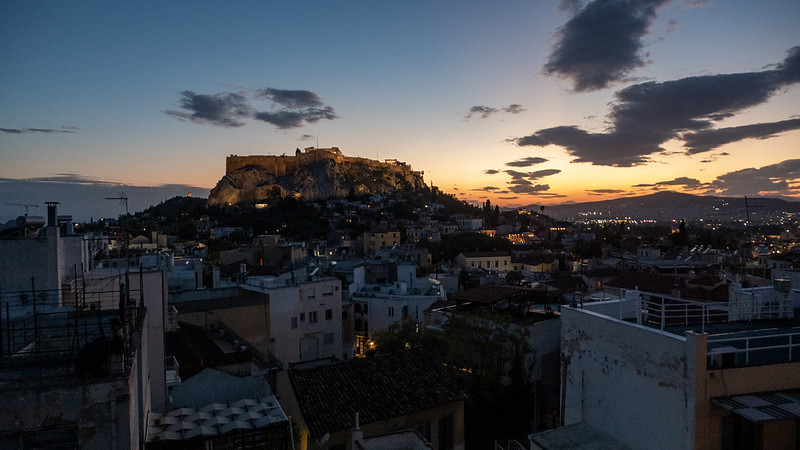
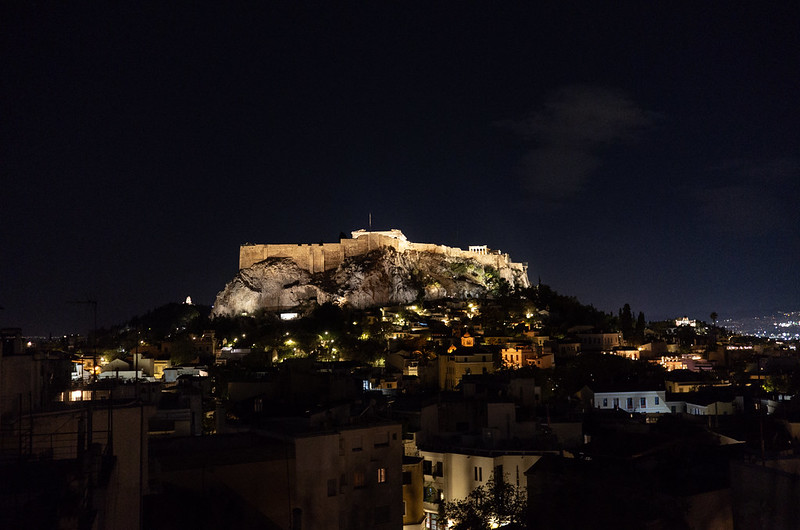
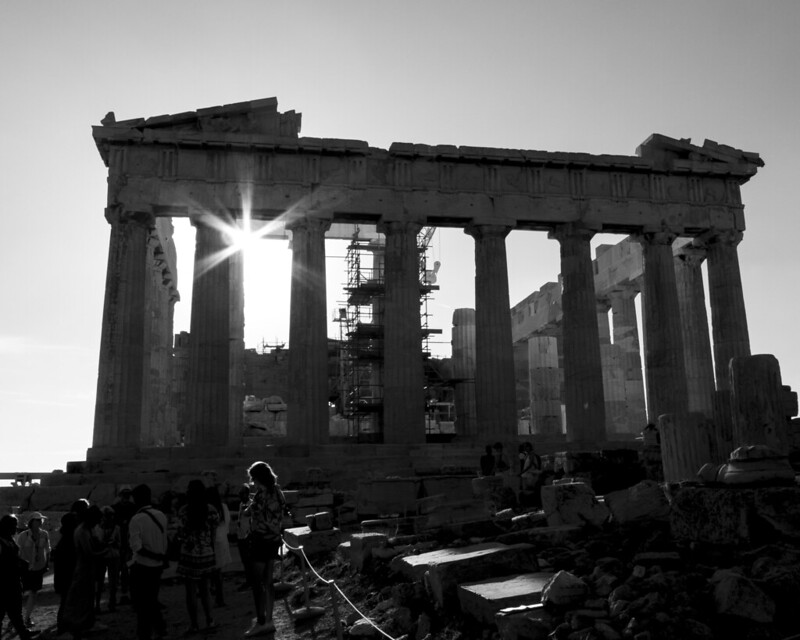
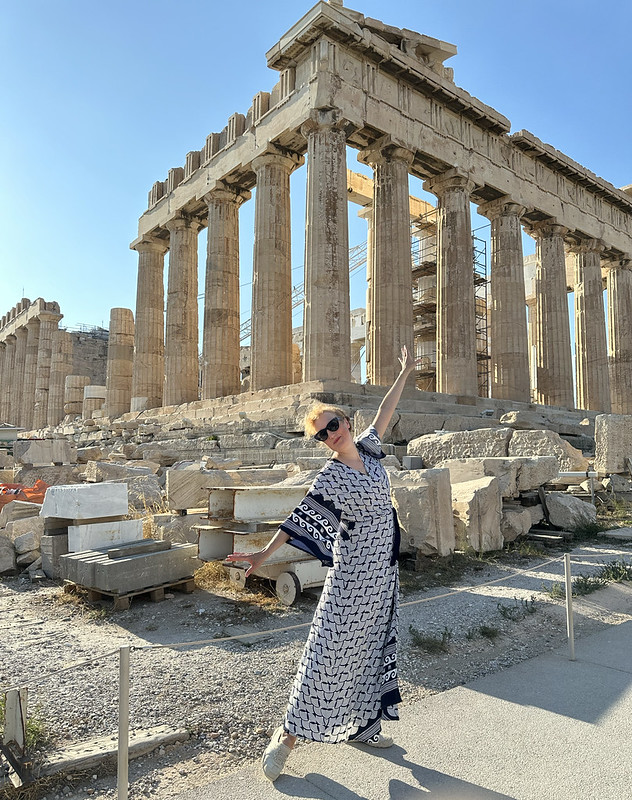
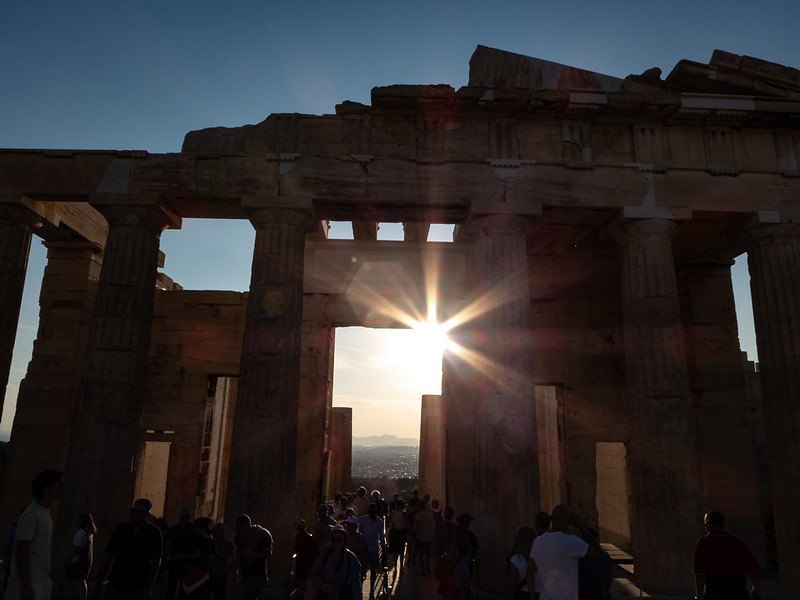
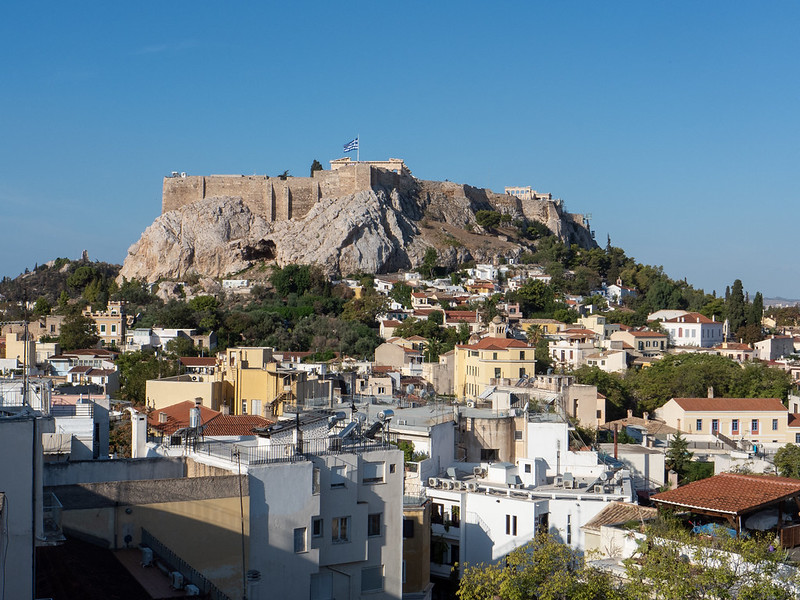
You know the Acropolis, of course. The high rock plateau that sits above Athens, layered and piled with ancient structures: most notably the Parthenon and, though less spoken of, the Erechtheion and the Propylaia, and with them the foundations of many other still older buildings, plus a flagpole and some public washrooms. It is within the city, it is surrounded by the city, but it is apart from the city.

Which might seem ironic, given that acropolis means ‘high city’. What city? It’s all temples! And they’re not in use or, for that matter, in usable shape at the moment. But on the other hand the polis is there too – the population, all the people. There are a lot of people up there anytime during open hours.

The parts of the word acropolis are as easily seen as the parts of the Acropolis: acro- as in acrophobia, acrobat, and so on, and -polis as in metropolis, necropolis, and so on. But right away we run into an interesting issue: its roots are akros ἄκρος and polis πόλις, but it’s not said acropolis, it’s said acropolis. Why the movement of stress?

The answer is not simply that we have a habit of putting the stress on the third-last syllable in borrowed Greek words, though we do do that – it’s why we put the stress on the first syllable in Socrates when it’s on the second in Greek. But even in Greek the stress in acropolis is on the second syllable, which is to say the third-last (antepenultimate): ἀκρόπολις (the accent on ό indicates the stress – which, in Classical Greek, is a pitch accent, but let’s leave that aside; if the ἀ catches your eye, that ’ is a breathing mark: it means the vowel doesn’t have a “h” sound before it). The stress has to move when the two bits are put together because it can’t be farther from the end than the third-last syllable.

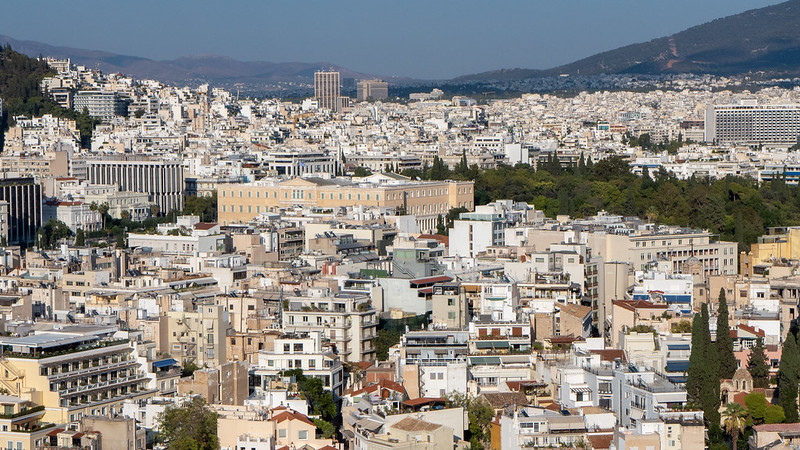
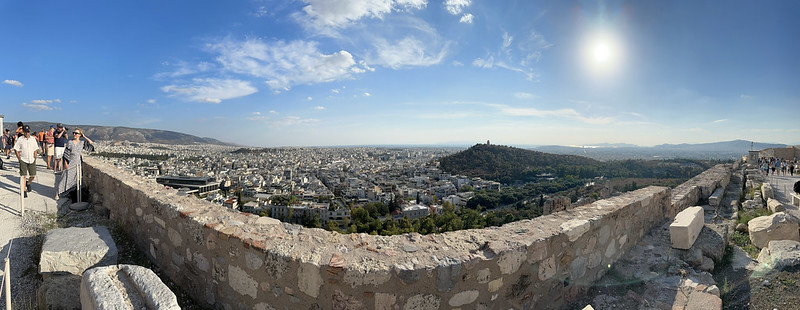
Which is sort of like the shift in perspective if you go from the city of Athens up to the Acropolis. If you start where we started, you first see a cliff keeping it high above you; then you go around the side on city streets and gradually uphill, and when you are on the far side you come to the entrance, where it is an easy stair climb to the top. And then you are no longer looking up at it, the thing that dominates the view (until you get to higher peaks surrounding the city); you are looking down and across at all the surrounds. You are not in the high city; you are in the acropolis. And all the stress you brought with you? You might have left it down there. (Or perhaps not. Especially if crowds bother you.)

And of course it’s quite the place, iconic and historic but also scenic. Which is one reason it is by far the best known and most popular of all the acropoleis.

All the what?

I wouldn’t be surprised if you had never paused to think of what the plural of acropolis might be. If there’s only one, you don’t need to pluralize it, right? Well, yeah, but there’s not only one. An acropolis was a central feature of many ancient Greek towns. It was why they were where they were: they were built around a high, defensible place. Towns would grow around the bases (water’s easier to get down there, for one thing), but the strength and protection was in the high part. Rhodes and Corinth also have notable acropoleis.

OK, but why this freakin’ weird plural? Why not acropolises? Well, of course, you can also say acropolises if you want. But in English we have a pretentious habit of borrowing the nominative plural – and no other inflections – from loanwords, especially Greek and Latin ones. And it just happens that the nominative plural of ἀκρόπολις is ἀκροπόλεις.

But if you’re watching those accents, you’ll notice a shift: that ό is now in the second-last (penultimate) syllable. This is because the final syllable is “heavier” (it has a diphthong rather than a short vowel) and so it drags the accent towards it. So this means that the pronunciation in Classical Greek is /a.kro.ˈpo.lɛɪs/ – and in modern Greek, /a.kro.ˈpo.lis/ (but the singular in Modern Greek is ακρόπολη, with η rather than ις, just incidentally, heh heh) – and in modern English it’s… /ə.ˈkɹɒ.pə.liz/. Heh, sorry. The stress doesn’t move; we just say it the same way but with an “eez” instead of an “iss.” And in fact sometimes we spell it acropoles. Because while we like to borrow the plurals, we’re not really as sophisticated or, you know, nerdy as all that. We just like the scenic famous stuff.

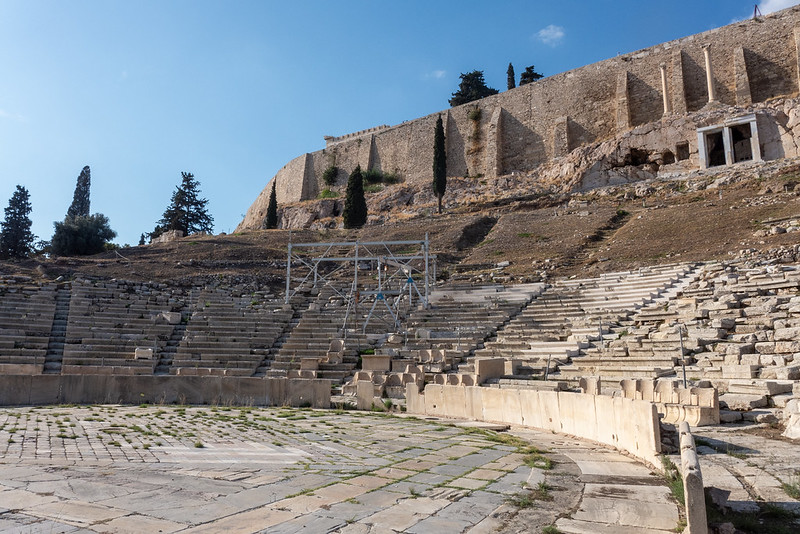
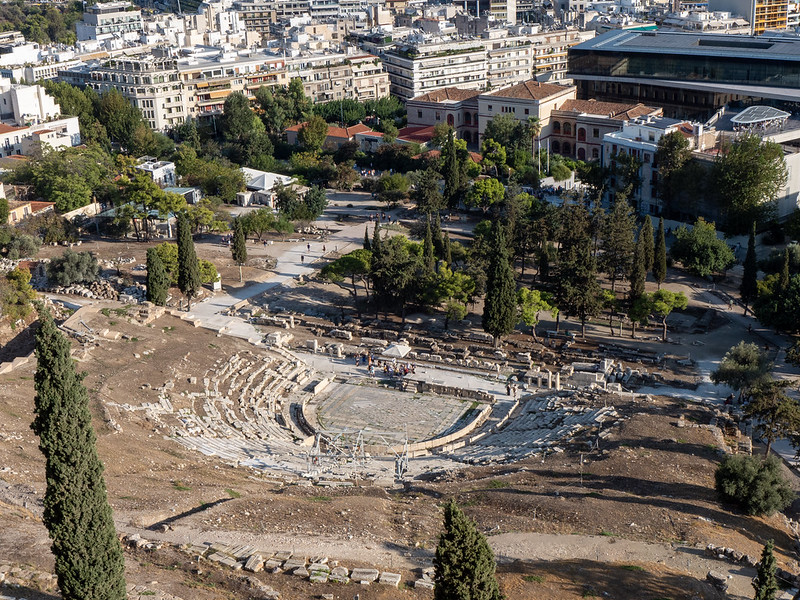
I mean, I am nerdy as all that, of course. I once performed an entire speech in Classical Greek (complete with chanting diction, and in the full costume and mask). It was in a production at the University of Calgary of Prometheus Bound by Aeschylus. And as it happens, at the foot of the Acropolis in Athens (accessible with your ticket to the Acropolis) is the very place that play, and thus that speech, was first performed: the (partially recovered ruins of the) great Theatre of Dionysus. 

Of course I went there. Of course I stood in about the spot where the speech was delivered. Of course I… did not perform the speech. I’m not that kind of dork! And there were lots of other people around. But I did note that it was very similar in size to the theatre at the University of Calgary. “Great” and “grand” don’t always mean the same thing, you see…

Santorini, Thira

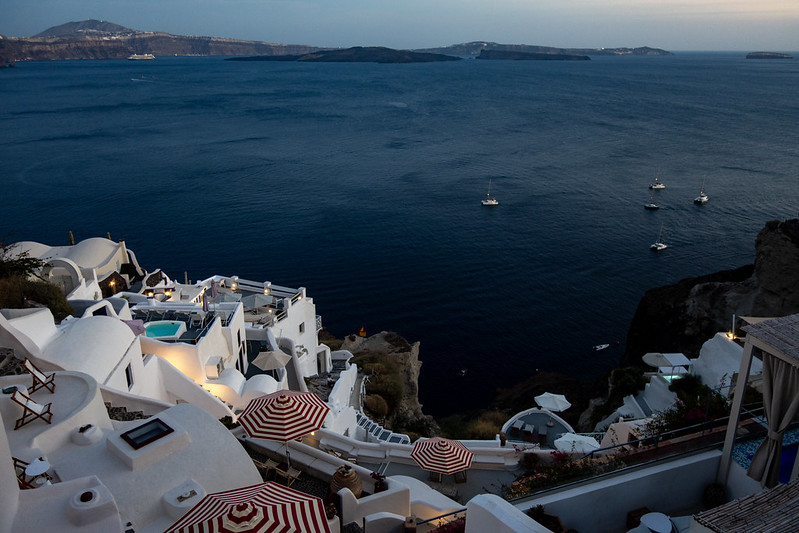
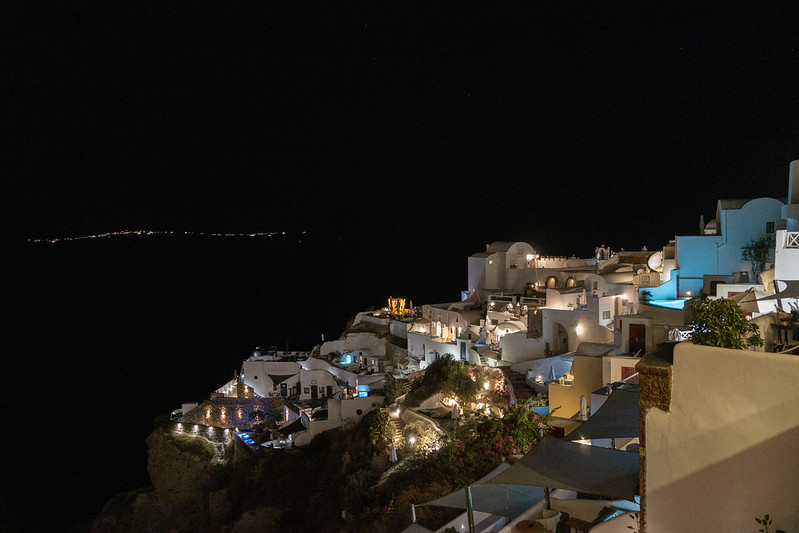
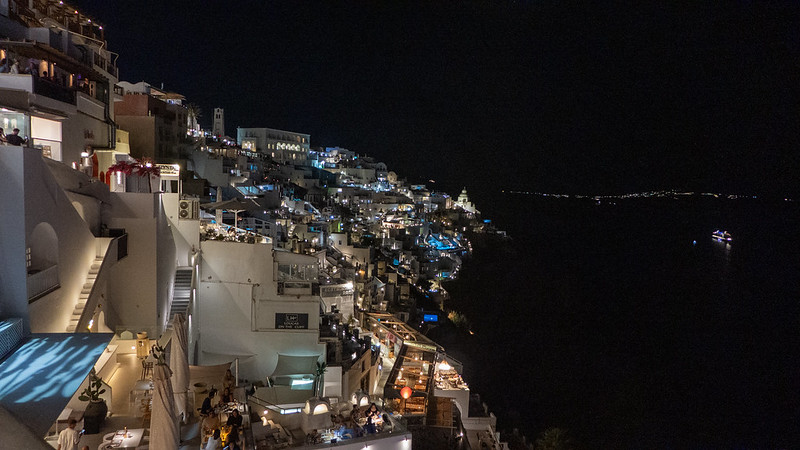
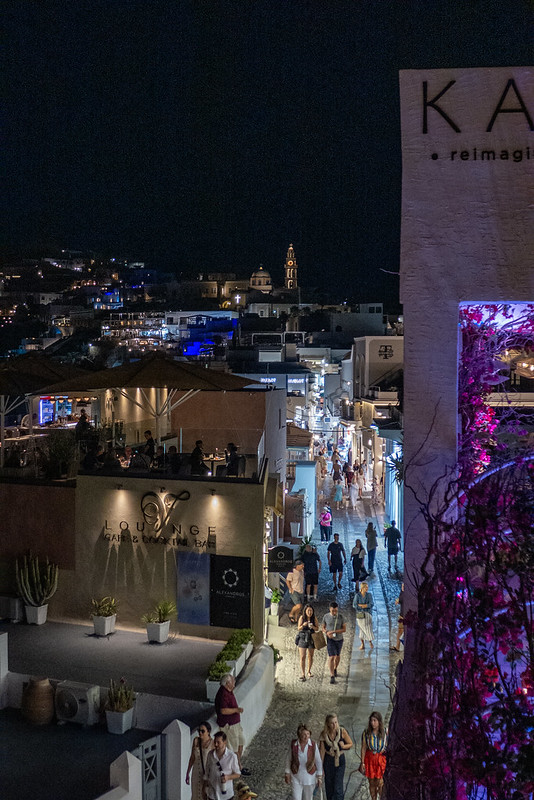
This is Santorini. And this is Thira.

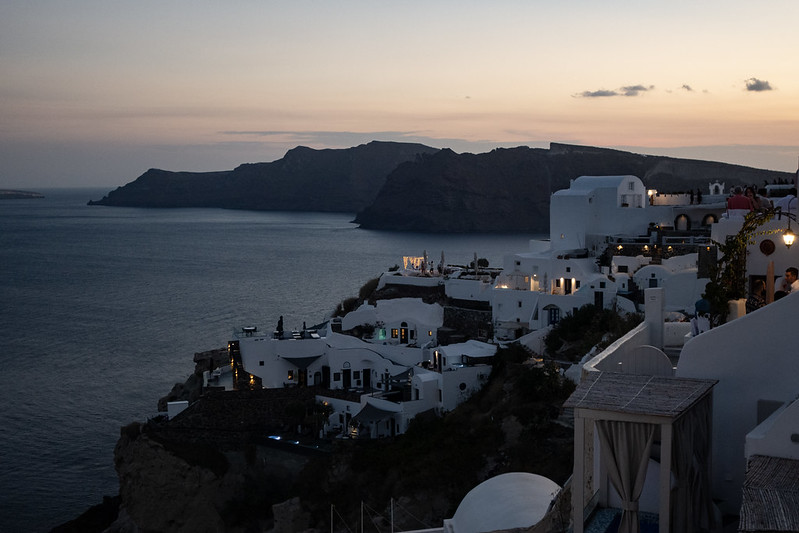
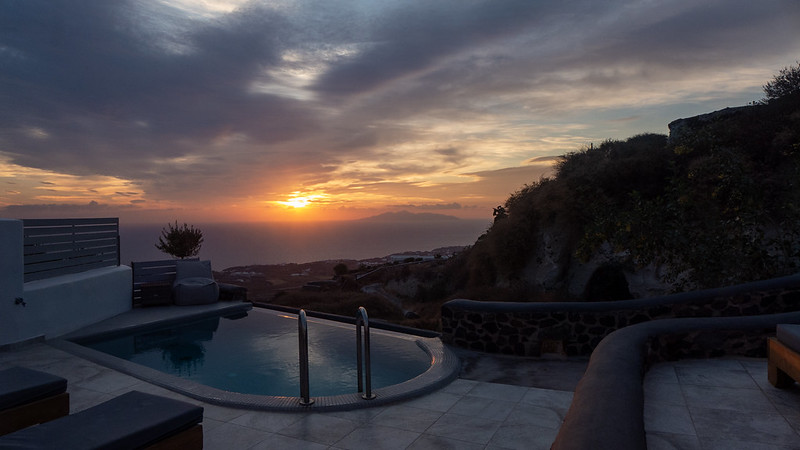
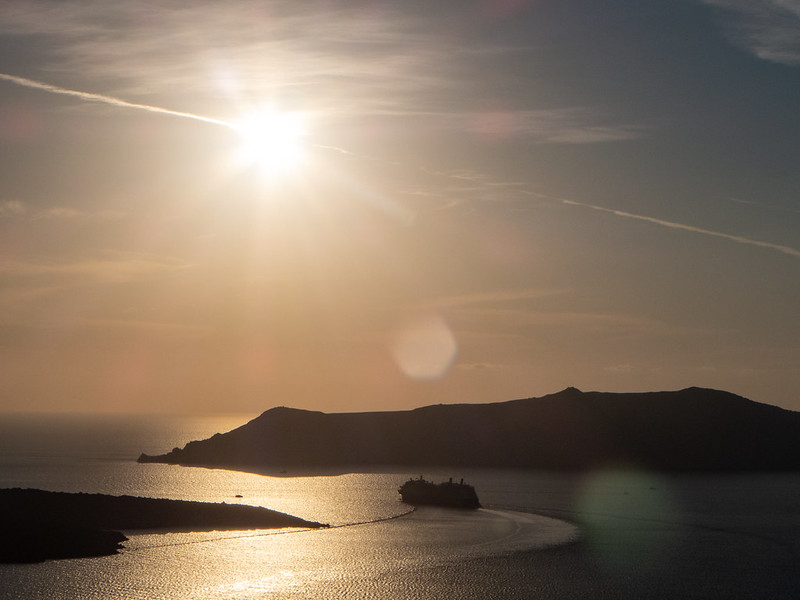
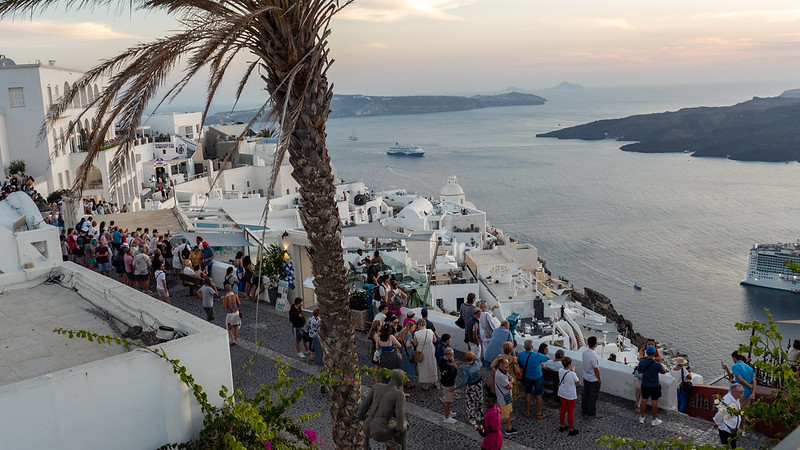
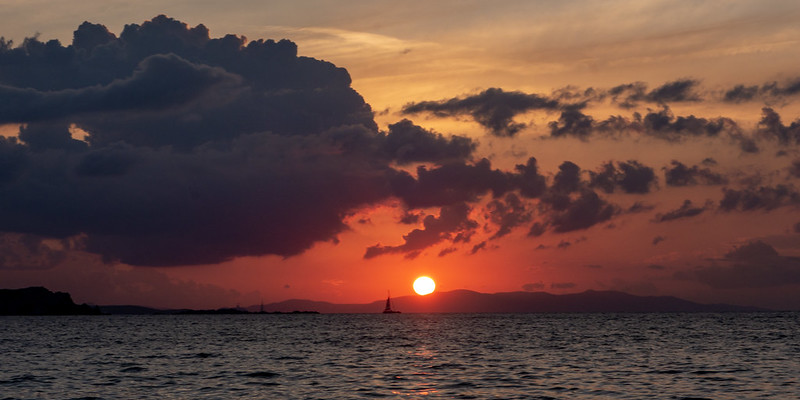
They’re not two places. Santorini is Thira, just as the sun I watched with hundreds of others setting across a caldera from a clifftop town is the sun I watched by myself rising over the open Aegean across a rural hillside.

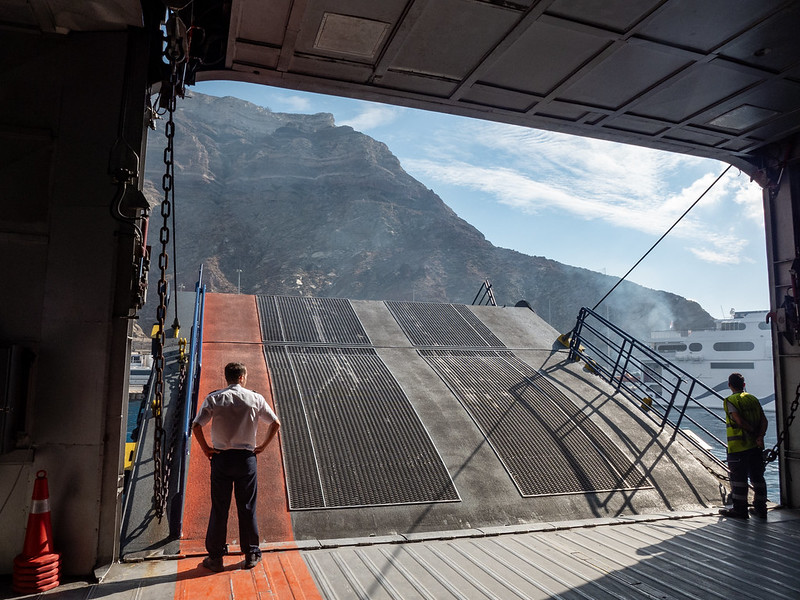
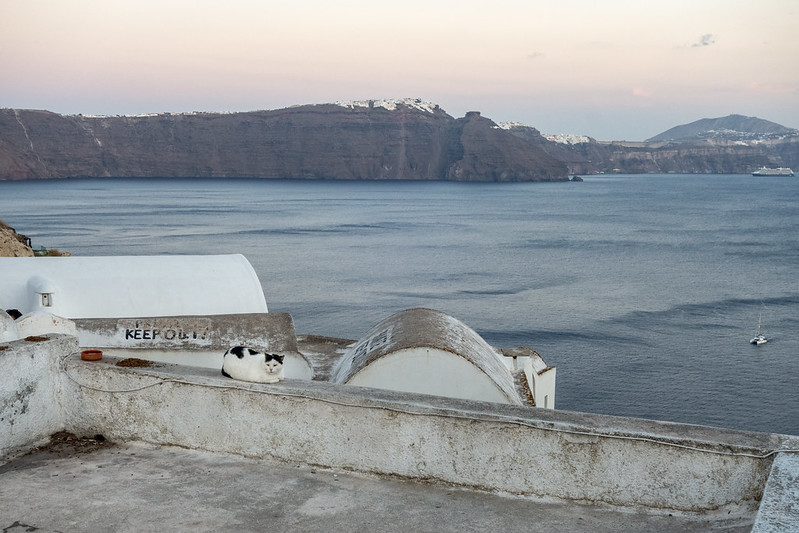
This island has a pervasive duality. If you arrive by boat, you come in on the caldera side and land at the base of a thousand-foot cliff. You are in the watery gullet of an ancient volcano, in a basin formed over the ages by multiple eruptions, the most recent of which a mere 3600 years ago – an eruption that destroyed a large part of the caldera wall and buried much of the island under many metres of ejecta, an eruption that, records tell us, affected the atmosphere in Egypt and even in China. 

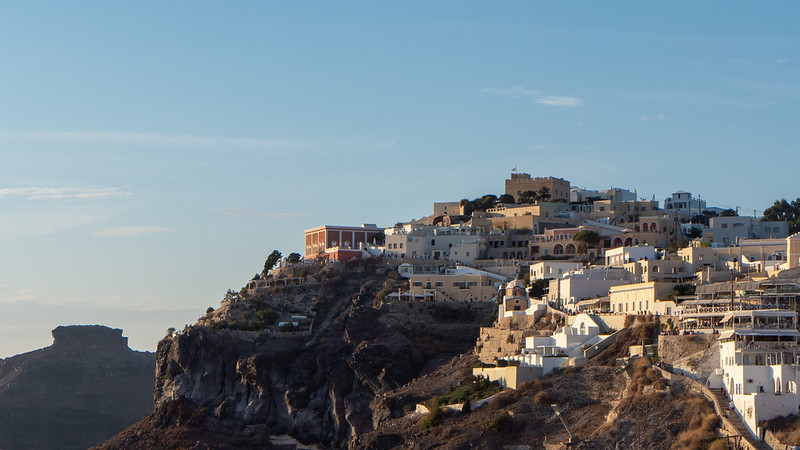
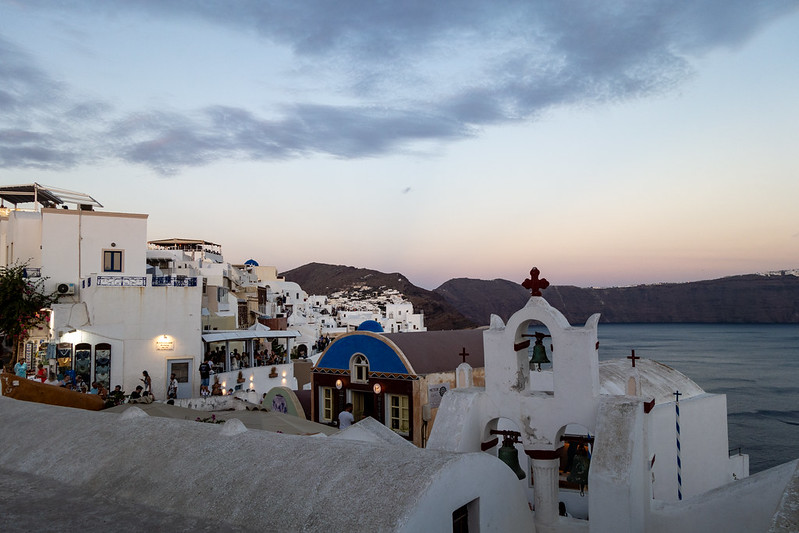
At the top of the cliff is a string of villages like a strand of pearls along the crest of the colossal cauldron, with the famous whitewashed blocks and blue domes and patios and pools descending towards the drop-off, and sloping less spectacularly on the other side. And all the tourists and all the photos you always see are concentrated on this elevated perspective.

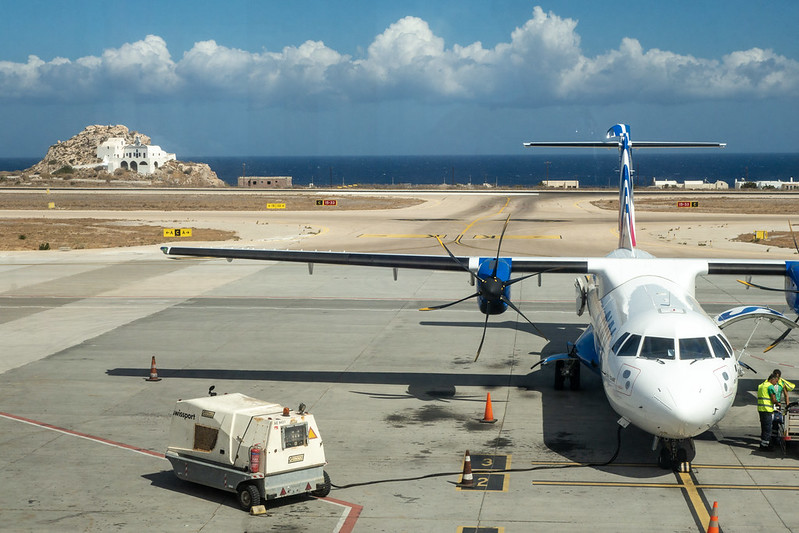
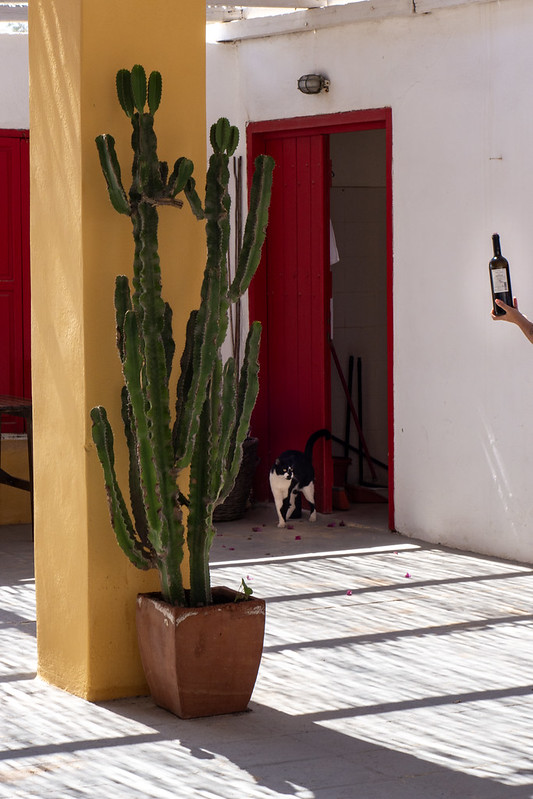
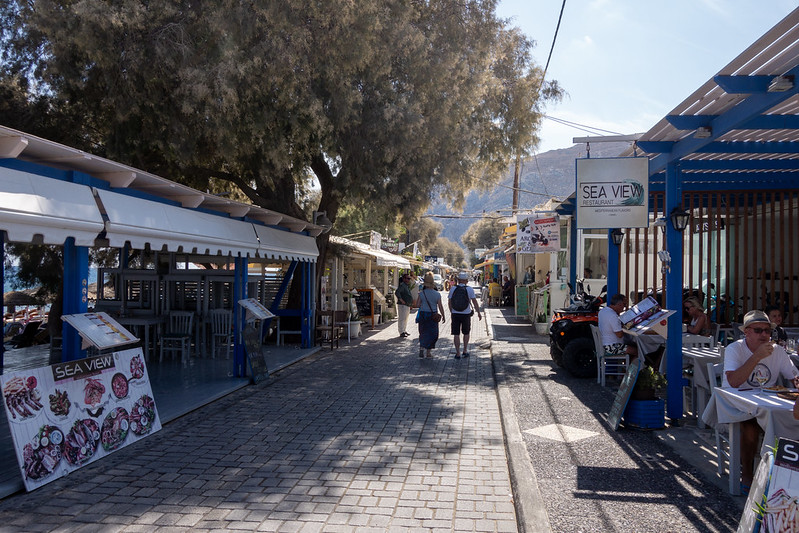
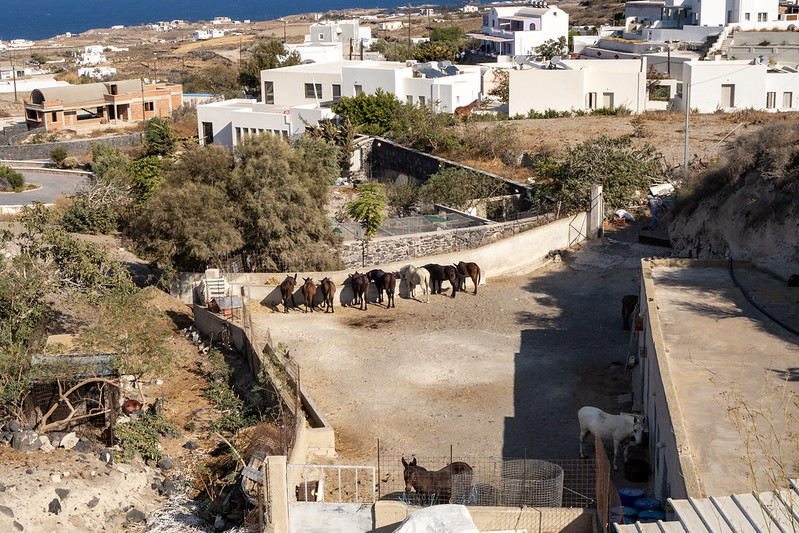
And if you arrive by airplane, you come in at the base of the gentler back side, a broad hillside with villages and fields and resorts and, just off the corner of the runway, a winery on a black sand strand that stretches into a seaside beach-bar town slouching at leisure into the water, the opposite of the busy ritzy clifftop aeries.

High above all of this is a monastery on a peak that dominates the back side and looks down on the caldera from a distance. At the north end of the curving caldera mouth is Oia, Οία (said “ee-a”), badly damaged by an earthquake nearly 70 years ago but you wouldn’t know now from its marble streets and moneyed shops. At the south end is Akrotiri, Ακρωτήρι, site of archaeological digs that have shown us that the people living here 3600 years ago had three-storey houses with colourful frescos – buried by that eruption, but still there if you know where to dig.

Even the name of this place is dual, and dual upon dual. The more widely known name, Santorini, may look more like Italian than Greek, and there’s a reason for that: it’s from Latin Santa Irini, ‘Saint Irene’, after a Greek saint (from Thessaloniki) to whom an old church is dedicated in the village of Perissa. (The Greek for ‘Saint Irene’ is Αγία Ειρήνη: Agia Eirini or, by sound, Ayia Irini.) The island’s ancient – and official modern – name is Thira,* Θήρα, after the leader of the Spartans who colonized the island. The capital and largest city has the same name, but with sound shifts: it’s Fira, Φηρά, with the stress moved from the first to the second syllable and the fricative moved from tongue to lip, making the letter for it 90 degrees different – Θ versus Φ. 

And so it is. A simple turn and a change of perspective. But it’s all there for the looking.

* Also transliterated Thera – the letter η is classically ē but in rendering Modern Greek is usually set as i because it, along with υ and the diphthongs οι and ει, has merged with ι to the /i/ sound.

Mykonos

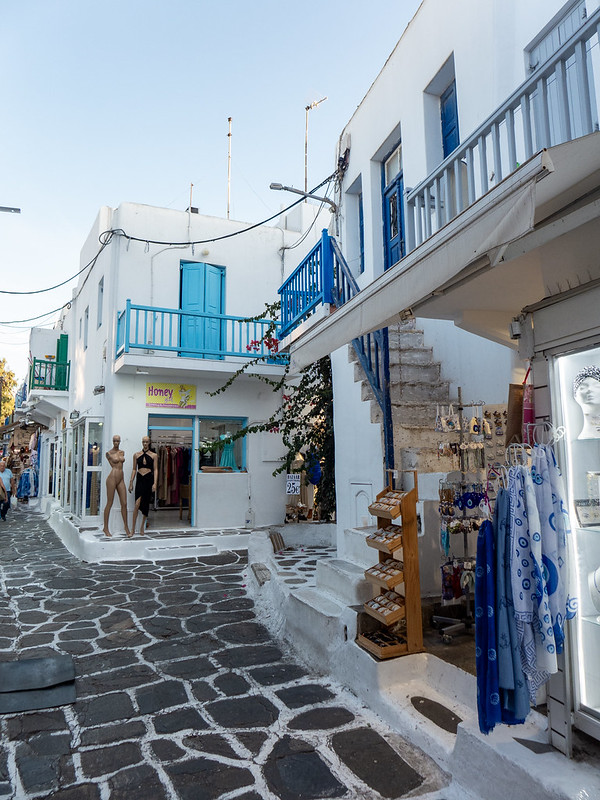
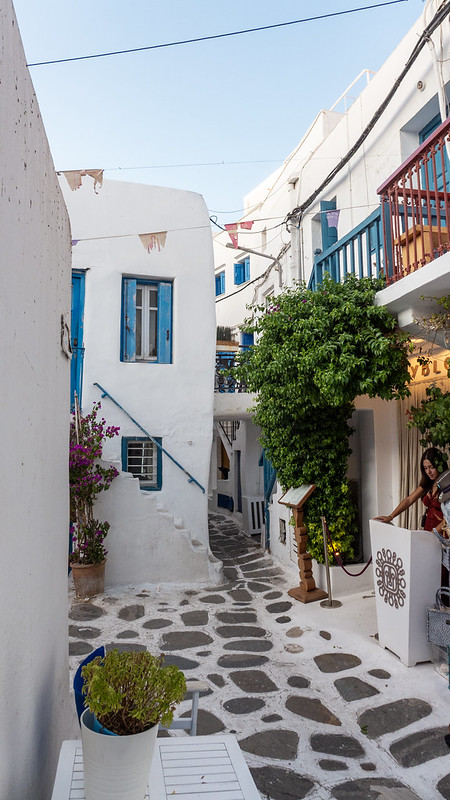
This is Mykonos.

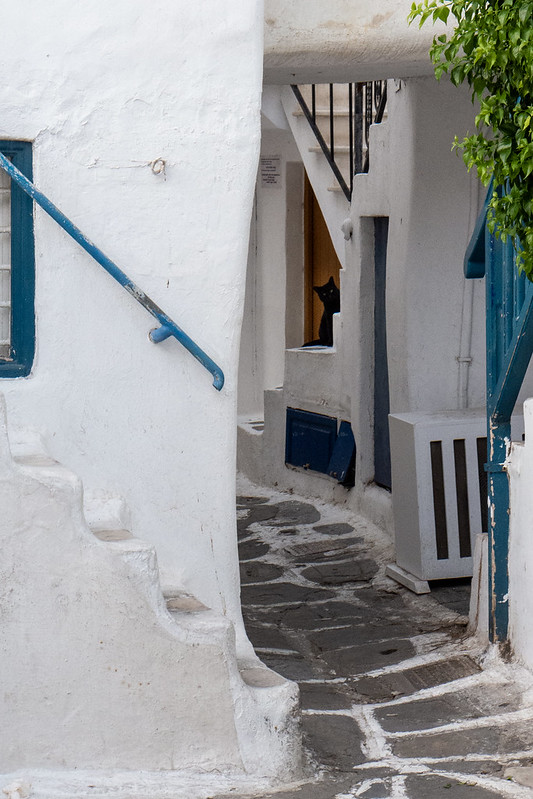
The doorways, the stairways, the white paint solid on walls and patterned on the pavement but not matching the cement between paving stones. The cat, one of ever so many. The street that’s about a metre wide – yes, that’s a street, have a look at Google Maps: it’s a normal-sized street of reasonable importance in the town of Mykonos. Google tells me it’s Delou Street. I saw no street signs.

The town of Mykonos is all this, plus stores and restaurants and bars.

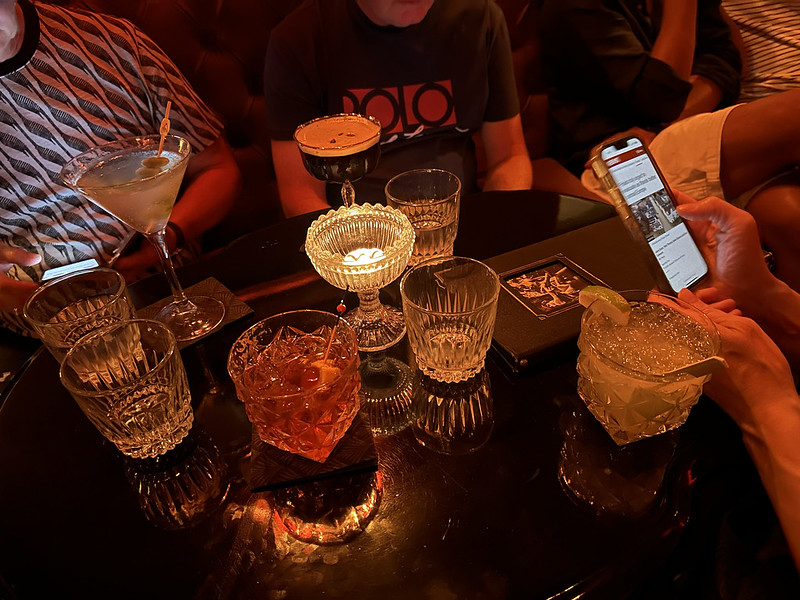
I didn’t have a clear expectation of what Mykonos would be like, but I assumed it would be like European seaside towns I’d been to before. It has a reputation for nightlife. I imagined a sort of small glitzy Barcelona, perhaps.

No.

When we stepped off the airplane in Mykonos an hour or so after sunset, it was my first foot on Greek tarmac. It was dark and warm and it was a small air terminal. We came out front and caught a minivan to the Fabrika bus terminal, at the south end of town, where the one in our group who had arrived earlier was waiting to meet the other four of us. She said we wouldn’t be able to get a taxi or minivan any closer than that.

Damn right we wouldn’t. Not without breaking the laws of physics, and several other things in the attempt.

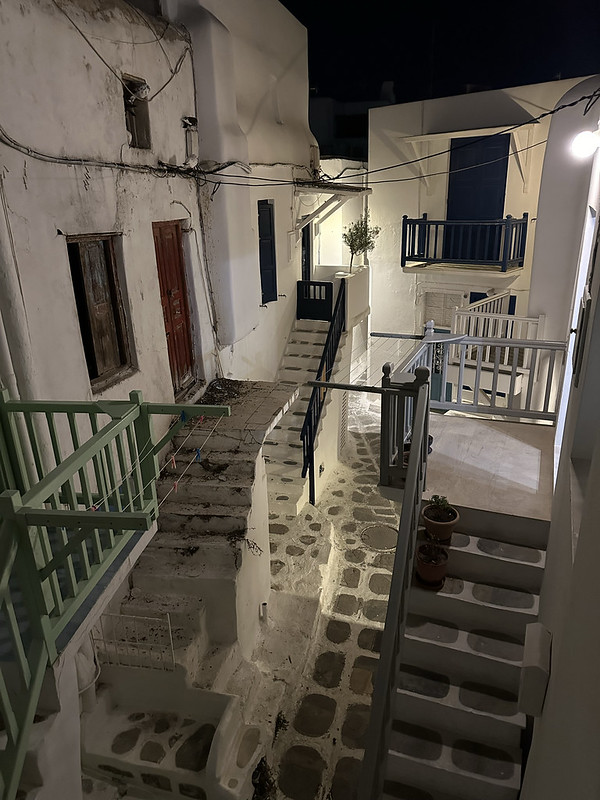
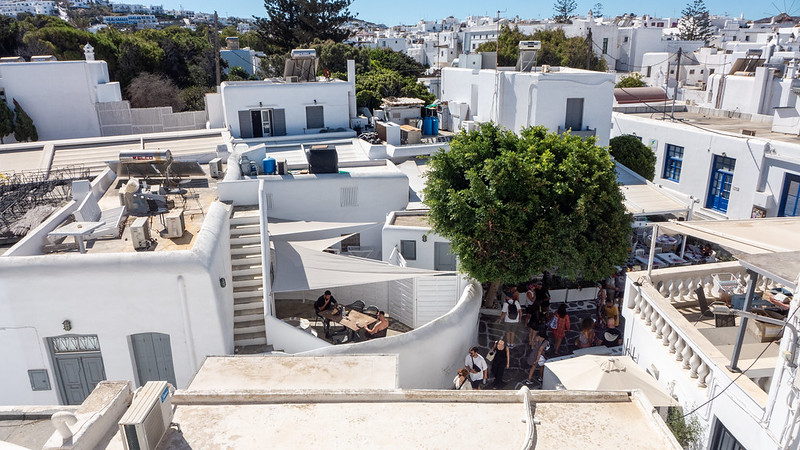
We dragged our bags and followed her down streets just wide enough for two people to pass on foot. Everything was open and busy. Stores in Mykonos mostly close at midnight during the warm season (and mostly don’t open in the cold half of the year). We took an anfractuous route that led us, after several minutes, to a narrow stairway up from a narrow lane. This was the view from the front door.

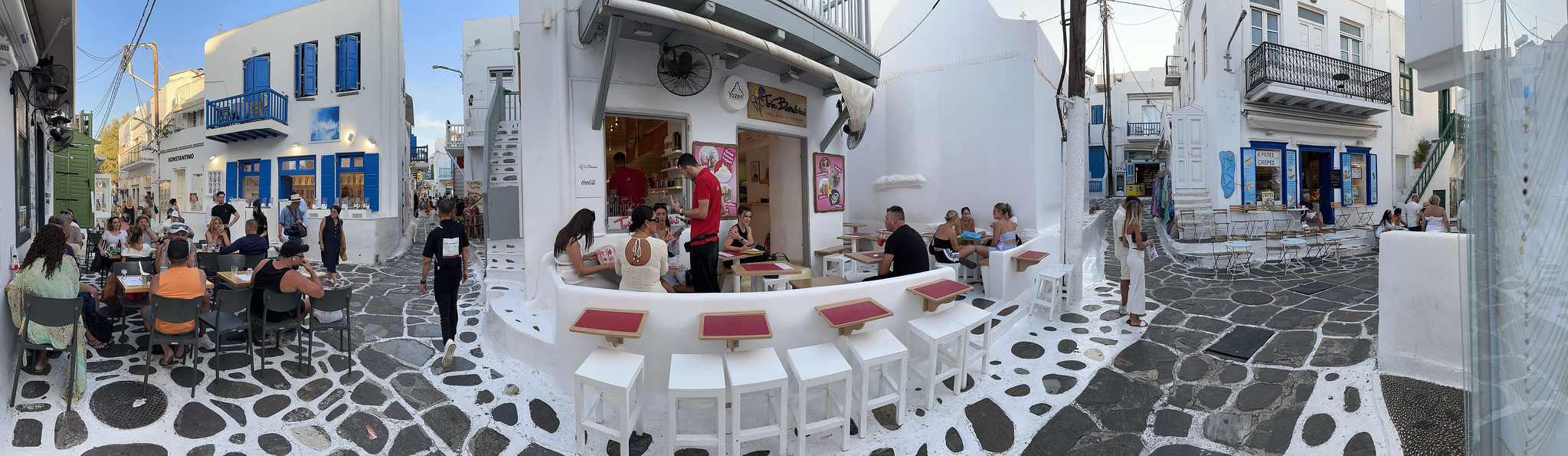
We were less than ten minutes’ walk from anywhere in town, and yet there was so much. Turn a corner and you find a bakery. Walk a little farther and the neighbourhood changes again. Go two very short blocks (scarcely farther than from one end to the other of the hallway in our condo building in Toronto) and you’re at a fabulous nightclub, with many others on offer. 

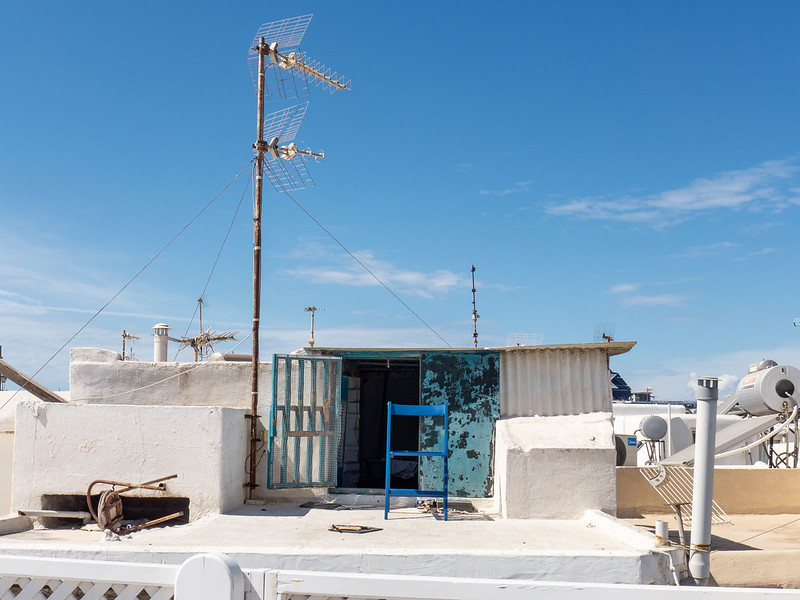
And in the morning, you come out onto the rooftop deck and see this.

No, I had never been to another place like this.

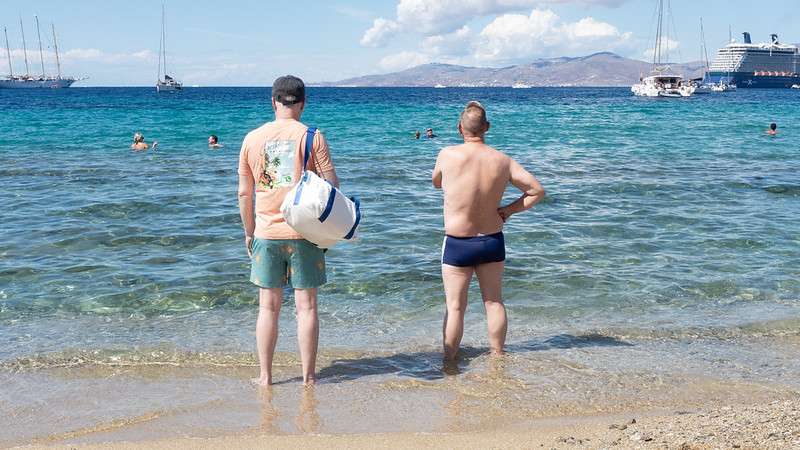
On our first day we walked to a nearby beach. The beaches in Mykonos do not load you up with sand in your shoes and clothes. It’s no miracle; their “sand” is small pebbles, too large to adhere. These pebbles have been wearing down for all of recorded human history, but they still have a ways to go.

The next day we took a bus to a beach on the other side of the island. It was crowded and we didn’t like it that much. We found a nice bar with a nice view and nice food and had a nice time. 

I didn’t take pictures of the landscape as we went by on the bus because I couldn’t, really, but the roads are neither straight, nor flat, nor wide, and the landscape is hilly and full of rocks of many sizes – the large ones, according to myth, are the petrified corpses of the giants slain by Hercules – and there is not much that is green. It does not rain much on Mykonos, or, as far as I can tell, on any of the other Cyclades.

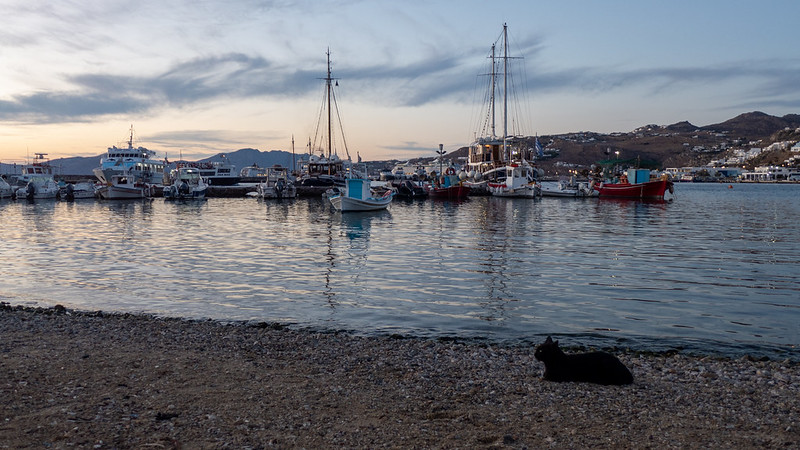
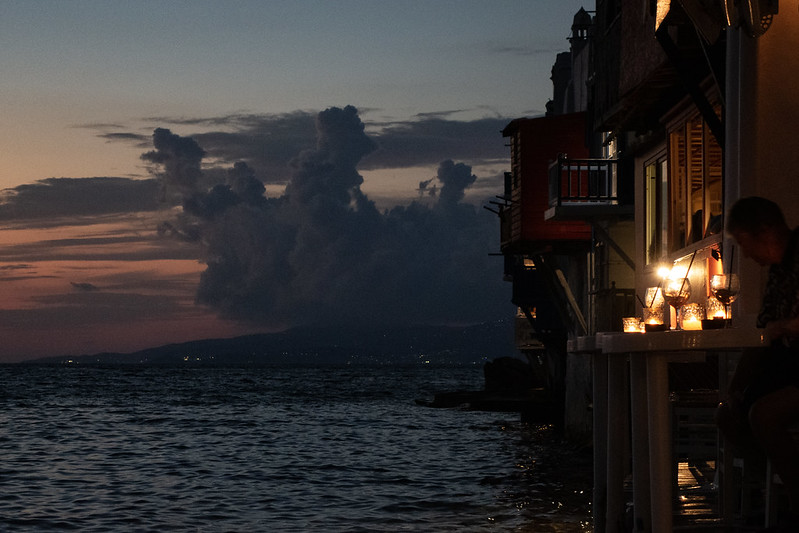
And then we went back to town and sat at a seaside restaurant and engaged in what is apparently the most popular tourist activity in the region: watching the sun set.

Mykonos does have luxury stores and nightclubs, as advertised. But they are all in this old condensed town. It is not like walking down a boulevard in Barcelona, or even an avenue in Verona. It’s small and cute and intense, almost Disney-like, but it’s not Mickey Mouse; it’s Mykonos.

During the day, if there are cruise ships in the harbour, the streets are clogged with impossible groups of people following sign-wielding tour guides. But after 4:00, they’re all back on their ships. And the nightlife people don’t come out until about 8:00. Which means you have four very peaceful hours when people are largely either napping or watching the sunset. Of course, you might be too.

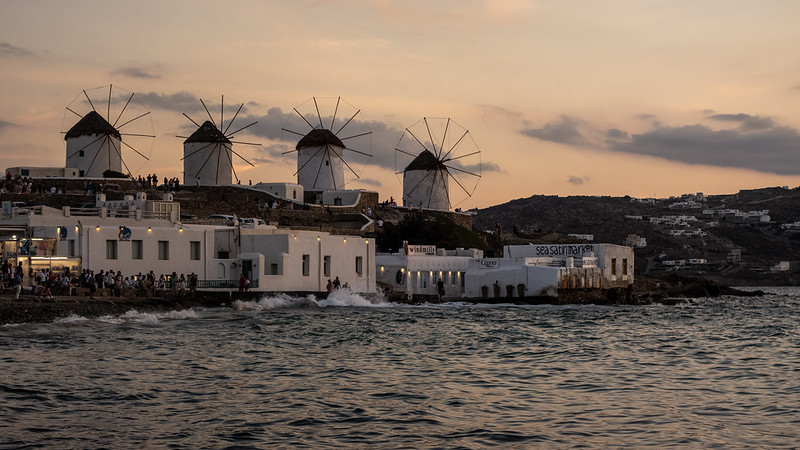
What does Mykonos mean? The island is, according to myth, named after its first ruler, Μύκονος, who was the son or grandson of Apollo. His name means… nothing else that anyone knows. It’s pre-Greek. It came with the island, I guess. The island’s nickname is “Island of the Winds” – hence the iconic windmills.

Mykonos has been inhabited for longer than people have been writing things down, but it used to be subsidiary to the nearby smaller island of Delos, which was an important site of trade and culture, in spite of having, really, no resources of its own. Now Delos is inhabited by 24 people and countless ghosts wandering among the myriad ancient ruins. But Mykonos is very much alive.

There’s much more to Mykonos than what I’ve shown you or what I’ve seen. This is just my cognizance of Mykonos, so far. Before I went, the name didn’t mean a whole lot to me. Now? It has gained considerable flavour.