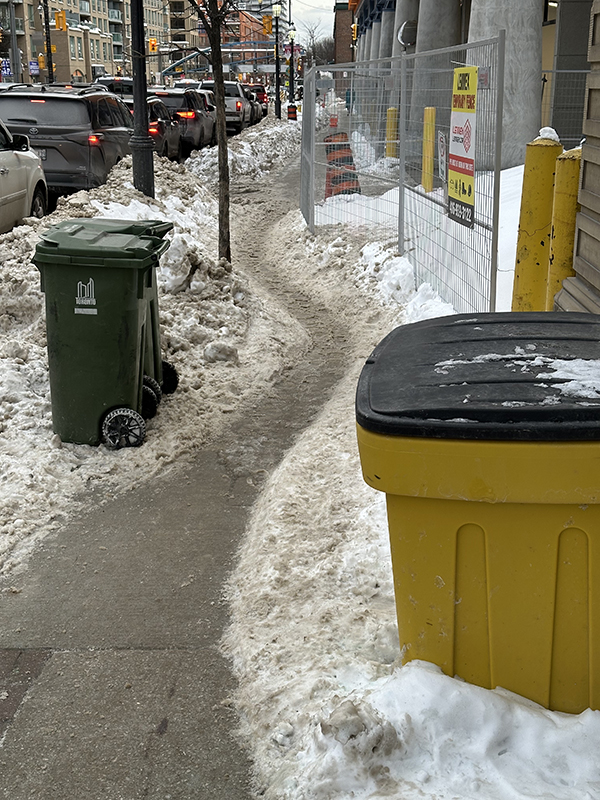
Neige a neigé! Snow has fallen, snow on snow… We are inneviated. Toronto has not seen so much snow at one time in several years, and the usual approach around here to handling snow is not so functional: push it aside into piles to leave a space down the middle or, if no one really “owns” the section of sidewalk, just let people posthole in it until they stomp it into submission (and what about the streets? oh, of course they plough those… and push the snow from them right up onto the sidewalk, which leaves less space for those walking). And, finally, dump endless tons of icemelt crystals on it, so that until the weather warms up enough to drain it all away, we are left schlepping through a salty muck of slush.
This poses problems for nevigation, plainly.
Nevigation? I hope you’ll permit me a confection here. In fact, like inneviated, I’ve borrowed nevigation from Latin via Italian. But unlike inneviated, I intend it as a sort of play on an English word (also taken from Latin), navigation. In Italian, nevigare is just a variant on nevicare, which means ‘to snow’, from Vulgar Latin nivicare, from nivem ‘snow’. (Believe it or not, French neige also comes from that.) But I think getting around in the snow deserves its own special verb.
Especially in Toronto when it’s snowed heavily. I’ll tell you what, I grew up in Alberta, where it snows like this every winter and goes long stretches without getting above freezing (although at length, at least in southern Alberta, a chinook will blow in and warm everything up and make the snow disappear quite quickly). They don’t dump salt all over everything there. They dump sand and gravel on it, so that you can have traction on the hard-packed snow, rather than seeing it all become filthy slush that ruins shoes and soaks boots. (On the other hand, in Boston, where I’ve also lived, they just ignore it for a day and usually the rain washes it away the next day. And if it doesn’t, they all have heart attacks trying to shovel the stuff, because it’s so heavy wet.) In Alberta, you just put on your boots and rely on decent traction. Even on pathways where no one sands, you can make your way on the pack.
But in Toronto? Ah, no. When it actually really snows, every sidewalk becomes a valley between parallel impassible ridges, and if no one is shoveling the sidewalk, you will have many one-person passages and the occasional dead end. It sneaks around like the etymological derivation of nevigation.
I mean that literally, more or less. You see, nivem comes (with some drifting and clearance) from Proto-Italic *sniks. That in turn comes from Proto-Indo-European *snéygʷʰs, which is also – and, frankly, with less alteration – the origin of snow. Which makes a person want to just plough a clear path. Specifically, why not just say snowvigation?
We cancelled our road trip up to Collingwood because of the snow storm. We reckoned it would be reckless, and perhaps not wreckless – if not bringing us to wrack and ruin, at the very least a bit nerve-racking, if you catch my drift. So instead of going in any direction, we played the recluse all weekend.
I’m not trying to snow you under, lexicographically. There’s a sound explanation for all of this, though most of it’s not explained by sound. In fact, while you can right it by writing it, what you hear is neither here nor there: You may notice that you round your lips when saying the wr in wrack and wreck and write, but you also normally round them the same amount when saying rack and reck and rite. That phonetic distinction disappeared centuries ago.
There are five lexical items to reckon with here – yes, five: reckless, wreck, reckon, wrack, and rack. So let’s go backward deliberately, as though reversing to extract ourselves from a drift. You may have noticed I wrote nerve-racking and you may have racked your brains about that: not nerve-wracking?
Well, if you care to be correct, no. Nerve-wracking is used, yes, and has been since the later 1800s – from wrack, as in wrack and ruin, an alternate form of wreck, used for a time (Shakespeare’s life plus and minus half a century) in southern England but otherwise mainly northern – but the older form, by at least half a century, is nerve-racking, from rack meaning ‘stretch’, from the noun rack, originally naming an implement for stretching things… or people.
Indeed, the figurative use of rack for something causing mental or physical anguish has been around since the 1400s. So something that stretches your nerves to the breaking point is, by history, nerve-racking. It just happens that we’ve leaned towards the w version now, and while I’m inclined to think that there’s a feeling of a crumpled piece of paper (perhaps a road map) from the w, the main reasons for the switch may come down more to the stronger semantics of wrack, as in wreck, and also to a prejudice in favour of less phonetic spellings.
Anyway, that’s how I reckon it. By the way, reckon comes from an old Germanic word for calculating. If you’ve ever been to a restaurant in Germany or Austria, you probably know that die Rechnung is the bill, and if Rechnung seems similar to reckoning, it is; they’re parallel descendants of the same original morphemes. So the next question is, does reckless mean ‘without reckoning’?
Surprisingly not. Historically, reckon and reckless come from different roots. Whereas reckon is related to right (and thus also to the same root that shows up in Latin rect words such as correct, direction, and rectify), reck as in reckless is from a root having to do with caring or paying attention to or being troubled by. So, at root, reckless means about the same as insouciant.
And, as I have already implied, wreck is unrelated to either; it has to do with ruin. The w was once pronounced – modern descendants of the same root in Swedish and Danish start with a v (vrak, vrag). But now we write it twice as much (vv —> w) and say it not at all. (Note that in Old English, a different letter form, derived from runes, was used for /w/; it was written ƿ and was called wynn, but it couldn’t win – looked too much like a p – and when the Continental languages said “double you or nothing” we took it.)
So anyway, seeing the results of the weather, we know we made the correct decision. And now you, too, can rectify your lexical directions. We will make it up to Collingwood later, when the weather is right.
How do you discriminate between cremini and portobello mushrooms? A portobello is less portable.
But the difference is incremental. You see, white button mushrooms (“champignon de Paris”), brown (cremini) mushrooms, and the big barbecuable beasties named portobello are all Agaricus bisporus, and the difference is mainly their age – though the white ones are descended from a mutant variety discovered in 1925 in Pennsylvania.
Pennsylvania! But they’re called champignon de Paris! Next I’m going to say that the cremini and portobello ones aren’t from Italy.
Yes, I am. Well, to be fair, they do grow them in Italy. But you don’t have to be in Cremona to get cremini; they’re also grown in all sorts of other places in Europe and North America. And the same, of course, goes for portobello; they’re grown in exactly the same places as cremini, just for longer (sometimes cremini are called “baby bella” – though I’ve never seen portobello mushrooms called anything like “cremaxi”).
But they didn’t get their names in Italy. If you ask for “funghi cremini” or “funghi portobello” in Italy they probably won’t know what the heck you’re talking about. You’d have to ask for “prataiolo” or use the French word “champignon.” These names – cremini and portobello – are marketing board inventions. The first use of cremini seems to have been around 1984; it’s based, apparently, on a diminutive of crema ‘cream’, and on what, per their research, sounds good to American consumers. The first citation the OED has for portobello is from 1985; it’s based, evidently, on Italian for ‘lovely port’ and, again, on what sounds good and impressive. They both sound like Italian place names – Cremona, for instance, the name of which traces back to shadows in the mists of ancient time, and, well, pick your pretty port (perhaps Porto Ercole, near Orbetello). And of course we all know that Italian food is delicious.
Well, criminy! That’s kind of incriminating, isn’t it? Ah, yeah, but what the heck. Consider the multiple spellings you can see: both cremini and crimini, and all four of portobello, portabella, portobella, and portabello, the last two of which would be grammatically incoherent in Italian – and yet there never seem to be grammar numpties ranging around with markers to make corrections. (There is, in fact, some uncertainty about which of the variants of each is technically correct. I go with cremini because it’s the more common variant and because it’s creamy rather than criminal, and I go with portobello because it’s the most common variant and because portabella means ‘pretty door’ – which it could be, I suppose – and the other two are, as I mentioned, grammatically incoherent: inflections are supposed to match between nouns and adjectives.)
Do you feel browned off by this? Does it make you not even want to use the words? There are a few other marketing-created terms you would, for consistency, also have to eschew – kiwi fruit, for one, and let’s not get started on the Italianate concoctions populating Starbucks menu boards. And even if you managed to cancel those, more marketing imaginations would sprout up like mushrooms, thriving in any fertile environment – especially one with ample manure. But, yes, you can always call them “brown mushrooms” and, I guess, “monster mushrooms” – actually, people didn’t talk about the full-grown Agaricus bisporus much before they got the fancy name: you can also thank the marketing board for pointing out that they make a suitable substitute for meat, and pretty much opening the door to their common usage with that name.
Can I say that? Is ramekin like casserole or paella, a dish (recipe) that has gotten its name from the dish (vessel) that the dish is dished from?
The answers to those questions are (a) yes and (b) no. Ramekin has not transferred the name of the container to the name of the foodstuff. In fact, it’s the reverse: the little round ceramic vessels (like cute little food parentheses) are named after a foodstuff that is made using them.
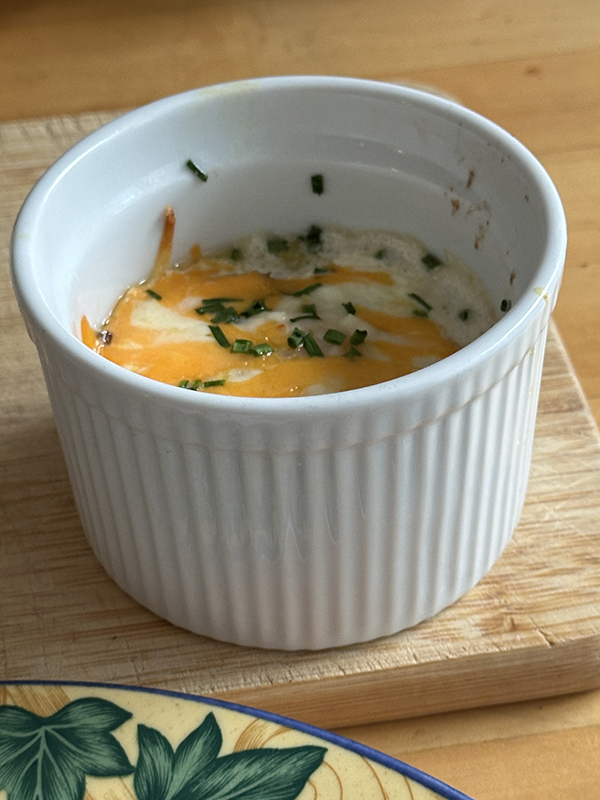
I should say, first, to be fair, that what I made is more typically called shirred eggs. But there are many ways to make shirred eggs, and the recipe I made also fits the definition of the culinary item called ramekin, which is, to quote the Oxford English Dictionary, “A type of savoury dish based on cheese, mixed with butter, eggs, and seasonings, and usually baked and served in a small mould or dish.” The word has been used in that sense in English since the mid-1600s – borrowed over from French – while the metonymic transference to the ceramic vessel happened only by the later 1800s (Funk’s 1895 Standard Dictionary of the English Language defined that kind of ramekin as “a dish in which ramekins are baked”).
Did you wonder, when I said “borrowed over from French,” why it’s not ramequin? In fact, at the time we borrowed it, it was. So why did we change it? Well… we changed it back. You see, French didn’t invent the word; it traces back to regional Dutch rammeken and Low German ramken. It’s like mannequin, which came from the Dutch manneken – meaning ‘little man’. The -(e)ken suffix is a diminutive.
So the next question must be “Little ram?” Heh. That has produced some perplexity; the OED (and Wikipedia, citing it) scratches its head and says that it seems to come from ram ‘battering ram’, “although the semantic motivation is unclear.” Meanwhile, Wiktionary notes that Rahm is a German word for ‘cream’, cognate with Dutch room (‘whipped cream’ is slagroom, but I’ll have it anyway) and the now-disused English word ream (displaced by cream, which is, go figure, unrelated). That seems a bit more semantically motivating, for what it’s worth.
Anyway, what you probably really want to know is how I made the ramekins. As in the shirred eggs. So here’s the recipe. (And since this is a word blog, not a recipe blog per se, you can’t complain about how long I took to get to the recipe. Be grateful I’m even telling you.)
Ramekin Eggs (one of many ways)
To begin with, make sure you have the following things:
4 ramekins (mine are 4 inches in diameter, I think)
4 eggs (chicken, not quail or duck)
4 mushrooms (brown, i.e., cremini, decent sized, not portobello, portabella, portabello, or portobella)
1 shallot
Chives (how much should you get? doesn’t matter; they always sell it in far greater quantities than a normal person can use up before it goes dodgy anyway) (that’s chives, not scallions, OK? whole other ballpark there)
2 thick strips of bacon (the North American kind, preferably “old fashioned” or some other way of saying “expensive”)
Whipping cream (get a little carton; you only need a few tablespoons and can use the rest for something else)
Shredded cheese (I used some Tex-Mex stuff I had around, but I would otherwise just use cheddar) (and I mean old cheddar) (like old enough to be speaking complete sentences) (but you could use whatever you want, as long as it’s shreddable) (if you use process cheese slices, you will be justly punished by the results of your wicked choice)
Butter (say, ¼ cup) (or so)
Salt
Pepper (if you want)
A cutting board
A knife
Little bowls to hold cut-up ingredients before you put them in the ramekins (optional but it helps)
A frying pan (stainless steel or non-stick or cast iron, doesn’t really matter) (you could even use a saucepan)
A stovetop
A spoon
A baking sheet sufficient to hold the 4 ramekins, so you don’t have to lift them one by one out of a hot oven
A hot oven (350° Fahrenheit)
Something to put the ramekins on when you get them out of the oven
Oven mitts (you could use a towel, but I wouldn’t)
Someone else to eat this with
Champagne (optional)
Now, do these things in this order:
1. Make sure your oven is heating up. (If you are the sort of person who stores things in the oven when it’s not in use, make sure there’s nothing in the oven; also, find a better place for those things, come on.)
2. Cut the mushrooms. I diced two of them fairly small and cut the other two into thin slices, but do whatever pleases you. (Cutting mushrooms is in itself pleasing to me. It’s one of my favourite things to do. So satisfying.) Bear in mind that they will have to fit into those ramekins with the other ingredients. Put them in a bowl.
3. Chop the chives. 6 or 8 oughta do. When in doubt, cut more. You’re not going to run out. Put it in a little bowl.
4. Cut the shallot. After cutting it in half lengthwise and peeling it, I cut each half once longitudinally and then sliced it latitudinally fairly thin. But suit yourself. You could mince it. Anyway, then put it in a little bowl.
5. Dice the bacon. Well, “dice.” I cut each strip in half lengthwise and then cut it into fairly small pieces crosswise.
6. Heat up your frying pan (or equivalent) to about medium. Put the bacon in and get it frying. Then add the butter (we buy it in 1-pound bricks [ahem, 454 grams] so I cut a slice about half an inch [1 centimetre] thick and toss that in). Then add the shallots. Stir and fry. Then add the mushrooms. Sprinkle some salt on them (how much? I dunno, I just use my learned judgment… maybe half a teaspoon? don’t go nuts; you can always add more, but you can’t take any out). Stir and fry until the mushrooms are looking cooked.
7. Oh, by the way, it would have been a good idea to take the eggs out of the fridge to warm them up to room temperature so they’ll cook more quickly. Oh well. I didn’t remember to do that either. Now, where were we…
8. When the mushrooms are looking cooked, add something more than half of the chives to the pan. Stir, fry a few more seconds. Then turn off the heat.
9. Now set those ramekins on that baking sheet. And butter them. You could actually have buttered them before you started the frying, but whatever. This is how I buttered my ramekins: I took about a tablespoon of butter and I used my bare hand to rub it evenly all over the insides of the ramekins. Make sure they’re properly covered. Since you’re working in a kitchen, I’m going to assume you’ve been washing your hands regularly with soap (dish soap is good), so they’re clean. When you’re done buttering the ramekins, wash your hand again. I see no point in using paper towel or plastic wrap to spread the butter so your hand won’t get dirty. Paper towel absorbs butter and plastic wrap is annoying. Just use your hand and wash it after.
10. Spoon all the stuff you just fried into the ramekins. Divide it evenly, of course. Make sure that it’s higher on the sides and lower in the middle, but don’t leave the bottom bare.
11. Crack an egg into each ramekin. You may want to use an intermediary bowl – crack the egg into a little bowl, then dump it from the bowl into the ramekin – so as to give you a chance to pick out stray shell bits and also to set aside any egg you broke the yoke on (so sad) (just ain’t the same with a broke yolk).
12. Pour cream onto and around the egg in each ramekin. Like, a tablespoon or so. Don’t measure it; just use your eyes and the decent sense you have developed over the hard-won years of your life. You should still be able to see the yolk.
13. Sprinkle shredded cheese over the top. How much? Dude, that is 100% up to you, but if you use a whole lot, it’ll be harder to get through and also it will insulate what’s below so you’re more likely to scald your tongue. Enough. Use enough. Probably like ¼ cup on each. I didn’t measure it.
14. Sprinkle the rest of the chives on top of that.
15. Have you been wondering about the pepper? I didn’t use any this time, but you could add it whenever and wherever and in whatever quantity you want. Or put it on the table when you serve it.
16. Put the tray with the ramekins on it into the oven. Middle rack. Close the oven door. Go do something for 15 minutes.
17. They might not be ready yet after 15 minutes. Your thing to look for – and this will be easier if you didn’t go hog-wild with the cheese – is if there’s any clear bit of white next to the yolk. If there is, let it go a couple more minutes and check again. If there isn’t, and especially if the top of the yolk is looking slightly whiter, then you can take it out if you like runny yolks. If you like firm yolks, leave it in a few more minutes. Remember, though, that the eggs will continue cooking after you take it out, because it’s all hot all around them.
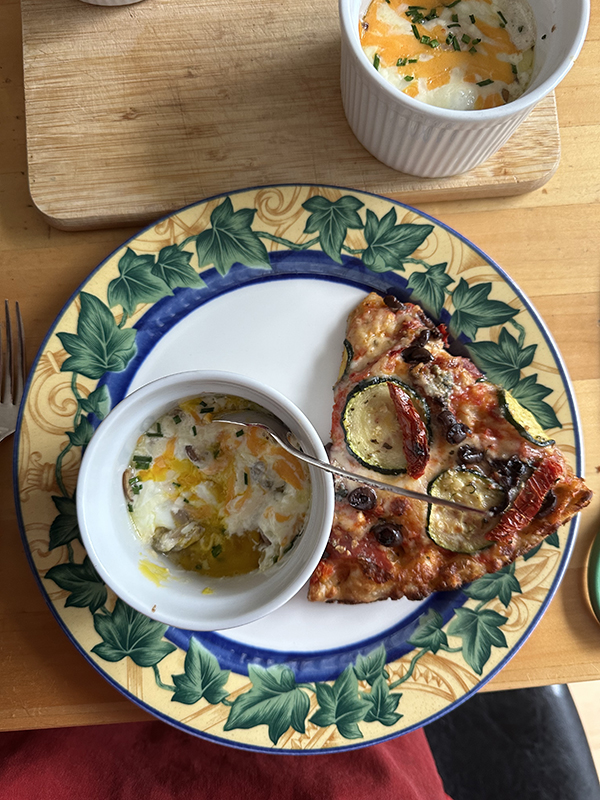
18. Take it out (using your oven mitts) and set it on something to cool off for a minute or two. Then serve it to table (I put the ramekins on my small cutting board for transport) and make sure there are things of some kind on the table to allow you and your co-diner to touch the ramekins and move them to the plates without screaming.
19. Aw, heck, did I forget to mention you should have spoons? I wouldn’t eat this with my fingers. You could use forks, but spoons work better.
20. Speaking of which, many people like to eat this with toast points. You could go back in time and make them. This time, I just heated up some leftover pizza in the oven since it was on anyway. Why not.
And that’s that for that. You can have it with champagne or with coffee or with whatever you want, but have it with someone else. Only one person, though. My wife suggested I make this the next time we have friends over for brunch, but I pointed out that I would need to buy more ramekins, and they take up space in the cabinets. You see, when planning meals, you must always consider the ramekinifications.
Well, it kinda depends… on what you mean by cobra and by python.
Let’s start with the words themselves (of course; you knew this was coming, so let’s get straight to it). In cobra versus python we have a contest of Latin versus Greek, but we also have two phonaesthetically different words.
Cobra is from Portuguese cobra, which started life as Latin colubra. That means ‘snake’ and is the feminine form of coluber, which also means ‘snake’ (yes, I can see that it looks like ‘someone who lubes along with you’, but I can neither confirm nor deny that it’s ever used to mean that). No one’s really sure where coluber came from.
Python is, via Latin, from Greek Πύθων, which is the name of the mythical snake slain by Apollo at Delphi. The snake got its name from an older name of Delphi, Πυθώ (Puthō), which might come from a Proto-Indo-European root meaning ‘depths’ but might on the other hand be related to πύθω (puthō) ‘rot’. This Πυθώ, because Delphi was the home of an oracle, was used in some names, most notably Πυθαγόρας, anglicized as Pythagoras; it means, roughly, ‘one who speaks in the public square like an oracle’. (And what does he say, oracularly? Apparently he says “The square on the hypotenuse is equal to the sum of the squares on the other two sides.”)
In a contest of Latin versus Greek, it depends on what you’re comparing. Latin grammar is difficult; Greek grammar is difficulter. Latin gets distorted in English pronunciation; Greek gets distorteder. But one detail we can’t overlook is that most Greek loanwords in English have passed through Latin on their way, and python is among them. So the Latin consumed, but the Greek came out the other side. And in fact python is more intact from its source than cobra is – Portuguese digested a whole syllable of colubra. Meanwhile, English actually added sound to python, changing y from a simple vowel to a diphthong. I’d say python prevails in this one.
Phonaesthetically, it’s hard to choose a winner. Cobra starts in the back with the /k/ and then continues with the mid back rounded vowel, and then the voiced bilabial stop, plus a liquid, and then a neutral vowel; it seems like a name for something that lurks and perhaps (like a bra) embraces and constricts. Python starts with a spit at the lips, /p/, then that narrowing diphthong (the sound of pain, “ay!”), then a soft hissing dental fricative, and so “on.” If I, never having heard of these two kinds of snake, were told that one kills with venom – bitten or spitten – and the other kills by embracing and crushing, I would, if going by the words, guess that cobra is suited to the one that constricts and python is suited to the one that envenoms. Which is, as you may know, exactly wrong.
Cobra is a name for a number of venomous snakes, many of which are of the genus Naja – though perhaps the best-known one, the king cobra, is not; it’s Ophiophagus hannah, and if you know Greek (or taxonomic Latin), you know that the genus name means ‘snake eater’, which is correct: a king cobra is an apex predator and happily eats other snakes, along with anything else that crosses its path at the wrong time. All cobras are among the deadliest of thanatophidians; the venom they carry is not an absolutely guaranteed death sentence, but if you don’t have antivenom on hand and one bites you, you’re in for a rough time – though perhaps not a long time (in some cases, less than an hour before you feel no more pain, ever).
Python, on the other hand, is a name for a number of non-venomous snakes that kill by constriction: they just wait and wait and wait and wait until a suitable bit of prey crosses their path, and then suddenly they leap out and grab it and start squeezing it, and once it stops resisting they eat it.
Neither kind of snake is really a major threat to humans, just because they avoid humans when they can. Also, they usually eat only once every month or two (sometimes even less often), and it takes a while to digest a meal. So that, along with the relative size difference, keeps humans from being likely prey; when these snakes attack humans, it’s usually for defence. People even keep pythons as pets; they are, I read, fairly docile most of the time. (I seem to recall that some people keep cobras, but probably fewer every year by simple attrition. It’s a terrible idea, what with the risk of death or debility from a single bite. Also it’s illegal in many places.)
What do we talk about when we talk about cobra? The Corpus of Contemporary American English (COCA) says that the words most often seen near cobra are king, helicopter, coverage, AH-1W, helicopters, Commander, and Shelby. So the king cobra is top of the list, and then there’s this helicopter, the Bell AH-1W Super Cobra, which is an attack helicopter and apparently a popular one (not with the people it’s attacking, though, of course). Also in there is coverage from the Consolidated Omnibus Budget Reconciliation Act (COBRA), which “gives workers and their families who lose their health benefits the right to choose to continue group health benefits provided by their group health plan for limited periods of time under certain circumstances.” Then there’s Cobra Commander, who is the main antagonist of G.I. Joe. And then there’s the Shelby Cobra, which is a sports car, one of the select few that have had a hit song written about them – which may have been the first place I ever heard the word “cobra,” since I heard that song various times in my long-ago childhood. There are also various sports teams named the Cobras, as people often name sports teams after things they would absolutely not want to find in a locker room.
And what other words show up when we talk about python? COCA says the most frequent ones are Monty, Ruby, flying, Burmese, Java, Perl, and Colt. Obviously Monty Python’s Flying Circus is top of the list. There are many stories of exactly how and why the group decided on that name, and it’s up to you which (if any) of them you wish to swallow, but it was meant to convey a certain slipperiness or sleaze. The most important thing to know is that, should some person not particularly familiar with the troupe ask, the answer to question “Which one of them is Monty?” is of course “Bugger off.” Moving on, the Burmese python is the most talked-about kind of actual python (ball pythons are also popular, partly because they’re smaller). As to Ruby, Java, and Perl, they are all, like Python, high-level scripting programming languages, and you’ve probably interfaced with many things created with each of them. Why did someone name a programming language Python? If you know computer geeks, the correct answer will already have suggested itself to you: yes, of course, after Monty Python. Oh, and Colt Python? It’s a .357 Magnum calibre revolver. I imagine that, if you’re a good shot, you can use a Python of that sort to dispose of a python of one of the other sorts.
Or a cobra. If you must. But be quick. Especially if the cobra is a Colt Cobra, which is a .38 special revolver.
Which takes us back to which would win in Cobra vs. Python. If it’s a .357 Magnum versus a .38 special, well, if they’re shooting at each other and they’re good shots it’s who shoots first, but otherwise my money is on the .357 Magnum Python, which outperforms the .38 special Cobra ballistically (fun fact: as the bullets are actually both .357 inches in diameter – the “.38” refers to the diameter of the casing – you can fire .38 special bullets from a .357 Magnum gun, but not the reverse, because the .357 Magnum shells are much more powerful). If the Cobra is the helicopter, on the other hand, any attack helicopter has the advantage over any single dude with a gun (let alone with a scripting language), but things happen. If the Cobra is a car, are we racing or shooting or biting or coding or what?
Overall in the list of things, the ones named Cobra are mostly more lethal than the ones named Python (unless you die laughing, which, if I ever was to have done, would have been while watching Monty Python’s The Meaning of Life, so there’s that). But how about snake versus snake?
Well, there are videos. Because it does happen from time to time. But here’s the thing. Both snakes can move quickly – like really quickly. In the time it takes you to sneeze, a python can be wrapped around you (at least enough to hold you while it continues the job). And it can be wrapped around a cobra in that time too. But a python needs to squeeze the life out of its prey, which takes time. A cobra just needs to get one bite in. If a python has a grip on a cobra, the cobra just needs to get its head free enough to sink in one fang and it’s game over. Yes, cobra venom is toxic to pythons – fast-acting, too. So unless the python gets exactly the right grip and never slips, the cobra wins.










 Sesquiotica