

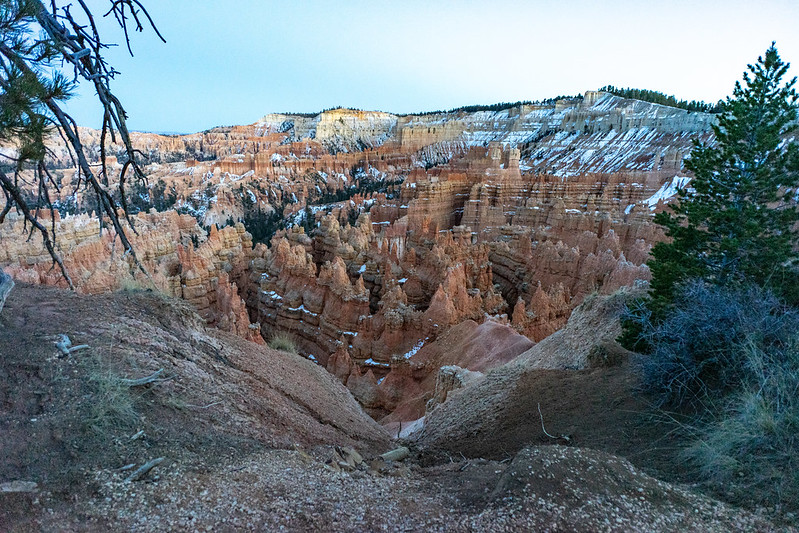
In the gloom and gloaming, hooded forms gather and loom in the amphitheatre, tall and peaked, inspiring terror. Who do you think they are?
As your eyes adjust, you see that the stony gazes are stones that you gaze upon, spires in terraces, not so much uncanny as in canyon. Hoodoo: you think they are?
The hoodoo is clear evidence of our propensity to see something more and other than is there – in this case, to enrich the sedimentary mentally into the eldritch. The striped reddish rank and file, so timelessly unmoving, were at one time very moving to the early white settlers in Utah and Wyoming, who referred to the area as “the goblin land.”
I grew up seeing hoodoos regularly; some are visible from the highway into Banff. They do, it’s true, have something vaguely creepy about them, as though, looking to an empty lot, you spied Lot’s wife. They present a vague semblance of a human form, greatly magnified, but rather than rising smoothly into the sky like a spire, they typically stand barely apart from a cliff, rough in shape as though clad in an ancient frowsy pilled woollen overcoat. It has long been thought that this is why they are called hoodoos: by association with hoodoo, magic, spiritual practices maintained by enslaved Africans – generally assumed to be a variation on voodoo.
There’s just one thing, though, that doesn’t quite make that figure. That hoodoo, also spelled houdou, is from Louisiana Creole, and the practices it names are spread throughout the coastal south of the US and in the Caribbean. Hoodoos, the stone pillars, are characteristic of high and dry mountain lands – like those Ebenezer Bryce and his wife settled in in the 1870s. Bryce set up right near a canyon that he described as a “helluva place to lose a cow,” with its labyrinths of stone pillars. Other people started calling the place Bryce’s Canyon, even though he not only wasn’t the first person to live near it (not by ten millennia) but wasn’t even among the first white settlers to be near it… and by 1880 he had left for Arizona.
The people who already lived near this canyon, which has the world’s highest concentration of hoodoos, were the Paiute; before them various other cultures had lived in the area, including the Anasazi. The Paiute had no connection to African culture or to Louisiana Creole – of course – but they did have a response to the stone pillars that seems near-universal: they saw them as like people who had been turned to stone (by Coyote, the trickster, of legend). According to the National Park Service, they named them with a word for ‘spirit’ or ‘scary thing’: oo’doo.
They also, of course, had a name for the place we call Bryce Canyon: Unka Tumpi Wun-nux Tungwatsini Xoopakichu Anax, which means ‘Red Rock Standing Like a Man in a Hole’. It’s safe to say that the name itself would scare off more English speakers than the place, which is a popular spot for tourists who can find the time to make the trip.
But anyway, we have these things that look like people but aren’t, named with a word that looks like another (semantically as well as phonetically similar) word but isn’t, found many places but most emblematically in Bryce Canyon, which has hardly any reason to be named Bryce… and also no proper reason to be named Canyon. A canyon is formed by erosion from a river or stream flowing at its bottom. This place was formed by a more general erosion from top and bottom (plus many freeze-thaw cycles every year). It is, in technical terms, not a canyon but an amphitheatre – or, really, several amphitheatres.
And those who do have the chance to visit it will scarcely believe their eyes.





 Sesquiotica
I take as much delight in the hoodooAs these scenes from Bryce make clear that you do.