
Monthly Archives: May 2025

cremate, incinerate, cinder, Cinderella

It is Cinderella’s funeral. “Ashes to ashes,” someone says.* The mourner next to you leans over and says, sotto voce, “Cinders to cinders.” And you, knowing she started out in Italy as Cenerentola, mutter back, “Cenere a cenere.” Which, as your interlocutor may or may not know, changes the complexion of the matter.

Cinderella, being fairy-tale royalty, gets a requiem mass, in the old style. “Requiem æternam,” the choir begins. At length it moves into the “Dies iræ,” at which point the person next to you whispers, “Is she going to be buried or incinerated?” And you are about to reply “Cremated” when you pause and think about this.

Because, even if we normally speak of the human dead as being cremated, wouldn’t it be more apposite for Cinderella, la Cenerentola, to be incinerated? And why don’t we say “incinerated” for people, anyway? Why is it vaguely offensive to speak of the beloved dead as having been put into an incinerator, and just as vaguely offensive to speak of trash as having been cremated?

The word incinerate has a long tenure in English. Since the mid-1500s it has been used to mean ‘reduce to ashes’, which is its literal Latin meaning: in- for ‘into’ plus cinis ‘ashes’ – the ancestor of Italian cenere – but specifically cold ashes, what’s left after the fire has burned out and the wind has passed over. Latin had a different word for hot ash, and the choir has just sung it:

Dies iræ, dies illa
Solvet sæclum in favilla

Yes, favilla. What we would in English call cinders. Different from cinis. (We’ll come back to that.)

But when a body is reduced to ashes, first hot, then cold, why do we not say incinerate (not to mention infavillate, which is a word that you will find nowhere)? Why cremate? Are we reducing them to the cream of their ashes?

It is worth noting at this juncture that cremation, as such, is comparatively modern. People have been burned on funeral pyres since time immemorial, of course. But the human body is not so easily reduced to ashes. It was not until the later 1800s that an oven was developed that would get so hot that, after three or four hours, all that would be left of an ex-person would be white ash. In 1873, at the Vienna Exposition, Professor Ludovico Brunetti presented an oven that would be able to reduce an adult body to 1.7 kilograms of cenere – which he presented as proof. (We do not know whose cremains they were.) 

His timing was good: cities were becoming dense, graveyards were filling up, and there was the problem that, along with taking up space, decomposing corpses were environmentally toxic. As Sir Henry Thompson, FRCS, MB.Lond., put it in his book Cremation: The Treatment of the Body After Death

The process of decomposition affecting an animal body is one that has a disagreeable, injurious, often fatal influence on the living man if sufficiently exposed to it. . . . The grave-yard pollution of air and water alone has probably found a victim in some social circle known to more than one who may chance to read this paper.

He, a founder of the Cremation Society of England, considered graveyard interment nothing more than “laying by poison . . . for our children’s children, who will find our remains polluting their water sources.” And just around the same time as he was writing this, Brunetti was presenting his furnace, and in England one Charles William Siemens was also developing a regenerative furnace that was suited for the process. And it was just around then that crematecremation, and crematorium (and crematory, now disused) appeared in English.

Well, you know, people have feelings about funerary obsequies. Such an occasion is a special time, not common, and if one may use a word that is not the common word – especially for the new invention (new inventions always cry for the invention of new words to name them) – then so much the better. Why should your beloved be put in an incinerator? When there is a nicer-sounding, less besmirched word that can be used?

A word that comes from Latin cremo. Which does not mean ‘cream’. Indeed, cream is unrelated; it comes not from Latin but from French crème, which comes from a Gaulish word that was also influenced by Latin chrisma ‘anointing’ – a thing that one undergoes while still alive, even if it is done with a combustible liquid. No, although my Cremo brand shaving cream does not burn my face or give me an ashen complexion, Latin cremo means ‘I burn’ – transitively: the infinitive is cremare and it means ‘burn to ashes, destroy by fire’ and ‘make a burnt offering’.

And as you think about this, the text of the “Dies iræ” gets to

Ne perenni cremer igne

“That I not be cremated by eternal fire.”

And, after another stanza, it continues on to a familiar bit:

Confutatis maledictis,
Flammis acribus addictis,
Voca me cum benedictis.

Oro supplex et acclinis,
Cor contritum quasi cinis:
Gere curam mei finis.

Lacrimosa dies illa,
Qua resurget ex favilla
Iudicandus homo reus:
Huic ergo parce, Deus:

Pie Iesu Domine,
Dona eis requiem.

You can hear it in there: “Cor contritum quasi cinis,” “contrite heart crushed like (cold) ashes”; “Qua resurget ex favilla,” “which from embers will arise”…

And somehow, after being cremated, the cinders of Cinderella will cool to the cinis, the cenere, of la Cenerentola. But how did cold cenere become hot cinders anyway?

The same way the cream came to cremation: nothing but coincidence, and a fatal attraction of sound. Cinder is not related to cenere; it comes from an old Germanic root for ‘dross’ or ‘slag’. La Cenerentola became French Cendrillon, from cendre, which is cognate with cenere but sounds more like cinder. And in English we have Cinderella, who has become a hotter property than she was in the Romance languages.§

And soon she will be consigned to the flames. Just one question remains: Will her glass slippers burn? 

The answer is no. As it happens, a crematorium typically reaches temperatures around 900°C, while glass generally melts above 1400°C. But that’s not why her slippers won’t burn. It’s because they aren’t in the casket with her. The prince has kept them… for some more fitting occasion.

* Not the priest, because that’s an Anglican saying, and Cinderella was Catholic.

† At Sleeping Beauty’s, it was “Requiem temporalis,” on the basis of precedent.

‡ Of the Siemens family, whose companies have made many technological things, including for transportation within this world, not just out of it.

§ I will not mention that her German name is Aschenputtel. It’s relevant, but I find it off-putting.
fatal, lethal, mortal

A couple of months ago, I read the following passage: “an extremely hazardous, quite possibly lethal sea journey.”

What was your first thought was reading that?

Mine was “Not lethal. Fatal.”

OK, but why?

If you ask someone to define fatal, they might say “deadly,” and if you ask them to define lethal, they might also say “deadly.” If you ask for another way of saying “deadly,” they might offer mortal

If you want a more detailed definition, you may go to Merriam-Webster, which offers the following definitions:

  • for fatal: “causing death”; “bringing ruin”; “causing failure”; “determining one’s fate”; “of or relating to fate”; “resembling fate in proceeding according to a fixed sequence”
  • for lethal: “of, relating to, or causing death”; “capable of causing death”; “gravely damaging or destructive”; “very potent or effective” (in a more figurative sense)
  • for mortal: “causing or having caused death: fatal”; “subject to death”; “of, relating to, or connected with death”; as well as several extended senses

OK, yeah, they all can mean ‘causing death’. And yet.

But of course we don’t learn the meanings of common words from the dictionary; we learn them from seeing the words in use, and occasionally, when we’re young, from having someone define the word for us, usually with a synonym. And then we see how they’re used. 

We know, for instance, that you can receive a fatal wound from a lethal weapon in mortal combat, and maybe you can receive a mortal wound from a fatal weapon in lethal combat (or maybe not), but you wouldn’t receive a lethal wound from a mortal weapon in fatal combat. Somehow that doesn’t sound exactly right.

Words are known by the company they keep. So what company do these words keep? When I look at the Corpus of Contemporary American English and search for collocations, I find that the following are the top dozen words that come right after each of these:

  • for fatal: shooting, flaw, disease, attraction, mistake, accident, blow, accidents, crash, heart, crashes, error
  • for lethal: injection, weapon, force, dose, weapons, combination, injections, doses, drugs, violence, form, virus
  • for mortal: sin, Kombat, danger, enemy, man, enemies, life, coil, Wkly, world, men, threat

(You probably know what Kombat is doing there – Mortal Kombat is a popular game series. As to Wkly, Morb Mortal Wkly Rep is the citation abbreviation for the medical journal Morbidity and Mortality Weekly Report. So it’s kind of an interloper. To make up for that, the 13th word in the list is combat.)

To get more real-life insight, I asked people on Bluesky: “According to you (as in from your own mind, not from a dictionary), what is the difference between ‘lethal’ and ‘fatal’? Take your time. Consider instances where you could use one but perhaps not the other.” (I didn’t ask about mortal because at first I was just thinking about those two.) Here are some of the responses I got:

i feel like “lethal” is done to somebody, and “fatal” just happens. a disease is fatal, not lethal. an accidental self-administered drug overdose is fatal. if the fault of a doctor, they administered a lethal dose. a weapon attack is lethal, an accident is fatal.

Lethal has the potential for death – like a weapon; fatal suggests that death is assured, like an attraction.

Hmmm this sounds weird but: fatal is always what you say about something in the past. Like, the fatal blow is only talked about after a person is assuredly dead. Lethal feel more about potential. This is probably miles off.

Result? Timing? Lethal has ‘potential’, while ‘Fatal’ describes sometime that’s already happened and has definitely ended in death.

Broadly, “fatal” is about “fate” and so emphasises the result, not cause or intent, and often implies inevitability (fatal flaw). “Lethal” implies intent or design (though it may not imply will: a lethal venom is evolved). Of course, such distinctions are pretty fluid and subjective.

I have no idea why, but lethal sounds active. Fatal sounds more passive. Like, lethal is something one does. Fatal is just something that happens. Makes no sense except in my head.🤷‍♀️

To a first approximation, I think I’m more likely to use “lethal” to describe physical objects/substances, and “fatal” to describe events.

Off the top of my head, “lethal” can be adjectival in an abstract way, and carries a sense of “able to cause death.” “Fatal” has more certainty to it. “The third dose of heroin she took was fatal.” This is not definitive, rather, it’s how the nuance strikes me, and they overlap in various cases.

Lethal is a possibility. Fatal is a result.

So, then. Here is what I get from all that: 

Fatal has a sense of inevitability to it: if it’s about death, it’s unavoidable; if it’s more figurative, such as “a fatal error” or (for a computer) “a fatal exception,” it is still irreversible. Like the hand of fate. 

Lethal has a sense of purpose or potential: a lethal dose may remain unadministered, but a fatal dose already has been administered. A lethal weapon can kill you, but that doesn’t mean it will, let alone already has. 

And mortal puts a thing in the atmosphere of death: a mortal enemy is someone who wants to kill you, or vice versa; mortal combat might or might not guarantee death but definitely allows for it; in this mortal world we mortal beings must ultimately shuffle off this mortal coil.

All of which, if you look at the origins and histories of these words, makes sense.

Fatal is, by origin, ‘of or relating to fate’; it comes from Latin fatalis, from fatum, which means ‘fate’ or ‘destiny’, of course, but comes from a verb meaning ‘speak’: it is the word that is spoken, the prophecy, the edict, the divine utterance. It has been in English since the later 1300s and first meant ‘decreed by destiny’. It always comes with the echoes of “fate.”

Lethal is, by origin, ‘deadly’; it comes from Latin letalis, with an intrusive h that chance and confusion ordained should be there – it’s a misconjecture of an origin in Ancient Greek λήθη lḗthē, ‘oblivion, forgetfulness’. Letalis comes from letum, ‘violent death’, ‘killing’, ‘ruin’; its further etymology is uncertain. It has been in English since the early 1600s and first meant (as it still means), per Oxford, “that may or will cause death.” It doesn’t come with strong echoes of other words.

Mortal is, by origin, ‘involving death’, as in ‘susceptible to death’ (i.e., not immortal), or ‘causing death’, or ‘punishable by death’, or ‘relating to the time of death’; it comes from Latin mortalis, from mors, ‘death’, which in turn traces back to a Proto-Indo-European root also referring to death that has given rise to deathly words involving /m/ and /r/ and usually /s/ or /t/ in quite a few languages. It has been in English since the later 1300s and was first used in relation to battle, combat, et cetera, as in mortal foe (one who will be satisfied only by the death of their enemy) and mortal battle and of course mortal combat (fought to the death). It brings a lot of associative baggage with it, since mortal has such a wide usefulness for human things, and it also echoes many other related morbid mor- words.

So there it is: three kinds of -talis – falemor. In matters of killing, fa will, le can, mor can’t not. We all have a sense of how to use these words, and how not to, but we mostly just feel our way around them. And meanwhile, we still also have the Anglo-Saxon words that these three Latin imports have not completely supplanted: deadly and deathly.

rude, crude

Obviously, you’d have to be a stupid a**h*** not to know these words.

Was that rude and crude enough for you?

Is there a way to be “rude” that’s not bad? How about “crude”? Is there any way for the rude and the crude not to be unrefined?

What, incidentally, is the difference between rude and crude? Do they overlap? What do they and don’t they even mean?

Let’s start with whether “rude and crude” is redundant. Can you be rude without being crude? Of course you can. “Good day, John. Tell me: Has your sense of taste entirely deserted you? That is an exceptionally ugly shirt; I would be ashamed to be seen in public wearing such a thing.” One could hardly call that crude, but, in most contexts, one could hardly not call it rude. How about the converse? “Hey, John! That is a beautiful f***ing shirt – I look like complete s*** next to it! Where in hell did you get it?” Undoubtedly crude, but entirely complimentary; in most contexts, at least if it’s not spoken sarcastically, it wouldn’t be at all rude.

This also highlights how we tend to use these words. Rude typically means ‘brutishly impolite’, ‘deliberately inconsiderate’, that kind of thing. Crude typically means ‘vulgar’, or at the very least ‘unrefined’ – and also literally ‘unrefined’, as in crude oil. Indeed, we might say that raw could be a sometime synonym for crude, as hinted at by crudités, which are raw vegetables often found at polite and refined occasions.

And that leads us right to its origin: Latin crudus, ‘raw, uncooked’ – which is related, via Proto-Indo-European *krewh₂-, to English raw. It showed up in English in the later 1300s meaning ‘raw, unrefined’ in literal senses, and, by the early 1600s, had spread to “products of the mind,” as the Oxford English Dictionary puts it: “Not matured, not completely thought out or worked up; ill-digested.” If we look to poetry, we can see it covering that range of sense, literal and figurative:

You are content to keep that mighty love
In its first steps forever; the crude care
Of animals for mate and young and homes
—“To the Indifferent Women,” Charlotte Anna Perkins Gilman

Expectation, like a cuckoo
taking shelter in the crudely scratched out nest.
—“Lapwing,” Hannah Copley

I do not think we are deceived to grow,
But that the crudest fancy, slightest show,
Covers some separate truth that we may know.
—“The One in All,” Margaret Fuller

Raw, roughly formed, artless – but not always bad in itself: “the crudely scratched out nest” and “the crudest fancy” could be better than they are, but they’re better than nothing.

But still, with all its developed nuances – its refinement of sense conveying a sense of a lack of refinement – “crude” is generally not good:

And what kind of a man is so crude that he hasn’t held a little something back from You,
Hasn’t in his free time fashioned something special for You
—“The Day of Gifts,” Paul Claudel, translated by Jonathan Monroe Geltner

You know sleep will dart beyond your grasp. Its edges
crude and merciless.
—“The Night After You Lose Your Job,” Deborah Kuan

Yet once more, O ye laurels, and once more
Ye myrtles brown, with ivy never sere,
I come to pluck your berries harsh and crude,
And with forc’d fingers rude
Shatter your leaves before the mellowing year.
—“Lycidas,” John Milton

And that last one brings us to rudeRude appears as an unfinished crude, one lacking the crisp beginning, that grasping and gripping c that differentiates crack from rack, crust from rust, cripple from ripple, crank from rank, crave from rave. But really it’s a different class of thing.

Well, it’s a strongly classist word from the very beginning in English. Since we first had it in the language in the 1300s, it’s conveyed ‘unintelligent, uncultured, uncivilized, uneducated, ill-mannered, ill-bred, low-class’. It came to us, via French, from Latin rudis ‘rough, raw, wild’. It traces back to Proto-Indo-European *Hrew- (‘tear up, dig up’), which has English descendants in rid and ridden and, possibly, redden. But there’s no evidence of any etymological relation to crude.

But when we look at poetry, it’s interesting to see how often the use leans toward a more neutral or almost endearing sense of ‘primitive’ or ‘low-class’ – a valorization of the rustic and unrefined – rather than the pointed ‘ill-mannered’:

By the rude bridge that arched the flood,
Their flag to April’s breeze unfurled,
Here once the embattled farmers stood
And fired the shot heard round the world.
—“Concord Hymn,” Ralph Waldo Emerson

I wondered, over trees and ponds,  
At the sorry, rude walls
And the white windows of the apartments.
—“Birdcage Walk,” Thomas Merton

The floor is ridged like some rude mountain lawn,
And in the east one giant window shows
The roseate coldness of an Alp at dawn.
—“Chartres,” Edith Wharton

“Speak! speak! thou fearful guest!
Who, with thy hollow breast
Still in rude armor drest,
Comest to daunt me!”
—“The Skeleton in Armor,” Henry Wadsworth Longfellow

We can’t easily imagine bridges, walls, and lawns interrupting someone or hurling insults. The armor might be a little impertinent, I suppose.

Beneath those rugged elms, that yew-tree’s shade,
Where heaves the turf in many a mould’ring heap,
Each in his narrow cell for ever laid,
The rude forefathers of the hamlet sleep.
—“Elegy Written in a Country Churchyard,” Thomas Gray

Our hut is small, and rude our cheer,
But love has spread the banquet here;
And childhood springs to be caress’d
By our beloved and welcome guest.
—“The Sleigh-Bells,” Susanna Moodie

The forefathers might have put their elbows on the table, but we don’t expect that they were actually bumptious – and Moodie’s rude cheer was more likely humble joy than, say, something a legion of English football fans might shout.

The poor have their virtues rude,—
Meekness and gratitude,
Endurance, and respect
For us, the world’s elect;
Economy, self-denial,
Patience in every trial,
Self-sacrifice, self-restraint,—
Virtues enough for a saint!
—“Christian Virtues,” Charlotte Anna Perkins Gilman

Gilman’s whole poem is a mordantly sarcastic take on the self-important pieties of the moneyed set who self-aggrandize through benefaction. But this “rude,” while clearly conveying low class and a simplicity of mind and value, definitely does not connote impertinence.

I, that am rudely stamp’d, and want love’s majesty
To strut before a wanton ambling nymph
Richard III, William Shakespeare

So do these wonders a most dizzy pain,
That mingles Grecian grandeur with the rude
Wasting of old time—with a billowy main—
A sun—a shadow of a magnitude.
—“On Seeing the Elgin Marbles,” John Keats

Still not to our usual sense, but getting perhaps impolite.

The moon was shining sulkily,
Because she thought the sun
Had got no business to be there
After the day was done—
“It’s very rude of him,” she said,
“To come and spoil the fun.”
—“The Walrus and the Carpenter,” Lewis Carroll

Ah, well, there we are. That thoughtless, pushy, self-important sun – manifesting a kind of rudeness that, we may note, is just as available to those of high social station. 

And so we see that the words rude and crude have a kind of refinement of development, depth, and nuance, notwithstanding their senses, or their status as blunt and basic vocabulary items. Oh, they’re unpleasant words, in their way; in some contexts, they’re better avoided (in favour of, say, impolite and unrefined). But one can’t have a fully mature and well-developed language without such words.

courgette, zucchini

You want to know how to make zucchini? I’ll show you how. I’ll also show you how to make courgette. They’re the same thing, literally. So get ready for some gourd times.

Let me start by saying that this summer squash, Cucurbita pepo, is brain food. How can that be, given that they’re about 95% water? Look, beer is about 95% water too, and it still makes you have thoughts. But in this case, I’m going to pretend that etymology is a suitable guide to essence.

The zucchini, also known as the courgette, is, in some places, called the baby marrowbaby because it’s smaller than a full-grown marrow. It’s not that it looks like part of a baby’s leg (although it does, at least of a baby Shrek). It’s that the pith of vegetables was, from Old English times, called the marrow, and from this the summer squash in question was called a vegetable marrow when it first hit the scene in England in the 1800s (although technically that’s what you call a larger version of the plant, hence baby marrow for our plant du jour). And the word marrow traces back through Germanic roots to Proto-Indo-European *mosgʰós, which meant ‘marrow’ and also ‘brain’. The brain is, after all, in one way of looking at it, the marrow of the head. So hey, brain food.

OK, yes, that’s kind of silly. But that’s not the only time the brain comes in when we’re making courgette and zucchini. Let’s start back with the Latin word for ‘gourd’: cucurbita. It was a name for the kinds of gourds that are used for fall decoration and music making, and also for other related squash, and also, figuratively, for someone who was kind of, uh, obtuse (we could say boneheaded). And when more kinds of squash were brought over from the Americas starting in the 1500s, cucurbita was applied to them too, as you can see in the Latin name for our vegetable du jour.

But not just cucurbita – also words descended from it. Because who speaks Latin besides botanists and choral singers and certain nerds and the occasional priest? However, Italian comes from Latin, and so does French. Over the centuries, Latin morphed into other languages through mutations both accidental and deliberate. Etymology is like horticulture in that way: people import seeds from a distant place and keep breeding them and making new versions of the plant until they have something that looks quite different from the source.

So this cucurbita got worn down over time, and in France, the second c and the b both got eaten and the t got voiced and it became coourde, which was dragged over to England and the c was voiced and we got gourd. Meanwhile, back in France, the d was softened to a fricative and they ended up with courge. And when, in the 1800s, someone bred a cute little version of a certain summer squash that had been imported from Central America in the 1500s, they added the diminutive -ette. And that’s how you make courgette.

But that diminutive version of the summer squash wasn’t bred in France, and it wasn’t bred in England. It was bred in Italy. And in the evolution from Latin to Italian, this word cucurbita lost the rb and softened the t to an affricate and became cocuzza, which was a name for a gourd and also for your “gourd,” i.e., your head. But the gourd times weren’t over yet: in some parts of Italy, over time, cocuzza became cuzza, and then the consonants swapped and it became zucca. Which is, again, a word for a squash and also, again, your head.

And then, when (as we mentioned above) someone made a smaller version of a certain summer squash – a baby version, we can say – it got the diminutive suffix. And zucca became zucchina – or, in some parts of Italy, the masculine form, zucchino. The plural of which is zucchini.

Which means, yes, if you want to be fussy, you can’t have “one zucchini,” you have “one zucchino.” Only, as anyone who has ever grown them knows, you can’t have one anyway. You always end up with many. It’s like spaghetto: Just ignore the singular, for your own convenience – and mental health.

So there it is. We could have called Cucurbita pepo a gourdette, or gourdlet, or gourdling, or gourdkin, or, um, gourdie (somehow), but we didn’t – although, etymologically, we did. Yes, some English speakers in some places call it a marrow or baby marrow, but it’s not bred in the bone for most of us, so never mind. Since about a century ago, some English speakers have called this plant courgette and some have called it zucchini, and in the end they’re the same thing anyway, even though they’re obviously not the same thing. And what’s the harm in using a word we got from somewhere else for a vegetable we got from somewhere else? It’s true that none of these names have anything to do with what the Cucurbita pepo progenitor was called by the people in Central America who knew it first, but on the other hand, our modern courgette/zucchini is quite different from what they knew too.

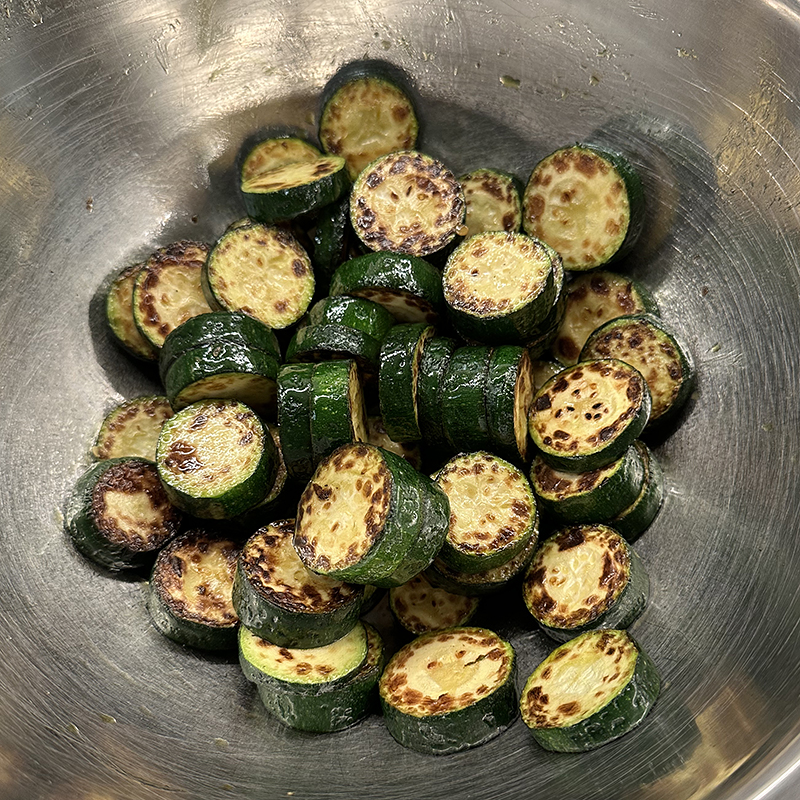
And if you slice it thick and fry it in hot oil, it makes a delicious and not-too-soft addition to a pasta sauce. Or you can slice it thin and cover it with olive oil and salt (and maybe a little sugar) and put it on a baking sheet in a very hot oven until it’s crispy, and that’s rather good too. Or have it raw in a salad. However you have it, it’s brain food. My proof? You already know more than you did a few minutes ago because of it.

