
Monthly Archives: September 2025

mosey

One thing that gets on my nerves is when I really gotta mosey somewhere and there are people in my way on the sidewalk or the stairs or the escalator and they’re just, you know, moseying.

OK, did both of those uses of mosey make sense to you? The one meaning get moving, motor, vamoose, and the other meaning go slowly, meander, no hurry? One like a rolling stone, and the other gathering moss? I’m sure I’ve encountered both of them – well, I know I have, because I’ve encountered both of them in every dictionary I’ve looked up mosey in, but I think I’ve also encountered both in real life – but my impression is that one of them, the one I lean to automatically, is the more common expected sense. And that impression has been reinforced by an informal poll I did on Bluesky, where respondents unanimously agreed… not so much that it means one as that anyway it doesn’t mean the other.

I asked the following:

In your own usage, if you say you are (or were, or will be) moseying, are you meaning:

1) going quickly

2) going slowly

3) either, depending on context

4) nothing so specific as all that

5) some other thing (specify)

I got 36 responses. Of those, 33 agreed that “going slowly” was either the definition or at least part of the definition. The other three, along with some of the 33 who went with “going slowly,” specified that the important detail was aimlessness, nonchalance, casualness, lack of urgency, wandering, meandering, that manner of thing. No one went with “going quickly,” although one allowed that it could be used ironically with that sense, and another allowed some contextual flexibility.

So, naturally, I’m about to tell you that “go quickly, make haste, get a move on” is the older sense. Because of course. You saw it coming, didn’t you?

The word mosey first appeared in the US in the early 1800s, with the first known published instance in 1829. The earliest senses specify not so much the speed as the motivation: fleeing, decamping, escaping, getting out of the way. The implication is also typically doing so on foot. But there are instances where the sense of speed is inescapable, such as “At last the spell were broke, and I moseyed home at an orful rate” from 1859 (thanks to Green’s Dictionary of Slang for that). So, in short, we could say that the first sense of mosey is as a synonym of vamoose.

Well, vamoose first appeared as such about a decade after mosey did, so you could say as readily that vamoose was a synonym for mosey. But you know what I mean. But say… vamoose comes from Spanish vamos, ‘let’s go’. Could mosey have come from that, too?

Well, it could have. But we’re not a hundred percent sure. It could also come from an Algonquian word for ‘walk’. Or it could come from Mosey as a nickname for Moses, either in reference to the exodus led by the biblical Moses or to someone of that name in a popular song who had to flee creditors. We’re just not entirely sure. The word didn’t announce its arrival and origins. It just… moseyed in, real casual like.

But anyway, within a couple of decades, the sense of ‘go casually, wander, meander, amble aimlessly’ et cetera also moseyed in, often bringing along an adverb such as along or off or around. And, at leisure and at length, it prevailed. And it doesn’t seem like it’s going to get out the way any time soon.

Just like those people who manage to walk in the least hurried manner possible right down the middle of the stairs or sidewalk, vaguely trending slightly right and left but never giving a clear way to get by so you can make it to the walk light or the train that’s arriving in the subway station. Come on, people! This ain’t a mo-seum!
avuncular

Hey, how are ya? Doing great? I found out something interesting you might like. A couple of things, in fact. The first thing is, it turns out that although I have three nephews and two nieces, I can’t be literally, etymologically, avuncular to all of them. Figuratively, sure, and that’s fine, of course. But that leads to the second thing: there are more English words than you might think that come from Latin kinship terms. And if you start trying to be literal about them all, you’re going to make trouble for yourself. It’s your life, of course! But just in case you wanted to know.

Isn’t it nice how uncles are assumed to be friendly and caring in a down-home, benevolent kind of way? That’s what we mean with the term avuncular, which, along with broadly meaning ‘kind, benevolent, tolerant (especially in the manner of an older person to a younger one)’, literally means ‘of, relating to, or like an uncle’. Except the Latin original, avunculus – from avus ‘grandfather’ and the diminutive suffix -unculus – refers only to the maternal uncle. You know, the mother’s brother – or, yes, the mother’s sister’s husband. So since my wife’s sister has two kids, I am literally avuncular to them. My brother’s three kids, though? Nope, sorry. Not etymologically literally, anyway.

But of course sticking to the Latin meaning of these terms would be atavistic. It would be not grandfathering the senses but great-great-great-grandfathering them – because, yes, atavistic relates to atavus, which means ‘great-great-great-grandfather’ – or just ‘ancestor’. That’s from the same avus (‘grandfather’) plus at-, which is a form of ad-, meaning ‘to’, ‘toward’, and a whole bunch of other things.

But let’s take a look at some of the other terms we have in English that come from Latin terms for family members. There are the literal ones like maternal (from mater, ‘mother’), paternal (from pater, ‘father’), and uxorial (from uxor, ‘wife’, which also gives us uxorious, ‘highly devoted to one’s wife’). There are the ones that have both literal and figurative uses, like fraternal (frater, ‘brother’), sororal (soror, ‘sister’; sorority is the most common English descendant), and novercal (noverca, ‘stepmother’ – and in the figurative use of the term, the stepmotherliness is generally wicked). There’s also nepotism, from nepos, which can mean ‘nephew’, ‘niece’, ‘grandson’, or ‘granddaughter’ – our use of nepotism to refer to hiring family members (especially direct offspring) comes from when the popes of the Middle Ages and Renaissance would appoint their nephews as cardinals.

We also have some other less common ones. There’s the term the levirate, which I first encountered in an anthropology book where the author, in categorizing various cultures, divided them between those that “practice the levirate” and those that don’t, but did not even once explain what “the levirate” was. Well, it comes from Latin levir ‘husband’s brother’ and refers to the practice of requiring a woman whose husband has died to marry her husband’s brother. (“Oh, that. Of course!”) 

There’s no corresponding term for marrying a deceased wife’s sister, presumably because that’s not a widespread cultural practice, but in any case Latin somehow didn’t even have a special term for that relation; a wife’s sister is just soror uxoris. A wife’s brother is similarly frater uxoris. But oh, by the way, a husband’s sister is glos; if we had an adjective based on that, it would probably be gloral, but we don’t. (If your husband’s sister is named Gloria, that would be close, though not actually related – except by marriage, of course.)

We also don’t have a word socral from socrus ‘mother-in-law’ and socer ‘father-in-law’, which really seems a missed opportunity. We do have a word materteral, ‘of or like an aunt’, the counterpart to avuncular – not broadly used, but it can mean ‘auntyish’. But, like avuncular, it refers only to the mother’s sister (matertera is just mater plus a contrastive suffix). The father’s sister is amita, apparently formed as a diminutive of ama, which basically translates as ‘mommy’. No word on – or for – what your father’s sister is supposed to be like; amital is not a thing, though its homophone amytal is a synonym for amobarbital and is seen in sodium amytal, the sedative that is supposedly “truth serum”… so who knows, maybe your aunt on your father’s side is prone to telling you the plain truth.

Which brings us to your uncle on your father’s side. If I’m not an avunculus to my brother’s kids, what am I? I’m a patruus. As it happens, we don’t have an English word derived from that – such as patrual. But in Latin, the patruus stereotypically was indeed prone to telling the truth – and not in a kindly, avuncular way. Patrual, if it existed, would mean more like ‘severely reproving’ or ‘brutally critical’. As it happens, we do have a term in English for someone sort of like that (though maybe more blunt than actually mean): Dutch uncle.

garnish

You said you withheld the garnish for safety reasons,” Maury’s friend Brandur said. “I’m sure it wasn’t withheld from your paycheque, though.” He raised one eyebrow to indicate that he had just made a conscious witticism. “You were not garnished.”

“Indeed,” said Maury, “the cocktail would have been the garnishee. But the garnish would have been an addition rather than a subtraction. However, that’s true in any case, because garnishing a paycheque is a subtract that comes only after an add.”

Add as in addition or ad as in advertisement?” Brandur said.

“Yes,” Maury said.

There was a pause. Maury sipped his Berlin cocktail and did not immediately explain. Brandur finished his own cocktail and said, “Well, I am going to serve the next cocktail, and I have brought a garnish for it too.” He reached into his bag and pulled out a vacuum bottle, set it on the table, and then pulled out a plastic container, the contents of which were only dimly visible, and set it down too. “But first you have to finish your cocktails” – he looked at both of us – “and explain to me garnish in more detail.”

Maury tossed back the last half ounce of his and set the glass down. “Garnish, as in deduct money from wages to satisfy a creditor, is shortened from garnishee. The verb garnishee is formed from the noun garnishee. The noun means ‘one who is garnished’.”

Brandur was about to exclaim something I probably wouldn’t want to transcribe here, but Maury continued: “It’s not circular because that garnished means ‘served notice’ – that is to say, ‘warned’. Specifically, warned – as for instance with a notice, or advertisement – that they are to have money deducted to satisfy a debt. So the garnish is added as an ad to indicate that there will be subtraction.”

“Ah, I see,” said Brandur. “I should have made the deduction. But such an addition seems more than decorative.”

I set down my empty glass. “Indeed,” I said, “the decorative sense is a latecomer. The word comes from guarnir, the same Old French source as for our word warn. It meant ‘provide’ or ‘furnish’ but also ‘defend’ or ‘warn’. Our word garnish came to mean ‘fortify’, or ‘equip’, and then to mean ‘clothe’, and from that ‘accessorize’ – but also, more pertinently, it could mean ‘serve dishes of food’ and then ‘decorate dishes of food’.”

“And guarnir,” Maury said, “came from a conflation of two Old Frankish roots, one meaning ‘warn, protect, prepare’ and the other meaning ‘refuse, deny’. So it is bifurcated both forward and backward in time, in each direction splitting into one sense meaning something additive and one meaning something subtractive.”

“Well,” said Brandur, pouring a cold, clear liquid from his vacuum bottle into our glasses, “I have prepared this for you.” He opened the plastic container and pulled out three small metal forks; on each fork was an olive and a cube of something white. “Speaking of bifurcation.” He plunked a fork into each glass and gave each a little stir. Then he held up his glass and said “Skál.”

“Scowl?” Maury said (he doesn’t know any Icelandic). He picked up his glass and eyed it skeptically.

“No need to scowl,” Brandur said. “It’s mainly brennivín. Fittingly.” He took a hearty sip and said “Ahhh!” theatrically.

Maury sipped his and made a face like a cat that had just tasted lemon juice. After a moment to recover, he said, “And vermouth, apparently. And something… else.”

I stared at the white cube. “Is that…”

“Kæstur hákarl,” Brandur said, with an angelic smile. 

For those who don’t know, that’s an Icelandic specialty: rotten shark. Anthony Bourdain once called it “the single worst, most disgusting and terrible tasting thing” he’d ever had.

“Well, now, that is the perfect garnish,” I said. “It both adds to and subtracts from the drink. I take it as a warning… and I will have to refuse.” I set my glass back down and stepped away from the table.

brandish, brandy

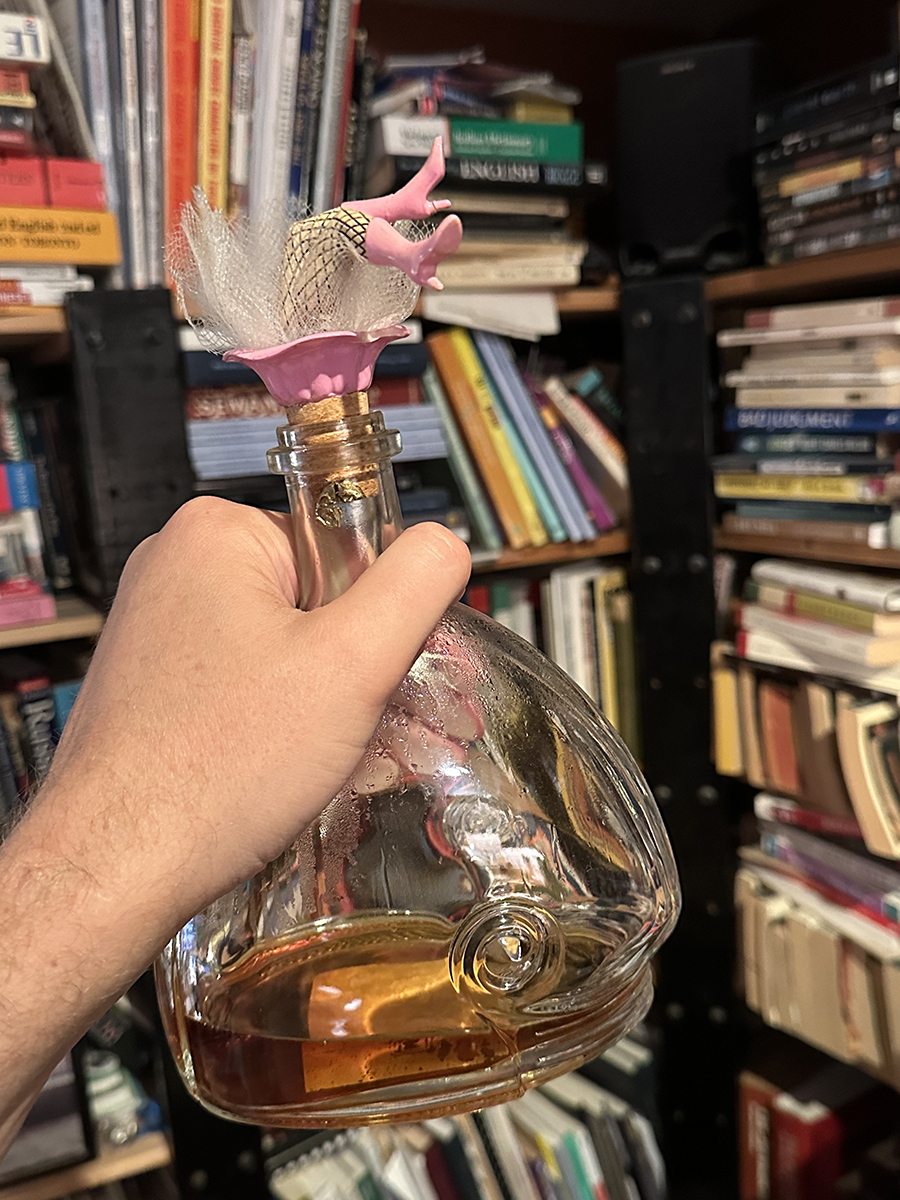
Maury’s Icelandic friend Brandur is quite the firebrand. As I entered Domus Logogustationis, he was brandishing a book and a bottle of Bas-Armagnac and shouting – in a style perhaps more of Russell Brand than of Marlon Brando – “What. Is. This. Word. Brandywine!”

I approached Maury and leaned close. “Is he on a bender?”

“No,” Maury said. “In fact, we were just about to have the first cocktail of the evening. A Berlin.”

“Ah, yes, a splendid beverage, though best had second.”

“We’re out of vermouth,” Maury said.

Brandur slapped down the book, which was a cocktail manual. “Look!” It listed the ingredients for a Berlin as “1 part Becherovka, 4 parts brandywine.”

“How very quaint,” I said.

“Do they think they’re Tolkien?!” Brandur exclaimed.

“Perhaps in a token way,” I said.

“I just want to know,” Brandur said, “is brandywine redundant, or is it a contradiction in terms? After all, brandy is not wine. But it’s made from wine.”

“It’s just the long form,” I said. “The short brandy was clipped from it, or else it was clipped and altered from the Dutch source, brandewijn, of which brandywine is a somewhat anglicized version.”

“At least it’s made from wine,” Maury chipped in. “Unlike that caraway-flavoured vodka with which you Icelanders get carried away.”

“Brennivín!” Brandur said.

“Same word,” I said. “In origin. Imported into Iceland, and localized; the liquor it names was not so easy to import, and impossible to make with domestic crops, and so the spirits were also localized. But, yes, brandewijn means ‘burnt wine’ or, more broadly, ‘cooked wine’.”

“And as brandywine and brennivín have the same origin,” Maury said, “so too does Brandur.”

“What!” said Brandur, brandishing the book. “My fine name refers to a burning log, or a sword!”

“Yes,” I said, “all from the same root. The Proto-Germanic *brinnaną, meaning ‘burn’ or ‘be on fire’, gave us English burn and its assorted Germanic cognates, such as German brennen, as well as brand, which started as a word for a burning log or piece of wood – a firebrand – and came to name a hot piece of metal, such as is used for branding animals and barrels of spirits, and also a sword, flaming or otherwise. And it is from that weapon sense that the French verb brandir came, meaning ‘flourish a weapon’, and from that – which is conjugated nous brandissons, vous brandissez, et cetera – came English brandish.” I nodded to the book, which he was still wielding at head level.

“And now,” Maury said, “let us lift our spirits another way, by pouring some of this brown river into this mixing vessel—” He began to free-pour the Armagnac into a cut-glass pitcher.

Brandur wagged a finger. “Ah, ha, I know what you did there. Brandywine, Brown River.” He turned to me. “In The Lord of the Rings, the Brandywine River’s name is a reanalysis of baran duin, ‘brown river’.”

“Or, in the real world,” I said, “baran duin was backformed by Tolkien, given that he had already given the river the name Brandywine and needed to come up with an in-world derivation.”

As Brandur and I chatted, Maury continued the mixing: he added an appropriate amount of Becherovka (Czech bitters, if you don’t know) and some ice, and stirred, and then strained it into three glasses. “Friends, the Berlin,” he said.

“So called because of the Brandenburg Gate?” Brandur said.

“That’s a rather clever connection,” I said. “Pity Brandenburg isn’t actually related to brandy.”

“It might be,” Maury said, raising a finger.

“Well, it might be,” I said, “but it might not. We’re not entirely sure. But that’s not why this cocktail is the Berlin. It’s so called for the same reason we ought not to be having it as our first drink.” I reached for the cocktail book, which Brandur had set face down open to the appropriate page, and showed him the epigraph on the recipe:

First we take Manhattan, then we take Berlin. —Leonard Cohen

“I see,” said Brandur. “And does it matter what brand of brandy one uses?”

“Cognac, Armagnac, but nothing cheap, please,” said Maury. “That would be disappointing.”

“Speaking of which,” I said, “where’s the garnish?”

“Withheld for safety reasons,” Maury said.

Brandur furrowed his brow and looked in the book. “Ah,” he said, and read aloud: “Orange zest, burnt.”

