Monthly Archives: March 2026

overwhelm, underwhelm, whelm, whelmness

I’m sure it’s not everyone, but there’s a lot of it going around: you’re overwhelmed by what’s going on in the world, overwhelmed at work, maybe even overwhelmed in your personal life, and then, when you get some leisure time and take in the available entertainments (or, after an overwhelming travel experience, get to an affordable destination, if any such exists), you find the enjoyment level… underwhelming.

Welp.

I reckon we need some whelmness coaching. So we can get our level of whelm just right.

OK, OK, word cranks. Yes, whelmness is not in your dictionary. So what. There was a time when underwhelmed wasn’t in any dictionary, but it took root nonetheless.

And OK, yes, word nerds, whelm actually means the same as overwhelm, according to any dictionary you look in. But try using it that way, my friends. “I was completely whelmed by work.” “Oh, so you were suitably gruntled? Reasonably combobulated? You’re acceptably shevelled?” “No, no, I was whelmed. Which means ‘overwhelmed.’” “Well, why didn’t you just say ‘overwhelmed’ like a normal person, then? Are you trying to overwhelm us with your dictionary study? Because I’m a bit… uh… underwhelmed here.”

Yes, this is how it is: whelm meant, originally, ‘overturn’ or ‘capsize’; a thing that was whelmed was either a boat or other thing inverted with concavity down, or someone or something covered by such a concavity. It seems to have come from a root referring to arches or vaults, as in vaulted ceilings – in other words, if you whelmed your boat, you turned its hull into a ceiling. And from that, whelm then came to mean ‘sink, submerge, drown’. And from that, it came to mean ‘engulf, bury’ – if an avalanche covers you, you are in that sense whelmed.

These senses of whelm showed up in English in the 1300s and 1400s, but also by the 1400s we had overwhelm, meaning ‘overturn’ or ‘overrun’. Why bother with the over? Well, why bother with the by in bypass? Why say both hence (‘from here’) and forth (‘forward’) in henceforth? Why say linchpin when linch means ‘pin’?

The answer is that sometimes it’s for clarity, and sometimes it’s for emphasis, and sometimes it just sounds more impressive – and sometimes it’s two or all three of those reasons, which is probably the case with overwhelm

And, quickly, from ‘drowned’ or ‘buried’, overwhelm came to a broader figurative sense of ‘defeat utterly’ – so that if you (figuratively) lose in (or by) a landslide, you are (figuratively in the same sense) overwhelmed. And thus we have overwhelming odds, overwhelming victory, and, you know, overwhelming stench and overwhelmed by emotion and, with only a little bit of weakening of the sense, overwhelmed by work.

And since we had this word overwhelm, so vivid and forceful and long, there was no call for the weaker whelm, and at length we did not learn what the books say it means. And thus of course it’s easy for people to make a guess as to what the whelm means and, seriously or perhaps a bit jocularly (just as with recombobulate), come up with underwhelmed. Which first showed up in the 1950s. And absolutely sealed the fate of whelm, which was, we may say, overwhelmed by the trend of usage.

And thus, in the same jocular vein, with a play on wellness, it seems perfectly obvious to talk about whelmness. I’m not the first person to confect that, either. It’s sitting right there. When you see whelmness, you can recognize what it means: something on the order of ‘level of challenge from life circumstances’. And you may smile ruefully and check your own internal whelmometer.

springe, woodcock, snipe

Hey, it’s the vernal equinox! It’s springtime!

Ha. Sure, the days are going to be longer than the nights now, but if you’re from any northern climate zone, you know that it’s more light than heat. And you can expect the slow thaw to be shot through with bursts of cold. Don’t put away your winter clothes yet – it’s a trap. Spring? More like springe. Don’t be a woodcock!

For those not at home with Hamlet, I’ll explain the reference. In act I, scene iii, Ophelia is telling her father, Polonius, about the vows Hamlet has made to her, and Polonius snorts, “Ay, springes to catch woodcocks.” As it happens, this turn of phrase didn’t originate with Shakespeare’s 1603 play; the Oxford English Dictionary has earlier quotations, including one from 1579: “Cupide sets vpp a Springe for Woodcockes, which are entangled ere they discrie the line.” You can see it means a trap for fools or the unsuspecting. 

Specifically, a springe is a snare trap using a bent branch and a noose, and when it’s tripped the noose catches the creature – in this case a woodcock – and hoists it. If springe looks like spring, there’s a reason for that: it’s really a variant of the same word (and, by the way, spring meaning bouncy or tensioned thing, spring meaning the season after winter, and spring meaning water source are all the same word, just set to different specific aspects of ‘leaping forth’). But don’t get caught out: springe does indeed rhyme with hinge.

And a woodcock? Well, leaving aside any double entendre, it is a bird – specifically a kind of sandpiper of the genus Scolopax, and closely related to the snipe – and, like the sandpiper, finds its food by stabbing the sand. Etymologically, woodcock really does just mean ‘forest rooster’. But the relevant point here is that the woodcock is, by reputation, rather stupid or foolish, such that woodcock was by Elizabethan times a term for a fool, dupe, sucker, simpleton, what have you. Also, the literal woodcock is, by reputation, good eatin’ – a fine little game bird. Which is why you would want to set springes to catch them in the first place.

That’s not the only way to catch them, though. Hunters would gladly go a-hunting for them and their near kin. They would employ dogs to flush them out of the shrubbery – specifically cocker spaniels; that’s why they’re called cocker spaniels, because they’re for flushing out woodcocks (which they may do with a little help from their friends, but they’re not Joe Cocker spaniels). Were you thinking that perhaps they would use springer spaniels for that? Indeed, springer spaniels were also meant for springing – flushing out – game birds, but mainly larger ones, which is why springer spaniels are larger. And note that this springer and springing are like spring, not like springe.

Incidentally, once the birds are sprung, they still must be shot. Keep your rifle cocked. I can’t tell you just how difficult it is to hit a woodcock, but I can tell you that their cousins the snipes famously require skilled shooters to hit. That is why we have the term sniper: originally a word for someone who could hit a snipe; then a term more generally for a sharpshooter; now a term specifically for someone who shoots with care and precision at people – with the verb snipe backformed from it. 

I swear, I’m not pulling a fast one on you here! I am not springeing you like a woodcock, nor am I taking you on a snipe hunt (which, by the way, as you may know, is not a hunt for actual snipes but is a prank played on summer campers, scouts, and similar young woodcocks, who are sent out on a wild chase looking for something called a snipe that is certainly not a wading bird). The word snipe truly is an Old English word from an Old Norse word for the bird, and might have originated in a reference to its snout – that is, its needle beak, suitable for stabbing the sand in search of worms to hoist, sort of like how frost stabs its way into spring to springe you like woodcock as you set out underclad. No need to get heated; I am just trying to shed some light on the subject.

Oh, by the way. Polonius says a little more than what I quoted as he warns Ophelia against Hamlet’s affections. Ah, a little more? Polonius is famously prolix: his brief advice to her stretches 21 lines. Here are his opening few lines:

Ay, springes to catch woodcocks. I do know,
When the blood burns, how prodigal the soul
Lends the tongue vows. These blazes, daughter,
Giving more light than heat, extinct in both
Even in their promise as it is a-making,
You must not take for fire.

Oh, say – are you more used to the phrase being “more heat than light,” typically used to mean “generating more emotion than understanding”? That’s a credulous reversal of the original, which, as you can see, means “giving a lot of show but not much real value.” Or, I guess, as Hamlet said, “words, words, words.”

…Huh, would you look at the time. We’re halfway between the winter of our discontent and glorious summer. I should take my leave now…

camouflage

Can you see it? And can you hear it? Maybe it’s right in front of you, and you can’t discern it. Or maybe it’s somewhere you’re not looking… Unless you know to look there. Finding it may be just a matter of knowing how to look. Look, and listen, and all the other senses. And where is it? Generally, we imagine that it will be something that’s in some location, not hidden but hard to distinguish, like a snow leopard on a winter mountainside, but that’s not the only way. Encryption is a kind of camouflage, and that can involve scrambling or distributing and distracting – for example distributing the object in plain sight but in an unexpected way among other things. Do you, for example, see a word in the capital letters of this paragraph… camouflaged?

Acrostics and such like notwithstanding, we have usual expectations of camouflage, of course. Most often we’ll think of a mottled pattern on fabric, designed to make a non-moving person or thing blend in visually with a background. Taken outside of the intended context, such camouflage can be quite the opposite: jungle camo in an arctic environment or vice versa, for instance, or any bit of army camo worn to the grocery store (the Rice Krispies are not going to attack you! and they do not need to be snuck up on!) – especially when the person wears camo pants and a hi-vis jacket (make up your mind!). It becomes a matter of ostentation.

Mind you, ostentation can be camouflage too: if you can dazzle or distract, you can slip some things past unnoticed, or just confuse the opponent enough that they can’t manage to attack. (For example, you may be a huge nerd who would get a major wedgie, but they’re too confused by your hi-vis and camo, or so you hope.) Arisen, indeed, in sundry circumstances often associated with matters fiscal or forensic addressed by prolix pettifoggers or those habitually prone to obfuscation are without a doubt from time to time again thickets of recondite lexis and anfractuous syntax designed to obnubilate, or perhaps inneviate, the intent and – such as one may even say – sense of the sentence. And a barrage of sound, or even just an unexpected or misleading sound, can give cover for movements that might make noises. There’s more to this kind of camouflage, more than just colour and shape. If a sound is indistinct – muffled or overlaid – it might be taken for something else, even something that doesn’t actually exist (who’s going now, into a classiomatic?).

Other kinds of camouflage are used in speech and behaviour, too. Ask an autistic person who is accustomed to “masking” – changing speech and behaviour patterns to match those of neurotypical people, at least for as long as necessary. Ask, for that matter, anyone who behaves in ways that are contrary to their natural sense of self for the purpose of self-preservation or social advantage. Even taking on a different accent counts – and many people find it necessary for career advancement or at least for avoiding annoying stereotypes.

Under the not-so-sheltering skies of nature, camouflage is rife; animal mimicry and background matching can be found throughout the world, in prey and predators alike. Some kinds of functional camouflage may seem accidental or incidental in some contexts, not connected to depredation – a black cat lying in a pile of fashionable fabrics, perhaps, or a firefly in a discotheque. Does it still count if there is no intent to deceive or any special benefit from doing so? Because our word camouflage itself hides things about its nature.

For, yes, camouflage is a noun that is made from a verb – a verb that is actually a noun in disguise. Or perhaps the verb only disguised itself as a noun disguising itself as a verb. Past a certain point, the disguise becomes so successful as to be inscrutable. 

Let’s start with the fact that camouflage is a borrowing into English from French, where it is a noun made from the verb camoufler (just as mirage is made from mirer, and garage is made from garer). But it may be that camoufler is a reconstrual of the noun camouflet, which means ‘affront’ or, more literally, ‘smoke blown maliciously up the nose from a paper cone’ (look, that’s just what Littré says, I think it’s strange too). 

Alternatively, it may well be that a verb that would have been camouffer took on the appearance camoufler in imitation of camouflet. The verb in question came from Italian camuffare, ‘muffle the head’, which does has more resemblance to the sense of camouflage. Camuffare is made from ca-, short for capo ‘head’, plus muffare, ‘muffle’, which is, yes, from the same source as English muffle

Guess what is the source of muffare is, this word that came from Romance Italian and French into Germanic English. It’s a wolf in sheep’s clothing that’s really a sheep in wolf’s clothing in sheep’s clothing (or vice versa): it came into Medieval Latin from Germanic roots, probably meaning ‘soft skin’ or ‘sleeve skin’. But we really can’t say that camouflagecamouflages words meaning ‘soft skin on the head’; the changes from the roots to the present form have been permanent, just as silly does not camouflage sælig, ‘blessed’, because it doesn’t mean that anymore. A modern word will not revert to an earlier form, and would not be recognized if it did. Yes, the camouflage on a snow leopard doesn’t change back when you spot it on the slope, but a snow leopard doesn’t become snow and rocks when it looks like snow and rocks – unlike words that change their meaning as they change their form. 

Even kinds of wordplay such as puns aren’t really camouflage: the word is meant to be discerned in those cases. And malapropisms and eggcorns are accidental and don’t aim to deceive, so they may not count either. More likely cases of camouflage include what are often called “dog whistles”: turns of phrase that have special meanings to in-groups but pass unnoticed by others. And, of course, words that are obscured by other means: word search puzzles, optical illusions, perhaps some clever brand names… But mainly it is not that a word is camouflaged; it is that words are – can be – camouflage, ways of dissembling by resembling. Each word is a leaf on your clothes as you aim to blend into the foliage – or distract by misdirection: a capital caper.

graffiti

Come see my etchings.

Well, not literal etchings. I just mean the epigrammatic epigraphs and autographs not so much engraved as gruffly roughed in on walls and other standing surfaces with spray paint and ink, occasionally chalk, rarely graphite. It depends on the graffitist and the graffito.

You do know, I assume – as you are highly literate and weirdly interested in words and their roots and branches – that graffiti is the Italian word for ‘etchings’. We are accustomed to treating it as a mass object, not just because it is objectionable to the masses but because it tends to come in quantity and variety and expanse – a graffitied wall is covered with paints, yes, but in the sum it is covered with paint; and so, be it scritti politici, be it tutti frutti, it is, like a plate of spaghetti, just so much graffiti. But it can be taken one graffito at a time; the artworks and taggings and plaints and quips and assorted other defacements are all done one at a time, just as posters are posted one at a time. And one piece of graffiti is one graffito.

Why? Because that’s the Italian singular. The verb is graffire, ‘engrave’ (or, yes, ‘graffiti’): io graffisco, tu graffisci, loro graffiscono; the past participle, ‘engraved’, is graffito or, in the feminine, graffita, and in the plural graffiti; and likewise an engraved thing – i.e., an engraving – is a graffito. If you wish to be waggish, take a sip of your martinus and call it a graffitus, but that was never a real word in Latin; Italian took its word from Ancient Greek γρᾰ́φω (grắphō, ‘I write, I draw, I etch’) – root of all those words that contain graph.

OK, but why would we call something that is painted ‘etchings’? Because before there was spray paint, there were things that scratched. First, I should say, ceramicists produced artworks on their pots by scratching through the glaze, and the result was called a graffito; but the various inscriptions on walls in Pompeii and Herculaneum, often sexual or scatological (“APOLLINARIS MEDICVS TITI IMPERATORIS HIC CACAVIT BENE”), were also called graffiti, and the term was also used for similar etchings at other archaeological sites. And so its use for more modern impromptu illicit mural inscriptions followed naturally.

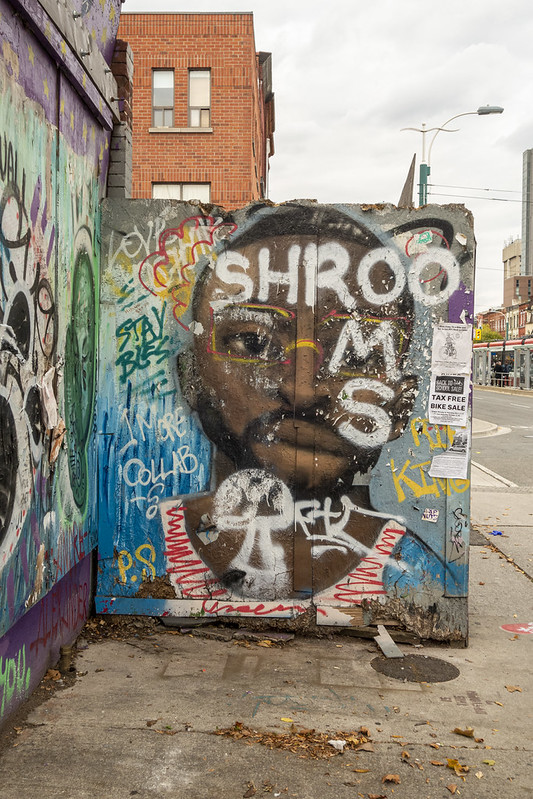
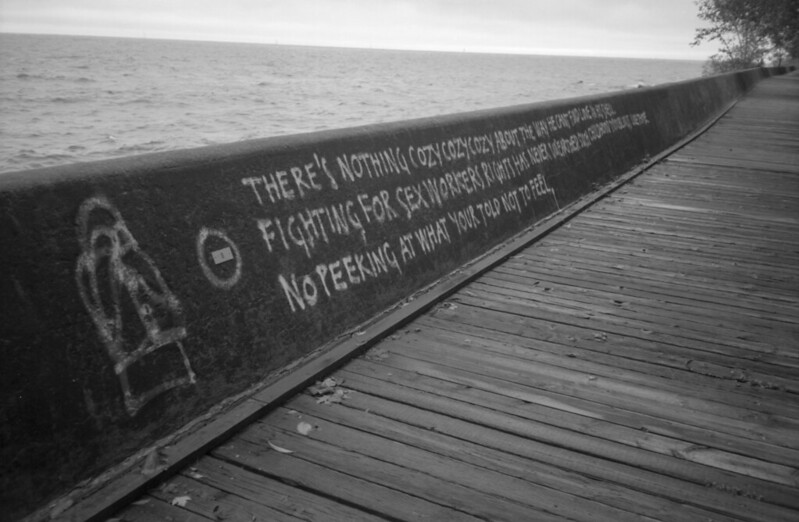
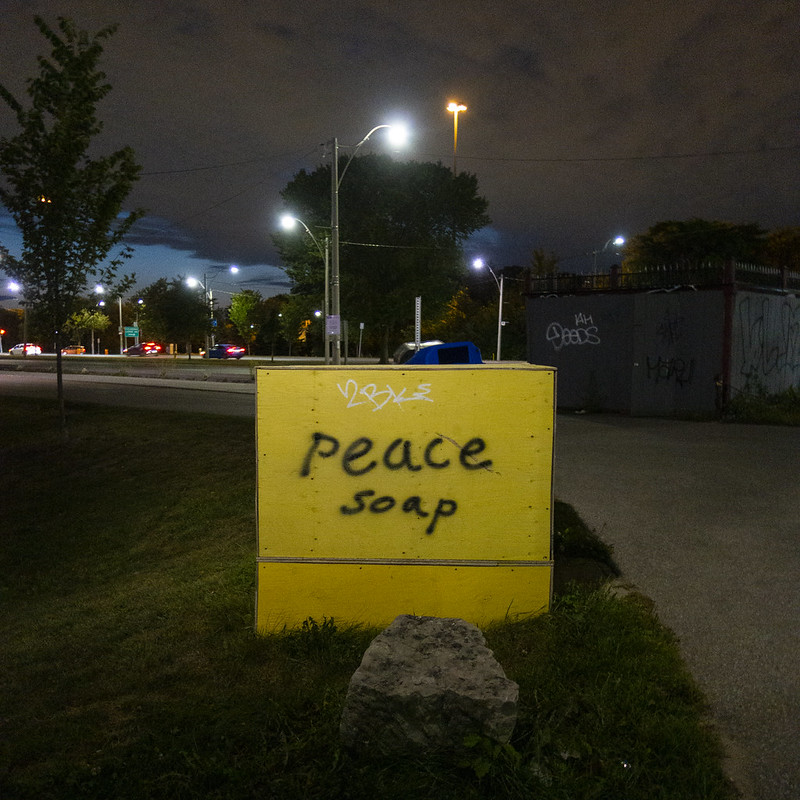
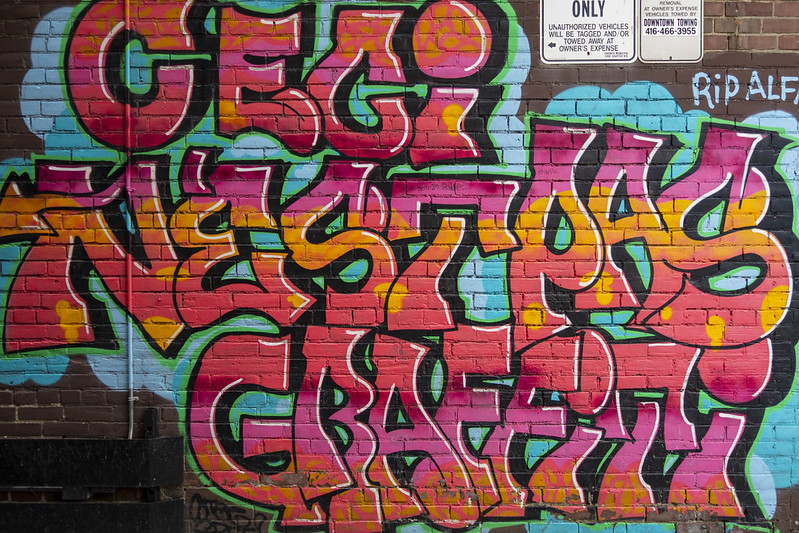
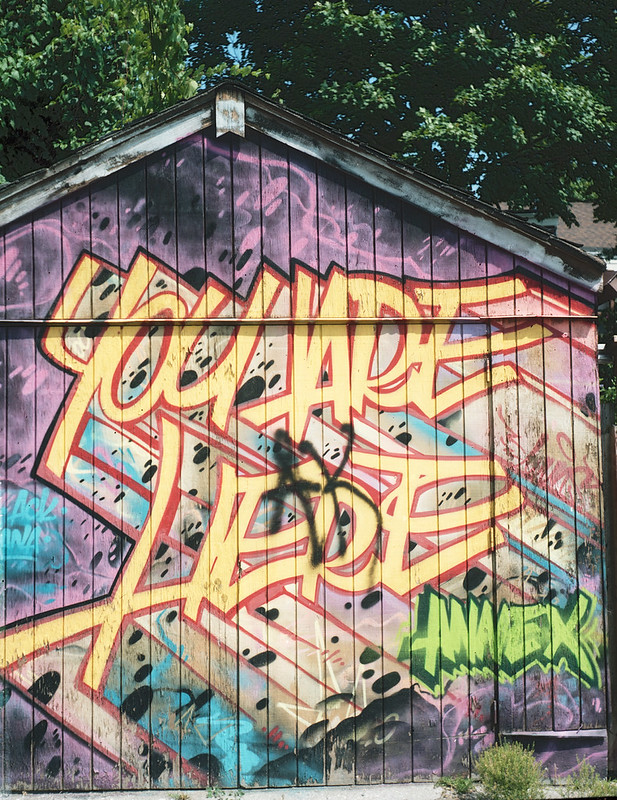
Now, I don’t blame you if you’re not so fond of graffiti. Not all of it is that great to look at, and if you’re the owner of the building affected and you didn’t ask for it to be there, you have a right to be disgruntled. But some graffiti – especially washroom writings – is witty: Nigel Rees put out five books of collected graffiti in the 1980s, and I bought all of them and read each multiple times, and have gotten some of my favourite witticisms from them. And some graffiti is vibrant and lively and a welcome addition to derelict buildings, longstanding hoardings, and sometimes the walls of people who have invited the artists. A few years ago I put together a book of my own photographs of that kind. Here are a few of my favourites.