Author Archives: sesquiotic

glögg, grog

Today Aina and I went to the annual Swedish Christmas fair at Harbourfront in Toronto. We go there mainly to do three things: 1) buy some Swedish packaged foods that are hard to get at other times (notably round tins of Nyåkers pepparkakor, which are gingerbread-like round wafers, and a 1.5 litre tub of lingon-sylt, which is lingonberry sauce, and which will be empty by this time next week); 2) buy some tickets in their tombola, which means you reach into a revolving drum and pull out the appropriate number of rolled-up slips of paper, and for each one that has a number in it, you can choose a prize according to what range the number is in (this year I won two, and chose a 5-DVD set of Attenborough’s Planet Earth – hey, these are all things donated by Swedes who live in Canada – and a copy of Den fantastiske Walt Disney, Från Musse Pigg till Disneyland, a Swedish version of a book my dad has in English that I read and looked at in my youth); 3) drink glögg. Two or three three-dollar cups each.

The first time I saw the word glögg, many years ago, I assumed it was a made-up fake-Swedish word. It just looked too much like a cross between grog and glug (as in glug, glug, glug, the sound of drinking a lot) with an exotic Teutonic umlaut thrown in for good measure. But no. It’s actually from the Swedish verb glödga, ‘make hot, mull’; in Norwegian and Danish, it’s spelled gløgg, because they use ø instead of ö (this is a super easy tip for telling Swedish apart from those other two: Swedish uses umlauts and the other two don’t. Icelandic does, but Icelandic sticks out because it has þ and ð. Finnish uses umlauts but Finnish looks completely different, a double-letter festival – though it does have a borrowed word for glögg, glögi).

So, if you’ve mulled all that over, you’ve probably concluded that glögg is mulled wine. This is true. It’s what the Germans call Glühwein. It’s something I was familiar with long before ever seeing the word glögg. When I was a youth, on Christmas Eve after going to the church service in Banff we would go to the house of a member of the congregation who was German and we would all eat snacks and drink Glühwein. I didn’t think at the time about what the glüh meant; we just called it “glue wine” and knew it was hot and sticky (cheap jug wine, spices, lots of sugar). But the glüh is… not another version of the same word as glögg. Surprise! It’s from a German word meaning ‘glow’. I wouldn’t be surprised if there were some connection, but there are practical limits to my Teutonic etymological spelunking just here and now.

So anyway. Glögg. Pronounced not like “glog” but with a mid front rounded vowel that we don’t have in English; the closest we get within the confines of our phonemes would be “glurg.” Which sounds a bit like gurgle, which goes with glug, and also reminds us of giggle which leads us to jigger and jiggle and on the other hand there’s glee and by the way glow and glass and jug and Yule log and chug and I’ll have another mug, please, of glögg, thank you, oops, guess I’m wearing that on my scarf, whatever, where were we?

After a few slugs of glögg you may feel a bit groggy. But while glögg is spicy and alcoholic and so is grog (well, maybe citrusy and alcoholic), there is no etymological connection. Grog, which is (or originally was – it can refer to a lot of things now) a mixture of rum with water or weak beer and lemon or lime juice, was introduced into the Royal Navy (in place of straight rum) by Vice Admiral Edward Vernon, who was called Old Grog, or Old Grogram, because he wore a grogram coat. Grogram is an English version of the French gros-grain, which means ‘large grain’ and names a kind of cloth that has a ribbed pattern, the sort of thing often used on ribbons for medals these days. Anyway, groggy meaning ‘sleepy, dazed, intoxicated’ comes from grog because obviously if you’ve had a lot you are. Or, if you’ve had glögg, you could be glöggy, I guess.

So glögg. Grog. Glug. Don’t forget eggnog. Which is seasoned with nutmeg. Beer is beer but comes in a keg or jug. There seems to be a theme of g words sticking when it comes to naming beverages. Given the spirits of the season, I think the Irish word for Christmas may be most in tune: Nollaig (pronounced “nollig”). But in Swedish Christmas is Jul and you get the g at the start when you give the greeting: God Jul! (Said like “Go Yule!”)

Anyway, the Swedish Christmas fair starts off the Christmas season for us, a sort of prologue to Advent – pro-glögg, I should say. It’s emblematic: crowded, hot, kind of expensive, more than a little pagan around the edges, we do it once a year, and if all else fails have another drink. God Jul!
tony

“They live in a tony part of town.” “It’s quite a tony crowd.” “A rather tony little restaurant.” “One tony relative in every family.”

We know what tony means here, don’t we? It’s another way the bon ton would say smart – not as in intelligent but as in, you know, cultivated and sweating money. Liberal in spending, but more of a Tory set. What lower sorts might term swanky (but doesn’t that word have such vulgar overtones, dears). The word has been with us since the later 1800s.

But who is tony? Who is Tony? Why is tony tony? What is tony is often not tiny; it is noteworthy. The name seems somewhat equivocal: there are so many people named Tony, after all. There’s Tony Soprano. There’s Tony Montana (played by Al Pacino in Scarface). There an auto mechanic named Tony hidden in every Fiat logo: FIAT = Fix It Again, Tony. And a Fiat is not the toniest car you can get!

But there’s also the Tony Award, named after Antoinette Perry. There’s Tony Blair, formerly prime minister of England (not exactly a toff – a bit more blaring than all that – but he did move in some tony circles). There’s Tony Aspler, Canada’s top wine critic – who often drinks and eats at some pretty tony places, though he’s an entirely unpretentious fellow (disclosure: I edit his website).

But what’s tony is not named after a Tony. It’s just that adjectival –y tacked onto tone. There are, of course, several kinds of tone. There’s muscle tone, skin tone, your tone of voice or the tone of what you’re saying – if you strike the wrong tone, you may be detonated! – and any smooth and steady note. Or even a rising or falling – or falling and rising – tone, as you might hear in a language such as Mandarin Chinese.

What we have in mind in this case, of course, is high tone. As in a high-toned affair. Attended by the bon ton. Perhaps like the one in the video for La Roux’s “I’m Not Your Toy.” Loaded with the toys of the rich, but the people there are not ones to toy with. Tony could be a melting of no toy; ignore that at your peril. If you try to crash a tony reception and you are no one of note, your reception will be stony.

Thanks to a reader who signs as Snowbird of Paradise for suggesting tony.

sphygmomanometer

I loved this word the first time I saw it. It was somewhere in my pre-teen years, I remember, maybe around the time I learned the word dimethylpolysiloxane (an ingredient in a chewable tablet we took so we would fart less). How can an developing boy not be charmed with such gassy words? So long (sesquipedalian was a word I learned a few years later), so interestingly shaped, such a well-assembled sound set.

The word immediately made me think of my mother, just because of the mom right in the middle of it. (Hi, Mom!) But that whole sequence of nasals… Would you animate an abominable homonym for hominy or enumerate an anemometer? Or merely nominate the Mahna Mahna from the Muppets? That momanom is almost numinous; for word tasters, it’s nummy – om nom nom! And the sphyg. Tight and mysterious, like a sphinx’s sphincter, or asphyxiation by sphagnum… or a mercury spy (spy + Hg). So the word starts with a hiss, then moves on with a murmur, and finally taps off the tip of the tongue and goes.

What is it really, a sphygmomanometer? It’s a device for measuring blood pressure, typically used by a physician with a stethoscope. If you have had your blood pressure measured it was surely with one of these. An inflatable cuff is wrapped around your arm and inflated until it stops the blood flow, and then the pressure (the gas, I mean the air) is let off gradually while the doctor listens with the stethoscope for the blood in your brachial artery. The pressure is gauged by the mercury (like a thermometer) or aneroid dial; it is measured in mm Hg, which may make you think “Mmm! Hug!” but actually means ‘millimetres of mercury’. It’s a mercury spy on your blood pressure.

The doctor is listening for Korotkoff sounds: the sound of your blood pulsing through your veins. When the beat starts pushing through, it’s the systolic pressure, the upper number; when the pressure is low enough that blood is flowing through all the time, it’s the diastolic pressure, the lower number. Here’s a video (a bit quiet, though) on the Korotkoff sounds. Here’s another, shorter one that you can test yourself with. The sound might make you tense: quiet, with a beating heart. It might raise your blood pressure — also known as your arterial tension. High blood pressure is called hypertension.

I’m not going to say that the Korotkoff sounds add up to something like “sphygmomanometer.” That would be pushing it a bit much. But I should be kind and tell you that the main stress in the word is on the nom. The parts, all from Greek by way of more recent European medical scientists, are sphygmo, from sfugmos σϕυγμός ‘pulse’; mano, from manos μανός ‘loose, open, rare, sparse’; and meter, from metron μέτρον ‘measure’. A manometer is for measuring pressure in a liquid or gas; a sphygmomanometer is a manometer put to use for helping to measure the pressure of the pulse.

Blood pressure readings are typically done by doctors. For some people, having a test done by a doctor can induce what’s called white coat syndrome, and in particular white coat hypertension: the sight of the doctor’s white coat – or just your presence in the clinical setting – makes you tense and gives a misleadingly high reading. But I don’t know if there’s a special term for having your blood pressure go up at the sight of a long word. I wonder how many extra millimetres of mercury have been measured on pulses over the years simply due to the effect of seeing SPHYGMOMANOMETER on the device that’s measuring…

Thanks to Daniel Trujillo for suggesting this word back in April. I finally got to it.

expiscate

I am a lexical escapist; this is perspicuously the case. Each evening I pick a specific lexeme, expiscate it from the lexicon, and explicate it luxuriantly.

In the above paragraph, my copy of Microsoft Word puts a squiggly red underline beneath exactly one word. I suspect the same word hooked your eyes as they tried to swim past it. As David Astle (@dontattempt) tweeted last month, “There’s no autocorrect on god’s green earth that will recognise expiscate – to fish out.”

And yet it has all the right parts: ex – ‘out’; pisc – ‘fish’; and that suffix that makes it an act, a verb, ate (which may also be what happened to the fish after its extraction). You will have seen that pisc swimming through various words, though sometimes a fish out of water: an Episcopalian has no more fish than opals, nor are there fish in the flashes of an episcotister; there is nothing literally fishy about concupiscence, and pisco does not taste like fish (it’s Peru’s answer to grappa); but pisciculture, piscicide, and Pisces are all truly fishy.

But expiscate is not used much. A lad with a rod strolling down to the stream will not tell his mother “I’m going to expiscate”; he would get farther saying he was going to figure skate. The TV news talkers, describing a depleted fishery, will not say “It has been expiscated”; indeed, even if it were a technical term, they would not do one of their “It’s called expiscation” schticks on it.

Why not? Because they couldn’t fish it out of their mouths successfully. The sound of the word swims back and forth on the stream of /s/ between hard rocks at back /k/ and front /p/ and back /k/ again, and in the effort the tongue flops and flounders like a freshly caught trout. (Or it trouts like a flounder, as you wish.) If you can say this word ten times in a row without vexing and perplexing your lips and tongue, your lexical organ is indeed dexterous. It is such a crisp and succulent word, echoing spice and pixies and sex and expiate and so many others, it ought anyway to be reserved for such rare occasions, poetry and fine language, as merit the exercise.

But also, fish out is perfectly fine for something as earthy, watery, slippery, and smelly as dealing with real fish. A word such as expiscate escapes the surly literal bonds. Incidental expectoration notwithstanding, it sparkles best in a more figurative setting. It is a word for fishing out as you would fish a word out of a dictionary (or your Twitter feed). And I am happy to report that, while a dictionary is a fine pond for expiscating, it is unlikely to be depleted to the point of expiscation – being fished to empty. There will always be more excellent delectables to extract from the lexicon, as witness this word.

egret

The egret, it seems to me, is a bird for the future.

It is not that I think the future is exactly like a pretty little heron with an awful squawking voice. It is just that its name and some other things about it seem to be looking forward.

For one thing, we always greet the future with a bit of confusion. And egret is greet with a bit of confusion.

For another, its name comes from Old French aigrette, diminutive of aigron, ‘heron’, but doesn’t it look like vinaigrette – a kind of salad dressing – without the vin? The aigre in vinaigrette (and its source vinaigre) means ‘sour’. So if you take the vin (wine) from vinaigrette, what you’re left with is a little sour. I don’t think that the future will be a little sour and without wine; I think this bird just reminds us that without wine, things can get a little sour. So add a bit of wine in the future and you will still be in your salad days.

For another, egret sounds like it should be an eaglet, a juvenile raptor, lone and threatened and set to become a large, voracious, revered, rapacious, endangered predator. But actually it is a fairly innocuous thing (unless you’re a fish, or own a fish pond) that, even full grown, would easily fit standing under a table and perhaps even under a chair. Not such a threat.

And not so threatened. A century ago egrets were in danger because of the harvesting of their feathers for use in such things as dress hats and uniforms. But collective action by concerned people made a real difference; with the aid of legislation, rapacity was forestalled and egrets are no longer threatened – although loss of habitat due to encroachment and similar changes could still hurt them. Like the future, maybe: the threat is not overt aggression, just the creeping ignorant comforts of humans.

Egrets are nice, egalitarian birds. They take turns caring for their nest eggs; when one comes to take over from the other, it may even hand over a stick, like passing the baton. They are pretty birds, too, as said: they’re herons, lean with needle beak, and elegantly lovely plumage. Especially the snowy egrets.

Snowy egrets. It’s snowy here today. But snow greets you often in the dimmer half of the year around here. So it goes. I live here happily; I have no regrets.

There’s no regrets – there’s snowy egrets. Sounds good, no? That’s the other thing for me linking egrets to the future: they’re regrets that don’t start. That’s the best way to approach what’s coming. If you see a regret coming your way, just knock it off as soon as it starts and have a bird instead.

bro-ffant

The other day, it occurred to me that this is one of those eras where a future person could look at pictures of what we consider fashionable in men’s hair – what’s featured in magazines and seen seated at Starbucks – and date it within a year or two.

Part of it is the massive lumberjack beards. For some reason, these facial muskrats have become all the rage of late, and what was formerly a thing seen on nineteenth-century sea captains and some painting-worthy men of establishment is now panting-worthy and “hot.” (Well, yes, it is hot, in the literal sense. I had one for a while in my 20s and I can tell you that your face is never cold. Nonetheless, I was glad to be shorn of it.) In particular, I must infer that someone passed a law requiring all red-haired men between 18 and 30 to grow huge beards. For brown-haired men it is optional and for blonde men it is simply a serving suggestion. Now, my father has had a beard since I was a small child, and his beard is Dumbledore length, but he is also a generally Santa-Claus-looking person and frankly sui generis in many ways. He is also not 23.

But the other component of the current masculine tonsorial tendance is that hair on the top of the head. If the beard is a bouffée de chaleur, the hair is more like a buffet for the birds and insects. It is trim on the temples but the top looks like a field of heather or heath buffeted by strong winds but held steady by enough gel to stop a Sherman tank. If a mullet is business in the front and party in the back, this hair is marine corps on the side and marine coral reef on the top: trim and tidy by the ears, Paris sequence from Inception up above. Look, look, it’s this: just Google images for |hipster hair|.

But when I wanted to describe it to someone on Twitter, hipster hair was not a good enough term. No, I wanted something descriptive. This hair, this buffeted, almost buffoonish puff of hair – cream puff? powder puff? puff pastry? puffin? Puff the Magic Dragon? – is something of a bouffant, that hairstyle named with the French for ‘puffing’. But it’s not quite the bouffant you see on women. That typically has more on the sides and hanging down. This is a bouffant for guys. So…

…I reached for a portmanteau that would blend bouffant with something signifying ‘guy’. The obvious was bro-ffant, with a hyphen because broffant does not look like it should be pronounced the desired way.

Is it exactly apposite? Well, not completely; bro tends more often to refer to the frat-boy type, the backwards-baseball-cap guy, the stereotypical clueless male pig, not hip enough really. But there is a weakened sense of bro that can just refer to masculinity, and when making portmanteaux, it is most important to go for the right sound. It just is.

So bro-ffant. With that ff looking like the hair and also manifesting more clearly the origin of the parts. Because English spelling has not really been about phonetics any time this half millennium.

Is this a word for the ages? I hope not. I hope not because I hope bro-ffants will not persist unduly. Or undulatingly. Or, really, much at all. They can end in barbers’ wastebaskets along with those baby bears hanging off the guys’ chins. The latest hipster look, in my eyes, is a desperate cry for a lawn mower.

But, then, I’m a quarter century too old anyway. And I remember what was popular hair when I was in my youth, in the 1980s. Yes, yes, famously worn by A Flock of Seagulls. Well, the flock of seagulls is now resting in the bro-ffants, having mistaken them for bent bulrushes. They will surely fly away soon enough, no?

Strong with the fronting Master Yoda is

One of the great classic topics in linguistics is… the syntax of Yoda’s speech. What’s up with the way he talks? What are the characteristics of his syntax? It’s not universally agreed on… or even galactically. But there’s something interesting you might want to know about the language he speaks. I tell you in my latest article for TheWeek.com:

Why so strangely Yoda speaks

For the interested, here are some more linguistic looks at Yoda-speak:


What’s English?

This was first published on The Editors’ Weekly.

Here’s a quick quiz. Tell me which of the following are English and which aren’t. For each one, say why it is or isn’t English and, if it’s not English, what it is.

  1. There’s no place to plug your car in in the parkade.
  2. A wha dat dey dem people deh nyam ih smell sweet.
  3. He was found to have contraband in the boot and under the bonnet, so he is in gaol.
  4. Breid is a staple fuid prepared by bakin a daich o floor an watter.
  5. That pom’s running around like a chook with its head cut off.
  6. Biiolojii esa saiens, daa studehs lief, plant a’ anamal.
  7. Sildenafil is contraindicated in hypertension.
  8. I might have the odd poutine, but mostly I don’t pig out.
  9. Tell me, what is one to do yaar? They are like that only.
  10. Ðā ġeseah ðæt wīf ðæt ðæt trēow wæs gōd tō etenne.
  11. If yall are fixin to go, I might could leave early.
  12. One coffee regular. All set?
  13. I damn tired den langgar the car lor. Dun know oreddy lah!

Wasn’t that fun? As you may have guessed, all of the above are versions of English from different places (and in one case a different time). But of course they’re not equally acceptable in all contexts, and some are sometimes treated as different languages now. I’m willing to bet that several of them were more than a little hard to understand, and most of them seemed somehow “wrong” to you. So let’s look at what they are and what they mean.

  1. Albertan: There’s no place to plug in the block heater on your car engine in the parking garage.
  2. Jamaican (patois; from Chat Jamaican by J.J. Thomas): What are those people eating? It smells sweet.
  3. British: He was found to have contraband in the trunk and under the hood, so he is in jail.
  4. Scots (from http://sco.wikipedia.org/wiki/Breid): Bread is a staple food prepared by baking a dough of flour and water.
  5. Australian: That British person is running around like a chicken with its head cut off.
  6. Pitkern and Norfuk (Pitcairn and Norfolk; descendants of the crew of the Bounty; from http://pih.wikipedia.org/wiki/Biiolojii): Biology is a science that studies life, both plant and animal.
  7. Medical jargon: Viagra® should not be prescribed to people with high blood pressure.
  8. Canadian: I might have the occasional dish of French fries with cheese and gravy, but mostly I don’t eat to excess.
  9. Indian English: Tell me, what can one do, man? They are just like that.
  10. Old English (Anglo-Saxon; from http://www.oldenglishaerobics.net/fall.html): Then the woman saw that the tree was good to eat.
  11. Southern US English: If you [plural] are getting ready to go, I just might be able to leave early.
  12. New England English: One coffee with cream and sugar. Is that everything?
  13. Singlish (Singapore English; from http://en.wikipedia.org/wiki/Singlish): I was really tired, which is why I crashed into the other car. I don’t know any more about it!

There is not one “right” English. English is a language complex. All languages have different levels and tones and different usages for different contexts, but English, due to its spread, has much more variation than many. Within their own systems, all of the above are perfectly grammatical. Obviously, most of them would only be acceptable in a conversational tone directed to a specific audience, but to that audience, they would sound entirely natural.

And that’s the take-home. What sounds natural to you, and what sounds natural to the audience you’re editing for, in the context of your document? Are you sure? The Albertan sentence sounds perfectly normal to me, but there are many Canadians who would scratch their heads at it…

kismet

Ah, kismet. The ineluctable, inescapable, yet somehow eternally exotic fate. What has been decided for you by God, your every move just like a chesspiece until, finally… mate.

Mate? You are mated. You kiss your mate. Kiss me, mate: it’s kismet. The attraction is more than merely cosmetic. Though it be a bridging of a chasm, it will take you to the other side surely. Kismet makes no mistake.

Kismet is fate, sure, but fate with an air of the exotic: Baghdad and baggy pants, perhaps – a 1950s version, not the 2000s. Kismet is redolent of foreign spices, as much korma as karma, not mere garlic but a right forest of foreign spices. Which ones? Doesn’t matter, as long as they have an exciting otherness. When you fall in love, after all, you project so many of your own desires on the other person, just as when you swoon for the exotic and mysterious you are really looking at a painted mirror reflection of the back of your own closet. You may be captivated, but truly you are held captive by a fantasy of your own devising.

Well, such are the anfractuous – nay, Byzantine – ways of fate. What goes out the front door may come in the back door, or vice versa. Things you set in motion may end up where you never see them; seeds you sow may be harvested by others. On your way to escape your fate, you meet it. But when you call it kismet, it probably also involves a striking coincidence.

Most responsible for the flavour of this word, as you may know, is a 1953 musical play, Kismet, which became a hit movie in 1955, a heady romantic stew full of waspy orientalism, a plot full of remarkable coincidences, all happening in a single day. Its best-known song is “Stranger in Paradise,” which an incognito prince sings to a maiden who has suddenly captivated him. The musical was by Wright and Forrest, with book by Lederer and Davis, but it was based on a 1911 play by Edward Knoblock (who changed his name from Knoblauch, which happens to be German for ‘garlic’). And the music that made it so famous is based on music by the Russian composer Alexander Borodin. That most famous song is taken right from Prince Igor, from the Polovetsian dances: songs of enslaved Polovetsian maidens forced to dance for their captor, Prince Igor.

The word kismet comes to English from Turkish, which got it from Persian qismat, which got it from Arabic qismat ‘portion, lot, fate’, which comes from qasama, verb, ‘divide’. Divide because your fate is your portion, the lot that falls to you. But of course fate may join together as well as pull asunder.

Why was I fated to think of this word today? People have started decorating for Christmas. That makes me think of the Huron Carol. Which, for musical reasons, makes me think of “Paint It Black”: you can segue the one into the other – “’Twas in the moon of wintertime I want to paint it black.” I have mentioned this previously here on Sesquiotica, in my word tasting note on quodlibet, from the fall of 2009. I decided to mention all this today, with video links, on Twitter. Now, if you look at the video of the Huron Carol I chose to link to, you will see it was done in 2010 by a group called Quod Libet. It so happens that the rendition of “Paint It Black” I linked to – an a cappella choral version – is by a group called Kismet.

So it was fated.

cartoon

I really like cartoons.

The feel of newsprint makes me think immediately of cartoons. If you give me a newspaper, I will read the cartoons. I may or (more likely) may not read any of the rest of it. (I get my news online anyway.) Some of the most important influences of my youth were cartoons. MAD Magazine. Calvin and Hobbes. Doonesbury. I even used to read a magazine called CARtoons, which was comic strips about cars. (I loved cars. I’ve still never owned one, though. I love public transport more. I rent when I have to.)

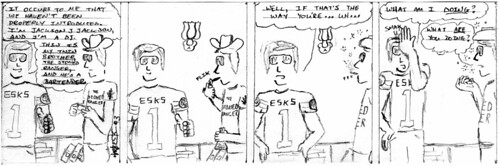
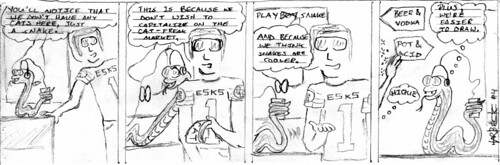
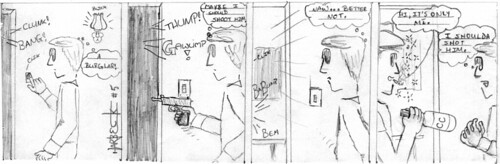
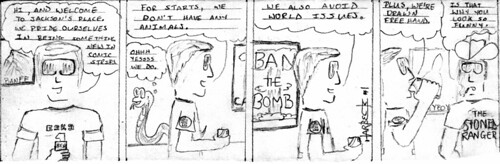
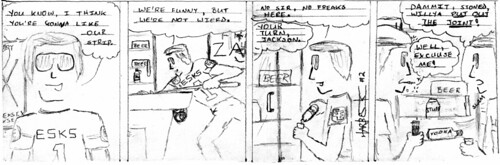
Naturally, I wanted to be a cartoonist, too. I’ve always aimed to amuse others (I have not always succeeded). I’ve always liked art. And I had the idea that cartoons would take less work than other forms of art. Not true, of course, but I was very good at self-deception. I wanted quick results. I did five panels of a comic strip somewhere in high school. Didn’t do anything with it. Never even got around to inking it – it’s just in pencil, with guide lines for the text. Here it is, so you can see the kind of person I was as a teen (click on a cartoon to see a larger version):

Explains some, doesn’t it? I did a better cartoon once in university, for a theatre class. I saw it somewhere in the last year or so. If I can ever manage to find it (no luck so far, but I know it’s around here somewhere), you will see it. [Revision: Found it!]

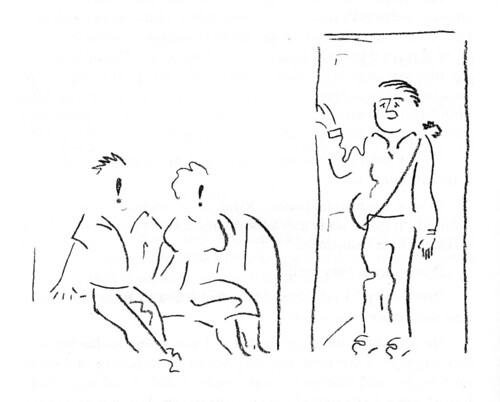
More recently, I have done light drawings on various sorts for various purposes. I illustrated my step-grandfather’s memoirs of playing the hobo during the Depression (edited and published by my grandmother):

I even did some for the Literary Review of Canada years ago (I’m the designer, and they were lacking a real artist for an issue or two several years ago):

(The smudges weren’t in the magazine version. Not sure how they got there.)

But those are not comic strips. Not that all cartoons are comic strips; originally, none were. They were preparatory drawings for paintings, stained glass, etc., done on heavy paper – Italian cartone, from carta ‘paper’. We get the word carton from the same source. But cartoon has the oon, as in loon, goon, poltroon, spittoon, saloon, and so on: generally less dignified and often funnier.

Humour is the key to cartoons. They can have great art in them; Bill Watterson, who drew Calvin and Hobbes, is an unbelievably good artist (as witness strips such as the tyrannosaurs in F14s one): excellent technique but always in the service of most excellent funniness. But some of the greatest cartoons out there rely on their wit much more than their technique. Dilbert is one; a more extreme example is xkcd, which is ridiculously smart and funny and just uses stick figures (although some of the strips, such as “Click and Drag” [you have to click and drag on it to see more of it], show us that it’s not that Randall Munroe can’t draw, it’s just that he mainly prefers to keep the art simple). And there’s my editorial colleague Iva Cheung, who takes a similar approach in her comic strips: spare in the drawings, but very intelligent and funny, and it can’t be done without drawing.

So cartoon started with the heavy paper. Then it transferred to the kind of drawings done on the heavy paper. Then the linear style of drawing came to be known mainly for humorous or satirical drawings (as with editorial cartoons). They came to be printed on lighter paper. Now we often see them on screen rather than on paper; in fact, animated shorts are called cartoons, as in Saturday morning cartoons with Bugs Bunny (originally drawn on vellum and shown via celluloid) – and these are made with full-colour paintings, even if simplified (just like cartoon violence: exaggerated, vivid, without lasting harm). And now the key element of many non-moving cartoons is actually the wit behind them, not the artwork itself. This word cartoon caroms semantically around.

I wonder if I should try drawing cartoons for Sesquiotica every so often.

Or maybe I’m better off not…