Category Archives: word tasting notes

zoom lens

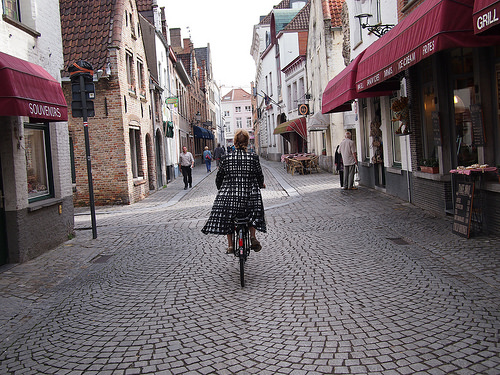
Aina and I spent two weeks zooming around France, Belgium, the Netherlands, Germany, Denmark, and Sweden.

No we didn’t. Zoom is not the right word at all.

Yes, it’s true, we did take a few very fast trains (the French TGV and Belgian Thalys both go over 300 km/h), and a few at least reasonably fast trains (120 km/h). But other than that, we mostly walked, averaging over 10 km each day.

And, more importantly, I did not use a zoom lens.

This really matters. I actually brought four lenses, but on the first day of the trip I put on my 20mm f/1.7 lens (equivalent to 40mm on a 35mm camera) and ended up leaving it on for the entire trip, no exceptions. It’s a nice, sharp, fast lens with minimal distortion. It’s a moderate wide angle and covers scenery quite well and, with any camera of good resolution (such as mine), can be cropped down for a tighter angle of view (you lose resolution, but are you planning to make a poster of it? If not, it likely makes no perceptible difference). With that lens on my Olympus E-PL3, the whole camera fit neatly into my jacket pocket when it had to, and it still took good pictures.

Meanwhile, everywhere I went, there were many tourists walking around with huge cameras, camera bodies the size of plates with zoom lenses on them that weighed a few kilograms each and could actually have been used to club a horse to death. Not that they were, of course. They were just used to club photos and a whole vacation to death.

Look, a camera that big and heavy is a pain to carry around. And a zoom lens is like any other all-in-one-type thing – fax/copier/printer combos, all-season radials, whatever: it does a wide variety of things not very well. It is guaranteed to be slower, harder to use, less versatile in the ways that really count (e.g., varying depth of field), more prone to distortion, less sharp. It guarantees that people will waste time zooming in and out and in and out trying to get just the perfect angle. It also guarantees that you’ll miss some shots just because you left the frickin’ heavy ugly thing in your hotel room for a switch.

Some people go for these lenses because they think they look professional. The truth is that when you do see a pro with a zoom it’s because they actually do need to shoot dramatically different focal lengths and they just don’t have the money to have multiple camera bodies with different prime lenses on them (prime = single focal length). Mainly, though, people have them because the camera body comes with them (a kind of basic all-in-one deal), or because some salesperson upsold them to one (they tend to cost more). Sure, they look impressive. In the same way as sesquipedalian words look and sound impressive but may impede communication.

The word zoom does not start with lenses, of course, and is not limited to them. But I’m finding that the word zoom probably means you’re being pandered to. Examples? Zoom lens, of course, for reasons I’ve just given: people think it looks impressive, but photographically it’s typically your worst choice. There’s also digital zoom, which is actually just cropping plus interpolation so you get a bunch of junk pixels – extra file size but no gain in image quality. But there’s also Zoomer, a magazine and marketing concept marketed to baby boomers who are becoming – not seniors, gracious no! – “zoomers.” And there’s zoom zoom, the marketing concept for Mazda. No worse than any other marketing concept, and in fact better than many, but marketing butters its bread by pandering, and zoom zoom is, like all car ads, selling you not a machine but a self-image.

The word zoom comes from onomatopoeia: it first of all described a buzzing sound. Airplane pilots borrowed the word to describe abruptly climbing with an airplane, no doubt at least in part because of the noise the engine made. The word has come to refer to fast motion in general, especially motion of short perceived duration (something may be moving fast for a long time, and we might not think of that in terms of zooming, but if you’re standing still it will zoom past you). The sound lends itself to a feel of such a motion; say it out loud and you may get something resembling the Doppler-effect sound of a very fast motor vehicle going by, the engine buzz coming and the tire hum fading away as the pitch lowers. And a zoom lens, when you’re looking through it as it zooms in or out, seems to be producing rapid limited-duration rapid forward or backwards movement: zooming in and zooming out. Suitable.

Which brings us to the fact that zoom lenses do have their uses. On movie cameras, they can produce a valuable effect, zooming in on someone to tighten the focus. (On news TV cameras, on the other hand, this effect has often been used to close in on someone who is experiencing a strongly emotional moment, a practice I have long viewed as one of the most utterly detestable things. They’re upset. Stop intruding on them for a moment, will you?) And for some varying real-life circumstances, a zoom lens makes equipment much simpler – you make trade-offs in terms of speed and weight (and cost!) for that specific versatility.

That’s really the thing about zooming. It zooms in on one thing: versatility in focal length. You lose some versatility in aperture (and thus range of shutter speed too) and portability of equipment, and you lose some sharpness too. You may even lose some skill as a photographer. Relying on zooming in and out for composition is like relying on punctuation to do your writing. Working with one lens with one focal length focuses your mind. It zooms out from the one thing and can help you think about all the other things more. It also makes you move your lazy butt a bit more.

Let’s take a parallel example in the world of words. Some people zoom in too much on the etymology of a word without paying attention to current usage and phonaesthetics. Just remember this: if we zoom in on etymology, a zoom lens is a lentil making a buzzing sound. Yes – lens is Latin for ‘lentil’; the piece of glass got the name due to shape resemblance.

Oh, are you curious how my single-lens adventure worked out? I took 1160 photos, and you can see the 230 I liked best on my flickr, www.flickr.com/photos/sesquiotic/. I cropped almost none of them, because I composed for what I saw and because, honestly, how much time do I have? Yes, many of them could use a bit of trimming and adjustment. I make no great claims as to their artistic merit, but I guarantee you they’re better than I could have gotten using a zoom lens. I do have a zoom lens – it came with the camera body. It stayed in the bag the whole trip.

laundromat

Last Tuesday evening we spent an hour and a half sitting in a German laundromat.

Well, OK, we did go out and grab some falafel while our wash was going. Front-loaders lock, so you have some security for the duration of the cycle. But in the main we were sitting watching the clothes go ’round (and reading), while other customers saw to their similar situations. One young bearded dude stared out the window and then, when the time came, folded his laundry with exquisite precision. A young woman’s little dog kept dragging around the chair to which it was leashed.

When you’re on vacation for two weeks and travelling through several cities and, indeed, countries (FranceBelgiumNetherlandsGermanyDenmarkSweden), you have to pack light, and there comes a time after a week or so when your few items of clothing really need a wash. For us, that time came in Hamburg. We had planned it that way: Hamburg would be the ease-off city, less exciting than those before or after. We were in a very nice hotel, converted from a 19th-century brick water tower – of course we could have paid them something above 100 euros to wash our stuff for us, but no, we could not have, thank you, not when we could spend 90 otherwise unclaimed minutes and a mere 5 euros. So after a day trip to Bremen we took a bit of time to walk down to the closest laundromat and freshen our togs.

In Germany, it is not a laundromat, of course. German uses Germanic morphemes in many places where English has preferred Latin- and Greek-derived bits. Our lavendry was a Wascherei. But I’m not writing in German about German words here, and the place I was in was a laundromat as we know it: rows of automatic washers and rows of automatic dryers. The only real variant was that you paid at a point on the wall and entered into it which machine you had stuffed your clothes into, rather than slipping coins into slots in a sliding tray in the front of the machine and then kerchung pushing them in to get it rolling.

You may have noted that the German word Wascherei has a capital. This is just because it is a noun. In English, it would have to be a proper noun to get a capital – for example, a trademarked name. The irony here is that Laundromat actually is a trademarked word. Westinghouse trademarked it in 1943 as a brand name for an automated washing machine. The vision of rows of clean white machines operating efficiently may match stereotypes of German efficiency. But actually German laundromats are about the same as American ones, Hamburg is a graffiti-covered city and a not especially clean one, German trains are less clean, modern, fast, and timely than those of their neighbours to the south, west, and north… and laundromats are a classically American invention, even though the word laundromat draws on a word that has a German reflex.

The word in question is automat. In German, Automat is an automaton, a machine that acts of its own volition (or at least its own apparent impetus). The source is Greek, αὐτόματον, from roots to do with self and thinking. In English, an automat was also first of all (by 1676) an automaton, then – in the US – by 1895 an automatic dispensing machine (e.g., a candy machine or similar dispenser). By 1902 it named a restaurant or cafeteria where you get the food from such machines.

So the leap was an easy one from the washing machine Laundromat to the establishment laundromat wherein you may use automated washing machines. Within a decade the capital was lower-casing and the sense was shifting. But not everyone calls the place that; it can also be a laundrette or (another trademark) Launderette. And the types of machines and establishments existed before the name did; in the 1930s a coin-operated laundry was a washateria. Like a cafeteria with automated machines. Like an automat, in other words.

Oh, and the laundro part? From the Latin lav root plus the same enda/anda suffix you see in agenda and propaganda, via lavendry and lavender – a name that was also applied to a plant historically often used in washing. Ever wonder why lavender is such a bathroom scent? Tradition.

Not that laundromats ever smell of lavender. I’m not sure exactly what is used to scent that powdered soap that is sold in them, but whatever it is, they smell of that. Plus perhaps the falafel et cetera that people may be eating as they watch their wash wash.

It was good falafel, too. Just the kind you go to Germany for.

slot

Amalienborg Slot, Copenhagen

Amalienborg Slot, Copenhagen

We just flew back from Copenhagen today. Copenhagen is a great place if you like slots.

No, I’m not talking about gambling. Or maybe I am…

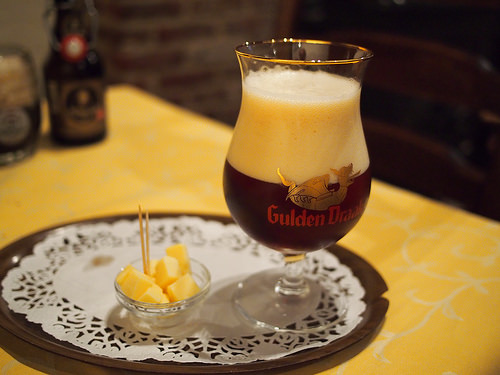
Slot is Danish for ‘castle’ (or ‘palace’). Copenhagen has several of them. Not all are still in use as royal residences, but some are. Denmark still has royalty and those royalties seem to get pretty good royalties from their royalty, if the number of royal endorsement seals on high-end products is any indication. I noted the royal seal on my 750 mL glass of beer that I had before boarding my flight, and the same seal on the high-end clothing store next to the bar.

The Danish royal seal on a large draft

The Danish royal seal on a large draft

But that’s not a gamble; that’s straightforward commerce. The gamble comes more in whose face is on the coins. (Actually, only the 10 and 20 kroner coins have a royal face; the others just have hearts around the edge and a hole in the middle.) The throne is a slot to fill; which coin gets dropped in that slot? It may be a political machine, but when the wheels turn you don’t know for sure what you’ll get when they stop – and what the coins will look like when they come out.

Denmark’s royalty was elected by the nobility until the mid-1600s. The nobles were a rather fractious lot and had last say in many things, notably finances, and after a couple of military defeats in the 1650s which led to a lot of bills to pay, King Fredrik III asserted the need for a strong, stable government, and so he instated hereditary monarchy and a law declaring the king to be sovereign beyond the law and inferior only to God. The people seemed to like that. Absolute monarchy held sway in the country for almost 200 years, until another war’s disastrous conclusion led to the establishment of a constitutional state – but retaining the hereditary royalty. So it remains a closed shop, and who you get is determined by the lottery of birth: who happened to be born when to whom. Ya pays yer royalties, ya takes yer princes and princesses.

It’s fitting to call it a closed shop. That word slot is an old Germanic word relating to just that: closing and locking. There’s another country that calls a castle a slot: the Netherlands. As it happens, you’ll also see signs on doors in the Netherlands saying gesloten. That means ‘closed’. With just a slight difference in historical sound changes you get German geschlossen ‘closed’ and Schloss ‘castle’. See the pattern? A fortress or castle is a closed, locked place – and a palace is a later development of a castle.

How does that relate to English slot? Is it from the door bolt sliding in a slot? No, actually. The English slot that is related is out of use now in most places; it refers to a bolt or bar for locking a door. To find the ‘groove’ version, we need to do a bit more sleuthing. It showed up first in English to refer to the slight depression running down the middle of the breast. But it seems to have taken that from the groove in the hoof-print of an ungulate animal, Old French esclot. That in turn appears to come from Old Norse slóð ‘track’, which is related to modern English sleuth. (A side-note: a sleuth may track an animal by its spoor; in modern Dutch, ‘railway track’, as in Track 9 in a station, is spoor. In Danish, by the way, it’s spor. But don’t think for a moment that Dutch and Danish are mutually intelligible. They’re not really that closely related.)

It is from that ‘groove’ sense that most English usages of slot come, be they the specific times allotted for plains coming into and going out of an airport (such as the plane I was on today) or (to quote the Oxford English Dictionary) “The middle of the semi-circular or horseshoe-shaped desk at which a newspaper’s sub-editors work, occupied by the chief sub-editor” – from which we get The Slot, Bill Walsh’s website for copy editors.

We could draw a parallel between the chief copy editor and a king, I suppose: the heart of the operation. But the slot in the newsroom is the beating heart, the control centre. That is not so true of royalty anymore; they are more ceremonial now. Just as well. We have seen how, in times past, when we have looked in the middle of the chest, the heart has been barred, closed – or when we look for it we find no more than a hole in the middle. Why cast lots or play slots with a country’s future?

We’re just as well off in English, where slot functions better as a word for things that often make a sound like “slot!” when in use: grooved mechanisms and openings for coins. But of course, we have a monarch too (not you, Americans; I’m talking about us members of the Commonwealth). She looks very nice on the coins.

frontier

I was recently talking with a friend about the 1988 Calgary Olympics. The theme song for those games was a very commercial-sounding piece by David Foster, quite catchy and all, but you did hear it a million times… I said I thought it should have been “Games Without Frontiers” by Peter Gabriel.

But of course that would never go. I mean, Calgary is a frontier town!

A frontier town? But the nearest international border is a four-hour drive south!

Ah, yes, well. Any place that brands itself with Old West draws on that sense of frontier – back when it was the advancing boundary of “civilization” (i.e., the front of an invading colonial force). Everything past it was beyond the boundary stake – literally beyond the pale (pale meaning ‘boundary stake’ is an archaic usage now, since we’ve generally gotten past impaling people for our own advancement; the term beyond the pale originated in Ireland when the British were colonizing it and the Irish were the “savages”).

But there are so many other frontiers. There are frontiers of science. International frontiers. Space, the final frontier. What they all have in common is just that they’re like a listening post on the forehead of advancement: a front ear.

OK, yes, the ier part isn’t related to ear. But the front part does relate to the forehead – that’s what it meant in Latin (nominative frons, accusative frontem). It also meant ‘brow’ and thus a part of the face that carried expression. And from those senses it had several figurative extensions. Old French took that front and added ier to indicate ‘the front side of a thing’. English took that word and sense, and extended it to a military sense and thereby a national boundary sense, and left the original sense behind. So it became a front of tears, an affront here, and then settled into the front tier of a fixed polity, and then from that it went to the various figurative senses.

The question, then, is what flavours dominate when we speak of frontiers of science or inquiry or exploration. These are intellectual endeavours, realms of peaceful discovery where things generally do not, as the saying goes, get mighty western. Should we feel uneasy that we are availing ourselves of a military and colonialistic metaphor? Or do we want to trace it further back – advance our frontier of historical regression, no, wait, you can’t advance backwards, that’s not a frontière, it’s a derrière… well, whatever, do we want to just go right to the forehead? That seems more reasonable, since it’s the seat of reason and the part of Zeus from which Athena, goddess of wisdom, was born.

In which case this word has a side of Apollo – rational, thoughtful – and a side of, um, not Dionysus but Ares, the god of war. It’s like the little tiny girl with the little tiny ear, I mean curl, right in the middle of her forehead: when she was good she was very, very good, and when she was bad she was horrid.

twee

I tawt I taw a puddy tat.

I did! I did taw a puddy tat!

An’ he all decked out in tweed. Hey, mister puddy tat, wanna bicky? Maybe a sammie or an appie?

(Puddy tat responds: I can has cheezburger?)

There’s sweet, and then there’s imitation-baby-talk sweet, super-precious sweet, dainty, cloying. The way some people speak to their infants and many more speak to their pets. Of course such dialect does nothing to improve comprehension – really, if you’re trying to communicate with a person who speaks little English, do you imitate their accent and errors? Rather, it just allows the speaker to live out an infantile fantasy by projecting it on the child or pet. And everyone else in hearing distance goes off to retch someplace quiet.

Is it really dialect? Certainly, and more than one. There’s standard motherese (infant-directed speech), but there’s also deliberate imitations of childish dysfluency: lolcat speak, for instance (I has a money. What I do wif it?), and the idiolect of Tweety Bird, but also much longer-established lexis, syntax, and phonology (including onset cluster reduction and stopping of dental fricatives: “How do you top a car? Tep on da brake, tupid!” “How do you catch unique rabbits? Unique up on them. How do you catch tame rabbits? Tame way!”). There are signal words, especially in British English: ickle for little, bicky for biscuit (in North Am we call them cookies). And tweet – or twee – for sweet.

Does twee sound like a bird call? Of course it does – so high-pitched, with the [w] in there like edge sharpening for contrast. It sounds bird-brained, too. Imitation of the childish invites irritation. And while originally something twee was just something really sweet, now it’s something that’s plain old overdone, affected, too quaint for words. Or at least for polite ones.

Twee is often used for décor, but it also gets applied to writing style. Sometimes just a particular choice of word is strikingly twee – it makes the reader say, “Gack! Stop!” The use by some restaurant reviewers of appie for appetizer and (even moreso) for sammie for sandwich has that effect on me.

Mind you, I’ve never been one for baby talk. My parents, linguists both, had no use for it, and I was a pedantic child. Once when I was 4, Adrienne Hass (a bit younger than I) said, “Want a samwich?” I said, “It’s not a samwich, it’s a sandwich.” She said, “You can have a sandwich if you want. I’m having a samwich.”

This persists to the present. Some people give their cats names like Sir Fauntleroy Pussington Spottisworth the Nth (Spotty for short), and write the most unbelievably infantile things presented in their cats’ voices. Full grown adults, I’m talking about. Let us just say I have no taste for this sort of thing (except lolcat speak, which is intentionally twee), nor for the way some people talk to their pets or children. It drives me right out of my twee. I mean tree.

Which is why I like to hang out on Twitter. Does “tweet” sound twee to you? Hm, no. Twitter is full of snarkiness, sarcasm, rudeness, captiousness, and trenchant observations. If there are twee things on it, I don’t follow them.

school bus

I was on a school bus this morning. It passed another school bus going the other way.

When I finished junior high school, I thought I was done with school buses forever. And I sort of was. The school buses this morning weren’t the yellow things that are used exclusively for school kids. But they were what was getting kids to school.

I was on a streetcar, actually. A middle school class of about 20 kids – plus a teacher or two – got on, on their way to take the subway to get to St. George Station, probably to go to Varsity Stadium, given that most of them were wearing athletic uniforms. They took up the back third of the streetcar, roughly.

The school bus I passed wasn’t really a bus, either. It was what rich kids come in to the expensive private elementary school at the top of Broadview: their parents’ high-priced SUVs. One or two children in each, being chauffeured by one parent. A dozen luxury private bus seats awaited in line as my streetcar passed, arriving one by one for drop-off in the driveway loop, taking up a half a block. With more SUVs coming from the other direction. Around 8:30 there’s always a traffic jam on Broadview south of Danforth because of the rich-kids-school-bus. Put them all in an actual bus and there would be no traffic problem at all.

Another irony of my morning’s dual school bus encounter is that I go to work by way of Broadview specifically to avoid being on a school bus. If I go by way of Eglinton, the bus platform at the subway station at 8:30 in the morning is jammed with students from Northern Secondary School. It’s a 10-minute walk away, at Mt. Pleasant, but of course they all want to hang with their friends and whatever. And since all the eastbound buses go past Mt. Pleasant, they wait for whichever one comes first and jam on, with no regard to all the adults who have properly waited in line. I do not like starting my morning wanting to murder adolescents. So I go by way of Broadview instead, where high school students are a rare thing. A dedicated route from Eglinton Station to Northern Secondary would probably help a bit, but that won’t happen. In Toronto, there are no “real” school buses.

What is a real school bus? A yellow thing, with padded bench-style seats and no seatbelts. Windows that can be jerked up or down to let in or block out air or allow the egress of projectiles. A door operated by a manual handle connected with an iron bar. A smell of diesel exhaust and pencil shavings and wet dirt and twoscore bag lunches and the sweat and breath of human whelps. And, on many of the ones I took in my school years, enough Skoal snus spit to make the grooved aisle slosh.

I had my fill of real school buses in my childhood. It started nicely enough: for grades 1 and 3 (I skipped 2), I lived walking distance from my school in Exshaw. School buses were only for field trips (yay!). Then we moved to a house up in the foothills in Morley, and for grade 4 I had a trip of nearly an hour to school on the school bus: my brother and I and all the Stoney (Nakoda First Nation) kids. For grade 5 we moved to northwest Calgary and my brother and I went to Strathcona-Tweedsmuir School south of the city. So we had a school bus trip down the entire length of Calgary and then some. The next year we moved to the town of Morley and took the school bus with the Stoney kids from its first stop there all the way to Springbank School, again at least an hour. Then, for junior high (7, 8, 9), I took the school bus to Exshaw School. But halfway through grade 8 we moved to the house at the foot of Yamnuska, putting us at the last stop on the way to school, and the first on the way home, instead of vice versa.

That mattered. The school bus wasn’t pleasant. Stoney kids are not nicer or better behaved than any other kids (and they use – or used – way more Skoal), and kids are mean, especially to kids who are different. Never mind that I was a white kid and all the other kids on the bus (except my brother, when he was on it) were Stoney; after all, they had way more to put up with in their lives than I did – cultural and institutional disadvantage is a fact of life for Canada’s first nations. I got picked on a bit? Boo hoo. The kid who was meanest to me for two years was dead before I finished university. I can live with having gotten a black eye from him. I’d easily assign another two or three shiners to pre-pubescent me if it might have kept him alive longer. He wasn’t an evil person, after all, just a kid. I would have gotten picked on even if the bus had been full of white kids.

As in fact I was every class field trip, and every Saturday through the winter when I took a bus with a bunch of other kids (all white) to go skiing at Fortress. I was a dweeb, a dork, a brainy arrogant socially idiotic shit. Of course I got picked on. Why would school buses be fond memories for me? The only thing I remember fondly was one driver we had, a wry, calm Stoney guy. He never actually intervened in fights. We were just kids, after all. But he was a nice guy and smiled at us and spoke nicely to us and was calm and didn’t tell us to be quiet. So I always liked him.

Once I got to grade 10, there were no more school buses. I rode with my brother in a burgundy Chevy Citation every day to and from high school in Banff for a year. Then he graduated and I lived with people in Banff for two years. And I had no more school buses to ride. Occasionally I have done things like a chartered bus for a wine tour with a church group where the bus has been a school bus. Not really the same thing, though of course it brings back memories: the dark dusty diesel side of Proust’s Madeleine. Now in Toronto I’m on a school bus every time I’m on transit with the kids, but it’s not really the same thing: different look and smell and crowd. It’s an adult space that has kids using it too. Sometimes a lot of them.

School bus. It seems elementary enough. It’s really one word with a space in the middle, like light bulb. But it’s made of two parts. The first is school, which stands as evidence that sch is not always pronounced “sh”. It looks like Dutch because there is a Dutch word school that means the same thing. But it has classical roots. The Latin source is schola, but that comes from Greek σχολή skholé ‘leisure, learnèd discussion’ (and a bunch of other things).

The second, which seems like such a nice, short word, some Anglo-Saxon thing, is bus, which is really a clipping. Imagine if we called fillings ings. That’s kind of like what we’re doing here. Omnibus is from omnibus, which is Latin for ‘for all’; the (i)bus is an inflectional ending the same way ing is – the root is omn(i) ‘all’. School students all like to go to the back of the bus, except for the dorky nerdy kids; this word has gone all to the back of the omnibus, and if you say the front part you too are dorky and nerdy. A possible parallel with school would be if we called it cool… of course if you’re cool you don’t go for school… Actually, I think being smart and well educated and making money is cool, but what do I know? Aside from quite a lot by now.

School bus makes me think of Laurie Anderson’s piece “Smoke Rings” from Home of the Brave. In a fake Mexican game show, the host (Laurie) asks, “¿Que es mas macho, light bulb o school bus?” The contestant guesses light bulb. “¡Lo siento!” says the host. “School bus es mas macho que light bulb.” School bus is more macho than light bulb.

Well, nuts to that. I never really cared what was more macho, either. And I’m happy being quit of school buses. If I ever can be.

Jeggings

Taste is individual, and your results may vary, but for whatever reason, I find this word quite disgusting. Not because of what it names – leggings that look like skinny jeans, or pants made of a material that is a sort of stretchy denim so they’re like a cross between jeans and leggings (really not any worse than a sweatxedo and maybe even a bit better). No, there’s just something about how it sounds that makes it seem to me like a name for something really disgusting. You know, like clippings of dead skin from callused heels or similar foot boogers.

I’m sure that smegma has something to do with this. I can’t see how egging would make a difference. Jugs and jiggling would make this word more suitable for Hooters if they had much influence (maybe they do for some people). The medial /g/ as in booger might have some effect on the taste of the word. But I think there is also an effect from the pluralizing s (so there are lots of whatever it is) and the ing (which can mean a small derivative part and/or the product of a process). Think nail clippings and nose pickings and diggings.

Jeggings is a trademarked brand name, so I capitalize it – although it’s already being treated by many as a common noun for the type of thing, like Kleenex. That also means that the people who own the trademark might be ticked off if they find out I think it’s disgusting-sounding. To that I can only say that taste is individual, I’m not their target market anyway (and I’m not sure how many of my readers are either), and they didn’t have to choose a name that sounds kinda nasty to one or more persons. I mean, they could have called them Jeanings. That has the mark of genius and a genie (and the name Jean, which has positive associations for anyone who has ever known and liked a Jean). But perhaps they didn’t like the leanings of that word.

And perhaps the people in their target market just like Jeggings better. I don’t know. There are all sorts of wildly popular things that I have no taste for at all. On the other hand, there are quite a lot of things I like that I can’t really understand why more people don’t like. Phonaesthetics, for instance…

scut

Over supper I was lamenting to Aina how much more bother it is to put together a paper in linguistics than it was when I was a drama grad student. Drama, at the PhD level, is like English or history: you read some books, do some historical research, think some. As a bonus you can even go to see a show or two. Then you write it up. But linguistics! To do a paper in linguistics you also have to go collect a bunch of data from speakers or texts and then code it all, analyze it all, just a whole bunch of tedious segmenting and entering into spreadsheets and calculating and so on. And then you think and write. In short, the real difference is all the time-consuming scut work you have to do.

Scut work. Such a good term. It sounds sort of like a word a camp counsellor would use, or some 20-year-old who’s supervising a bunch of 18-year-olds. Scut work is the sort of stuff you do for pittances when you’re young. Scut work is also the sort of stuff you still probably have to do more of than you expected when you’re older, but the pay is better. And if you’ve climbed up the ladder a little you can foist a lot of it on your juniors.

Scut work is work for scum. It’s the kind of work you cut and scoot – or cuss about if you can’t. You may think your day is empty and you’re Scot-free, but no, there will be sweeping up of assorted remains, scat of customers, flotsam and jetsam of the day’s dreary traffic, tightening of the loose and loosening of the tight, and unclogging of the foul (o most unkindest scut of all). Scut work is the kind of work you can do while listening to the most mind-destroying music you have. In fact, it practically demands it, or you’ll be too skittish.

Scut is like a loose little cut-off bit, perhaps an end of a piece of wood left on the floor in a construction site or theatre shop. Its sound is broken off before it reaches its end: it slides in on /s/ like a broom sweeping, snaps at /k/, gives the shortest, most indistinct vowel possible, and then before you can even get your tongue to touch on the /t/ your glottis stops the sound: enough of this, I’m done. (If you actually fully crisply pronounce the /t/, you are not likely the sort of person who is in any way accustomed to doing scut work – or speaking of it.)

Whence comes this scut word? From the same place scut work comes from: around. Just sort of came up and whatever, can’t ignore it forever. There are actually several scut words. One means ‘short’ or ‘cut off’, like a skirt (or, better, a cutty sark). One refers to a tail that is short and upright, as on a rabbit or deer. Neither of these seems to be related to our work word.

Then there is a Scots word for a scoundrel, a contemptible person – when I look at the OED illustrative quotes, it occurs to me that some current Scots speakers might use a similar-sounding but rather ruder word (if you have seen Trainspotting, think of Begbie’s vocabulary – although Begbie himself is rather a scut). It may be from that scut that we get the scut of scut work. Or it may not be. We’re not entirely sure. Finding out involves a lot of lexical historical dumpster diving, poring over old texts and making notes. Yet another kind of linguistic scut work.

Żubrówka

Last night we saw The Grand Budapest Hotel, a rather fanciful and enjoyable movie. Going into it I said to my wife that the only things that I knew about it (aside from the cast list) were that it probably involves a hotel and probably takes place in Budapest. Well, I was half right. Don’t always trust appearances… the hotel is actually on a mountain in a fictitious central European country (somewhat reminiscent of the Czech Republic and Austria) called Zubrowka.

Naturally, today I went and bought a bottle of flavoured vodka.

No, there is no flavoured vodka consumed in the movie (not that I noticed, anyway). The name of the country is the name of a flavoured vodka. Or, rather, is very very like the name of a flavoured vodka. The actual name of the vodka is Żubrówka. That’s a Polish word, and it’s pronounced “zhoo-broof-ka” /ʐu ˈbruf ka/.

Sorry, does that not look like how the word would be pronounced? Don’t always trust appearances. It’s perfectly consistent with Polish orthography. Do they pronounce it the same in the movie? Actually, they don’t pronounce it in the movie; you just learn it in titles setting the scene. And there are no diacritics on the letters in the movie. Funny – they would have made it seem more foreign. But might have made it too exactly like the vodka name. (I don’t know if there was any arrangement between the makers of the movie and the makers of the vodka.)

So what flavour is Żubrówka? Buffalo grass – or should I say bison grass. Every bottle of it has a blade of bison grass in it. It’s called bison grass because European bison like to eat it. The name for Europan bison in Polish is żubr. The rest is derivational affixes making it about the grass rather than the beast. The vodka gets the same name. I’m giving it a capital because, in spite of its having been consumed in Poland for quite a long time, it’s trademarked.

Oh, you don’t know what bison grass tastes like? Well, going by the vodka, it’s pleasant enough, and curiously familiar; it makes me think of vanilla and chamomile and similar anodyne and soporific herbals. Look, just because bison are large brutish horned hairy beasts worth of a Yeats poem, it doesn’t mean they like nasty flavours. Yes, I suppose to naïve ears “zhubroofka” might sound like a threat of violence uttered through clenched teeth on steamy breath in a cold place, but the only cold place involved in this case is my freezer, where I keep my vodka.

And bison may seem the size of trucks, but they’re not inevitably truculent. Usually they’re quite placid. Quite unlikely to drop from a stroke, I’d say. Especially since they’re eating all that bison grass. Aside from having a soft, sweet flavour, it happens to have coumarin in it, you see, which is an anticoagulant. Which is why real Żubrówka has long been unavailable in the US, a fact of which I was unaware because I live in Canada and that’s where I’ve always bought mine.

That’s also where I’ve seen bison, which we usually call buffalo. We have bison in Alberta, where I grew up. I grew up on the Stoney Indian Reserve (my parents worked there; we are not members of the Stoney tribe). They have a buffalo paddock. They also have quite a few other things. Including bison grass. But they don’t call it that. The North American name for it is sweetgrass. And I first tasted and smelled it as a small child, long before I ever heard of Żubrówka. Such a foreign-looking word, and such a homey, curiously familiar thing. Don’t trust appearances…

So I am drinking a toast to a charming movie with a star-studded cast. The cast really is quite admirable. Regrettably, the movie rather fails on the Bechdel test, but its two most notable female characters are played by two redoubtable actresses: Tilda Swinton and Saoirse Ronan. Are you wondering, by the way, how Saoirse is pronounced? Like “seer-sha.” Hey, it’s perfectly consistent with Irish orthography. Don’t always trust appearances… I do wonder, come to think of it, whether that wouldn’t be a good name for a liquor…

grimalkin

May a cat look on a king? Perhaps a pussycat can be kin to a prince. Which prince? I’m inclined to think Albert of Monaco would be good… His mother was Grace Kelly, after all. But never mind her feline charms; the man’s a Grimaldi – that’s his dynastic family. So if a cat (especially an old cat (especially an old grey cat (especially an old grey female cat))) is a grimalkin, is that not kin of a Grimaldi?

Alas, no; the word resemblance is mere coincidence. But as we will see, a grimalkin is indeed relative to royalty – of a rather colder place.

I do like the sound and feel of grimalkin. Yes, it sounds like it could be the love child of John Malkovich and Ellen Barkin, but it also sounds like a word best said by Allan Rickman. But really it’s a nice word because it’s a word for a cat. It has that grim beginning, true, but perhaps it’s really just a fading grin as on a Cheshire cat. It has a sound like milk, too. And, honestly, the whole word grimalkin sounds to me more than a little like a cat purring as it licks itself clean – or just maybe like one of those quizzical little chirruping trill meows some cats make when they want you to follow them, probably to the kitchen, where their bowl sits empty, obviously some kind of mistake, why aren’t you filling it already, are you even paying attention? Grrrimmmmallkin?

In fact, it comes from grey plus malkin. No problem with the grey, a grand old word for the colour of my hair, with cognates in various languages. But what is malkin? It looks like a surname. But it’s actually a word used on its own for a scarecrow, a mop, or a girl who resembles one or the other or both. From the girl sense comes the cat sense. But the word itself began with the girl sense – Malkin is a pet form of a girl’s name. The kin is as in babykins, pussykins, et cetera: cognate with German chen as in Gretchen and many others. And the mal? From Maud, the name for which Malkin is a diminutive.

Maud, I should say, is itself a bit of a familiar form. It’s shortened from Matilda, which comes originally from Germanic roots for ‘might in battle’. The stop in the middle was dropped, and the /l/ was reduced as we see in folk and palm and sauce and faucon – sorry, we spell it falcon now in honour of its etymology and have repronounced it to match the spelling.

And where is the royalty? If you go to your wall-sized map of Antarctica that hangs above your bed, you will see an area of it called Queen Maud Land (although if you really have such a map, you surely know of Queen Maud Land already). Why is it called that? The Norwegians of the earlier 20th century named it after their queen. Why was a Norwegian Queen named Maud? Maud of Wales, in fact? Because she was the granddaughter of Queen Victoria – her father was Edward VII. She married a Dane and then they were invited to be the royalty of Norway, which they became in 1906.

So there we have it. No Mediterranean Riviera for this old grey cat, just Norway and Antarctica (and England and Wales). But that may still be enough glamour for this grimalkin.