Some people have fun embellishing the truth: they start with facts, but they take A and expand it to AEIOU. It’s all in good humour, though – if challenged, these sparkling wits will insist they’re just being facetious.
The ability to jest is an important facet of a sparkling personality. But somehow, “being facetious” is never thought of as the diamond of humour. Indeed, misplaced facetiousness sometimes ignites tempers, and it can get more than a bit hairy. Someone might become tious.
That means they’d lose face. Get it? Aw, come on.
I owe you an etymological explanation here. Is facetious related to facet? It may be. But it doesn’t mean that a person who is being facetious is being two-faced (or multi-faced) like a cut gem. Although facetious now mainly means ‘treating a serious matter in a flippant way’, which is not always appreciated, it first meant simply ‘jocular, jovial, witty’ – and before that, ‘having manners that are elegant, agreeable, and polished’.
Which is not to say that the connection to facet is ‘polished’. Facetious comes (by way of French) from Latin facetia ‘wit, humour’, from facetus ‘witty, jocose’, which comes from a Proto-Indo-European root meaning ‘shine’. But the connection to facet isn’t from ‘shine’ either.
In fact, our word facet comes from French facette, which is the diminutive of face – yes, it means ‘little face’. The relation between facetious and facet is via face… if facetious is related to face. Which it may be.
Face comes from Latin facies. And facies may come from a Proto-Indo-European root meaning ‘impose, set, place’, or it may come from facere ‘make’ (which is also the root of fact), or – here’s the possible connection – it may come from the same root as facetus (see above) and fax.
Fax? I’m not being funny. The Latin word fax, which is from the same source as facetus, means ‘torch’ or ‘fireball’ or ‘incitement’. Obviously it’s not related to the English word fax. Which means ‘hair’.
I’m still not jesting! Although today the only fax we know and use is a clipping of facsimile, in Old English the word for ‘the hair of the head’ was feax, and that, with ease (and without Es), became fax in Middle English and Early Modern English… and then fell out of usage by around the time of Shakespeare. We do still see it in names such as Fairfax and (perhaps, but perhaps not) Halifax. But that’s irrelevant. Sorry.
So… does the message come through? Facetious comes from facetus, which may be related to facet but only by way of face (and maybe not that), and it’s also related to fax but only the fax that means ‘torch’ and not the fax that means ‘hair’ or the more recent ‘facsimile’. And so, starting with facetious, once I’ve paid out the IOU and left behind the E, we end up with just the facts.
After I was so frank about the last word, some of you were incensed and started to myrrhmyrrh. “Gold-durn it,” you said, “where’s the third one?” The magi famously brought gold, frankincense, and myrrh to the infant Jesus, after all. I was going to demurrh, and pretended the cat had got my tongue (myrrhowr?), but it got so bitter, I was worrhied I might get myrrhdered. So here we go.
The first question is: Why myrrh? The justification of these three gifts – gold, frankincense, and myrrh – rather than something more practical for a newborn (like, uh, a drum solo, I guess, or, you know, diapers and so on) – has typically been on the basis of symbolism: gold for royalty, frankincense for holiness, and myrrh to symbolize… death.
Well, yikes. Super nice gift for a baby, eh. Wise men indeed. Wise women would have brought some skin lotion and talcum powder.
But the Bible doesn’t actually say that’s why myrrh. The Bible doesn’t say why myrrh at all, because whoever wrote the Gospel of Matthew (the book that mentions the gifts) figured everyone would know what kinds of gifts they were. Like, if someone showed up at a baby shower today and gave a Rolex, maybe later commentators would say “That’s symbolic of the passage of time” but people present at the shower would say “Who’s the wise guy who gave the watch?” They would know it’s a flagrant luxury gift appropriate for an adult male at a significant life juncture and, frankly, weirdly overpriced and under-useful for an infant.
Which, however, myrrh actually wasn’t. Well, not the under-useful part, anyway. Because myrrh wasn’t used just for burial. It was used for anointing, and for burning as incense, and to help treat aches and pains, fevers, infections, coughs… Have a look at “Frankincense and myrrh as remedies in children,” by C.A. Michie and E. Cooper, from the Journal of the Royal Society of Medicine, October 1991. Yes, frankincense was also used medicinally, but myrrh even more so – and still is by some people.
And like frankincense, myrrh is the resin of a tree that grows in the area of the horn of Africa (myrrh is genus Commiphora, while frankincense is Boswellia; both are members of the family Burseraceae). International trade routes were well established at the time for these and other much-prized goods from the area. Frankincense and myrrh were luxury gifts of the kind you might very well give a royal infant – or royal adult – without getting suspicious murmurs. (And gold, of course, was always good: cash is king.)
Myrrh does have some narrative value as well. In the Gospel of Mark, when Jesus is on the cross, he’s offered wine mixed with myrrh (in Matthew, it’s not myrrh but gall). In the Gospel of John, his body is wrapped with myrrh and aloes for burial. If you merged the four gospels, you could make some nice narrative connection and foreshadowing with it. But as it is, you at least get a wider view of its cultural roles. It’s not quite like bringing white lilies to a christening, but it’s sort of like if a baby shower had a lovely spread of cold-cut sandwiches for the guests – it’s not that that’s only for funerals, but funerals are one place you’ll get it.
And myrrh is, famously, bitter. Frankincense has a pleasant sweet smell, relatively; myrrh has a more earthy bitterness. Which is why it’s called myrrh. English got the word from Latin myrrha, which got it from Greek μύρρα, which came from a Semitic root meaning ‘bitter’ that also shows up in Arabic and Hebrew words meaning ‘bitterness’. In Greek, the vowel was originally like German ü, and later unrounded like i; the rolled r sound was held long and had “rough breathing” added, which is to say an [h] sound after it. So the Greek pronunciation is a bit like a distinguished-sounding English magician saying “mirror” with a flourish – more fit for magi to say to royalty, as opposed to our modern “mrr” for a mere Mr., or for the cat that may look on a king.
Wise guys like this – it’s so frank, it’s censered!
Happy Epiphany! Twelve days after Christmas, and it’s time for the three kings (wise men, magi, whatever) to show up. It’s been nearly two weeks since Jesus was laid in a manger (that’s an animal feed trough, in case you didn’t know), and the Bible doesn’t say he was still in there, but it doesn’t say he wasn’t. Here’s what it says (King James Version):
And when they were come into the house, they saw the young child with Mary his mother, and fell down, and worshipped him: and when they had opened their treasures, they presented unto him gifts; gold, and frankincense and myrrh.
Odds are good that if you know the word frankincense, you know it from that passage. You’ll see the incense in there and you’ll have an idea that it’s incense, and you’ll be right, but you may otherwise think it’s something completely outside of your experience. But if you belong to certain varieties of Christianity, it’s not. Frankly, if you smelled it, you’d immediately get a familiar sense from it.
What is it? Here’s the definition from the 1755 dictionary by that deity of lexicography, the good Doctor Samuel Johnson:
Frankincense is a dry resinous substance in pieces or drops, of a pale yellowish white colour; a strong smell, but not disagreeable, and a bitter, acrid, and resinous taste. It is very inflammable. The earliest histories inform us, that frankincense was used among the sacred rites and sacrifices, as it still continues to be in many different parts of the world. As well however as the world has at all times been acquainted with the drug itself, we are still uncertain as to the place whence frankincense is brought, and much more so as to the tree which produces it. It is commended against disorders in the head and breast, and against diarrhœas and dysenteries.
That definition is the Doctor’s frankincense, but what you inhale clouds of at the cathedral is frankincense’s monster: frankincense is what makes the smoke the billows from the censer at the high services in the Anglican and Catholic churches (and no doubt some others too). If you go to a service for Epiphany, or to a midnight mass for Christmas, or any other similar formal rite for the kinds of Christians who like to take their chants, you will have smelled it. It’s the resin for the season – and for many other seasons.
That’s not just cheap puns (that too, though); the point is that frankincense is produced from a resin from a tree. And it has been highly valued over the centuries and millennia, not just for its ritual value, not just for its purported purifying properties, but also for its use as a holy offering: apparently deities (or The Deity) will always be pleased to see this purified tree sap presented to them. (If they were Canadian deities, I think they might prefer another tree sap product, also highly valued: maple syrup. But as it stands, such an offering would have to be syruptitious.)
But Johnson says that “we are still uncertain as to the place whence frankincense is brought, and much more so as to the tree which produces it.” Well, that “we” carries a lot of assumptions. Obviously someone knew.
And in fact if Johnson had put his mind to the Latin name of the resin in question – or, better, its name in Greek, which was the lingua franca of the Levant at the time of the Epiphany – he would have had some suspicion of its origin. It wouldn’t have been an accurate suspicion, but it would have been better than nothing. You see, the Latin for frankincense is olibanum, and the Greek is λίβανος. The Greek word means ‘Lebanon’ and the Latin is a condensed version of ‘oil from Lebanon’. It’s not that frankincense comes from Lebanon, but it came by way of Lebanon, from southern Arabia and from the horn of Africa.
So why is it called frankincense in English? That comes from the French franc encens. As you may suspect, encens is incense. And franc? Well… the word starts with a Germanic people, the Franks, who happened to have power, prestige, and priority in the right time and the right place to have a whole country (France) and language (French) named after them, even though the country was (at the time) full of Celts and the language was descended from Latin. The word gets around so much, it even shows up in toponyms such as Frankenstein (‘Frankish stone’).
But no one thought that the incense came from France. The Franks had such good marketing, franc also came to mean ‘free’, ‘noble’, ‘brave’, and ‘honest’. When you say “to be frank,” that’s the same frank. Not that frankincense is ‘honest incense’, though; it’s (probably) ‘noble incense’.
OK, but what tree does the resin come from? It comes from several species of tree, all of the genus Boswellia. Johnson couldn’t have known this, as the genus was first named in 1807. But does the name seem familiar? It’s named in honour of the Scottish botanist John Boswell. He was – as it happens – the uncle of James Boswell… who was, famously, the friend and biographer of Samuel Johnson.
Surprised? Well, you couldn’t be expected to have known this. It’s been censered.
I only ask because it seems (by my corpus searches) that the most common use of the verb clobber is in the phrase get clobbered by. Which may be passive voice, if you don’t insist strictly on forms of be as the auxiliary required for the passive voice. Anyway, it’s at least notionally passive.
That’s not to say that it’s the only way clobbering occurs. Often enough the clobberer is named. But who is clobbering whom, and how? Well, phrases that turn up in the Corpus of Contemporary American English include “Clinton clobbered” and “got clobbered by Clinton” along with “the market has clobbered” and “getting clobbered by the market” and “the Cardinals clobbered” and “clobbered the Cardinals”…
In other words, politics, finance, sports, that sort of thing. Literal physical clobbering? Not so much. It may sound like clubbing a robber who’s jobbing the cupboards in a clapboard house, but it’s more like giving a legal drubbing to a lobbyist or jubilantly grabbing a fumbled football and doubling your point lead. Or, more to the point, “getting clobbered” is the experience of being the butt of such problems. If you get clobbered, you may blubber, but your body will probably rest intact.
Just as well, I suppose. Not just because physical violence is bad, but because… well, tell me what is and isn’t literal clobbering. To me, the sound of “clobber” is the sound of being punched on my head, especially on my ear (ow). But I don’t think anyone really uses it that specifically. If a parent says to a child “I’ll clobber you” (do they still say that?), it probably means whack or spank – though preferably the threat suffices and the exact act does not need to be determined. But, though personal physical assault shows up early in the use of the word, that doesn’t seem to be its origin.
By the way, before we get to that, how old would you guess this word is? When do you think it was first used?
The 1850s? Sure… if you mean the sense of ‘patch’ or ‘cobbler’s paste’. Which is not related to the verb in question; it may come from an older word for clay.
The 1870s? Yeah… if you mean the sense of ‘clothing’ (e.g., “a new suit of clobber”). Which is also not related to the verb in question; it is speculated that it may be related to German Kleider, but I don’t know if there’s any actual support for that.
The 1890s? Well, hmmm…
The thing is, the Oxford English Dictionary’s earliest hit, from 1944, has to do with aerial bombardment in World War II. Shortly after that, they refer to sports, personal assault, and more war, followed by more figurative senses. Wiktionary says it showed up around 1941, possibly imitative of the sound of bombs. Merriam-Webster says circa 1942, no comment on origins. But Green’s Dictionary of Slang has an 1894 citation from Australia, “The larrikin / So full of sin, / has now no fear of getting clobbert,” plus an 1892 quote from a barrack-room ballad by Kipling, “An a’ woman comes and clobs ’im from be’ind.”
So that’s the trouble: we don’t really know for sure. Our research efforts have bombed, or at least they have bombs. But, really, no one is clamouring to discover the origin. When one gets mobbed by bumptious problems, etymology is not job one.
When you say “It’s going to happen soon,” when exactly do you mean? How now is “soon”?
If a movie poster proclaims “COMING SOON,” does that mean next week, next month, three months? Six months? And so on? When does soon stop being soon and become so on?
And if you say “I’ll wash the dishes soon,” does that mean in five minutes, or an hour, or five hours, or tomorrow? Is next week, so soon for a movie to come, not soon enough for dirty dishes to be done?
And is soon getting later? We know that things seem to move faster and faster, and we are less and less patient with delays on our digital devices – the sighs I emit while waiting for Word to wake up could probably turn an air turbine to power my laptop – but when you tell someone “I’ll be there soon,” is it not as soon as it once would have been? When the airport staff tell you your plane will be boarding soon, is it as soon as it used to be?
I ask just because soon, when it was Old English sona, at first meant ‘immediately’; that is to say, if thing A happened and soon thing B happened, that meant that thing B happened as soon as thing A happened – no sooner said than done. Consider this passage from Beowulf (with my translation):
Dura sona onarn, fyrbendum fæst, syþðan he hire folmum onhran
[The portal popped open, though fire-forged fast, once his fist touched it]
Or this one:
Sona þæt onfunde fyrena hyrde þæt he ne mette middangeardes, eorþan sceata, on elran men, mundgripe maran.
[Right away he realized, that wrangler of vice, he’d never met in middle-earth, on the planes of the planet, in any people, a greater grip.]
In Old English, sooner and soonest weren’t a thing, for the same reason immediatelier and immediateliest aren’t now (well, there are other reasons for those too). But as soon as Old English had sloped into Middle English – if not sooner – the sense broadened.
After all, even in Old English you could say soon after (sona æfter) and use soon in relation to relative times, not just the present, so as soon as and the comparative forms were sure to follow promptly. The moment you depart from simultaneity, there is a gap, and gaps of time are always relative… and ultimately flexible. If you’re on your way to meet someone, and perhaps you’re a bit late, and you reckon you’re not more than ten minutes away, will you tell them you’ll be there in five minutes? I have observed that many people will. But why don’t they just leave earlier to get there sooner? Well, you don’t want to be too soon…
The world is too much with us; late and soon, Getting and spending, we lay waste our powers
Everything that isn’t too late is too soon, and vice versa; we’re never really comfortable inside the now, but we’re impatient and yet never quite ready. The early bird gets the worm, but the second mouse gets the cheese.
Soon is a promise, a challenge, a taunt; think about the settlers in what is now Oklahoma, who were told that as of noon on April 22, 1889, they could cross a border and claim land from the Indian Territory, but if they went sooner they would not have the right to the land. Many did go sooner, and claimed land anyway (“Me? I just got here, five seconds before you”), and the “sooners” were at first looked down on as cheaters… but soon enough their image was rehabilitated as people who were clever, and enterprising, and not going to be told what to do by some government. Now Oklahoma calls itself “The Sooner State.”
Whereas for me, the sooner state is what I’m in when I wake up sooner than my alarm, the sleep draining out of me and the dreams dribbling away like Joyce’s Finnegans Wake: “not yet, though venissoon after, had a kidscad buttended a bland old isaac: not yet, though all’s fair in vanessy, were sosie sesthers wroth with twone nathandjoe.” I know I’ll come around, soon enough, perhaps to the sound of a song sung by Streisand: “Soon, soon, veni veni veni…”
Well, you can’t say I go about things the wrong way. I am human, and I need my time… which is soon enough. And I hope this has come soon enough for you. Now? Now is already past as soon as you say it. It needs to be sooner than now to be now, and sooner than soon, and so on. Or how soon is now?
It’s New Year’s Eve, and the atmosphere is one of hoopla… depending on what channel you’re tuned to, at least. If you choose to be at a party, there will be hooting and hollering and whooping it up, perhaps some woo girls (the ones who shout “WOO! PARTYYY! WOOOO!”), and maybe even a hula hoop.
OK, perhaps not a hula hoop, but if not, why not? The year is a ring around the sun, after all. The connecting point of the ring – the mouth of the ouroboros, as it were – is generally celebrated with much ado. And if you’re in Singapore, a request for a hula hoop sounds like a request for a hubbub: “Give me the hoop lah.” (And as I write this, it’s already the new year in Singapore.)
Why do we ring in the new year – the end and start of the year’s ring – with such hoopla? Any excuse for a party, and any chance to try to clean the slate, to be sure. But also just to get a leg up on it. To mount the steed of the times, or to jump the threshold, anyway. Because hoopla – influenced though it may have been in English by words such as whoop and hoot – quite possibly comes from French houp-là, which means, more or less, ‘upsadaisy’, as a thing you say to a human or beast. It might have spread into English on the basis of its being a thing you say to accompany or encourage sudden movement, and from that became a word for the sound of excited exclamations – cheering, jeering, or other clamour.
Well, it made the leap, one way or another. And it puts me in mind of a passage from Adolf Hitler – My Part in His Downfall, Spike Milligan’s memoir of soldierdom in World War II, wherein he recalls one Gunner Naze competing in a high-jump competition with little (no) preparation:
Came time for the jump off. An official signalled Naze and asked him if he was competing. Naze nodded. Naze walked twenty yards away, turned, and now saw that the officials had set the bar at five foot. For the first time he looked worried. He walked back a further fifty yards. He started his approach. The stadium fell quiet as the great athlete bounded across the grass. We all felt that something unusual was about to happen. On and on he came, making little clenching gestures with his hands . . . he reached the bar and with a triumphant shout of “Hoi Hup la!” and an almighty effort he hurled himself upwards. The bar broke across his forehead. Cheering broke out from the stands. Gunner Naze kept running, he left the field, he left the stadium, he left athletics.
May you enter the new year – without or without hoopla – with more success. It is a leap year, after all.
Merry Christmas to all who celebrate. I hope you have received a plethora of gifts and consumed a plethora of good food and beverages. Or maybe no, I don’t hope that.
I’ll explain… but first, let’s get something out of the way: the stress goes on the first syllable. It’s pleth-o-ra (actually ple-tho-ra, because the th is the start of the second syllable, but because the e is short, and the th is voiceless, we tend to think of it as pleth-o-ra even as we actually say it ple-tho-ra).
I don’t know about you, but when I first encountered this word, I assumed it was ple-thor-a, and I’m sure many other people have assumed that too. But no dictionary includes that pronunciation. I don’t make the rules. There is not a plethora of ways to say this word, and you don’t want to sound like you’re trying to put on airs and failing.
Oh, another thing: you probably know this, but when it’s used to mean ‘a lot’ (which it nearly always is, but wait for the surprise), as a rule it’s preceded by an article (or other determiner) and followed by of: “a plethora of ways,” “the plethora of options available,” et cetera. You must not say or write “there are plethora gifts under the tree.” You can do that with myriad, but you can’t do it with plethora. I don’t make the rules. There is not a plethora of ways to use this word, and you don’t want to sound like you’re trying to put on airs and failing. You can write, as Alistair MacLean did in Puppet on a Chain, “from this sophisticated plethora extracted a humble but essential screwdriver,” but you probably won’t.
And here’s a third thing: you can use plethora with countables or with mass objects. When I look at the nouns that most often follow a plethora of in the Corpus of Contemporary American English, I see issues, options, studies, possibilities, and problems, but I also see evidence, research, and especially information.
So anyway. In general, a plethora means ‘a lot, and I’m fancy’. Most people who use it seem to use it just because it’s more dressed-up and literary – and perhaps more effusive – than many or much. They may also particularly like the sound, with the pleasure of that opening [pl] (or even [pl̥] with voiceless l due to spread of the aspiration of the p) followed by the soft touch of the [θ]. But – and here’s the problem – they seldom seem to have an eye on just where it might sit on the semantic spectrum from sufficiency to surfeit.
For those who want to know, though, its origins, which it has not altogether left behind, are squarely in the realm of surfeit. You are not (now) wrong if you use it with a positive tone, such as “a plethora of tantalizing dishes,” but you connect more to its history when you use it with a negative tone, not so much in the sense ‘a lot of a bad thing’ (“a plethora of pests”) but rather in the sense of ‘too much of a thing that could otherwise be good’ (“the plethora of festive beverages left me in a parlous state”).
And this is because – surprise! – the original use of plethora in English was to name a medical condition – or, more precisely, a medical sign: a physical manifestation of some particular condition. Plethora, medically, is an excess of a bodily fluid, usually blood (a.k.a. polycythemia). When it involves the face, it gives a puffy, rounded, reddish appearance. It can also involve other parts of the body, such as the heart (pericardial effusion). It is used in this sense in the same way as names of other medical conditions: “the patient has plethora,” or “the patient has a plethora,” or “the patients have plethoras.” No of.
It’s still used in this sense, although not often. It transferred from that to a broader sense – two quotations from the early-mid 1800s given in the Oxford English Dictionary are “full to a plethora with knowledge” and “swollen to plethora with plebeian pride.” But it’s not used that way anymore, it seems. If it’s not medical, it’s a plethora of something. I don’t make the rules.
And where did this word come from? Greek, originally: πληθώρη plēthṓrē, ‘fullness, satiety’. You may notice that Greek has the high tone accent on the second syllable. If we had carried that over to English, the way it looks like it should be said would be the way it is said. But it was borrowed from Greek to English via Latin, and its English pronunciation was affected by Latin patterns – and by scholarly affectations. The people who made the rules on these things knew that if they kept the pronunciation counterintuitive, it was a useful way to put on airs and at the same time to make sure that other people who tried to put on airs would fail.
It’s all a bit much, isn’t it? I hope I haven’t impaired your pleasure in your plethora of festive funstuffs. But I know that once you know things like this about a word, it tends to affect how you think of it. If the word plethora now seems de trop, well, there are plenty of others available.
You’re a highly literate person, ever so widely versed in the ways of the word, so of course you can picture what these quotes from hits in the Corpus of Contemporary American English (with its cited sources) are describing:
a simpering, whimpering child (The Nanny)
that simpering, doe-eyed ex-housewife (The Best Exotic Marigold Hotel)
you simpering twit (Batman: The Animated Series)
simpering at me over the meatloaf (Confrontation)
not posing or simpering, but doing something useful (Paradise Found)
am I not simpering hard enough (Miss Sloane)
If you see someone described as “simpering,” you will undoubtedly have a good sense of what the mood and attitude are, and what kind of person and relationship is involved.
But can you define it?
If I asked you to simper, what would you do?
Should I have asked something simpler? It can’t be a very complex act, can it, simpering? But I asked the question “Without looking it up, how do you define or describe simpering?” on a couple of social media platforms and got varied responses:
fake obsequiousness to manipulate
self-pitying, self-serving whining
way over-the-top fanboying
obsequious, performatively unassertive, and gratingly ingratiating
affected sweetness/cutesiness; fake attempt to charm
coy and falsely shy
something like having a silly (embarrassed? self-conscious?) smile
smilingly whimpering
It spreads over a saccharine spectrum from sucking up to smiling fatuously. Quotes from literature give an at least equal range – let me turn again to the Corpus of Contemporary American English for simper:
learning to simper in that charming southern way (The Adventuress Lady)
we also like our heroines to have less simper and more personality (Entertainment Weekly)
and the way they simper like starstruck teenage girls (Fantasy & Science Fiction)
learn to handle things with a resounding bang, not a girlish simper (Atlanta Journal Constitution)
But in some cases, the author seems to have a different sense of the word:
Peter’s expression turned into a mocking simper (Ender in Exile)
his lips curled into a simper (Ploughshares)
a mean little simper accompanied her statement (Hudson Review)
a bored, cruel simper lifts the scar on his lower lip (Harper’s Magazine)
So… what’s going on here? This doesn’t quite seem like simper fidelis.
Let’s have a look at what dictionaries actually give for the meaning of simper.
Merriam-Webster is concise – verb, intransitive: “to smile in a silly, affected, or ingratiating manner”; noun: “a silly, affected, or ingratiating smile.” Smile? No sound or anything like that? Just smile? Not quite; there’s also a transitive form of the verb: “to say with a simper.” Smile plus words.
Wiktionary is also brief – verb: “to smile in a foolish, frivolous, self-conscious, coy, obsequious, or smug manner”; noun: “a foolish, frivolous, self-conscious, or affected smile; a smirk.” OK, but smug is different from the other manners, and a smirk is different from the other kinds of smile. The others are deliberately inferior, status-wise, while smug and smirk are pointedly superior. This needs a bit more thought.
The Oxford English Dictionary is more replete, as is its wont, but in essence it’s in agreement with Merriam-Webster. The intransitive verb is “to smile in a silly, self-conscious, or affectedly coy or bashful manner, or in a way that is expressive of or is intended to convey guileless pleasure, childlike innocence, or the like”; the transitive verb is “to say, utter, or express (something) with a simper, or in a simpering manner”; the noun is “an affectedly coy or bashful smile; a smile expressive of, or intended to convey, guileless pleasure, childlike innocence, or the like; a smirk; an act of simpering.”
That was going well – including the “in a simpering manner” loophole – but there’s that smirk again. So let’s look at the OED’s definition of smirk: “an affected or simpering smile; a silly, conceited, smiling look.”
Hmm… circularity of definition aside, that’s not how I use smirk – how about you? I go more with Wiktionary’s definition: “an uneven, often crooked smile that is insolent, self-satisfied, conceited or scornful” or “a forced or affected smile.” But then Wiktionary gives simper as a synonym of smirk.
I’m sure I’m just missing something here. Facial expressions convey attitudes and negotiate relationships, and perhaps you could tell me how something that conveys “affectedly coy or bashful” can equally convey “insolent or conceited.” The looks might be similar in the broad strokes, but it’s like sugar and salt: you can say they’re both granular and white, but when you put them into use there’s no confusion as to which is which.
But all these writers quoted are such fine writers, really quite respected, and they’re all published and paid and widely read; I guess there’s just something new I’ve learned from them today.
But, then, the other question: Is simpering really a matter of a kind of smile above all? Couldn’t you simper without smiling? Say, by some other gesture, or by words alone? Gosh, I don’t know, I couldn’t possibly say…
Does it matter what it’s a dollop of? Is a dollop of mashed potatoes more than a dollop of whipped cream?
Don’t tell me to look in a dictionary. I’m asking you what you think without looking at the book. Anyway, I have looked in a dictionary. Several, in fact. Here are the definitions of dollop in Merriam-Webster:
chiefly British : an indefinite often large quantity especially of something liquid
a lump or glob of something soft or mushy
an amount given, spooned, or ladled out : portion
a small lump, portion, or amount
something added or served as if in dollops
So. Is it a large amount (1), a small amount (4), or just a portion (3) or glob (2)? An 1819 definition quoted by Oxford says “a dollop is a large quantity of any thing,” but current usage suggests that a dollop doesn’t go as far as it used to.
If you do an image search for dollop on Google, you will mainly find images of a dollop of whipped cream, which is that amount of whipped cream that fits on a piece of pie and rises to a peak. It’s larger than, say, a Hershey’s Kiss, but it’s surely less than the amount of whipped cream I put on a piece of pie when using the canned sort: hold can upside down and dispense for at least three seconds while laughing maniacally.
And yet my Marge-Simpson’s-hair-shaped pile of whipped cream is still less by volume than the amount of mashed potatoes that would be described as a dollop. Why? In part because a serving of mashed potatoes is by habit, custom, and good sense much more than a serving of whipped cream. And also, and relatedly, in part because we use a bigger spoon for the mashed potatoes.
I don’t know about you, but for me, “dollop” expresses the singular gesture of splopping one good serving of some heapable mass off a serving spoon onto a plate or other surface, such that it might plausibly make the sound “dollop.” It doesn’t have to be food – I suppose one could talk of a dollop of oil paint or mortar or wet cement – but it typically is food.
Of course, that’s entirely an impressionistic personal sense; there’s no reason to think that’s where dollop comes from. We don’t know exactly where it does come from – its origins are lost in the mists of time – but, starting in the 1500s, the oldest senses of dollop (often spelled dallop) meant ‘patch, tuft, or clump of grass or weeds’: for instance, “Dallop, rank tufts of growing corn where heaps of manure have lain” (R. Forby, Vocabulary of East Anglia, 1830, quoted in the Oxford English Dictionary).
I’m tempted to say that the sense transferred from the vegetation to the manure, but I don’t know that. Indeed, there’s nothing to say with absolute certainty that the modern dollop comes right from that. It could be mere coincidence. By 1830, dollop was already being used to mean ‘large quantity’ or ‘big shapeless lump’. And over the intervening years… well, you know. The sense has become ever more formless and impressionistic. As Lenie (Midge) Johansen’s Dinkum Dictionary puts it, a dollop is a “shapeless and messy lump of food” – and I don’t think that’s an exclusively Australian definition.
But if I’m going to ask you how you use dollop, I should really ask, do you use it? Is it a part of your active vocabulary? You may have an aunt or grandmother who uses the term, but would you say “Give me dollop of mashed potatoes”? Or is it more a word that you just expect to hear or see in certain contexts – such as recipes and food reviews?
Magazines, newspapers, and websites, in that order, are the top three places you’ll see dollop, if the results from the Corpus of Contemporary American English are indicative. It’s not quite a tawny-gourd-ism like pontiff or temblor, but it seems to be used by the kind of people who write things like “munching thick crusty slabs” and other slightly self-conscious feature article stylings.
And what do they say comes in dollops? As I look through some of the results from the Corpus of Contemporary American English, I find that dollops can be of yogurt, ice cream, mascarpone, pesto, mayonnaise, packaged coleslaw (really, People magazine?), cornbread mixture, hot sauce (really really, People magazine? hot sauces are too runny to dollop in my world), and other things that go into recipes (and in Country Living magazine, a dollop of peppermint filling is about 1.5 tablespoons, a dollop of orange cream filling is about 1.5 teaspoons, and a dollop of preserves is about 1 teaspoon), along with hair mousse, shaving cream, shampoo, moisturizing foot cream, and such manners of thing; also, in extended senses, of melting snow, tritium, and land (a small island); but then also, and fairly often, you can have “a dollop of” such abstract things as cuteness, comedy, drama, fun, government intervention, and “old-fashioned sex-and-violence soap opera” (thanks, Newsweek).
So, in other words, a dollop is, generally, a nonspecific quantity that can be added all at once (in one gesture) of something that can be seen as a thick but fluid mass. You can’t have a dollop of steak (oh, I hope not), and you can’t have a dollop of wind (can you?), and not everyone would say you can have a dollop of soup. You can usually fit a dollop into your mouth, but that’s not the defining characteristic. And a dollop is not precisely shaped: it looks about the same from any angle. Which is one more way the word dollop is apposite… rotate the word 180 degrees and it still looks about the same.
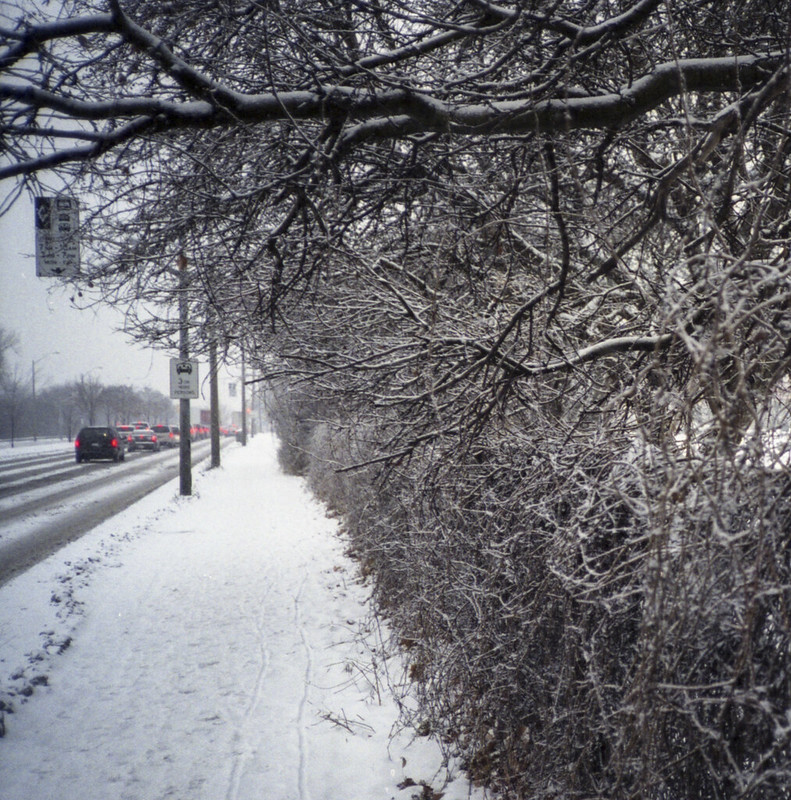
We are in the season of dreary weather now, and shall remain largely in it for some months. There will be breaks of sun, yes, and festive decorations for a time, but by and large it will be dreadfully bleary and drab and uncheery as we drudge, weary, through the grey rain and dull snow, longing even for the quick red break of a brake light.
Dreary is a word that seems well suited to its sense, and it is readily used as a clear brushstroke in poetry. It is a word of winter, often, and of wintry places:
Be left more desolate, more dreary cold Than a forsaken bird’s-nest filled with snow ’Mid its own bush of leafless eglantine— Speak, that my torturing doubts their end may know. —William Wordsworth, “Why art thou silent! Is thy love a plant”
Let the wind moan through the pine-trees With a dreary, dirge-like whistle, Sweep the dead leaves on its bosom,— Moaning, sobbing through the branches, Where the summer laughed so gayly. —Harriet Beecher Stowe, “Below”
All day the gusty north-wind bore The loosening drift its breath before; Low circling round its southern zone, The sun through dazzling snow-mist shone. No church-bell lent its Christian tone To the savage air, no social smoke Curled over woods of snow-hung oak. A solitude made more intense By dreary-voicëd elements, The shrieking of the mindless wind, The moaning tree-boughs swaying blind, And on the glass the unmeaning beat Of ghostly finger-tips of sleet. —John Greenleaf Whittier, “Snow-Bound: A Winter Idyl”
Ae dreary, windy, winter night, The stars shot down wi’ sklentin light —Robert Burns, “Address to the Devil”
I’m on my way to Canada, That cold and dreary land; The dire effects of slavery, I can no longer stand. —Joshua McCarter Simpson, “Away to Canada”
But it is perhaps even better known and loved in poetry for rhyming with weary:
He passes the fountain, the blasted pine-tree, The footstep is lagging and weary; Yet onward he goes, through the broad belt of light, Toward the shade of the forest so dreary. —Ethel Lynn Beers, “The Picket-Guard”
She only said, “My life is dreary, He cometh not,” she said; She said, “I am aweary, aweary, I would that I were dead!” —Alfred, Lord Tennyson, “Mariana”
“Your old earth,” they say, “is very dreary;” “Our young feet,” they say, “are very weak!” Few paces have we taken, yet are weary— Our grave-rest is very far to seek! —Elizabeth Barrett Browning, “The Cry of the Children”
Of the mother I think, by her sick baby’s bed, Away in her cabin as lonesome and dreary, And little and low as the flax-breaker’s shed; Of her patience so sweet, and her silence so weary, With cries of the hungry wolf hid in the prairie. —Alice Cary, “The Window Just Over the Street”
But of thee it shall be said, This dog watched beside a bed Day and night unweary, — Watched within a curtained room, Where no sunbeam brake the gloom Round the sick and dreary. —Elizabeth Barrett Browning, “To Flush, My Dog”
Glad from a world grown old and cold and weary; Leave the sick hearts that honor could not move, And half-men, and their dirty songs and dreary, And all the little emptiness of love! —Rupert Brooke, “Peace”
Often footsore, never Yet of the road I weary, Though long and steep and dreary, As it winds on for ever. —Edward Thomas, “Roads”
All the world is sad and dreary Everywhere I roam. O dear ones, how my heart grows weary, Far from the old folks at home. —Stephen Foster, “Old Folks at Home” (revised version)
Once upon a midnight dreary, while I pondered, weak and weary, Over many a quaint and curious volume of forgotten lore —Edgar Allan Poe, “The Raven”
And sometimes we get both winter and weary:
Crying, my little one, footsore and weary? Fall asleep, pretty one, warm on my shoulder: I must tramp on through the winter night dreary, While the snow falls on me colder and colder. —Christina Rossetti, “Crying, my little one, footsore and weary”
Thick throng the snow-flakes, the evening is dreary, Glad rings the music in yonder gay hall; On her who listens here, friendless and weary, Heavier chill than the winter’s doth fall. —Julia Ward Howe, “Lyrics of the Street”
Dreary is, in fact, seldom rhymed with anything other than weary. Oddly (or not), no one seems to rhyme it with dearie or teary or even bleary, let alone query or cheery. But Longfellow did (a bit dodgily) rhyme it with Miserere:
Ah! what a sound will rise, how wild and dreary, When the death-angel touches those swift keys! What loud lament and dismal Miserere Will mingle with their awful symphonies! —Henry Wadsworth Longfellow, “The Arsenal at Springfield”
But dreary was not always a word of dullness. Its sense of ‘dull, drab’ came from a sense of ‘doleful, melancholy, sad’, which descended from the Old English dreorig, which meant ‘grievous, horrid, gory, bloody, sad’ – senses that seem still to have been present in the mind of Edmund Spenser in 1590:
So fiersly, when these knights had breathed once, They gan to fight returne, increasing more Their puissant force, and cruell rage attonce. With heaped strokes more hugely then before, That with their drerie wounds and bloudy gore They both deformed, scarsely could be known. —The Faerie-Queene, book 1, xlv
The Proto-Germanic origin of dreorig, *dreuzagaz, meant ‘bloody’, too. But in its other modern Germanic descendants the redness has also receded, perhaps under the cross-influence of *drūsijaną (‘look down, mourn’): Dutch treurig means ‘sad, gloomy’ and German traurig is ‘sad, sorrowful’.
Still, a lingering spatter of bellicose blood may be discerned in a few places:
Many men mauled with bronze lance-heads, Battle spoil, bearing yet dreary arms: These many crowded about me, With shouting, pallor upon me, cried to my men for more beasts —Ezra Pound, “Three Cantos”
Is it really there? You can hear it if you put your ear close, as to a seashell. Or perhaps you’re hearing only the roaring of a dull and dreary wind.
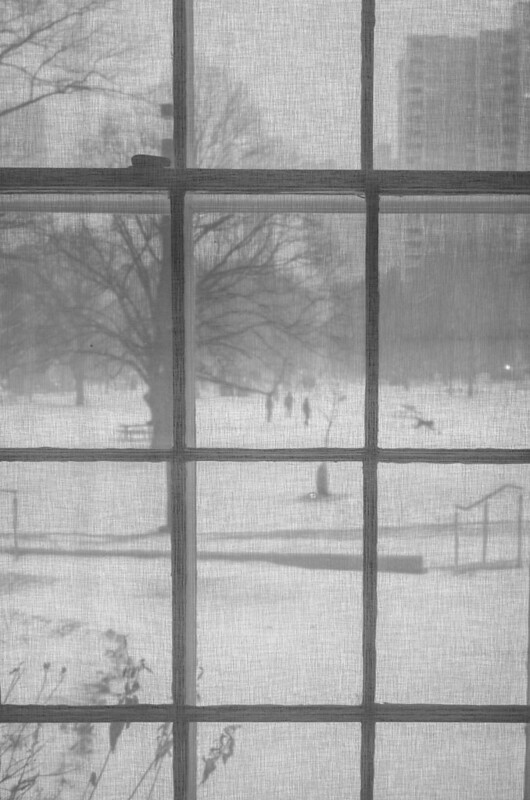
Well. Close the door, light the fire, let winter be wearisome beyond the window, and open a book of poetry. Life will never be fully dreary if one can always do verse.






 Sesquiotica