Category Archives: word tasting notes

nucivorous

Nuts to that doctor. Really. …Actually, no nuts to him. I’ll have the nuts. See if he stops me.

The doctor in question is one I talked with a few years ago, one who helped me to an important realization: that some medical specializations tend to filter out people who have a normal sense of enjoyment of life. This doctor, who seemed affable enough and demonstrably had a sense of humour, nonetheless was telling me that I should make eating a spoonful of psyllium my “special time” of the day. And that I should avoid Thai food, because everything in it was bad for digestion. And nuts? “I don’t even understand why anyone eats nuts.”

By that time I was beginning to feel a little… squirrelly.

Well, at least in that squirrels are nucivorous.

Isn’t that a delicious word, a munchable word, a word you can get your teeth into? You can see the -ivorous, which you’ll recognize from carnivorous and herbivorous and omnivorous and so on. And the nuc(i)-? Well, you may (just perhaps) recall the term nuciform sac, a fictitious organ (invented by G.B. Shaw, I think); that literally means ‘nut-shaped sack’, not to be confused with the common term that is exactly like that definition but without the -shaped part, and names something not fictitious at all.

So, yes, nuc(i)- means ‘nut’. It’s the combining form of the Latin nux. Which, I must say, is about as perfect a word for a nut as any I have ever seen. Especially if you can crack the nut with your knuckles. It’s a bit of a pity that it changes form when used in combination; nuxivorous would be even better. But Latin declension is a tough nut to crack, and I think I will decline.

The word nucivorous doesn’t get a lot of use, but there are some critters that eat mainly nuts. Squirrels are the emblematic case, but I can tell you from personal observation that they eat quite a few other things too. There’s a bird called a nucifrage that is noted for nut-eating; its Latinate name translates directly to its much more common English name, nutcracker. What it eats, though, are often actually seeds, as for instance from pine cones. (Do those count? Nuts if they do.)

And most people are, in the non-restrictive sense, also nucivorous. We’re all-sorts-of-things-ivorous, really; most of us are omni-voracious. But sometimes some nutcase of a gut doctor tries to redirect our diets.

Well. I’ve eaten a heck of a lot of Thai food since I last talked to him. With peanuts in it. And I’ve consumed countless almonds and even countlesser pistachios (or, as I call them, vegan clams). I remain nucivorous. And if the doctor says no nuts are good nuts, I’ll have his.

elucubrate

Here I am, elucubrating again. If you want to set the world on fire, sometimes you have to burn the midnight oil.

Allow me to elucidate. It is late, and I am creating. By the glow of lamps – OK, of electric lights and also of my laptop screen – I am researching and writing yet another work of lit literature. (And, as brevity is the soul of wit, and the hour is not getting any earlier, I intend to make this one more soulful and witty than most, although this parenthesis is not helping the cause.)

You may be familiar with the verb lucubrate or its noun form lucubration. It is often used to refer to strenuous learnedness, overdone erudition, the output of late-night sweating over inkhorn terms by the glow of a lamp. Well, elucubrate is about the same kind of thing – working late by lamp light – but perhaps with less implied derision. It has escaped the accumulated sootiness of snootiness through the simple expedient of not being used. Both lucubrate and elucubrate appeared in the early 1600s, but lucubrate has stayed in occasional use – mainly as a pointedly learnèd word (used to scorn pointed learnedness) – while elucubrate has generally not. But oh well. Here it is, come to light once more.

The source of both words is Latin lucubro, which means ‘I work by lamplight (or candlelight)’ and traces back to lux ‘light’ and luceo ‘I am light; I illuminate’. It was clearly a common enough activity in ancient Rome that they had a word for it. In fact, they had more than one, because they also had elucubro. The distinction between the two words is in the e-, which adds the sense of expenditure (it means, basically, ‘out’). So it’s not just that you work by light; it’s that you use up the light – or its fuel. Or your own fuel, until you burn yourself out. You burn the midnight oil, so to speak. In fact, ‘burn the midnight oil’ shows up in the definition of elucubrate.

Of course, we mostly don’t literally burn oil in our houses now for light. But that doesn’t mean we don’t burn it at all – the electricity powering your lights and your laptop may be coming from combustion of coal or even oil. And while, as Edna St. Vincent Millay knew, a candle that burns at both ends (so to speak) “gives a lovely light,” in the long run of elucubration we may not be able to sleep even when we want to, if we’ve set the world on fire…

swath, swathe

You sway as you swing your scythe: swoop, swish, slash. And again and again. Each sweep makes a swath: a track of cut stalks as wide as your blade and as broad as your swing.

And then, oops, you slip! Your scythe cuts your skin. You stop and grab a bandage, a big piece of cloth, and wind the swathe around the wound until it is swathed.

Most of the time, swath – also spelled swathe at times, mainly in England – and swathe are used figuratively. We know “cuts a wide swath,” for instance. We think of a swath as a sweeping span of terrain, typically lately cleared by action. The sw- plays well with other words suggesting curving motion; they make a nice set, even though they’re not all related. But then there’s this other swathe just to confuse things: the one that is not an exposed patch but a wrapping or cloth for one. You could lay down a swathe on a swath, even.

Is that how we got here? That you make a swath and then you ease it with e, laying that last letter on so you can lay a swathe on top?

Nah. The words are not originally related. It’s like cleave and cleave. Except that the cleave words were at least distinct in Old English. The swath(e) ones were already both written as swæþ by the time of Beowulf. But, on the other hand, they sound different. The scything one, which rhymes with moth, comes from a root to do with swinging – it may or may not be related to swing – while the wrapping one, which rhymes with lathe or with the first part of rather, comes from a root to do with bandages – and is also the root of swaddle.

So how do you remember which is which? I tend to think of the one without e as bare, and the one with e as dressed. But remember that readers in general are likely to be less familiar with the swaddling one. And while you’re at it, remember that the bare-patch or open-tract one shows up most often in tired clichés. Consider cutting it.

cynanthropy

Woof. Ruff. Grruffff! Wrrf wrf woof wuf grf grruff grf gruh rruh rurf ruh wuurh ruwww! WRUFF! Huhh huhh huhh huhh huhh huhh huhh huhh

Oh, sorry. Just mistook myself for a dog there for moment. Much canine. Very dog. Such bark. Wow.

Oops, sorry, did it again. Different kind of dog this time.

I don’t really think I’m a dog much. (A cat, sure, all the time, though.) But some people do seem to imagine themselves as such, or at least to embody themselves as dogs in fantasy (advance notice: this video has rude language):

I’m not sure whether anthropomorphizing dogs, as in the famous poker-playing-pooches pictures, counts, but there is a word for cynanthropizing humans.

Which I kinda gave away there, didn’t I? Yes, it’s cynanthropy.

You may be familiar with lycanthropy: a human becoming a wolf, or at least believing it’s happened. The English word for one such is werewolf (the were is from an old Germanic word meaning ‘man’; it’s not the past tense of was). Well, the English word for a cynanthrope is weredog. Though, really, if you want to go with the Old English roots, it should be werehound—the word dog is an interloper from we’re not sure where.

But speaking of roots, you may have been expecting cananthropy. After all, the classical root for ‘dog’ is can-, right? As in canine, cave canem, et cetera? Well, yes, that’s the Latin root, but anthrop- is from Greek, and the classical Greek root for ‘dog’ is κυν-, which passed through Latin as cyn-, and is seen most often in modern English in cynical (there’s a story behind that, but it’s not today’s word).

So you see what a bit of dogged research can dig up. But is cynanthropy relevant? Yes, it seems it is.

Not that there are packs of weredogs roving around. But in the face of the cynicism of the age, some people are attracted to the ingenuous eagerness of pooches. I don’t mean that they’re dressing up as dogs – though, yes, that too, sometimes, for various reasons –

– but they’re pretending to be dogs on social media. There are, for example, Twitter accounts presenting as dogs, and expressing all the simple wonder and emotional dependency that tend to be projected on dogs. 

And, hey, why not? On the Internet, nobody knows you’re not a dog

conference

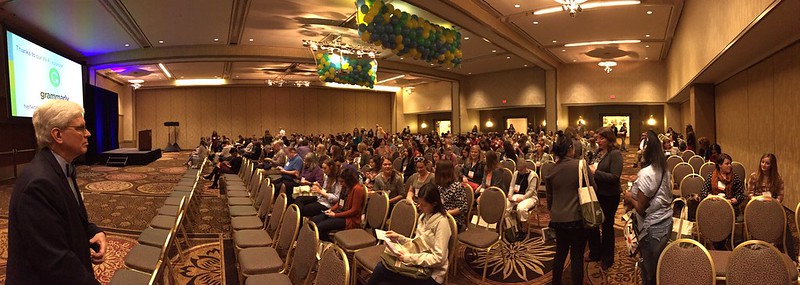
This weekend I’m attending the Editors Canada conference. And this year it has been… different.

Every year, I attend two conferences for editors, one in Canada, one in the US. In 2020, for reasons of global plague, both were cancelled; in 2021, both have moved online, at least for this year.

Before I became an editor, conferences I attended were academic ones – specifically theatre studies and performance studies. But the model was the same. Conferences are organized around speeches and presentations, some to smaller groups, some to bigger ones. You get to learn about all sorts of interesting and relevant ideas.

And then there’s what they’re really about.

Conference is a word that is used for more things than this sort of gathering, as we know; it can be a small meeting (between a lawyer and a client, for instance), or a grouping for the purposes of sports (the Eastern Conference of the NBA, for instance) or religion (e.g., certain sets of Methodists), or any of several other assemblies of people. Conference is the noun form of confer, which comes from Latin confero, from con- ‘together’ plus fero ‘I bear, I carry, I bring’.

And conferences are about bringing people together.

They’re about not just listening to information, but listening to it sitting next to someone interesting you just met. They’re about not just laughing at a witticism, but laughing about it in a room full of people. They’re about sneaking into a session late, sneaking out of a session early, standing listening at the back because the room is too full, live-tweeting, asking a question in person, sharing in the silent group indignation when someone goes on a rambling more-a-comment-than-a-question.

They’re about big rooms full of hundreds of people with a common interest, and smaller rooms with fewer people focusing on a niche subject.

They’re about banquets, with their curious mix of pro forma, exciting, starchy, and awkward presentations, plus the infinite logistical vagaries of mass food.

They’re about standing in front of a room full of people, talking to them as a group, seeing their faces, hearing them respond, and then getting to chat with some of them afterwards.

They’re about sitting at a picnic table with people from several continents, having lunch and talking about whatever really interests you.

They’re about bumping into people at receptions. They’re about banquet table strategy. They’re about going out touring the town and seeing other people from the conference doing the same.

They’re about sitting in a lobby bar, or a local pub, or someone’s hotel room, until rather late in the evening, with people you get to see in person for three days each year, talking about what’s happened with you and what you’ve seen and how business is going and…

They’re about getting to meet people in person whom you’ve long admired from a distance – or, these days, long interacted with online (more or less mutually).

They’re about group outings, and silent auctions, and events such as dance-offs and spelling bees (yes, really), and playing cards or Scrabble (or both) in the lobby.

They’re about all sorts of human interaction and observation. (And they’re about the best occasion you could ever want for taking pictures of people.)

But when you can’t get together in person, they’re still about coming together. Webinars are justly reviled – from the audience perspective, they’re not very engaging, and from the presenter perspective, they’re talking into the void, disorienting, unnerving, panic-inducing – but they do let you slip in late and slip out early without being noticed, and they do make question-and-answer less susceptible to domination by the most aggressive. And the small-group meet-ups – I took part in two of them today – still let you talk to other people and see their smiling faces, not to mention whatever part of their residence is behind them. And they let people from many places come together with minimal expense or inconvenience.

But online conferences still bring only about ten percent of what I go to a conference for. They don’t bring the same togetherness.

So I look forward to seeing people in person again… next time!

winx

If you were to see this word, perhaps on some packaging or in an ad, what would you think it meant?

It’s a hard one, isn’t it, to take a go at without making an ass of oneself. Let’s see…

It could be some version of Windows, I suppose. Actually, that’s Win XP, right?

It could be like Spanx, only for, uh, your eyes? Like somehow to keep them less baggy, in place of cosmetic surgery? Or maybe just wicked fake eyelashes. Sure, that could be it.

It could be a breakfast cereal. If Trix are for kids, Winx could be for adults. Rather than the unpleasant Trix rabbit, its mascot could be a pleasant donkey – in other words, a nice ass, if you know what I mean, nudge nudge, winx winx…

It could be a Dutch name. You know, like Schillebeeckx, Hendrix, Six (yes, that’s really a family name)…

It could be an animated series on Nickelodeon. Actually, it is – well, Winx Club is – but that’s not what I have in mind here. Because this winx is actually a common word – a verb, in fact.

So could it be a combination of wink and wince? That’s a thing for sure. I’ve seen people do it. Also some people who have really pronounced dry-contact-lens blinks do similar. But that’s not what the Oxford English Dictionarysays winx is.

According to the OEDwinx is a now-obsolete verb meaning “to bray as an ass.” Its formation is apparently analogous to whinnock (meaning ‘whinny’) and whink (meaning ‘yelp, bark’).

But can you even picture a donkey’s bray sounding like “winx”? I mean, I guess if you give it some latitude… or maybe asses sounded different in the 1400s, when this word was attested.

But just imagine if this word had stuck around and caught on. That great TV variety show Hee Haw could have been called Winx. And then it could have had its own line of cereal and fake eyelashes and…

disjune

You wake up. It’s 8:30 am, May 31. Your beloved is standing nearby. “Disjune?” you say.

“May,” your beloved replies. “Tomorrow.”

“Tomorrow?” you say. “Why may we not today?”

“May not what?”

“Disjune!”

“No,” your beloved says. “Dismay!”

“I am dismayed!” you say. “Not only that, I’m hungry!”

“Well, let’s eat, then,” your beloved says.

“You said we may not,” you say, slowly attaining the vertical.

“No, I said we June not. It’s May.”

“If we june not, then let us disjune.”

“I don’t want to diss it,” your beloved says. “It’s not even here yet.”

“What?”

“June!”

“Disjune!”

“Look,” your beloved says, “I can’t deal with this on an empty stomach. Let’s have breakfast.”

That’s what I was saying,” you say.

At this point you’re awake enough to sort out that perhaps your beloved does not know the word disjune, and you are about to explain it. However, your beloved has already escaped the room and is headed for the kitchen.

You (dear reader) may not know disjune either. But you may know the French word déjeuner, which these days usually means ‘lunch’, and petit déjeuner, which is ‘breakfast’. Well, déjeuner is just the modern French of the same word that has come to us (and especially to Scots, apparently) as disjune. It is formed on the French jeun, as in à jeun ‘on an empty stomach’ and jeûne ‘fasting’, which comes from Latin jejunus, ‘fasting’. (No connection to jeun/jeune meaning ‘young’.) So to disjune is to un-fast, de-fast, or, um, break fast. (Disjune is mainly used as a noun, but has been verbed, though not often.)

Yes, disjune literally means the same as breakfast, etymologically.

It has nothing to do with the month June, though. The month is named after the Roman goddess Juno. Now, it happens that jejunus traces back to a Proto-Indo-European root referring to sacrifice and worship (well, fasting has its religious uses), but Juno does not – it probably comes from roots meaning either ‘heaven authority’ or ‘lifetime authority’.

But that’s all good news, d’you know? It means you can still have breakfast between May 31 and July 1 without any disjunction.

escal

So… we have some food. Heh. “Food.” “Snack food.” 

Well, it’s escal.

Escal? Isn’t that just a scale you stepped on too hard and the end spun around to the beginning? Nope, it’s a word for ‘fit to be eaten’ or ‘pertaining to food’. In other words, it’s pretty close to edible. But… edible has taken on a new sense lately. At least in my neighbourhood, where there are various cannabis emporiums springing up like, uh, weeds. And after you’ve had an edible or two, what do you call the kind of thing you may want some of?

Just to be clear, by the way, I have not been eating edibles. I mean, I have, but not of the tetrahydrocannabinol kind, just… food. Escal things. We had some leftover barbecue ribs with beans for supper. And after a little bit we each had a Werther’s. And I finished the cheese-and-caramel popcorn. And then I felt like opening the taco chips. And… it kind of escalated. Ya know? It was escal and I ated.

That is not where escal comes from, though. Nor from escalier, the (related) French word for stairs, which are 27 storeys from the street to our apartment and yes, I have taken them, yes, recently (our building’s elevators are not always reliable and we have no escalators), and yes, it does build up an appetite. But no, escal comes from esca.

Now, I don’t know about you, but Esca looks to me like a name. Maybe the name of a Roman nobleman – like Casca – or maybe a Celtic deity – like Ecne – or maybe a soft drink – like Fresca. (One of those three is wise and hasn’t killed anyone. Hint: the Irish one.) But esca is really just a Latin word for ‘food’.

It isn’t the only Latin word for ‘food’. There’s also cibus (modern Italian for ‘food’ is cibo), victus (as in victual but not as in invictus or victim), and alimentum (alimentary, dear Watson). But esca has its own related words: esculent is a fine word, and the related Latin verb edo gives us edacious, a good adjective for a caterpillar or any other incessantly esurient entity. Oh, and come to think of it, edible also comes from edo.

Ya know what else comes from Edo? Sukiyaki, teriyaki, tempura… oh, um, Edo is the name of a chain of Japanese restaurants, no relation. But they excel in the escal, the kind of thing you might want if you’re peckish. Still, I’m not going out to get food, not at this hour, and not when we have all this stuff in bags. Well, look. It was on sale, see?

esbatement

This word is presented here just for your diversion; you won’t get to use it in earnest – it hasn’t been current in English since before Shakespeare’s time. But what is fun if a bit of ultimately otiose intellectual exercise isn’t? Those of us who go running for fun and exercise aren’t trying to get anywhere, and there are various other ways of killing time that amuse without direct issue.

Esbatement may look like basement, but it’s not, though some people may find self-abasement to be an esbatement. It also looks like abatement, and to that it is related, though we need to beat back the semantic connections. Both esbatement and abatement trace to the same Latin verb, battuere, but with different prefixes: ab- versus ex-. The route to esbatement is especially diverting, however.

Let’s start with battuere, also known by its first-person singular indicative form, battuo: ‘I beat’ or ‘I fight’ or, as Wiktionary puts it, “I bang (have sex with)” (Latin is not the only language in which a word for bonking is a word for boinking). That combines with ex- ‘out’ to give exbattere. This has passed into modern Italian as sbattere with an assortment of uses: ‘beat’, ‘bump’, ‘shake’, ‘whip’, ‘whisk’, ‘chuck’, ‘force’, ‘wear out’, and – again – ‘boink’ (i.e., ‘bang’). But that’s not where our esbatement came from.

No, we got it from French, Old French in specific. The Old French verb was esbattre, and the noun derived from that was esbattement, or esbatement. It has come to be spelled ébattre and ébattement in modern French. Littré gives some nice historical examples of its use. Here’s from the 1300s: “En certains esbattemens comme luittes ou courses pour soy eschauffer et exerciter” – that can be translated as “In certain esbatements such as wrestling or races to get energized and exercised.” Here’s from the 1500s: “Les dames se trouvoient aux esbatemens publiques et assistoient à veoir les jeux” – “The ladies found themselves at public esbatements and attended to see the games.”

So it means fights, competitions, matches? Well, sure, but it has come to have a broader meaning: ‘amusement’, ‘diversion’, ‘recreation’. The word came over into English by the 1400s with that trend of sense, and Oxford has some nice historical quotations. Here’s one from 1531: “If he haue pleasure in wrestling … where shall he se any more plesant esbatementes, than that.” 

Apparently wrestling and other things involving beating were considered excellent sport at the time. We often incline to less physical, more verbal entertainments in our time. But words are not only recently a good sport – here’s William Caxton, who brought the printing press to England, in 1484: “These wordes are but sport and esbatement of lordes.”

So… we have verbally mastered esbatement for our own diversion, as it has been diverted from thrashing or even tongue-lashing to just a lush luxury of linguistics. Doesn’t that beat all!

prepone, postpare

“Sorry,” Jess said just after her window appeared in our Zoom chat. “My meeting was preponed and so I was busy postparing.”

“You what was what and you what now?” Daryl said.

Behind him, Margot said “Her meeting was postponed and she was busy preparing.”

“No…” Jess said, with that you-did-not-get-that-right dip in intonation. “My meeting was preponed. You know, moved earlier.”

“Oh, yes,” I said, “that’s apparently a common term in India.”

“It is,” Jess said, “but they’re not the only people who have meetings moved earlier on them.”

“We usually just say moved up,” Daryl said.

“And you tell me whether that means moved earlier or later,” Jess said.

“It’s simple,” Margot said.

“Deceptively simple,” Jess said.

“What do you mean by that?” Daryl said, apparently speaking to Jess but turning to look back at Margot as he did.

“Exactly,” Jess said.

“So your meeting was preponed,” I said, to get the conversation back on the rails. “A perfectly reasonable word. Postponed is ‘put later’; preponed is ‘put earlier’.”

Daryl was looking up data as we spoke. “Been in the language more than a century,” he said, “and not just in India. In the US and England too.”

“Because it’s obvious,” Jess said. “And, obviously, if you were supposed to prepare for a meeting, but as you were about to start preparing you got a message that the meeting was moved to, say, five minutes from that very moment, you won’t be able to prepare.”

Prepare from præ- and parare,” I said, trying to contribute, “‘make ready before’.”

“So you make ready after,” Jess said. “You postpare. Obviously you have to BS your way through the meeting, but if it has deliverables or required background knowledge, there are things you’ll still need to do.”

Arlene appeared behind Jess. “Sort of like doing the readings after the lecture,” she said. Arlene was more recently graduated from university than some of the rest of us.

“Exactly right,” Jess said. “You pretend you know what they’re talking about, and you fill in the blanks later.” Arlene wandered off screen again.

Catching up, you mean,” Margot said as she passed behind Daryl.

Postpare is a perfectly cromulent word,” Jess said, with a little smile. Needling Margot was one of her favourite sports.

Daryl was tapping on his device with the same look on his face as Thomas Dolby had at the Grammys when his keyboard was producing no noise. “It’s not in there,” he said.

Postpare?” Jess said.

“Not in Oxford or even Wiktionary.”

“Try Urban Dictionary,” I said. I knew – because I had just looked – that it had an entry for postpare from 2010.

“Urban Dictionary is not authoritative,” Margot said, busying herself with something or other.

“I guess they’ll just have to catch up,” I said.

“Well, we’ll have to catch up with you later,” Margot said. She turned to Daryl. “Dinner’s on.” She continued bustling back and forth in the background.

I checked the time. “I haven’t even started cooking,” I said. “I should, though.”

Jess looked off screen. “Hey, Lene. Everyone’s having dinner. Where’s ours?”

Arlene reappeared. “Just put it in the oven.”

“You knew when I was going to be done the meeting.”

“Did I, though?” Arlene smiled angelically. “Sometimes these things run long. I didn’t want it to be overpared.”

Jess looked back at the camera. “I think I’m overmatched.”

“I think I’d better preheat the oven,” I said. I knew this would nettle Margot, who considers the pre in preheat to be unnecessary. 

I was not disappointed. She stopped in her tracks and glared towards the camera. “Why don’t you just postheat it? Eat your food first, cook it later.” And then she resumed her bustling.

“Oh, you’ve worked for my company, have you?” Jess said. She turned back to Arlene, who was just off screen. “What are we having?”

Arlene leaned in. “Corn pones with pears.”

Daryl stood up from his chair. “Sounds pre-post-erous. See you later!” He waved and disconnected.

“See you sooner!” Jess said, and then she, too, waved and blinked out.