As I stroll through the neighbourhood where I work, I see mostly apartment blocks and trees. I like the trees; they are calming, anodyne. There is one tree that is especially salient. It rains green on the lawn between a road and a building; none of the others around can match its winsome nobility. It is an elixir for the eyes.
I am told that if I were to lick its bark, I might be absolved of pain temporarily. I think it’s better to leave that extraction to others. But this tree, this regal green-duster, is a salix. It is from its bark that we derive salicylic acid. If that has a familiar sound, it is because its acetate – acetylsalicylic acid, also called ASA – is the active ingredient in Aspirin.
I like this word, salix. It starts with a curve and ends with a cross, and in the middle there is a tree or perhaps two. The word as a whole is slick, even slippery, but crisp.
Perhaps you don’t see the word too much. It names a whole genus, comprising some 400 species. Do they have other names? Some are called osier; some are called sallow (a word that is cognate with salix); but as whole, and for most individual species, they are known as willow.
Yes, willow. That famous tree of love and longing, of wisdom and wind, of weeping and whomping. The usual word is soft as a pillow, liquid and gliding, and in shape so willowy with the w and w fairly dripping with leaves and the ll reaching above. It is a tree of pain and relief, of despair and perseverance: where there is a willow, there is a way. But why not, as the occasion allows, use the Latin word, which has been formally adopted into English as well, though not often used? Why not call it salix? We can call holly ilex if we want, and there are other plants that also carry a Latin name for dropping into conversation. We may, if we will, wallow in willow, but I will on occasion elect to relax in the sunlight under a salix.
Times are dark, thoughts are dim. The current tense celebrity of some shady figures tempts many to ebriety in hopes of managing at least some glow in the turbidity to match the afterglow of retreating brightness. How may we frame the situation? How do we see ourselves in this tenebrity, overshadowed, benighted? Are we left to pray in the dark hours?
That might seem suitable; tenebrae is the name of a Christian service held in the dark hours before the last three days before Easter. It is marked by the extinguishing of candles, leaving the congregation in the gathering gloom. But tenebrity refers not specifically to this but to darkness more generally, not only of the earth and firmament but of the mind and mood and spirit and heart. Its Latin etymon is tenebræ, but in Latin that just means ‘darkness’.
But what is darkness? Are you now, as you read this, in darkness? If not, is there anywhere that is brighter? If you are inside, you are not in the brightest circumstance you could be in; step outside into daylight and you may squint at first. If it is after dusk and before dawn, however bright your surroundings, they are still too dim for high-quality photos from many a camera. If you are in darkness, how do you read this? The glow from your screen is bright, yes? But if it is like my computer or my phone, the screen adjusts its brightness according to context. Sit where there is light on the screen but not on the camera and the screen will seem excessively dim. The truth of tenebrity is that there is almost nowhere that brightness is ten out of ten. We simply adapt our eyes to the dimness. It’s all a matter of how you frame it.
Consider the photo above, taken by the elevators in the building where I live. I am in the dark, little light reflecting off my face, my eyes almost vanishing in the well of shadow. If it were not for the glowing frames of the repeating mirrors, there would be nothing at all. And yet that’s true anyway: without a light source, whatever wherever, we can’t see – our eyes don’t reach out and grab objects to perceive; they await the light, and they adjust to its level.
And sometimes they adjust too well. And sometimes we adjust our view too much to try to bring the truly bright down to an acceptable level so we can see its contours better. When I am standing at those mirrors, I can see the surfaces of the lights and yet I can also see myself well: the hallway is not dim but quite acceptably bright. But when I point my camera at the mirror, it adjusts its narrower dynamic range to the brightness; my face, quite clearly lit to the eye, shows in the image as badly overshadowed.
Tenebrity is relative. What light level is shadow in one place is a bright spot in another. Likewise in our minds and our lives: we know tenebrity by contrast. If we adapt too much to the brightest lights, all else will seem unduly dim. The truly dark will always seem dark, but there is much else that could be bright if we would let it.
Does this word seem to be missing something? Is it sticking in your throat? If you’re undecided, let me needle you a bit. I first came to know this word as the name of a run at Sunshine Village ski area in Banff. Like so many of the black-diamond runs at Sunshine, it’s just a quick steep plunge from a moderate slope above to a nearly flat runout below, and there are few trees in sight – few but not none.
Did they misspell it? Surely it should be larynx, no? No. In the end it is voiceless. It is named after something you might happen to get a glimpse of while you’re there. Is it a rock, like onyx? Or a wildcat, like lynx? Or an ungulate, like oryx or ibex? Or a furry little critter, like hyrax (or its Seussian reflex the Lorax)? Or part of a bird, like syrinx? Or a shrubbery, like ilex? Well, you’re getting closer.
How close? Let me put it this way: If you’re busy trying to spot some elusive creature while skiing down Laryx, you might just run right into a laryx. And you would probably be hospitalized if you did.
What is a larch? It is a tree with needles – like a pine or spruce – but ones that fall off every fall: it is deciduous. When I was a kid, we would hike every fall to Larch Valley, above Moraine Lake near Lake Louise, farther up the highway from Sunshine, to look at the larches as they changed colour and dropped their needles, and to eat cold Shake ’n Bake chicken roughly the colour of those needles.
At the Lake Louise ski area, they have a much larger run (and a chairlift) named Larch. Not at Sunshine. Sunshine Village, which for me has always had the most classic ski-bum-hippy vibe of the Banff areas and which is probably the most family-friendly area there, has managed to insert an uncommon Latinism into its trail map. And an uncommon spelling at that. The normal spelling is larix. The y version is just by analogy with… well, see above for words that might have influenced it. As you may have suspected, larix and larch are etymologically related.
They are quite similar words. And yet there is something of the lurch and starch and large in larch, while laryx seems a curious spry item sitting tensely in wait in its lair or at least relaxing rakish and sparkling (perhaps like a cup or its contents – a calyx or pyx). Larch, naming one of Louise’s most popular wide blue-square intermediate freeways, is a common word. Laryx, naming a short, steep, lightly trafficked slope off the back of Standish abutting the boundary of Sunshine, is a rare small jewel. And it is an expert run, black diamond – perhaps there is onyx there too after all. But more likely you will find the skier’s white elixir: powder snow.
On a pluvious day, having neglected to pack a parasol and wearing pervious clothing, I elected to persist a half hour longer in the Art Gallery of Ontario. I do not think modern art is dry, but I do think modern art museums are dryer than rainy streets. They also add more life and show more ways of seeing. Pulverous they are not.
I normally carry at least one camera with me, and when I’m in the AGO I tend to use it. Not on the art – go see that for yourself – but on the architecture, some (the most interesting) parts of which are by Frank Gehry. And occasionally there are people in it too. And views. Buildings across the street, seen through the rainy windowpane.
People (seated rather than supine) sleeping off the storm or the slow friends and family.
In Toronto, you can often look to the west and get a feeling from the sky where the weather is going, because that’s where the weather is usually coming from.
But when I want to know whether it’s raining at the moment, if the windows are not dripping, I look for one thing: parapluies.
An umbrella is a parasol, right? Well, the sol in parasol is for ‘sun’, but yes, it holds back the rain, and after all, the umbr in umbrella is for shadow. If I say parapluie it may seem pretentious (because French) but at least it means it’s for rain. Because the pluie refers to rain.
Because there’s always more (plus) rain to come? No, because ‘rain’ in Latin is pluvia, and that’s where French got it from. The via has nothing to do with ways (as in Via Appia and impervious) or life (as in French vie), and yet rain is a way of life. And a view of rain is also a portent of petrichor, especially in springtime.
I hope you pardon the purple prose and the mostly monochrome photographs. Everything is more beautiful after rain: the colours are more saturated, as is the chiaroscuro, as is the soil, and the shirts too. In a pluvious cityscape, I may not want to soak in the raindrops and puddles, but I do want to soak in the scenery.
We spend our lives seeking pearls of wisdom, rare gems of insight acquired at great price. We will plough an acre of racinated soil in hopes of finding one shiny stone; we will sluice and pan a creek in hopes of sifting the nugget that will settle our debts with enough for a bottle of Cognac remaining. But this is playing the lottery: it loses a lot. If we want hard truths now, we would do well to alter our perspective.
Look down, for instance. At your shirt. What holds it on? Those buttons – how they iridesce. What colour are they? What colour aren’t they? If, as buttons and some other things sometimes are, they are made of nacre, they will be hard, durable, pieces of some bygone bivalve’s shell, shining in elusive phantasms of colours. If you do not see the colour you want, look another way. If you do see the colour, it will shift in an instant. It is all soft, glowing, never too vivid. It is a durable reminder that what you see often depends on your position. And that things perceived are not always so – and can at the same time be quite different when seen from another perspective. Such is the mother of wisdom.
Mother of wisdom? Mother of pearls of wisdom. Mother of pearl. That’s what nacre is: mother-of-pearl. It comes from the shells of various molluscs: oysters, mussels, nautiluses, various others. Not all molluscs make nacre, but some of the most ancient lineages do.
Why does it shimmer and glow and shift its colours so? It is made of stacks of plates of aragonite held together with elastic biopolymers, producing a very strong material. The thickness of the plates is similar to the wavelength of visible light, and it causes interference with light rays differently at different angles. The shimmering colours are not intrinsic to the material; they are an effect of its arrangement and interaction with the surrounding. Shine a light on nacre and it will simultaneously reflect many different colours at many different angles, but you will only see what is in your angle of view. This is not the one true colour, but it is not a false colour either: it is what you see, and it came to you through light reflected from what you’re seeing, as colours do. Without reflection there is no seeing.
In this way is nacre like our minds, our personalities, the world: reflecting many things in many directions at the same time, and what another person perceives depends on their angle. And because it is a material in a shell, it helps protect the tender being inside. Shells have their uses, after all.
So nacre is the mother of wisdom: when we learn that what we see depends on our angle, we are one step farther forward. And then we can enjoy the light show for what it is. And why is nacre the mother of pearl? Pearls are made with nacre too.
Pearls, those very precious pieces, are made when an irritant intrudes inside an oyster’s tidy shell, a little flaw in its serene world, and the oyster encloses this irritating flaw in the shell material – the nacre. Gold is gold, and is as scarce as it is, but pearls are just a special arrangement of common materials – not even like diamonds, which are highly disciplined carbon; pearls are made of the very same calcium carbonite structures as line billions of shells. But because we want just the pure sphere, we seek it and kill countless other less irritated oysters in the course of finding it. The great price of pearls is the cost of the hours of slaughter required for finding one. We are obsessed with finding the perfect flaw.
In our own lives, we may often be as happy as clams, but we are never as serene as unslaughtered oysters. Life is too irritating, and we gain our own flaws and wounds that we coat with hard shimmering layers to make cherished things of beauty. After all our sea-changes, each of us grows as many pearls as a whole bed of oysters. But most remain hidden from sight, even our own.
And so, looking outward, we still toil to seek the pearl, shuck an acre of shells and chuck the nacre because it’s not in the form of our desire, while the same shifting shine, unnoticed, lines our shells and holds our shirts on.
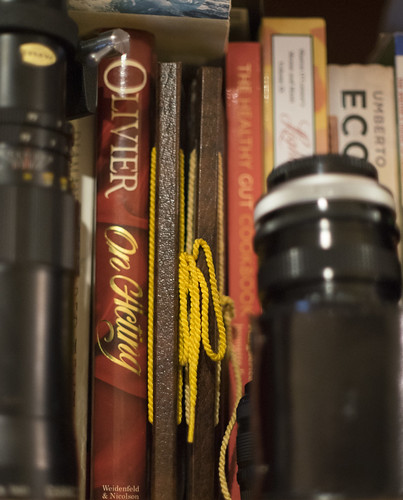
I have something special today. A special book from my bookshelf – well, aren’t they all – but this one calls for a special lens on my camera to photograph it.
The lens is an ordinary enough lens by description: 50mm f/2. There are quite a few of these out there, and 50mm f/1.8, and 50mm f/1.4. The f/2 maximum aperture may stand out for some because two of the most revered lenses in photography, the Leica Summicron and the Zeiss Sonnar, use it.
This lens is not one of those.
Not quite. After World War II, the Russians and their proxies took over some German lens factories and their designs, though not necessarily their production standards. This lens is a Russian copy of a Zeiss Sonnar. It’s called Jupiter-8. It cost me well under $100 on ebay a couple of years ago. It’s uncoated, prone to flare and not very contrasty, and tends to do interesting things with colour, especially when I adjust the files to recover some contrast.
Which makes it a favourite of hipsters. In fact, a remake of it is now being released. I’m not sure why; you can still get an original for well under $100 on ebay. But whatever. Some people like to revive old, questionably made translated copies. They have some charm, after all.
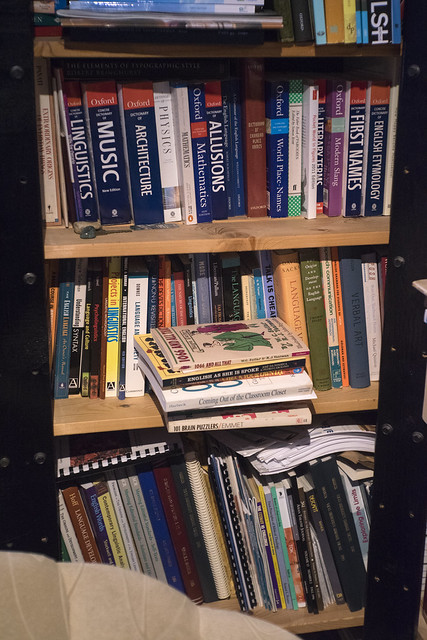
Now. Let’s look at my bookshelf. The part in the corner behind the chair. As you can see, it’s so full I have started stacking books in front of the standing books.
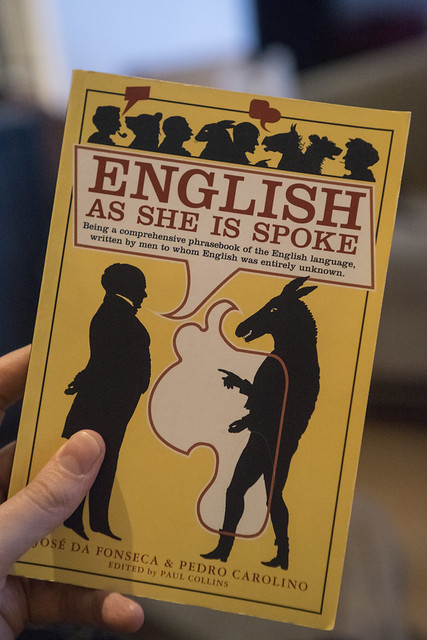
Here’s the one I want. It’s a reprint of a classic that I first read about years ago.
The author, Pedro Carolino, set out in 1855 to make an English phrasebook for Portuguese speakers. He was a native speaker of Portuguese. He did not speak English at all. He also did not even have an English-Portuguese dictionary. But he did have a French-English phrasebook and a Portuguese-French dictionary. Why wouldn’t that work just fine, eh? Find the equivalent word and slot it in.
Ha ha ha.
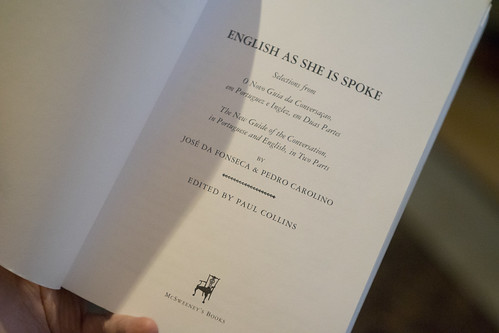
It was so classically awful, Carolino had made himself the Ed Wood of translation. The book was subsequently reissued under the title English as She Is Spoke for the amusement of all and sundry.
How bad is it? Here, read.
You see, it’s not just that the translations are awful, it’s that some of the things that are being said are quite iffy too.
The crowning glory, however, is the last section.
And its greatest moment, surely its most quoted line, comes at the very end of this edition.
To craunch the marmoset.
This may sound like something one does at brunch, but it is presented as a translation of Esperar horas e horas, which means ‘To wait hours and hours.’
So we have three questions. First, what is craunch? Second, what is marmoset? Third, how on earth did he get from Esperar horas e horas to To craunch the marmoset?
Number one, then: craunch. Does it sound like crouch? Understandably, but that’s not quite it. How about crunch? Yes, there we are. It has alternate form cranch, which has related form scranch, which has 16th-century Dutch cognate schranzen ‘split, break’, which has become modern Dutch schranzen ‘eat greedily’. To craunch a marmoset means the same as to crunch a marmoset.
Number two: What is a marmoset? It is a small simian, a funny little long-tailed monkey. Johnny Carson had one of his classic moments on The Tonight Show when one of them relieved itself on his head:
Does marmoset sound like it should be a marmot or some similar rodent? The words marmot and marmoset are almost certainly related. A marmot is, in French, une marmotte. The word marmot now refers to a small child, but it used to refer to a monkey. Both words seem to come from the same root as murmur, though it’s not entirely established (but it may be spoken of quietly). The diminutive form of marmot came to English as a name for this little monkey, marmoset.
They don’t call marmosets marmosets in French, though. They call them ouististis, a word formed in imitation of a sound they make. That word shows up in an idiomatic phrase as well: un drôle de ouististi. I am assured by my Collins Robert French-English dictionary that that means “a queer bird” – I suspect we would now say an odd duck to mean about the same thing.
Speaking of idiomatic phrases, if I open my Le Robert Mini, which is entirely in French, I find at marmot that there is an idiom meaning “attendre longtemps” (‘wait a long time’): croquer le marmot.
Remember how Carolino made his book? He used French as an intermediary.
Having found that croquer le marmot meant, in Portuguese, esperar horas e horas, what remained was to translate it into English: croquer became – well, it should have become crunch or munch, but I guess he liked craunch better; marmot became marmoset, because marmot could be translated thus as easily as croquer could be translated craunch (and anyway it didn’t mean ‘marmot’ in the English sense of ‘big squirrel-like critter’).
This, however, leaves us with another question: What does crunching a marmot or marmoset or monkey or small child have to do with waiting for a long time? Does it just take hours to eat one?
I’ve gotten the answer from a couple of handy French reference sites. The first is the eminently useful Wiktionary. The second and more detailed on this point is Expressio.fr. Both of these are in French, so I will just tell you the answer here in case you don’t easily read French or can’t be bothered. In times bygone (up to a half millennium ago), doorknockers on French dwellings (that had them) were often done in the style of grotesque figures like monkey heads, and so they came to be called marmots. In that same time period, croquer was used to mean ‘knock, hit’. So croquer le marmot meant ‘knock at the door’, and by implication ‘stand outside the door waiting and knocking’. And thus ‘wait hours and hours’.
At last. I bet you’ve been craunching the marmoset for that little explanation, eh? Well, it’s one for the books now, by Jupiter.
People break away. Logic fails. Lines are broken. Needs and desires diverge. Perfectly good things are disarticulated. You expect disco
very but get disco
nnected.
Sometimes you let things slide. Sometimes you can’t, because the slide is no longer there. Sometimes you look across a water gap at a waterslide that is being dismantled, displaced. At some moments life feels like a slide that is falling apart behind you as you slide down it. Or being taken apart.
We can connect disconnect to its history. It traces easily back to Latin. The verb at the heart is nectere, ‘bind, tie, fasten’. It gives us nexus but not (etymologically) necktie. Tie two things together (con) and you get connectere, which (by way of French) gave us the English verb connect by Shakespeare’s time. Add the dis and you have disconnect, according to Oxford first attested in English in 1751 meaning ‘destroy the logical sequence of’ or ‘make disjointed or incoherent’. In 1758 a physical sense is attested. An electrical sense came in 1826; a telephonic sense, in 1877. A personal relationship sense appeared in 1870. A sense of withdrawing from society did not show until 1961. The noun meaning ‘an act of physical disconnection’ shows up by 1905. But the more common current noun sense, ‘discrepancy of understanding, agreement, or communication’, dates only to the early 1980s in the citations. Somehow it took 230 years for the verb to come around in the noun. But that’s not a disconnect. It’s just a slow connection. Like dial-up, not hang-up.
This picture, right here, at the top of this word tasting, which you probably have to scroll back up to to see, is a picture of a disconnect. Not just a disconnection. You can see that the waterslides are being disconnected, of course; the reason they are is a disconnect. Or perhaps more than one.
That’s Ontario Place. An amusement park in central Toronto, on the shore of Lake Ontario, built by the Ontario government, opened in 1971. A great place for urban citizens. Paddle boats, log ride, maze, discotheque, IMAX theatre, concert venue, mini golf, and that waterpark. Summer employer for many a student, including my wife, who was a lifeguard there for several years and, for one summer, a costumed character, which she will readily tell you was “the worst job of my life.” After she and I moved into our place in the heart of Toronto, we would go to the waterpark once or twice each summer to do the waterslides.
It got older and a bit more worn, as things do. Suburban citizens didn’t need to come to it, of course; there are amusements farther out, including a much larger park with many roller coasters and waterslides at the very edge of the urban area, a long trip if you don’t own a car (and not a short one even if you do). Ontario Place remained for those of us who lived in and loved the heart of the city, even though we somehow seemed to be less important to the government. But a renewal project was launched and things were starting to look more spruce. We went and waterslid and looked at the new slide parts and the landscaping being done in preparation for construction.
And then, the next year, 2012, the government decided to close it. They cited some vague budgetary I can’t even tell you what. No communication, no understanding. No waterslides.
The concert venue is still operating, a great place to see acts you liked 30 years ago. The spaces are still there for event rental. The marina is still in business. The rest is empty, echoing silence. They say the whole place is being revitalized. The plans are vague. They do not appear to include a waterpark.
Certainly not this one, anyway.
Since then, Aina and I have been to a couple of waterparks. In Orlando, Florida. Not much harder for us to get to than the one on the north side of the city, and associated with a much better theme park. But that doesn’t let our government off the hook. They’re there; we’re here.
Disconnects. We look at them and we ask why. Why do they have to be? Do they have to be?
Are we, after all, connected? Our minds do not meet, not in this world. We can’t hear or read each other’s thoughts, which is probably a very good thing. Communication is not truly contact; it is an attempt to get solitudes to resonate in harmony. Sometimes they do. Sometimes it seems they do and then we find at some point they do not, perhaps have not. We try to repair, or we fight, or we walk away. We all want different things. Sometimes they are close enough. Sometimes the line is
We all have hangups. If we can let them slide, it may go swimmingly. If we disconnect instead, what will we build next, and how?
Books you’ve had for a long time may seem like a trip down memory lane. But a book is more than a lane, especially if it carries an important part of your formative years. It’s more of a memory neighbourhood. Smetimes when you visit it you notice that it’s still a living neighbourhood. And sometimes as you step into the houses you find the foundations… of your present life and world. You open the cover, leaf through the pages, and see that it is part of how you learned to see. And what you learned to see.
I have two copies of a very special book. The book was printed in a limited leather-bound edition in 1980. One copy was given to me, signed, in 2003. The other belonged to my grandmother, and so, like my full set of Encyclopedia Britannica, it came into my possession. They are up behind some of my other ways of seeing, new and old. I need to remove a lens to see it more clearly.
Not a metaphorical lens. That Canon 135mm f/2.5 lens. (Ironically, I grew up using my father’s Nikon F2. The Canon equipment, though of similar age, came into my possession in more recent years.)
Do you see them now? Two leather-bound books with ornamental laces? Here, let me take one down and set it on the table.
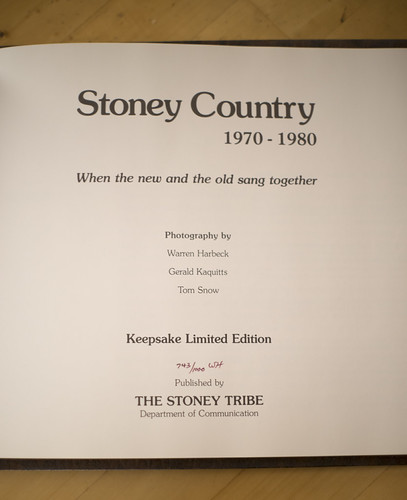
Stoney Country, 1970–1980.
Is this a rocky land? It is a land near the Rocky Mountains. But though the country may be stony, and often dry and dusty and cast in the colours of cover and table, Stoney is not a description of it, not directly. It is the English name given to that people who live there. They call themselves Nakoda. Where is there? Morley, Alberta, Canada. The Stoney Indian Reservation (that’s still the official designation). If you saw The Revenant, you saw some of it, because much of the movie was shot there.
But I saw even more of it. Because I grew up around there.
I saw this sign every time we drove back home from Calgary on the Trans-Canada Highway.
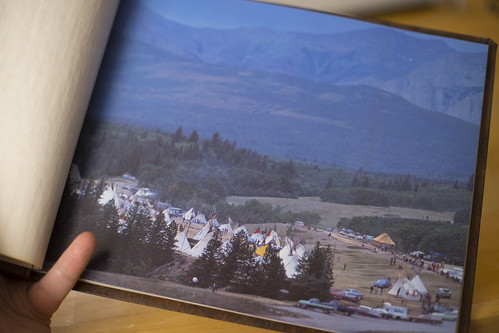
This is a lovely book, many images, few words. It has sheets of parchment every so often with a few more words. When you open the book, the first photo you see is half-seen through a sheet of parchment, like a palimpsest.
Like a memory that is still there in full vividness when you turn the page.
If your memory seems like parchment, it may be that it is parched and needs water. Or it may be that you just need to turn the leaf.
As I leaf through this book, I see picture after picture of what I remember from my childhood.
Teepee encampments in the summer. Real teepees, not fake ones set up by tourists looking for some “authentic” experience. Ways of living, set up in the summer as a retreat from their houses. Flip aside the flap, stoop down and come in, greet everyone one by one, have a cup of tea, sit and talk.
Or, if you were me, sit and mostly not listen and mostly not understand. We, not being Stoney, spoke English at home, but my parents – especially my father – spoke Stoney and had long conversations. I looked at the fire. I played outside. Sometimes I played with the other kids.
Sometimes we went to the rodeo.
One time I even – in a small paddock by the house of one of our neighbours on the reserve – tried riding a calf. I’m not sure I lasted two seconds before ending in the dirt. At the rodeos I just watched, or didn’t watch, and maybe played or got some food. Tea, bannock. (A culinary ethnologist could be forgiven for thinking at first that the Stoneys were a lost tribe of Scots.)
Then I got older and didn’t join my parents to these things as often. Looking back, it would have made more sense for me to have learned the language. But little kids never really enjoy adult conversations, do they?
But the mountains don’t go away. None of it goes away. I went away, but it didn’t go away from me. Look, here is the mountain we lived at the foot of for five of my most formative adolescent years. Yamnuska.
The book closes with a traditional Stoney benediction. I’ve heard it spoken so many times. I’ve even said it aloud a few times myself. Next to the benediction is a picture of crocuses growing on the shoulder of that same stony Rocky mountain. Crocuses like we used to pick when I was a small child.
It is the country of the Stoneys, so it is Stoney Country. It is also stony country with rocky mountains. And I, having grown up there, am a child of those stones. Having been born there, to parents who had been accepted as part of the community, I was given a name: Îpabi Daguskan (or, as it sounded to my young ears, “Pobby Dowscun”). It means Son of Rock. Or, I guess, Stonechild.
Perhaps it’s fitting, then, that I have ended up with two copies of this book. This one is number 743 of 1000, initialled at the time of publication by the person who did much of the work putting it together, who took me to the production shops where I first learned about CMYK offset printing, who photographed so much of it with his Nikon F2.
My dad, of course. (But the snowy photo above was, fittingly, by Tom Snow.)
I haven’t really talked much about this word Stoney, have I? Not directly. But what you see above is some of how it tastes to me.
Oh, and this. The theme music from a multi-media show about the Stoneys my dad did in 1977 (using, among other things, some of the same pictures). It wasn’t written for that, but it was perfect, and the singer – Lobo – let it be used. Let’s play this video of it for the closing titles today, shall we?
Miss Henderson had circled a word in his essay and written, “You don’t know what this means.” But he had looked it up in the thesaurus! It was a synonym of spirit! So how could he be wrong to talk about “finding the right chimera”? Such a nice, shimmering word, too, like a ghost or a ghostly chiffon wrap. “Shimera!”
I’d never seen the word before either. It was high school, and his outrage seemed quite reasonable to me. It was some time before I learned what a chimera actually is, and even longer before I learned that the ch is pronounced “k.”
The joke on Cliff was that he had already found the right chimera. It’s called the English language.
What, historically, is a chimera? First of all, it’s also a chimæra. The æ is the Latin spelling, seen in some English versions though lost in the French chimère that was the immediate source of the English word (some writers changed it back to match its glorious classical origins). The Latin got it in turn from the Greek, χίμαιρα khimaira – note that that χ that I render as kh is before a high front vowel and could be like the ch in German ich, which is as close to “sh” as to “kh,” but phonemically it is nonetheless “kh.” But we in Modern English, having neither sound, just harden it to “k.”
A chimera is a mythical creature. It is made of parts from a lion, a goat, and a serpent, and it breathes fire; in Homer, it was slain by the hero Bellerophon riding on Pegasus. By extension, chimera refers to any creature made of wildly disparate parts, or to any implausible fantasy. Or, as the Oxford English Dictionary puts it, “An unreal creature of the imagination, a mere wild fancy; an unfounded conception.” Like if you had to fight a dungeon monster made of reanimated hash. Or rehashed animals. The chimera has been quite catchy in popular culture too, as Wikipedia gladly manifests. It is like a camera on America, an avatar of the hyperreal. There are also fish of the order Chimaeriformes, most notably Chimaera monstrosa, also called the rabbitfish or ratfish. Chimeras are, as Buck 65 puts it, wicked and weird.
And so is English: a West Germanic language that displaced a Celtic language and was heavily changed under the influence of invading Scandinavians who had settled in France and brought their version of French to England, and other invading Scandinavians who came directly from different parts of Scandinavia, and that has in more recent times augmented its vocabulary heavily with bits from Latin, Greek, Italian, Spanish, Japanese, Polynesian languages, Algonkian languages, and, frankly, everywhere. And it has things that look like one thing but are another (ch, anyone?) and things that are sometimes there and sometimes not, or sometimes one thing and sometimes another (is the e version more likable, or is the æ version more likeable?). Whatever you think you have, you don’t have, or you have two of. Every allusion is an illusion, every illusion an allusion.
But you don’t need to be Bellerophon: you don’t need to slay the chimera that is English. You just need to find the right spirit.
This word may bring to mind a preferred adjective of a paradoxically half-baked yet overdone blowhard. “Yuge! It’s gonna be yuge!” It looks like another way of spelling it, doesn’t it? One that is simultaneously quasi-classical-looking and yet iconic of a revulsion reaction, the cut-eye glance e e with the ug in the middle like a thought balloon.
But this is a word seasoned by time. It manifests another paradox: that truly well done things are rare.
Is this word well done? Would I steak my name on that? Sorry, I mean stake? I could. It is a Greek bearing a gift. It comes from εὖγε euge, the bits being eu ‘well, good’ (as in eulogy, euphoria, euthanasia) and ge ‘done’. It was a cry of approbation in Greek, and was borrowed whole cloth into Latin.
But how was it pronounced? In the original Greek, it would have been two syllables, something like /ɛw gɛ/. The pronunciation of Greek has progressed over the ages so that in modern Greek (where it still exists) it is said /ɛv jɛ/ (i.e., “ev yeh”). But when Latin took it, it gained a syllable: /e u ge/. Shouted (as one may with such praise), it sounds a bit like an old car horn – just a little higher in the front than the classic “ah-oo-gah.”
But, you know, English has developed its own ways of saying words borrowed from Greek and Latin. We know how we say Eugene, which comes from Greek for ‘well bred’ (the gene from the same root as genesis and generation – and gene, for that matter). The correct English pronunciation of euge, when it’s actually said, is /ju d͜ʒi/ (i.e., “you gee” – in other words, Eugene without the /n/). The ferment and curing of the ages can have profound effects, and whether you think they are improvements is a matter of taste.
But it’s not actually said very often. It may be ‘well done’, but it is rare. We have other ways of saying things are well done, of course – for one, we borrow from Italian the expression bravo (which, by the way, modern Greeks do too: another way of saying ‘Well done!’ in Greek now is Μπράβο!, which is just a modern Greek transliteration of Bravo!). Ironically, we have also made bravo a noun (uncommon now, true) meaning ‘daring or reckless villain; hired assassin; desperado’. Somone in the line not so much of “Euge!” as of “Yuge!”