
crux

Here’s an excruciating question: Can you talk about the crux of a book? A book’s crux? Or a movie’s? Can you say that the crux of The Crying Game is Dill’s disrobing?

What, in fact, do we even mean when we talk of the crux of something? Does it seem sometimes that we are at cross-purposes with it?

If you know Latin you know what crux is: ‘cross’. Not cross as in intersection, or as in deletion; cross as in crucifying, as in excruciating. An instrument of physical torture (and execution) used metaphorically for mental torture. An analogous case is travail and travel, which trace back to trepalium, a three-staked torture device. (If you’ve flown to, or in, the US lately, the link between travel and torture may make sense.)

Crux in this non-literal use showed up in English in the early 1700s to mean ‘something that is torturous to figure out or explain’; it may have been taken from Latin crux interpretum and/or crux philosophorum. By the late 1800s this had evolved to be the ‘central problem or point of interest’ – the crux of the matter or crux of the case. Meanwhile, by the late 1800s, it had also come to be used by mountaineers and rock climbers to refer to the toughest part of a route: the crux pitch or crux move or crux of the ascent. Again, a most difficult problem to solve. Not murderous in creation and resolution like a horcrux, but still something you would not want to double-cross.

So. Can we have a central problem of a book or movie? A central point of interest, sure. But let’s look at the words that crux of the usually goes with: according to the Corpus of Contemporary American English, the top ones are matter, problem, issue, case, argument, debate… and story. So in general, things that require resolution have cruxes; the crux is, in a way, the central knot. Stories aren’t problems in the same way as arguments are, but they have a structure, and that structure normally entails a problem and resolution.

And a novel is a story, right? Except it’s mentally schematized differently. How do we know? We know because we don’t use the same words and phrases to talk about it. And a book, and a film. A book is a container; it may contain a narrative conflict, but that is in the book. A novel is an elaborated presentation of a story or stories. It’s not that no one speaks of the crux of a novel, book, or movie; it’s just that almost no one does, and anyway somewhat fewer than speak of the crux of a story – let alone of an argument or problem.

But why? Schematization: the mental entailments we have for a concept. All the threads and connectors it has. Also collocations – the other words a word tends to travel with – which come from and reinforce the schematization. Words are known by the company they keep. And we learn them by hearing and habit – much less so by looking them up or applying logic to them (both of which can produce some of the most egregiously deadhanded dyslocutions). Just consider how many people speak of the problem’s crux or the matter’s crux (hint: no one, really). If you can talk of the problem’s resolution rather than the resolution of the problem, why can’t we talk of the problem’s crux?

For that matter, why not the exercise’s point rather than the point of the exercise, or the day’s soup rather than soup of the day? They should mean the same and be interchangeable, but they’re not. The longer version has two the’s because it has two noun phrases, each of which can have a determiner, whereas the shorter one is one noun phrase with a possessive noun modifier and as such can only have one explicit determiner (the determiner attaches to the possessive noun, but the possessive noun itself functions as a determiner for the other noun). But that’s not a problem for such things as the problem’s resolution. In the cases in question, the prosody seems to be important – when the modifying noun is dangling off in a prepositional phrase (of the problem), it is less central, more clearly a peripheral modifier that can be dropped off.

We might also consider some influence of the sources – soupe du jour and crux interpretum. Of course we don’t have that in mind when we say the crux of the matter. But we do have the gravity of tradition and habit. And that is the crux of this word tasting note.

If I may say that.


Thanks to colleagues on the email list of Editors Canada for discussing crux and inspiring this word tasting.
peregrine

A pilgrim is someone who undertakes a life-changing journey. A peregrine is a wanderer, someone venturing far from home. A bird away from the nest. A stranger in a strange land.

Both words come from peregrinus, which in Latin meant someone from a foreign land; it appears to have been assembled from per ‘by’ and ager ‘field, territory, land, country’ (also descended to acre and agriculture). Pilgrim arrived in English first, and in fact has been in English as long as there has been an English to be in; peregrine came later, but by a more direct route (first seen in Chaucer, referring to the bird I name below).

In Rome, a peregrinus was a non-citizen resident. At one time, nearly 90% of the residents of the empire were peregrini, “foreigners,” even if they were in the land they had been born in. This meant they had fewer rights, less recourse, lower social status. A citizen would get the benefit of the doubt and had a right of appeal; a peregrinus was entitled to neither. At death their property was taken by the Roman state. Rome relied on their labour but scorned them. Pilgrims may be honoured, but peregrines – “foreigners” – are not.

On the other hand, a peregrine well known in our times is a predator: the peregrine falcon, the world’s most widespread raptor. It is also the fastest animal: it can pass 320 km/h (200 mph) when it plummets from on high to the abrupt undoing of a lesser bird. It is the lickety-split grim reaper, not a scythe but a flying sickle – Latin for ‘sickle’ is falx, believed to be the origin of falco, ‘falcon’, as in Falco peregrinus.

There are many people named Peregrine, including three saints, one of whom is the patron saint of cancer and several other diseases (he rarely sat, and this may have led to his developing a “cancer” on his leg, which was miraculously healed just before the leg was to have been amputated). He is said to have been a wise and caring person, dedicated not to destruction but to healing.

If the name has a familiar ring, however, it may be because it was also the name of a familiar of the ring-bearer – a companion of Frodo Baggins in The Lord of the Rings: Peregrin (no e) Took, casually known as Pippin. He went with Frodo and the Fellowship of the Ring and joined in battle against the orcs and the dark forces of Mordor; he was also the only one who looked into the palantír and spoke directly with Sauron. After Sauron’s defeat, he returned to the Shire, helped defeat Saruman, and became Thain of the Shire. So he wandered and returned; he had his battles and his victories.

Peregrinus makes me think of one particular battle, the battle on the ice of Lake Peipus, a large lake now on the border of Estonia (coincidentally, the country my wife’s father emigrated from) and Russia. Alexander Nevsky fought the knights of the Teutonic Order there. Sergei Prokofiev scored the movie Alexander Nevsky by Sergei Eisenstein, and in the battle scene the text of the music is “Peregrinus expectavi pedes meos in cymbalis”:

What does that mean? It’s difficult to translate – the Latin seems battle-weary and far from home. It’s really four things: ‘a stranger’; ‘I waited’; ‘my feet’; ‘on cymbals’. Various theories have been advanced about this text, a seeming musical lorem ipsum, but the most persuasive research finds that it is snippets from four psalms that were used in Stravinsky’s Symphony of Psalms (read the whole analysis by Morag Kerr). Prokofiev and Stravinsky weren’t getting along well, and this was likely in part a shot from P at S. The words’ place in the score is as largely meaningless text expressing the mindless hypocritical religion of the Teutonic Knights.

That’s quite a far journey from the effervescence of the other end of peregrinus: a mineral water transported in glass bottles across the ocean… San Pellegrino, named for Saint Peregrine. Of course, mineral water is “good for your health,” and mainly it’s refreshing. Whether it needs to be bubbled from the earth in Italy and transported across the Atlantic to be guzzled in, say, Toronto and returned thereafter (mutatis mutandis) to the water cycle is a question to ponder at leisure; necessary or not, it happens.

And necessary or not though our wanderings and estrangements may be, they happen. We are all, in our ways, strangers in strange lands, on loan to this world and peregrinating through it before returning, dust to dust, water to water, gas to gas, spirit to spirit. Here are two of the songs I like best about this wandering and return.

To this perpetual peregrination I welcome my great-nephew, newly born to tread the earth. His name is Peregrine Toms.

pilgrim

Listen, pilgrim.

That’s John Wayne talking to Jimmy Stewart in The Man Who Shot Liberty Valance.

What is the valence of liberty? As your periphery enlarges, as you wander farther from your home base, do you become freer? Fuller? More interactive? The Tao Te Ching tells us that without going outside, we may see the world, without looking out the window we may know the ways of heaven, and the farther we go the less we know. But is that because our valences expand and we have more room for the little sparks of knowledge – the more we know, the more we don’t know, and the more room there is to know?

Or do we just become unstuck?

Listen: Billy Pilgrim has come unstuck in time.

That line is from the beginning of Slaughterhouse-Five, by Kurt Vonnegut. Its protagonist is a Pilgrim, and an involuntary pilgrim of sorts. He wanders far from his origin. He sees things. He learns things. He watches people die. He sees life out of order.

Well, life is out of order, really. One thing we like to try to do is put it in order. Or at least put ourselves in order, our own lives. Give them a purpose. Give them a trip. A narrative. A Destination. A pilgrimage. The geographical journey is a longstanding analogue and metaphor for the spiritual journey. John Bunyan’s allegory Pilgrim’s Progress dates to 1678, but real pilgrimages date to well before that. Geoffrey Chaucer’s Canterbury Tales was about a company of pilgrims to Thomas Becket’s shrine in Canterbury. They went in company, had a good time along the way, paid their respects, and returned home.

Not every pilgrim returns home. The Britons who arrived at Plymouth, now in Massachusetts, in 1630 styled themselves as pilgrims. So did the ones who arrived at the Canterbury Peninsula on New Zealand’s South Island in 1850. Easterners who went west in the USA were sometimes called pilgrims – that’s why John Wayne’s character keeps calling Jimmy Stewart’s character that. They went to make new lives in a new place, most of them never to return to their origins. Did they change themselves? Or did they just change the place they went to? Were the changes for the better? Sometimes change is a grim pill. Sometimes liberty’s valence is violence.

But millions of people are pilgrims every year, making sacred journeys, going farther from home to find things deeper within themselves. The pilgrimage to Mecca is something every Muslim is supposed to make at least once in a lifetime if possible. Many Christians walk hundreds of kilometres to Santiago de Compostela; others go to Medjugorje. Young westerners voyage to India and other places in the East to see light in the darkness and make some sense of it.

It serves what Jung called a transcendent function.

And there are secular pilgrimages, now, too – just look at the baseball devotees arriving in Cooperstown and the Elvis fans converging on Graceland in Memphis, Tennessee. Somehow even these can be transformative experiences. I live near a “shrine” that I can see from my window: The Hockey Hall of Fame, at Yonge and Front in Toronto. The Stanley Cup is the Great Canadian Fetish. Not too many people come specifically to Toronto just to see it, but quite a lot of them make side trips. (My mother, on the other hand, made sure to make her side trip five blocks farther west, to the CBC headquarters.)

Do pilgrims seek liberty in increasing their valences? Some do. Others seek growth. Others seek confirmation of what they always wanted to believe. Others are just adding to their libraries of experience. But all movement is change. In deed, in thought, in word.

In the beginning was the word. At the end is a word, too. But it’s a different word. No, it’s not – it’s the same word, but different. The word that has ended up where we are is pilgrim. It came to us, by way of old German languages, from Medieval Latin pelegrinus. Which was in turn a changed version of Classical Latin peregrinus. Which has also, on a separate, more direct path, come to us as peregrine.

Which I will get to next.

encave

What is it about us that we think we are immune if immured? The world is big and full of variety, and help comes from others, but so does danger, and many of us, faced with the temptation of an overbuilt cocoon, cave in and encave in an enclave, urban (and suburban) troglodytes warming ourselves at the blue flicker of giant flat screens – the new silhouettes in our Platonic caves. It is so craven to cave in so, to crave encavement. In the yard perhaps is a sign signifying cave canem (‘beware of the dog’), the pooch positioned to protect us – forgetting as we do that in Goethe’s Faust the devil appears as a poodle – but our motto may as well be cave diem (‘beware the day’).

Do I overstate the case? Go into the newest neighbourhoods and see: vestigial yards fronting overinflated balloons of boards, bricks, and vinyl siding, a mere metre gap between one and the next, as if on compact archival shelving for house models. No life outdoors; even when you evacuate you encave: hop in your moving imperial shell to get to shopping or work, joining others to make a metal-and-glass bubble-wrap unrolled along the “free”way.

So we are encaved. It is a simple enough word: en ‘in’ and cave ‘cave’ (obviously) from Latin cavus ‘hollow’ as in concave and cavity. But look in two dictionaries and see two slightly different senses. In Webster’s Third New International Dictionary, it is, succinctly, “to hide in or as if in a cave.” In the Oxford English Dictionary, it is “To enclose or shut up in, or as in, a cave.” Both are shown as transitive: you do not encave, you encave yourself or someone else. Both allow an “as (if) in,” so I can say we are encaved and not add figuratively. But there is the difference between “hide” and “enclose or shut up.” You may be enclosed or shut up but not hidden (a glass cave?) and hidden but not enclosed or shut up (duck behind a rock?). The difference is in perspective and who is restrained. Is it that others are kept from seeing us, and we are free from their gaze? Or is it that we are kept from leaving, and others are free from our presence?

And can we easily tell which is which? And when one becomes the other?

The hardest language

Originally published on The Editors’ Weekly, the official blog of Editors Canada

What language is the hardest to learn?

The hardest for whom to learn?

The world has many languages of many different kinds, but one thing they all have in common is that kids grow up speaking them fluently and think of them as the natural way to say things. Some languages have many inflections – up to two dozen forms of the same word – and yet their speakers have no trouble with them. Other languages rely on strict word order: move a word and the meaning changes. Kids learn them fine. Some assemble very long words from little bits; others use short words that can have many meanings depending on context. Children learn them all.

Adults, on the other hand, have a hard time learning what they’re not used to. A language that’s very different from what they grew up speaking will be a much greater challenge no matter whether we might think it simpler. But there are several factors that can affect just how hard the language is to learn.

Grammar is an obvious one. When speakers of one language have to learn a different language, they tend to learn the core denotative parts but not so much the grammatical connectives. That should make a relatively uninflected language such as modern English easier to learn (in fact, influences of foreign learners are the main reason it’s so simple – Old English was heavily inflected), but for people who are used to substantially different word orders, or to seeing grammatical relations marked on words, it could be a problem.

Pronunciation can also make a language harder. If it has sounds you aren’t used to making and distinctions of sound you aren’t used to paying attention to, that’s going to be trouble. English defeats a lot of people with our “th” sounds and subtle vowel differences (such as bit versus beat); Mandarin’s palatal consonants and its tones stymie many English speakers. Hindi has consonant differences most Anglophones can’t even hear.

One thing that makes a language particularly hard to learn is inconsistency: irregular verbs, idiomatic phrases, wildly inconsistent spelling. The same historical contacts that helped simplify English grammar helped nightmarify its spelling so even native speakers can’t get it all right. We’re not the only language with troublesome spelling: languages as different as French, Gaelic, and Tibetan are larded with silent letters. But they’re still mostly internally consistent. English doesn’t quite require a person to learn each word form, as Chinese does, but it’s much more challenging than most.

All of the above, however, is at least in the textbooks. The truth is that what really makes a language hard is culture: what words or ways of saying things you must or must not use with certain people or in certain places. Unspoken rules of politeness and social hierarchy, along with the habits of different genres (formal versus informal, or newspaper versus novel), are the real landmines, especially for someone from a very different culture. As odd as English spelling is, the fact that “Would you mind shutting the window,” “Could you shut the window,” and “Please shut the window” can mean the same thing in decreasing order of politeness, patience, and deference is likely to be even more vexing… and is less likely to be explicitly taught.

keck, kecks, keckish, kex

There are times when you feel… keckish. Your throat feels like one of those hard hollow plant stalks, or a pants leg dipped in saltwater and dried out, rigid, astringent. It is as if someone has stuck a popsicle stick too far back in your gullet. You can’t kick it; you keck, keck, keck!

Keck, verb, means ‘gag’ as in ‘try not to vomit but not have an easy time of it’. It can be used figuratively (with at) to refer to expression of disgust: “Ugh. I keck at that jackass’s expectorations.”

Keckish means ‘inclined to keck’; it’s disused but useful, and has a synonym kecklish.

Kecks plural can refer to pants: in Scotland and northern England, your kecks are your trousers, and if you’re caught with your kecks down, you’re in an embarrassing spot. That usage comes from kicks, as far as we can tell.

Kecks seems not to have to do with kex, also seen as keck, which like pants legs is tubular but is harder and smaller – it’s a hard hollow stalk of an umbelliferous plant such as cow parsnip, wild chervil, or marsh angelica (as Oxford tells me). The x may lead you to expect a Greek origin, but no, not as far as we can see. On the other hand, we don’t quite know just what lexical marsh it did sprout out of.

What a keck-collection! It’s nothing to cough or scoff at; it kexceeds kexpectation (but not kexpectoration).

So. If the sight or sense of a strawlike stem in his dungarees makes a fellow gag, that means he kecks at kex in his kecks… just for kexample.

sheel

To sheel is to shell, meaning to de-shell.

And when you peel away the shell, how does it feel?

Clams and mussels are shell without and flesh within, which means that without the without they are soft. Turtles, de-shelled, are soft but have bones farther in. Humans have the hard deep within and are soft without – so we cannot be without something hard to go around us: buildings, and cars, and the assorted armour of culture. The world is our oyster because we are cultured oysters in our world: we build our shells and then take what irritates us and build shells around it so we have pearls. Of wisdom? Of great price? Of art? Sheel us and find out.

One sheeler I think of is Charles Sheeler. He was a photographer of things industrial, and a painter of them too. Factories, buildings, chimneys, bridges, iron scales, slate roofs, the hard diagonals and sharp angles of steel and stone: the bones and shells of our culture and means, all rendered with exquisite precision. Do have a look at some.

I first met Sheeler’s work in the Museum of Fine Art in Boston; I went there often to swim in the paintings. Take the red subway and the green streetcar (E) and walk a block until you are almost in a lush little fen-way park, and there is the flat stone face. Go in and you will know that museum smell. Upstairs, go left, then right, halfway to the other end, turn right, and there in the centre of it all is a gallery of moderns. The Sheeler is on a half-wall in the middle, facing left. Or at least it was two decades ago. Shale-grey steel carrying steam, an image of what we have made to produce things to protect us and convey us. This hardness we’ve produced, now flaked off in a flat pinacothèque rectangle for us to admire and see ourselves reflected in its sheen. Other painters show people; Sheeler’s pearls were our shells: he sheeled them for us. Does that seem inside-out? Remember that a pearl is just shell grown in the other direction. The outside is deep inside, a universe locked in a grain of sand; the inside is all there is to see, and it shines at the infinite within without.

Where does sheel come from? It is related to shell, of course, but also (and perhaps more closely) to shale. Shale was first a word for a husk, a covering; from that (we think) we got the name of the rock. And all this is also related to scale. As we scale the sheer heights in our buildings, so we scale the heights of our art, and we weigh our lives in the scales and the scales fall from our eyes. But we never stop making our shells within and without, even as we ever look to the sheeling.

frontline

Who is at the frontline of language change?

Sorry, should that be front line? I think it should. If you are at the foremost front, you are at the forefront, not the fore front, but the line that forms the front of a battle – or, more figuratively, any other advance (especially in conflict situations) – is the front line, according to, well, every dictionary you look in.

But a lot of those dictionaries have frontline too. Not as a noun, though: as an adjective. Staff who are dealing directly with customers are front-line staff or frontline staff. If they were written as front line staff, there could be confusion over whether they were line staff at the front rather than staff at the front line. So we hyphenate. And, over time, as with this adjective, we may merge.

Or we may not. Mergers happen sometimes and not other times. You can be a healthcare professional working in health care – or working in healthcare, because that noun has a closed-up version now too. And you’re reading this on a website – or, to be old-fashioned, a web site. But you can have an ice cream float or an ice-cream float, but if you had an icecream float you risk having some pedant with a marker draw a couple of lines to indicate that there should be a space there, implying that you need grammatical trainingwheels.

The front lines, in language change as in war, are very uneven, meandering up and down and in and out, and the main thing that keeps them from moving is just if they get really entrenched (yes, when you think about it, front line and entrenched both call to mind the ghastly battles of World War I – both predate it by centuries, but both have military origins).

So… could frontline become the noun form too? Some people want it to be – a colleague mentioned to me that one of the people he works with is pushing for that change in their published text. Mind you, his coworker isn’t saying “I know that front line is standard, but I think we are making a good move forward to close up this compound. We may be in the, erm, vanguard, but we can take the fire.” No, his coworker is saying “I looked in the dictionary and it has frontline as a form so I’m going to use it everywhere.” His coworker is heedless of the noun-adjective distinction.

Which is how language change so often happens: reanalysis, or what members of preceding generations tend to call mistake. The English language isn’t really an ongoing battle – if there is an enemy, they are us. It’s more like a complex game that gets passed on from one family to another, and it doesn’t have a rulebook, and each new group of players pick up a few things from the previous players but mostly figure things out for themselves, resulting in some shift of the rules over time. We hear our parents talk, and we work things out for ourselves, and they don’t correct all of our reconstruals.

So, yeah, you could say that the front line in language change is the battle between the older generation, wanting to preserve what it knows, and the younger generation, wanting to do what suits them best. But from another perspective, the battle is as much like explorers having to put up with previous people – who didn’t get as far – shouting at them “No, you fools! You’ll fall off the edge of the planet!”

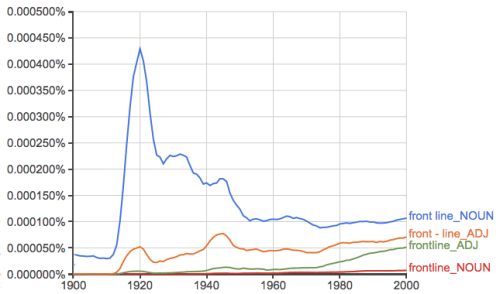
Fine, fine. The question remains: is frontline taking over from front line as a noun? Is it heading the way of healthcare and forefront? Will we soon see not only the frontline but the frontlines just as we see the headlines? Or is it like icecream and trainingwheels? Let’s have a look at a Google Ngram:

frontline_NOUN is way below front line_NOUN and both adjective forms, and not gaining very much

Hmm. Nope. Anyone who uses frontline as a noun is going to be awfully far in front of everyone else, exposed and prone to being shot at… from behind. And the general usage may not ever come close to catching up. It looks pretty well entrenched.

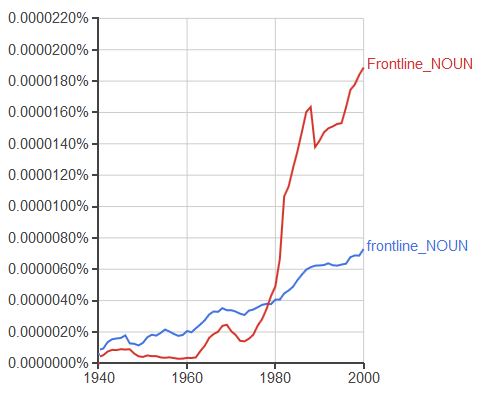
Addendum: I neglected to consider one important vector for change in this. Google ngrams are case-sensitive, and I only surveyed lower-case. But take a look at this:

Frontline-1

So Frontline is increasing in usage much more than frontline. Why is that? I’ll tell you one reason. Since 1983, PBS has had a documentary series called Frontline. TV shows are important vectors for language change.

But that doesn’t mean the branding of the show is spreading the one-word noun throughout the language rapidly. A brand is a brand and may stay as such. Let’s put this in perspective:

Frontline-2

After all, it’s on PBS, not NBC, ABC, or CBS. Public broadcasting is at the front line of knowledge, but most people don’t actually like to get too close to the front line. At least not intentionally.

winsome

You win some, you lose some. But if you’re winsome, how can you lose?

Winsome doesn’t mean you tend to win things. Well, OK, hearts, agreement, devotion, prizes for the best smile, those sorts of winning ways, sure. But it’s not quite like meddlesome or quarrelsome. The win that it’s for is not the win of competition – from an old Germanic verb meaning ‘labour, exert, contend, fight, gain’ – but the otherwise-disused win of joy and delight, from Old English wyn (or wynn), related to wish and more distantly to wine (but if you’re winsome and you wish for wine, you will surely win some). So winsome means ‘delightful, agreeable’ and refers most often to manners, mannerisms, or appearance.

I’m sure we all know someone who is exceptionally sweet without seeming fake – someone you like as soon as you meet them, and keep on liking thereafter. In the world of figure skating, I’m told Jason Brown (a current leading men’s single skater from the US) is such a person, and he certainly has a winsome smile. In the world of words, Carol Fisher Saller (of the Chicago Manual of Style and Subversive Copy Editor) may as well have her picture next to winsome in the dictionary. But in my own world, my wife (Aina) is the winner, and then some. Herewith I present evidence:

Obviously all you see from that is her smile when in a state of bliss, as for example when she is holding a bowl of sauerkraut in a Hofbräuhaus. But I can assure you that she has delightfully winning ways. The set of all the people who like both me and her is the set of all the people who like me (there may be a few, I’m not sure) and have even so much as met her. She gets me invited to social occasions just because I come with the set. (Ironically, she is more introverted than I am, and often has to be dragged to events.)

It’s unsurprising that smile is the word most often described by winsome. But other things can be winsome too. A person can have a winsome manner, for instance, or a winsome laugh. The term is sometimes used just to mean ‘good looking in an unthreatening way’. Which describes quite a lot of the editors I recently finished conferencing with in St. Petersburg, Florida. Relaxed, happy, cheery, non-threatening – I mean, yeah, that’s pretty usual for people at a collegial conference in a warm place. But these ones have the edge of both being winsome and knowing it. Not knowing that they’re winsome – knowing the word winsome and how to use it.

flabbergast

Flabbergast. F-L-A-B-B-E-R-G-A-S-T. Flabbergast.

This would make a good spelling bee word, wouldn’t it? Other than its being reasonably well known and predictable. It sounds long and floppy and loosely jointed, garrulous as a flibbertigibbet, frenetic as a flutterbudget, verbally flabby and flatulent (gaseous) and ultimately aghast.

Well, especially aghast. The word may be fluttering and rubbery but its meaning is slackjawed: “to overwhelm with shock, surprise, or wonder,” to quote Merriam-Webster (m-w.com). The Oxford English Dictionary shows us a nice quotation well suited to our times: “Now we are flabbergasted and bored from morning to night.” That does seem the incessant go-round of digitally mediated modernity, no? But this observation was made in 1773, in the Annual Register for 1772, in a jeremiad on faddish new words, signed “Observator,” and the author was inveighing not on the state of life but just on the words used to speak of it.

So flabbergasted (and flabbergast) was new in 1772. Where did it come from? There has been speculation and there have been observations – related forms in Suffolk and Perthshire – but no one knows (yet). It is likely a collision of flabby and aghast and who knows what else, formed on the basis of sound symbolism and phonaesthetics on the nonce by some fashionable lark in London society and passed about as a bit of the latest lexical frippery.

And it has lasted, especially among those who love lively syllables. I had occasion to use it myself lately when I described a haul of prizes from a spelling bee. You see, the ACES (American Copy Editors’ Society) conference, in St. Petersburg, FL(abbergast), which I was attending, had a spelling bee sponsored by Lingofy, with officials from Merriam-Webster and Scripps, to raise money for the ACES Education Fund scholarship program. There were 15 entrants and a goodly audience. It went to 7 rounds, I think. And the last person standing, successfully spelling agelast, A-G-E-L-A-S-T, was… me. For which I won a nice little lucite trophy. And a Bananagrams game. And a copy of Webster’s Third New International Dictionary, Unabridged, which weighs 18 pounds. And an iPad Pro. And a messenger bag to carry it all in (which I did, and was nearly Grendelized, disarticulated at the shoulder by the weight). Flabbergasting indeed.

