mote

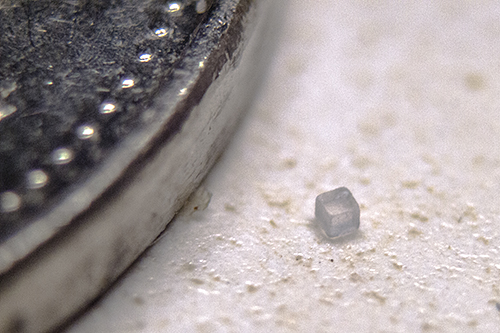
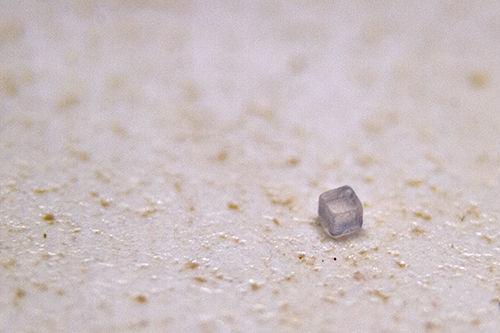
Look at this beautiful little cube. Its lines are almost clean; there are just a few irregularities. It could be a thing of beauty or a thing of use.

Or it could be an irritation. Those sharp edges, digging into soft, tender surfaces. Put it in the wrong place and it can be quite uncomfortable. It is small, but it may seem rather larger in contact with sensitive parts. It can be the sort of thing you may want protection from.

Let us call it a mote.

Mote is a word you may or might not be familiar with. If you are, it is likely from the King James Bible – Matthew 7:3, “And why beholdest thou the mote that is in thy brother’s eye, but considerest not the beam that is in thine own eye?” – or from some cultural reference to that passage, such as the science fiction novel The Mote in God’s Eye by Larry Niven and Jerry Pournelle.

Which does not exactly tell you what a mote is. It’s something that gets into your eye, yes, but… OK, it’s a speck of dust, a grain of sand, some tiny but noticeable particle. The point Jesus is making in the famous line – typically translated in more modern versions with speck – is that one ought not to counsel others on their small faults when one has much larger ones of one’s own (a beam – or, in some modern versions, a log!).

Is mote related to mite? They’re both small things, but it is not, though they both come from old Germanic words. Mote seems like a word for a larger thing, though, doesn’t it? That o tends to go with big, round, heavy things, while i is more common with small things (this isn’t universal, of course, but it’s enough of a tendency that we tend to form expectations of unfamiliar words on this basis). There is a larger thing called a mote: a mound, hill, embankment, or similar natural feature or man-made fortification; the word comes from Latin mota. It just happens that the ‘fortification’ sense was extended to a ditch, sometimes filled with water, and that version is now respelled as moat. It sounds the same, of course. Such is English; so be it. So mote it be.

That’s the other at least modestly current mote: an auxiliary verb meaning ‘may, be permitted to, have the opportunity to’. It has a more archaic and lofty flavour now than may, and it also has fewer uses. “So may it be” or “It may be so” can express doubt or evaluation; “Let it be so” is effectively a third-person imperative. “So mote it be” is (especially in some ceremonial uses, for example in Freemasonry) an equivalent for Amen (which, by the way, does not actually mean ‘OK, that’s the end’). “As mote be” – for example, in “As wicked a person as mote be” – means ‘as could exist’. The Germanic root has grown into Dutch moeten and German müssen, which translate back into English as ‘must’: a command. But mote is a permission, a possibility. Quite the opposite of the obstacle or irritant presented by the other two senses.

Which takes us back to our pretty little cube, a thing of beauty or irritation, of help or harm. How small is it? I have nudged a Canadian nickel (5-cent piece, for my international readers) next to it for comparison:

And yet if you get that in your eye, it could hurt.

Briefly. This cube is a grain of not sand but salt: a good thing as long as it is in the right place and the right quantity. Put it in a moist place such as your eye and it will dissolve soon enough and run away in tears.

So mote it be.

spathiphyllum

Some things just are as they are. They justify themselves by themselves for themselves. They exist for their own reasons, but they are exigent. They may be long, they may be complicated, but for all that, they are beautiful. They cut like a blade but caress like a leaf, soft, in liquid whispers. And even when they are done they are not done; they stand statue as a memory of what they were and still are.

Such ones may to their friends and servants seem drama queens – or contrarily peaceful. All is possible. But do not ignore them for too long.

I have two of these plants in the office where I work.

I have quite a few plants in the office where I work, all inherited from one person or occasion or another. They’re mine now; I water them, and if I didn’t they would simply die. There are four poinsettias, growing crazy; two philodendrons, bent on world domination but lacking support; a cactus; a polka dot plant; a phalaenopsis orchid, identical to the day it arrived years ago; a few other plants the names of which escape me; and two plants that I have long called the drama queens.

The drama queen plants grow in a lively shock of stems with hooded blooms here and there. If you forget to water them for a day or two too long, they droop appallingly, mournfully, like a fourteen-year-old who is bored and hot and tired and ugh I am simply going to die. They truly do look dire. But water them and within a few hours they have perked right up again, as though nothing had passed.

I took a photo of one of them and posted it on Twitter, trying to recall its formal name. Sylvia Hunter obliged: it is a peace lily, or, technically, spathiphyllum – not really a kind of lily (less deadly to dogs and cats, for one thing, though you still ought not to eat them).

They are such a romance of a flower. The stems grow long and beautiful, topped with a ceremonial mace or corn cob of a pollen pod, hooded in the most elegant white. So pure, so simple, so desirable. Over time they dry to a sere brown, still wavy and veined, and the pollen pod sprinkles its white dust everywhere like a sentimental chef making dessert pastries. Juxtaposed, a new bloom and an old one seem the phases of life, or a May-December romance, or perhaps that is really what life is, youth and age yearning to be each other. But beneath all this is a tangle of leaves, a wild, winding jungle, hard to penetrate or trace paths in; you will never get all the way to the roots. Without those leaves, it would all die, but the leaves are so… unresolvable.

The peace lily. For the lovely top to be at peace, there must be turmoil below. Turmoil like the millefeuille pastry of the taxonomic name: spathiphyllum. What does that word mean?

We can see that it comes from Greek. We may remember the phyll from chlorophyll and phyllo pastry: it means ‘leaf’. But spathi–? It means ‘spathe’. It is what it is.

Do you know what a spathe is? Does it seem at all self-regarding to define spathi– as ‘spathe’? Will it help if I tell you that spathe rhymes with scathe? No?

Well, then. A spathe is a large bract. Does that help? Wikipedia and the OED both seem to think it will. But perhaps you don’t know what a bract is, because you are not a botanist. I will tell you: it is a modified or specialized leaf. A spathe is a large one that provides a shield or hood. At the beginning, the blossom of the spathiphyllum is entirely enveloped by its bract; at length the bract unfurls to reveal the nude heart, as a cinema starlet unwinds her fur.

So this plant is a spathe-leaf, which sounds marginally better than a bract-leaf. The word spathe comes from a Greek word for ‘broad blade, broad piece of wood, that kind of thing’ that is also the root (via Latin) of spatula. And the starlet, the pollen pod that sends its fairy dust over all as a dying farewell? That is called a spadix.

So the spathe envelops and then unveils the spadix. And then they grow old together, and droop and perk together, and dry together, while other young pairs arise to have their turns.

riverrun

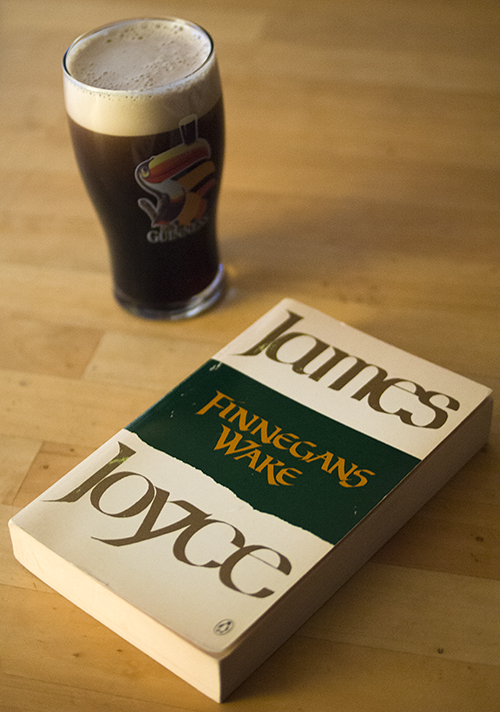
September 1985. I am beginning my second year as a drama undergraduate student at the University of Calgary. I walk into the bookstore and buy my required course books, plus this:

It is in the course books for some English course, possibly a graduate-level one. They don’t check whether you’re enrolled in a course before they let you buy a course book. I may have deprived some English student of the chance to buy Joyce’s famed masterwork.

I doubt it, though.

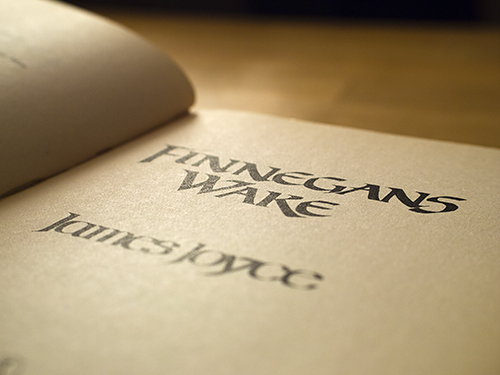
I had first read about this book in a Time magazine anniversary issue looking back over the past most-of-a-century. The book, described as having no discernible plot and not written in normal English, sounded fascinating. It is 628 published pages long and took 17 years to write (1922–1939). There is no apostrophe in the title; that is deliberate, to encourage a multiple reading: the wake of Finnegan; the waking of Finnegans; an injunction to Finnegans to wake.

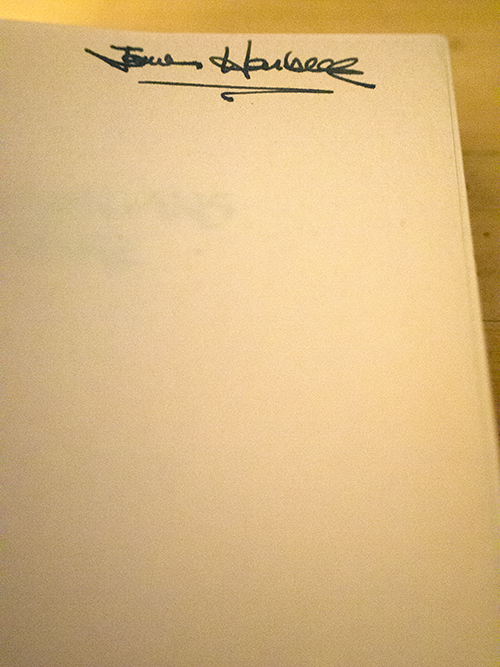
I take out my wet-ink pen and write my name on the fly leaf, a river of blue running to dry and mark my passage.

This was back when my signature was almost legible. That signature would not work for forgery now. My current signature looks like the dust cloud that always follows Pigpen in the Peanuts comics.

I read this book like an exercise program, 10 pages a day, whether I understood them or not. It was a marathon, a 63-day marathon, all while I was putting up with a difficult roommate and he was putting up with a difficult roommate. But it was a huge influence on me. I wrote quite a lot of unreadable incoherent garbage for some time afterwards. It may have stunted my development as a writer for a year or two. Probably not, though; I was so immature, nothing I wrote was really worth the effort for a very long time.

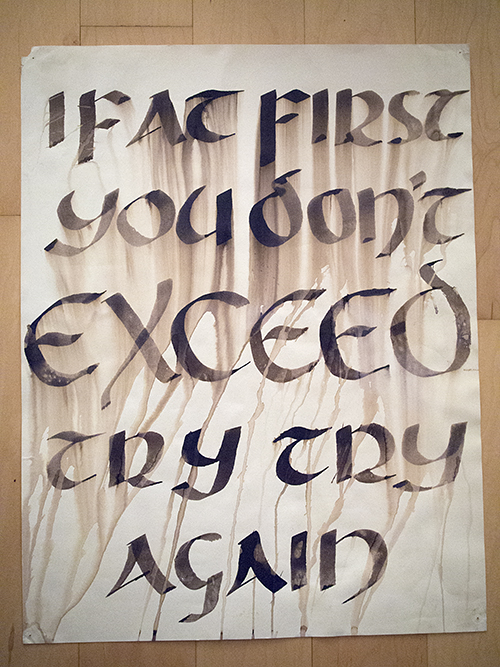
The calligraphy of the cover I loved; I had loved calligraphy for me for some time. We may count that as another influence. Somewhere around then, I made this poster.

The water blur was not intentional. It happened when someone, in a water fight with my roommate, splashed a large mugfull through our doorway and nailed the poster squarely, rivers of cold tap water running the ink to exceed the paper. The dude was apologetic, but I must admit it was probably an improvement.

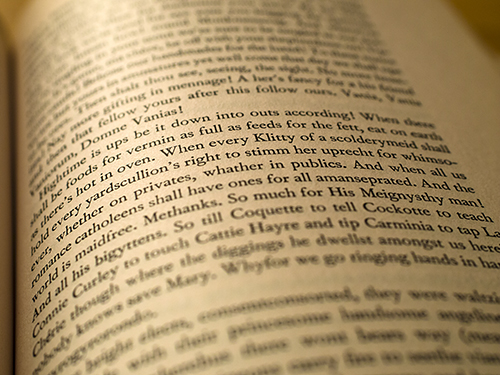
The motto was not intended as a reference to Finnegans Wake, but it might as well have been. Joyce truly exceeded all reasonable bounds. Perhaps when I am retired, at age 102, I will read it again and begin to understand it. We all know that Shakespeare made up a lot of words, but Joyce made up as many on any given page. Here’s one chosen at random.

Invention is much easier when you are not constrained to coherence.

What word could I possibly choose from all this? The first: riverrun.

It is also the one after the last. The narrative loops back on itself, like a fever dream that simply doesn’t end. The final sentence stops in the middle and is resumed at the beginning. I have paused in the middle of that sentence, dammed, but damned if I don’t pick it up again in the full course of time.

Is this a word beyond the shores of this book? It is, with a caveat. As of the mid-1800s, it was known as two words, river run, the course of a river. It shows up in the 1900s as one word. The first known instance is the one you have just seen. All other uses refer to this. This word is like a canal barge or river boat, carrying that freight. And what river does it ride on? The stream of consciousness. A stream prone to frequent overrun. The marks it has left on the riparian strand are the letters of this book.

River Run is also the name of a race. Have you seen the movie Run, Fatboy, Run? Do not take it as counsel for preparing for a marathon; its details in respect to running are less realistic than the contents of Joyce’s book, but never mind, it’s entertainment. The marathon the protagonist decides to run is not the London Marathon but the Nike River Run. The London Marathon was not available for use because another film had secured rights to using it. The Nike River Run is not a race in the real world. But doesn’t that make it just all the more suitable?

So. Riverrun brings us by a commodious vicus of recirculation back to Howth Castle and Environs. Howth Castle is a real place. But HCE are the initials recurring through the book; its protagonist (yes! it has one! like a dirty leaf floating on the current, followed by an unsteady, blurry camera) is Humphrey Chimpden Earwicker, not a real-world person. Howth Castle, for its part, sits on a peninsula north of Dublin. There is swerve of shore and bend of bay to get to it, but not a riverrun in sight.

Still. This word riverrun has those three liquid letters r r r, the second overrunning into the third. The ocean by the castle has enough liquid to sustain it. The rivers of time ever run, and the sea is eternal. And in the end, after a lifetime of incoherence, it loops back on itself.

And after that, I read Ulysses, which Joyce wrote before Finnegans Wake, and which actually makes sense.

pectin, Penticton

I grew up in southwestern Alberta, where the wind comes over the waves of mountains and keens across open brown hills. It is all horses, wheat, and cattle. Our jam came not in jars but in big metal tins: Empress raspberry jam, which I would eat in viscous lakes on buttered toast. Dig the spoon in, scoop, spread, it stays put. I’ve never understood drippy jam.

The nearest place fruit was actually grown was a vacationland for us: the Okanagan. It was a drive over the Continental Divide and through successive ranges until we finally met a warm valley with large lakes and ample orchards. There are towns with names like Peachland and Summerland. There is a long, deep, bendy lake, the sort you would expect to have a Nessie-like beastie (the beastie is named Ogopogo). The heart of the area is Kelowna; farther north is Vernon, a town whose name I’ve never fully reconciled myself with (there was a Vernon in my school who didn’t seem all that nice); but the truly quintessential fruitland name for me has always been Penticton. Somehow, this city at the south end of Okanagan Lake seems singularly fruity, or at least jammy.

You can see where I’m going with this. Yes, I think that pectin and Penticton are forever glued together in my mind with all those fruits picked in the valley and all that sugar packed into the jams. There are other echoes and overtones, of course, if I go looking for them: Pentax could be a brand of camera I took pictures with there (but it’s not – I’ve never owned or even used a Pentax); panic and impact are somewhere in the sound neighbourhood but seem entirely irrelevant; nictating winks but then blinks out; sticky connects as much with the sense; pectoral has a strong start but is not particularly more apropos than, say, pentacle. Nectar shows up late but is a welcome addition to the mix.

But keep an eye on that mix. This weekend I had a chance to observe the impact of excess pectin. My aunt-in-law Zaiga buys jam and jelly at a farmers’ market in Collingwood, on Georgian Bay, but the latest jar she picked up was a bit thick. She picked it out of the fridge and poked at it with a spoon: barely a pock-mark on the surface. Even when warmed to room temperature, it was… um… gluey. Here, have a look:

Now, yes, pectin comes from pectic, which comes from Greek πηκτικός péktikos ‘congealed’, which comes from the verb πηγνύναι pégnunai ‘make firm or solid’, but this was really a bit too thick. It looked like it could stay in the jar forever.

Which would, at least, make it Penticton, so to speak. The city is not a town (ton) named after some personage, perhaps a Captain Pentic, though the word has gravitated to a familiar English-style form; rather, it appears to come from a word in the Okanagan language (the local First Nation) meaning ‘a place to stay forever’.

Fair enough. A lot of people seem to be quite happy living there. But nothing is entirely forever; people come and go. And so do orchards. They still grow fruit in the Okanagan, but their most notable product now is the wine made from grapes grown where there used to be peaches.

Suits me fine. I didn’t have any jam or jelly with breakfast at Zaiga’s, but we did have some sparkling wine. That’s a holiday tradition I don’t mind sticking to.

spirea

In front of the building in which I work is a well-tended bed of plants, nicely coiffed in its long box bordered with metal cladding. Some are prairie grasses. Others are hardy, enthusiastic eruptions of spearmint-like leaves with tiny flowers toned in that purple that theatre lighting technicians know as “surprise pink” (also, less officially, “FM pink,” and the FM does not stand for frequency modulation but is a reference to how attractive it makes the complexion). On my way in and out of the building, passing them at eye level as I walk on the small pavers before the boxes, I find them anodyne or at least analgesic, and in some ways positively inspiring. Such little pops of prettiness, purple spurs daring the suburban cityscape… no discarded coffee cup can conquer.

However, I suck at knowing plant names. Plants don’t care about their names, so why should I? I know them by sight. I know words well enough to know their limitations (a picture is not worth a thousand words; there is no exchange rate – besides, for any word in the language I could find a thousand pictures). But every so often I find that I want at least to know what people call something (see parthenocissus). And so I posted the photo above on Facebook and asked, and Jennifer McIntyre informed me that it is spirea – Japanese spirea, to be precise.

Spirea! Also spelled spiraea. Pronounced /spaɪˈriːə/, which is to say “spy rhea.” One may wonder if it is a synthesis of spy and diarrhea, but that would be spurious. A relation to spiral? Not spurious; they both trace back by way of Latin to Greek σπεῖρα speira ‘coil, twist’. But never mind this mortal coil. These flowers are more of a divine inspiration.

Inspiration? Such a word. Different people find different inspirations in different ways. When I want to write something, I go out looking for inspiration like harpoon-holding Ahab, ready to spear any spermaceti-filled cetacean but confident I will in the end master that one white whale. When I want to take pictures, I don’t expect inspiration at all; I am like a calf-roper, lasso at the ready. But when I want to seek a prophylaxis against improving my context, or simply want to dream about desiderata well beyond my means, then (as likewise for many on Pinterest, apparently) “inspiration” is the order of the day – pretty pictures and plans for things that would take too much effort to gain, but the having of the picture, the “inspiration,” gives me a momentary sensation of the goal, a little pipe dream… an opiate.

As, perhaps, are these flowers. I have said they are analgesic, even anodyne. Could they be narcotic? Likely not – they’re not poppies. But while they lack opium, they do have aspirin. In Canada Aspirin is still a trademark, but in the USA it lost that status during World War II because its owner was Bayer, a German company, and so they lower-case aspirin as the generic term, while in Canada the generic term is ASA, short for acetylsalicylic acid. But do you see a spir in aspirin? It is indeed the same as in spiraea, and the flower name is the source of the drug name. Spirea contain salicylates.

Not that I need to eat these flowers to cure headaches. Just the sight of them and their little purple spurts – first spheres, then spears – eases the blood, sweat, and tears. Sometimes it’s the small things that make the difference. And these spirea are small. Yet they can aspire to greatness.

peremptory

I have had good response to the first instalment of from the bookshelf, so I will do another today. I don’t intend to make it a daily thing – it’s more time consuming than a post without pictures – but I won’t run out of books however often I do it.

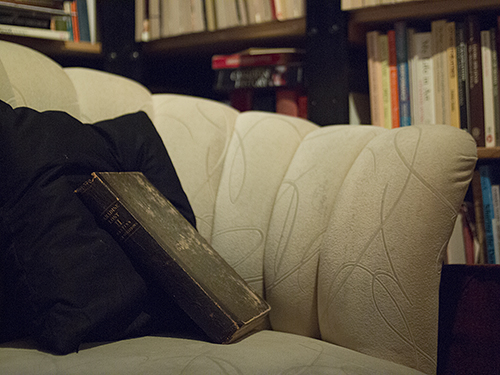
Today’s book is a time-abused little volume of instruction that came into my possession I know not how (though I think my mother-in-law picked it up at a rummage sale for me). It has seen rain (though not fire) and curious white substances. But it stands proud and confident nonetheless.

Behold Cobbett’s English Grammar, a volume far more sure in its learning than even those far more knowledgeable books piled beneath it. Ah, grammar: one of those fields, like painting and sartorial fashion, in which many people feel that the confidence of their opinion is the surest index of their rightness, and they just make things up on the basis of their own felt discernment – and publish them (caveat emptor). Grammar is like feces unto the flies of prescription: people who believe that we must have rules are naturally drawn to it and impose rules willy-nilly, brooking no question or opposition, giving no quarter.

And of course they seek to impress those rules on the still-curing cement of young minds, to pre-empt any grammatical libertinism that could take hold. Flip this book open and the very first page you see – before even the title page – is this:
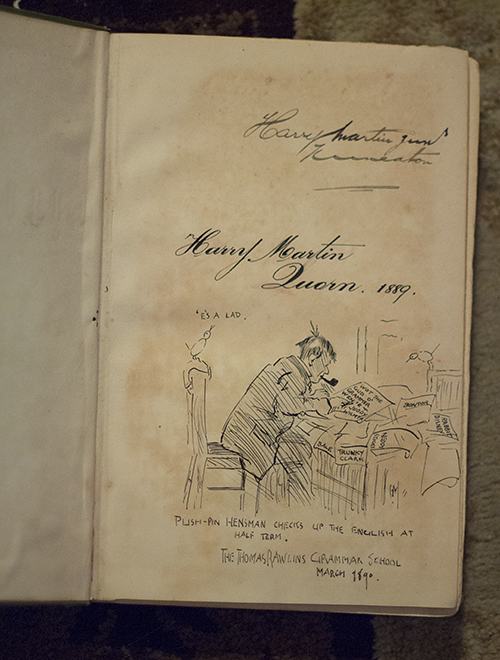
Whoever this Harry Martin was, he was a dab hand with a pen. We can see that this book was set to brand its rules on his brain fully an eighth of a millennium ago, and on the far side of the Atlantic: the Thomas Rawlins Grammar School in Quorn, Leicestershire.

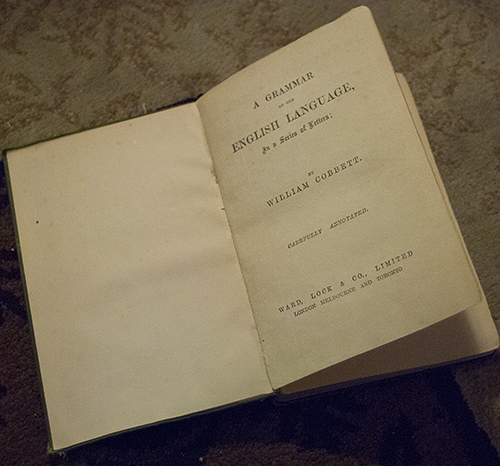
Here is the title page:

This book is, as I say, very confident in its prescriptions. It is no respecter of persons; however great they may be, if they do not meet the standards of the author, they are given no courtesies, as you will see from the table of contents:

Doctor Johnson, the king, various other statesmen: all guilty of “false grammar” and “errors and nonsense.”

Would you let a creature such as this slip his crusty avuncular arm in its shiny sleeve around the shoulders of your impressionable offspring today? But this is just his approach. The book is written as a series of letters to his fourteen-year-old son, James. You will see that the letters are dated beginning 1817, a full human lifetime before this volume was entrusted to the instruction of master Harry Martin.
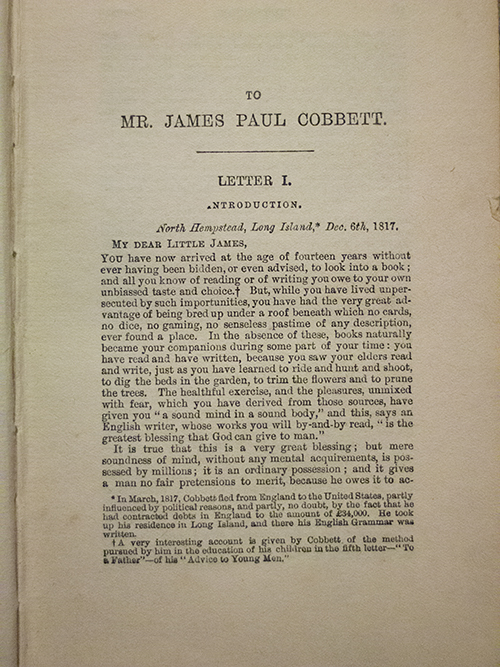
Why is he writing letters to his son? He is on Long Island, New York. What on earth for? The footnote is instructive: “In March, 1817, Cobbett fled from England to the United States, partly influenced by political reasons, and partly, no doubt, by the fact that he had contracted debts in England to the amount of £34,000.”

£34,000 is a fair chunk of change even today. But a debt of that size at that time would be equivalent to almost exactly one million pounds in 2015 spending power. A million pounds! What did Mister Cobbett do with that? I’ll tell you what I think he did: poured it into his book. Every reader of this work is weighed down with a million pounds of high-handed prescription, of which not a featherweight is honest linguistic research and understanding. (He doesn’t even use the term etymology correctly.) And Harry Martin made notes and underlinings in the book, giving thereby at least the impression of heeding its admonitions.
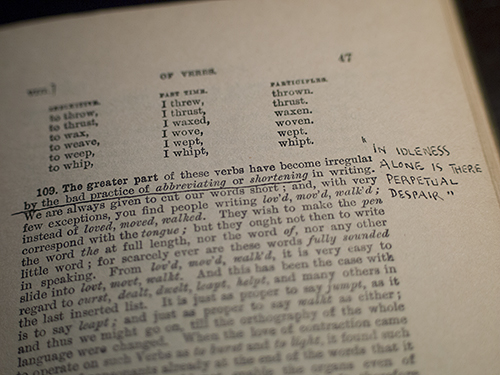
I am confident that Cobbett was as conscientious and scrupulous in matters of learning as he was in matters of finance. He may have brooked no idleness or shortcuts, but he was apparently quite fine with deciding things without considering that they may not be true.

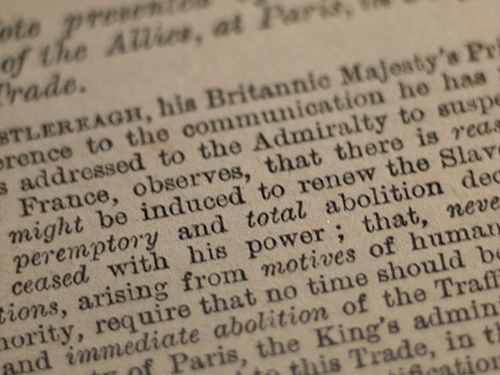
There are so many words in this book. Which one shall I taste? Well, you know already; it’s at the top of this article. On what page do I find it? I find it in a speech by Lord Castlereagh reproduced on page 150.

The sentence is long, but here is the part of it with which we are concerned: “there is reason to foresee that French ship-owners might be induced to renew the Slave Trade, under the supposition of the peremptory and total abolition decreed by Napoleon Bonaparte having ceased with his power…”

Mister Cobbett does not like this. He does not like the speech at all. He states no position regarding the slave trade; it is a mere trifle in the face of such terrible writing. He presents his own revision of this unintelligibly obscure speech, including this revised passage: “there is reason to apprehend that the French ship-owners may be induced to renew the Slave Trade, from a supposition that the total abolition recently decreed by Napoleon, has been nullified by the cessation of his authority…”

If you think his version is worse than the original, well, so do I. But Cobbett is a man on a mission. He picks the speech apart sternly, mercilessly, decisively, conclusively.

“If the abolition were total, what had peremptory to do there? Could it be more than total?” Well. Is that what peremptory means? It’s not a word we often use. What is peremptory?

This book and its author, that’s what. Peremptory comes from Latin perimere ‘kill, destroy’, which in turn comes from per ‘thoroughly’ and emere ‘take’. That same emere later came to mean ‘buy’ and shows up in caveat emptor and pre-empt. (It is not related to emetic, which comes from Greek ἐμεῖν emein ‘vomit’, but in a case such as this there may be some concinnity.) That which is peremptory takes a merciless attitude: slaughter and scorched earth. Decisive, conclusive, fixed, dogmatic, intolerant of other positions, hyperconfident.

So peremptory would not mean more than total. It could seem to be redundant with total, at least until you stop to think that a person may peremptorily declare a partial ban: “The slave trade shall be limited to [place X] and [persons Y], and all others shall be punished without mercy.”

If you were Napoleon, you could make such a decree and expect it to be enforced. If, on the other hand, you simply had a Napoleon complex, you might make your pronouncement emptily. Well, you could enlist a children’s crusade, perhaps, and these children, some at least, could grow to have brains as desiccated and obdurate as yours – mistaking the wizened for the wise – and pass the instruction to the next generation.

Peremptory is an important-sounding word, proud with its p’s, conservative with its tory. It may describe good things, such as abolition of slaving, or bad things, such as, well, books like this. But this is a nice volume to have for historical interest and entertainment. The paper is soft and still resilient, though it is clearly wood pulp and not quality linen bond. I do not know what the type face is; there is no colophon. But I have noticed – have you? – that there are wide spaces after the periods. They would probably create what designers call “white acne” on the page… if the sentences weren’t several lines long each. I don’t like those big spaces. But that’s a hot topic for another time.

hyaline

I’m going to try a special feature every so often, at least if people like it. It’s called from the bookshelf. I’ll take a book off the shelf and find a word in it to taste, and add some bibliotechnical cheesecake shots while I’m at it.

I’m going to start with one of my most alluring volumes, part of a two-volume set of Paradise Lost that I saved from perdition at Tufts University two decades ago (it was part of a bequest but was not needed and, frankly, would not have survived in a circulating collection).

It has illustrations by John Martin and was published in London by Septimus Prowett in 1827.

It has the dusty-honey smell of an old book, with those age spots called foxing. Open it carefully; the binding is falling apart, though the pages are still strong. It is tempting to think of it as like a smudged old window, the glass rippling, the view obscured. But the words on the page are there as plain as any day, and when you can read them you can see with the clarity of the mind’s eye into the world it describes.

Let us turn to page… 27. O look, they put spaces before colons and semicolons and exclamation points! And larger spaces after them and – is it? – a double space after a period. Double at least. A space as wide as the sea and more transparent.

The sea? The glassy sea. Line 619: “On the clear hyaline, the glassy sea”… We have our word: hyaline. A word that rhymes with violin. What note does it play?

Is the glassy sea the hyaline? Is it then the high line? It is haline – salty, that is. It may be healing, but it may consume you. Not this sea, though, this glassy sea, this clear hyaline. It is as smooth as water in a glass, and as clear as a looking-glass. It may even reflect.

Which would be why we see the sense and then the same sense again. Hyaline, you see, comes to us from Latin hyalinus, which (as the y should tell you) is a loan from Greek, where the original root is ὕελος huelos ‘glass, crystal’ – a word that Greek may have gotten from Egyptian. A word, then, that has sailed on the Mediterranean, smooth or rough, more than once.

Glass and glass again. Elegant variation, ramified repetition. Use of a fine and pricey word, and then explanation of it with plainer stock. And that poetic trick of taking an adjective and using it as a substantive noun. Milton was not the only to use hyaline this way, though perhaps the first, but its longer and fuller history in English is as an adjective. It means, as the OED says, “Resembling glass, transparent as glass, glassy, crystalline, vitreous.”

Transparent not as the pages of a book, nor as an old and foxy word that requires looking up, but as plain text that, once read, shines an image into your mind. Or as a camera lens, letting the image pass through and be recorded to be re-presented to your own eyes, with their lenses and their vitreous fluid. And, so launched, it sails on them.

keleusmatically

Look at this word. Read it. Try to say it. Ask yourself whether it’s five syllables – /kɛljuːzˈmætɪklɪ/ – or six – /kɛljuːzˈmætɪkəlɪ/ – or even seven – /kɛliuːzˈmætɪkəlɪ/. Decide, correctly, that it is most properly six but, honestly, if you’re ever going to say it, really five or at best five and a half (a long /l/ as in /kɛljuːzˈmætɪklːɪ/ is less than a syllable but more than not a syllable). Question whether your command of it will ever be such that you would use it. Wonder whether it will ever be imperative that you do so.

Wonder where this word comes from. Look it up, either in the Oxford English Dictionary or, if you don’t have that, right here in this article you’re reading right now. Find that it’s an Anglicization of Greek κελευσματικῶς plus the adverbial –ally ending. Find that that in turn comes from κελεύειν, which is a verb meaning ‘order’. Conclude that this is a fancy word meaning ‘as an imperative’ or ‘in the form of an imperative’ or just ‘imperatively’.

Muse. Ponder this word. Think about how it seems like keloid (a kind of cicatrix) and Kelita (a kind of singer), and decide that you would rather order up the latter than the former. Reflect further that it has a taste of charismatically, and decide that it would be helpful to be charismatic if you are going to be keleusmatic. Also not to be asthmatic.

Look in your wallet and wonder if you can afford this word, which is clearly not some stock five-dollar word. Wonder if it appears anywhere other than the OED, and chuckle as you think of it showing up in Urban Dictionary, that hotbed of crude slang and fourteen-year-old-boy definitions.

Find it in Urban Dictionary, complete with a definition that uses vulgarity.

Think about how it is odd to have such a long word referring to the imperative, which is generally by dint of circumstance a clipped form.

Use it anyway that one time you have a chance and remember it. Keep it on your lexical trinket shelf until then.

chlorid

A scene utterly ridden with (as opposed to rid of) flowers, or having that general sense or quality literally or metaphorically, is called florid. What about when there aren’t many flowers but there are a whole lot of leaves and other green things?

Well, yes, there’s verdant, which is a fervent-sounding word, faintly suggesting vermin but generally with more verve and offering something covered and dancing with green, perhaps in Vernon, BC, or some place yet to be discovered. But verdant is a Latinate word, with that open-shirted v and all that. How about something Greek-derived? And to rhyme with florid?

What’s the Greek root for ‘green’? You see it in chlorophyll, which is formed from χλωρός khlóros ‘green’ and ϕύλλον fullon ‘leaf’ (note how Latin transliterated the Greek differently from how we tend to today). Yes, that chlor that also shows up in chlorine. Does it sound unpleasant? We may have bad associations with it, thanks to Clorox. But it has two lovely liquids – /l/ and /r/ – and that velar fricative in the original, so often written as ch in Gaelic and German and other languages, and when you hear it in Irish Gaelic, the language of the Emerald Isle, it sure doesn’t sound so horrid. Not that Irish uses a chlor word for ‘green’; actually, the Irish word is glas, which can also mean ‘grey’. Yes, in Ireland green and grey are thought of as the same colour. From what I’ve heard (and pictures I’ve seen), this makes sense: grey shades into green there. And many other places too.

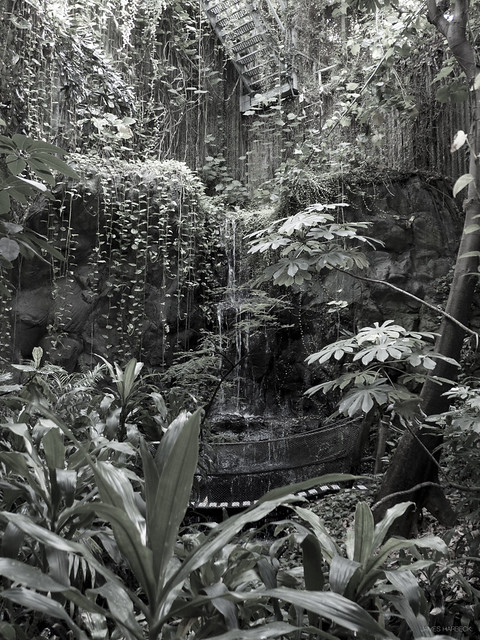
But that is a digression. The word we are looking for is obviously chlorid. As in “I walked into a concrete-walled room dripping with mist and overgrown with plants but few flowers; it was not arid or frigid but humid and vivid, suitable for annelids and aphids and triffids, and probably also orchids, but it was not florid, simply pervasively and irrepressibly chlorid.”

But is this a word? A real word? Well, I can’t swear that anyone would understand it were you to use it. Not so many people know the sense of the chlor root. But it has been used and is in a dictionary. A dictionary: the Oxford English Dictionary. With one citation, from 1822. And that citation appears to refer to complexion or skin tint.

So a person might say “You’re looking a little greenish, lad. Positively chlorid, in fact.” Sure, that would work. But I can think of no especially good reason not to take this word made of known parts and press it into service for other green-hued things if we want. As long as we don’t mind that many readers will think it a typo for chloride and will come to a variety of inferential misadventures on that basis.

Still. Why not have another special secret word for verdant? With a different flavour and tone? A word like a special room full of green plants and rain hidden in a brutalist building?

R u OK w Hillary’s emails?

The release of emails to and from Hillary Clinton when she was secretary of state has provided much interest and entertainment. One thing that caught my eye immediately was the use of abbreviated forms such as thx, pls, w, and especially u. So I wrote an article for The Week about it (I didn’t give it the title, though):

Hillary Clinton, and the surprising history of elder statesmen writing like tweens