
flautist

What is a flautist? A flutist, but perhaps a little snootier. Fowler wrote, “Flutist is more than 350 years old; flautist (from Italian flautista) dates only from the middle of the 19th c., and there seems no good reason why it should have prevailed. … But it has.” Well, it has in England and perhaps in Canada, rather less so in the United States.

But what gust of linguistic afflatus would lead us to flout standard sensible English derivational morphology and the usual rules of English pronunciation just to flaunt a foreign word as the preferred form? Here’s a little thought experiment: Let’s say that you met someone who played the bassoon, or even just someone who seemed to know a fair bit about music, and he said not “bassoonist” but “bassenist.” Would you think, “Wow, that’s weirdly wrong,” or would you think something more like, “Huh, I guess bassenist must be the more cultured way of saying it, because it’s not the simple predictable way and there’s no reason for this knowledgeable person to say it unless it’s the more correct way, just like all those other weird exceptions we have in English”?

Linguistic insecurity is very common in English and tends to cause us to prefer what linguists call the “marked” form — our lexicon is a flock of odd ducks chosen for their oddness. We learn as small children that there are many words where the seemingly logical form is the “grossly uneducated and illiterate” one. We must learn to play the instrument of our language as carefully as a delicate and fickle fipple flute.

It also doesn’t surprise me that we would go for flautist more in Canada; Americans lean a little more towards the straightforward, dropping silent letters willy-nilly. We also retain greater ties to Britain in Canada. But there’s also the little matter of pronunciation. Oxford gives the pronunciation just as /ˈflɔːtɪst/ – as in “flawtist.” But the preferred pronunciation among North Americans who are “in the know” is the one modeled on Italian: /ˈflaʊtɪst/, the main vowel like “ow” rather than “aw.”

And why shouldn’t we take the word from Italian? That’s where we got flute, after all, isn’t it? Hmm, no, actually. Italian got its word flauta from Old Provençal or Old French, which didn’t get it from Latin. Now, yes, the form at that time was flaute. But it moved up through French to English and in so doing the vowel changed a little. Modern French is flute and flûtiste. We rather likely borrowed flautist from Italian later on because we borrow all sorts of musical terms from Italian. But we didn’t borrow it intact, flautista; we clipped the a off the end, making it not so much a borrowing as an affectation… and a mark of linguistic insecurity: we think it highfalutin’, but others may think it flat-out flawed.

Thanks to several of my colleagues in the Editors’ Association of Canada for discussing this word today on the email list.

sparkler

I like sparklers.

I don’t often buy the coated metal rods that, when ignited, burn down quickly, throwing off forks of sparks as they go, like a sprinkler of light. One time, for my brother’s bachelor party, I accidentally bought incense sticks instead, thereby giving my brother much more time to down a bottle of Coke than I had intended. He ignored me anyway.

But I do like sparkle-sticks. And things that are like them. Things that sparkle. Other things that are called sparklers.

Sparkling wines, for instance. Prosecco, cava, crémant, champagne: my kind of fizzy-o-therapy. Mixed with orange juice or Campari or taken straight and frothing, dotting my spectacles with picolitres of effervescence. Tasting stars? Tasting the evanescent asterisms of a sparkle-stick.

Sparkling eyes, too, green or grey or blue or onyx black, not staring but starring and sparring, promising solemnly that they are up to no good: a little mischief adds spice to life. Winking and twinkling, and more: literally glittering, sparkling with larkishness. And sparkling teeth below, white and smiling and sharp, inclined to bite just a bit. And sparkling wit. A mind that shoots soft little knives and bright feathers all in a flickering mix.

The first definition of sparkler in the Oxford English Dictionary is “One who sparkles or shines in respect of beauty or accomplishments; esp. a vivacious, witty, or pretty young woman.” That dates from the early 1700s. Also listed: a sparkling eye, a sparkling gem, a sparkling insect, a sparkling wine, a sparkling firework.

Sparkler of course comes from sparkle. Sparkle is spark plus the frequentative –le suffix, seen also on nestle, crackle, and quite a few others. Spark has been around as a word longer than English has been its own language, and it has always meant what it means. Sparkle dates back more than 800 years.

We have not always had sparkling wine, but we have always had sparklers, though we did not always name them thus. The word is so suited; it seems like an oral performance of what it names, with the crisp stops and just a bit of fluid. Even the shape of it helps, in particular the k, which shoots off a fork like the little sparks on a sparkle-stick. More complete still is sparkly, with the y for added shape.

And most complete is life when it includes sparklers, of all sorts.

Does this bother you alot?

If you’re like many highly literate people, seeing alot is like chewing on aluminum foil. It doesn’t sit well with me either. But I am of the considered opinion that while it may not become the formal standard, it’s not going away either – because it makes a certain intuitive sense. Read the reasoning in my latest article for The Week:

Hey, grammar nerds! Stop freaking out about ‘alot.’


pingo

It’s in the frozen remote north, so frozen and so remote that even Robert Service did not dream of it. Life and everything else stops here. Frozen earth heaping over frozen earth, ice capping on ice, growing, frozen from the top in, going frosty from the bottom up. A massive pimple of land and ice, swelling slowly, pinguid with frost.

And then something thaws. Deep below, the permafrost loses its perm. The gases in the ground expand, and bingo: with a “pingo!” the mounded earth is popping over the environs. And in place of the lumping obstacle is a gaping orifice.

This, anyway, is what some people think caused the 80-metre-wide hole in the Yamal Peninsula, surrounded by burst and spurted earth. No meteorite was seen that could have done it, and anyway the shape is wrong. Something erupted from below, a pocket of gas no longer held down by permafrost and the plug of ice above.

Was the eruption a pingo? Oh, no, how misleading. What was there before the eruption may have been a pingo. A pingo is a big mound of earth made by heaving and accumulating frost. It grows slowly, a fingertip’s length a year. Pingos may collapse, yes, but not normally so spectacularly. This was an exploding ex-pingo.

The word may seem to be expressive, a verbal performance of something pushing the flat earth up like a popping bump of plastic or metal. But actually it’s taken from an Inuvialuit word, Greenlandic dialect, and it first meant something like nunatak, except that a nunatak is a peak poking through the ice while a pingo is a peak perceptible under the ice. It was European geographers who borrowed it to refer to these permafrost pimples, which are especially abundant near Tuktoyaktuk. Europeans also added a /g/ to the pronunciation, so it now rhymes with bingo rather than thing-o.

So where is this Yamal Peninsula? If you’ve never heard of it, it’s not the end of the world. Or actually, it is, as the news media have been fond of pointing out in the stories today about this pit. In the local Nenets language, Yamal means ‘the end of the world’. But not the end with the penguins. Have a look at a map of Asia. Look at the top of Russia, the rough backbone of Siberia against the Arctic Ocean. There’s a canted eyebrow of an island east of Scandinavia: that’s Novaya Zemlya, which means ‘new land’. Directly south of its eastern tip, across the Kara Sea, is the Yamal Peninsula. New land lies above the end of the world, just like the heaped earth around the new crater that’s an empty pit, a pinhole somewhere in that gelid tip, the opening that perhaps was a pingo.

louche

I like the taste of louche, and I like a taste of the louche.

I don’t mean I actually like hanging out in shady, sketchy places. Genuine criminals lack charm for me. But I like the fantasy of infraction, of impropriety, of pulling at the seams on the underskirts of life. I like it some in movies – film noir, British thieves, American gangsters – and I like it in music.

When I tell you what music, you’ll see how I mean it’s a charming fantasy. I especially fancy two popular musical duos for their louche touch: the Pet Shop Boys and Steely Dan. Here, listen to the lush lashings of the louche, from the licks and the lips of Tennant and Lowe and Fagen and Becker.

Just listen to that music slouch, the sly undercuts like a low-slung deuce. I could have given you many Pet Shop Boys tunes and just about any Steely Dan song at all – I nearly picked “Rikki Don’t Lose That Number” and “Babylon Sister.” It’s all so loose and sly, looking at you sideways from a squinting eye. But of course those musicians aren’t gangsters at all. They’ve never hurt anyone or been shot at. It’s all an act.

But it’s still the opposite of spending the Sabbath at shul (literally the reverse: /luʃ/ – /ʃul/). No, this word doesn’t come from a reverse reading of the Yiddish word for ‘synagogue’. If you want a backwards echo, look at the word itself: louche – echuol. It can echo you well. It shows you not the mirror but the shadow you cast, and if you follow your shadow it will always lead you farther away from the light, always just ahead of you. Watch that it lead you not straight to ouch.

But you really need to squint to see this word. Or you need to be squinting: French louche, from Latin luscus ‘one-eyed’. Do you think of pirates with eye patches or criminals with ocular scars? You could also think of a wink, a flash of the lashes. A delicious pair of soft peepers, one of them open to look you over, the other closed just for a moment to signify an invitation to come over to the dark side. And then a lick of the lip – “l,” but so silent, so soft – a luscious exhalation of release and delight, “oo,” and a “sh” to silence you as you slip into something shadier… just a little role-playing, nothing dangerous

“I know, right?”: the podcast

I’ve done another podcast for The Week, this one based on my latest article on “I know, right?” Listen to it here. It may take a few moments to load. Click on the white > in the orange circle to make it play.

coryza

I think this is a rather pretty word. It balances in the middle on that rakish funnel y, it has the chic and angular z, and it contrasts them at the sides with curls and just a little bit of straight line. It looks like it could be a name – a merging of Cory and Liza, perhaps. It’s a little crazy, strangely cozy, subtly racy. Spicy like a chorizo. It’s a word like a smart, sharp, small woman who wears careful but angular makeup, perhaps a piercing or tattoo – or perhaps the sweet-tartness comes entirely from a wicked wit.

Whatever it is, though, she has a cold. A runny nose. Hope she doesn’t have a nose ring; that would be uncomfortable when you have coryza.

Yeah, this word falls into the category of nice words for unpleasant things. Sorry. The common cold has a couple of those – the other is the mellifluous, or anyway something-fluous, rhinorrhea, so soft and pleasing, though admittedly with an echo of the unpleasant-meaning diarrhea.

If you want a less charming word for the common cold, use catarrh. Both words come to us from Greek via Latin; catarrh is a clipping of the Greek for ‘downward flow’ (that rrh is the same as in rhinorrhea and diarrhea, but the ea flowed away). Coryza is from the Greek κόρυζα, which a modern Anglophone might more likely transliterate as koruza (that letter υ is a little problematic due to historical sound changes; in modern Greek it’s pronounced “ee” and in Biblical times more like German ü). In the Greek it meant ‘runny nose’ (or, as some dictionaries put it, ‘running at the nose’, which technically isn’t exactly the same object, but in looser usage will come to be applied to the same condition).

You can, if you wish, insist on a distinction between coryza and catarrh – I mean aside from the feelings of the words themselves: to quote from the medieval Regimen sanitatis Salernitanum,

Si fluat ad pectus, dicatur rheuma catarrhus:
Ad fauces bronchus: ad nares esto coryza.

Which is to say, if the flow is in the chest, it’s catarrh; if in the nose, it’s coryza.

One more thing: because the word came from Latin into English by the 1600s, the y is pronounced as in “why.” So while you may want to say “co-ree-za,” to be correct to the established English standard you should say “co-rye-za” (with the o probably reduced to a schwa).

Having a cold is unpleasant. You want to get rid of it as soon as possible; drink lots of liquids and get lots of rest. But while you have it, you can at least – if you want – call it by a more chic, more erudite, name: “I am indisposed by a touch of coryza.”

I know, right?

My latest piece for The Week is about a currently popular expression. It’s idiomatic, and when people hear it they understand it, but some people still insist it makes no sense. …I know, right? Read it here.

rim

Pick up the crystal glass and hold it by the stem. Moisten your fingertip and run it in a ring around the lip at top. Its sound names it: “rim.”

The rim, the brim, the perimeter. A trim and prim ring, or a grim edge; the beginning of merriment, or an interim rest, or the end for a criminal. As Daniel Trujillo wrote to me, “A boundary, an insurmountable frontier that both denies passage and invites trespassing.” Transparent yet intransgressible like a scrim, or opaque yet surpassible. An edge that is at the heart of so many uses. Glasses, tires, oceans, coins: inside the rim is value, but use comes from touching the outside.

The word rim does not have such a taste of the edge; it is something found crimped in the middle of other words. It rings and hums, but its sounds are made with the heaping heft of the tongue and the closing of the lips. A word that made more of the edges in the mouth (tip of tongue, ridge, teeth, lips, back) would be loving. Or living. Or leaving. The contact points of our existence, the interface between the value within and the use without. But while these are our rims, our word is rim; it collects the rime and the rhymes.

The rimes, in fact. The Rime of the Ancient Mariner, by Coleridge:

The sun’s rim dips; the stars rush out:
At one stride comes the dark;
With far-heard whisper o’er the sea,
Off shot the spectre-bark.

The rim of consciousness, The Day-Dream of Tennyson:

And o’er the hills, and far away
Beyond their utmost purple rim,
Beyond the night, across the day,
Thro’ all the world she followed him.

The rim of an acquaintance, Parting at Morning by Robert Browning:

Round the cape of a sudden came the sea,
And the sun look’d over the mountain’s rim:
And straight was a path of gold for him,
And the need of a world of men for me.

On the rim of the air, The Skylark of James Hogg:

Over the cloudlet dim,
Over the rainbow’s rim,
Musical cherub, soar, singing, away!

The rims of flowers on the rim of a house, When Lilacs Last in the Dooryard Bloomed by Whitman:

As we wander’d together the solemn night (for something I know not what kept me from sleep),
As the night advanced, and I saw on the rim of the west how full you were of woe,
As I stood on the rising ground in the breeze in the cool transparent night,
As I watch’d where you pass’d and was lost in the netherward black of the night,
As my soul in its trouble dissatisfied sank, as where you sad orb,
Concluded, dropt in the night, and was gone.

The feeling you get on the rim of the west. At last, past the rim of the earth and the rim of consciousness, past sun, hills, mountains, rainbows, without recrimination, we touch the lip and enter the heart, or the heart enters us. Or both. We drain the cup, but then we are the cup, and we overflow. No: we are the rim, and the overflow is our living, loving, leaving.

glint

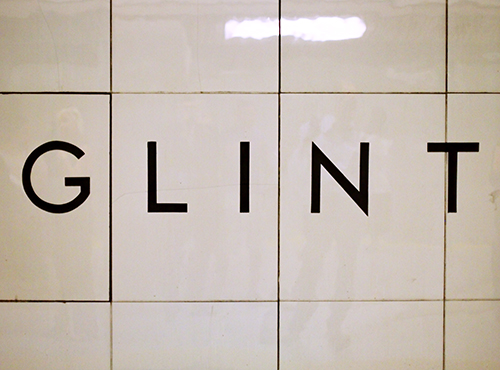
GLINT

You can see the glint on the wall, a tingle on your retina, a tongue of light vibrating like the long tine of a tuning fork – a simple toning luminescence alighting lonely, lasting only a moment, not lingering. A gleam, a glimmer, a glancing glow, just a glimpse on the glassy glazing. Something you think you see for a moment, a movement, a brief brightness, as semi-soft and sudden as [g] and as light and liquid as [l].

There are so many words to do with light and shining things that start with gl. They don’t all come from the same source; they just all shine with the same brief light, that verbal glint of the gl phonaestheme. We choose the words we prefer, and we shape the words we choose. Language is a performance, and sometimes we like to do a little dance of the tongue and the sound to give a more vivid sense of what we’re describing – and when we do, we may prefer known choreography. We lean towards a gl for light, perhaps, or a sw for rapid motion or a sn for the mouth or nose. Then we pitch the vowel for effect: big and blazing as in glare, soft and cool as in glow, dark as in gloom, bright and shining as in gleam, medium and flat and hard as in glass, light and short as in glint… The final [t] adds to the shortness, too.

This word glint actually came from an older word glent, which basically meant – and came from the same Germanic root as – glance as in both ‘look quickly’ and ‘quickly bounce or strike aside’. The verb glint was well in use by the 1700s, but the noun glint waited until the 1800s to be glimpsed, although it glitters in common usage now.

It’s a word I think of more often than some. Not that I am exceedingly prone to having a glint in my eye (or perhaps I am, I don’t know; I don’t look at my own eyes); I simply see the glint on the wall as I wait for the subway at Eglinton station, flashing half-noticed before my eyes and fading back into the covering illumination, gentle but shifting and lambent – no, glimmering, barely superliminal.

