snooze

Oops, sorry, took a little long to write this one. I guess I was snoozing… Well, I snoozed, I losed. No, wait: I snost, I lost. No, that doesn’t work either…

Funny—we’ve had the expression “You snooze, you lose” (at first more often seen as “If you snooze, you lose” or “When you snooze, you lose”) since the early 20th century, especially gaining in popularity starting in the 1960s and ’70s, but no one ever seems to want to look back at past occasions of snoozing and losing. Couldn’t English have been good enough to give us a strong past tense form of snooze?

It would help if we could sniff out where the word came from. It seems to have just snuck into the language while we were all sleeping. Its first known use in print is from the 1700s; Green’s Dictionary of Slang lists a 1753 entry from a glossary of cant (thieves’ lingo): “The Cull is at Snoos; The Man is asleep.” The snooze spelling showed up 30 years later. Etymology? The Oxford English Dictionary shrugs and says “apparently a cant or slang word of obscure origin.” Merriam-Webster says simply “origin unknown.” Green’s offers “[? SE snore + doze].”

Wiktionary seems just slightly more helpful: “Unknown. Compare Dutch snoezelen (‘to snooze’) or snusa (‘to snore lightly’).” Hmm… if I look at the entry for snoezelen it says “Blend of snuffelen (‘to sniff’) +‎ doezelen (‘to doze’)” but gives no indication there of how old the word is. And a bit of searching seems to indicate that the word was first seen in the early 1980s, and is associated mainly with a kind of sensory therapy. So it’s not the source of the word snooze… quite possibly the reverse.

Well, fine. We have snooze. And we like snooze. It has a certain snugness and a sound of snoring, doesn’t it? And that comfy buzz of dozing (perhaps with the aid of booze). Sometimes of dozing through a buzzer, too – thanks to the Snooze button on your clock radio (or similar device). I wouldn’t say it oozes comfort, but only because oozing is kind of a gross image – more like one you would choose for some loser schmoozing on a cruise.

There’s nothing so louche about snoozing; it’s simply somnolent. It’s true, it axiomatically entails missing opportunities – if you zone out, you get zoned out – but it doesn’t get you into trouble, either… or into any other indulgence. As my brother once said, “Try the sleep diet: you snooze, you lose. No pain, no gain!” Well, verily did I snooze, and yea, I did lose… time, anyway.


hackneyed

Are the Rolling Stones hackneyed?

They just came out with a new album, Hackney Diamonds, almost 60 years after their first album! Are hackneyed diamonds tired old gems? At this point, are the Stones just a bunch of hacks flogging a dead horse? Do they keep at it for lack of a better choice? After all, Mick’s 80 years old. It gives kind of a new edge on being “shattered, shattered”… but with an unexpected facet.

You see, Hackney diamonds is a slang term for the shattered glass of a window that’s been broken for burglary. (“Whole Wide World,” the fifth track on the album, starts with “The streets I used to walk on are full of broken glass” – but doesn’t mention Hackney.) Hackney is a district on the north side of the East End of London, and it’s historically… not posh. But nowadays, it’s hip and full of hidden gems. None of the Stones are actually from there, though (and, although part of Hackney is called Clapton, Eric Clapton isn’t from there either).

The exact origin of the name Hackney is unclear, but it has nothing to do with knees. The -ey suggests that in Old English it referred to an island, probably in the marshland between two streams. The Hackn- part… well, that hasn’t been hacked decisively. By the way, while hack as in ‘chop’ or ‘break into’ isn’t related to Hackney, hack as in ‘writer for hire’ is. It’s taken from the sense ‘horse for hire’, which is shortened from Hackney, as in the place. 

It seems there were meadows in or near Hackney where such horses were pastured. The thing about horses for hire is that they got worn out over time. Ridden too hard, too long, too often. Before you’re flogging a dead horse, you’re already dealing with something that’s gotten hackneyed – used up like a tired old jade, long since broken. Hackney doesn’t have much in the way of horse pastures now, but hackney was a byword for hired horses by the 1400s; by the 1500s it was applied to hired persons (not in a positive tone), and before 1600s it was applied to idioms tired from overuse. Hackneyed (past participle) appeared a few decades after that. Which means that it’s been ridden hard and long too. But still it perseveres, like a diamond (I’d say unbroken, but it has also been cracked down to hack)… 

As a side note, one stable keeper (though not in Hackney) dealt with the problem of people wanting to take out just his best horses – wearing them down quickly – and not wanting to take out his tired horses by offering them a simple choice: take the horse closest to the door, or don’t take a horse. The stable owner was named Hobson, and now we call something a Hobson’s choice if it’s not really a choice, is it.

But did the Rolling Stones face a Hobson’s choice?

I mean, come on, they don’t need the money. They don’t need the fame. They don’t walk on streets full of broken glass. But on the other hand, the album doesn’t sound tired and trite. I guess the thing is that a rolling stone doesn’t get to choose whether it keeps rolling.

yclept

This is a word that says “please clap.” Or should I say, it claps for itself. It is one bowtie-wearing word. But it’s like wearing a bowtie on the beach. 

No, no, that’s not even it; a bowtie on the beach would be like saying “Methinks the lady doth protest too much” or perhaps even “Methinketh thou dosteth forgetteth to whomst thou art speakinge.” It plays to the groundlings. Yclept is, hmm, maybe like serving Kool-Aid at a picnic in a Shreve, Crump & Low gurgling cod pitcher, or pouring it through an antique silver port funnel to get the sand out. Yclept is a word that on the one hand is an absolute cod, but on the other hand is a filter: the very ability to recognize that it is a real word and not a typo or keysmash bespeaks a relatively rarefied education. Yclept is not a word for people who use a pseudo-calligraphic font to signify fanciness; it is one for those who use a font that emulates the rough type sets of half a millennium ago. It says “ha, ha, look at me, I’m fancy, ha ha, no but actually I am, ha ha.”

Yclept, I will say for those who have never had it inflicted on them, means ‘called, named’, as in “The old and tenantless dwelling yclept Fieldhead,” but it’s not for street use. It is “occasionally used as an adjective or verb for humorous or archaic effect,” as Wiktionary says – or, as Oxford more repletely explains, “much affected as a literary archaism by Elizabethan and subsequent poets; in less dignified writing often used for the sake of quaintness or with serio-comic intention.” It is a word that Shakespeare used, and Milton, but only once each; it is a word Charlotte Brontë used for archaism (“yclept Fieldhead,” in Shirley), as Henry Fielding did a neat century before her (“thoſe fair River Nymphs, ycleped of old the Napææ,” in Tom Jones), and James Joyce did fourscore years after (“a young learning knight yclept Dixon,” in Ulysses). It is a word that Kurt Vonnegut definitively wiped his butt with in Bluebeard: “When I saw them, they were painted the palest rose-orange, not unlike the Sateen Dura-Luxe shade yclept ‘Maui Eventide.’”

So now, if you were (as my friend Iva Cheung suggests) to jokingly refer to A Streetcar Yclept Desire, it would get chuckles just from the same set who would be amused by a cartoon of Marlon Brando shouting “Ave, Stella!” And if you were to try to use yclept in earnest in an essay, any teacher who didn’t circle it with a red pen would probably have to take a week of sick leave after rolling their eyes too hard.

You might want to know how you’re supposed to say this word, inasmuch as you’re supposed to say it at all. It’s two syllables; you say it like “eclipse” except with “ept” in place of “ipse.” And you can – if you fancy being extra fancy – say it to rhyme with “leaped” rather than with “kept,” or even – if you want to spell it ycleped – like “ecleepid.”

You might also want to know what the yheck that y is doing there. Well, it was a kind of a fad in Middle English; past participles got it added to the front of them willy-nilly. There are various among them that are supposedly not obsolete yet, but I doubt you will see any of them, perhaps with the exception of ybounden in the song “Adam Lay Ybounden” (which you might hear during Advent – here’s a rendition: https://www.youtube.com/watch?v=626Nrbtwtao). And where did Middle English get the y- from? Old English ge-, which was a productive prefix for past participles. That in turn came from the same Germanic origins as the modern German prefix ge-, which is used in exactly the same way (Das habe ich gedacht). In yclept, it makes matching cufflinks with the -t, which forms clept from clepe the same way we form slept from sleep.

OK, and what is clepe? I already told you: a verb meaning ‘call, name’. But it also had other meanings – ‘call out, shout, summon, hail’ – and it comes from an old Germanic klip- stem meaning ‘make a sound, make a loud noise’, which, apparently, is another form of the klap- stem, from which we get ‘clap’.

So, as I said, yclept claps for itself. Take a bow… tie.

whoa

I’m gonna tell you something that’ll make you say “Whoa!” …or maybe “Woah!”

If you’re fussy about spelling, you probably winced at seeing woah. If you’re very unfussy about spelling, you might have blinked at seeing whoa. But here’s the thing: among those who nitpick at spelling, one of them is considered absolutely right and the other is considered absolutely wrong, but both spellings have been around for centuries. Either could have prevailed. And neither is the original spelling.

Just to be clear, I’m talking about what you say to make a horse stop, or to make a person stop, or to react to something that is a lot to take. I am not talking about sorrow – that’s woe, as in Woe is me (and no, it is absolutely not Woe is I, it’s the same impersonal verb plus dative that you see in methinks). And, on the other hand, we are not talking about a word John Travolta used in Saturday Night Fever to refer to a sexual professional (you could spell that who-a, but of course usually that -a is written re).

This word, whoa, pronounced the same as “woe” (these days), has been spelled as whoa since about the year 1800, though there do seem to be a few cases of that spelling from earlier. The spelling woah, which seems increasingly popular today (no doubt a sign of the abject failure of modern education, an abject failure that, if we’re to go by the complaints of people who complain about such things, has been ongoing since the 1600s), first shows up in texts in the, uh, 1790s.

Which is not to say they were equally popular the whole time. No, whoa did prevail. But during that time, various published sources also had it as woa, woh, woo, wooh, whoh, and wo. And before either spelling showed up, it was also spelled as whoe, whoo, and who. But before that, there was the earlier word ho, also spelled hoo, hoa, and hoe (speaking of that word Travolta used).

So what the heck? Noah Webster helps us just a little here. In his 1828 American Dictionary of the English Language, he put an entry for ho with the definition “a word used by teamsters in stopping their teams” and the note “This word is pronounced also whō, or hwō.” So, you know, with that “hw” sound that English speakers generally don’t make at all anymore, except occasionally when emphatically saying “What?!” – like you might have done when I said that you could spell this word either way.

OK, OK, I know, if you’re a big ol’ word nerd (as I am, and I have socks that say so), you might find this disturbing. We have spelling for a reason! Yes, yes we do; in fact, we have it for several reasons, and one of those reasons is to help us distinguish who is “properly educated” (socially acceptable) and who is not (socially inferior in a certain way): people write what instead of wut because they know what’s what, and the biggest reason we write who as who even though we’ve said it like “hoo” for ages is to show who’s who.

Look. If spelling were just for purely phonetic purposes, to transcribe what you say, whoa and woah would both be bad. If it were for etymological reasons – to show where the word came from, and believe me, that’s an important influence in English spelling – both spellings would still be bad. If it were both of the preceding but also to help distinguish words that could be spelled the same (from woe on the phonetic side and from hoe and who on the etymological side), we’d still do better with, say, woa. No, spelling is also for the very conservative purpose of displaying tradition, and when you’re displaying tradition, you’re choosing whose tradition is worth displaying, and you’re keeping up the tradition of putting people into a social order, one in which people who write whoa, for instance, are in some way better than people who write woah.

I have never found that spelling is a useful indicator of a person’s worth. But I’m not saying that anything goes or that anything should go. Even if I wanted anything to go, it’s not up to me. And it behooves everyone who writes this word to know what the intended readership will think of the different spellings. Words, like horses, tend to come with riders (sometimes more than one), and when you take the horses you take the riders too – in this case, the social significance. Might as well; social navigation is one of the main reasons we use language. It’s not just for fun that we have many ways of saying the same thing – your choice of “Hello,” “Hi,” or “Hey” depends on who you are, who you’re speaking to (or to whom you are speaking), your relationship, and the context. And “gonna” is pointedly more casual and engaging than the basic “going to.”

Anyway, whoa is still very well entrenched. In the Corpus of Contemporary American English, published instances of whoa outnumber instances of woah by more than 100 to 1. On the other hand, in the Corpus of Global Web-Based English, instances of whoa outnumber instances of woah by less than 3 to 1. So, uh, change in progress? Might be. But before you whoa the language on this…

What? Whoa isn’t a verb? Huh. Actually, it’s been used as a verb since the later 1800s, but this raises an important point: in the main, this word is an exclamation, a phatic usage, a sound people make not as part of a sentence but as a whole utterance issuing forth on a wave of feeling. It’s in the same class as the British phwoar (also spelled a whole bunch of other ways), which expresses a surge of sexual desire in response to seeing someone, and the North American whoo (also spelled woo and wooh and wooooooo), which expresses “Partyyyyyyyy!” When you’re in the throes of a crucial instant, not only is spelling not the most essential thing, infractions of spelling are a good way to signify the intensity of the moment (see also teh, pwn, and hodl!!111!!1!).

Taken that way, whoa is something a staid, genteel person can say and write. But woah means you mean it – and to hell with pedantry!

nice, silly

Etymology is great sport, especially when it’s nice and silly, and I have a couple of words for you today that really are nice and silly.

I insist on accuracy in etymology, partly because just-so stories fill people’s heads with asinine ideas about words and humans in general (people are asinine enough without the assistance of fabrication), but partly because the truth is often weirder than anything some twit could invent. Today, though, I’m giving you a story of why being ignorant can be nice, and why being good can be silly. And it shows the hazards of being too fixated on what a word originally meant.

We all know and love the word nice. Some of us use it about 69 times a day. We know that it means ‘agreeable’ or ‘virtuous’ or ‘pleasant’ or ‘inoffensive’ or ‘absolutely not naughty’. But like many a nice person or thing, it has a shady history.

Nice is a pretty bland word now, but we still see uses like “a nice distinction” that show an earlier sense of ‘accurate, attentive to details, even finicky’, and we might notice that some older uses of “nice” also mean ‘dainty’ and ‘delicate’. But wait—there’s more.

Nice went through a phase of often being used to mean ‘skillful’ and ‘meticulous’, and that came from a sense meaning ‘minute, subtle’, which could also shade into ‘obscure’ or ‘trivial’ or even ‘coy’. That sense came from a sense meaning ‘delicate’ or ‘fragile’ or ‘timid’. But there was also a usage, in the same general time period (which, at this point, was before Shakespeare), of ‘lascivious’ or ‘wanton’ or ‘ostentatious’. Sometimes in historical examples it’s kind of hard to know exactly which sense of “nice” the writer had in mind. Which is pretty… nice. 

But when you go all the way back, the earliest sense comes directly from the Latin that evolved, through French, into nice: nescius… which meant ‘ignorant’. From ne (‘not’) and scius (from scio ‘I know’). So nice, when it first showed up in English in the 1300s, meant ‘ignorant’ or ‘foolish’ or ‘silly’.

Except, at the time, silly didn’t mean ‘silly’.

Now, I should say that silly didn’t show up in English until the 1400s. So it didn’t exist when nice came in. But that’s just because before silly was silly it was, since the 1200s, seely (or sely). However, it didn’t mean ‘giddy, inane, foolish’ until the mid-1500s. Silly came to that sense from a sense meaning ‘simple, rustic, unsophisticated’, but that sense also appeared in the 1500s. Before that, it meant ‘weak, innocent, defenceless’. And that’s about how it was when it was first silly rather than seely. But seely, now… 

Well, at the time that nice (or nyce or nys or however those silly people wanted to write it) first landed in English, seely meant ‘insignificant’ or ‘poor’ or ‘weak’, and that in turn came from ‘pitiable, miserable’, which came from ‘innocent, harmless’. And that came from a sense of ‘pious’ or ‘holy’ or ‘blissful’ or ‘lucky’ or ‘blessed’, which came from Proto-West Germanic *sālīg, the descendants of which have generally kept that sense in other languages: German selig, Dutch zalig, Swedish and Danish salig, Scots seelie

So, to put it loosely, silly originally meant a very nice state of being, and nice originally meant a very silly state of being.

Fortunately, some of us think it’s nice to be silly (though it’s not at all silly to be nice). But you can also see that etymology is not destiny; the origins of words—and other things—are not proper guides to their current state. So when someone tells you that a certain word has to mean exactly what its origins or distant historical use reveal, just tell them they’re very silly and not at all nice. If they’re offended, they’ve proved your point; if they’re not, well, you meant it the modern way anyway.

twig

I twigged to it after reading Brendan Behan’s play The Quare Fellow.

In act two, Crimmin, a warder in an Irish prison, is slipping a few cigarettes to a prisoner who – unlike most in the play – speaks Irish first and foremost. He says, “Seo, cúpla toitín. Táim fhéin is an screw eile ag dul isteach san ospidéal, nóiméad. Roinn amach na toitíní siúd, is glacfhaidh sibh gal. Ma thagann an Governor nó’n Chief nó an Principal, na bíodh in bhur mbéil agaibh iad. A’ tuigeann tú?” And the prisoner replies, “Tuigim, a Thómais, go raibh maith agat.” 

The text helpfully gives a translation note: “Here, a couple of cigarettes. Myself and the other screw are going into the hospital for a moment. Divide these cigarettes and let you take a smoke. If the Governor or the Chief or the Principal come, let you not have them in your mouths. Do you understand?” And the reply: “I understand, Thomas, thanks.”

I first read this shortly before I started to study Irish, but at the time – and later, as I learned some of the language – I couldn’t help but notice that tuigeann tu means ‘you understand’ and tuigim means ‘I understand’. Which meant that the root for ‘understand’ is tuig-. Which is not pronounced exactly as “twig” – it involves a velarization of the t and a palatalization of the g that English phonology has no grasp of – but the closest English sound to it is “twig.”

Most of the time in English when we say twig we mean sense number one in the dictionary, noun, ‘little branch’ – it comes from an old Germanic and ultimately Proto-Indo-European root that is related to the root for two (because it splits in two). Now, sometimes, if a word gains a new sense or nuance, we might say it’s been tweaked, which traces to Old English twiccian ‘pluck’, which is a thing you can do to a twig, though the two are unrelated etymologically. But if instead of plucking you grasp – figuratively, as in you gain insight into something such as the development of a word – you twig, in sense number two, verb. And guess what. Guess where this twig comes from.

Well, if you ask the Oxford English Dictionary, it says “Of unknown origin.” But if you ask Merriam-Webster, it says “perhaps from Irish & Scottish Gaelic tuig- understand.” And if you ask Wiktionary, it declares, “From Irish and Scottish Gaelic tuig (“to understand”).” Incidentally, this word tuig is not etymologically related to English twig; it seems to come from a Proto-Indo-European root relating to understanding. But these twigs have twined together in the thicket of the English lexicon.

Sometimes, in etymology, when you grasp at twigs, they do not support you and you fall – as linguists like to say, etymology by sound is not sound etymology. But suggestive resemblances can sometimes lead you to a true root: something tweaks your ear, and you twig. A’ tuigeann tú?

comradery, camaraderie

When I was young, I spent some years trying to get somewhere as an actor. I did almost no professional work, but I did a lot of community theatre. I love community theatre. There’s no cachet and no cash, eh, but it’s so much fun and there’s such comradery. Erm, camaraderie, I mean.

Which reminds me of a play I was in called One for the Pot, a farce by Ray Cooney and Tony Hilton in which I played identical twin brothers (no, wait, identical triplets…) who were aiming to collect an inheritance. It had quite a bit of stagecraft and clever use of trapdoors and body doubles. I played Billy Hickory Wood, a likeable, not-too-bright Yorkshireman, and Rupert Hickory Wood, his long-lost brother who had a posh southern English upbringing (also Michael Hickory Wood, a wily Irish-raised brother, but he shows up halfway through). It occurs to me that Billy might be the sort to say (and write) comradery but Rupert would certainly be the sort to say and write camaraderie.

To be fair, comradery is much less commonly used, and seems to be more American. But to those with linguistic savoir-faire, it may seem to be an error – a vulgar reanalysis, a mere Americanization, taking a lovely French word that had been carried into English unchanged and stuffing it into those English britches. Why, camaraderie refers to sharing a room – it comes ultimately from Latin camera ‘room, chamber’, but passed through Spanish on its way to French; camarade was first a word for a soldiers’ dormitory, but then came to refer to those who slept in the dormitory, the brothers in arms. So it is a word for a certain esprit de corps! Whereas comrade, well…

…well, it comes from camarade, of course. And while it has gained a certain “communist” tinge by association, it is still used quite a bit for general companions and friends and comrades in arms. And there is quite a company of English words that end in -ry – scores and scores, such as artistry and devilry and gadgetry and peasantry and on and on. So comradery is a perfectly reasonable construction in English.

But it just happened to show up as a parvenu to claim the inheritance of its French doublet. Camaraderie has been in English at least since the 1840s, and comradery only since the, uh, 1870s.

Well, whatever. They are long-lost twins, with different cultural bearings, but both are worthwhile, even if they never seem to be seen in the same room together… ironically.

Speaking of which, by good fortune, someone brought a camera to a performance of that production of One for the Pot, and a couple of years ago I digitized it from a gradually degrading VHS tape. You can watch it, or anyway as much of it as you can bear (the sound and image quality are not to 2023 standards)…

scamper

What scampers?

Mice scamper, right? Running around quickly on their fleet little feet? People seem to agree that they do.

Do kittens scamper? Puppies? Cats and dogs? Horses?

How about very small prehistoric horses? Charlotte Perkins Gilman thought so – here’s the start of her “Similar Cases”:

There was once a little animal,
No bigger than a fox,
And on five toes he scampered
Over Tertiary rocks.
They called him Eohippus,
And they called him very small,
And they thought him of no value—
When they thought of him at all

My wife wouldn’t say that dogs scamper (I asked her), but Jessica Suzanne Stokes would; in “Strolling (2020-___)” she wrote,

Eventually, we brought dog and cat treats so each block
we’d meet a friend we earned unfairly. We sought out any company that
   might wag and scamper with us.

Maybe a marmoset scampers? T.S. Eliot thought so – here’s from “Whispers of Immortality”:

The couched Brazilian jaguar
Compels the scampering marmoset
With subtle effluence of cat

Certainly there are things that do not, cannot, scamper, yes? Things that merely crawl, and not quickly? Someone hold a séance and tell Robert Browning – in “Caliban upon Setebos” he wrote,

Then, when froth rises bladdery, drink up all,
Quick, quick, till maggots scamper through my brain

(Which has, by now, I guess, been accomplished.)

Do body parts scamper? Your hands, your feet, your tongue? Do your eyes scamper? David Tomas Martinez thinks so – here’s from “Love Song”:

Upwards our eyes scamper,
         a reflex action,
         when inserting an object
                  in the mouth,

even when the object
is a gun.

Did some feeling in you scamper when you read that last line? Tracy K. Smith would allow the possibility – in “I Don’t Miss It” she wrote,

And that scamper of feeling in my chest,

As if the day, the night, wherever it is
I am by then, has been only a whir

Of something other than waiting.

Humans, as whole entities, scamper, of course. William Wordsworth, in “The Prelude: Book 2: School-time,” wrote,

In wantonness of heart, through rough and smooth
We scamper’d homeward.

And what would that scampering have looked like?

Take a moment now and scamper. Can you? How would you? (I’m not asking you to upload a video, but on the other hand I couldn’t stop you if you did.)

Are you scampering away from something? Or towards something? Or are you just scampering around?

Can you use scamper any old where? You can use it in a poem, obviously. You can use it in casual conversation (such an instance brought the word to my mind for this word tasting in the first place). Can you use it in a sermon? In a political speech? In an annual report? It seems playful, undignified. I think there are contexts for which it is too cute, too camp. But is that just me?

Is scamper the sort of word of which, the more we try to capture it or uncloak it, the more it escapes?

When we seek its etymology it most certainly is.

Scamper scampered onto the English tongue in the late 1600s. It may have come from military slang. Its earliest sense was ‘run away’ or ‘decamp’ – or, to use an older synonym for ‘decamp’, ‘discamp’.

Hmm. DiscampScamper. Could it be?

Well, it could… one of the proposed possible etymons is Middle French escamper, and another is Italian scampare. Both mean ‘leave’ or ‘escape’. But…

Well, escamper is from the same root as decamp and discamp, both of which connect, yes, to camp in the military sense, which in turn is from Latin campus, which originally meant ‘field’.

And scampare is thought to be from Vulgar Latin *excampare, which is, they say, a variant of *excappare, which has as its root not campus but cappa ‘cloak’. This *excappare is also the source of escape. Its origins thus literally mean ‘uncloak’ or ‘take off the cape’ – and yes, by the way, that means excape is etymologically altogether justified, even though it’s not accepted in Modern English.

But wait – there’s more. There’s a proposed possible Dutch etymon, schampen, but that means ‘graze’. I don’t know if it has anything to do with schaap meaning ‘sheep’. If sheep scamper at all, it’s not while grazing, is it?

And then there’s scamp. We know this word as a noun meaning ‘vagabond’ or ‘rogue’; the noun comes from a slightly older verb scamp, which somehow meant ‘go about in an idle way’, often implying mischievous intent. And that verb seems to come from scamper.

Oh, and when scamps get caught, what will they do? Scarper, I’m sure – which comes from Italian scappare ‘run away’ (yes, from *excappare), possibly influenced by Cockney rhyming slang, which used Scapa from Scapa Flow in place of go. But will they, when scarpering, scamper? Oh, you tell me. Scamper is a word of senses both expansive and fugacious.

muster

It’s taken me some time to muster the words to write this, and I’m still not sure it will pass muster. It’s true, the biggest part of writing – of any kind of performing – is just showing up, but if you do show up, you don’t want to get shown up, you know? You want to demonstrate that you have it all together. You need to cut the mustard. You have to have something to show for it, lest you serve as a warning to others – or leave a trail of ruin like some kind of monster.

So. Muster. Is it musty, or is it tangy like mustard? Does it fight like a musketeer? Or does it just manifest what you must? 

Etymologically, it’s none of those, if that matters – after all, most of us think of words on the basis of what they sound like they resemble rather than what they actually come from. But what a word seems to show will not always bear up under inspection; the deeper you get into a word, the more new senses and connections you make, but the more you break as well. You monster.

Let’s get deep into the roots of this word, with Latin moneo ‘I warn, I advise, I admonish’ (yes, admonish comes from moneo). From it was derived monstrum ‘omen, portent, ominous thing, monster’ (yes, monster comes from monstrum – first meaning ‘omen’, then meaning ‘what the omen was warning you about’, and then more generally ‘bad bad thing’) and also monstro ‘I show, I indicate, I advise, I denounce, I demonstrate’ (yes, demonstrate comes from monstro). 

Monstro came through Middle French monstrer (whence Modern French montrer ‘show’ and montre ‘wristwatch’ – the English watch the time, the French show it) and landed in English in the later 1300s as moster (and a collection of other spellings), a word for an assembly of persons or things for showing or reviewing. In particular, in the military, it was when all the troops stood to be inspected (and, often, thereafter paid).

And from that we get all our current uses. Muster the courage, muster the energy, muster support, muster enough votes, muster the strength… all from calling together a collection of the thing in question, as you must. Pass muster comes from being deemed acceptable in the military inspection (in civilian life, if you persistently pass muster, you can become a past master). From that comes the surprisingly common pass constitutional muster, meaning ‘hold up under scrutiny on the basis of what is allowed and required by constitution’ – you also see fail constitutional muster, withstand constitutional muster, meet constitutional muster, stand up to constitutional muster… It’s all about cutting the mustard, which, however, has no traceable connection to muster (see World Wide Words on the topic).

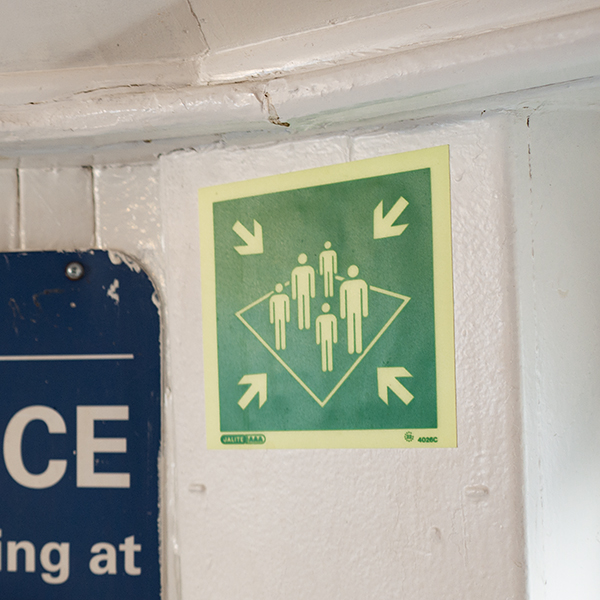
And then there’s muster point and muster station and so on, which you will see on big boats (ferries, cruise ships, etc.) and at some construction sites. When the occasion (fire, natural disaster, imminent immersion) demands that you come together, right now – show up, show yourself, stand and be counted, and perhaps also put on protective equipment – that, too, is from the military inspection parade. But sometimes, just for the sake of clarity, different words such as “emergency gathering area” may be used – or just an image, to show you.

oncet

English spelling is a jungle, full of wonders – and perils. Sometimes the peril is a lurking ocelot wanting to prey on you. Sometimes it is just that the lush meandering vine-knitted pathways of the written form have been maintained by tradition between eroded edifices of ancient orthography while the limestone bedrock beneath has been eroded by the gradual currents of usage and in places has collapsed and re-formed altogether, so that at one moment you are walking blithely in the bushes and the next you are plunged through the darkness into the deep obscure pool of a cenote. And you will have had no sense of the onset of that cavity; it was there before your time and has been waiting for you, and you will make the error only oncet.

Onced.

Onct.

Wunst.

What the heck.

OK, look, here’s the deal. A long time ago, in Old English, when the word for ‘one’ was ān, the instrumental form of it was ǣne, which was used adverbially, and the genitive -s was later added to this form to make enes, similarly to how we got besides and anyways and towards. Meanwhile, the form oon (based on a pronunciation shift from ān) had come into use for the number (while an stayed on as the indefinite article); to go with that, enes became ones, which subsequently was written as once following a trend of spelling the final [s] as ce, as in hence, pence, and mice

But in the meantime the pronunciation of the vowels was shifting, and long vowels became diphthongs. And while in some other derivatives of one the diphthong became [ow], as in alone, atone, and only, the original word one and once both went with a variation from the south and west of England, which is how we say it now – and not at all how our forebears said it once.

But there’s one more thing: a tendency in some varieties of English and some contexts to add a [t] after a final [s], as in amidst and against. In the case of once, that variation didn’t become standard, but it became common enough that it gets written down from time to time.

But it’s not so common that there’s any spelling of it that doesn’t look wrong. Usual habits are so ensconced that our expectations of what spelling spells are likely to prevail at first glance. We accept once and one because we’re used to them, but most of us are not used to the t-ful version, especially not in print. So our foot hovers above a void that we do not know how to avoid.

And if you try to bypass the cenote, you’ll get chased by an ocelot that’s just waiting for a hapless misstep: you have to know all the strange side paths of spelling or you will be attacked. You see, if you want to show that someone is uneducated, you can use what’s called “eye dialect” and write them down as saying wun and wunce to indicate that they don’t know good English, even though (a) these spellings sound the same and (b) the “bad” spellings are more sensible than the “good” spellings. But when you have that added [t] at the end, wunst is just a step too far for many people; it looks like it wandered over from German, and it also looks almost unduly uneducated. 

But the alternatives are mostly worse. Oncet, the most economical approach, thrashes like a bird of paradise caught in hanging vines, and onct is like the same bird but missing a wing – there’s no way it will fly. Oncst is that bird now being eaten by a snake. Onced may look like it’s pronounced [wənst], but the thing that helps the pronunciation – the productiveness of -ed as a suffix in many contexts – obstructs comprehension: it looks like a past tense form rather than like just once with a spare t. Onest seems not quite honest. Oncest seems vaguely indecent and also vaguely pleonastic, and in any case it appears to have two syllables. 

Perhaps one’st would pass, but only perhaps. The best bet may – may – be once’t: for once, an apostrophe actually helps make something easier to read rather than just being another orthographic ocelot. The only problem is that some readers may infer that something has been contracted, such as it. (You do not want to contract it unexpectedly in the jungle of orthography!) Blessings accrue to those speakers in some areas who say this word yinst, as they have it nailed down, but that’s off in the dense underbrush for the rest of us. We’d prefer to stick to the trail and hope we can sidestep the cenote this time.

The worst thing of all this, though, is that you can’t even represent one using a numeral. As perfect as 1st would be, it has been taken by first, which is formed not from the number at all but from the same root as gives us fore (which also gives us forth, which forever confounds with fourth – such a mischievous root). Perhaps the best solution is to have your characters do things not oncet but twicet (or twice twicet, but that would be forced).