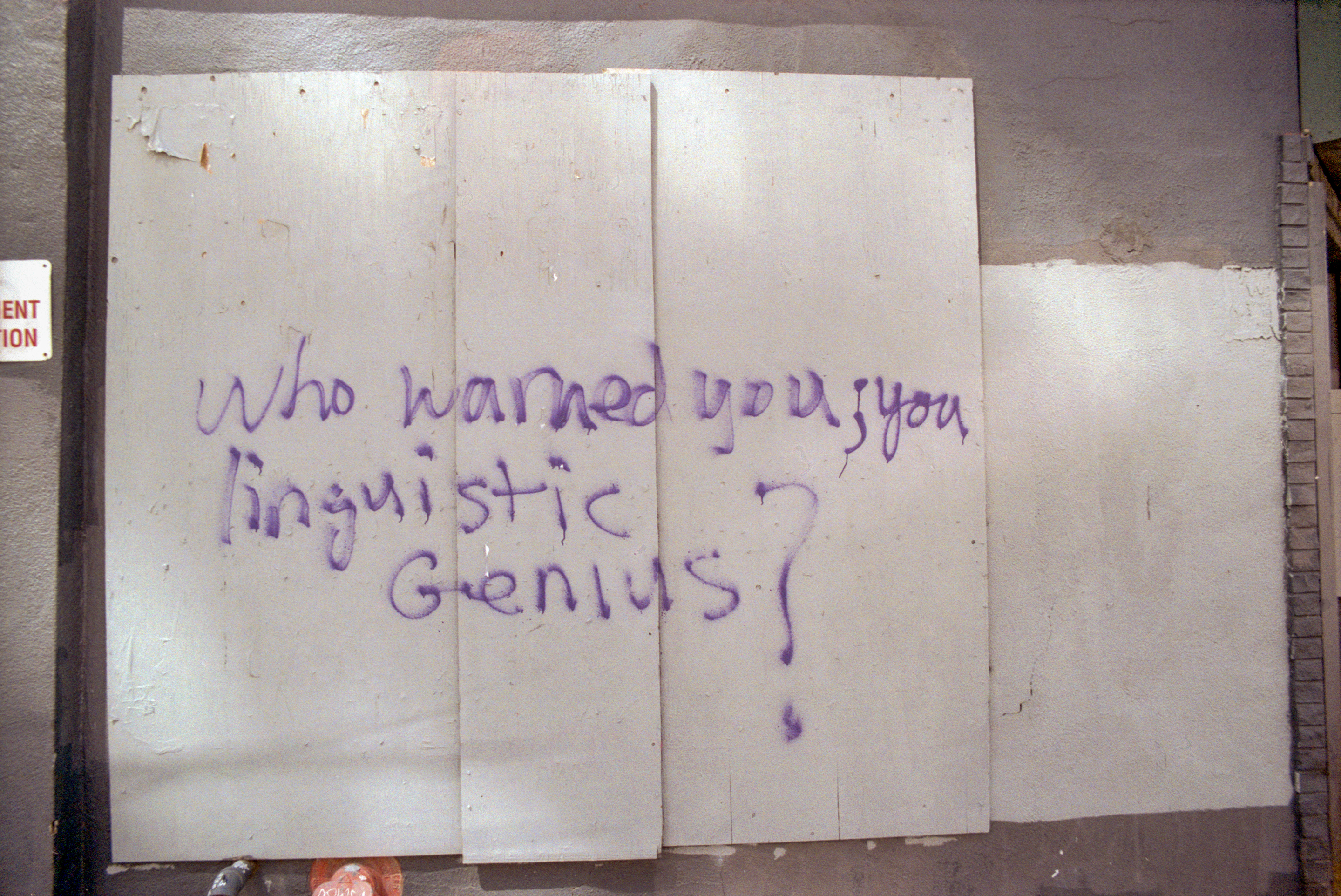
calypso

He came off the boat, onto an island, and he wandered far and long; at last he came to where there was refreshment, and a place to stop and stay. And he partook of the intoxicating beverages, and of the nourishment, and he was at ease. But at length he looked towards the water, and he longed for his wife, who was across it; but he could not leave, because of Calypso.

Homer’s Odyssey, book 5? Maybe. But my Wednesday, after work? Certainly.

How could that be? Was I in hiding, perhaps, from the crypto bros of the apocalypse? Or entrapped by a goddess, kept concealed for seven years, until at last I could step up?

Oh, I was there at the behest of a goddess, to be sure, but she was my wife, who was coming to meet me. I had made my own small odyssey – a six-kilometre walk from the other end of the island, rather than taking the ferry to the dock a hundred metres from my destination – but not all who wander are lost. The Calypso that had me get on the island and was keeping me there was a local calypso band called Shak Shak, performing in the evening at the Island Café (in its new quarters, after the old one was incinerated by a fire a year and a half ago)… and I had to arrive early and bide my time to stake a spot. Seven years? No, but a couple of hours. I was, it is true, served intoxicating beverages by a woman from a foreign land, but they were beers, I had ordered them and would pay for them, and the woman was the Venezuelan bartender.

Why go to such lengths for calypso? My friends, if you’re asking, you haven’t been where calypso is being played live. It really is a musical intoxicant, almost guaranteed to make you come on and dance:

Which is how it got its name. Well, its first name… but then there were wanderings. Calypso music, you see, is descended from kaiso music; both are from Trinidad, the southernmost Caribbean country, just off the shores of Venezuela. Kaiso comes from Ibibio and Efik phrases meaning ‘come on’ or ‘get on’, which are said as encouragement, sort of like “Bravo!” And, as far as we can tell, the word kaiso got so encouraged that it got on and wandered and grew until it became calypso.

Which, of course, was already known as the name of a goddess (specifically a nymph) who held Odysseus in thrall on her hidden island for seven years, until at length he began to pine for his homeland and his wife. The island of Calypso was named Ogygia, as opposed to the island of calypso music, Trinidad (or the island I was on for calypso, Ward’s Island, which is not actually its own island but part of Toronto Island).

And Calypso’s name did not mean ‘come on’ or ‘get on’. No, it came from Greek καλύπτω kalúptō ‘I cover, I conceal’ – because Calypso concealed: she hid Odysseus from everyone else for seven years. This word καλύπτω also has a mysterious resemblance – mysterious because it’s not clear how they’re related; they may have come from unrelated sources and over time gained greater phonetic resemblance because of their similar sense – to κρύπτω krúptō ‘I hide, I cover, I conceal’, the source of our modern crypto.

Well, perhaps in the fullness of time we will find out exactly how Calypso and crypto are related, and exactly how kaiso came to be calypso. At the end, we are told, all will be uncovered, revealed – the cover will be taken away: ἀποκάλυψις ápokálupsis ‘uncovering, revelation’, from ἀπό (apó, ‘away, back’) and καλύπτω. Which is, of course, the etymon of apocalypse… But a revelation doesn’t have to involve incineration; it can just be when the band comes on stage and begins to play.

Which Shak Shak did. And there was no cover – although a jug was passed around, and we put some cash into it. (They also had a tap machine for cards, but they weren’t taking crypto.)

At length, Calypso, in spite of her love for Odysseus, heeded the direction of the gods of her time and gave him the means to make a boat and cross the water home to his wife. And at length, my wife and I, in spite of our love for calypso, heeded the god of the time tables and made it to the boat, got on, and crossed the water home, away from the island and calypso. But we can always listen to calypso at home, even if it’s not quite the same as being there. Here’s a concert video of the Mighty Sparrow, one of the greats of calypso, who I saw in concert more than 30 years ago in Edmonton (not this concert, just to be clear):

Pronunciation tip: French cuisine

It’s been a while since I’ve done a pronunciation tip video, and it’s mainly been because I wanted to do this one but I was hoping to do some kind of stunt for it such as making coq au vin. Well, I made coq au vin less than a month ago, and I was too busy cooking to make a video. So never mind. Here, for those who want to know the French pronunciations, is how you say 65 food-related terms from French that show up in English: aigre-doux, aïoli, à la carte, à la minute, à l’orange, amuse-bouche, apéritif, au jus, baguette, bain-marie, béarnaise, béchamel, beurre manié, beurre noisette, bon appétit, bouillabaisse, bouillon, bouquet garni, brioche, brunoise, chiffonade, confit, coq au vin, cordon bleu, coulis, court bouillon, crème brûlée, crêpe, croissant, croustade, demi-glace, digestif, en croûte, entrecôte, fleur de sel, foie gras, fricassée, hors d’œuvre, julienne, lyonnaise, macaron, macédoine, Madeleine, mélange, mesclun, mirepoix, mise en place, moules marinières, pain d’épices, pain perdu, papillote, pâte à choux, pâtisserie, piperade, ratatouille, rouille, roux, salade niçoise, sauce bordelaise, sole meunière, soupe du jour, tournedos Rossini, velouté, vichyssoise, and vol-au-vent.

caboose

When you were a kid, did you always wave at a caboose when you saw one?

There are four possible answers:

  1. Of course!
  2. That was before my time.
  3. What’s a caboose?
  4. Whaaaaaaaaaaaat? That would get me slapped!

Well, there is a fifth possible answer – “No” – but I think the only people who would say that would be ancient mariners. You see, though it’s now often used to mean, um, “booty,” caboose has gone on a long and interesting trip, starting in the same place you might find booty but perhaps on a higher deck. I mean that it started out as food storage, whereas now it’s, um… Let me put this another way: it was a place where you could really get cooking, whereas now it…

OK, let me be plain. A caboose, in the oldest sense we know of, was a shack built on a ship’s deck to house the stove and/or to store the food. It was used when there wasn’t a proper galley. The word is descended from Middle Dutch kombuys via French cambuse (and we’re not really sure where kombuys comes from; the etymons have the look of meaning ‘something-house’ but I’m not sure what the something would be. Also, although Portuguese comboio ‘train’ has a certain resemblance, it’s unrelated – though it is related to convoy). Other descendants of these words (e.g., modern Dutch kombuis, Swedish kabyss, Italian cambusa) still generally name a food storage place or a cookhouse. But in English, in particular in Canada and the US, the word got on a different train.

It’s not that other countries don’t have trains, of course. But in North America, the long freight trains that covered long distances needed a crew car at the back, partly so someone could hop off and reset a switch once the train had passed over it, partly to give a place to look over the train and make sure that everything was OK with it (no load shifting, no damage, no fires, no detachment), partly to give a place to do paperwork and to sleep and cook, and they decided to call the car – which was originally just a cabin on a flatbed – a caboose, after the shipboard thing it first resembled. (It’s not that nowhere else in the world had similar cars; they just didn’t look quite the same, and they weren’t called cabooses.)

Cabooses are cute, especially the ones with the little cupola on top. The cupola is there so a crew member can look over the train; some cabooses instead had bay windows on the sides, and some had both. But there’s something very Richard Scarry about a little head poking up in a little cab on the top of a little red car at the end of a train. If you’re a kid and you see one, of course you wave! And maybe the train whistles back at you (probably not, though; you’re at the end away from the whistle).

Nowadays, though, you should neither wave nor whistle, for the only caboose you are likely to see on the average day is the rear end not of a train but of a person. The transference of sense is obvious – from back end to back end – and the word has a certain fun sound to it, complete with boo like in booty. But the train that got it there has moved on now. Train cabeese (sorry, cabooses) were legally required up to the 1980s, but improvements in train technology – which included not only cameras and sensors but also suitable room for crew quarters up in the engine – obviated them, and the train companies’ fiscal desires led to crew reductions, and so cabooses were written out of the law. And that made an end of them. So to speak.

plankton

Imagine you’re a right whale. Left to your own devices, you wander around the oceans, filter-feeding and taking it as it comes. No planked salmon for you, just plankton: copepods, krill, pteropods… the true drifters of the ocean, riding the current from past to future until they are baled by your baleen: a live-and-let-die diet. They’re not chewy; they’re so small, they’re indistinguishable from foam (and not the kind that’s gotten tired on Michelin menus – just the sea foam you see foam on the sea). You could have ten million in a dessertspoon of saltwater. In one baleen-filtered rightfully right full right whale mouth you could have as many microscopic life forms as there are whales and humans hosted by our whole planet, all brought together by circumstance, not a phalanx but just a huddled mass.

You could also have that as a human, if you were to drink seawater. But don’t. It will make you sick. Among the plankton are not just vanishingly small shrimp-looking and flea-looking and jelly-looking things but also mightily many bacteria and viruses, not to mention far too much salt for a human gut. Plankton is, after all, a whole class of thing: any kind of small living thing that drifts in the ocean, ranging from the micrometre scale to the centimetre scale – even a jelly or squid relative that is carried willy-nilly by currents counts as a plankter. It only matters that it not motivate volitionally in counteraction to currents.

The definition of plankton – and indeed the word itself (and the individual plankter) – was created in 1887 by the German marine biologist Victor Hensen. Plankton is, tout court, organisms that drift; the word is from Ancient Greek πλαγκτός (transliteration plagtós but phonologically plaŋktós), which means ‘drifter’ or ‘wandering’, from πλάζω (plázō) ‘I wander’.

Wander? Hmm, I wonder. There is another Greek word for ‘wander’: πλανάω (planáō), and it seems as though it could and should be related to πλάζω but it’s not clear how – the phonological transformation required is troublesome. Perhaps the two simply drifted together. It’s a big enough planet…

…and, by the way, planet comes from πλανάω because the planets (Mars, Venus, etc.) were seen by early astronomers to wander in the sky. Of course now we know that our own island home is also a planet like those others, and also that they are not wandering aimlessly; they are carried by the currents of gravity, swirling in the eternal gradual gravitational whirlpool of a star. Physics! We are all plankton, from the galactic to the Planck length.

What is the Planck length? It’s a short walk; before you know it you’re in the foam. Planck distances are the smallest conceivable distances in space and time; the Planck length is so small a hundred quintillion fit in a proton, and even the smallest bit of plankton is a whole universe, relatively. To quote David Mermin, “spacetime becomes a foam at the Planck scale.” It’s the great class equalizer, invented by Karl Ernst Ludwig Marx Planck – or, as he called himself from childhood on, Max Planck. (Why Planck? It seems that – to abridge a prolix peroration – his ancestors lived near a bridge, i.e., a plank across a stream. And plank, as it happens, traces back through the seven seas of European languages to Greek φάλαγξ, phalanx, which names a wooden board, or a mass of infantry arrayed for battle, or one bone of a finger.)

Well. That’s all a whale of a tale, isn’t it? But it’s not just a tale of a whale. In this ever-changing world in which we’re living, we all intake our share of plankton. After all, it’s not just adrift in saltwater; a dessertspoon of tapwater will likely have some too, as everything carries myriads of myriads of microscopic beasties, just drifting. The air does, too: aeroplankton includes viruses, bacteria, fungi, and even pollen and similar plant propagations. And of course aerosols; if you sit in a space with other people, they will exhale not just aeroplankton but microscopic water drops with various entities in them, and you will inhale some in turn (unless you’re wearing a well-fitted N95, and even then a few may pass through). They drift into you as you drift on this planet, whether wandering in the woods or tapping into the daily phalanx of the digital sea. Such is the foam of time and space, the walk we are planked on.

lizardry

Let us say, just to taste the air, that you want a word for the state, quality, or practice of being a lizard. Lizardlikeness? Hmm, no, not like. Lizardsomeness? Well, er, OK, but that’s just to do with the essence, you know, the state of being, rather than, say, the actual practice and so forth. We need a word that covers eating dragonflies, shedding skin, staring into space, occupying prominent appointments in certain political administrations, that manner of thing. 

Say… there’s an inspiration. What would be the equivalent for, say, coward? Or, on the other hand, wizard? Well, there’s cowardice, and cowardliness, and, on the other hand, wizardry. Is there wizardice or wizardliness or cowardry? And, to get to the point, is there lizardice, or lizardliness, or lizardry?

There is, in fact, wizardliness, though not, it seems, wizardice (except perhaps in some role-playing game). And there is cowardry. And, to get to the point, there is lizardly and, by extension, lizardliness; there is no lizardice (except in some social media handles and brand names, I guess), although I rather like that; and yes, Iva, there is lizardry, and I must say, I fancy it.

The truth is that -ry nouns have a broad appeal, and a broad range too. Wiktionary lists 308 of them. And among those, there are 12 that have -ardry. The rest are bastardry, blackguardry, drunkardry, dullardry, haphazardry (I like that), hazardry (gambling, apparently), Lollardry, niggardry (note that this refers to miserliness and is not related to a racial epithet that it somewhat resembles, but I’m inclined to avoid it anyway), and stewardry.

I should say that neither Merriam-Webster nor Oxford has lizardry. But Wiktionary does, and it has citations to support it – the first being from 1940, from Esmé Wingfield-Stratford’s Crusade for Civilization: “just as we can imagine that when Tyrannosaurus met Brontosaurus, no consideration of common lizardry prevented them from tearing each other to pieces.” (For those who wonder about the likelihood of this Jurassic picture: Mr. Wingedlizard-Stratocaster was not, I find, a paleontologist.)

Wiktionary’s definition of lizardry is “The state or quality of being a lizard.” But I can’t help but wonder whether there could be also some lizardmongery possible – you know, lizard husbandry: not wedding lizards but wielding them, or anyway enchanting or otherwise impelling them. Or would that technically be suborning lizardry? I mean, if you can suborn perjury and suborn bribery, you can suborn lizardry, right?

Which is not the same as saying you should, mind. If we’re talking figuratively, about being lizardly as a human, it may not be something we want to foster. As long as the lizards are merely lounging, we have little to fret about, but if they are being skinky right from the gecko, they will need strict monitoring, no heel dragon, lest you have a reptile dysfunction. 

On the other hand, if we’re talking about literal lizardry, well, that’s lovely; suborn to your heart’s content – perhaps you can be the Dame aux Chameleons.

slog

A while back, I asserted confidently that “traipsing is exactly like walking, only much much worse.” Several people responded to disagree with me, which just goes to show that different people even in the same culture have quiet but real differences in the meanings they attribute to some words. (For the record, dictionary definitions are broadly, though not invariably, in agreement with my sense of traipse; but the dictionaries clearly have not consulted absolutely everyone.) I will hazard a guess, though, that I will not get such disagreement when I say that a slog is never pleasant.

Let me put it this way: If someone said “That was an easy slog,” what would you think?

You might hear someone say that, after all. But you’d probably think they were being witty, or perhaps that they’d grabbed the wrong word, or that slog was a word they hadn’t fully gotten a grip on. Because by definition, a slog isn’t easy. Right?

But let’s look at it from another angle. If I search the Corpus of Contemporary American English to see what words most often precede slog, I see long, hard, tough, uphill, slow, and frustrating, in descending order. We seldom refer to just “a slog”; a slog is pretty much always “a long slog” or “a hard slog” or something like that. So I have to ask: To what extent are those adjectives superfluous?

Consider: Wiktionary defines slog (noun) as “A long, tedious walk or march” and “A hard, persistent effort, session of work or period.” Merriam-Webster says it’s “hard persistent work,” “a prolonged arduous task or effort,” or “a hard dogged march or journey.” So can we not agree that, on the face of it, long slog, hard slog, and tough slog are all pleonastic?

And yet. Somehow, the reinforcement – and perhaps the emphasis on the particularly salient quality that makes the instance a slog (the duration or the effort) – seems part of the expression. Besides, think of the berry in cranberry: there isn’t cran- anything else (except in blends like cran-apple), but we can’t just say cran. So why not an overspecified slog? And anyway, the extra word adds a certain iconicity: Concision would not be in the spirit of a slog. A slog is something you gotta keep slugging at, like a…

…well, not a slug, because slugs don’t slug other slugs (or people). But slugs slog, don’t they? The verb slog means ‘move or work slowly, deliberately, and tediously’ – though it can also mean ‘hit something with a heavy blow’. In other words, to slog, either be a slug or slug something.

Incidentally, slugs are called slugs because they’re sluggish, and not the other way around; slug referred to a slow person long before it ever referred to a gastropod. But slug meaning ‘hit’ doesn’t seem to be related; that verb probably comes from the same root as German schlagen ‘strike’ (which shows up in Goldschläger, which has made many people sluggish, but only coincidentally). 

Anyway, as it happens, slog might be related to slug. We’re not sure. But if it is, it’s related not to the slow-moving person or animal, but to the blow. As in you keep slugging away (rather than, say, going on strike).

But, as I say, we’re not sure. The use of slog to refer to hitting hard showed up in the earlier 1800s; the use to refer to working hard showed up in the later 1800s. Either way, that’s pretty recent, as such words go, so it’s probably drawing on another English word – or on several, on the basis of what just sounded right, as people sometimes confect words by vibe. After all, you won’t find too many bright and sprightly things named with similar-sounding words. Slog sounds like slow going: A slovenly slob in a slum may slobber slop slowly and slothfully down a slope, but you need to move the vowel sound up and forward in the mouth if you want anything slick or slippery or even slim. You can slog doggedly like a hog on a log in a clogged foggy soggy bog; you might go jogging with a frog, but you won’t do a vigorous jig on a big twig with a pig. 

Which makes me wonder whether a slog that is not long and hard might be a slig – a slight reduction, and why not? But there is, in fact, no such thing. If you take the labour from the slog, you have nothing at all… or anyway, you’re done already and it’s time for a break.

clod, clot, cloud, clout, klutz

Look, lexically, and in life, sometimes things just get bumped about. The school of hard knocks and all that. But if you – as I once did some years ago, with my head in the clouds – clout your cranium like a clod on a block of wood or concrete, leaving blood to clot on whatever you’re clad in, you can rightly be called a klutz.

All of which works together just fine – leaving aside the scar on my forehead – because clod, cloud, clout, clot, and klutz are all of the same family, not just in sound (though they do all sound rather like what was echoing through my head after its brisk contact with that beam) but in origin.

Here’s how it goes. There was a Proto-Indo-European root that referred to balling up or clumping or clenching. It descended to a Proto-Germanic word, reconstructed as *klott, that named a lump, ball, or similar clod, as well as to another Proto-Germanic word *klutaz, naming a lump, boulder, rock, or hill. Clumps of earth, in short.

And then from *klutaz we got cloud, because, somehow, a cloud was seen as a boulder or hill in the sky, or a clumping of the whiteness in the air. And we got clout, which named a fragment of cloth – a mere shredded piece, barely worthy of mention – and also, somehow, a blow with the hand (and, from that, via Chicago English, social influence). We also got cleat, for a wedge of some hard material used for attaching things or stopping things or grabbing things.

And from *klott we got clot – originally earth, or a ball or lump thereof – and, emerging as a variant form of that, clod: a lump, for example of earth, and also a stupid or clumsy person. Blood and soil, but specifically the kind of each that agglomerates. And then, at length, by way of Old German kloz and then Yiddish klots, both – like modern German Klotz – words literally denoting a block of wood or other hard material, we got klutz, borrowed into English only about a century ago: originally a word for the same kind of person as we would call a clod – slow of wit and body, and rough of reflex – but now we focus particularly on the tendency to physical calamity. Which means that a person may be quite intellectually acute and yet be a klutz… but not a clod.

And so now how heaven and earth, for a time broken into their own clumps, are collated by clumsiness and lack of cautious coordination: the clod of the earth, the Klotz of the wood and stone, the clout of striking, the klutz who strikes, the clot resulting from clouting, the clouds high in the sky, all from the same original agglomeration. That’s quite a lot to bear in mind! And when the beams of wood or of earth (e.g., concrete) are moved from their origin with the clods of earth up closer to the clouds, or anyway to forehead level, the insights can indeed be striking.

dalliance

“Did I,” said Maury idly, “ever tell you of my deli dalliance?”

“Your dilly-dallying?” I said, looking up from my daiquiri.

“No,” he said, “not dilly. It wasn’t a Dairy Queen. I was a teen, working in a delicatessen, and I formed a… daily alliance with a charming co-worker.”

“Do tell,” I said. “You say it was a dalliance, so…”

“Yes,” Maury said, “it was not a serious thing. Mere dabbling. An alternative to indolence. On occasions where we would need to go to the cooler together, we would simply cool our heels for a little longer.”

“And heat your passions?”

“They needed no encouragement, just a bit of time. And a bit of time we took. A small delay. A small delayance.” Maury knew as I do that delayance is not a word in our dictionaries, but that delay and dally are doublets: both come from Old French delaier, which was de- plus laiier, meaning ‘hinder, delay, leave alone’. But dally, and in particular its derivative dalliance, somehow gained a specific sense focusing on a particular way for a pair of people to make the time pass…

“…Just chilling,” I said.

“Yes,” Maury said, “as the younger sets would say it. No Netflix necessary. Simply letting the minutes pass pressed against the pastrami, noodling next to the macaroni salad.”

“Until your boss wondered where you were,” I said.

“Ah, well,” said Maury dolorously. “There was the rub. Dolly—”

“Dolly?” I said.

“Yes, that was her name. Dolly had a dual alliance. I was getting afternoon delight, but my idyll was additional. We were dwelling for a few moments in the cooler, but she was dwelling much more durably with my supervisor.”

“I see,” I said.

“And so, and length, would he,” Maury said dully. “We both recognized the indelicacy of the dalliance, and I knew that she would rather cleave to her spouse, my boss, than cleave from him. I also recognized his skill with a cleaver. So, one day in July, I delayed no longer, and kissed my job – and her – goodbye.”

“A wise move,” I said.

“It is best to follow an unwise choice with a wise one. And, duly de-allied, I thereafter distributed my amorous dilettantism more dutifully.”

“Did you really,” I said. I raised an eyebrow.

“Well,” said Maury, after draining his drink, “I’m not the Dalai Lama.”

greenlighted, greenlit, gaslighted, gaslit

I’ll launch today’s word tasting with the following exchange:

“I thought they greenlighted the project?”

“Nah, the dude gaslit me.”

Wait, no… maybe it’s this:

“I though they greenlit the project?”

“Nah, the dude gaslighted me.”

Ah, come on, I need someone to give the official go-ahead on one of these. Right now I’m questioning my sense of reality.

You see the issue, right? If you’re not sure which to use – gaslighted or gaslit, greenlighted or greenlit – dictionaries tend to list both, and Google’s Ngrams show both options as current for each one.

So why is it an issue in the first place?

The verb light is irregular; its past tense is lit. Some people will say, on that basis, that the past tenses of greenlight and gaslight are naturally greenlit and gaslit. But the issue is that we’re not really dealing with the past tense of the verb light here.

Let’s say – by way of a parallel example – that you see a fellow in fancy dress, bespectacled, bowtied, top-hatted, and smug-faced. We can accept that bespectacled is past tense of bespectacle, ‘put spectacles on [someone]’. But bowtied? Top-hatted? Smug-faced? All three of those are using the adjective-forming function of -ed. You can add -ed to a noun to make an adjective. Top-hatted means wearing a top hat. If you object that you can say “I’ll top-hat him” meaning to put a top hat on him, consider the others: smug-faced doesn’t mean ‘faced smugly’; bowtied doesn’t mean ‘tied in a bow’. Both use the ‘having or wearing or otherwise associated with the noun modified’ sense of -ed. And likewise with greenlighted and gaslighted.

However, if a project has been greenlighted, as in given a green light, you might say that metaphorically green light is shining on it. So it is lit green. So it is greenlit. And while that is not the origin of the construct, I can’t object to the reconstrual.

But gaslighted is less ambiguous. You know where the term comes from, right? It’s from the 1944 American movie Gaslight, which was based on the 1940 British movie Gaslight, which was based on the 1938 play Gas Light. In the play and movies, a man does things to cause his wife to question her sanity, including telling her it’s just her imagination that the gas lights in the house are dimming at certain times (which they actually are, because he is turning on other gas lights – but I won’t give away any more). 

So deliberately doing things to make a person question their grip on reality is named gaslighting after the movie. And that is a verb: you gaslight someone. But when you gaslight someone, you are not lighting them with gas. This is not a modified form of the verb light; it is a verb formed from a noun, and in such cases, as a rule, the word gets regularized. To give a parallel example, if you butterfly a pork chop, you do not say “I have butterflown the pork chop” or “I butterflew the pork chop yesterday.” 

Yes, of course butterfly the verb is named after butterfly the insect, which is formed from butter plus fly noun, not fly verb, but that’s exactly the point: fly the insect is named from fly the verb that it does; light the object is named from light the verb that it does. Butterfly is named as a kind of fly (yes, yes, it’s really a different genus, but nonetheless); gas light is a kind of light. And butterfly the action is named after something associated with the butterfly (its shape), while gaslight the action is named after something associated with gas light (the play and movie). So it’s parallel.

And yet. Few people would ever say “I butterflew the pork chop” (except to be funny), but many people will say “She gaslit me.”

There are a couple of reasons I can discern for this. 

For one thing, gaslit does have literal use: something that is lit with a gas flame is gaslit. In the Google Ngram, if you check the hits for gaslit, you will find quite a few literal ones. So that establishes a precedent that doesn’t exist for butterflew.

And for another, it’s just not all that jarring. Especially if you haven’t seen the movie and don’t know the details of the reference, it quite plausibly might seem to refer to lighting someone with gas; and even if you have seen the movie, the scenes are gaslit, so… Common usage can tolerate the reanalysis, which also is, ironically, a kind of regularization – because the verb is known to follow an established vowel gradation pattern, and so lit is just expected.

Either way, whichever form seems natural or correct to you, there is the presence of the other one, used quite commonly in a way that might well make you question your grip on reality. But at least no one is intentionally gaslighting you with it.

And, hey, language evolves in many ways, one of which is reanalysis, and another (overlapping) one of which is alteration by analogy. So whichever of each you want to use, I’d be happy to greenlight it… but it’s not up to me anyway.

cremate, incinerate, cinder, Cinderella

It is Cinderella’s funeral. “Ashes to ashes,” someone says.* The mourner next to you leans over and says, sotto voce, “Cinders to cinders.” And you, knowing she started out in Italy as Cenerentola, mutter back, “Cenere a cenere.” Which, as your interlocutor may or may not know, changes the complexion of the matter.

Cinderella, being fairy-tale royalty, gets a requiem mass, in the old style. “Requiem æternam,” the choir begins. At length it moves into the “Dies iræ,” at which point the person next to you whispers, “Is she going to be buried or incinerated?” And you are about to reply “Cremated” when you pause and think about this.

Because, even if we normally speak of the human dead as being cremated, wouldn’t it be more apposite for Cinderella, la Cenerentola, to be incinerated? And why don’t we say “incinerated” for people, anyway? Why is it vaguely offensive to speak of the beloved dead as having been put into an incinerator, and just as vaguely offensive to speak of trash as having been cremated?

The word incinerate has a long tenure in English. Since the mid-1500s it has been used to mean ‘reduce to ashes’, which is its literal Latin meaning: in- for ‘into’ plus cinis ‘ashes’ – the ancestor of Italian cenere – but specifically cold ashes, what’s left after the fire has burned out and the wind has passed over. Latin had a different word for hot ash, and the choir has just sung it:

Dies iræ, dies illa
Solvet sæclum in favilla

Yes, favilla. What we would in English call cinders. Different from cinis. (We’ll come back to that.)

But when a body is reduced to ashes, first hot, then cold, why do we not say incinerate (not to mention infavillate, which is a word that you will find nowhere)? Why cremate? Are we reducing them to the cream of their ashes?

It is worth noting at this juncture that cremation, as such, is comparatively modern. People have been burned on funeral pyres since time immemorial, of course. But the human body is not so easily reduced to ashes. It was not until the later 1800s that an oven was developed that would get so hot that, after three or four hours, all that would be left of an ex-person would be white ash. In 1873, at the Vienna Exposition, Professor Ludovico Brunetti presented an oven that would be able to reduce an adult body to 1.7 kilograms of cenere – which he presented as proof. (We do not know whose cremains they were.) 

His timing was good: cities were becoming dense, graveyards were filling up, and there was the problem that, along with taking up space, decomposing corpses were environmentally toxic. As Sir Henry Thompson, FRCS, MB.Lond., put it in his book Cremation: The Treatment of the Body After Death

The process of decomposition affecting an animal body is one that has a disagreeable, injurious, often fatal influence on the living man if sufficiently exposed to it. . . . The grave-yard pollution of air and water alone has probably found a victim in some social circle known to more than one who may chance to read this paper.

He, a founder of the Cremation Society of England, considered graveyard interment nothing more than “laying by poison . . . for our children’s children, who will find our remains polluting their water sources.” And just around the same time as he was writing this, Brunetti was presenting his furnace, and in England one Charles William Siemens was also developing a regenerative furnace that was suited for the process. And it was just around then that crematecremation, and crematorium (and crematory, now disused) appeared in English.

Well, you know, people have feelings about funerary obsequies. Such an occasion is a special time, not common, and if one may use a word that is not the common word – especially for the new invention (new inventions always cry for the invention of new words to name them) – then so much the better. Why should your beloved be put in an incinerator? When there is a nicer-sounding, less besmirched word that can be used?

A word that comes from Latin cremo. Which does not mean ‘cream’. Indeed, cream is unrelated; it comes not from Latin but from French crème, which comes from a Gaulish word that was also influenced by Latin chrisma ‘anointing’ – a thing that one undergoes while still alive, even if it is done with a combustible liquid. No, although my Cremo brand shaving cream does not burn my face or give me an ashen complexion, Latin cremo means ‘I burn’ – transitively: the infinitive is cremare and it means ‘burn to ashes, destroy by fire’ and ‘make a burnt offering’.

And as you think about this, the text of the “Dies iræ” gets to

Ne perenni cremer igne

“That I not be cremated by eternal fire.”

And, after another stanza, it continues on to a familiar bit:

Confutatis maledictis,
Flammis acribus addictis,
Voca me cum benedictis.

Oro supplex et acclinis,
Cor contritum quasi cinis:
Gere curam mei finis.

Lacrimosa dies illa,
Qua resurget ex favilla
Iudicandus homo reus:
Huic ergo parce, Deus:

Pie Iesu Domine,
Dona eis requiem.

You can hear it in there: “Cor contritum quasi cinis,” “contrite heart crushed like (cold) ashes”; “Qua resurget ex favilla,” “which from embers will arise”…

And somehow, after being cremated, the cinders of Cinderella will cool to the cinis, the cenere, of la Cenerentola. But how did cold cenere become hot cinders anyway?

The same way the cream came to cremation: nothing but coincidence, and a fatal attraction of sound. Cinder is not related to cenere; it comes from an old Germanic root for ‘dross’ or ‘slag’. La Cenerentola became French Cendrillon, from cendre, which is cognate with cenere but sounds more like cinder. And in English we have Cinderella, who has become a hotter property than she was in the Romance languages.§

And soon she will be consigned to the flames. Just one question remains: Will her glass slippers burn? 

The answer is no. As it happens, a crematorium typically reaches temperatures around 900°C, while glass generally melts above 1400°C. But that’s not why her slippers won’t burn. It’s because they aren’t in the casket with her. The prince has kept them… for some more fitting occasion.

* Not the priest, because that’s an Anglican saying, and Cinderella was Catholic.

† At Sleeping Beauty’s, it was “Requiem temporalis,” on the basis of precedent.

‡ Of the Siemens family, whose companies have made many technological things, including for transportation within this world, not just out of it.

§ I will not mention that her German name is Aschenputtel. It’s relevant, but I find it off-putting.