
bokeh

My dad writes a weekly column, Coffee with Warren, for the Cochrane Eagle, in Cochrane, Alberta. He asked me to do a guest column this week. I decided to bring together two of my passions: photography and words. Fancy that. Here’s the column:
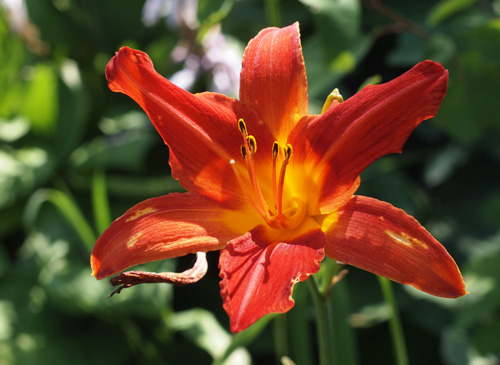
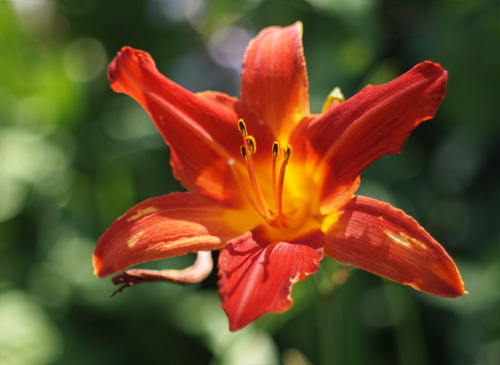
I was out at the country place of a friend this past July, near Owen Sound, Ontario. The house is lovely, and it has a pretty property, including a charming little garden. Naturally, I brought my camera.

There are different ways to photograph a garden. You can take a picture of the whole garden in its context. You can photograph part of it, just a nice arrangement of botany, bouquets in the wild. Or you can photograph one thing – a flower, for instance. I wandered through the garden, doing a bit of each, and a flower caught my eye.

I came up close to make the flower the centre of attention, with the greenery behind it a supporting cast – perhaps a chorus line, or perhaps even just extras in a crowd.

I clicked. I looked at the results on my digital camera’s screen. I decided I wanted a different amount of blurring the background. I adjusted the aperture on my lens and clicked again. You can see the two results in my two pictures accompanying this column.

Photographs have that feature that we’re little used to when we look with our eyes, a feature that never showed up in the visual arts until photography introduced it: things that aren’t the centre of attention can be out of focus. Blurry.

What makes the background (and foreground) more or less blurry is an effect caused by the width of the aperture (the opening in the lens the light passes through).

Something that would be a single point of light in focus is a circle when out of focus, and the size of the aperture – and how far out of focus the point is – will determine how big that circle is. The circle is called a circle of confusion. Put all those circles of confusion together and you have a blur.

That sounds like real life, doesn’t it? Things that aren’t what we are focusing on, that aren’t on the point, are a bit of a blur for us – they’re in circles of confusion. They’re like so much background noise. How much they factor in at all depends on how focused we are – and perhaps how wide-eyed we are.

But that’s not necessarily a bad thing, in real life or in photography. In a noisy room, you want the voice of the person you’re listening to to stand out. In ideas, you want the important one to blossom forth more clearly. In a photograph, you want a suggestion of the background, but you don’t always want it so sharp it distracts.

But not all blurs are equally nice. Different lenses produce different kinds of circles of confusion: some have sharper edges, some have softer ones; some are really polygons. Some blurs are less smooth or less blended than others.

There’s a word for the out-of-focus part of a photograph: bokeh, which comes from Japanese for “blur” or “haze.” It’s not just about how blurry the area is. It’s about how smooth the blur is. If a photograph were a glass of wine, the quality of the unfocused areas would be its “bouquet.”

It makes a difference, just as it makes a difference how much and what kind of noise you have to ignore in a busy room, or how well the related ideas you’re not focusing on at the moment blend together to work with the one that is central. Not just how you’re focused but also how you’re unfocused can help determine if it will be OK.

Bokeh. Such a hard word for a soft thing. Well, taste does come into these things. Different people like different effects. Which of the two flower photos do you prefer?

I couldn’t include links to other people’s work in the column, and I didn’t have a great diversity of examples of different qualities of bokeh, but here are a few examples of photos with bokeh with noticeably different qualities:

Sadie (Mamiya C330) by Laura Burlton

Zeiss Ikon REALA 516 by Tecumseh73

Rosemary by Mitch Zeissler

water drop macro (with a bug walking over it!) by Matt Bilton

Grasshopper by James Harbeck

I encourage you to surf through flickr and other photos and look at the different qualities of the bokeh in them. Call it a bokeh tasting – or nosing, as one might say of a bouquet.
viscid

This is an artful word, and one that clings; it coats the tongue and mind like attar or a tar. It has the same Latin root and the same denotation as viscous, but viscous has a little catch or cough in the middle, while viscid slides smoothly with no stop in the middle. It partakes of the same id idiom as limpid and turbid and, for that matter, vivid, morbid, frigid, liquid, arid, solid, fervid… Visually it presents not a symmetry but a pairing of opposing teams, vis versus cid – the i’s the common element, the vibrant v against the dull stop d, and the snake s against the hook c. But these opposing sides are glued together, the slick liquid /s/ sliding over the c and hiding it, covering it like a scent even as it has the sound of scissors or a scythe.

The overtones of this word are many, some close and others faint: vivid, civet, vicious, divisive, visit, lascivious, livid, fishes, civil, device, invasive, vision… So much of life. Life is indeed a viscid art; it is like honey, flowing but sticking to you, keeping memories, petals, dirt, all close to your skin, and making others so much harder to pull away from. It is vivid, it is civil or divisive, it has its devices and visions – oh, do not ask “What is it?” Let us go and make our visit. We come and go like insects drawn to the nectar. And sometimes we do not go, are not let go.

And the most viscid art of all our arts, I would say, is music. If life is a bowl of roses, music is the attar, the viscid resin; if it is something less pleasant, music likewise is the tarry distillate. We make and listen to music not to wash sticky life off us but to savour it, to feel how it pulls at us but to grasp it, too, and to try to control how we are swept away by it. It is mellifluous, but that means it flows like honey, and honey does not come away clean. The fly in the honey rubs its feet and enjoys the flavour as it is slowly engulfed. And then it looks up – we look up – and what is our song, what comes forth from the viscid art?

To me, it must be “Vissi d’arte,” from Puccini’s Tosca. “I lived for art,” Tosca sings, and cannot uderstand why, when she has only ever done good and wanted good, has always dwelled – so she thought – in the innocuous and well-wishing world of an artist, why the dark and lascivious machinations of life have engulfed her, why the pain and danger are real now. The music, a slow viscid liquid, drips in big slow ropes, runs down her and engulfs her, and though she strains she cannot escape. Watch (and listen to) Angela Gheorghiou sing it and then see if you can rise from your chair or if you, too, find you are trapped by the viscid reality, once delicious, now simply inevitable and decisive.

To split the sweet infinitive

Instead of a word tasting note today, I present, for your entertainment, a video of my poem “To sweetly split the infinitive” from Songs of Love and Grammar. I think you’re going to really like it. 😉

uncleft

The word-orchards of some languages keep their rootstocks and seedstocks very much unchanged. The trees and vines might age and mutate some, but they remain largely uninvaded – there is little in the way of foreign rootstock introduced.

English is not like that.

The orchard of English is a mixture – I was going to say a wild mixture, but for much of it it’s really quite carefully cultivated, so I’ll say a somewhat crazy mixture – of mainly invasive species. We do not make do with what we have. We are quite happy taking cuttings and seedlings and such like from other languages. Most of our wordstock is not originally from English roots.

But there are still Germanic roots. The central words that are the heart of the language come from them. So do various less-used words. Words for family members, such as uncle, are grown on old Germanic roots. Words for familiar creatures – familiar to residents of Britain more than a millennium ago, and to residents of Germany and environs before that – also often spring from Germanic roots, from common bird and deer and hound to less-popular ones such as eft (a newt – which was once an ewt). And some but by no means all of our prefixes and suffixes are Germanic – non comes from Latin, but un is good Germanic.

English words also go through their mutations, cross-breeding, and such like, often with foreign stock, but also sometimes with other native stock. Somehow a word for “divide” and a word for “adhere” came to have the same form: cleave. How can you divide the two? Use the past participle – cleft only means “divided”.

Uncleft thus means “undivided”. But you’re not going to see it a whole lot. And you’re really not going to see it used much as a noun. On the other hand, there is a word we have taken from Greek that in the original means “undivided” or “indivisible”: ἀ a “not” and τομος tomos “cut, cutting, that cuts” come together to make atom, that particle originally thought indivisible.

Now imagine how it would be if English didn’t take cuttings from other languages. How it would be if it were uninvaded, undivided; if it did not cleave to roots borrowed in more recently from other languages but remained cloven from, and uncloven by, them. What sort of wine of words would we make from this terroir? (Not one that included the word terroir, to start!)

English would more closely resemble its Germanic relatives, to be sure. It would also need quite a lot of words compounded afresh from elementary rootstock to signify things for which we have borrowed words from other languages – more like making molecules from atoms than like blending wine, really.

The great science fiction author Poul Anderson once made a lovely demonstration of the sort of thing we would get. He wrote a primer (um, I should say a firstword, I guess) on atomic physics – which is to say, worldken of unclefts – in an English made entirely on Germanic wordstock, to an approximation of how English might be if it did not borrow like a magpie all the time. The result is sentences such as “The firststuffs have their being as motes called unclefts.” Which means “The elements exist as particles called atoms.”

You can read the whole text of this essay, “Uncleftish Beholding,” at www.grijalvo.com/Citas/Peculiar_English.htm. (It is followed there by two shorter texts by someone else that use almost exclusively Greek loan words in English.) And then you can decide for yourself which way you prefer your English to cleave.

triboluminescence

As I mentioned in my note on supernatant, the latest video from NurdRage is on triboluminescence.

Triboluminescence. Rub that around in your mouth for a bit. Is it a light word? Does its form bring any light to its sense? It breaks with a bit of friction on the tongue tip at the start, then bounces between lips and tongue twice before easing to a hiss and then a nasal plus hiss, all on the tip. Seventeen letters, fifteen phonemes, six syllables (all but the last of which open, i.e., ending with a vowel).

But what makes all this trouble, this voluminous verbal tribulation? Its letters are superabundant like tribbles. It seems to balloon; it may recall bulimia, but it ends “in essence.” There are dark mines in the heart of it, but at the beginning a rib – from Adam’s tribe? Let us triturate it and reform it, to find in its parts centre cues in limbo, minor cuts been lice, nimble stucco Irene, lo mini cube centres, combines in lecture…

No sparks? No flashes? Not even a scintilla? Sometimes the best way to be enlightened is to start in the dark, in the hard, cold dark. Sometimes a bit of friction is necessary to discover the attributes. Smash a sugar cube – or, better, chew a wintergreen mint – in a dark room. You may well see – a spark? Just small flashes of light. So let us break apart this word into its morphemes.

It ends in ence, which is a Latin- (via French-) derived suffix forming nouns that refer to abstract qualities. Before that is esc, which is really escent with the ending eclipsed by ence; it refers to becoming: adolescent – becoming an adult; somnolescent – becoming sleepy. Before that is lumin, referring to light; there are several kinds of luminescence, of which bioluminescence may be familiar to you – living things giving off light (fireflies, for instance).

But tribo: groups of people? (Tribes are often thought of as benighted, but that is a colonialist view.) Tribunes? No. Rubbing. It comes from Greek τρίβος tribos “rubbing” (as in tribology – and the i is “short”) – meaning that this word, triboluminescence, is formed of a short Greek front and a long Latin back. It is crystallized in an asymmetrical form.

Which means it might give sparks when broken apart. Asymmetrical crystals seem to produce the little flashes due to electrical charges being separated and recombined when the crystals are broken apart – through rubbing or other fracturing. Do watch the video and see what happens at the end.

This word, triboluminescence, isn’t the crunchiest or crackliest word. But we have had little flashes of insight by breaking it apart. And then putting it together again.

supernatant

One of the YouTube channels I subscribe to is NurdRage, a series of videos showing cool chemical reactions and processes, hosted by someone who calls herself Dr. N. Butyl Lithium (“herself”? the voice sounds male, but it is evidently synthetically lowered, and its quality matches what I’m used to hearing in synthetically lowered female voices – so the host could be male, but I’m guessing female).

Today’s video, demonstrating triboluminescence (wait for a tasting on that word), was announced with an email that used the word supernatant. That immediately precipitated a solution to the question of what I was going to write about today.

“Precipitated a solution?!” the chemistry geeks snort. Of course, the joke is that if you’re not part of the solution, you’re part of the precipitate – a precipitate is what falls out of a solution. Things precipitate from a solution. But do you know what’s left, what’s floating above the precipitate, what the precipitate was born out of? The supernatant.

I won’t go so far to say that this word is supernal or supernatural. On the other hand, I won’t spurn it either. It has two obvious parts: the super, which we all recognize as a morpheme, and the natant, which is actually two morphemes (nat and ant). That natant has a nice sort of varying pattern to it – it makes me think of the sort of molecular transposition that chemical reactions often produce. It’s the part at the end, anyway, the part that comes last, sitting there like a tenant ejected by a superintendant. Above it, naturally, is super, which means “above” (so close to supper or purse but just not the same). Put them together and it does look a bit like a comic-book hero…

So we have the start, super, with its soft hiss, lip pop, and rolling liquid, and the end, natant, with its tongue-tip stops and nasals. It seems to settle easily into a pattern rather than to have a falling out. But how would you think of the process of precipitation? Is it something being ejected, wasted, dying out? Or is it something being born? I guess it depends on whether you want to keep the precipitate or the supernatant. In the triboluminescence reaction, it’s the precipitate that is kept. It is born from the solution. O nata lux!

But if you think that this is heading towards natant being related to prenatal and all the other nat words referring to birth, well, you’ve gone after a red herring. This is the other nat – the one that refers to swimming. The supernatant is swimming above the precipitate – or, actually, floating on top of it (natant can also refer to floating). Well, that’s as long as everything goes swimmingly.

doubt

Of all the woods that flowered out,
that bloom most prone to be excrescent
of all that would’s the flower doubt:

indubitably efflorescent
though doubly trimmed, it doubles back
that bloom. Most prone to be excrescent

is the b, that sign of lack,
lost once, now showing debt to Latin
though doubly trimmed. It doubles back

as if to say, “Should we put that in?”
Return to find a sound that we’ve
lost once now. Showing debt to Latin

dubitare: keep or leave
that seed? Weed out? And sow we? No –
return to find a sound: that weave

that fools us still. What steals the show
of all the woulds that flowered out,
that cede? We doubt, and so we know –
of all the woods, the flower: doubt.

A note of explanation: Latin dubitare became Old French duter, which became Middle English duten, which with loss of the last syllable and a change of the main vowel (in the Great Vowel Shift) became doute; at a certain point some scholars fancied that we should show the noble classical roots in our words, so silent etymological letters such as o in people and b in debt and doubt were inserted. “Um… did we really want to lose those? Maybe let’s keep them in after all…”

midway

This word feels to me thick, humid, like a muddled mass of humanity, perhaps a murmur – no, more, a roar, and not just of people but of things, machines, and bright flashes. It is not dry and soft like halfway. It may seem to mean the same as halfway, but this word goes all the way, right into the middle of things (it may even meddle in the midden). If it is the middle of the road, it is not the noncommittal even-handed blandness, it is the madman at midday in the middle of the way, waving. You may feel you are midway between the devil and the deep blue sea, or perhaps midway in the Red Sea behind Moses.

It is a word of life, a medium. We are mandated to move to the middle of the way, to choose moderation, but what we find when we are midway between birth and death – in a murky wood, maybe – is that the midway is where it all happens, and we have always been in the midst of it. The midway is a midwife, a medium of emergence; and when we have at the end made our way away, we may emerge again by way of a medium. And in the midway between? Sound and fury and light.

Midway is the point in a sporting season when games have been played and teams have moved up or down in the standings, and trends may continue or may be reversed – the outcome is still up for grabs, but there is a history to look to. Midway is the name of an atoll in the middle of the Pacific where an important battle of World War II was fought – a battle that happened midway in the war and that helped turn the tide between the US and Japan. Midway is also an airport in Chicago – the smaller, more tolerable, more central alternative to O’Hare.

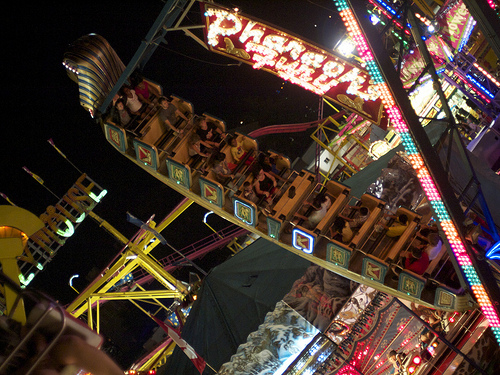
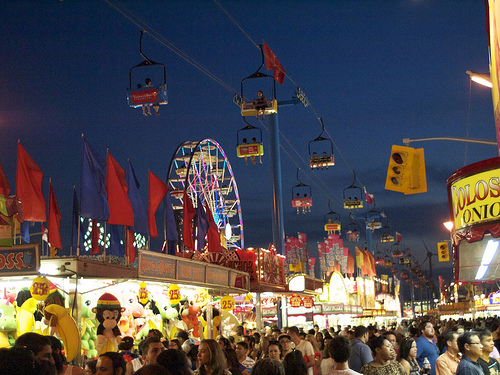
And midway is a place in a fair, a carnival. It is where the fun foods and fun rides are. The carnies roll up and set up and the crowds flood in and for some stretch of time in the summer or fall people eat deep-fried things on sticks and throw things and spin things and shoot things and fish for things to win prizes, and people pile onto machines to experience key consequences of the laws of physics in a very immediate way. It is all midway in the year – between winter and winter, between the birth of spring and the death of the late fall. And it comes around every year. Ever since 1893, when the Midway Plaisance – a south Chicago park, originally meant to be an answer to New York’s Central Park (by the same designer) – was included in the grounds of the World’s Columbian Exposition in Chicago, this stretch down the middle of a fair, the fun grounds, has been called the midway. (The Midway Plaisance is now part of the University of Chicago’s grounds.)

So midway has made its way. Its real source is now academic; for millions midway has an immediate humidity and wildness, an air of deep-fried everything and a smell of onions and fat, and sticky fingers, and the pops and bangs of games and the urgings of young men and women with megaphones to get you to spend your money on their entertainments, and the attractions of rides that make you fly and fall and scream and splash and laugh and whirl. It is the via media, admitting all – for a price – and everything is up for grabs, and while we are amid it it is all our world whirling around us: a madness we have made for our own diversion, until at day’s end leave, arms full, pockets empty, following the dispersing crowds and at last making our several ways back home.

scarth

This mountain is not quite smooth, not quite even all the way up, not quite furry with the green of trees from top to bottom. Wrapped in a band around it near the top is a grey scarf of rock face, a scar of earth. This is no simple hill you could drive a car up – you would get more than a scare if you tried. I cannot say you would face the wrath of the mountain, as I think it would not truly care; it is just the implacable reality of this swath of scarth, swaddled at the bottom in scree. If you were to be scrappy and scramble up it, your boots would make the sound of what they were trying to climb: “scarth, scarth.” A soft slide, a catch with a kick, and then more sliding – dirt hissing down, perhaps, or your boot, or all of you ruffling down, and then it may be you who would have the scar.

How did it get to be here, this scarth on the mountain of words? Was it the result of some unnatural or accelerated process? Seismic or volcanic changes in the geology of lexis? No, no – it has been here for a long time; it came up naturally, from Old Norse, skarð “notch, cleft, mountain pass”, cognate with our word shard – such cracks and gaps are broken places, and in some things the break leaves pieces. And here is a piece that slipped into a gap in the language, and it has been there ever since. Few people now know of it; you might say it has passed out of usage. Yet it still abides in a few old books, peeking out between the mosses, and in some dialect. A word, once having been, cannot un-be, but it can change its form and its meaning, and it can be forgotten. Until one day, hiking in word country, you find a gap… no, not a gap. There is something there: bare rock, a cliff. A scarth.

canoodle

“A Canadian,” Pierre Berton once said, “is someone who knows how to make love in a canoe without tipping it.” I wonder to what extent that’s still true, if it ever entirely was. But you expect a Canadian to know about canoes and to have some idea of how to use their noodle – I mean their brain – when canoeing and canoodling. And, come to think of it, I would assume a Canadian would know what canoodle means. (So would an American – the word seems to have come from the US.)

Admittedly, the word is not the most transparent word ever, morphologically. It sounds sort of like a version of cannoli made by Chef Boy-ar-dee. It has the can that makes one think of Canadian and of being able; Canadian reactions may include CANDU, which is a Canadian-made reactor. It could give an image of canoes and pool noodles and oodles of similar things. And, yes, it has that oodle end that is rather gleefully silly (I really have never quite been able to get my head around the fact that, in Goethe’s Faust, Mephistopheles appears at first in the form of a poodle). Also possibly aimlessly wandering and exploratory, in an artistic sense: in drawing, we have doodling; in music, noodling.

And in romance, canoodling. It’s not the full deal; it’s something that, if you see two people doing it on the subway, might make you think “Get a room” but won’t make you call security, escape to another car as soon as possible, or (if you’re a teenage twerp) pull out your phone and take a video. It’s just kissing and cuddling, caressing, fondling, petting – light petting, not heavy petting. Rather the romantic equivalent of doodling or noodling.

It’s not usually used to mean “cozen” or “blag” or “caboodle”, though it can be used in that sense – there is some connection between smooching and schmoozing, between gentle caresses and subtle blandishments. And it’s not kibbitzing or confabulating or, in general, chatting. It’s important to know this.

Which CTV News anchor Andrew Johnson didn’t. Following a segment in which an interviewee referred to canoodling, he suggested to weathercaster Astrid Braunschmidt that she might want to canoodle with him before giving the weather report. His producer set him right (by way of headset) before Astrid had finished laughing (but not before she informed him that they were not going to be canoodling). You can see the clip at o.canada.com/2012/08/23/ctv-anchor-just-wants-to-canoodle-a-bit/.

Ah, language. Especially a language as overloaded as English – we’re never satisfied with having just one way to say anything. We like to play around, idly noodle and doodle… it’s a sort of way of canoodling with the lexis. But watch out you don’t get bamboozled or otherwise look like a fool. You k’now… use your k’noodle.

Thanks to my friend Brian Bukowski for sending me the link to Andrew Johnson’s embarrassing moment.

