prosciutto

The usual good way to eat decent prosciutto is of course just as you get it in thin slices, with your fingers, never mind putting it on anything. Let the flavour express itself. That’s if you’re pro-sciutto, of course. If you’re anti-sciutto, go have some antipasto and rejoin me after the recipe I’m about to talk about.

The deli I usually buy my salumi (cold cuts) from often has packages of prosciutto ends. These are nice because they can look pretty and they’re always a good deal less expensive – and because you don’t feel quite as bad if you decide you want to cook with them. You can just pick up a few packages and toss them in your freezer for future reference (freezer? well, they’re already sliced, so there is that gradual risk…).

Cook with prosciutto? Doesn’t that seem like gilding the lily – or like frying sushi? Well, yeah, prosciutto doesn’t need to be cooked; it’s cured. That’s why it’s called prosciutto crudo in Italian – the crudo meaning “raw” (prosciutto cotto, “cooked”, is in the line of what we think of as baked ham). But that doesn’t mean it can’t be nice cooked, too. Look, tomatoes and peaches are lovely raw, too, but they can be nice cooked for variety.

For instance, if you want to cook something quickly for yourself and your hungry significant other, take 200 grams of prosciutto – ends or not, as you wish – and cut it up. Scissors do nicely, especially if you’ve just pulled the prosciutto out of your freezer. Fry the prosciutto on medium-high in some butter. Chop up a peach (I mean a fresh one!) into, say, 48 parts, and halve a dozen or so grape tomatoes (the smaller the tomato, the richer the flavour – do not buy those enormous beefsteak tomatoes, they’re insipid; bigger has never really gone with more flavourful) and toss them in. Add some pepper flakes. Don’t bother with salt. You could have minced and added a clove of garlic, too, if you wanted, but you probably should have put it in first. It’s not really necessary anyway.

Meanwhile, you should be boiling water and getting your pasta ready. This is a very quick dish. In fact, you probably should have put the water on first. You may need to turn the heat down under the prosciutto after a couple of minutes, to medium-low, to let the pasta catch up. What kind of pasta? Ideally, tagliatelle would be great, but who keeps that ready in the cupboard? This is a what-the-heck-am-I-gonna-make-tonight dish. I used linguine this time – actually pumpkin, ginger, and rice linguine by King Soba, because my wife can’t have gluten (and anyway it’s good stuff). For two people, I used 200 grams.

Wondering what the sauce is going to be? Ha. Just toss in a bit more olive oil. In fact, make it pepper oil if you have it. And then add some sherry, madeira, marsala, or muscat, or something of that order. I used a bit of madeira and a bit of muscat. Oh, get over it. I’m not mixing them in a glass and drinking them. I wanted it sweeter than the madeira and not as sweet as the muscat. Oh, how much? Not more than a quarter cup or so in total. The point is flavour, not runniness. A lot of it will simmer off, too.

So now stir that and put a lid on it and let it sit on medium-low. Get your pasta cooked. When it’s drained and rinsed, put it in the frying pan with the rest of the goodness, take it all off the heat and toss it together. If you really want to go crazy, throw in a bit of cream of some sort, but not so much it gets all runny. I suggest drinking a nice, non-cloying rosé with this.
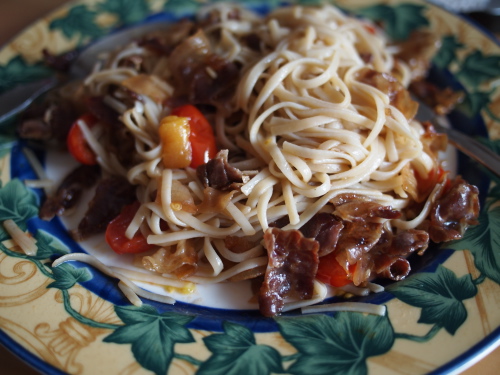
As you eat it, you will notice that the prosciutto has curled up in the cooking. Actually, unless you don’t look at what you’re cooking, you will have noticed that ten minutes ago. The little strips and snippets have, en masse, a reminiscence of the shapes of the word prosciutto. Do they look not very juicy? What they heck are you talking about? That’s the point of prosciutto. The word comes to us from Latin: the pro is that old “for, forward, etc.” prefix, and the sciutto – which by itself has a rather slicing (or cutting as with scythe, sickle, or scissors) look, doesn’t it, recalling that whirling steel disc that cut your slices at the deli in the first place – comes from exsuctus, “sucked out”. Why sucked out? Because the juice has been expressed from the ham – squeezed out – and also drawn out with salt before the ham is left to dry and then age. Prosciutto shouldn’t be like shoe leather – maybe more like ham sushi, or a touch firmer. Best sliced thin.

Prosciutto is not all equal, of course. When you go to the deli, you will probably have a few choices of sources and ages. The oldest stuff is the best, with the richest flavour. (People who like prosciutto will also like jambon de Bayonne from France and jamón serrano from Spain.) The classic prosciutto is from Parma, though I’ve gotten some pretty nice stuff from Niagara too. The difference in the flavours of the different ages is sort of like the difference in how one pronounces prosciutto: the six-month-old stuff is like the casual Canadian English pronunciation, “pr’-shoe-dough,” easy but lacking in a certain definition; the twelve-month-old more like a more formal British pronunciation, making real diphthongs of those vowels and making the /t/ a crisp, aspirated [t]. But the eighteen-month-old is like the Italian pronunciation, with its trilling /r/ and crisp double (actually long) /t:/ and its clean and steady vowels.

One has to be careful, though. Excessive attention to notions of what’s best or most right can lead one to go too far. If, for instance, you insist that prosciutto must only ever be eaten as the deli gave it to you, and not ever used in cooking, you miss a rather nice dish that gives a new angle on something enjoyable. And if you try too hard with the Italian, you make the word too angular. I can’t tell you how many times I’ve heard people say “pros-choo-toe” or “pros-choot-toe.” For the record, sc before i or e in Italian is “sh” (and sch is always “sk” in Italian). So say it with a roll of the tongue and a held touch on the crisp stop but without that credit-card sound in between, just a nice smoothness like the smoothness that is at heart of any respectable prosciutto: “pro-shoot-toe” – oh, but keep that last /o/ steady, and don’t aspirate the /t/.

Or just say it according to English phonotactics, “pro-shoe-toe.” You don’t want to risk sounding pretentious, do you? (Wink.) Better yet, save it all till after you’re done eating. Good grief, it’s getting cold already. You should be saying this word with your mouth full – and shut, too.
uglily

Do you like this word? Do you like-like it?

As a word taster, of course, you can like some detail of it or fact about it without liking the whole thing. You might find the back half to be lovely, fluid, fragrant even – that nice flower lily – but the front half to be rather, um, ugsome. You might like the chic stripes of the middle but have distaste for the bumps and knots of the front and the funnel of the back. You might just dislike the quick repetition of the liquids with a bare minimum of vowel in between – you barely get your tongue unglued from the /gl/ when you have to touch it up again.

Or you might dislike the ly plus ly that come together to be the lily here. What’s with that? Isn’t one enough? Aren’t they the same thing?

They do, in fact, come from the same source: the old root that, as an independent word, became our word like. It was originally more commonly used to form adjectives, as we see in words such as friendly and homely; we also have words in which the root has retained its stress and form, as in warlike. Adverbs were more commonly formed with e in Old English: for instance, the adverb form of slow was slowe. But those endings tended to be dropped over time (adverb slowe became slow, for instance), and so the ly was increasingly added to adverbs (giving us the alternative, and now dominant, slowly). Now many people assume that ly is the necessary hallmark of adverbs, and sometimes adjectives ending in ly are reanalyzed as adverbs – for instance, walk leisurely, which still looks wrong to me because leisurely is installed in my brain as an adjective.

But sometimes those ly adjectives are well enough established as adjectives that they need to be converted to adverbs with the now-standard addition of ly. So whether you like-like it or not, it like-likes you. And ugly becomes a repellant flower, the uglily.

But the garden of language has room for many, many words – even many of what you might think of as the same type. If a flower garden can have hundreds of different lilies, ranging from the graceful, patrician, stately calla lily to the blousy, enormous, noisome, ghastly stinking corpse lily, you can have – like them or not – an assortment of lilys in the word garden, even if some are hard not to use uglily… imagine what kinds of flowers these all might be:

burlily
chillily
cleanlily
comelily
costlily
deadlily
earlily
friendlily
ghastlily
ghostlily
godlily
goodlily
holily
homelily
jollily
kindlily
livelily
lonelily
lordlily
lovelily
lowlily
manlily
melancholily
oilily
portlily
sicklily
sillily
sprightlily
statelily
timelily
uglily
unrulily
unseemlily
wilily
woolily
worldlily

Quite the masterly garden, isn’t it?

Thanks to Christina Vasilevski for suggesting uglily.

grasshopper

The wind sifts the grass, which breathes its own name, “grass – grass.” And a little tick like the zap of static electricity releases a flying form: you hear the “hop” and see the hopper. The hoppers, in fact; the field is full of them, flying in lines of counterpoint. The locus of action is the action of locusts.

They’re big bugs, grasshoppers. Many a smaller bug is to them as a bird is to a human. And their hind legs are huge, patterned, articulated, in a way like the word grasshopper. The legs send them flying through the air in a trajectory you can recall as you watch their name launch from the back of your mouth and, by way of tongue tip, bounce off the lips. James Joyce mutated the name to gracehoper, but most of us can only hope to have the grace one of these exhibits in its leap. Perhaps this is why there are several kinds of aircraft named Grasshopper.

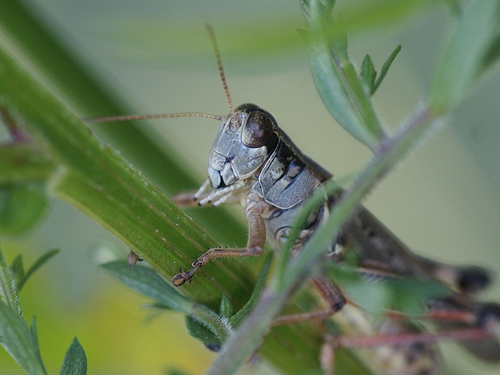
Grasshoppers hop not only on grass, of course: my camera and I had a good look at one on a longer stalk of something today. And a grasshopper may hop into your glass – if it’s a greenish cocktail made with crème de menthe, crème de cacao, and cream, or if it’s a wheat beer made by Big Rock (of Alberta).

Grasshoppers are big for bugs, but they’re still bugs and as such rather small in the world. And grasshopper may be a long word, but it’s simple, plain, made of obvious parts, and old: we’ve had it in English at least since the 1400s, and probably longer, since nearly identical forms show up in other Germanic languages. But simplicity, clarity, and elegance – and perfect control of motion – are one more thing some of us think of when we hear the name Grasshopper… thanks to the 1970s TV show Kung Fu.

summer

Sumer is icumen in. And the livin’ is easy. And the weather is hot. Hot town, summer in the city: the boys of summer, that summer wind, but uh-oh, those hot summer nights, and suddenly last summer…

Beer, patios, music – the estival festival. And the estivation: the sun simmers, and all slumbers summarily. The oven timer of the sun-baking set is the heat-buzzer insect, harbinger of torpor, the sick cadence of the cicada. The warmth of summer incubates the yeast of memory. While we are in the summer, our skin-tracing beads of sweat are the amber of an eternal present glazing us, but when we stop and think of summer, and bite into the word summer as into a warm fresh bun, all the summers of our lived lives and fantasies re-present and blossom in our tongues, our sinuses, our crania, and again before our eyes.

Your summer is your summer. The sound is the same for all, the /s/ that could be fresh or hot, the /m/ ever warm and the /r/ ever soft; the word has come through time no more changed than the form of the dragonflies that darn the warm fabric of the post-solstice air; but in word country, summer may be a meadow or forest or beach or porch and more, but it is multiple worlds, a different geography for each person and at each turning: a magic glass that contains all warm worlds and words in one. And always, at the heart of summer, we are young.

I enter summer as a small boy in Exshaw, walking the highway past village edge to find a swamp called Dragonfly, or climbing Cougar Mountain, knocking rocks past choirs of crocuses, coming back down to chocolate bars and childish trickery, and its soundtrack is the five-note song of a bird whose name I never learned. I see in it road trips on Interstates over the great plains to the sound of Gordon Lightfoot, and beaches with peeling sunburns that made my back feel like a split kielbasa. A yawning time of no school, then later of summer courses, of long days and far walks alone under green branches to broad views, and poems in which things are seen but nothing happens. Days to plant the seeds of romance – much rarer in my younger life than in the songs and movies that told me what should have been.

The ever-young summer is carefree, hopeful times, now grasped like paper fluttering by in the wind of weekday work: stop, swim, sun, sleep, and then again for eight hours it is already autumn. Summer is weakened to a weekend, a dash to a porch and a glass of Pimm’s, and then warm slumber accompanied by the timpani of thunder and the castanets of fat raindrops. Summer is now that other mirror, the one I turn to when I turn off the ice of the office, and looking in it see the frost on my temples melt back to golden straw and the rumpled shirts to skin, and nothing needs a name.

multiplicative inverse

Today’s note is a guest tasting by Daniel Ginsberg, @NemaVeze.

Mathematics seems peculiarly prone to confusions between the symbols through which ideas are communicated and the ideas themselves. —David Pimm

What do you remember from middle school math? Do you remember how to divide fractions? For example, if I ask you to divide two thirds by five sixths, what do you do?

Well, you take the second one and flip it. Then you multiply.

You flip it, huh? What does that mean? Five sixths is a concept, a philosophical proposition. It’s a portion of an abstract unit which is divided into six segments but you only take five. How do you flip that?

Don’t be obtuse. Five sixths is a five, and then a line under it, and a six on the bottom. You flip it. You write the six on top and the five on the bottom. Then you multiply.

Right, but when you say “flip it,” that’s just a trick of notation. It’s like saying that multiplying something ten times is the same as writing a zero on the end. It’s how you write down what you’re doing, and it’s a kind of shorthand for what you’re doing, but it’s not what you’re really doing.

Okay, smarty pants, what am I really doing?

You’re taking advantage of the fact that multiplication and division are really the same thing, a concept that’s obscured by integers and then brought back into clarity with fractions. The rational numbers are a field; they can be added, subtracted, multiplied, divided. To divide by a number is the same as multiplying by its reciprocal. “Flipping” is the notation; what you’re really doing is taking the multiplicative inverse.

—–

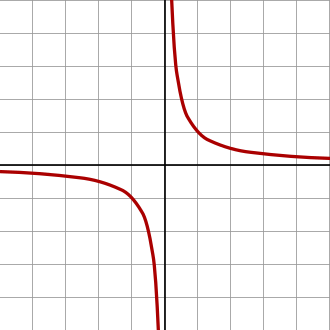
Multiplicative inverse begins staccato in a telegraph clatter of plosives, to tail off through nasals and fricatives of lessening intensity. Like the function one over x, it traces a swooping descent toward zero.

Okay, not like the function. Like the graph of the function.

How precise is the pronunciation of multiplicative inverse. More than technical, it sounds technological. It has a feel of moving parts that fit together like a watch, or like the Platonic ideal of a watch that makes the sound of an unlocking iPhone. The sound of precision machinery for a precise piece of terminology.

But what is it? What layers of abstraction are buried here? Multi-plic-at-ive from plectere, folding. Cousin to the plectrum that picks out the notes on your guitar (and music as you know is mathematics), to thesolar plexus (a kick in which some people would take if it would get them out of math class), to the multiplex where you go when your math homework is done. In-verse, like inversion, turning upside down, but in fact it’s more of a reverse, doing it backward. If multi-plic-ation is folding over and over, the inverse is unfolding.

With all this morphology, the words’ structure reflects the nesting of concepts by which mathematics proceeds. At the core is the idea that you can take a quantity (of what? Doesn’t matter), copy it repeatedly (how many times? Indefinitely), and sum up the results. Like folding a sheet of note paper along the vertical: if there are 30 lines then each fold makes 60, 90, 120 little boxes. But the process to multiply becomes an object called multiplication that imputes multiplicative properties to other objects. Multiplicative inverse, multiplicative identity. Mathematical objects that exist in our minds, if we train our minds to hold them. Math isn’t a science; it’s an appliable philosophy.

Flip it and multiply. Phooey, he says, shaking his head, pushing his glasses upward on his nose.

swim

Ah, swim – it’s a fluid word, lacking in liquids (/r/ or /l/) but with a fricative /s/ and a glide /w/ and a nasal /m/. It seems more sustained at the end than swing, more immersed than slim, more muscularly controlled than sweep, more in the water where swan is on the water… And you can see waves in the w and m and perhaps some indication between them of the difference between front crawl and backstroke – or between butterfly and breast stroke. And the s and i? The i is the swimmer, for sure, and the s may be the flip and twist when turning to change directions.

Well, that’s what I’ve been seeing over and over as I write this. I’m watching the Olympics right now, and there are double helpings of Phelps and lakhs of Lochte and, well, we’re swimming in swimming. Freestyle, backstroke, the insane butterfly and the weird-looking breast stroke, plus medleys and relays, all in the several multiples of 50 metres… plenty of races and plenty of medals to be had. A marathoner might train all year and have one race for one chance at gold. A swimmer no less but no more fit might have a shot at a chocolate box of them.

Which is not to slur swimming as a sport. I can run miles and miles but still have trouble swimming more than 100 metres without pausing, while my lithe wife puts in 40 lengths just for recreation. During the summer we make it to the pool often, and it all goes swimmingly; by Labour Day I’ve built up better pecs and deltoids, and then they atrophy over the winter. But swimming, for most people, really is the eternal summer sport: warm weather, water, immerse yourself and swim in the amniotic suspension of the pool or lake. Do not speak of winter. The future is the future and the past is the past, but in the swim of things you go with the flow and you don’t look back.

Speaking of the past, tell me what past tense and past participle you use for swim. Thinkfast! Are you sure? Have you always been sure? I would say I swam yesterday and I’ve swum already today, but there is anything but unanimity on this in the historical record. The Oxford English Dictionary’s historical citations have instances in the past of swum as simple past tense, swam as past participle, and even swimmed as one or the other. Even if you use the “correct” form, you may feel you’re swimming against the current – but I wouldn’t say it’s sink or swim. When you look at the etymology of this word and at its various cognates among the other Germanic languages, every single vowel shows up in one place or another between the sw (sometimes sv) and the m.

Try them all and see how they feel. Say them one after the other: swim, swam, swem, swom, swum… Watch your mouth as you do that. Tell me what the gesture reminds you of.

Know what it makes me think of? The breast stroke.

lakh

Today Sesquiotica reached 100,000 page views since its inception a bit under 4 years ago. A hundred thousand? Ten myriads? That’s a lot, isn’t it? No… that’s a lakh.

Well, such is my lakh in life, allakhated perhaps by Lakhesis. Or perhaps chalk it up to good lakh, nothing inelakhtable. I find I have no lakh of readers – true, since many readers account for rather more than one page view each. But I would not call this a lakhluster performance. I would certainly rather have lakhs than bagels! Let’s lakh this in: if each page view were a cube of water 90 metres on a side, I would have enough water to fill Lakh Lomond. Had I a square kilometre for each view, I would have more land than there is in Ladakh. Surely this calls for a celebratory drop of lakher – no lakhtose tonight, but I won’t get shellakhed. The greater intoxication is from all these delakhtable words!

But do you know this word? Do you lakh it, with its lush lick to start with and its hard gravel landing at the back? Are you familiar with its common collakhations? It’s used often enough in Indian English – not just in its literal sense of “100,000” (giving it a base 10 lakharithm of 5) but in the plural in the same sort of general use as one might see for myriads and millions: “I have lakhs of rupees. I am a very rich man.” “I can give you lakhs of reasons to read this.” (You may feel justifiably relakhtant to embrace some of these assertions…)

The word lakh, which can be pronounced (in English) with the vowel of lock or that of lack, comes from Hindustani, which got it in turn from Sanskrit laksha “sign” (noun). Why have a single word for 100,000? It’s the South Asian numbering system: 100,000 is a lakh; 100,00,000 (yes, that’s right, 100,00,000) is a crore; 100,000,00,00,000 is a lakh crore (we’d call it a trillion – we being North Americans; some Europeans would call it a billion); and so it goes, stacking encores of crores and lakhs on crores, the zeroes in a 2,2,3 pattern all the way. (And never mind millionaires; in India, a rich person is a crorepati – someone who has a net worth of a crore or more of rupees.)

But I probably won’t reach a crore of page views. At my current rate, I may well reach a million before I turn 80. As long as I don’t get too lakhs about my writing.

wlat

Wlat? What? Or what with the hump of the h cut off? But that’s just wrong.

This word makes me think of the time I was working in a bookstore and had to take down a customer’s name. She was a middle-aged British woman; she said something that sounded to me like “(a) LOX” or “(th’) LOX!” This made for confusion in transcribing it, leading to her exclamation, in her Thatcherite accent, “You’ve got it wrong. All wrong.” Finally it became apparent that she was saying “(w’) LOX!!” – that is to say, Willox. I still recall her excessively high-contrast pronunciation with a certain amount of wlat.

So wlat means… well, think of the sound a person who is disgusted past the point of nausea makes. “Wlat,” perhaps? Ah, why not? I can’t say exactly where this word – meaning “loathing, disgust, nausea” – came from before it appeared in Old English as wlætta. It’s actually been out of use in English for quite a long while. As has its related verb, wlate (“feel wlat”). Even wlatsome (“provoking wlat”) is disused now. I mean, yes, we have loathsome, but while that makes the mouth pucker, wlatsome gives such a nice expression of appalled disgust to go with the wet smack…

Don’t you think its absence leaves the language a little flat? Sometimes extreme sentiments are better served by extreme words. Why not be flamboyant from time to time? If you wish to tickle the ivories of your teeth with electric lexis, make like Wladziu – Wladziu Valentin Liberace, I mean. Be a little outrageous when you’re more than a little outraged. Of course, Liberace was delightful, but, really, so is this word, in its high-dudgeon and phonologically confounding way. You can be like Wladziu when expressing wlat. Indeed, you can use ancient words as though the world were your fantasy or fairy-tale… if wlat makes you dizzy, be a Wlat Disney. Say not just “Blah!” but “Wlat!”

If you can make yourself say it, of course. The juxtaposition of the glide and the liquid is something one just doesn’t do… in English, anyway. I mean, it’s not physically impossible at all; if you hold a /w/ all you need to do is raise just your tongue tip to touch the roof of the mouth, then unround the lips, to move into /l/. We just happen to think of /w/ with an off-glide after, which would make /wl/ more like one of a score of sore swallows as one tries to drink a glass of water as slowly as possible. Or perhaps some repellent medicine.

But we can safely say that if the word had made it to the present day in continuing usage, the /w/ – and perhaps the written w – would be gone. So isn’t it nice that the musty old treasure chest of old literature and the foxing pages of the OED have retained it with its ancient form so that we may blow off the dust, wipe away the cobwebs, but perhaps keep the patina, and use it with relish in asperity like a battle-axe long kept in the family – hacking off the hump of the h and hearing if fall with a wet splat? Displaying defiance doubly through unintelligibility and sheer phonemic inappropriateness?

“I make you feel what?” “You make me feel wlat.” “What?” “Wlat.”

scrat

This word might look like a typo – perhaps my dactylography is not up to scratch? But this is not scratch with the ending scratched off – this word, and cratch, appear to have been merged to become scratch, which shows up later. But while cratch meant pretty much what scratch does, scrat refers in its primary sense more specifically to attacking with the nails. If you’re in a spat with some rat who you wish would scat, you make like a cat and scrat. “I’ll scrat your eyes out!”

With scratch, you can hear the scraping /s/ and the beginning to catch /k/, and the gripping with the /kr/; the aggressive heart /æ/; and then a catch and scrape away again at the end /tʃ/. With scrat, there is no scrape away – it catches. The nails scrape on the skin and then dig in. This is not for getting rid of an itch, it’s for getting even with a bitch. Compare: smack, slap, scrat – all with the /s/ in at the start, the /æ/ in the heart, and a flat voiceless stop at the end. There are several more words with those same characteristics – I leave it as an exercise for you to think of them all and see just how much they have in common.

And, on the other hand, look at scrape: similar in sense, similar in form – almost identical to scrap – but with a different vowel in the middle, /eɪ/. And just like that you move towards crate and crepe and on to grape for all we know… and grate, for that matter.

Ah, yes, grate. Which comes from French grater, cognate with Italian grattare, and tracing back to a borrowing from the Germanic root that gives us modern German kratzen, which may be the source of scrat – there’s just the question of how that s got there. I mean, aside from its quite evident suitability phonaesthetically and by analogy with the pattern of other words.

diacritic

There’s a website called “There, I Fixed It” that specializes in photos of assorted appalling improvisations for mechanical situations – quick fixes done with whatever things might happen to be lying around: elastic bands holding multiple remotes together; mailboxes made of ski poles and reusable bags; roofs held up with blocks, sticks, and binder twine; car doors made from vinyl siding or carbdoard boxes; insulation made with towels and glue; wrong-sized parts everywhere; and of course ductape, ductape, ductape, and no doubt a fair amount of WD-40 too. A veritable MacGyver festival, only keeping the crazy but losing the brilliance.

Well, that’s the infinite ingenuity of humanity. People improvise when they don’t have the parts necessary and, for some reason or other, can’t or won’t get them. Now, imagine you had a language with that kind of problem: you wanted to write it down, but the letters you had available weren’t exactly matched to the sounds the language made. What would you do?

Ha. Welcome to most languages in the world. Including ours. We’re using an alphabet that was made for the Latin language. We have sounds that Latin didn’t. What do we do?

Well, OK, English is a special case. We’ve given up even trying to fix it, exactly. It’s all just git-r-done. But many other languages determined that the letters available would work fairly well with their sounds if they just had some extra marks to put on them. What, you object? Listen, live a critic, die a critic.

Diacritic. Indeed. That’s what they put on selected letters: diacritics. Also known as diacritical marks. The word comes from Greek δια dia “between” and κρίνειν krinein “separate” (verb). They separate between different sounds represented by what is otherwise the same letter.

Oh, we mean accents? Actually, accents are just part of it. Acute and grave accents, é è, are certainly diacritics; so are circumflexes î, tildes ñ, cedillas ç, diaereses (also called umlauts for the phonological process they often indicate) ü, and a small host of others such as dots, hooks, and rings. These are the ductape and WD-40 of orthography.

Except that ductape and WD-40 fixes are decidedly downmarket. Redneck. At the opposite end of the scale from, say, a French restaurant. Diacritics, since they are not normal in English but are associated with certain European languages that we valorize for their exoticness, often increase the dollar value of a word. What has more class: a resume, a resumé, or a résumé? Will you pay more for cream, creme, or crème? And which publication is higher-brow, the one that talks about getting the naive to cooperate or the one that talks about getting the naïve to coöperate?

Yep, they may be ductape for other languages, but they’re bowties for English. Except the umlaut (diaeresis). Oh, it’s special, as we’ve just seen, and can raise the tone. But it can also just add a certain Teutonic otherness, as more than a few heavy metal groups have noticed with distinct disregard for phonological functionality (Mötley Crüe are a particularly notable offender, but I suppose Blue Öyster Cult get a lot of blame for starting it). Those two dots are like the eyes of Kilroy looking over the wall, but sometimes Kilroy is a copyeditor for the New Yorker and sometimes he’s a headbanger in studded leather.

And all that from a really fairly dry, light, even prissy-sounding little word. Diacritic. The air of intellectual circumspection from dia is, I think, a factor: diametric, diatonic, dialysis, perhaps dialogue; it may seem feminine from the flavour of Diane. But the crisp click-rebound of critic cannot but be detached and askance (and, yes, it’s actually the same critic as critic, at root). Put them together and you have a clear, shiny taste of acrylic and perhaps a bitter taste of acrid. And of course dialectic and dialect.

Which brings us back to the infinite variety of language. And the limited toolkit of letters we have for transcribing it. Wayyyyy too much trouble to get a new letter widely used, usually. We’ll just take what we have and fix it till it works.