
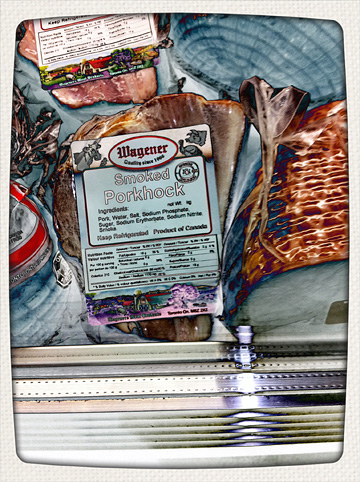
porkhock

I was at the St. Lawrence Market, as usual for me on Fridays after work; I stopped at Whitehouse Meats and, walking past a refrigerator case, happened to notice a package with a particularly savoury bit of wording. I pulled out my iPhone and took a picture of it with the tadaa app, which takes whatever picture you take and adds extra processing – it has a variety of cute filters and frames and controls you can apply to the raw image, sort of like curing or smoking meat.

The word that especially grabbed my eye was porkhock. Just look at that and listen to that! It has this forest of stems – it looks almost shocked. The k’s bend like knees. Between, the o’s are round like hams. But the sound of it! If you have aspirations to produce a percussive word, this is your percussive word with aspirations!

Aspiration, linguistically, names the puff of air that in English follows a voiceless stop when it’s at the start of a syllable, particularly a stressed one. Hold your hand in front of your mouth and say pork. You feel the puff on the /p/. Now say porcock. You’ll probably get a lesser puff after the c. But when you add the /h/ to make it porkhock the puff becomes, if not stronger, then certainly longer.

Now, for added pleasure, take that popping, cracking compound word and add a smoky and coughing word before it: smoked porkhock. Say that a few times at different volumes, pitches, and intonations. It might even make you thirsty after a while.

I’m sure smoked porkhock could make you thirsty, too. A 100-gram serving has nearly half your RDA of salt. Sounds more like ham than like pork, no?

It’s not just that hamhock is seen and known, and not only as a character in the comic strip Tumbleweeds (well, Hildegard Hamhocker, to be more exact – the bucktoothed lass who is forever trying to drag Tumbleweeds to the altar). Generally, the pork/ham distinction rests partly on the cut of meat but more importantly on whether the meat is cured. Pork is, admittedly, the more general term; it comes to us from Latin porcus “pig” by way of French. Ham is in origins first of all a reference to a part of the leg – the part behind the knee, and extending up the back of the thigh to the buttocks. And that’s not just on pigs; it’s on people and anything else with legs with knees and a butt. But when it comes to pigs, a ham is cured – salted and smoked or dried or whatnot.

So why porkhock? Well, the point may be made that the ham only extends so far down the leg, and this bit of meat is from father down. That’s true – the hock is (or is the area up to and including) the backward-angled joint that ungulates have, analogous to our ankles but raised off the ground and with a stretch of leg before the foot proper. Hock is a Germanic-derived word that has a still-extant older form hough.

So, really, hamhock is actually the less accurate word anatomically, although porkhock is less accurate in terms of preparation. But what do you do when you have something that’s not entirely this and not entirely that? You might as well use a word that’s partially Latin-derived and partially German-derived – a word that, incidentally, is not usually even seen as one word: pork hock is the usual way it’s written when it’s written. But Wagener put it as one word on their packaging, joined together (and thereby you know that it’s porkhock that’s been smoked, not hock of smoked pork). It’s specially prepared with added flavour and saltiness. I mean the word. But also the meat. And the photo I took, too, for that matter.

So, by the way, what wine should you have with it? I would recommend hock. Which is what white German wines are sometimes called (from Hochheimer, Anglicized ages ago to Hockamore).


caseness

In some fields, some terms have a certain casual currency – everybody knows them and nobody bothers to define them, but outside the field no one knows them and they’re not really transparent, even if they’re made of perfectly ordinary bits. They gain a sort of shibboleth status, but unconsciously.

I encountered one such today at work: caseness. It shows up in the psychiatric literature here and there, often in scare quotes:

“Caseness” for depression and anxiety in a depressed outpatient population: symptomatic outcome as a function of baseline diagnostic categories

The Psychiatric ‘Caseness’ of Clients Referred to an Urban Social Services Department

Psychiatric caseness is a marker of major depressive episode in general practice

Chronic fatigue syndrome-like caseness as a predictor of work status in fatigued employees on sick leave: four year follow up study

The scare quotes indicate some recognition that it’s somewhat casual in-group jargon; the lack of them in other instances indicates that it’s commonly used and is not inevitably seen as exceptional, odd, colloquial, or jargony.

Whatever a new word may be, for me seeing one is like a bit of Christmas. And this one has the added touch of a sound similarity to “Christmas”: a [k] at the start; in the middle, a [s] followed by a nasal; and another [s] at the end. But there’s no [r] in this word, and the first vowel is a diphthong and is longer and more open than the one in Christmas. Caseness is cold and hard and cutting in sound, like a knife breaking through a barrier and starting to sever (perhaps a box cutter cutting open a case), but it can also be heard as a kiss and a soft whisper in the ear. And it is a word of curves: the simple c, the doubles s ss, the twists e e, the ornamental a, the humped n. It has almost ceaseless caresses for the senses.

But what does it mean? Its parts seem obvious enough: case, from Latin casus “fall, chance, occurrence, case”, from cadere “fall”, and ness, that time-honoured West Germanic nominalizing suffix seen in darkness, kindheartedness, wildness, wilderness (odd one out, that), hotness, highness… I note that Case and Ness are also family names, so that it would be possible to be named Jack Case Ness or Jill Case-Ness. But that’s not our case here.

So put case and ness together and you have “condition of being a case” or “degree to which something is a case”. But does that really help? A case of what?

Ah, well, first, in the dehumanizing world of medical jargon, patients – what they call people who are on the other side of the treatment equation – are often equated with their conditions: the broken leg in cubicle 13, for instance, or the case of measles that came into the office this morning. And in psychiatry, where the border between normal and abnormal can be quite arbitrary and fuzzy, there is often a question of whether the person is or isn’t a case of depression, or of schizophrenia, or whatnot. This is also true of other tricky diagnoses such as chronic fatigue syndrome.

So if, in your doctor’s judgement, you are a case of something, then you have caseness. And, to add more depth, one may say that the extent to which you match the criteria of a particular condition is your degree of caseness. Some articles argue for determining caseness on the basis of a chosen cutoff in criteria, and in fact in many instances there are criteria that can be checked off to come up with a score: if you have three of these, you’re not a case; if you have four, you are. Does this seem arbitrary? Well, of course it is, but tell me: does a box containing eleven beers (or eleven bottles of wine) have caseness? Is it a case of beer (or wine) or not?

The remaining question is this: Is caseness a word? The answer might seem self-evident, given that I’ve just been using it, and I’ve defined it for you, and you now understand it. Moreover, it’s made of perfectly combinable parts. If I say “That cat has a certain dogness,” you don’t need to look up dogness even if you’ve never heard or seen it; you can tell what it means. But when you first encountered this word caseness, was its meaning obvious to you? If you tried to look it up in a dictionary, even in the Oxford English Dictionary, you would have come up empty.

So what is the criterion – what are the criteria – for wordness? I often say “I used it, you understood it, it’s a word.” But what if you didn’t understand it? Then it’s a word for me but not really for you. Or not fully: you may recognize that it’s been used as an independent lexical unit, but it doesn’t communicate to you any more than, say, There are three squedgels in the carmavery. And if you know it and can use it but the people you would use it with don’t understand it, does it have full wordness? But is there ever truly full wordness, in that case? In what context, for what users, does caseness attain sufficient wordness? As with psychiatric diagnoses, there is much in the individual judgement.

changeroom

Tense, tired, and cold, I sought escape to someplace exotic, warm, and relaxing. I replaced my world of concrete and dust and ice and dry wind with a realm of warmth and wet air, redolent of lemongrass and myriad mysterious fragrances, a place where my tension could be wrung out of me and dripped off me. Bowls of fruit lay open for the taking; cups of citrus water refreshed; nearby, a table could be had and served with coconut soups and red and green curries. I had ventured somewhere – where? Chiang Mai? Yangon (erstwhile Rangoon)? Angkor? Was the moist air the onset of a monsoon? Quietly, wafting over the air, I could hear singing, or was it the chants of meditation?

My portal, my access point to this world of wet warmth and relaxation, bore a sign: Changeroom. Ah! Another long, complex word with a mixture of foreign flavours. Changeroom meant “welcome”. Changeroom meant “come in”. Changeroom meant “leave behind your daily burdens”. Changeroom meant “take on new light, soft vestments”. This was a liminal place, a border, a Narnian wardrobe. Everything became something different, underwent a sea-change into something rich and strange.

Even the word itself. Ten letters, but of those, two different sets of two each stand for a single sound, while two other letters stand for altered sounds, and one stands for no sound at all but merely works a small magic on another letter. The word has two parts: the first is affricate-to-affricate with a nasal in between, all on the tip of the tongue; the second pulls the tongue back and at the same time rounds the lips, and a liquid moves through a vowel tunnel to a nasal. The first part comes from warm southern climates, the second from cold northern ones, but the first word is crisper and more biting, the second warmer and softer. The word is rich and strange and mixed, a magic trick, a linguistic shapeshifter. How you see it depends on… how you see it.

These simple letters could stand for singing – Mandarin chang ger – or meditation, the long tone of om, but instead they present a space for transformation: change, from French, ultimately from Latin cambire “change”, and room, an old and widespread Germanic root referring to space and interior places. An interior of transformation: here is where you go within, lock away your quotidian raiments, and come forth clad in soft white. The silence will change you just as the silent e signals a change in the way you say the a.

Yes, I spent another evening at the spa, steaming, soaking, swimming, and getting a massage. I left my keys and cards and money and phone and clothing in my wardrobe locker in the changeroom, put on a bathrobe, and my world was become a softer, quieter place for three hours.

But of course all my stuff was waiting for me when I was done. As was the bill. Ah, spa, and your magic gate changeroom, I will return. I would go back there tomorrow but for the work that I have taken on… On the other hand, that work pays for me to go in the first place.

mulligatawny

Imagine being a young Canadian and first seeing this word on a soup can. What crosses your mind? Probably first of all “That’s a long word” and, immediately, “What the heck is that?” Could it be some weird ingredient like gumbo, or weirder, like mongoose or alligator or tadpole? Or some creature from Dr. Seuss’s If I Ran the Zoo? A check of the ingredients reveals nothing as exceptional as the name: just some meat, some vegetables, some spices, stuff like that.

So it must be some kind of eponym, perhaps? (I’m sure every Canadian youth knows the word eponym. If by every you mean “no”.) It does look like a Scottish or Irish name. Maybe this soup is what they serve at St. Andrew’s in the clubhouse to anyone dressed in tawny clothes who has taken a mulligan. Or is it a magic word uttered by the witches in Macbeth – something on the line of alakazam but with the duller, rounder sound reminiscent of the rumbling in a sheep’s gut, or in yours after an excess of haggis? Maybe it’s a place, like the Mull o’ Kintyre. It kind of has the sound of some burbling bog, actually.

But if you’re mulling a getaway to the home of mulligatawny, cold muddy bogs are not on your itinerary. Rather, take your tiger repellant. This word is another hangover of the British Empire. Tony Aspler, the noted wine critic, once wrote about how England has “phantom Raj syndrome” – they no longer run India, but they still eat curry by the bucket (or the takeout container). This soup is a product of the British domination of India; it’s a contact food – it came to being due to the contact between the British and the Indians. It is indigenous to India in the same way as a child born in India of an Indian parent and a British parent is. It’s a gastronomic creolization (but not what in gastronomy is called a creole), like South Africa’s bobotie.

The British, you see, particularly the officers and various other moneyed sorts, expected a soup course at their meals. Indians did not do soup courses. In fact, Indian food is normally served all at once, not in courses, and the soups they had – or the closest thing they had to soups – were really sauces to pour over rice or plain curries. So something was come up with. More than one something, really, but in Madras (now on maps as Chennai) this soup – or its progenitor – was come up with, and it spread as readily as that other great Raj invention, the gin and tonic (a palatable way of taking your quinine).

The something up with which they came has a lot of variations, it should be said. It usually has meat, and a yellowish colour, and a curryish flavour; there are normally onions in there somewhere. Expect a mixture of ingredients as heterogeneous as the mixture of letters in mulligatawny: humps, cups, lines, curves, rings, crosses and angles, and a dot. The mulligatawny I have in my fridge right now – I made it on the weekend and we will continue to consume it for a couple more days – contains chicken breast, chicken stock, onions, garlic, carrots, potatoes, red lentils, an apple, a chili pepper, an assortment of spices, and coconut milk. It’s yummy. But you could buy a can of soup labelled Mulligatawny and encounter something as different from mine as Richard Mulligan is from Tawny Kitaen.

Still, it will have at least a little pepper of some sort in it, one hopes, if only for the rectification of names. Etymology is no guide to current meaning, but your enjoyment of the soup and its name may still be seasoned a bit more by the knowledge that it comes from Tamil milagu tanni, “pepper water”. The word, like the food, has been adapted; it remains fairly close to the original, but it has been given a sort of bluff British officer’s walrus moustache and a touch of the throat-clearing “harrumph.” In fact, it’s an excellent word for evoking a moneyed British accent. Try it aloud and see for yourself. Then have a bowl of the stuff.

bannock

I was over at the house of my friends Beth and Keith for a party last night, and at one juncture Keith brought out, fresh from the oven, a nice round hot bannock: a griddle-baked soda bread made with, in this case, oats and flour. It was duly served onto the table next to all the other snack-type items (including a quartet of cheeses that served further to prove that Quebec makes the best cheese in the world), and maple syrup was set out for dipping it in. A small crowd of small children materialized instantly around it, but I did manage to get a piece.

It reminded me of my childhood, sort of. Bannock was a staple when and where I grew up. Not that I relished it as these children did. But I still ate it, a fair amount of it.

Why did I not relish it? And where did I grow up? Regular readers may recall that I have on occasion adverted to my formation in southern Alberta. From that you may speculate that my exposure to bannock was due to the strong Scottish influence thereabouts. This is actually only indirectly true. And in fact I had no idea that bannock was originally Scottish. I assumed it was Indian. As in Canadian First Nations. Specifically Nakoda, also known as Stoney, a branch of the Sioux ethnic group.

My parents worked on the Stoney reserve at Morley, west of Calgary. My younger years were spent in the surrounds of the reserve, and many of the things I went to with my parents were functions on the reserve: tent meetings and house meetings (evangelical gatherings with preaching and prayers and hymns accompanied by electric guitar, bass, and drum – and maybe accordion – late into the evening) and pow-wows (gatherings for competitive and community dancing in ornate costumes to the beat of a central group of drummers and singers) and, on certain holidays, feasts.

At any one of these gatherings, after and before endless rounds of handshaking and greetings of “Âba wathtech” and so on, and washed down with enough strong black tea to float the British navy, and – at feasts – nestled next to turkey and good canned cranberry sauce (I love canned cranberry sauce, especially when it’s still in its cylindrical shape from the can), there would always be squares of bannock. Which in this case was a fairly plain wheat-based soda bread baked in pans, and if ever in my life I had it at any temperature other than room temperature I do not recall it.

Nor would there have been maple syrup for dipping it in. Maples don’t grow in Alberta, and maple syrup is even more expensive there than it is in Ontario. We put Roger’s Golden Syrup (lightly flavoured corn syrup) on our pancakes and corn bread, but not on bannock.

The Stoneys and other First Nations people across much of Canada apparently picked up the concept, recipe, and name of bannock from fur traders. The fur traders brought it from Scotland. The word bannock may come from Old English bannuc and/or may be related to Scots Gaelic bannach, which in turn was probably borrowed from Latin panicium, from panis “bread”.

In other words, like the food, this word also follows a trail of borrowings. Just as the bread is economical and easy to make, the word is not difficult – it would never cause a speaker any panic, in spite of the rhyme – and transfers easily from place to place. You can take it to the bank, as it were. It touches all three main points of articulation in the mouth – lips, tongue-tip, velum – and brings a voiced stop, a nasal, and a voiceless stop. And, true to English form, it uses seven letters to spell five phonemes. It occurs to me that the shape of the word could be seen as a bit like a pan of bannock, with the risers of the b and k the sides and the letters in between the bready contents (have an n, won’t you?).

So was the bannock my equivalent of Proust’s madeleine? Did it bring childhood memories flooding forth unbidden? Well, not the taste of it; as I say, it was somewhat different from the kind I grew up with. But that word bannock, well, now, it took me back to Alberta’s dusty foothills, to a community hall in the Bow Valley full of people mostly talking a language I didn’t understand, who called me by the name Ûpabi Daguscan, “Son of Rock” (to my ears it was “pobby dowscun”) and all commented to me in English on how big I was getting, and to tea and tea and tea and bannock and bannock and bannock.

ulu

This word looks architectural, doesn’t it? Or, in a way, like an epergne. Or a post with a basin on either side. Or something, anyway, with a central stem and two cups on the side. But when you say it, the lips don’t show symmetry at all; they show a simple steady rounding all the way through, and the tongue, in its hiding place behind, manifests the symmetry: the tip starting behind the teeth, then flipping up to touch the palate, then dropping back, sort of like the motion with which you remove the skin from, say, a chicken breast or a dead seal.

Not that this word seems symmetrical to everyone. We in English tend to think of the spelling first, and if we have some linguistic knowledge or understanding, we may think in terms of phonemes or phonetics. But what if you think first in terms of syllables? Then you have two: [u] and [lu]. So if you spell this word with a syllabic orthography, you have two characters, one of which may be, say, a triangle pointing to the right, and the other of which may be, let us say, a fish hook lying on its side with the bottom of the hook to the right and the top of the stem to the left. Letter forms are, after all, arbitrary, as transparent as they may seem to the native speaker.

In either case, mind you, I would be able to point at a semicircle in a letter form and say, “Look! A resemblance!” Pure coincidence, but there it is. And what does a semicircle have to do with this word? Well, it’s like this. I have a pizza knife that has a semicircular blade and, attached to it at the diameter, a straight wooden handle. I tend to think of it as an ulu. This is not quite accurate, but there is a resemblance. And ulus are something I saw in pictures and/or videos in school long before I ever saw a pizza knife.

Why would I see ulus, or have seen them? Because I live in Canada and we are taught about the Inuit. For non-Canadians, the Inuit are the people formerly called Eskimos – calling them Eskimos is like calling the Deutsch Germans, or the Saami Laplanders, or calling Magyarország Hungary, or Zhongguo China: it’s using someone else’s term. Obviously we do that a lot, but it happens that we are increasingly tending towards calling people what they call themselves, and that is the case now in Canada with the Inuit.

Which reminds me: one Inu, two or more Inuit; one ulu, two or more uluit. I have been calling them ulus, going by English morphology, but since we now like to keep plural morphology on loan words where we can, we might as well call an ulu and another ulu together uluit.

So, oh, yes, what is it? A knife with a curved blade (now steel, formerly slate) and a handle made of wood, bone, or whatnot. The handle is, like with my pizza cutter, parallel with the tangent of the peak of the blade, but it is attached at one or two points, rather than at full width, as with mine. The curve of the blade is like the curve in your tongue, downward between tip and tail, when you say [ulu] (which does give a new meaning to “cutting remarks”). The ulu is used among the Inuit by women (at least traditionally) for skinning, cutting food, and trimming blocks of snow and ice for igloos (I won’t say igluit, though I could).

And what does the word taste like? I get halo and hula (as in hoop) and lulu and similar curved things, plus uhuru, the widely borrowed Swahili word for “freedom”. And perhaps yoohoo!

Oh, and the interior jungle portion of Malaysia. Which, as the OED tells me, has a word: ulu. We can assume that it’s not what the Inuit have in mind.

epergne

This word seems almost pregnant with possibility – especially, at least to my eyes, the possibility of food. Perhaps because it’s a French term, and in particular one that you don’t see every day, the assumption tends to the gastronomic. Of course, it could be some other stereotypically French thing – like an épée, say, or some diplomatic manoeuvre – but when I think of the land of Époisses and Bourgogne, my thoughts turn to cuisine.

I suppose this word isn’t obviously French to everyone. After all, epigone comes originally from Greek (via French, true), and we have a few cases of gn words from Greek as well (gnosis, for instance) – and Gnaeus was a Roman personal name (look as it might like the growling gruntings of Gnasher, the nasty little dog in the British strip called Dennis the Menace – no connection to Hank Ketcham’s American one of the same name). And in that light, the gn can look a bit gnarly. But if we can say lasagna and cologne, I think we can manage epergne.

Um, so how do we say it, by the way? Take it as a given that it’s not “ee-prrg-nee”; some will say it in the Anglicized way, sort of like “ippern”, and others will do the English rendition of the French pronunciation, like “eh pair’n”. If you know how to speak French, you know how it would be said in French; if not, never mind, just grab a cream puff and you won’t have to speak.

Cream puff? For what it’s worth, that’s what the three e’s in this remind me of. Of course, they could be serving bowls attached to a centrepiece or something like that. Serving bowls attached to a centrepiece? Who would have something like that? How about the sort of person who would have an epergne?

Yes, indeed. An epergne is a centrepiece, typically made of metal or sometimes glass or both, that has a larger central bowl with a number of smaller bowls (shallow or deep according to the design of the specific item) in orbit around it. The best way to get an idea of the thing is to look at lots of pictures of examples. For those of you who like to read classic fiction, you may recall it in a memorable scene in Great Expectations:

An epergne or centrepiece of some kind was in the middle of this cloth; it was so heavily overhung with cobwebs that its form was quite undistinguishable; and, as I looked along the yellow expanse out of which I remember its seeming to grow, like a black fungus, I saw speckled-legged spiders with blotchy bodies running home to it, and running out from it, as if some circumstances of the greatest public importance had just transpired in the spider community.

I also like this charming snip from Our Mutual Friend, also by Dickens:

‘Here you have as much of me in my ugliness as if I were only lead; but I am so many ounces of precious metal worth so much an ounce;—wouldn’t you like to melt me down?’ A corpulent straddling epergne, blotched all over as if it had broken out in an eruption rather than been ornamented, delivered this address from an unsightly silver platform in the centre of the table.

Indeed, in general, epergnes seem to be associated with wealth and its display – hoi polloi may have lazy Susans, but voici une Susanne paresseuse. This is possibly a great irony, as, inasmuch as anyone has any idea what the etymology of the word is, it seems to come from épargne. Which is French for “saving”.

Oh, but above all, remember this: in French, it’s not even called an epergne (or épergne). It’s called a surtout.

Thanks to Carolyn Bishop for suggesting epergne.

quirt

“It’s such a cute little word!” Elisa Lively chirped, looking at the piece of paper Ross Ewage had just handed her.

I raised an eyebrow. Cute is not exactly Ross’s usual métier. Elisa held up the slip. “Quirt.”

“Oh, yes,” I said, “quite.”

“No,” Elisa said, “quirt! Not quite quite! It’s such a quick little chirp, like a small bird. Like… quirk. Or quart. Or maybe even quiet.

“Don’t forget squirt,” Ross said.

“You know,” Elisa said, rotating the slip of paper, “I’d never really thought before of how qu rotates to nb.”

“Note that well,” I said.

“Of course, the rest of the word isn’t much to look at rotated,” she said. “But that q… What does it make me think of, shape-wise?”

“A little whip?” Ross offered. “Straight handle, the whip curled up, awaiting use…”

Elisa snorted. “A little squirt of whipped cream, maybe. Oh, this is such a cute, charming little word. Does it have anything to do with quarto?”

“Latin for fourth? Yes, by way of Spanish, it seems. Cuarto, which is the source for cuarta, which slipped into English and became quirt.”

“Noun or verb?” Elisa was champing at the bit.

“Noun, and a verb derived from it,” Ross said. “Here, let me read you some sentences using it cited in the OED.” He pulled another piece of paper from his pocket. “Here’s C. Winterfield in The American Review: ‘“Davis can tell,” said some one, in a loud voice. “Yes, he knows all about it,” said Fitz—“lets quirt him until he tells.”’ Here’s one from Hopalong Cassidy: ‘He says you did—an’ somebody quirted him.’”

“It sounds like tickling!” Elisa said.

“Here’s from Where the Wagon Led by R.D. Symons: ‘So I quirted that pony a couple of times.’”

Elisa pulled a little quizzical smile. “Really?”

“Teddy Roosevelt in The Century Illustrated Monthly Magazine: ‘A first-class rider will sit throughout it all…quirting his horse all the time.’”

“Ooohh…” Elisa said. “For some reason that sounds kinda sick.”

“Here’s one with the noun, from The Look of the Old West by William Foster-Harris: ‘The cowboy’s quirt was ordinarily about 2 or 3 feet long, of plaited leather, though sometimes of stitched buckskin or woven horsehair.’” Ross smirked slightly.

“Oh, now, I really am all at sea,” Elisa said, beginning to look marginally queasy.

“If you were at sea,” Ross said, “you might be less likely to see a quirt or to be quirted with it. Depending on the kind of ship, I suppose.”

Elisa held the slip of paper in front of her gingerly now, as though ants might start crawling out of it. “I’m not going to like it, am I?”

Ross shrugged. “It’s a braided whip with a short handle. It seems to be named after the length of its handle, since a cuarta was a unit of measurement.”

Elisa looked sad. “It’s such a cute, quaint word… Oh dear.”

“Sometimes a cute thing can really smart,” Ross said, and took the piece of paper from her, ready to spring it on another victim.

hesher

I was talking with my friend, colleague, and fellow word taster Amy Toffelmire today about the Oscar results, and how she had beaten me in the office Oscar pool by correctly picking the documentary (all the rest of our picks were identical). I had picked Paradise Lost 3. Amy commented that the characters in the movie were what she, growing up in Arkansas (where the movie is set) and California, had called heshers.

Now, if you know what hesher means, and you have read enough of my posts to know I have a certain liking for heavy metal music (many other kinds, too, have no fear), you will probably be surprised to learn that I was entirely unfamiliar with the term. Amy explained that they were metalheads, a particular breed thereof. She forwarded me the Urban Dictionary link.

I love Urban Dictionary. It shows very clearly that the way a lot of people approach semantics – trying to isolate abstract defining properties, and setting aside what they call “encyclopedic knowledge” – has real shortcomings. As a reliable dictionary, Urban Dictionary of course has its own shortcomings, but for a term like this one – a slang term used by just the sort of people who frequent the site – its assorted entries, which are contributed by whoever wants and voted on by site visitors, help to paint a pretty good picture of the way people picture the word’s object. I will quote several of its definitions at length, with vulgarities censored not because I have a problem with them but because I know they will unduly distract some readers:

Reebock-wearing, mulleted person in acid-washed jeans and a Judas Priest T-shirt who, at the age of 28, still lives in his/her parents’ basement and swears that he/she can really rock out on his/her Ibanez Stratocaster copy guitar and probably owns a Nova that hasn’t run in 5 years but you just wait, that ——er is gonna smoke those ——in Japanese rice burners once I put a new head gasket on it.

Long haired, usually mulleted person who listens and rocks out to Metal or Thrash music.Generally seen wearing acid-washed jeans, leather motorcycle or denim jacket covered with band and skull patches. Will often have a Molester Moustache

A grungy, long haired, plastic comb-brush in the back pocket stoner with an 80’s rock shirt. Sometimes, a little ‘off’ from the drug damage. Rides an adult sized BMX bike around town and knocks over trash cans by kicking out with his back tire.

By now you really have a pretty clear image, don’t you? It’s true that the definitions can be a little overly precise, but if you have the image, then you have the type, and you undoubtedly have seen that type of person. Not all metalheads are heshers. Not all stoners are heshers. Not all people with mullets (or similar hair) are heshers. Not all people who have a problem adapting to adult reality are heshers. But heshers exist as a subset in the intersection of those sets, and further characteristics are entailed as emergent or culturally determined properties.

To further define the type, a movie, Hesher, was made in 2010. The central character is actually named Hesher, but it’s after the type. The biggest-name actor in the movie was Natalie Portman. And yet you probably haven’t heard of it, let alone seen it. Neither have I. From what I’ve read, it sucked. Which seems oddly appropriate.

The term hesher itself has been around for somewhat longer than that. It seems to have come into being in the 1980s. The etymology is a little smoky, but of course there are plenty of ideas. The lamest one is one that I saw on Yahoo! Answers, suggesting that it’s from he+she+her in reference to the long hair. Other speculation is that it’s some kind of blend of headbanger or heavy metal and thrasher. Some think it was first a term for a drug user (possibly from a verb hesh, heshing), but aside from an obvious taste of hash there’s no particular account for this (nor any explanation for the necessary vowel shift). Certainly no one is attempting to say that the word comes from the sound and sensation of inhaling marijuana or the torrents of white noise you hear when too near a stage stack speaker, both of which hesher sounds a bit like.

Perhaps the most common theory attaches it to Hessian, which was a term that came into being in the 1980s, probably in self-reference first, for a certain aggressively masculine type of headbanger (metalhead), perhaps a specific subset who preferred German industrial metal and perhaps neo-Nazi imagery (metal in general is not a hotbed of racism), but Germanic and bellicose imagery are common currency in many metal circles. The reference is of course to the Teutonic mercenaries of the 18th century. Some references to Hessians (of the metal kind) use hesher as a shortened form. Given the frequency of -er words in reference to types of music fans (especially in these kinds of genres), as well as the palatalization of the /s/ before the /i/ in Hessian (and the frequent assimilation of the /i/ into that), the derivation is reasonable, though I do not have full proof for it.

Incidentally, the original Hessians were called Hessians because many of them were from Hesse, a state in Germany. It contains cities such as Frankfurt, Wiesbaden, and Offenbach. Hesse in turn gained its name from a Latin version of the original Germanic name of the inhabitants, the Chatti or Hassi. And there the trail runs cold. But it’s fair to imagine that the Chatti had long, greasy hair, wore leather jackets, smoked a lot of weed, listened to thrash metal, and drove burnt-out cars or BMX bikes. Not.

tranche

If letters were legs, this word might be a truncated tarantula. But aside from the faint echo of arachnid (mainly in the spelling), to my eyes this word looks more like it is in need of truncation. Perhaps don’t take the t off; then you’re left with ranche, which is a somewhat hokey-seeming olde-style spelling of ranch. Rather, dispense with the e. Or, better yet, dig the a right out of the middle and drop the e in. After all, this word sounds like someone with a certain kind of accent saying trench.

But which accent? Some say it to rhyme with ranch. The more “proper” way has it more like “tronsh”. And some people hear it – and misspell it – as trunch. That’s not a fancy spelling for trunk; it rhymes with lunch, I guess. But trunch is found in dictionaries only as an adjective meaning “short and thick” (derived from Latin truncus, which refers to the trunk of a tree) and an obsolete noun referring to a post or stake – or a truncheon (truncheon also comes from truncus, which, incidentally, at origin means “broken off” or “lopped off”). However lopped off a truncheon may be, it’s not fit for doing any cutting itself, and it’s not really related to tranches, unless you use a truncheon to aid you in depriving someone of a tranche.

Now, if you did wield a truncheon to ill effect, it would surely be a trenchant moment, but if you then wished to make the victim disappear into a trench, you wouldn’t be able to dig the trench with a truncheon or a trunk. Fair enough: none of them are cutters; all three have been cut, and all three words come from the same Latin root – the source of truncus is in turn truncare, “cut”, and that gives us not just truncate but trench as well.

But never mind trench. Our word tranche looks French. Indeed, to my eyes, tranche is a slice – of pie or cake. Well, as Pink Floyd (specifically Roger Waters) sang, “Share it fairly, but don’t take a slice of my pie.” With or without the aid of a truncheon, and whether or not at a luncheon. But what is the pie that a tranche is a slice of in English? Typically stocks or bonds or perhaps a loan: if a block of money (or paper promises) is handed over not all at once but in bits over time or to several parties, those shares are tranches. And, yes, tranche comes from a French word that ultimately comes again from truncare. Are we counting how many legs this linguistic tarantula has – or how many shares it is divided into?

Of all these different words, we may make two broad groups (or tranches, shall we say): ones in which the Latin c has retained its original /k/ sound, and ones in which it has become a fricative or even an English affricate “ch” (/tʃ/). There is a distinct phonaesthetic difference between these two tranches – one may even say there is a trench between them. The trunk side lands with a hard clunk at the back of the mouth, like knocking against wood. The trench side seems to have more of a cutting feeling: what is “ch, ch, ch” but the sound of chipping away at something? Both endings come in for a softer landing with the nasal: the tree is soft wood, or the cutting is in the ground.

But also either way, it starts with tr, which in French and Latin is a simple stop and liquid but in English with its retroflex /r/ causes the stop to become an affricate – another “ch”. Indeed, trench sounds a bit like the act of digging a trench: “trench, trench, trench.” But tranche? Well, first you have to take stock of whether you’re going to say it like “tronsh” or like “tranch” (or “trunch”), and you have to get past any echoes of trance and trash – and any spare change (to say nothing of drudge and trudge and so on) that might be lingering. And then? Well, I’ll let you say your piece.
