orgeat

So you decide to make yourself a mai tai. You’re going down the list of ingredients and you see orgeat.

Orgeat? O great! Where am I going to get that? What is it, anyway? Some kind of orangeade? How do you make or get a thing like that anyways? It barely makes sense. What do you have to do, garrote an ogre at an orgy with a Tuareg toe-rag? How do you even say it? It almost makes you want to rage

But of course you probably found your mai tai recipe online, and you can very quickly find out online what orgeat is too. And, fittingly for something that looks like orangeade (the name does – not the actual thing), it gets its name from barley and is flavoured with almonds.

Ah-yep. Barley in French is orge, from Latin hordeum by way of Occitan (a language of the south of France). Originally the beverage was simple barley water, but its flavour was improved with almonds and sugar. And it turns out that the barley doesn’t really add much of anything to it, so usually now it’s just made with almonds, and perhaps a bit of rose water – or maybe a little orange flower water. In its current form, it’s a syrup with much almond oil, and it makes an emulsion in water. (But it beats the heck out of “almond milk,” which tastes like Play-Doh.)

So, just to run through that again, you’re making a tropical cocktail with rum and orange juice, plus lime and curaçao, and it calls for an ingredient that has a strange name, French as it turns out, a name that looks a bit reminiscent of orange but is named after barley but the barley was supplemented, and then supplanted, by almonds. Why have a cocktail now? Your head is probably already spinning. And of course you could sub in almond extract, but wouldn’t you regret it at least a bit?

Oh, and if you’re wondering how it’s pronounced, well, you could say it in the anglicized “orgy at” way, but really, it’s like a snip from “Eva or Zsa Zsa Gabor,” or perhaps like Borgia without the B, at least the way some people say it.

Suzanniwana

When I saw this word, it caught my attention immediately. It seemed like a possible nickname for a girl, sort of like Anna Banana (and it occurs to me it might seem like a rather naughty nickname, for a girl purported to say “I wanna”). But I also immediately thought of the swampy South – way down upon the Swanee River, perhaps, or oh! Susanna, oh don’t you cry for me, I’ve come from Alabama with a banjo on my knee. Or maybe there’s a river, down near which is Suzanne’s place, where she feeds you tea and oranges that come all the way from China.

I admit the image of the swampy South and the river may have been influenced by the picture I was looking at. It’s a triptych – not of the Biblical Susanna being preyed on by some reptilian old men, but of life in a particular place at three sequential times: specifically, before, during, and after the Paleocene-Eocene Thermal Maximum, about 56 million years ago in what is now Wyoming. If you have the October 2011 issue of National Geographic, you can see it for yourself.

It’s one of those beautiful reconstructions that seem so vivid, you might not stop to wonder how they managed to figure it all out and put it all together. To the left and to the right are swamps like Okefenokee, someplace near a river. In the middle is a drier, more arid scene. And perched on a tree on the right side of the middle panel is a small mammal with its catch, a lizard dangling from its mouth. The caption explains: “Raccoonlike Chriacus, a Paleocene holdover, preys here on a new arrival from the south.” The creatures are all labelled. The label next to the dangling lizard, soon to be lunch, is Suzanniwana.

Really, isn’t it a pretty, eye-catching name? The lizard, an iguanid, is itself a pleasant enough thing to look at, but its markings don’t quite match the zig-zags of z and w and the visible scales of u nn n. I had to know how it had been put together. By “it” do you wonder whether I mean the lizard or the name? Well, both, really.

You may not be surprised to learn that both were put together by the same person. OK, the lizard itself originally was not assembled by a human, but a human put together the bones that had been found and figured out how they fit together and what sort of a critter they made, and then he named it. It turns out that that human is a fellow named Krister Smith, a California-born vertebrate paleontologist, at the time a grad student at Yale, now at the Senckenburg Research Institute and Natural History Museum in Frankfurt (Germany). You can read all about his findings in the Journal of Systematic Palaeontology, volume 7, issue 3, in his article “A new lizard assemblage from the earliest Eocene (Zone Wa0) of the Bighorn Basin, Wyoming, USA: Biogeography during the warmest interval of the Cenozoic.”

You probably wouldn’t find most of the article your kind of reading. It’s a very detailed exposition of the different reptiles found: the bits of bones (with pictures) and a detailed textual description of the physical characteristics of the fragments in exquisitely technical terms (“The subnarial arterial foramen, from which issues a shallow groove anteriorly, is located near the medial margin of the premaxillary process just lateral to the low crista transversalis,” to give a brief example), plus an overall description going by what other similar creatures it differs from and how:

An iguanid lizard differing from Iguaninae, Hoplocercinae, Crotaphytinae, Oplurinae, Phrynosomatinae and Tropidurinae in having weak to moderate supraorbital flanges variably developed on frontal (rarely in some Phrynosomatinae and Tropidurinae). Differs from foregoing list (except some Iguaninae) plus Polychrus and Leiosaurini (sensu Schulte et al. 2003) in having a Y-shaped parietal table. Differs from foregoing list except Hoplocercinae and some Iguaninae in having a moderate to broad, parallel-sided nasal process on premaxilla.

Et cetera, at length. So from all those bits, somehow a whole came together, and from that textual description an artist managed a nice visual representation. Imagine the same for all the other animals and plants in the illustration. That picture is worth rather more than a thousand words!

And how did the word Suzanniwana come together? From easier bits, to be sure: “After Suzanne Strait – friend of lizards, excavator of the Castle Gardens fauna – who kindly allowed me to study the fossils described herein; and iwana, Caribbean root of Spanish iguana (from the Oxford English Dictionary (OED)).” It may not be the origin of species, but it is the origin of the genus name: a bit of linguistic archaeology for the Caribbean word (an older form of the word for an older form of the creature), plus the name of a biological anthropologist and paleomammalogist who teaches at Marshall University and who was named after a young woman from the Bible who was ogled by old men. Smith does given the origin of the species name, too: the lizard is specifically Suzanniwana patriciana, and the eponymous Patricia – a name that glancingly refers to old men in Latin – is “Patricia Holroyd – wordsmith, provocateur, facilitator – in recognition of her contribution to Eocene herpetology.” She’s a paleontologist who teaches at Berkeley. Oh, and note the personal touch: this lizard is not, after all, Straitiwana holroydiana. This suggests that the two were (and presumably are), for Smith, friends, not just colleagues to be dined out on. And, as Smith has confirmed to me in an email, close friends of each other too: “the generic and specific names honor two scientists who also happen to be close friends. Thus, they’re united now for as long as biological taxonomy continues to exist.”

Well. It’s easier to do a dig on modern words than on ancient critters, isn’t it? Although, of course, much etymological research is far more involved, and people are still arguing over the origins of words some of which are hardly a century old. It’s amazing to think of the work required to reconstruct, for instance, Proto-Indo-European roots. And, as Krister Smith said in his email to me, “Linguistic phylogeny is often so like the biological sort, and I delight in finding little cognates between languages, like ‘abide’ (which has no cognate in German that I know) and ‘bo’ (Swedish, to live/dwell, which otherwise seems so ‘out of nowhere’).”

Indeed, the most fascinating part with language is the natural process of it: how we have these bits still in use, though much changed over time, that have come down to us from time immemorial, how we arrange them and rearrange them not just to figure things out but to create entirely new things, and how we determine the sense of our words and concepts by what other words and concepts they’re like and how they differ from them. Every word is like another Suzanniwana… being described by and in terms of still more of these lovely little lizards of language.

quux

This word is an eye-catching, if rarely beheld, asterism of graphemes; it seems made for Scrabble, but your chances of getting away with it are variable at best (it’s not in the official dictionary). And yet, in an interesting twist, for all its visual éclat, it is a simple little workhorse word – in fact, one that merely speaks for others, a proxy. But it is not idle speech or just blowing hot air.

Well, you may blow a bit of air, hot or cool, when saying it, given the voiceless stop it opens with and the following aspiration that will whistle through your rounded lips. (Reconstructions of Proto-Indo-European roots suggest quite a lot of velar obstruent–rounded glide pairs, /kw/ and /gw/ and fricated and aspirated versions as well. It may or may not be coincidence that it’s something like the oral gesture infants perform when breast-feeding.)

It also has three amusing orthographical features: on one end, it has a letter that is as a rule only ever seen with the letter following it to indicate a coarticulated/off-glided stop, /kw/ spelled qu; on the other end, it has a letter that actually stands for two sounds in sequence, /ks/ spelled x; at its heart it has two instances of the same letter, but standing for two different sounds, neither of which the original vowel sound it stood for (the u after the q stands for a related glide, /w/, but the second u stands for /ʌ/ or /ə/, as most versions of English shifted it to that sound from /ʊ/ or /u/). In other words, it’s a little salad of orthographic oddities.

But what is quux? Is it an ancient word returned, atavistically? No, actually, just a modern confection on old models. It’s a metasyntactic variable, invented (in youth) by a luminary of American computer programming named Guy L. Steele. What is a metasyntactic variable? It’s like a math variable – a placeholder – but used for programming functions and similar. It can be used in conversation – instead of saying “The title of your blog entry will show in the URL as the final string,” you can say “If your blog entry is titled quux the URL will be http://www.somewebsite.com/blog/quux.” And instead of “If female person A submits an application,” you can say “If Ms. Quux submits an application.” Normal people do this with terms like “Joe Blow”; nerds, when putting variables in their syntax, prefer something nerdier – say, fake Latin, which this is (Steele came up with a whole declension for it, including the genitive plural quuxuum). It happens that Steele also wrote computer science geek poetry under the name The Great Quux, and that the phrase the quux of the matter is sometimes used in joking contrast to the crux of the matter to mean a non-essential point.

So, then, say you are searching for some word, and this word has a particular property, you could say, “I’m looking for a word quux such that quux is an English word with the letter sequence quu. What lexical values are there for quux?” Admittedly, you could perhaps more perspicuously phrase it (or, to be precise, a closely related question) the way Joe Kessler, @kessling, did today: “I can’t think of any #English words that contain /kwu/ or /kwə/. Is this just due to the strangeness of spelling ‘quu’?”

One answer to Joe’s question is, of course, quux, but only if you accept it as an English word. There are, as it happens, other values for that variable besides quux, but very few, and, in spite of their visual éclat, rarely seen. The one still in common use is really medical Latin: obliquus, a name for several muscles, such as the obliquus externus and obliquus internus, abdominal muscles involved in exhalation and abdominal torsion – blowing hot air and twisting.

Also in the Oxford English Dictionary are ventriloquus, meaning “ventriloquist” (which comes from Latin for “chest speaker”, by the way, though of course everyone uses the chest in speaking, if obliquely; a ventriloquist gets some other thing’s mouth to seem to speak for him or her) and inaniloquus, an obsolete word – in fact, probably a nonce word – meaning “idle or foolish speech”. And that’s all the quuxes in the OED such that quux contains quu (quux itself is not in the OED).

But we may want to allow the name of a constellation as well: Equuleus. This charming name, which I first saw on a bottle of wine (a Bordeaux-style blend made by the Niagara winery Château des Charmes), means “little horse” or “foal”, and it’s a small, faint constellation – the second-smallest of the 88 modern constellations.

And what’s the smallest modern constellation, by the way? One that’s much more visually salient – in fact, it features on a couple of national flags. Or, rather, its dominant asterism does, the Southern Cross. The constellation as a whole is called Crux.

But, of course, while the vagaries of “the stars” (fate) may be variable (even disastrous), and while Equuleus and Crux may seem to move through the skies, we know that, unlike, say, quux, they are not variable: they are firm in the firmament. And that’s the quux of the matter here.

Chez what?

A colleague who works on French and English texts was musing lately on French place names such as “Chez Pierre” and how in English we would deal with a place name starting with a preposition – her example was “At Pete’s Place.” Could we say “The party is at At Pete’s Place”?

Part of the issue, of course, is that in English we don’t normally use that kind of prepositional construction in place names. But a parallel could be found in a synopsis of Of Human Bondage or perhaps if you looked into Into the Woods or cast your eyes on On the Waterfront, and perhaps glanced at At Fault (by Kate Chopin)…

You can’t get away from the fact that At is part of the name. If you don’t like the at-at, then rewrite! But short of going out with a chainsaw and cutting the At off the sign (as one colleague suggested), you can’t change the name of the place – articles (a, the) may be dispensable, but articles are specifiers on noun phrase heads, whereas prepositions are heads of prepositional phrases, and you can’t cut off heads so glibly. (An argument may be made as to the role of the prepositional phrase as a case proxy for its complement noun phrase, but we can’t avoid the overt syntactic realization and its entailments.)

And anyway, heads though they be, prepositions are usually unstressed except at the beginning of a name, so it’s not quite so awkward, as we have seen above.

ill-starred disaster

Dear word sommelier: I just read the phrase “an ill-starred disaster.” That’s redundant, isn’t it?

Ah, this is a question not simply of linguistics and etymology but, as it happens, of one’s metaphysics and world-view as well.

As you evidently know, but others may not, disaster comes from dis “bad, ill, adverse” plus aster, from Latin astrum, from Greek ἄστρον astron, “star”; a disaster was originally not any old bad accident but specifically one attributed to a bad aspect of a star (although one could contend that pretty much any major mischance was, in the Europe of centuries past, typically attributed to a bad celestial influence; in case you’ve forgotten the extent to which the stars were thought to have a role in everything – not without input from human action, to be sure – go back and look at Shakespeare and his contemporaries, or perhaps read E.M.W. Tillyard’s excellent small book The Elizabethan World Picture; similar views were common throughout the continent). If you look in the OED’s entry on disaster, it suggests that you compare English ill-starred.

So, in origin, a disaster was by definition ill-starred, and vice-versa. But, now, tell me, is that how you use these terms and hear them today?

I could ask first whether you consider all disasters to be due to the operations of the stars. You very likely will say no, since you probably don’t hold so tightly to astrology and you must be honest and admit that disaster is today used to mean “calamity, catastrophe, cluster-f***, etc.” and not specifically “unfortunate occurrence due to adverse celestial effect”. Words often drift from their original meaning, as I mentioned yesterday in rile (see the comments too).

More loosely, since ill-starred could be said to be an allusive way of saying ill-fated, do you consider disasters all to be the operation of fate or acts of God? If you do, there may be a job waiting for you in the claims department of an insurance company. But you likely believe in human error as a cause of many a disaster, and in definable if unpredictable forces – plate tectonics, for instance – as the cause of many others. Given that, specification of a disaster as “ill-starred” would set it apart from disasters that had causes other than ineffable fate.

And you likewise may hold that things may be ill-starred without being disasters per se – for instance, Romeo and Juliet, being star-crossed lovers, were ill-starred, but not everyone would classify adolescent love suicides in the category “disasters” (“bad things”, yes, but disaster, travelling often nowadays with natural, tends to be thought of as involving mass destruction of real estate – or else a really bad outcome for a social event).

However, if you don’t believe in the existence of anything that anyone could in any way call “fate”, then is there still a distinction to be made? If you use ill-starred to mean “a thing that shouldn’t have happened but did”, which is pretty much the meaning available for those who hold no truck with fate or celestial influence, then isn’t a disaster automatically something you’d call ill-starred, like calling water wet?

One could make that argument, but one would risk overlooking all the other effects of lexical entries besides those of paraphrasable definitions. For instance, one might say that a disaster is automatically upsetting, and that dammit expresses being upset, and that therefore “This is a disaster, dammit” should be edited down to “This is a disaster.” Yet can you honestly say that there is no difference in what is expressed about the speaker’s attitude between one and the other?

In truth, even for those who don’t believe in fate or astrology, ill-starred brings an image of either a certain inevitability or a particular conjunction of adverse forces. It also, of course, has the flavour of ill, which can seem a bit green at the gills and which, along with being popular in youthful use lately (ever since the Beastie Boys, really), has rhymes with chill, kill, spill, etc., and a certain similarity to eww. And there is the flavour of star, which has an éclat, a flash and bang, or at least a little twinkle. Don’t miss those double letters in the spelling, either, sort of like the motion lines of a cartoon object entering a collision.

Disaster, for its part, has its own flavour, and although it has similarities with ill-starred (the s t r hint at the fact that aster and star are cognate way back), its sound has more in common with catastrophe (even though that’s not a cognate word). You also get a feel of blast, cast, disturb, and perhaps zaps – less likely sister and Zoroaster, which have resemblances in form but not in sense.

And don’t forget the different effect the length and rhythm of the phrase will have. “This is a disaster” is a simple declaration; “This is an ill-starred disaster” is much more epic and solemn, not only because it’s longer (and more rhythmic) but because it’s more literary-seeming. It says as much about the speaker as about what’s being spoken about. After all, how often do you even hear ill-starred these days? Surely you wouldn’t want to delete it when you actually do see it, would you? That would almost seem to be tempting fate…

rile

It’s quite something how some people get riled up about language. (Some people? I’ll bet most people have some usage or other they hate.) An interesting point of general consistency is that these hate-ins usually lack a defensible basis. (See “When an ‘error’ isn’t” for a rundown of some popular bugbears that aren’t the bogeymen they’re made out to be.)

The basis they often do draw on is amusingly opposite to a common trend in some other areas of human behaviour, where change is seen as good: people want to have the latest clothes, the latest electronics, et cetera. Stirring the waters is desirable. And indeed there are fads in language, too, and people may be mocked for using out-of-fashion words. But when it comes to hobby horses, it’s typically a conservative impulse that motivates it – albeit often a misguided one that actually muddies the waters rather than clarifying them. A person learns about some “original” form and decidnes that anyone who uses some changed version is an annoying cockroach and that the usage is a linguistic weed, a dandelion on the lawn of the language, and must be eradicated.

Of course, when talking of language, “original” is nearly always nonsense talk, since there is almost always a form prior to the one cited, and a form prior to that, and it’s turtles all the way down. And, for that matter, change is central to the nature of language. A language that has stopped changing is dead. But typically those calling on some “purer” form are off on some important fact anyway. I am reminded of a fellow student at the University of Calgary (back in about 1986) who “informed” me that Calgary wasn’t really a city because it didn’t have a cathedral. This was based on the idea that in medieval times a city was a city because it had a cathedral. But that was not the first or last definition of a city, and anyway Calgary does – and did – have a cathedral.

But if I seem to have produced a bit of a troubled or turbid tasting here, let me pour some oil on the waters to address what one may see as a mixed-up lie about the word rile. I will quote from the alphaDictionary “What’s the Good Word?” email I got today:

First, let me get this off my chest: “Nothing roils me more than hearing someone pronounce roil [rail] or seeing it spelled rile.” Now, here is a quaint Southernism I just concocted to remind us of the original meaning of today’s verb: “Don’t roil the water where you may have to drink.” It also serves to demonstrate that not all Southerners misspell this verb rile.

It is true that rile is most likely a variant form of roil, which means “make turbid, stir up”, with reference to water. However, it is not some odd American regional aberration, though it has been thought by some to be such, due to a greater use in the US in the 18th and 19th centuries. The Oxford English Dictionary’s first citation of it is from a 1724 translation of a classical Greek text, published in London; the next is from an 1815 list of Essex dialect words in a magazine. (Note that the OED’s first citation of roil for the sense “make angry” – which is of course what rile means, as I think we all know – is from 1742, and the second from 1818.) So these words first split a quarter of a millennium ago, and rile is quite well established now; indeed, it is much more common than roil (either sense of roil), even in Britain.

“But it came from a mispronunciation!” some may object. “It’s like saying ‘bile’ for boil!” First of all, it is more accurate to say that it came from a dialectal pronunciation, and was respelled, as many words have been over time. But even if it had come from a mispronunciation, so what? It’s established now. It’s far from being the only common word used today that has its present form due to an error or aberration of some kind back in history, and people don’t get riled up about most of them. So never mind whose fault it may be – oh, sorry, should that be faut? tsk – it is as it is now. If we accept a complete reanalysis such as cockroach (from Spanish cucaracha) or dandelion (from French dent de lion), or if we have no problem with cleaving to the cloven pair daft and daffy, or or or (I could spend a lot of time adducing examples), we can certainly accept such a well-established word as rile.

And it does such a nice job, really. It tends to go with some fairly folksy phrases – get all riled up, for instance – but I have seen it in perfectly mainstream contexts. It has that cranked-up /r/ start (I’m put in mind of the sound some people make when imitating someone who’s ranting: “Rarrarrarrarrar”), followed by the biting-down diphthong /aI/, which is part of a rime that rhymes with I’ll, as in “Arrrr, I’ll smite the next person who says ‘rile’ instead of ‘roil’!”

So, yes, rile is a good word – quite a good one, I think. And it’s a nice reminder that, really, we English speakers are living the life of Riley when it comes to our luxuriously replete wordstock and freewheeling usage patterns. Some people may dislike such richness and comfort, but really, I’ll take it.

dabchick

How would you like to take a quick dip with a dabchick? Does that sound a little agreeable, or is it even in the least grievous? Would you have a bird, would it be a baptism of fire (“Stop, liquid, stop!”), or would you just duck out altogether?

Well, you would think a dabchick would be a dab hand at quick dips. After all, the dab here refers to dipping – or diving – quickly. Yes, it’s related to our verb dab, as well as to dip and deep. But when I’m talking about a dab chick, I’m not talking about a girl, let alone some dapper boychick; in fact, this chick is not even a truncated chicken (though chick is always a truncated chicken). Rather, it’s a little grebe.

OK, now, we’ve moved from a two-syllable word with a certain charm – the light and lively connotations of dab (not just dab hand but all those dabs of colour) and its cheerful bookends d and b, plus the slick check-and-click of chick to sharpen the sound after the voiced stops – to a one-syllable word that might not seem so agreeable. The various gr words it brings to mind are not invariably pretty: grab, grub, grip, grim, greed; green can be OK, and greet is meet, but their final consonants differ from /b/ in two features (place and manner), not just one, so they’re a little farther to swim.

But do you know what a grebe is? It’s a swimming bird, rather like a duck (but the dabchick has a pointed bill and a “powder puff” posterior). There are various kinds of grebes, all the way from the least grebe (120 grams, 23.5 centimetres) to the great grebe (1.7 kg and 71 cm – good grief). The dabchick is a kind of grebe also known as the little grebe, a name which has its own pretty patterns (the various parallel lines in little with liquid-stop-liquid, and then the repeated e’s of grebe with stop-liquid-stop).

Dabchicks aren’t much for running; their legs are too far back. But they, along with a few other small grebes (including the least grebe), are such sudden dippers that they make up the genus Tachybaptus. That’s from the Greek for “quick diver” – yes, that’s the same root you see in baptism, but this bird is no holy diver; its sudden ducks would make for a tacky baptism indeed, what with a fish in the mouth on resurfacing.

This is not to say that these wee birds say fishy things. If the little grebe has been a little piggy in its eating, or even if it hasn’t, it will be heard to say “wee-wee-wee” all the way home (or to another dabchick’s home; it’s a mating call). Which reminds me that there’s another bird called a dabchick, the New Zealand dabchick, a.k.a. the weweia.

Oh, and Dabchick happens to be a nickname for residents of Aldbourne, Wiltshire, England. There are various stories to account for this. But as I am only dabbling lightly in this tangent, I will leave it to you to check them out for yourself. Or perhaps one of the readers of Sesquiotica will add a comment with context – they may not all be dabchicks, but they are dab hands and quick dippers into the lexis.

Charlevoix

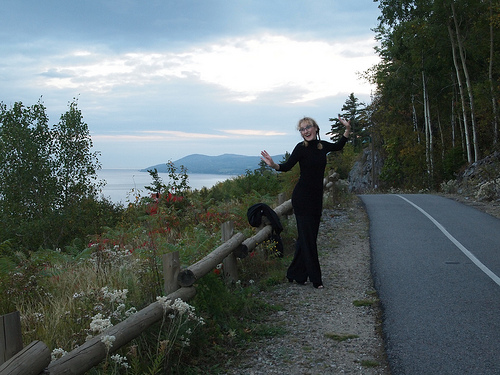
My wife and I took a few days off this week and had a small vacation in Charlevoix, a region of Quebec I had heard of at various times but knew not all that much about. Various people had told us it was nice (or better than nice), and it was supposed to be a place rich in good scenery and good food. And my wife had long been charmed by the images of the Fairmont Manoir Richelieu. So a conjunction of available vacation days, a seat sale on Porter Airlines (free wine with breakfast? but of course), and a good rate at Le Manoir Richelieu made for a midweek excursion.

We tasted some lovely food, oh yes we did (my eyes still pop when I recall the duck breast on maple sabayon at Les 3 Canards), and saw some beautiful scenery and drove some roads with up to 20% gradients, and now I’m back to taste the word Charlevoix with you.

Of course, forever henceforth for me, Charlevoix will have a strong flavour of maple-covered hills and maple-soaked food and outstanding cheese (many great cheeses are made in France, but the best I’ve ever had have been from Quebec, and Charlevoix is a key cheese-making region) and fresh air and on and on. You can be sure I will come back to Charlevoix! But before I went there, the word had a few other resonances for me.

First of them was of Charlebois, as in Robert Charlebois, a French-Canadian singer popular in the ’60s and ’70s, known for a very large, curly head of hair and for songs such as “Je reviendrai à Montréal” (“I will come back to Montreal,” www.youtube.com/watch?v=lZAaEZAzGf0). As it happens, he was also once a part-owner of Unibroue, that remarkable Quebec beer maker. (Most things in Quebec come back to food and drink eventually, and usually fairly quickly. It’s wonderful.)

But also, Charlevoix had the simple resonances of Charles (which Charles? or Charlemagne?), char (“chariot”, or, slangily, “car”, such as the rental one we drove up and down and over and around), and voix (“voice”, also sounding like voie “way, lane”, such as those on which we drove with said car, and of course like the start of voilà, which is from vois “see [second person singular imperative]” and “there/here”). The soft fricative and liquids of the Charle seemed to speak with the voice given them by the voix; the /v/ gives the word a vibration, a verve, a joie de vivre. And the angularity of the v and x catches the eyes. And what does the voice have? Perhaps choix, “choice” (taking which from Charlevoix you are left with arlev, an anagram of velar; by choice or not, the word Charlevoix has no velar consonants – though in French it has a uvular liquid r).

It does seem classic French in form, taken to the ninth degree with the ix end (which may manifest a bit of Gaul as well). And noble? Why, yes, as it happens: it’s a family name from French lesser nobility. Its most famous holder was Pierre François Xavier de Charlevoix, a French Jesuit priest for whom is named everything named Charlevoix (including the town in Michigan, which is pronounced with a final “oy” – oy!).

What did Charlevoix do for such honour? Well, you see, his was an important early voice in Canadian history – of the sort of voice you see: a book. He travelled to many places (including Japan) and wrote about his travels; of his considerable time and travels in what is now Eastern Canada (and some of the US) he wrote Histoire et description générale de la Nouvelle France, avec le Journal historique d’un voyage fait par ordre du roi dans l’Amérique septentrionale (History and general description of New France, with the historical journal of a voyage made by the order of the king in North America), published in 1722.

Did Charlevoix visit what is now Charlevoix? Well, he certainly had to go by it – it’s on the way up the St. Lawrence. In 1608, Jacques Cartier had tried to anchor at the river close to where the Manoir Richelieu now is, but he found it unsuitable for anchorage – and then the tide went out and his ships were grounded. So he called it Malle Baye, “bad bay”, which became in modern French La Malbaie, the name of the town right there. But I should say that for a long time it was called Murray Bay, after the English general who succeeded Wolfe (who won at the Plains of Abraham but was also killed there).

It happens that Murray Bay came to be a popular vacation spot starting in the 1760s; indeed, some call it Canada’s first tourist resort. In the 1800s and early-to-mid-1900s many Americans came to visit it. The present Manoir Richelieu was built in 1929. And it remains a cardinal point in the area.

But have you heard of it? And have you been there? I would encourage everyone to visit un lieu si riche et chaleureux (a place so rich and warm)… except that it was rather nice without crowds. Tell you what, you go in the summer. Then we can go and see the autumn colours (and sometimes snow on red leaves) without people in the way.

(If you want to see more of Charlevoix and Quebec City, see my photos on Flickr.)

school

The time is come around again: shoals of students appear in the hallowed, formerly hollow hallways of schools across the country. The youngest are wide-eyed oo; older ones stay cool as they scan their schedules. Some submit meekly, and some dive in enthusiastically, while others resist in ways passive or active. They are socialized in ways society finds expectable and acceptable, and may seek out opportunities for going against the grain. But for all it is an important part of their formation through information: they learn things that may not be self-evident, some of which may even be capriciously arbitrary, but they also learn to use their brains.

One of the things they learn is, of course, to spell – English spelling being so capricious as to be mocked in the reference to the elementary school trivium as the “three r’s” (reading, riting, and rithmetic). They may have heard this word school, but they couldn’t possibly predict its spelling from its pronunciation. In fact, they will certainly learn that sch as a rule is pronounced the same as sh, leading to mispronunciation of bruschetta and variant pronunciations of schism and schedule (thoroughly capricious words, neither of which having any actually good historical reason for having an h).

But they will learn that this word is pronounced /skul/; on the other hand, they are unlikely to learn that it comes from Greek σχολή scholé, and thence Latin schola, and has cognates in pretty much all Western European languages, most of which spell it without the h – as English also did until around 500 years ago, when the h was added back in, presumably because that’s how it is in Latin (idealized at the time and often since as the model language) and Dutch (native tongue of many of the early typesetters of English).

School is one of the earliest words kids will learn, so it will affect their perception of some other words, and it will have countless social accretions and collocations. Many of those will involve songs – old standards such as “School days, school days, good old golden rule days” or the one we sang on the bus home from the last day of school, “No more school, no more books, no more teachers’ dirty looks,” etc., or any of quite a lot of popular songs (songs by Supertramp and the Moody Blues spring to mind immediately for me; I wonder what today’s students associate musically with school).

There are also a few words that school may or may not make you think of but that might make you think of school: cool, skull (actually remarkably different for how similar it is), spool, stool, and snool (verb, “submit meekly” or “cause to submit meekly”; noun, “one who submits meekly”).

There are many words that show up commonly with school: before it, elementary, high, public, private, etc.; Sunday, business, medical, etc.; after it, year, bus, uniform, etc.; and of course verbs such as go to, finish, skip, and prepositions such as after, at, and in. The verbs and prepositions demonstrate a particular grammatical fact about school that native speakers have no trouble with but adult learners of English often find confusing: it can be a countable (at a school) or a mass object (at school). Sort of like fish.

Ah, yes, fish. As in a school of. Why are fish in schools? Lexical splitting and merging. On the one side we have this word descended from Greek and Latin and referring to a place of education; on the other side, and taking the form school just a couple of hundred years ago, we have a Germanic word with the same meaning and origin as shoalschool and shoal split apart at about the same time as school regained its h. That’s shoal as in “large group of marine life”; shoal as in “shallow area in the water” is of different origin, cognate with shallow. English words split and merge about as readily as high school romantic pairings.

Oh, yes. What do you remember from school, really? How much of the experience of the lessons? And how much of the social experience? We have school reunions to meet up with friends and to relive our fun times, not to review notes from our classes. But is not school work? It involves it, of a sort, but we ought to remember that school originally – and still, for some people in some places – is something one does instead of work. (In our society, grad school is certainly known as such.) You take your leisure time to learn something new and interesting – just as you are doing this very moment. After all, as you probably did not learn in school, Greek σχολή originally meant “leisure”.

nerd, geek

Dear word sommelier: When should I call someone a nerd, and when should I call someone a geek?

I ought to be a reasonable authority on this, since I’ve been something of a nerd and a geek for pretty much my whole life, although in recent years I’ve become socially adept enough, and learned to dress myself well enough, that my status has occasionally seemed questionable. But my wife still calls me a “sexy geek” and many of my readers call me a “word nerd,” so I guess I still meet the criteria.

But what are those criteria? They’ve shifted during the course of my life. When I was in high school in the early ’80s, geek was really a rather insulting term – I tended to think of some skinny person who couldn’t dress himself properly and had no social skills, or at least no non-repugnant ones.

I do think the phonaesthetics of the word, including the articulatory gesture it involves (mouth spread wide as though you’re trying to swallow something unpleasant and slimy, and the tongue’s double-touch at the back of the mouth reinforces that), had some influence on my sense of it. It was also commonly bruited about that the term originally referred to someone who bit the heads off live chickens. (The correct term for that is actually Alice Cooper Ozzy Osbourne. Oh, sorry, that was a bat.) In fact, geek was used as a name for sideshow freaks of various sorts, especially those who ate nasty things; its origins seem to be a Low German word for “fool”, via Scots English. Somehow it came to be transferred to what Brits call swots and anoraks. But with the rise of computers as a major social tool and necessity, those kids you used to insult have turned out to be very valuable: the ones who are immoderately interested and expert in things that most people find flummoxing and perhaps a bit distasteful. It’s sort of revenge of the geeks.

Wait! The movie is Revenge of the Nerds! So why is it that we tend to use geek more than nerd for these kinds of people now? When I was in school, nerd was what you called the smart kids who weren’t smooth socially but were well-intentioned and knew all sorts of stuff that everyone else would never know. Nerds dressed for function, not looks – pocket protectors, tape on the glasses – and were fascinated with things that made other people’s eyes glaze over. And you know what? I still think of nerds that way. Nor am I the only one. I think of the YouTube videos by NurdRage (yes, a different spelling), in which various chemical and other physical stunts are shown – cool lab stuff. Cool, that is, if you like to see, for instance, how you can make flowers glow in the dark, or use a chemical reaction to cause gallium to beat like a (small and fast) heart.

Nerd is a 20th-century term, possibly coming from nert, a slangy variant on nut. It’s a softer word, with a nasal sound characteristic of many a nerd’s speech; it stays near the tip of the tongue but uses that syllabic /r/ for its peak, which may seem intense or ineffectual. It seems suitable for something ineffectual and without sharp edges. A possible prime vector for the word is Dr. Seuss’s book If I Ran the Zoo, in which a nerd is a kind of exotic critter. Which, come to think of it, nerds still are, sorta. (Nerds are also a kind of candy: tangy, crunchy sugar nubs sold under the Willy Wonka brand. Could you imagine a candy called Geeks? Me neither.)

Why, then, has geek taken over? It seems that nerd has retained the sense of “an intellectually inclined person without social skills” and geek has kept the sense of “someone who has an abnormal amount of knowledge and interest in a certain topic” – as tvtropes.org points out, “There can be such a thing as a Fashion Geek, someone who knows a lot about fashion and is pretty obsessed with it. A Fashion Nerd, in contrast, would be completely unaware that stripes and plaids are unmix-y, and wouldn’t care, even if you told them why the two don’t mix.”

I would add that, while sexy nerd remains something of an oxymoron, the collocation sexy geek is reasonably current – Wired magazine has even had a “Sexiest Geek” contest, and you can see a buxom devochka discourse on geek and call herself a sexy geek at www.youtube.com/watch?v=a9jlefnXKyQ. As she points out, intelligence has become very popular, and that has caused geek’s stock to rise somewhat.

But I find that the distinction is not altogether clear cut. In some cases the sound matters – for instance, where word geek might seem natural, rhyme helps word nerd to prevail. Often, though, personal proclivity comes into it. Of course, not everyone cares that much; if you have strong opinions on the difference very much, then, as the great nerd (or is it geek) comic strip xkcd diagrams, you are a nerd, a geek, or both: xkcd.com/747/.

But speaking of Venn diagrams (since you’re a geek, a nerd, or both, you know that intersecting-circle diagrams are Venn diagrams), there is one currently making the rounds that purports to set the matter straight on the difference between not just nerd and geek but also dork and dweeb: www.buzzfeed.com/scott/nerd-venn-diagram. It’s not bad, but I don’t find that everyone sees it exactly that way. I polled editors and people on Twitter and got a mixture of responses, among which were the following distinctions:

– nerds are less intelligent than geeks
– nerds are much bigger losers
– on Big Bang Theory (wondering how long it would take for me to mention it?), Leonard is a geek but not a nerd, while Sheldon is both
– nerds are antisocial, while geeks are just not socially focused
– nerds have no friends, while geeks have people seeking their advice
– nerds use pocket protectors; geeks don’t
– geeks are cool
– nerds swim against the pop culture grain; geeks are more tech-focused
– nerd = geek squared
– a geek has a useful skill

I just asked my wife if I was a geek; she said “Of course.” I asked her if I was a nerd. She demurred. I asked what the difference was. She had to think. “Well… they’re both genius… geek seems to be more… suave?”

So, in the current linguistic climate – though this may well change – although the terms have a certain amount of overlap, and although you have to allow for factors such as rhyme, generally geek is applied more broadly and with a certain amount of approbation, rather like wonk, while nerd has a greater connotation of social ineptitude or some kind of cluelessness. Among the crowd watching planes take off and land, a geek would be more like an aviation photographer, a nerd more like a planespotter. Trainspotters and other anoraks are no longer geeks; they’re not cool enough. Oh, but what about gongoozlers? A class of their own, I think.

