ambsace

This word makes me think of three others: Alsace, Ames, and Ambrose.

It also makes me think of embrace and ambulance and a few others, it’s true. But I’d really like to roll the dice on those three proper nouns.

I should say, first of all, that this word comes from French ambes as, from Latin ambas as, meaning “both ones” or “both aces”. In English, the more common term for this is snake eyes. It’s referring to dice, you see: those two separate dots that stare at you like a colon or a snake’s eyes, expecting what is to follow – your loss. In Texas Hold ‘Em, two aces is good – pocket aces are usually good for a pre-flop all-in. But in craps, two ones is doubleplusungood. So ambsace can, aside from “snake eyes”, mean “bad luck”. It can also mean “the smallest amount”, no more than a jot or a tittle – you may have heard “within an ace of” something; in craps terms, that’s “within ambsace”.

I should also say that this word has two pronunciations. You likely read it as “ams ace”, which is one possible; the other is “ames ace” (i.e., “aims ace”). This is why it reminds me of both Ames and Ambrose.

First to Alsace, though: that region that has historically been bounced back and forth between France and Germany like a tennis ball. And yet, for all that, it is not just politically important, it also produces much of France’s beer and some mighty fine Rieslings and Gewürztraminers. Nuts to the bad-luck rolls of history: the glass is neither half-full nor half-empty – when it’s empty, refill it and have another!

Now, Ames: that’s the name of a town in Iowa, but it’s named after a U.S. Congressman, Oakes Ames. Why name a town after him? For the same reason they named a monument in Wyoming after him: he was perhaps the single biggest factor in getting the Union Pacific portion of the transcontinental railroad in the U.S. built. Lincoln asked him to take charge of it, and he did: he awarded a bunch of contracts to firms his family owned, and then he sold shares in them at discount prices to other congressmen, and they voted for legislation that allowed it to go ahead. And it got built. And a monument was erected to him in 1882 at the highest point of the railroad: a stone pyramid, not really a monolith but nonetheless an ace for Ames.

But his dodgy dealings in the sale of shares led to his censure and expulsion from congress, and he died soon after. And in the decades after 1882, the railroad realigned, stranding the monument and killing the nearby town of Sherman. Ames’s ace became ambsace.

As to Ambrose, I mean specifically Ambrose Bierce, that crusty American writer best known for The Cynic’s Word Book, republished under the better-known title The Devil’s Dictionary. It is a satirical, cynical work, with tart little definitions such as “Selfish, adj., Devoid of consideration for the selfishness of others” and “Loquacity, n., A disorder which renders the sufferer unable to curb his tongue when you wish to talk.” For “Railroad” he offered this definition: “The chief of many mechanical devices enabling us to get away from where we are to where we are no better off.”

Not all of Bierce’s definitions were pithy; I would like to quote at length his definition of “Lexicographer”:

A pestilent fellow who, under the pretense of recording some particular stage in the development of a language, does what he can to arrest its growth, stiffen its flexibility and mechanize its methods. For your lexicographer, having written his dictionary, comes to be considered “as one having authority,” whereas his function is only to make a record, not to give a law. The natural servility of the human understanding having invested him with judicial power, surrenders its right of reason and submits itself to a chronicle as if it were a statue. Let the dictionary (for example) mark a good word as “obsolete” or “obsolescent” and few men thereafter venture to use it, whatever their need of it and however desirable its restoration to favor – whereby the process of improverishment is accelerated and speech decays. On the contrary, recognizing the truth that language must grow by innovation if it grow at all, makes new words and uses the old in an unfamiliar sense, has no following and is tartly reminded that “it isn’t in the dictionary” – although down to the time of the first lexicographer (Heaven forgive him!) no author ever had used a word that was in the dictionary. In the golden prime and high noon of English speech; when from the lips of the great Elizabethans fell words that made their own meaning and carried it in their very sound; when a Shakespeare and a Bacon were possible, and the language now rapidly perishing at one end and slowly renewed at the other was in vigorous growth and hardy preservation – sweeter than honey and stronger than a lion – the lexicographer was a person unknown, the dictionary a creation which his Creator had not created him to create.

In other words, old words crap out, while new ones are told “No dice.” But good descriptive lexicographers are not so cruel; it is, rather, certain users of their field guides who load the dice.

As to Ambrose Bierce: at the age of 71, he  departed for Mexico and simply vanished, his ultimate end unknown. His words survive, of course, every titillating jot of them.

Thanks to Elaine Phillips for suggesting ambsace.

awesome, fantastic

Dear word sommelier: I’m at a friend’s place, and he’s made bobotie, and it’s really good. Should I say “This bobotie is awesome” or “This bobotie is fantastic”?

First of all, we must acknowledge that there is a certain set of people who will insist – quite vehemently – that neither is acceptable: that awesome can only mean “inspiring awe” and fantastic can only mean “characteristic of, or produced by, fantasy”. People of this set actually do have dictionaries, but if they look in them, they arrogate to themselves the right to declare the ones they disagree with (all of them, ultimately) wrong: only the “original” meaning of a word is correct, and by “original” they mean “etymological, as they understand it”. (In truth, awesome first meant “full of awe”, and only in the next century “inspiring awe”; the original term for that was awful, a word that picklepusses frequently use unreservedly in its much more modern meaning of “nasty”.)

But such people are among the most arrant fools in all of creation, and ought not to be heeded any more than one would heed an unknown petulant two-year-old’s admonitions. So let us proceed with reality. Reality does include the meanings mentioned above, to be sure, but it is not restricted to them.

The question you ask may reflect a shift in usage, though I’m not sure of it as yet. My friend Michelle remarked to me today that she had the sense that fantastic was overtaking awesome as a general adjective of enthusiastic approbation. This is quite difficult to assess objectively, as simple searches don’t sort semantically. In overall usage, fantastic has always been more common than awesome, but awesome is actually a newer word and has certainly increased in usage, reaching a soft peak around 1980 and holding fairly well since, if Google Ngrams are to be believed (and they do have their limitations!). A Google search for each does pick up twice as many hits for awesome, but wordcount.org places fantastic much farther up in the British National Corpus.

Awesome is the more bivalent of the words. It retains a more specific sense, and one may use it as such. When someone sings the hymn “How Great Thou Art” and pronounces “O Lord my God, when I in awesome wonder consider all the worlds Thy hands have made,” there’s no risk of its being taken to be like saying “when I in totally wicked wonder” or “when I in way bitchen wonder” or something like that. But within the context of colloquial usage, it has a very clear air of youthful informality. It became so common and bleached in its peak (from which it has not subsided too much) that I used to think of this version of it as ossum, a sort of verbal marsupial hanging by its tail in the midst of the sentence. Which awesome is wanted can readily be specified by surrounding words and their tone: which would you take truly awesome to mean (I would take it to mean “awe-inspiring”)? How about totally awesome (“really good” for me)?

While awesome has had this bleached usage only since the late-mid 20th century, however, fantastic has been in similar broad service since at least the 1930s – which is still recent, given its existence as a word since the 1400s. But any use of it to mean anything other than “really good” now is very likely to have an air of quaintness. In the more cultured spheres, wherein dwell such people as know Berlioz’s Symphonie Fantastique, the sense of phantasm and fantasy is likely more present, and that large set of people who have see the musical The Fantasticks will have that charming tale (and its memorable tunes) imprinted in their minds, but hoi polloi will more likely think of a brand of spray-on cleaning solutions, Fantastik. (Observe the effects of the k with or without c, too, though.)

For either of the words, of course, usage on TV and in movies will have a strong effect, and we may assume those were prime vectors of the ascendancy of awesome for approbation. Fantastic likewise gets used by some notable personalities, and I can recall an ad from a few years ago for a lottery that paid $1000 a week for life in which  the protagonist exclaimed “Faaaaantastic!” on receiving each cheque.

And that takes us to the heart of the matter. The bleached sense of these words is fundamentally phatic, and relies strongly on expressive potential. Awesome allows the gaping “aw” to lead in, embodying an expression of awe, surprise, amazement, et cetera. It then closes off neatly with an unstressed second syllable. It works much better, rhythmically, with totally than fantastic does (try both and see what I mean). It’s a big, smooth, solid stroke.

Fantastic, on the other hand, has three syllables, the stressed one of which is the second – but the first may be stretched out and emphasized as well. Due to its rhythm, it is conducive to tmesis: you can slip in an expletive intensifier, as in fan-freaking-tastic, which is not done in a word such as awesome. So it is more flexible and extensible. Its sound is less full of round-mouthed amazement and more full of wide-mouthed joy, pride, or enthusiasm. It has voiceless stops and another fricative, giving it the éclat of fireworks.

Moreover, because fantastic is widely established as a simple term of strong approbation, it doesn’t carry with itself the air of “valley girl” or similar teen in-group-ness (of course it was an “in” term back in the ’30s, but that’s too far back to have influence now), and so there is less likely a sort of winkingness to its usage, at least currently.

In your case, given the rhythm of bobotie and of the sentence as a whole, I would incline towards fantastic. It also more likely carries a tone that is more ingenuous and sincere and less self-observing. It may seem a stronger term of approbation, mind you, and the shape of the mouth in awesome may seem more suited to a comestible, so you do have to go with your own immediate sense of the occasion. The truth of it is that usage in such matters is an art, not a science, and one may defensibly use either, for different taste sensations.

You will also, by the way, want to consider what term, if any, you will use for the blatjang that (I presume) has been served with the bobotie.

ark

Ark shows up in a lot of places. Most of the time it’s a reference to Noah’s ark, that very large wooden box (that’s really what it was – an epic parallelepiped) that, the Bible tells us, held eight people, seven pairs of each species of clean animal, one pair of each species of unclean animal, and seven (individuals, not pairs) of each kind of bird. It was like an enormous treasure chest preserving the future of dry-land life, bobbing on the waves like a message in a bottle: each entity a word, or, really, many many words. It puts me in mind of the Global Seed Vault in Svalbard, which is preserving the vegetal biodiversity of the planet (especially its food crops) – see the article in the July 2011 National Geographic.

Ark often appears in science fiction, as the idea of an interstellar ship carrying the few survivors of a planet through the dark oceanic void of space is an appealing one and can present quite a few possibilities. (Not all such tales use ark; I’m put in mind of Arthur C. Clarke’s Rendezvous with Rama and of the ill-fated TV series Starlost.) There is typically the idea of a ship or an analogue of one, perserving all life. But, really, it’s not a ship that one navigates from one place to another – it simply floats like a message in a bottle, or rather a treasure chest floating on the water with the hope for the future inside it.

Did you know that the little vessel of bulrushes in which the infant Moses was placed so that he could float down the stream and be discovered by the Pharaoh’s daughter was also an ark? Not all translations of the Bible use the term, but that is the time-honoured term, and is a reasonable translation of the Hebrew teiva (compare tebhath Noah, “Noah’s ark”). That little vessel, most likely made of papyrus reeds, carried the hope of Israel – and of all its words; the words were later themselves written on papyrus, but the man traditionally given as the origin of the first books of the Bible was Moses, who was carried to safety in a boat of papyrus.

But an ark is not a boat, not really. No, it is a box. A treasure chest or any other kind of chest. Noah’s ark was an exceptionally large one; the ark of bulrushes was smaller, but not really closed like a usual box. But the sea vessel image is so pervasive that when I first heard of the movie Raiders of the Lost Ark (shortly before it was released in theatres), I assumed it had to do with Noah’s ark.

It didn’t, of course; it had to do with that third ark, the Ark of the Covenant: the holiest vessel in the Biblical Hebrew religion. It contained the tablets on which God inscribed the commandments – the words that they took as their guide. Of course, they didn’t open it and look in all the time; it was far too holy for that. They knew the words; the box preserved the originary text, but while it held the cold stone the words were alive outside it, and even after it disappeared they survived. (In the here and now, there are many people who have things to say about the value of those words and their effect, but I am not here to enter into that debate; I’m tasting the word ark, and this is an important influence on it.)

I would be remiss if I did not mention also the sense of promise and covenant following on these three arks. You may remember what sign God gave to Noah as a promise not to flood the planet again: a rainbow, a great arc in the sky (arc-en-ciel in French, in fact). Moses, of course, brought promise and the covenant with God in the form of the commandments, and it is those commandments that were in the Ark of the Covenant. So an ark holds treasure, holds words, brings promise, brings covenant.

That’s quite a bit for such a small, plain word, isn’t it? Ark comes to us from Latin arca, “box” – nothing more arcane than that. Our English ark is a short, sturdy word, almost a fragment; it shows up in so many other words (and its sound in even more). It’s quite popular in its role as abbreviation for Arkansas. You may remark on the marks you read on the page, or hark to the words you hear spoken. It is not a seed of these words, or a root, but it is carried in them and keeps them afloat. I will not even begin a list of words with the letters or sound in them; that’s an exercise you can occupy yourself with in your spare time.

But I will mention the photo with which I illustrate this note. This ARK is obviously scratched with many more words, the etchings (in Italian, “etchings” is graffiti) of the masses passing by. In fact, this ARK was hidden behind a metal sign for some time, and was revealed by the sign’s removal. To see it (I believe it is still there), you must travel through the dark void in a box, in this case a metal box, not made of rushes but used during rush hour; it holds words in many languages, some printed or etched but many more spoken and heard by the mingled masses of humanity carried safely to their futures in it. The box itself embodies something of a covenant with nature: if you’re in it with the others of humanity, sharing their words, you are not alone in a metal box by yourself, clogging up the streets and polluting the air.

Of course the box is a subway car. The sign is on a subway platform. In full, it reads QUEEN’S PARK. But at the end is a word, and the word is ark.

flaxseed, linseed

You’re probably familiar with Claude Débussy’s Prélude “The Girl with the Flaxen Hair.” If you’re not, or even if you are, I invite you to listen to a harp transcription of it played by a young woman with flaxen hair: www.youtube.com/watch?v=7v_ys5Fgqiw

Now, that harpist is named Alexandra King, but I rather like to fancy that the name of the girl with the flaxen hair is Lindsay. I’m sure it’s not – that’s hardly a French name – but it does have a certain paronomastic appeal.

I’ll explain. In English, we call the plant with the blue flowers that produces the blonde fibres flax, and its useful seeds are often called flaxseeds (you can find them in certain hot cereals – Sunny Boy and Red River come to mind – and in some multi-grain bread, among other places). But the French have a quite different name for it, as you see in the French title of Débussy’s piece: “La fille aux cheveux de lin.” Yes, lin, which we do see in some English words: linen is one, and linseed is another. Indeed: linseed, which produces that oil that is used in so many places for so many things, is the same as flaxseed.

So lin makes me think of linseed, which makes me think of Lindsay. Now, Lindsay is not related to linseed at all; it’s actually a Scottish family name (a clan which I apparently have some connection to somewhere way back there), but in fact it’s not originally Scottish; it comes from Sir Walter de Lindesay, a retainer of King David I of Scotland (1084–1153), and he brought the name from Lincolnshire – Lindsay comes from words meaning “Lincoln’s wetland.” No relation indeed – you don’t even grow flax in wetland.

But look at the difference – taste the difference, even. Flax flashes and flaps; it is dry as flint, and it rustles like clean sheets in the breeze (which linen does not). It appears to come from old Indo-European roots meaning “plait”, though some suggest the real root relates to “flay”. It is perhaps ironic that flaxseed, with its printing-press sound, and its sword-crossing x and tall grassy f, sounds somewhat like flaccid.

Linseed, by comparison, is lighter, more liquid (better suited to oil than to crunching?), perhaps even more refined-seeming. It is the more classical word; it traces to Latin linum, meaning “flax”. Flaxseed and flaxen make me think of a country girl with flying whitish hair who delights in leaping fences; linen makes me think of domestic niceties, and the sound (not the oily taste) of linseed makes me think of a genteel lass, one who sits in parlors and plays piano. Or harp – except that, of course, Alexandra is rather more like flaxseed, isn’t it? Compared to the more feathered f of flax, the l of lin is lean and lithe: just a line (oh, yes, line is directly related to lin and linen – thanks to the threads, strings, and ropes one may make from flax). The n is legs held in parallel where the x is legs crossed. And so on – of course one may discern what one desires to see to match the sense.

But remember that the sense is in fact the same, really. The words are used in different contexts, but the plant is the same. Remember too, though, that the girl’s hair looks like the fibres, not the seeds. It may be, too, that her eyes are as blue as the flowers of flax, but we don’t know. We don’t know her name, either. But we do know that she has cherry-red lips, and that she has been sitting on the flowering alfalfa (not the linoleum), singing since the fresh morning.

We know this because Débussy’s piece is based on the poem “La fille aux cheveux de lin” by Leconte de Lisle:

Sur la luzerne en fleur assise,
Qui chante dès le frais matin ?
C’est la fille aux cheveux de lin,
La belle aux lèvres de cerise.

L’amour, au clair soleil d’été,
Avec l’alouette a chanté.

Ta bouche a des couleurs divines,
Ma chère, et tente le baiser !
Sur l’herbe en fleur veux-tu causer,
Fille aux cils longs, aux boucles fines ?

L’amour, au clair soleil d’été,
Avec l’alouette a chanté.

Ne dis pas non, fille cruelle !
Ne dis pas oui ! J’entendrai mieux
Le long regard de tes grands yeux
Et ta lèvre rose, ô ma belle !

L’amour, au clair soleil d’été,
Avec l’alouette a chanté.

Adieu les daims, adieu les lièvres
Et les rouges perdrix ! Je veux
Baiser le lin de tes cheveux,
Presser la pourpre de tes lèvres !

L’amour, au clair soleil d’été,
Avec l’alouette a chanté.

I hope you will not think me lax for not providing a translation here and now. In order to do the poem real justice (rather than simply translating it word for word, which rather betrays the overall poesy) I would need more time than I can spare this evening. I suggest that you instead watch the video of Alexandra King’s rendition again, and reflect on whether you find her more to suit flaxen hair or cheveux de lin.

aftermath

Ah, the aftermath. Sort of like the afterlife without the life part – or is that right? It’s a word with soft sounds in its cretic rhythm, but the softness may be the softness of fatigue and the flaccidity of the destroyed. The rhythm could be the echo of distant drums from the army moving on from the scene of carnage, or it could be nothing more than the waves lapping at the battered shore.

There are different kinds of use of aftermath, to be sure. The tone may be light or heavy, literal or figurative, serious or sarcastic. The aftermath may be the scene the morning after a high-school party, where an assortment of friends and near-strangers drank too much vodka and smoked too much grass. It may be the scene after a math exam, when many a mind has been uprooted by roots. It may be the wreckage and crater Wile E. Coyote climbs out of after failing again to catch the roadrunner – when will he learn that he never can mow him down? Or it may be the scene after a military encounter, be it Sherramuir or Agincourt or Ypres or – well, anywhere where many have been mown down for real.

Rather a solemn thought, is it not? It puts me in mind of the section from Brahms’s Deutsches Requiem:

Denn alles Fleisch, es ist wie Gras
und alle Herrlichkeit des Menschen
wie des Grases Blumen.

“For all flesh is like grass, and all human glory is like the flowers of the field.” (It’s a quote from the first letter of Peter in the New Testament.) But when you mow the grass, it’s not that there is nothing left; there is less, and the cuttings are strewn about, but the cropped blades push up still. And so, too, in an aftermath, there is often some remnant sign of life, something pushing up or simply persistent. The silence may echo, but the violence is gone. I remember the scene at the end of Slaughterhouse-Five by Kurt Vonnegut, in the aftermath of the fire-bombing of Dresden. They spend so much time dealing with the dead, and some more of them die in the process as well…

And somewhere in there was springtime. The corpse mines were closed down. The soldiers all left to fight the Russians. In the suburbs, the women and children dug rifle pits. Billy and the rest of his group were locked up in the stable in the suburbs. And then, one morning, they got up to discover that the door was unlocked. World War Two in Europe was over.

Billy and the rest wandered out onto the shady street. The trees were leafing out. There was nothing going on out there, no traffic of any kind. There was only one vehicle, an abandoned wagon drawn by two horses. The wagon was green and coffin-shaped.

Birds were talking.

One bird said to Billy Pilgrim, “Poo-tee-weet?”

And aftermath, with a rhythm sort of like poo-tee-weet, gains the aspect of trees soughing with breeze, so calm after the scene when, as Robert Burns put it in “The Battle of Sherramuir,” “My heart for fear gae sough for sough.” Now the blades have cut the blades: the grass is mown; it lies still; new grass will push up. Aftermath.

In aftermath, you see, there is after – which is “after” – and math, which is not mathematics (not even the inexorable addition of casualty counts and the subtraction of multiplying attrition) but mowing: the act of mowing, or what has been mown. This math is in fact cognate with mow. Aftermath referred first to the state after the first mowing of grass in early summer, and to the crop that sprang up thereafter for the second mowing (look: do you see the bent f, the cropped t’s, the rising h, in the field of low letters?). But as mowing is an event, and applied figuratively to people one that bespeaks negative consequence (a wide swath cut down), aftermath came to name the state left by an event, typically one of destruction or unpleasantness. What follows.

And what follows what follows is memory, the last aftermath: when the grass is grown its tops still show the mark of the blade, until it dies and new blades push up the next spring. But memory is an important thing in the aftermath, as Siegfried Sassoon so emphasized in his 1919 poem “Aftermath,” which concludes,

Have you forgotten yet?…
Look up, and swear by the green of the Spring that you’ll never forget.

Thanks to @LaSoeur_Lumiere for suggesting aftermath.

oleaginous

Following on my note on unctuousness, Jim Taylor wrote that, for its wonderfully rich sound, he prefers oleaginous. He directed my attention to a limerick:

There was an old man of Calcutta
Who coated his tonsils with butta
Which altered his snore
From a thunderous roar
To a soft oleaginous mutta.

We can see, in this poem and in usages such as “Elvis’s tame musical taste vacillates between gospel standards and the oleaginous hits of Dean Martin” (from Vanity Fair, November 2001), that, like unctuous, oleaginous is often used figuratively.

But not always. It can easily be applied literally, as in this bit from the Tatler (July 1993): “Confit of duck with bean cassoulet includes a tasty and suitably oleaginous duck but bland beans.” Or this from the July 1915 Science: “A picture of trilobites and other oleaginous Cambrian crustaceans.”

For all three quotes I thank the OED. They all have something else in common: they are written with a particularly good feel for the sounds and the mouth movements. Just say it slowly: “suitably oleaginous duck but bland beans.” Love the lissome and occasionally crunchy alliteration of the Science sentence. This is a word that makes for a modern dance of the tongue and jaw.

It’s different from unctuous, to be sure. That word sticks and requires quite the effort to pull the mouth open, and it doesn’t open very far. Oleaginous is more like walking through a pool of olive oil. (You can see it coming slowly, like a distant oily warning.) The jaw opens smoothly, the tongue following behind before lightly tapping back at the tip. The /l/ is a liquid, and it’s palatalized here too. It seems almost absorbed into the flow – how close this word is to “Oh, yeah!” (Or “Oh, yeah, genius!”)

And such a vowel movement! But also vowels on the page. All five standard vowel letters show up, and o is there twice. But the only letter that disappears in pronunciation is the second o – otherwise, each one stands for a sound: “o-le-a-gi-n(o)us”.

This word makes me think of Olean, a city in New York State, but for most people it’s likely to bring to mind, well, oil. The ol(e) shows up here and there in words with oily senses. And well it should. It comes from Latin olea “olive tree” (whence much oil), and the aginous from a Latin suffix of relation.

You may or may not like this word, depending on your feelings about oil; at least it does not have quite the negative connotations of unctuous. I do like oil, in sensible measure, and olive oil in particular. But I also like this word just a little better for the verbal playfulness it seems to encourage, and just now for leading me to this quote from the book True Colours: “After wondering for the gazillionth time whether Dick Suris, the oleaginous, slimetudinous political consultant to Jack Stanton, was bugging our little power retreat…”

Slimetudinous! What a perfectly cromulent word.

embiggen, cromulent

Daryl, Margot, Jess, and I were seated at Café Kopi Luwak enjoying our cups of espresso, compresso, represso, and corretto with some crumbly cakes. Daryl was showing us some pictures on his iPad. “Let me embiggen that detail,” he said, dragging his fingers in opposite directions across the surface.

Embiggen?” Margot said, her voice fairly dripping.

“It’s a perfectly cromulent word,” Jess said.

Margot was clearly about to say “Cromulent?” but decided to fight one villain at a time. “Em, big, en. The word is enlarge. Or magnify. Expand.”

“Well, you obviously understood it,” Daryl said. “Besides, those words all have different nuances of meaning. And they’re all less fun.”

“They’re better formed,” Margot said. “Embiggen has a Latin prefix stuck onto an Anglo-Saxon root and suffix.”

“Like enlighten,” I pointed out.

“But you can’t just make a word up on the spot like that,” Margot protested.

“I didn’t,” Daryl said. “Look.” He held up the iPad. “That was the detail. It’s a sign with the town motto of Springfield, from The Simpsons: ‘A noble spirit embiggens the smallest man.'”

Margot was momentarily nonplussed.

“The word was coined in 1996 by writer Dan Greaney,” Daryl added.

“It’s perfidiously ugly,” Margot said finally. “And unnecessary.”

“So?” Jess, Daryl, and I all said at the same time. And we added, again in unison, “It’s a perfectly cromulent word.”

Cromulent!” Margot said, turning to her next foe. “Is there really such a word?”

“Yes,” Jess said.

“Since 1996,” I added.

“It was invented by David X. Cohen, for The Simpsons,” Daryl explained.

“That doesn’t make it a real word!” Margot exclaimed.

Daryl was doing a quick Google search. “Well… over a quarter of a million usages might do it.”

“But what does it mean?”

“I’d say its most common use is as a linguistic equivalent of truthy,” Jess said. “Used for a neologism that has good feel and seems like it ought to be a real word.”

“It does have a broader, plainer sense,” Daryl said. “For instance, as Principal Skinner said, ‘He’s embiggened that role with his cromulent performance.’ So ‘valid’ or ‘credible’ or something like that.”

“To me,” I said, “it has an air of something you can sink your teeth into. Like this coffee cake. Only transferred metaphorically.”

“You mean with the taste of crumble and granular and the grabbiness of grommet and glom?” Jess asked.

“Yeah,” I said. “And succulent and corpulent and crapulent and esculent and opulent and poculent and…”

“And fraudulent and purulent and feculent and morbulent,” Margot grumbled.

“And truculent,” Jess added.

“And soylent green!” Daryl said.

“Well,” Margot said snarkily, “just because u lent a word to the language doesn’t mean we must cram it in.”

“Oh, there’s infinite room to embiggen the vocabulary,” Jess said.

Margot looked around as though contemplating defenestration. She slugged back the last of her coffee and declared, “I need a corretto.”

I signalled the waitress. She came over. “What can I get you?”

“A round of corretti would be cromulent,” I said.

She smiled. “Shall I embiggen them?”

Margot looked at her, slack-jawed. Pause. “Yeeeesss. Please.”

Vancouver

If you’re like me, this word is a primary word – a word learned so early that it gives resonances much more than it receives them. I am aware now, for instance, that it is a Dutch-derived family name (to be precise, it’s a British version of the Dutch family name Van Coeverden), but when I hear of the Canadian Olympian Adam van Koeverden, it always makes me think of Vancouver, not the other way around (even though van Koeverden is actually from Ontario). My early associative reflexes related Vancouver more closerly to louver and Hoover and even mover.

And discover. For me as for many, Vancouver is a city that is forever a discovery, forever young and beautiful (note the double V-neck – would that be Van as in Vanna White?), forever a meeting of new cultures (less than half of Vancouverites have English as their first language). It has a certain style. It’s not quite Canada’s Hawai’i, but it is our San Francisco, a hilly peninsula sandwiched between sea and mountains. When I was a little kid, after the first time visiting it, I decided I would live there someday. I haven’t changed my mind. It just never gets old for me.

But I’m not sure I can get old for it – I doubt I could afford to retire there on a reduced income, or even to move there on what I make now. Vancouver may have the neighbourhood with the worst reputation in Canada (Downtown Eastside), but it’s also famous for property prices as breathtaking as the views. For many, the word Vancouver now brings to mind some very expensive condominiums.

Also, lately, hockey: Vancouver Canucks is a common collocation – but let’s not talk about them now, shall we? More gloriously, Vancouver also goes with Olympics (a word that used to go more strongly with Calgary). And, of course, with Whistler (would you rather whistle or vancouve? how about both?). It also, for an unexpected set of people, goes with style: Vancouver style is a standard reference format for medical and science journals.

And, as ever, Vancouver goes with Island. Which really confuses people, of course, since Vancouver isn’t on Vancouver Island. Well, we should say to start with that the Island was originally named Quadra and Vancouver’s Island by the British explorer Captain George Vancouver and the Spanish explorer Francisco de la Bodega y Quadra, in honour of their friendship (in spite of occasional competition between their countries for the turf thereabouts). Now Quadra is the name of a smaller island between the mainland and Vancouver Island.

And of course the town, originally named Gastown and then Granville, came to be named somewhat later in honour of the captain who, having been a midshipman in his teens under James Cook, completed the longest surveying expedition in history – four and a half years. He spent his winters in the Sandwich Islands – now known as Hawai’i – and negotiated British ownership of them with King Kamehameha. He came up the coast starting just north of San Francisco and made it up to Alaska. He produced some very detailed maps of the inlets and coastline (though he overlooked some rivers that didn’t look promising for inland navigation, such as the Columbia and Fraser). He met – often on friendly terms – the Spanish and the local indigenous cultures. His ship, I should mention, was called the Discovery. And after he sailed it back to England, he retired on half salary, started working on his memoirs, and died a mere two years later – at age 40. Just as Vancouver never gets old, neither did he.

ongoing

I’m not an early adopter of technology and trends, but I’m not a late holdout either. In the ongoing development of the latest thing, I tend to notice its usefulness around the same time as a lot of other people do. I’m relatively conservative in my approach; I haven’t started on with Digg, or Tumblr, or Reddit; I am not a regular habitué of HuffPost or Boing Boing. But a couple of weeks ago I started up a Twitter account, @sesquiotic. And I have to say I have really gotten caught up in the goings-on, the ongoing march-past of facts, fascinations, fancies, and fritterings. I get a lot of good jokes and news clips from it, and updates on things that keep my mind spiralling a bit too late in the night.

One of the tweeters I follow is the Guardian style guide, @guardianstyle. Today @guardianstyle tweeted (among other things) “Can we agree to delete the word ‘ongoing’ whenever & wherever we see it? The writing will be improved & the world will be a happier place.” @guardianstyle’s reason for such an ongoing dislike of ongoing has to do with the typical excrescence of its use: it often adds little – if anything at all – in actual sense, certainly in news reports. (“It’s a meaningless jargon word.” Meaning it’s typically used meaninglessly, not that it is unable to convey meaning.) @guardianstyle is of that set who abhor excrescence and “unnecessary” words. Reasonable enough in the newspaper business.

I, qua word taster, on the other hand (if less so in my editorial day job), get to enjoy words even when they’re just extra icing (or frosting) on the cake; I have no duty of ignoring the aesthetic pleasures of words. While @guardianstyle recommends (and justly so) near to rather than in close proximity for journalistic and similar writing, I get to say “Near to is concise, but in close proximity does a luxurious tapdance on your palate if you have the time.” And ongoing? Any word that makes me think of boing boing (the onomotopoeia, not the site) can’t be all bad. I suppose this will be an ongoing point of difference between us.

It is a funny word, isn’t it? It almost looks like an imitation of chewing with the mouth open: “So he’s sitting there, chewing away with his mouth open and full of food, ‘ong oing ong oing,’ and I’m like, that’s so gross, shut it, OK?” The two g’s in the word remind me of two infinity signs ∞, but rotated 90 degrees and deformed. Hmmm… it’s like zero (o) through any real number (n) to a reckless infinity (g), and then the same but through any imaginary number (if we take in to be i, the original imaginary number – square root of –1 – times n). On the other hand, g also stands for gravity, and o can be the origin of a circle – or the circle itself, of course – but I’m not sure where I’m going with this… Maybe it’s a no go.

The word really divides before, not after, the first g, anyway. It has three morphemes, one per syllable: on+(go+ing). It’s sometimes written with a hyphen after the on. It’s good old Anglo-Saxon, about as English as a word can be. It could be taken for a valediction – something one says on going – but as we know it’s actually not going off, and not even just going on, but continuing forward: on as in onward. The circles and twists, and the springy sound, may suggest a spiral, but it is not a mortal coil – at least its end is not foreseen. This word, like the enjoyment of words, is – to use some common collocations – an ongoing process, an ongoing investigation, an ongoing debate, with ongoing research and ongoing efforts on an ongoing basis. Even if @guardianstyle is shaking the head and saying “Come off it.”

I’m taking a few days away; my ongoing word tasting notes will resume on Tuesday, barring unforeseen eventualities.

coitus

This word is enjoying something of a resurgence thanks to its common use in The Big Bang Theory as the geeky way to refer to sexual intercourse. It’s technical and yet uncommon enough that it may seem coy to us; it’s not quite as barefaced as some of the other terms available.

Of course, one may play with the shapes – the circular c and o, the linear t and i, coming together to make us. But the salient feature for me is the sound, which feels to me as though it spirals (screws?), like boing (from a spring coil) and oink (from a spiral-tailed pig). Indeed, for me, it has always had a sort of taste of coil – but also perhaps quoits (that game of throwing rings onto a stick), and for that matter Coit Tower, the name of San Francisco’s 64-metre-high hilltop lingam, and, come to think of it, Duns Scotus, a philosopher from whose name we get (unfortunately) dunce (and that conical cap). And maybe a Brooklyn version of the name Curtis – after all, there’s the noted bathroom scribble “A little coitus never hoit us.” But how do these things go together?

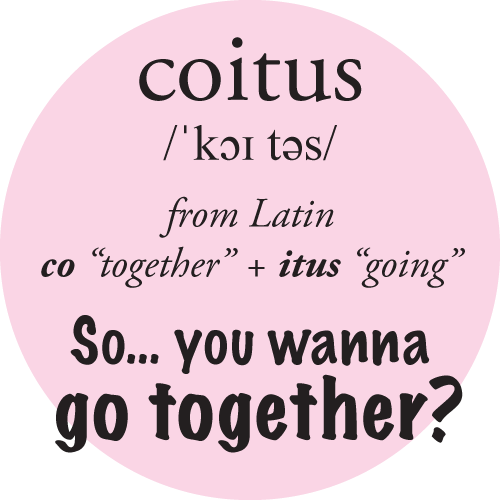
Hm, well, maybe like a horse and carriage. You know, that song “Love and marriage, love and marriage, go together like a horse and carriage”? Though actually I don’t think it’s exactly like how a horse and carriage go together. It might be something more like what a teenage boy is hoping for when he says to a teenage girl (or do they even still say this anymore?), “You wanna go together?” (And then there’s Monty Python: “Is your wife a goer, eh? Know whatahmean, know whatahmean, nudge nudge, know whatahmean, say no more?”)

The thing is, coitus is from the Latin word coitus, “going together”, from co “with” plus ire “go”. It’s nothing more specific or literal or prurient than that! And yet, somewhat as the pronunciation has merged the co and it into one syllable, like some pretty co-ed and her thuggy boyfriend (“It” to her parents) might merge likewise, so the euphemism has come to merge with the more technical and literal sense.

And what word is most often seen next to coitus? Why, interruptus, of course. (And then there’s the dorm-room door sign, “Coitus – don’t interruptus.”) Amusingly, the interruption prevents not the going but the – oh, well, I’m sure you get the idea.

It occurs to me that were go together to become the accepted English term, one might say in hostility, “Go go together with yourself.” Which is of course a logical impossibility – the sound of one hand clapping, as it were. At best it would be an invitation to solipsism or narcissism; at worst, well, some other ism.

BUY COITUS ETYMOLOGY JUNK
Now at CafePress, you can buy this charming design on T-shirts, iPod cases, mouse pads, bugs, and so on: