I have always been fond of the word atrocious, and, alas, it has never stopped being useful. I was pleased to hear it used several times in documentary movies I watched over the past week, mostly to describe details of geopolitical reality, though I believe once or twice it was describing something in severe bad taste.
And that’s part of the charm of atrocious. It has two spheres of usage: moral and aesthetic. It’s either gut-wrenching or eye-rolling. About half the time it describes trash, and about half the time it describes… well, atrocities.
Which gives us a clear hint as to which it meant first, since atrocity – a patently related word – is much less often applied to simple bad taste or poor performance. An atrocity is not when some artwork is horribly executed; it is when some artist – or other person – is, horribly, executed. It applies to crimes against humanity, not crimes against the humanities.
And so it was in the beginning with atrocious, which came to us from Latin atrox ‘fierce, bloody, vicious, cruel’; the first definition the Oxford English Dictionary gives for atrocious is “characterized by savage enormity; excessively and wantonly cruel; heinously wicked.” Samuel Johnson characterized it as meaning “horribly criminal.” But it was only a matter of time (about two centuries after its late-1600s arrival in English) before it was also in use as meaning “criminally horrible.”
And that’s how it splits now. Look in the Corpus of Contemporary American English and you’ll see that sometimes it’s seen in atrocious crimes, atrocious acts, and atrocious conditions (as in prisons, labour camps, slave ships, and other depravities against humans and beasts), but sometimes it’s seen in atrocious behavior, atrocious spelling, and atrocious accent (mostly in criticism of actors’ performances), and when it’s seen in the collocation absolutely atrocious it’s more often referring to software performance, pro athletes’ records, and things of that order. And so we have a situation where both an army and a sports teams might be described as doing atrocious things, but only in the case of the army would they be called atrocities.
I make no commitments as to whether the sound of atrocious has affected the development of its usage, but I will say that it probably hasn’t hindered it. Atrocious sloshes around enjoyably in the mouth, sort of like “trash” in a cement mixer or washing machine – which atrocity does not. Its currency also can’t have been hurt by the line in “Supercalifragilisticexpialidocious” in Mary Poppins, “even though the sound of it is something quite atrocious” (and the following rhyme with precocious). And I have long liked its contribution to a classic word I know from How to Eat Like a Child by the delightful Delia Ephron: vomitrocious. Which is another word that is, alas, only ever more useful lately.
Sometimes I feel that sleep is like a thick and heady liquid and I am a piece of drying bread, and I am dropped into a pool of it or it is poured over me, and even if I am trying to be as dry as toast I sop it up until I am soaked and squishy and swimming in dreams. And when I wake, I am lifted out of it and it drains only slowly from me.
Sometimes I feel that sleep is like a delicious treat thrown to me, and even if I was busy being awake, I devour it and I am wrapped up in dreams until I am done it. And then, with a last swallow, I am awake again.
Both of these are sops: a sop is a piece of bread, soaked in wine or something wonderful, and perhaps even fried thereafter (yes, French toast starts as a sop). And a sop can be a loaf soaked in honey and thrown to the dog that guards the gates of Hades. When we talk about something being done or given as a sop to someone, the reference is to Sibyl throwing Cerberus a sop so Æneas could get past.
And neither of them has anything literal or etymological to do with soporific. And yet.
Soporific, as you may know, means ‘causing or conducing to sleep’. A soporific is a thing that puts you to sleep.* And if you say something is soporific – perhaps a movie or TV show you’re watching through your eyelids, or perhaps a speech or sermon – well, it ain’t exciting, we’ll put it that way.
For as long as I’ve know this word, I’ve thought of it as a little sloppy-seeming (sleep droolers of the world represent!), but especially I’ve thought of it as sopping. Which, for those of us who experience sleep as a heavy liquid draining into and out of our veins, seems sensible enough. But I’m not surprised that it’s mere coincidence.
The Latin root of soporific is sopor, which means ‘deep sleep’. It has a doublet that may look familiar, somnus, as in somnolent. Both come from the same Proto-Indo-European root, *swep-, a verb meaning ‘sleep’. Though they are related by that root to hypnotic (by Greek ὕπνος hupnos), they are not etymologically related (as far as I know) to stupor or to sleep. But there is an Old English word for ‘sleep’ that is related, a word that somehow to me seems even more sleepy than sleep: swefn (said “swevn”). A pity we have left it behind, but sleep is often a forgetting that is in turn forgotten.
But so it goes. We took a liking to classical roots; the myths and philosophies of the Romans and Greeks appealed to us more than those of the Celts and Saxons. And so we think soporific is somehow more exalted than sleep-inducing. But when we descend to dreamland, soaked in a soup of delicious sopor, what words matter anyway?
* In medicine they prefer the Greek-derived hypnotic to refer specifically to sleep-inducing drugs; however, the most popular drug for that effect is actually an antihistamine: if you’re in a hospital and they want you to sleep, you’re probably getting Benadryl.
My latest article for The Week looks at a divide that not everyone is even aware is a divide: how people say the word succinct – and a few other cc words such as flaccid and accessory… and why there would be any divergence on the subject at all.
One of the viewers of my YouTube videos asked me if I would take a small commission to make a video reading a poem. I would! I rather like the poem, too. Here is the video.
One of my favourite Italian words is capolavoro. Literally it means ‘head work’ (capo ‘head’ plus lavoro ‘work’) or ‘chief work’ or ‘head of work’ or, more figuratively, ‘top work’. The English equivalent word is masterpiece, but come on, masterpiece is a mutton-and-potatoes kind of word, and capolavoro is cappellini alle vongole.
Originally, in English, a masterpiece was a particularly exquisite piece of work – a lock, for instance, or a cabinet, or whatever you had trained to make – to serve as proof that you were a master of your trade and worthy of guild membership: effectively, a craftsman’s equivalent of a doctoral dissertation. Since then, the term has broadened in use to refer to any utterly exquisite bit of artistic or artisanal work.
In Italian, the word capolavoro (pronounced ca-po-la-vo-ro, by the way) meant exactly the same thing as masterpiece did originally, and it has expanded to mean the same thing as masterpiece does now. Its etymological bits are different but it is functionally identical, though perhaps more delicious.
But what if your masterpiece is crap? A mess? What if it is, in fact, a masterwork of crappiness? Craptacular? Shambolic? What if you have shown the opposite of a Midas touch? Two words automatically suggest themselves.
One is messterpiece, and you will find it with a Google search – someone has already added it to Urban Dictionary, and it’s also used in some books and other materials for kids (with a slightly more positive angle). You knew it had to exist.
But the other, ah, the other one I am – of course – more fond of. Admittedly, it is what is sometimes called “macaronic”: a blending of two languages. Crap is not an Italian word – English got it from French, which seems to have gotten it from Old Dutch (I must object! Old Dutch potato chips are not crap, as any western Canadian knows!). And capolavoro has not been swiped into English – or not officially yet, anyway. But how can you not like crapolavoro, with its jarring juxtaposition of mellifluous Italian with brutish English and its vaguely abracadabra sound (remember, made from crapo and lavoro, not from crapola and voro, which would probably mean a crapola-vore, i.e., crapola eater)?
And there are so many things one could apply it to – certain movies come to mind, and definitely some bits of architecture, although which bits will forever be hotly disputed. Books and albums too. But, hey, do you have any examples you’d like to suggest?
To have been, or not to have been? As a friend of mine has put it, “What could it was?” We understand that the years add and the years subtract, and when we think of an old, greyed person we may think they are wisened, grown in knowledge and understanding, or we may think they are wizened, withered and shriveled.
Life is a feast. The question is, are you the one feasting – feasting your eyes and mind upon it, being nourished without diminishing it – or are you the one being feasted on – being eaten up and eaten away, or eating yourself from within like a hungry ghost as you crave more and more and eat up more and more and yet have less and less? Do you, when faced with some new view or fact or perspective, approach it with curiosity, hoping to learn, even if it means letting go of some things you thought were sure, or do you reject it as a threat to the world view you have built up, the position you have claimed for yourself, the cage you have so carefully constructed around you? It all comes down to a small shift in perspective – as little as from s to z or from z to s.
Well, historically, it also all comes down to coincidence. To grasp what is, let’s look at what was. And first of all, let’s look at what was was.
The English verb ‘to be’ is suppletive – that means that different conjugations use different unrelated forms. Whereas regular verbs are like I like, we like, she likes, he liked, suppletive verbs are like I am, we are, she is, he was. And that was is related to the German wesen and ultimately to the reconstructed Proto-Indo-European (PIE) *h₂wes-, ‘dwell, live, stay’. It came to us by way of Proto-Germanic wesaną.
That was also sounds somewhat like wise. But wise traces ultimately to PIE *weyd-, ‘see’, also source of vision, video, view, and German wissen (‘know’) and English wit. A wise person is one who has seen and has sight (so to speak). And so a wisened person is someone who has seen some stuff – who was and who is and who has waxed in wit.
On the other hand, wizened, from wizen, pronounced with a “short i” (as in “wiz”), the word for someone who has short sight and who was more and is less, comes from PIE *wes-. But there are three kinds of *wes-: one meant ‘clothe’ (are you vested in years or knowledge? no, that is not what it means), one meant ‘sell’ (have you sold out? perhaps, but that is not the source), and one meant ‘eat, consume, graze’. It is that last one that became Proto-Germanic wesaną – but not the one that could was was. It’s another one of the same form, and it meant ‘consume’. And, although it seems unrelated (historically) to wither, it came to be a rough synonym for it. When you are wizened, the years have gnawed on you. Originally (and still, in some contexts) wizen has nothing especially to do with advanced years; things and people can shrivel quickly. But it looks so much like wisen and perhaps like wizard that we can easily be led down another path.
And which, by the way, is a wizard? Although we think of a wizard as like Merlin or Gandalf, an ancient greybeard, there is nothing that says the person must be wizened – only that you expect a kind of wide zen from them, in a way. And, of course, you expect them to be wise, which is where wizard comes from – it could have been spelled wisard. You might say knowledge is knowing that it sounds like [z], while wisdom is knowing that it comes from wise, not from wizen. There is wisdom in knowing the difference between some seemingly identical things.
So to be a wizard, you must be wise – open to seeing – and thus, in any mental or spiritual sense, you must not be wizened, consumed, eaten up, dried out. You may not be green in years, but you must not be a dry stalk that breaks at the first breeze. Your education must be ongoing, even if you wheeze as you walk your ways.
“The only difference between a caprice and a lifelong passion,” Oscar Wilde wrote, “is that the caprice lasts a little longer.”
And if your lifelong passion is caprices? Or is capricious? Then you have found the eternal and ever-changing – you have found language, and its words.
Words have such caprices as may curl your hair or get your goat – they caper, caprine, and may strut out of place like a captive capercaillie on Capri. When you wonder where they come from, you may find it doesn’t matter but still makes you madder. When you try to season your sayings, you may yet find the words unseasonal, as in Mark Turbyfill’s 1924 poem “Weather Caprice”:
Little unuttered words Hover about you, Definite and understood— Now suspended a moment, Figured with frost and cold. Audacious snow-flakes in spring!
Canadians know this well enough (though Turbyfill was from Chicago). But caprices can be good or bad, and sometimes both at the same time.
I must admit that the word caprice brings an unrelated, adventitious image to my mind, simply by dint of sound association: it makes me think of a particular cherry ice cream from my childhood, because that ice cream was called Cherries Capri, and why would I not associate Capri with caprice? Only later would I learn the meaning of the word caprice and learn of the island of Capri and the actual dessert named for it. Too late by then; some pairs of words are strangers on a train who lock eyes for a moment, never speak, get off at different stations, but never forget each other their whole lives.
But is Capri related to caprice? Perhaps. We’re not really sure because we’re not really sure where each of them comes from. Capri may be from Ancient Greek κάπρος kápros ‘wild boar’, or it may be from Latin capreæ ‘goats’, or it may even have been from the one and then shifted allegiance to the other. (And, while we’re with wildlife, the boreal grouse called capercaillie gets its name from Gaelic for ‘horse of the woods’, capull coille. Enough random animals yet? No, there will be more.)
And caprice? Well, when my friend Laurie Miller asked me whether capricious had to do with goats, I did a quick check on Wiktionary and said (somewhat to my surprise) it didn’t seem so… but now I sit here with a dozen browser tabs open and three reference books splayed on the floor (I put back the others already), and I find I cannot say for certain one way or another.
We know that caprice, which has been in English since at least the 1600s and came from French, which has had it for at least a century longer, came to French from Italian capriccio, of the same general meaning. Now, Capriccio is, for me, first of all the name of the first character I played in a mainstage production as a theatre student, a part I got (not the only one, and not the best one) because I was good with languages. The play was Sheridan’s The Critic, and my character was an Italian impresario named Capriccio Ritornello. But that’s neither here nor there (well, it was there, and it’s here now, but the point is that it’s not to the point). The thing is that if you look up capriccio on Wiktionary, it will tell you (citing L’Etimologico – Vocabolario della lingua italiana by Alberto Nocentini and Alessandro Parenti) that it comes from capo riccio, ‘curly head’, because “people believed that curly hair was a sign for a capricious and unruly character.” And if you’re still curious and you look up riccio, you find that it means not just ‘curly’ but, as a noun, ‘hedgehog’ and ‘urchin’ – indeed, riccio and urchin both come from Latin ericius, ‘hedgehog’.
But if you then leap over to the Oxford English Dictionary, you will find instead that capriccio is “apparently [from] capro goat, as if ‘the skip or frisk of a goat,’” and it suggests we compare capriole. And what is capriole? Well, it’s a caper – the dance kind (not the little green thing you eat with smoked salmon; that’s entirely unrelated, but just try and forget it now, eh?). And you might think that a dance leap would naturally connect to the leaping of a goat. After all, have you seen young goats when they’re having fun?
It’s a wonderful life. And the OED agrees that capriole is from capriola, ‘kid’ (the goat kind). But Wiktionary? It reckons that the dance kind of capriola is based on capra ‘trestle’ rather than capra ‘female goat’. I don’t know why; perhaps they’re just being capricious. I don’t wish to be captious (by the way, not related – it’s from Latin capere ‘take’, same as capture and others, including Italian capire ‘understand’ – capisci?).
But I digress. (I contain multitudes, OK? Or, to quote another part of Whitman’s poem, “Howler and scooper of storms, capricious and dainty sea, I am integral with you, I too am of one phase and of all phases.”) The question is, how do we get from the curly-haired urchin (who, yes, is a kid, but) to the goat? Well, my Webster’s Third New International Dictionary has some thoughts: in its entry for caprice, its etymology is as follows: “F, fr. It capriccio caprice, shiver, fr. capo head (fr. L caput) + riccio hedgehog, fr. L ericius; basic meaning: head with hair standing on end, hence, horror, shivering, then (after It capra goat), whim—more at head, urchin).”
So, in their view, it started as the hedgehog, and then – perhaps startled by the spines – jumped over to the goat. If you’re wondering whether etymology can get your goat, the answer is quite evidently yes. But words are fickle; they can turn on a whim. As the 17th-century author Aphra Behn wrote in “Love’s Witness,”
Slight unpremeditated Words are borne By every common Wind into the Air; Carelessly utter’d, die as soon as born, And in one instant give both Hope and Fear: Breathing all Contraries with the same Wind According to the Caprice of the Mind.
(And how could she rhyme wind with mind? Well… she could. But the wind has shifted, and the mind has changed. You see how it is?)
Words are free, for which let us be glad: we may be both profligate and cheapskate, revelling in the embarrassing riches of our endless lexical pocket change while still having cash to spare for any occasion. How much does it cost to use words as lavishly as Meghan O’Rourke in “Sleep”:
Pawnbroker, scavenger, cheapskate, come creeping from your pigeon-filled backrooms, past guns and clocks and locks and cages, past pockets emptied and coins picked from the floor…
When the coin of the realm is the endless shiny pennies of words, we can not only be prodigal but even look the gift horses in the mouth: How old is this word? Where does it come from? And the word’s value only increases when we do so.
So where, by the way, does this word cheapskate come from? I am married to a figure skater, and I know for certain that there is nothing cheap about skating. When we’ve made side trips in Sheffield to buy blades from the factory, and in Vienna to buy boots, for the sake of saving some dollars and getting the best selection, and when these are to be worn on ice that is created and maintained indoors even in the middle of summer, I do not put the word skate with the word cheap (except in the etymological derivation of cheap, which has to do more broadly with buying – see its German cognate kaufen). Indeed, if you want to skate well, the last thing you should be is cheap; you can save more money in lessons than you spend on skates by buying good-quality equipment.
But this skate is not that skate. There is some question of where exactly it comes from, but we know that the term cheapskate seems to date to the late 1800s, and the sense of skate meaning ‘contemptible person’ likewise. However, there’s a skite that’s been around somewhat longer, especially in Scotland, and it means much the same; we know it in blatherskite. It’s not unreasonable to suspect that this unpleasant skate may be modified from that skite, though we have no etymological smoking gun.
But we do have some thoughts about where skite comes from. It’s likely connected to Old Norse, as many words in English and Scots are (especially originating in the northern parts of Britain). It happens that in some languages, over time, a [k] before a vowel such as [i] moves forward and becomes less of a stop and more of a fricative, and in combination with [s] can make [ʃ] – which is to say, “sh.” And the Old Norse word skitr from which skite might have come is also the source of Scots and English shite – and English shit. Effectively, calling someone a skite is calling them a shit.
Which seems perfectly sensible: cheapskate can be replaced in modern English with cheapshit (a word that is certainly current in essentially the same sense), and the negative uses of skate for a rotten person can likewise be turned to shit with no particular harm to the meaning.
I must be fair, of course: cheapskate is not vulgar, and it has gained some sense of quaintness by being old-fashioned; a person might even declare it as an almost endearing fault: “I’m a bit of a cheapskate, so I just walked there.” But there’s no question that in its traditional use as a direct synonym of skinflint, it isn’t at all far from cheapshit.
And no, no one likes a cheapshit. But many of us like being cheapshits when we can do so without scorning or hurting others. For we may yet, at the same time, be lavish, if we can lavish things that cost us nothing. Or, at the very least we may, with Meghan O’Rourke,
promise tomorrow I will be profligate, stepping into the sun like a trophy.
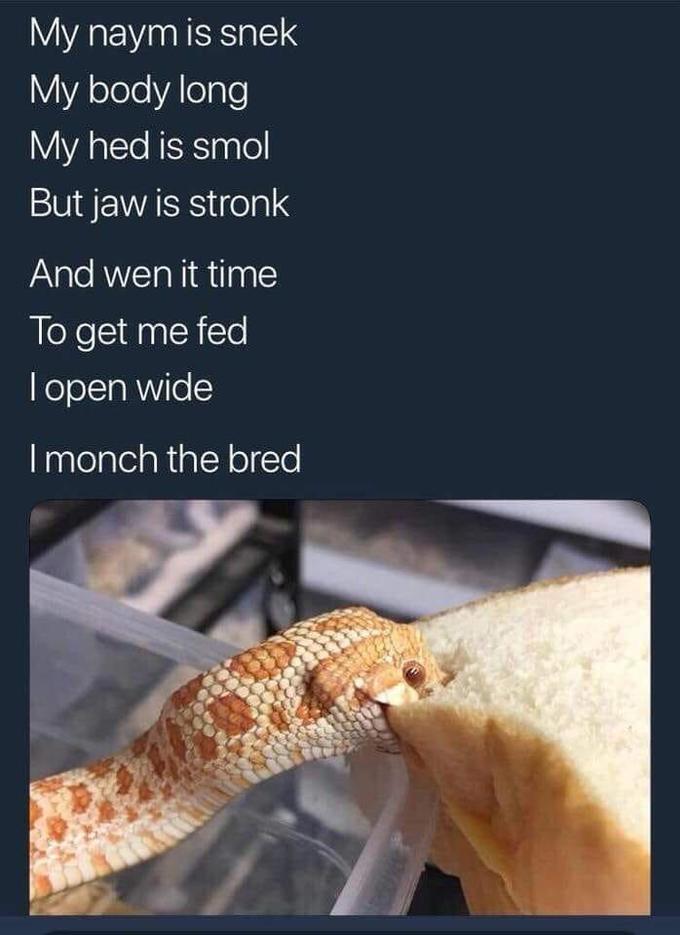
I just love a replete historical dictionary full of quirks and oddities, and by that I mean the Oxford English Dictionary. It is my lexical daily bread, and I would truly be a snake if I were devour its gifts without thanks. A snake? Sure, like this one, from a popular meme of a few years ago:
I think of that snacking snek in particular because the OED has given a gift of a term for just such a greedy ingrate as I would not want to be: maunche present.
This lexeme is not so much of the present, ironically; it is a thing of the past, not seen in the wild in about four centuries. But it is re-presented for us by the OED and so I am regifting it to you. Maunche present is, we are told, “A term of contempt (applied variously) for: a slanderer; a cheat, an impostor; a glutton.” Some of the presented quotations define it as ‘sycophant’.
The guts of it are conveyed by the shape of it. Present means ‘gift’ (which, by the way, is ultimately the same present as in “the present time”; in both cases it’s what’s set before you, from Latin præ ‘before, in front of’ and sens/sent-, present participle of esse, ‘be’). And maunche means… well, the OED says it probably comes from maunge, perhaps influenced by munch, but maunge comes from French manger ‘eat’ and means ‘devour greedily’, while munch refers more to the act and the sound of eating, and is thought to be at least partly imitative (“munch, munch, munch”) – but also partly to come from maunge. So this is feeding back on itself. And with what thanks, hmm?
Anyway, this is your little gift for today. There’s never a shortage of people to whom to apply it, locally and nationally. If you happen to see one, you can mutter under your breath “Maunche present!” Your hearers will likely think you’re saying “much presence” or “Mount Pleasant,” and they might be confused for long enough that you can make yourself absent.
Here’s the presentation I gave at the 2022 ACES conference in San Antonio, Texas, in which I talk about how nonfiction is driven by feelings, and how to work with them to make the structure as effective as possible.






 Sesquiotica