pregret

I’m probably going to wish I hadn’t written about this word.

It’s not a word for a pregnant egret. It has nothing to do with pre-greeting either. Also, you won’t find it in Merriam-Webster or the Oxford English Dictionary or even Wiktionary. But I didn’t make it up. It’s really far too obvious a coinage to have languished to the present day unstruck. Its earliest entry in Urban Dictionary is from 2006. And its top Google search result is an entry in CollinsDictionary.com – as a “new word suggestion” from 2016.

What does it mean? Well, what do you think it means? The definition Collins has is “Regretting an action before you have even done it”; the Urban Dictionary one is “The feeling of regretting something you’re about to do anyway.” It’s a feeling I think we all know, some of us much too well, and many of us experiencing it more often at the end of December. It’s a feeling probably mostly absent from the “Hold my beer” set – that is, people who attempt to one-up someone else’s extremely questionable act; they are sure to be thick with regret after the act, but if they were likely to pregret it they would more likely convert that pregret to caution, hesitation, second thought, continuing to hold their own beers and not leaping into action. But I think adult humans who have not experienced pregret are very few and far between, split mostly between the utterly reckless and the extremely deliberate or cautious. It surely deserves the word.

Nonetheless, pregret is not widely used. I searched for it in vain in the various databases at English-corpora.org. And while Google says it gets 63,000 hits, pretty much the whole first page is definitions of it. To this point, it seems to be a word that is only used when it is introduced and defined – in other words, people think “here’s a clever word” but no one is using it in conversation, really.

But that could change. I’m sure that if a character in a popular movie or TV show were to use it in conversation, it could catch on. Perhaps even someone famous on social media could be a vector. In the meantime, though, nothing stops any of us from using it. The sense is so clear and easily taken up, it may well be introduced without definition: “Yes, I agreed to go visit my uncle, the one with the… opinions. I told my mom I would, so I will, but I’m pregretting it.” We do have other words with similar meanings – dread comes to mind – but pregret has a different mood and shade of meaning, and it’s clever-sounding, and anyway if you don’t like adding words to your vocabulary why are you even here reading this?

You may be wondering, if there’s regret and now pregret, what on earth gret is, and how we’re doing it again when we regret. In fact, regret came (first as a verb, then as a noun) from the French verb regretter, which uses re- as an intensifying prefix (in other words, meaning not ‘again’ but ‘doubly so’ or ‘very’ – as in resplendent). The gretter was borrowed into French from a Germanic root – so, yes, it came from Germanic into French and then back into English, rather than being directly descended. The direct descendent of the Germanic root in English is greet, but not the greet that means, for example, ‘say hello’; no, this one means ‘lament, weep’. It also has descendants in other Germanic languages, such as Swedish gråta, meaning the same thing. 

So we could say that pregretting is greeting an upcoming event knowing that you will greet for it afterwards.

Sorry.

fizz

Many people like to go on a health kick for the beginning of the year. I prefer to give it a head start on New Year’s Eve – with a bit of fizzy-o-therapy.

Well, what? Who doesn’t like a little bit of pop and bang in life from time to time? If your life lacks fizz (as in Margaret Fishback’s poem “Blackout,” which I link to because it’s too short to quote from), you may well be justified in adding some. And, providing that you consume alcohol at all, what better way to bring some sparkle to the start of a new year than some sparkling wine? (Don’t say fireworks. A properly opened* bottle of champagne or other vin pétillant would never frighten a dog or set off a car alarm.)

I do not call all wine that spits and hisses champagne. I find it useful to surrender to the insistence of those in the eponymous region to maintain the sanctity of their trademark. Besides, there is much variety in frothy wines – sekt, cava, prosecco, and various others made by the traditional method or the “Charmat” (a.k.a. “bicycle pump”) method. But when I do want to refer to them all as a type, I most often call them fizzy – or, for short, fizz.

Not that fizz is a shortening of fizzy; the derivation goes the other way. The adjective fizzy was formed from fizz by the mid-1800s, and was used as a noun by the late 1800s. The noun fizz existed by the mid-1700s, and it in turn was formed from the verb fizz, which had come to us by the late 1600s – it’s imitative: onomatopoeia. Hold up a glass of Veuve Clicquot or Coca-Cola (or any of many other things, including some that actually existed in the 1600s) and listen to it and you will hear a sound that, if we’re being honest, is more like “ffff” or “shshsh” or “khkhkh,” but could plausibly be described with “fizz.”

It could, I suppose, also be described as being a little like flatulence. French allows that option: along with vin mousseux, a standard term for sparkling wine is vin pétillant, and pétillant derives from péter, a verb meaning ‘fart’ (it’s also the source of petard, q.v.). But if we called it farty wine, it would… fizzle.

Speaking of which. You would expect fizzle to be formed from fizz plus the suffix -le (as seen on sparkle, twinkle, and other verbs describing repeating or continuing action). On going to look it up, you would therefore be surprised to see that fizzle was around more than a century before fizz. Does that mean that fizz was backformed from it? There’s no evidence to support that (though we don’t know that there was no influence). But since fizzle plainly has the -le suffix, what was the root? It was fise, an alteration of fist, but not as in what you make with your hand; no, as in what you – or your dog – may make somewhere near the tail. It’s pronounced like “feist” (rhyming with heist), but by the time it got to fizzle the i shortened. 

So, yes, fizzle first referred to breaking wind – but surreptitiously, not loudly. Eventually (in the 1800s) it came to refer to failing: sputtering out like a damp squib.

Which is also a thing you do not want your year to do, especially not when it’s so new. Better to add some levity, some froth and sparkle, some fizz. Even if the price can be a bit steep… as Hilaire Belloc observed more than 120 years ago in The Modern Traveller:

And yet I really must complain
About the Company’s Champagne!
This most expensive kind of wine
In England is a matter
Of pride or habit when we dine
(Presumably the latter).
Beneath an equatorial sky
You must consume it or you die;
And stern indomitable men
Have told me, time and time again,
“The nuisance of the tropics is
The sheer necessity of fizz.”
Consider then the carelessness—
The lack of polish and address,
The villainy in short,
Of serving what explorers think
To be a necessary drink
In bottles holding something less
Than one Imperial quart,
And costing quite a shilling more
Than many grocers charge ashore.

A standard bottle of fizz is still just a pint and a half in size, and the good stuff is somewhat more per bottle than most of us would think to spend on non-fizzy wine of equal quality. But on the other hand, there are quite a few perfectly decent fizzies out there that cost no more than an acceptable bottle of dinner red. And they are quite suitable for adding levity!

*Oh, yes, there is that matter of proper opening. If you fire off the cork with a bang, it may be fun but you will almost surely waste some wine and make a mess, and you may break something or injure someone. The better way is to keep a grip on the cork and let it come out gradually, with a little sound like, um, a surreptitious fart. The point of the fizz is the drinking, not the wasting. We are not race car drivers, nor ships a-launching.

perimath

When I worked in a bookstore with a replete Penguin section, I came to know a whole lot about a whole lot of books. I knew who classic authors were, I knew what books they had written, I knew what the books were about.

I had not actually read all the books. 

Who has that much time? I read their back covers. In matters of classic literature, I was not a polymath; I was a perimath.

You know what a polymath is, I reckon: someone who knows a lot of things. That’s from πολυ- polu- (normally rendered as poly-) ‘many, much’ plus μάθη mathē ‘learning’ (and yes, that’s related to the math in mathematics). I imagine you’re also familiar with peri-, as in perimeter, periscope, periphrastic, and peripatetic. That’s from περί peri ‘about, around’. So, yes, perimath means someone who knows about things – you could say they know details peripheral to the things. (And a person who knows about a lot of things could be called a polyperimath.)

That might not sound like a good kind of thing to be. But believe me, there’s a lot to be said for knowing about things – knowing that information exists, and knowing where and how to get that information. Very few people will remember everything exactly as they read or learned it, and the amount of information available will be forever greater than any one person’s capacity for learning it all. But if you see some reference to a fact, and you can remember where and how to find out the details – if your mind is not an encyclopedia but a catalogue or search engine for a whole library – you can be very intellectually effective indeed. And, I must add, people who are sure they don’t need to look things up tend to get things wrong enough of the time to vitiate their effectiveness.

Let me give a little example. When I was in grad school, I taught test prep for the GRE, GMAT, and LSAT, which are standardized tests for admission to graduate school, management school, and law school, respectively. They have a “reading comprehension” section, wherein you read a passage and then answer multiple-choice questions about it. A good way to do badly on it is to read the passage once and then answer the questions on the basis of what you’re sure you remember. The way to do well on it is to look back at the passage and confirm the exact answer to every question. (Remember: these tests are multiple-choice, so you are given the correct answer for each question, along with three answers that are incorrect in ways that people who rely on memory may miss.) But it’s a timed test, so you need to be able to find the information without rereading the whole passage every time. You need to have an idea where and how to look (numbers and capitalized words make great landmarks, for instance) – and then you need to pay attention to what it definitely does and does not say.

Real life isn’t like standardized tests, of course, but it does present unlimited opportunities to make dumb mistakes on the basis of what you’re sure you remember. The ability to find and check facts is very useful – and the inclination to do so is a mark not of insecurity or ignorance but of diligence and careful thinking. It should also go without saying that it’s better to know that a piece of information exists than not to.

So sure, it’s good to be a polymath. No one could say otherwise. But it’s also good to be a perimath. And, if we’re being honest, a lot of people we think of as polymaths are really mainly perimaths – or polyperimaths, if you want to insist. One of my favourite quotes about high intelligence (or producing the impression of high intelligence, anyway) is from a guy named Rick Rosner, who characterized it as “doggedness and reference skills.”

Which also characterizes essential traits for getting a graduate degree – and for several professions, such as librarian and editor. So here’s to the perimaths.

By the way: you won’t find this word in wide use… yet. I assembled it from existing parts, and its sense follows quite reasonably, but I have no prior attestations for its use. I do hope it catches on, though!

gelid

It’s the gelid time, the time when the cold is legit, when you glide on the sidewalk even in your clonky boots. When you get together with the larger family for larger family meals, with jellied cranberries or jellied salad or jellied eels depending on what your clan is like. When from your urban shoebox dwelling, perhaps, you make a trek to a cold country home, decorated as in Maya Angelou’s vision:

Flush on inner cottage walls
Antiquitous faces,
Used to the gelid breath
Of old manors, glare disdainfully
Over breached time.

Oh, those gilded gelid days, when the warm family embrace was from the fingers of Jack Frost. It is in the deep mid-winter (which somehow is proximate to the very first day of official winter, though the denizens of the true north strong and freezing know it hit us a month or more ago); frosty wind makes moan; earth stands hard as iron, water like a stone. Thank divine providence and clever humanity for central heating, if you have it.

Yes, gelid is ‘cold’, basically. It’s like frigid, but it’s freezing. It’s the same -id, but frigid starts with Latin frigus, ‘cold, coldness’, whereas gelid starts from Latin gelu, ‘frost’. So if you are gelid, you are as cold as ice. You may be as pretty as the fancy ferns of frost on an Alberta foothill windowpane, but you are no less frozen. You are as welcoming as that jellied salad, at the very most, but no warmer than a Jell-O popsicle, and in this weather it will be you who is licked; it is not the August dog days. It is the moon of wintertime, when all the birds have flown. You may hope for Santa Claus and his Missus, but what you get is Jack Frost and his wife, Gellian.

Unless, of course, like some people I know, you are where it is still quite warm know. In which case, count your blessings and treat yourself to a gelid beverage.

Tsk, tsk! Or is that tut, tut?

“Tsk!” is a word that stands for something that isn’t a word that we use all the time because it’s not a word, but we mostly don’t use it for what we think we use it for. Here, let me explain in my latest article for The Week:

The not-word you’re always saying

snew

As the day grew bright on Saturday, I knew it was going to be wintry. The wind blew, and it snew abundantly.

What? 

The past tense of grow is grew. The past tense of know is knew. The past tense of blow is blew. Who can object to the past tense of snow being snew?

Sure, I admit, it might be a little uncomfortably like spew (which is not the past tense of spow). But it matches the pattern. Not only that, there was a time in English when snew truly was normal for the past tense of snow.

Mind you, that time was 500 years ago. And you know what they say: Où sont les neiges d’antan? (Where are the snows of yesteryear?) They all blew away or flew with the dew.

But also, while snew was common a half a millennium ago, it wasn’t the original past tense of the verb. No, that was snewed.

I’m not kidding! The original present-tense verb in English was snew. Yes, it’s derived from snow by ablaut, the same process that gave us those “strong” past tenses such as grew and knew. But that process could also be used to derive a verb from a noun. Not from the noun snow, though; the ablaut happened much farther back. Even in Proto-Germanic there was a distinction between the verb *snīwaną and the noun *snaiwaz.

But, you know, even though snowflakes are all at least slightly different, they all drift together into one big mass. And likewise, although English started out having the verb snew (with its regular past tense snewed) and noun snow, by the 1400s a conversion of the noun supplanted the verb, making it snow… in the present tense. Because of course snew looked like a past tense, and a past tense it became. Until even that melted away, and it all just became regular snow and snowed.

Ah ! comme la neige a neigé !
Ma vitre est un jardin de givre.
Ah ! comme la neige a neigé !
Qu’est-ce que le spasme de vivre
À tout l’ennui que j’ai, que j’ai !…
—Émile Nelligan

Or did it? Where are the snows of yesteryear? Recycled as the snows of this year, that’s where. They melted, went back into the streams and lakes, and that went back into the clouds, and now here again is snow. And if you want to say snew, well, no one can object that it’s new.

loggerhead

When times are festive, sometimes spirits run a bit high: someone says something flip, and things get heated and end up at loggerheads.

Have you ever wondered where that phrase, at loggerheads, came from?

We know, more or less, what it means: an intractable conflict between two dug-in parties. Blockheads butting heads. Perhaps a barstool argument over grammar or etymology getting out of hand as the beer gets out of mug. (Say, should it be at lagerheads? No, it should not; there’s no evidence for that as an origin.)

So OK. What are loggerheads? Once this question was raised by my longtime friend (and reader of these blitherings) Margaret Gibbs, I knew where I wanted to look first: Michael Quinion’s site World Wide Words. And I was not disappointed.

It’s not that he had the exact perfect answer. Actually, no one knows for sure precisely where and in reference to precisely what the phrase was first confected. But the list of suspects is greatly narrowed.

Loggerhead, as the Oxford English Dictionary confirms, is confected from just what you see: logger plus head. In this case, logger appears to be in reference to a block of wood or similar lump, rather than (as we use it now) someone who cuts down trees and moves them to market. A loggerhead has thus, since the late 1500s, been one of two things: a thick-headed person (a blockhead, etc.), or a thing or person with a head out of proportion with the rest – could be a tadpole or similar critter, or could be an instrument made of, for example, a pole with a bulbous end. And, it seems, there is an intractable dispute about which of these the phrase came from. (Well, unresolved, anyway.)

If at loggerheads comes from the first sense, the derivation is straightforward enough: it’s two people being blockheads – pigheaded, in fact. Butting heads.

But if it comes from the second sense, it may well refer to the item that, since the late 1600s, has more often been called a loggerhead: an iron rod with a bulbous head, heated in a fire and used to heat up liquids such as pitch or tar.

Did people get into fights with these? Well, I don’t know. I wasn’t there (so glad about that). But it is true that a loggerhead may even today be involved with a flip utterance. 

You see, there is a beverage called flip; it is made of warmed ale, eggs, sugar, nutmeg and/or ginger, and rum or brandy. The ale is warmed in advance, but when the flip is to be served, it is heated again – by plunging a hot iron implement into it. And, from what I have read, the implement first used for this was a loggerhead.

Which doesn’t really explain how at loggerheads would come from that. Frankly, I prefer the idea it came from the first sense: two people being blockheaded. But I am sure that on many occasions when servings of flip heated by loggerheads were involved (and perhaps still are, in those places where historical reenactment buffs gather), flip utterances led to parties at loggerheads.

A novel usage

It’s been two and a half years since I last wrote an article for The Week. I’ve been meaning to get back into writing for them (meaning pitching articles to them and, when they greenlight a pitch – as they mostly do – writing it), and I’ve finally found the time and state of mind. This time around, it’s a topic that came up not so long ago on Twitter: the phrase “a fiction novel” – redundant or not? Read the article to get the goods:

Is ‘fiction novel’ the ‘pin number’ of books?

gaudy

Advent – the four weeks leading up to Christmas – is, in general, a gaudy time: lots of bright lights and colourful decorations. But originally it was a penitential season. Except for one Sunday. The third Sunday of Advent. Which was today. That Sunday is, by definition, gaudy.

OK, well, it’s Gaude. Or, in the plural (since gaude is the singular imperative), Gaudete Sunday. Or, as many Anglicans and Roman Catholics call it, pink candle Sunday.

An Advent wreath has four candles in a ring. Three of those candles are purple (technically violet or blue), but one of them – the third one to be lit – is pink (technically rose-coloured). That signifies that you can take a break from your solemn penitence (everyone’s being solemn and penitent, right? right?) and rejoice! Gaudete! You in particular, gaude! Be both godly and gaudy!

And yes, that’s no coincidence The Latin verb gaudere means ‘rejoice’ or ‘make merry’, and its noun form gaudium means ‘joy’, and it has given English its noun gaud meaning ‘trick, prank’ or ‘plaything’ or ‘ornament’ as well as its adjective gaudy, meaning, of course, ‘flashy, showy, brightly coloured, happy’ – but pronounced after the English fashion, rhyming with bawdy rather than, to match the Latin, rowdy.

Of course what is gaudy can be bawdy or rowdy, but it would be unseemly to be either in the context of holy rejoicing. You can have the gaudy, bawdy, rowdy flash and trash of the shopping mall as the holiday shopping season ramps up, but if you feel like something a little less lucrative and ludicrous, a little more to the gaudete, you can always pause in a peaceful place to light a pink candle and listen to (or sing) a bit of happy music. For those who want, here’s a nice song (a bit early, by the lyrics, but so what, it’s Latin):

jeepers

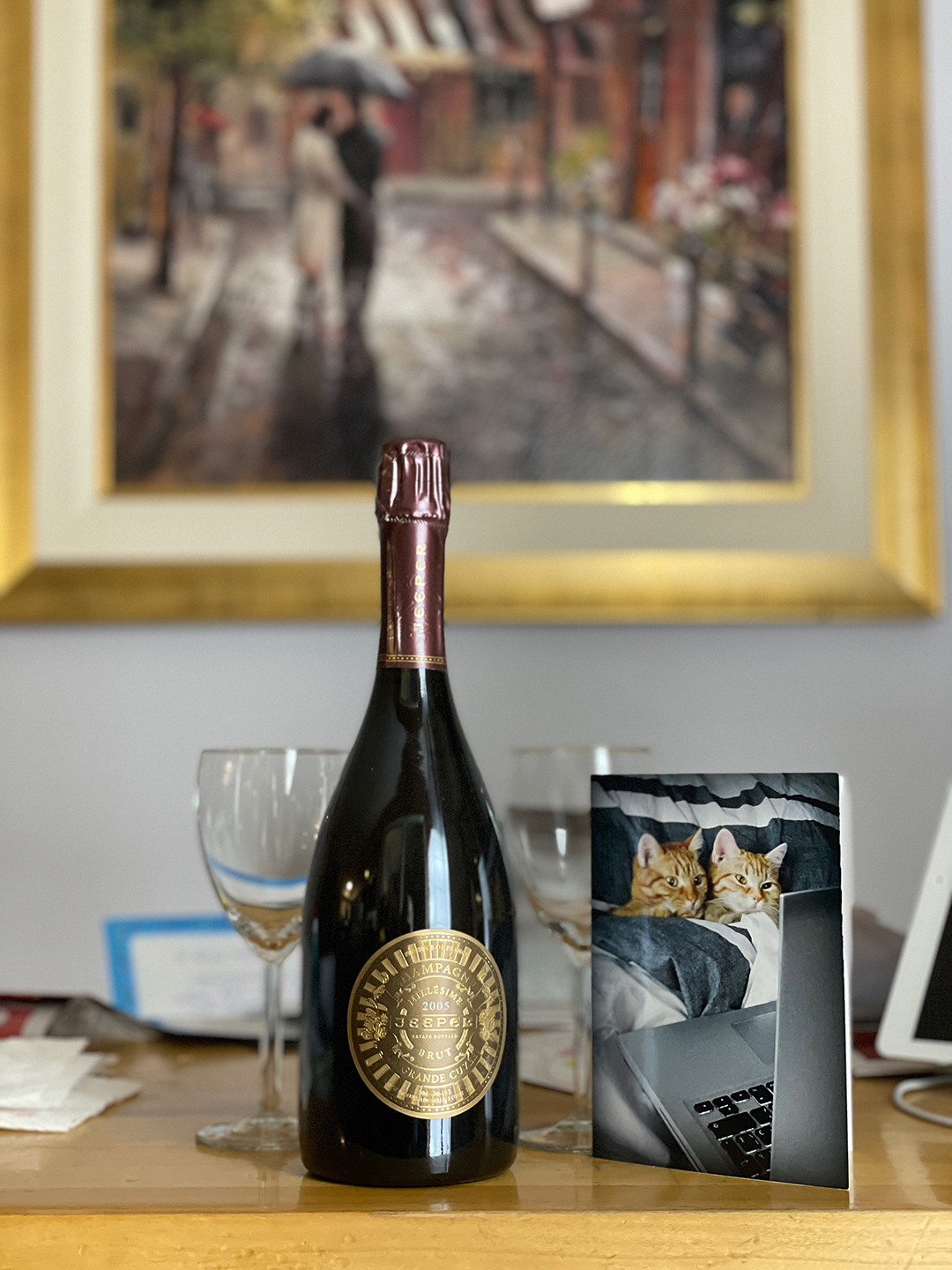
Jeepers! I’ve been married to a sweet, beautiful, talented, charming woman for 21 years! So to celebrate, we opened some champers. (The photo is obviously from before we opened it. Once it was open I was too occupied with serving dinner to take another picture.)

You know the term jeepers, I suppose. It’s rather old fashioned now, about on level with gadzooks. It probably brings a particular song to mind:

(It might also bring to mind a much more recent horror movie franchise of the same name, but I’m not posting any video clips from that.)

That song first came out in 1938; Ethel Waters did the first studio recording of it, but Louis Armstrong boosted its fame the same year by singing it in the movie Going Places – only in the movie he sings it to a horse. (A horse? Well, he was black, and it was 1938 in the USA, so there was no question of his singing it to a woman in a movie. In the script they named the horse Jeepers Creepers and he sang the song to it. Now, horses can have nice eyes, but come on, hmm?)

So is that where jeepers comes from? Nope. Johnny Mercer – the guy who wrote the lyrics to the song – explained in an interview that he had some music by Harry Warren that he needed words for, and then he saw Henry Fonda in a movie where he played a farm boy, and Fonda said “Jeepers creepers!” And that was exactly what Mercer needed for the song.

So it was something that Fonda said in a movie? Yeah: in The Farmer Takes a Wife (1935) – but Fonda didn’t exactly improvise it. It’s in the script, and the scriptwriter got it from the novel the movie is based on, Rome Haul (1929), by Walter D. Edmonds. Did Edmonds make it up? It doesn’t look like it; you can find several earlier uses of it in short stories published in magazines in the 1920s in Google Books. A few of them are proper names, but the rest are exactly this exclamation.

So, OK, whoever said it first had to make it up on some basis, right? 

…Yes… It’s an exclamation, of the euphemistic kind. 

What could a person being substituting “Jeepers creepers” for? Well, hmm. What thing might some people exclaim that involves two words starting with “jee” and “cr,” do you think?

Mm-hmm. It’s a minced oath for “Jesus Christ.” Kind of casts a new complexion on the song, I suppose – but, then, complexion is also why Louis sang it to a horse.

But then why am I exclaiming it about the happy occasion of my marriage attaining an age such that, if it were a person, it could drink in any province or state? I guess I just thought of it because of the champers we were drinking. (Champers as a cute version of Champagne dates to a couple of decades later than jeepers, by the way; the OED’s first citation for it is 1955.)

Did you notice the label on the bottle? It’s Jeeper La Grande Cuvée Millésime Brut 2005. It came well recommended, so, as Aina and I both love our fizzy-o-therapy, I bought a bottle four months ago and hung onto it for an occasion. Now, the names of Champagne houses are often a bit on the unexpected side – Krug hardly sounds French; Moët and Perrier-Jouët fool people who don’t know you’re supposed to say the t on the end of each, and Perrier-Jouët also sounds like it might be high-priced water; Taittinger is an evidently German name but an obviously French producer, so however you pronounce it is going to sound wrong to someone – but Jeeper struck me as next-level. Is it a Dutch name that ended up in France (like Citroën)? Is it some regional quirky French thing? Is it an English family that set up shop?

None of the above. It’s apparently because the original owner of the Champagne house, back in 1949 (yes, it’s not as old as some), had a Jeep he bought from the departing American army after World War II. He used it to drive around the vineyards. I guess he was fond of it, and proud of being a Jeeper. And that original Jeep owes nothing to jeepers (nor vice versa; Jeep dates to the 1940s), though it’s not unreasonable to imagine the brand Jeeper might have some influence from it. (I’d hope that’s the only influence the owner was driving under, but…)

So there you go. That’s quite the journey, eh? But not as long as 21 years. Jeepers!