
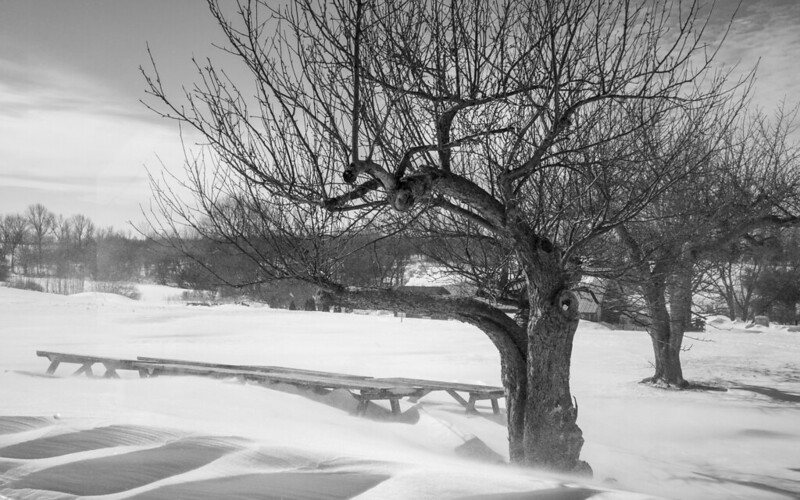
Snow White was a drifter.
OK, you say “ha ha,” but there are reasons I say that beyond the obvious pun. How did she end up with those dwarves? It was a blow of the winds of fate. And snow drifts when the wind blows. But where does it drift? Not so much on the plain, where things are smooth and crisp and even. It drifts against high points and it drifts in low places and it drifts at the edge of shelter; it does not decide on its own, even if it takes a fence. Snow that’s on a peak can be blown off a cornice and land just where it catches enough interference to stop – which may well be a very humble location indeed, such as among the dopey, sleepy, and grumpy. And when we say snow is blown, what that means is it’s driven. Driven by the wind, yes, but driven as surely as if it had been in a car on a highway.
Snow White was driven out by the queen and driven on by fate, but in more modern times she also could have been driven on a highway on her way to where she would settle down: She could have been a hitch-hiker. And hitch-hikers are by definition drifters. I’ll explain in a moment, though I doubt you doubt me.
Snow White, you may object, was hardly what we think of when we think of a drifter. She was pure as the driven snow!
But exactly. What is the driven snow? It is the snow in drifts.
Drift, you see, is the secret twin of driven. Both are past-tense forms of drive (or of an older form of drive). Drive originally meant (and in some uses still means) ‘send forth, push forward, cause to move forward’. The noun drift names something that is driven – as in pushed forth by the wind. A drift is made of snow or sand that has been caused to move forward – by the wind – and displaced from where it first lay to a new formation, typically at a change in the landscape. We’ve lost sight of that sense when we talk of driving a car because we envision a sort of cybernetic relationship between the steerer and the steered, but you can see it when we speak of a cattle drive – yes, including steers, as in bulls that have had their drive cut, if you catch my drift. Oh, and yes, “my drift” means what I’m driving at – where I’m guiding the sense to (and it’s a turn of phrase we’ve had for half a millennium now).
So yes, the driven snow is the drifting snow. And anything that drifts is driven. Which means that drifters are people who are driven, not by their own inward forces but by the winds of chance and change. And hitch-hikers are, of course, driven. The fact that the first ‘driven’ refers to the way the wind blows and the second ‘driven’ refers to the easy come, easy go riding in a car that is controlled by another person doesn’t really matter (to me).
And Snow White, who was, we all are sure, pure as the driven snow, and who was driven out and driven into cohabitation with miners, at both a low point and a high point in her life (hi-ho!), was plainly a drifter. Snow doubt about it.





 Sesquiotica