Tag Archives: recipe

ramekin

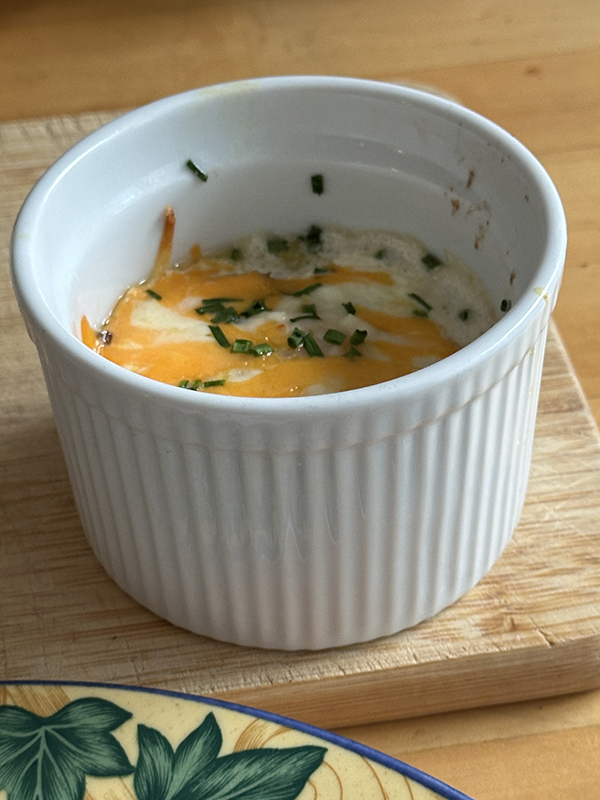
For brunch on Sunday, I made ramekins.

Can I say that? Is ramekin like casserole or paella, a dish (recipe) that has gotten its name from the dish (vessel) that the dish is dished from?

The answers to those questions are (a) yes and (b) no. Ramekin has not transferred the name of the container to the name of the foodstuff. In fact, it’s the reverse: the little round ceramic vessels (like cute little food parentheses) are named after a foodstuff that is made using them.

I should say, first, to be fair, that what I made is more typically called shirred eggs. But there are many ways to make shirred eggs, and the recipe I made also fits the definition of the culinary item called ramekin, which is, to quote the Oxford English Dictionary, “A type of savoury dish based on cheese, mixed with butter, eggs, and seasonings, and usually baked and served in a small mould or dish.” The word has been used in that sense in English since the mid-1600s – borrowed over from French – while the metonymic transference to the ceramic vessel happened only by the later 1800s (Funk’s 1895 Standard Dictionary of the English Language defined that kind of ramekin as “a dish in which ramekins are baked”).

Did you wonder, when I said “borrowed over from French,” why it’s not ramequin? In fact, at the time we borrowed it, it was. So why did we change it? Well… we changed it back. You see, French didn’t invent the word; it traces back to regional Dutch rammeken and Low German ramken. It’s like mannequin, which came from the Dutch manneken – meaning ‘little man’. The -(e)ken suffix is a diminutive.

So the next question must be “Little ram?” Heh. That has produced some perplexity; the OED (and Wikipedia, citing it) scratches its head and says that it seems to come from ram ‘battering ram’, “although the semantic motivation is unclear.” Meanwhile, Wiktionary notes that Rahm is a German word for ‘cream’, cognate with Dutch room (‘whipped cream’ is slagroom, but I’ll have it anyway) and the now-disused English word ream (displaced by cream, which is, go figure, unrelated). That seems a bit more semantically motivating, for what it’s worth.

Anyway, what you probably really want to know is how I made the ramekins. As in the shirred eggs. So here’s the recipe. (And since this is a word blog, not a recipe blog per se, you can’t complain about how long I took to get to the recipe. Be grateful I’m even telling you.)

Ramekin Eggs (one of many ways)

To begin with, make sure you have the following things:

  • 4 ramekins (mine are 4 inches in diameter, I think)
  • 4 eggs (chicken, not quail or duck)
  • 4 mushrooms (brown, i.e., cremini, decent sized, not portobello, portabella, portabello, or portobella)
  • 1 shallot
  • Chives (how much should you get? doesn’t matter; they always sell it in far greater quantities than a normal person can use up before it goes dodgy anyway) (that’s chives, not scallions, OK? whole other ballpark there)
  • 2 thick strips of bacon (the North American kind, preferably “old fashioned” or some other way of saying “expensive”)
  • Whipping cream (get a little carton; you only need a few tablespoons and can use the rest for something else)
  • Shredded cheese (I used some Tex-Mex stuff I had around, but I would otherwise just use cheddar) (and I mean old cheddar) (like old enough to be speaking complete sentences) (but you could use whatever you want, as long as it’s shreddable) (if you use process cheese slices, you will be justly punished by the results of your wicked choice)
  • Butter (say, ¼ cup) (or so)
  • Salt
  • Pepper (if you want)
  • A cutting board
  • A knife
  • Little bowls to hold cut-up ingredients before you put them in the ramekins (optional but it helps)
  • A frying pan (stainless steel or non-stick or cast iron, doesn’t really matter) (you could even use a saucepan)
  • A stovetop
  • A spoon
  • A baking sheet sufficient to hold the 4 ramekins, so you don’t have to lift them one by one out of a hot oven
  • A hot oven (350° Fahrenheit)
  • Something to put the ramekins on when you get them out of the oven
  • Oven mitts (you could use a towel, but I wouldn’t)
  • Someone else to eat this with
  • Champagne (optional)

Now, do these things in this order:

1. Make sure your oven is heating up. (If you are the sort of person who stores things in the oven when it’s not in use, make sure there’s nothing in the oven; also, find a better place for those things, come on.)

2. Cut the mushrooms. I diced two of them fairly small and cut the other two into thin slices, but do whatever pleases you. (Cutting mushrooms is in itself pleasing to me. It’s one of my favourite things to do. So satisfying.) Bear in mind that they will have to fit into those ramekins with the other ingredients. Put them in a bowl.

3. Chop the chives. 6 or 8 oughta do. When in doubt, cut more. You’re not going to run out. Put it in a little bowl.

4. Cut the shallot. After cutting it in half lengthwise and peeling it, I cut each half once longitudinally and then sliced it latitudinally fairly thin. But suit yourself. You could mince it. Anyway, then put it in a little bowl.

5. Dice the bacon. Well, “dice.” I cut each strip in half lengthwise and then cut it into fairly small pieces crosswise.

6. Heat up your frying pan (or equivalent) to about medium. Put the bacon in and get it frying. Then add the butter (we buy it in 1-pound bricks [ahem, 454 grams] so I cut a slice about half an inch [1 centimetre] thick and toss that in). Then add the shallots. Stir and fry. Then add the mushrooms. Sprinkle some salt on them (how much? I dunno, I just use my learned judgment… maybe half a teaspoon? don’t go nuts; you can always add more, but you can’t take any out). Stir and fry until the mushrooms are looking cooked.

7. Oh, by the way, it would have been a good idea to take the eggs out of the fridge to warm them up to room temperature so they’ll cook more quickly. Oh well. I didn’t remember to do that either. Now, where were we…

8. When the mushrooms are looking cooked, add something more than half of the chives to the pan. Stir, fry a few more seconds. Then turn off the heat.

9. Now set those ramekins on that baking sheet. And butter them. You could actually have buttered them before you started the frying, but whatever. This is how I buttered my ramekins: I took about a tablespoon of butter and I used my bare hand to rub it evenly all over the insides of the ramekins. Make sure they’re properly covered. Since you’re working in a kitchen, I’m going to assume you’ve been washing your hands regularly with soap (dish soap is good), so they’re clean. When you’re done buttering the ramekins, wash your hand again. I see no point in using paper towel or plastic wrap to spread the butter so your hand won’t get dirty. Paper towel absorbs butter and plastic wrap is annoying. Just use your hand and wash it after.

10. Spoon all the stuff you just fried into the ramekins. Divide it evenly, of course. Make sure that it’s higher on the sides and lower in the middle, but don’t leave the bottom bare.

11. Crack an egg into each ramekin. You may want to use an intermediary bowl – crack the egg into a little bowl, then dump it from the bowl into the ramekin – so as to give you a chance to pick out stray shell bits and also to set aside any egg you broke the yoke on (so sad) (just ain’t the same with a broke yolk).

12. Pour cream onto and around the egg in each ramekin. Like, a tablespoon or so. Don’t measure it; just use your eyes and the decent sense you have developed over the hard-won years of your life. You should still be able to see the yolk.

13. Sprinkle shredded cheese over the top. How much? Dude, that is 100% up to you, but if you use a whole lot, it’ll be harder to get through and also it will insulate what’s below so you’re more likely to scald your tongue. Enough. Use enough. Probably like ¼ cup on each. I didn’t measure it.

14. Sprinkle the rest of the chives on top of that.

15. Have you been wondering about the pepper? I didn’t use any this time, but you could add it whenever and wherever and in whatever quantity you want. Or put it on the table when you serve it.

16. Put the tray with the ramekins on it into the oven. Middle rack. Close the oven door. Go do something for 15 minutes.

17. They might not be ready yet after 15 minutes. Your thing to look for – and this will be easier if you didn’t go hog-wild with the cheese – is if there’s any clear bit of white next to the yolk. If there is, let it go a couple more minutes and check again. If there isn’t, and especially if the top of the yolk is looking slightly whiter, then you can take it out if you like runny yolks. If you like firm yolks, leave it in a few more minutes. Remember, though, that the eggs will continue cooking after you take it out, because it’s all hot all around them.

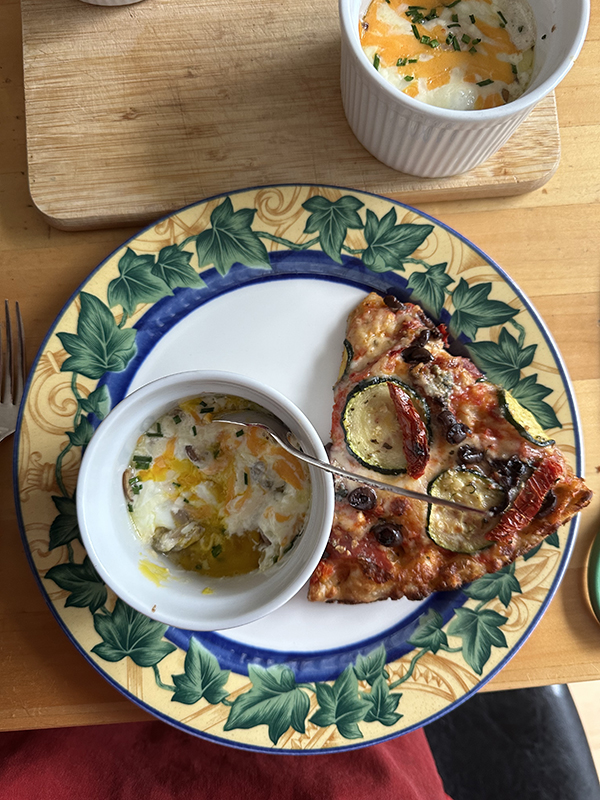
18. Take it out (using your oven mitts) and set it on something to cool off for a minute or two. Then serve it to table (I put the ramekins on my small cutting board for transport) and make sure there are things of some kind on the table to allow you and your co-diner to touch the ramekins and move them to the plates without screaming.

19. Aw, heck, did I forget to mention you should have spoons? I wouldn’t eat this with my fingers. You could use forks, but spoons work better.

20. Speaking of which, many people like to eat this with toast points. You could go back in time and make them. This time, I just heated up some leftover pizza in the oven since it was on anyway. Why not.

And that’s that for that. You can have it with champagne or with coffee or with whatever you want, but have it with someone else. Only one person, though. My wife suggested I make this the next time we have friends over for brunch, but I pointed out that I would need to buy more ramekins, and they take up space in the cabinets. You see, when planning meals, you must always consider the ramekinifications.
recipe

When the summer air near the shores of Lake Ontario and Lake Erie starts to thread with coolness, and the Concord grapes grow heavy, and the leaves start to shiver and fade a little, my mind slips back to when I would drive down to Gerry, New York, and visit my grandmother, who has been gone more than a decade now. There is no cure for old memories, loss, and nostalgia, but there are prescriptions, and I have one here:

Streusel Concord Pie

Unbaked 9″ pie shell
4½ c. (1 qt.) Concord grapes
1 c. sugar
¼ c. flour
2 tsp. lemon juice
⅛ tsp. salt
Oat Streusel

Wash grapes, remove skins by pinching end opposite stem. Remove skins.

Place pulp in saucepan, bring to boil, cook a few minutes until pulp is soft. Stir often. Put thru strainer while pulp is hot, to remove seeds. Mix with skins. Stir in sugar, flour, lemon juice, salt.

Place mixture in pie shell. Sprinkle on Oat Streusel. Bake at 425° for 35–40 mins.

OAT STREUSEL: Combine ½ c. minute oats, ½ c. brown sugar and ¼ c. flour. Cut in ¼ c. butter or margarine.

The recipe does not add that, after eating a slice of the pie, you should smile at whoever you are eating it with so you can show your purple teeth. That is not part of the recipe that my grandma wrote out and gave to me. But it is part of the instructions I received from her when she served me pie at her kitchen table. This recipe will not bring back my grandmother, but it will recall her. Proust had his Madeleine; I have my Concord grape pie.

And I have many other recipes. I have quite a few cookbooks: the Larousse Gastronomique I received (on my request) for my fourteenth birthday; my own copy of the Better Homes and Gardens New Cookbook, my mother’s copy of which was so important to my culinary education; and a decent shelf full of others, the most used of which is probably How to Cook Everything by Mark Bittman. Several of them are ones I received as gifts, often from my cousin (on the other side of the family), who shares with me a love for food and wine and who (with the advantage of being much older than me) helped my education in the subject.

Humans have passed down instructions for preparing food since time immemorial, of course, and we have had cookbooks for centuries at least. Among the oldest extant cookery books is The Forme of Cury, dating to 1390, a new (and uncorrected) edition of which was published in 1780. I enjoy perusing its recipes for such things as “Pygge in sawse sawge,” “chykens in hocchee,” “Connyng in clere broth,” and “laumpreys in in galantine,” though I haven’t made any of them, in part because some of the ingredients and instructions (and the very English they’re written in) present a challenge for the modern cook. You can find a lovely collection of online versions of old cookbooks at MedievalCookery.com. Cooks nearly a half millennium ago (let us say ten grandmothers back – your grandmother’s grandmother’s etc.) set down instructions such as these:

To make egges in moneshyne

Take a dyche of rosewater and a dyshe full of sugar, and set them upon a chaffingdysh, and let them boyle, then take the yolkes of viii or ix egges newe layde and putte them thereto everyone from other, and so lette them harden a lyttle, and so after this maner serve them forthe and cast a lyttle synamon and sugar upon thẽ.

How big were the dishes of rosewater and sugar? The person who wrote this down surely knew. And surely knew when the appropriate occasion was to serve this, and who would enjoy it, and how. That was understanding that was received in person and through experience, though not written down as part of the recipe. 

There was, naturally, a great diversity of foodstuffs. Take this, if you have the guts:

Garbage.— Take fayre garbagys of chykonys, as þe hed, þe fete, þe lyuerys, and þe gysowrys; washe hem clene, an caste hem in a fayre potte, an case þer-to freysshe brothe of Beef or ellys of moton, an let it boyle; an a-lye it wyth brede, and ley on Pepir an Safroun, Maces, Clowys, and a lytil verious an salt, an serue forth in the maner as a Sewe.

Junk food had a different valence in the 1400s. 

As you read these recipes, you get to know the general style of the cooking of the time, which favoured a few spices (such as galangal, saffron, cinnamon, cloves, and pepper), tended to rely on boiling and baking, and used more sugar than you might expect. A recipe typically ended with the instruction to serve it forth (in more recent times, that seems to go without saying). And one more thing they had in common: these recipes were not recipes.

By which I mean they were not called recipes. It was only in the early 1600s that instructions for cookery were commonly called recipes; starting slightly earlier, they were called receipts, a usage that persisted to some degree in British English until quite recently. The term recipe did exist in English before that, but it was used first for such sets of instruction as these:

Take half a handfull of Rue a handfull of isop ix fygges gardynn mynttes a handfull & boyll all thise in a quart of condyte water with thre sponefull of hony & skym it clene then streyn it thorugh a clen cloth into a close vessell & drynk therof half a pynt at ones blod to arme so contynue to it be done.

Here is a translation provided by Margaret Connolly, the author of the article from which I got this recipe:

Take half a handful of rue, a handful of hyssop, 9 figs, and a handful of garden mint. Boil all these in a quarter of water from the conduit with 3 spoonfuls of honey and skim the liquid, then strain it through a clean clothe into a vessel and seal. Drink half a pint at once to fortify your blood. And continue until it is finished.

It is a recipe, yes, and it involves things you would eat as food, yes, but in this case it is meant to treat a medical problem. We’re not at grandma’s table for dessert, not this time. But these were the original recipes, because they were the first kinds of things for which was written Recipe – Latin for ‘receive’: this is what the apothecary will prepare and you will receive. Over time, this word Recipe came to be abbreviated as a simple R with a long tail and a line across it: ℞. These days it’s usually written Rx, though there’s no x, not any more than, say, there’s a letter I in $.

This is also why recipes have been called receipts: originally, a receipt was a thing or amount received; it could be money or property, or it could be a medical preparation. Over time, as we know, the word has mainly – though not exclusively – come to be used for the record of the receiving. But we received receipt as a word for a formula, with ingredients and instructions, and it had considerable shelf life. And recipe persists, along with the decocted grammatical stylings of the genre, which originated on the bench with the chemist’s crucibles.

The spread of recipe from the apothecary to the kitchen was not even a leap. In medieval times, there was not such a sharp division between the medical and the culinary; the things that you took to make you healthy were, by and large, things that you also ate to keep you healthy, though in different combinations and servings. The restorative value of food is recognized even in the word restaurant (from the French for ‘restoring’), which named first a restorative beverage or soup, and then transferred to the places that served such. And while we in Canada and the US today can readily buy many kinds of food (including junk food) at most drug stores in sections separate from the pharmacy counter, in times past the foods and drugs were not even administered separately. Remember even the fairly recent beginning of Coca-Cola, in 1886: as a health tonic served up by the druggist, originally containing cocaine as an active ingredient. 

Consider this comment from the 1774 book Domestic medicine; or, A treatise on the prevention and cure of diseases by regimen and simple medicines ; With an appendix containing a dispensatory. For the use of private practitioners, by William Buchan:

CONSERVES AND PRESERVES.
Every apothecary’s shop was formerly so full of these preparations, that it might have passed for a confectioner’s warehouse. They possess very few medicinal properties, and may rather be classed among sweetmeats, rather than medicines. They are sometimes, however, of use, for reducing into boluses or pills some of the more ponderous powders, as the preparations of iron, mercury, and tin.

Then turn the page and read this recipe:

Conserve of Red Roses.

Take a pound of red rose buds, cleared of their heels; beat them well in a mortar, and, adding by degrees two pounds of double-refined sugar, in powder, make a conserve.

After the same manner are prepared the conserves of rosemary flowers, sea-wormwood, of the leaves of wood-sorrel, &c.

The conserve of roses is one of the most agreeable and useful preparations belonging to this class. A dram or two of it, dissolved in warm milk, is ordered to be given as a gentle restringent in weakness of the stomach, and likewise in pthisical coughs, and spitting of blood. To have any considerable effects, however, it must be taken in larger quantities.

The compounding apothecary would not, perhaps, say “Recipe” when giving you this preparation. But when you paid, you might get a receipt. And if you receive a dram or several of it, I think you might feel better.

Most of the things you will receive now when you hand a pharmacist a prescription have little or nothing to do with what you will receive when you order in a restaurant. But the heart of health is the kitchen, and many a recipe is a key to a healthy heart. I am happy that my grandmother pre-scribed her recipe. It was indicated as a memory aid, and it does help me to recall her; and on preparing and receiving it, I am – and in a way, she is – restored.

butternut

Where I come from, butternut is the name of a squash. If you say the word, you mean the squash. The squash, of course, is neither butter nor nut, and does not taste specifically buttery or nutty; neither does it look like any nut you’re likely to see, nor like any butter you’d want to eat.

But, as it happens, it goes very nicely with butter and with nuts. Melt the one and sprinkle the other, or use both in a soup with the squash. Or whatever. Butternut squash is one of the most agreeable squashes, as far as I’m concerned; complaisant in the cooking, the flesh a rich orange hue on the eyes, the texture neither grainy nor too stringy, and the taste soft and sweet and round. It’s not dissimilar in these respects to pumpkin, but it’s smaller, it’s easier to handle, and it has a much higher ratio of flesh to entrails. And it has perhaps the most appetizing name of all the winter squashes.

Seriously. Butter? Nut? Compare with kabocha, acorn, spaghetti (I mean, yes, spaghetti is nice, but come on, butter and nuts are really nice), Hubbard, delicata, buttercup – well, that’s not bad, but I think nut beats a flower – or pumpkin. The only negative to the name is its resemblance to better not, and even that is a plus for those of us who like plays on words: “Should I pass on the squash ravioli?” “You’d butter nut.”

Where does it get its name from? Is it somehow an exocentric compound, a bahuvrihi? No; it seems to take its name directly from the nut called the butternut. The butternut is an oily walnut, hence the name (honestly, I think macadamia nuts are butterier, but I guess they didn’t have those around in the 1700s when the walnut got the name). I don’t know that those who gave the squash that name in the 1940s thought it tasted like it; actually it tastes closer to roasted chestnut. More likely they used the name because of the colour. Butternuts were used sometimes to home-dye fabric, thus giving the cloth and a colour the name, and some of that fabric was used for some Confederate soldiers’ uniforms, which is why Confederate soldiers were sometimes called butternuts (whether there was also any intended impugning of their manhood I’m sure I don’t know). Not seen any of them lately? Well, butternut cloth is about the colour of the skin of a butternut squash: a light grey-yellow-tan kind of colour.

Of course, you can use butternuts with butternut squash if you have some and you want to. Walnuts can sometimes make my mouth sore, so I lean more towards pecans (though if it comes to nut butters, I prefer almond butter – to me, peanut butter seems a bumptious second to the almond kind, though the almond kind is runnier and has to be stirred). Here’s a recipe I made this weekend (as I tweeted it) for what I have decided to call butternut bacon soup, although there are no actual butternuts in it (if you make it, you can use them in place of the pecans and I’m sure it will be splendid). Actually, I didn’t use butter, either, but you certainly could.

  1. Quarter and slice an onion and fry it in red palm oil. Add a minced clove of garlic. Toss in a bit of maple syrup so it will caramelize.
  2. Halve two butternut squashes and scoop out the entrails. Put them face down on a baking sheet in a 400˚F oven.
  3. Once the onion is caramelized, add a litre of chicken stock.
  4. Once the squash is soft (the baking sheet will be all wet with squash sweat), take it out and let it cool face up.
  5. Clean the baking sheet off because you’re going to use it again right now, unless you’re just made of baking sheets.
  6. You didn’t turn the oven off, did you? It needs to be on still, at 400˚F.
    What? Well, turn it on again then.
  7. Get out your kitchen scissors and snip up about 3/4 of a pound of bacon onto the baking sheet. I like the Danish style but whatever.
  8. Add a bag of pecan pieces. Um, I guess 100 grams or so. As much as you easily hold in your hand in a bag. As many as you want, OK?
  9. Add them to the baking sheet, I mean. With the bacon. Which you cut into strips about 1 cm wide, right? Mix them together and spread out.
  10. Well, so read all the instructions before starting. Or do you want me just to do this for you?
    Stick the baking sheet in the oven.
  11. Cut the squash off the skin. Or the skin off the squash. Anyway, you want the squash into cubes that you can smush. Toss the skin.
  12. By the time you’ve done that, it’s probably about time to pull the bacon and nuts out and stir them up and smooth them out. Do that.
  13. Sprinkle some curry powder over the bacon and nuts. Stick them all back in the oven.
    I use Sharwood’s.
    Some! Like, to taste!
  14. Grab the squash by handfuls and smush it up and drop it into the stock. Stir it. Add a can of coconut milk and a couple ounces of sherry
  15. Once the bacon and nuts are all roasted – the bacon is looking towards crispy – I don’t know, ten minutes? Shit, I just look…
  16. Anyway, take it out and add it to the soup. Stir it all. Give it 10 or 15 minutes to simmer.
  17. Purée? You wanted it to be that smooth? Well, you could have done that before adding the bacon and nuts if you wanted. Too late now.
  18. I think the texture is nice, OK? I like it like this.
  19. If you happen to have some candied cashews lying around the house (like, in a bag, not on the floor), you can sprinkle them on each bowl
  20. Oh, I know what I was forgetting! Sprinkle some brown sugar on the bacon and nuts if you want before putting them in the oven.
  21. Yeah, it’s a little on the sweet side. Your call. Also you may feel like adding more salt. Or not.
  22. Anyway, this makes enough to feed two people several times this week. I hope you have room in the fridge.
  23. Did I mention the sherry?
    Oh good.
    Well, you can drink some, too, you know.

There you go. Butternut squash is winter comfort food. Butternuts are, um, oily nuts. The word butternut is appetizing, probably not really because of its pattering sound like that of pecan pieces being dropped on the floor, I mean on a baking sheet, but just because butter and nut both bring tasty images to mind so quickly. Squash is not a pretty word but just eat it, OK?

prosciutto

The usual good way to eat decent prosciutto is of course just as you get it in thin slices, with your fingers, never mind putting it on anything. Let the flavour express itself. That’s if you’re pro-sciutto, of course. If you’re anti-sciutto, go have some antipasto and rejoin me after the recipe I’m about to talk about.

The deli I usually buy my salumi (cold cuts) from often has packages of prosciutto ends. These are nice because they can look pretty and they’re always a good deal less expensive – and because you don’t feel quite as bad if you decide you want to cook with them. You can just pick up a few packages and toss them in your freezer for future reference (freezer? well, they’re already sliced, so there is that gradual risk…).

Cook with prosciutto? Doesn’t that seem like gilding the lily – or like frying sushi? Well, yeah, prosciutto doesn’t need to be cooked; it’s cured. That’s why it’s called prosciutto crudo in Italian – the crudo meaning “raw” (prosciutto cotto, “cooked”, is in the line of what we think of as baked ham). But that doesn’t mean it can’t be nice cooked, too. Look, tomatoes and peaches are lovely raw, too, but they can be nice cooked for variety.

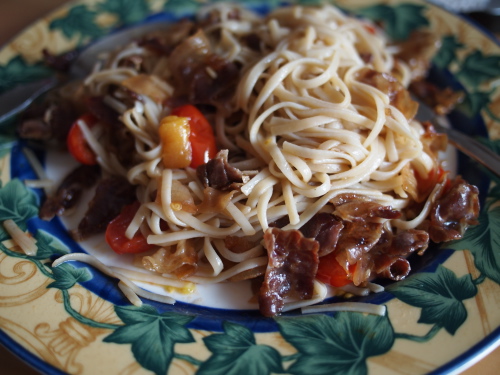
For instance, if you want to cook something quickly for yourself and your hungry significant other, take 200 grams of prosciutto – ends or not, as you wish – and cut it up. Scissors do nicely, especially if you’ve just pulled the prosciutto out of your freezer. Fry the prosciutto on medium-high in some butter. Chop up a peach (I mean a fresh one!) into, say, 48 parts, and halve a dozen or so grape tomatoes (the smaller the tomato, the richer the flavour – do not buy those enormous beefsteak tomatoes, they’re insipid; bigger has never really gone with more flavourful) and toss them in. Add some pepper flakes. Don’t bother with salt. You could have minced and added a clove of garlic, too, if you wanted, but you probably should have put it in first. It’s not really necessary anyway.

Meanwhile, you should be boiling water and getting your pasta ready. This is a very quick dish. In fact, you probably should have put the water on first. You may need to turn the heat down under the prosciutto after a couple of minutes, to medium-low, to let the pasta catch up. What kind of pasta? Ideally, tagliatelle would be great, but who keeps that ready in the cupboard? This is a what-the-heck-am-I-gonna-make-tonight dish. I used linguine this time – actually pumpkin, ginger, and rice linguine by King Soba, because my wife can’t have gluten (and anyway it’s good stuff). For two people, I used 200 grams.

Wondering what the sauce is going to be? Ha. Just toss in a bit more olive oil. In fact, make it pepper oil if you have it. And then add some sherry, madeira, marsala, or muscat, or something of that order. I used a bit of madeira and a bit of muscat. Oh, get over it. I’m not mixing them in a glass and drinking them. I wanted it sweeter than the madeira and not as sweet as the muscat. Oh, how much? Not more than a quarter cup or so in total. The point is flavour, not runniness. A lot of it will simmer off, too.

So now stir that and put a lid on it and let it sit on medium-low. Get your pasta cooked. When it’s drained and rinsed, put it in the frying pan with the rest of the goodness, take it all off the heat and toss it together. If you really want to go crazy, throw in a bit of cream of some sort, but not so much it gets all runny. I suggest drinking a nice, non-cloying rosé with this.

As you eat it, you will notice that the prosciutto has curled up in the cooking. Actually, unless you don’t look at what you’re cooking, you will have noticed that ten minutes ago. The little strips and snippets have, en masse, a reminiscence of the shapes of the word prosciutto. Do they look not very juicy? What they heck are you talking about? That’s the point of prosciutto. The word comes to us from Latin: the pro is that old “for, forward, etc.” prefix, and the sciutto – which by itself has a rather slicing (or cutting as with scythe, sickle, or scissors) look, doesn’t it, recalling that whirling steel disc that cut your slices at the deli in the first place – comes from exsuctus, “sucked out”. Why sucked out? Because the juice has been expressed from the ham – squeezed out – and also drawn out with salt before the ham is left to dry and then age. Prosciutto shouldn’t be like shoe leather – maybe more like ham sushi, or a touch firmer. Best sliced thin.

Prosciutto is not all equal, of course. When you go to the deli, you will probably have a few choices of sources and ages. The oldest stuff is the best, with the richest flavour. (People who like prosciutto will also like jambon de Bayonne from France and jamón serrano from Spain.) The classic prosciutto is from Parma, though I’ve gotten some pretty nice stuff from Niagara too. The difference in the flavours of the different ages is sort of like the difference in how one pronounces prosciutto: the six-month-old stuff is like the casual Canadian English pronunciation, “pr’-shoe-dough,” easy but lacking in a certain definition; the twelve-month-old more like a more formal British pronunciation, making real diphthongs of those vowels and making the /t/ a crisp, aspirated [t]. But the eighteen-month-old is like the Italian pronunciation, with its trilling /r/ and crisp double (actually long) /t:/ and its clean and steady vowels.

One has to be careful, though. Excessive attention to notions of what’s best or most right can lead one to go too far. If, for instance, you insist that prosciutto must only ever be eaten as the deli gave it to you, and not ever used in cooking, you miss a rather nice dish that gives a new angle on something enjoyable. And if you try too hard with the Italian, you make the word too angular. I can’t tell you how many times I’ve heard people say “pros-choo-toe” or “pros-choot-toe.” For the record, sc before i or e in Italian is “sh” (and sch is always “sk” in Italian). So say it with a roll of the tongue and a held touch on the crisp stop but without that credit-card sound in between, just a nice smoothness like the smoothness that is at heart of any respectable prosciutto: “pro-shoot-toe” – oh, but keep that last /o/ steady, and don’t aspirate the /t/.

Or just say it according to English phonotactics, “pro-shoe-toe.” You don’t want to risk sounding pretentious, do you? (Wink.) Better yet, save it all till after you’re done eating. Good grief, it’s getting cold already. You should be saying this word with your mouth full – and shut, too.