
It snowed a fair amount over the weekend, and then the ploughs got busy producing large heaps of snow along the sides of streets, often blocking driveways and pedestrian access points. So, obviously, the question is…
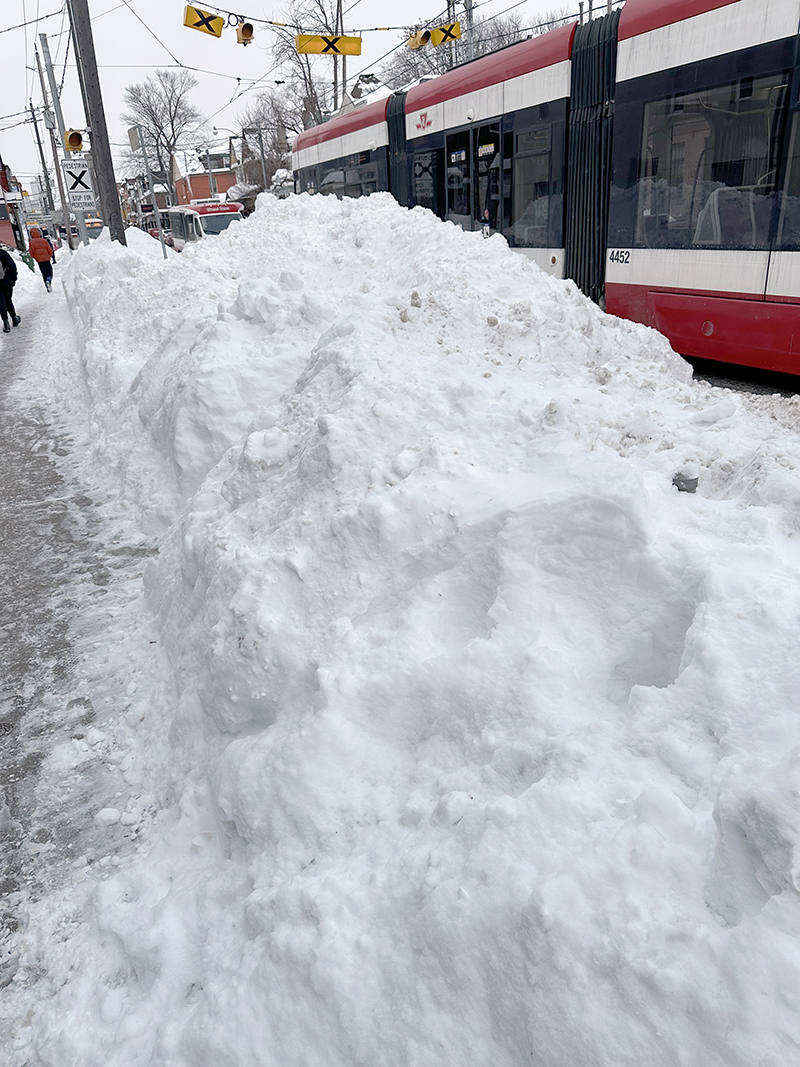
…what do you call this heap of snow?
I surveyed people on Bluesky, and for the most part they didn’t have a specific word for it. But those who did mostly called it one of three things – the same three terms I have used at various times.
The word I most often use for it is berm, though I don’t know whether that’s really common where I live or where I grew up; the Bluesky people who gave that word were from northern parts of the US. Also, I can’t find “long heap of snow left by a plough” as a definition for berm in any dictionary. Per dictionaries, a berm can be an earthen shelf at the top or bottom of a slope, or a raised bank along a canal, or a bank of earth used as a barrier, or the big pile of sand above the high tide level on a beach, or a roadside grass strip – which is what the word means in Dutch, where English got it from. Several of those things resemble these huge piles of snow, but they’re all dirt or sand. However, in snowboardcross, a berm is bank of snow at a corner – transferred from the bank of earth called the same thing in motocross and BMX. Of course the meaning can drift from dirt to snow. Why not?
The next thing I might call this niveous ridge is snowbank. But, speaking of drifts, a snowbank more usually is – as in “a drifted bank,” to quote the song “Jingle Bells.” Still, it may seem reasonable enough to call these heaps snowbanks, since, like other banks, they contain deposits that have been accumulated and saved up. Mind you, they do not get much interest, and everyone is hoping they won’t compound.
What? Oh, the other kind of bank? Like riverbank? Oh, yeah. But say, why do we have bank as in savings bank and bank as in riverbank? The answer is that they both come, ultimately, from a root meaning ‘bench’, a root that is also in fact the source of bench; one bank refers to a landform that’s like a bench, and the other refers to a money-handling business that was originally done at a bench, table, or counter. Which is a farther drift than merely going from a pile of dirt to a pile of snow.
But, to get back to that big pile of snow, there’s the third word, the thing that some Canadians – and only some Canadians – call it: windrow. Canadian cities, after snow storms, after all the ploughing, may talk about “clearing windrows” so people can get out of their driveways. So in the morning you look out your window to see if the windrow has been shoved aside or if you’ll have to shovel it yourself.
OK, but why is it called a windrow? Isn’t that a row of trees that keeps the wind off a field? Hm, that’s usually called a windbreak. Windrow is most often a word for a long heap of mown grass, hay, barley, corn, peat, or such like, that’s sitting being dried out by the wind, in some cases before being gathered into bales and in some cases before being burned. It can also (probably on the basis of conjecture from its form) be a word for loose vegetation that has been blown into long piles by the wind. And by drift from the first sense, a windrow can be any other thing that has been ploughed into long piles: dirt, gravel, or, of course, snow. Yes, there’s a wind there, even though windrows usually don’t get blown away (pity, perhaps), but that’s how things get piled together sometimes. A window is still a window even if it’s not letting wind through. And a shovel is a shovel even if you’re using it to heave snow rather than to shove it around (and yes, shovel is indeed etymologically shove plus a suffix).
Still, why windrow rather than berm or snowbank in these Canadian places? I don’t know for sure, but my suspicion is that it started with farmers, of which we have quite a few in Canada. If you’re used to calling the long heaps of hay and whatnot windrows, then calling long heaps of snow made by the same kind of process windrows seems sensible – certainly at least as sensible as calling them, say, berms.
But, again, that’s if you call them anything. Other than a nuisance or something less polite, that is.





 Sesquiotica