
Tag Archives: whirl

whorl

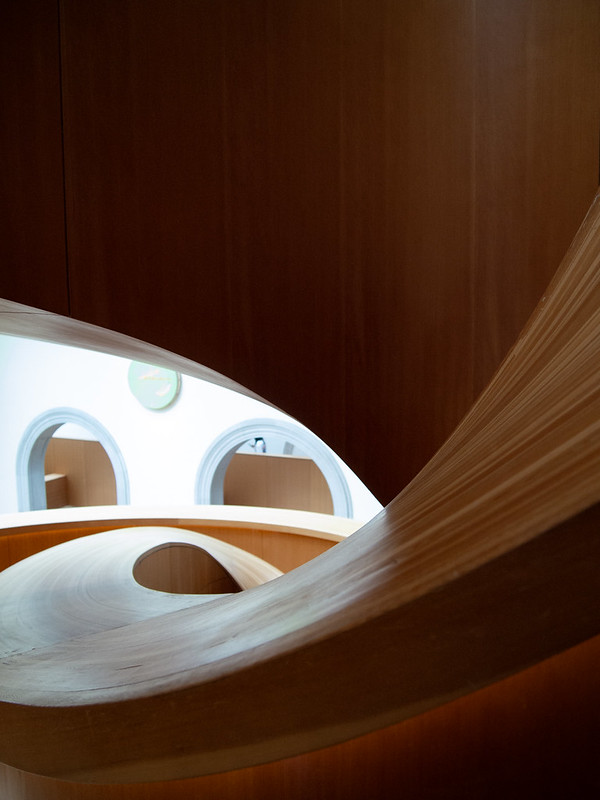
In the Art Gallery of Ontario, there is a staircase designed by Frank Gehry that swirls from the old lower parts to the new upper parts, ascending from floor 2 to floor 5. It is not merely spiral; it is a vortex of wood, an eccentric cycle, weaving through the air and through a glass ceiling too. You have a choice when going up from the merely modern to the very latest in the art world: you can take an elevator, rising straight and without view, as though the floors were swapped like cue cards behind the sliding doors, or you can climb step by step through the art whorl, seeing the building revolving as you exercise your prerogative and are in turn exercised.
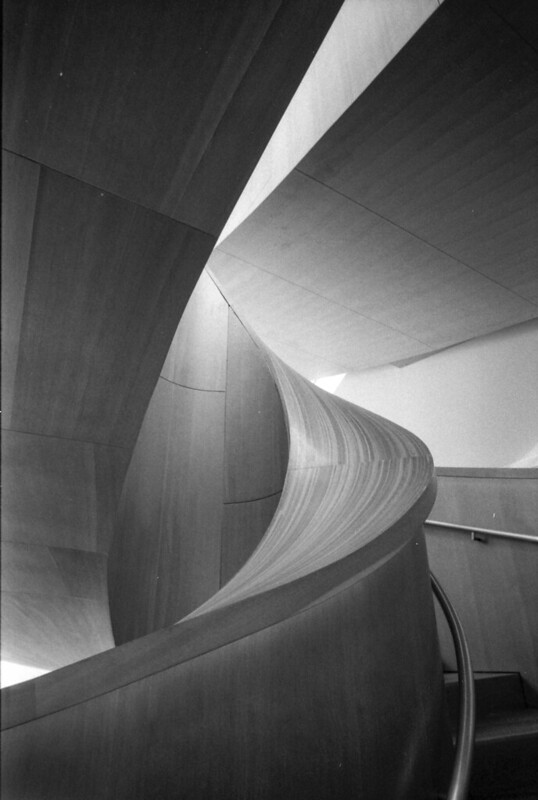
The staircase suggests motion; it encourages motion; it sustains motion; and yet it is not motion. It is as unmoving as the people who stop on its steps for photographs. It is dynamic past and future, but still present. It whirled; it will whirl (or we will whirl while on it); but it is a whorl. It is whole, unbroken, containing an open hole.

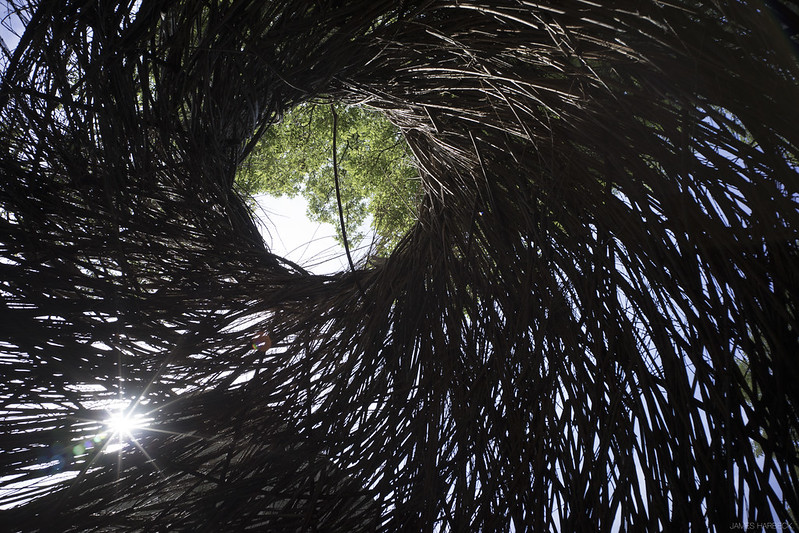
Frank Gehry is famously fond of natural forms, and a whorl is natural enough, but it can also be artificial, whether artistic or not. There are many ways you may visualize a whirled piece. You may barely bend a forest’s worth of twigs to make a funnel to the sky, for instance.
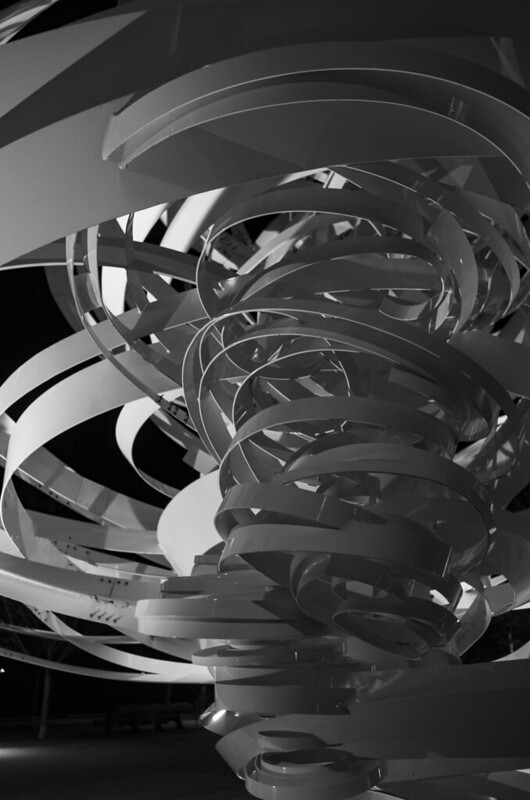
You may curve strips of rolled steel into an abstraction of a whirlwind, a clone of a cyclone.
You may paint petals of fleering faces onto a wall, all encircling a void eye. Though your eye may avoid it, and your heart may reject it, it is an injection of art, nature denatured. 
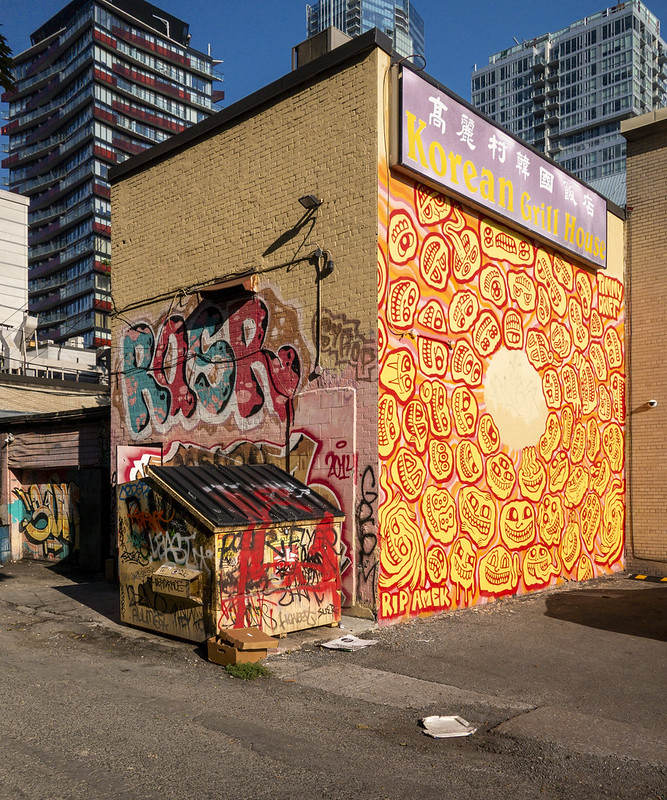
All are in the world of the whorl: if it is in some kind of concentric circles or spirals, it is a whorl.

Is whorl, the word, a frozen whirl? A whirl that was? In a convoluted way, yes. It is not a past tense of whirl – we have never said “I whirl today, I whorl yesterday” – but it is evidently formed from a variant of whirl; in earlier times, there were words whorwil and wharwyl that seem to have been especially swingy forms of whirl. This makes more sense when you know that whirl comes from something like whirvelen, likely from Old English hweorflian, a frequentative of hweorfan ‘turn’ (with the same frequentative suffix as gives us settle from set and prickle from prick). And it is also related to whirr and wharve.

And so it has turned around and come around again, and now it is concentrated, fixed in ink and pixels. But nothing stays still forever; the nature of nature is cyclic, and any whorl, too, may flower and grow and fade.
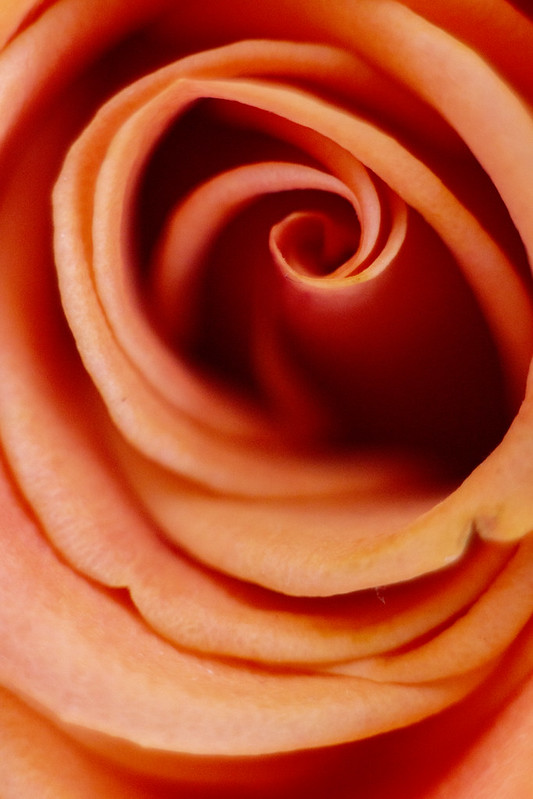
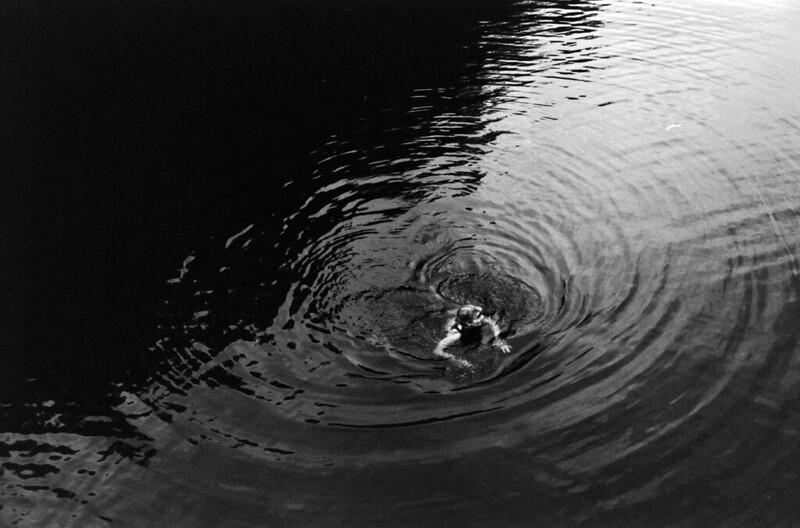
Or it may even ripple away in moments, waving as it passes.
earl-url-irl

There once was an earl named Merle – a bit of a lout, actually – who had a fancy for a pretty girl with hair in ringlets. She was from the country and wore a country-girl’s apron skirt, and she liked perfume and jewelry. He was rich, and he wanted to see her dance on a bump on a lump on a log, twirling her skirt in the wind, to the sound of bagpipes from somewhere east of Moscow. So, bearing gifts, the Merle the earl thought, “I reckon this pearl and a little myrrh’ll make the pretty rural girl with the curls unfurl her dirndl and go for twirl and a whirl on the knurl of the burl to a Ural skirl.”

But she just hurled at the churl. Well done, girl.

Earl, url, irl… at one time, and still in some dialects, these had different sounds. But in many cases they’ve merged now to a syllabic /r/ followed by the final /l/ – a double liquid, and just incidentally a murderously difficult combination for speakers of many other languages. Not because it’s actually so hard to say – watch yourself doing it, and you’ll find that if you’re North American, you just hump the tongue up in the middle of the mouth, and then turn the tip up to touch – but because it’s nothing they’re used to saying; it doesn’t belong to their phonemic sets.

There are plenty of things that don’t require any more effort that most English speakers have similar trouble with. The Vietnamese name Nguyen, for one. But for most English speakers, this /rl/ rhyme segment of a syllable is nothing so hard – especially since we’ve merged the different original sounds really just by way of reducing speech effort. (There are exceptions, as Laura, commenting on my note on thrall, has reminded me – and thanks to her for suggesting these words.)

But although they sound the same, do we think of these the same? Don’t earl and pearl have a sort of higher-toned sense to them, with the extra “silent” letter and the association with riches (also not hurt by similar words such as earn)? Don’t the url words seem somehow lower-class or more blunt because of the u that we associate with the dumb “uh” sound, plus of course the senses of words such as burl, hurl, and churl? But what is the effect on it of URL, as in a web address? And what about irl, which shows up in some archaic words (thirl and tirl) and the uncommon skirl but mainly is seen in whirl, twirl, and girl? Doesn’t it seem somehow lighter? Does the little echo of skirt add to this? How about just the thin, spindly i?

Of course, there’s also the erle in Merle and some other names (including La Perle, an Edmonton neighbourhood I lived in 20 years ago) – not as thin, but still more elegant than url. And then there are cases such as in rural, Ural, and myrrh’ll, which are thought of as two syllables and so are often more filled out. And there’s the orl in world, which can get extra drawing out from the /w/ and /d/ bookending it – when I write it in verse, I instinctively treat it as two syllables, but not everyone else does!

And where do all these words come from? Well, not any East Asian languages, true, but they do have various origins, many but not all Germanic. We can trace most of them well back into the mists of time, but some, well, we’re not exactly sure about. Just where, for instance, did that girl come from…?

